

M:OFA Studios Wraps a Wave-Shaped Gridshell Around India's Largest Water Sports Institute in Goa
A 12,000 square meter campus on Goa's coastline uses 15,000 steel pipes and 5,000 CNC-cut panels to channel the energy of the sea.


Government sports buildings in India rarely aspire to anything beyond concrete pragmatism. The National Institute of Water Sports in Miramar, Goa, commissioned through an international competition in 2010 and completed thirteen years later, rejects that template entirely. Designed by M:OFA Studios, the 12,075 square meter complex is organized as three curving volumes that radiate from a rectilinear entrance core, their rooflines undulating to mimic trochoidal waves. The result is the largest water sports training institute in Southeast Asia and arguably the most technically ambitious public building on Goa's coastline.
What makes the project genuinely interesting is not the wave metaphor, which on its own could have been mere decoration, but the way it drives every decision from structure to climate. The 4,000 square meter gridshell roof, assembled from over 15,000 pipes of varying length and clad in more than 5,000 uniquely shaped CNC-cut panels, is not just sculptural spectacle. It provides deep shading, enables stack-effect ventilation through double-roof cavities over the hostels, and channels cooler sea breezes across classrooms fitted with high-level louvers. Form and environmental performance are the same thing here.
Three Lobes and a Core

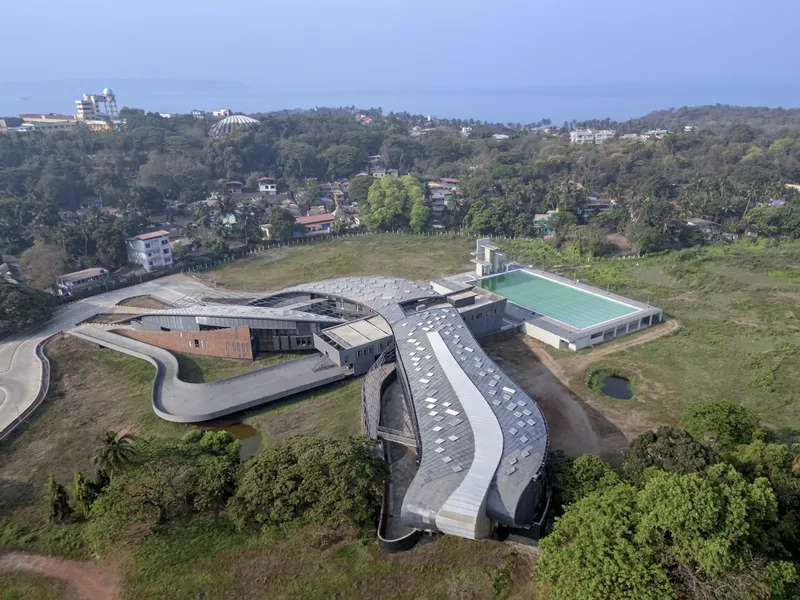
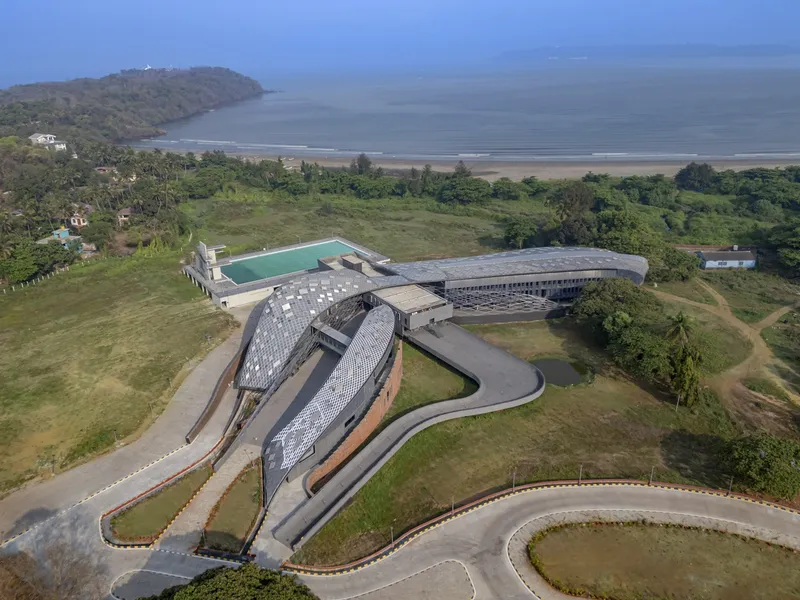
From the air the plan logic is immediately legible. Three curving wings, housing institutional, residential, and recreational programs respectively, sweep outward from a central rectilinear block that contains the entrance foyer and common room. The site sits on a hillside close to the coast, and the lobes respond to topography and orientation rather than imposing a rigid footprint. Each wing is oriented climatically, angled to catch incoming sea winds while the spaces between them open into courtyard-like zones sheltered by the overhanging roof.
The aerial views make one thing clear: the building's footprint is as much landscape as architecture. Lawns, paved plazas, and mosaic-tiled surfaces flow between and beneath the curving forms, and a rainwater pond at the site's edge turns stormwater management into a visible element of the campus. There is no single front door; the building is porous on all sides.
The Gridshell Roof as a Building System
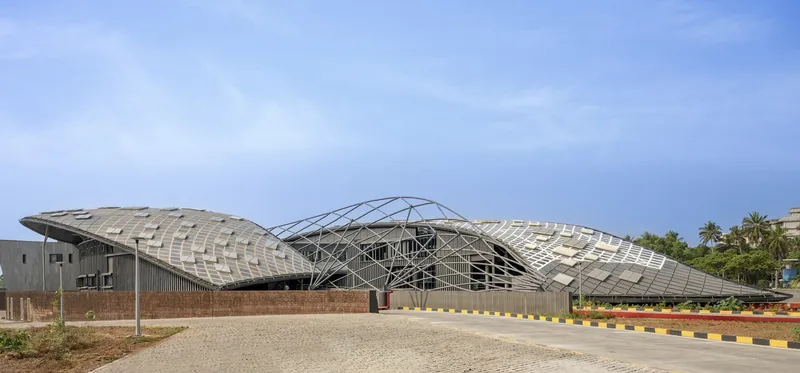


The mega-roof is the project's defining technical achievement, and it deserves scrutiny. Constructed from 220 tonnes of steel, the gridshell drapes over the complex like a net. Its diamond-patterned geometry is formed by tubular sections from TATA Structura, sandblasted for corrosion resistance and coated with three layers of polyurethane to survive Goa's salt-laden air. The cladding is Zincalume sheets from TATA Bluescope Lysaght, cut into scale-like diamond panels, each with a unique shape and size.
What prevented this from becoming a fabrication nightmare was a deliberate strategy of breaking complexity into repeatable modules. The structure was divided into segments small enough to be lifted and positioned manually, meaning the project did not require heavy cranes for assembly. CNC cutting happened off-site, but folding and fitting were handled by local fabrication units. The combination of digital precision and manual assembly kept costs within the reach of a public commission while achieving a formal complexity usually reserved for airports or concert halls.
Eliminating the Corridor


M:OFA Studios made a decisive move by abolishing the corridor as an organizational device. Instead of lining rooms along double-loaded hallways, the plan distributes program into zones connected by open-air walkways, covered decks, and semi-enclosed passages that weave beneath the exposed gridshell. The distinction between interior formal space and outdoor informal space is deliberately blurred. Elevated timber walkways with diagonal steel bracing serve as bridges between levels, while covered passages with lattice screens filter light and frame views into the courtyards.
The effect on daily life in the building is significant. A student walking from a lecture hall to the hostel passes through communal squares, shaded plazas, and areas where the gridshell structure is left exposed overhead. Every transition becomes a social opportunity. The interior circulation spaces, with their diamond-patterned ceiling grids casting geometric shadows, feel as considered as any formal room.
Material Language: Glocal in Practice


The competition brief called for a "glocal" approach: globally ambitious in form, locally grounded in materiality. The building delivers on that tension. Red brick, a staple of Goan construction, forms the base walls of several wings, giving the lower portions a familiar heft. Steel grey granite provides cladding on key elevations. Terrazzo flooring, made with local stones, runs through interiors. These are the materials of the region, deployed with care.
Above the masonry base, the palette shifts to high-performance aluminum facade systems by Jindal and low-emissivity glass from Saint-Gobain, with semi-unitized glazing developed in-house by the design team. The juxtaposition is honest rather than jarring: heavy, handmade materials anchor the ground plane, while the lightweight engineered roof floats above. The building does not pretend to be a traditional Goan house, nor does it ignore its context.
Climate as Architecture

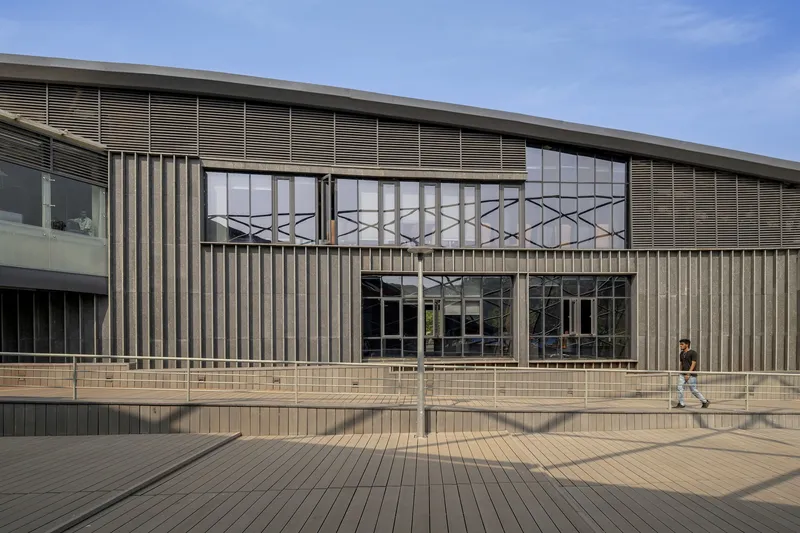
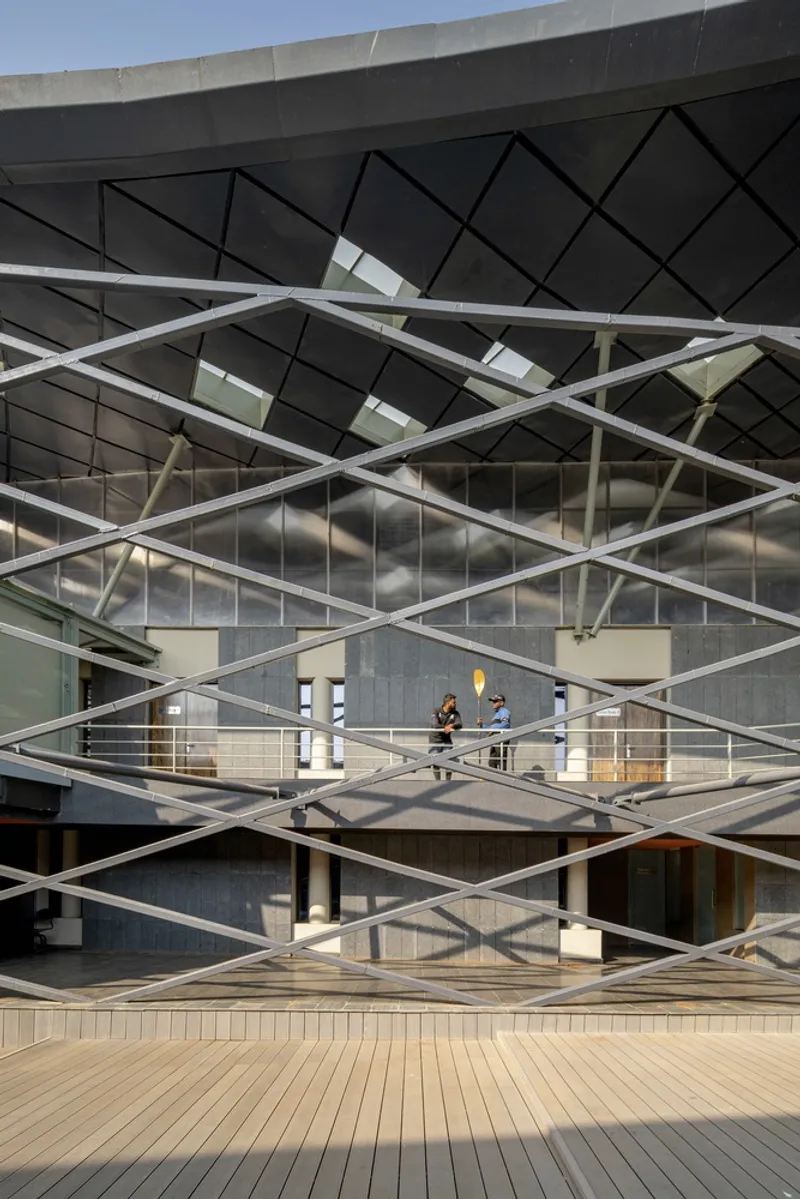
Goa sits along a tropical coastline with intense sun, heavy monsoon rains, and reliable sea breezes. The building treats these conditions as design inputs rather than problems to solve with mechanical systems. The deep overhangs of the gridshell roof shade every facade, while vertical louver screens on the timber-deck plazas control glare without blocking airflow. In the classrooms, high ceilings with operable louvers at the upper level allow hot air to escape, drawing cooler air from the windward side.
Over the hostel wings, the roof creates a double-skin cavity that generates a stack effect, pulling warm air upward and exhausting it through the gap between inner ceiling and outer shell. A pressure equalization system across the lightweight roof prevents uplift during monsoon storms. These are not add-on features; they are embedded in the geometry of the building itself. The result is a campus where most occupied spaces can rely on natural ventilation for a significant portion of the year.
Interior Spaces and Program
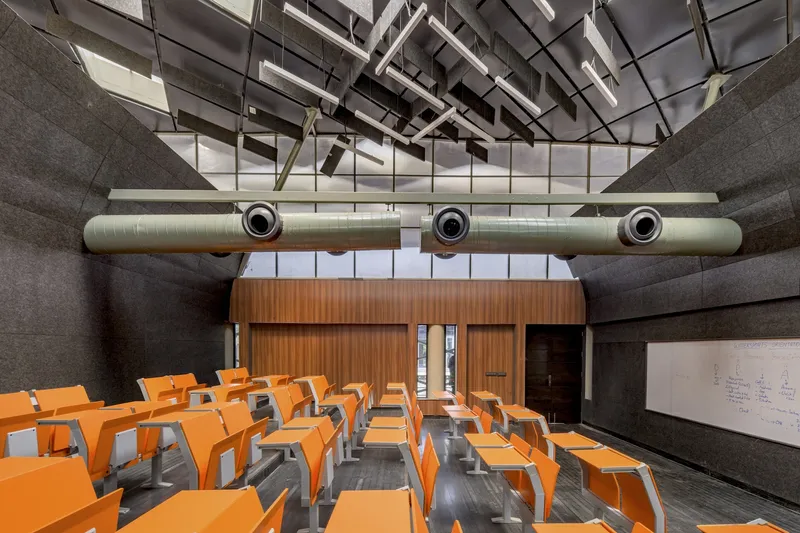
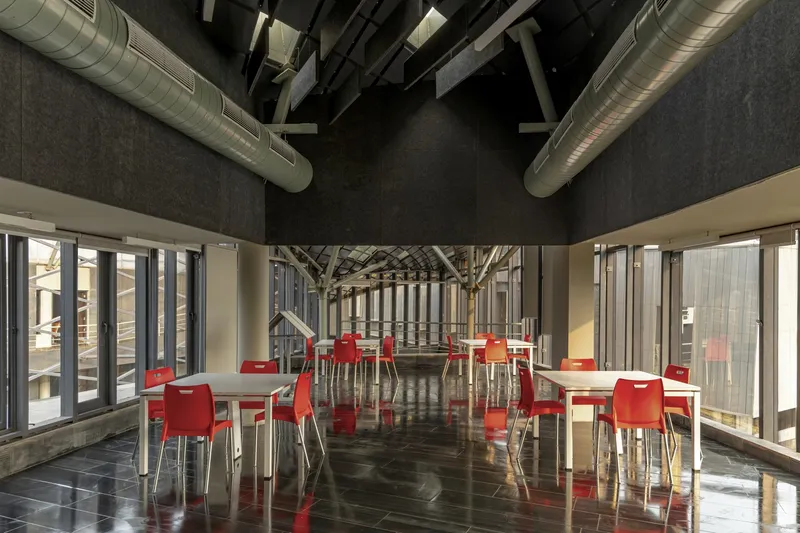
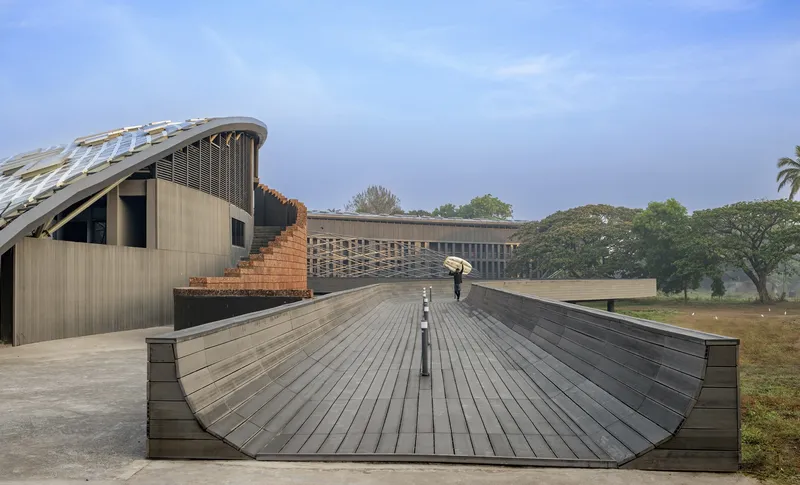
Inside, the functional rooms are straightforward but well-detailed. A lecture hall with tiered orange seating sits under exposed cylindrical ventilation ducts and generous skylights, giving it the atmosphere of a small auditorium rather than a government classroom. The dining space pairs polished dark floors with red chairs and glass walls that open to the timber structure beyond, collapsing the boundary between eating indoors and sitting in the courtyard.
One of the more unexpected gestures is a curved timber-deck amphitheater that descends toward the treeline at the campus edge. It functions as an outdoor gathering space, a transition between the building and the landscape, and a place where students can simply sit and watch the horizon. Not every space in a sports institute needs to be athletic; the quiet moments matter too.
Facade Detail and Structural Expression
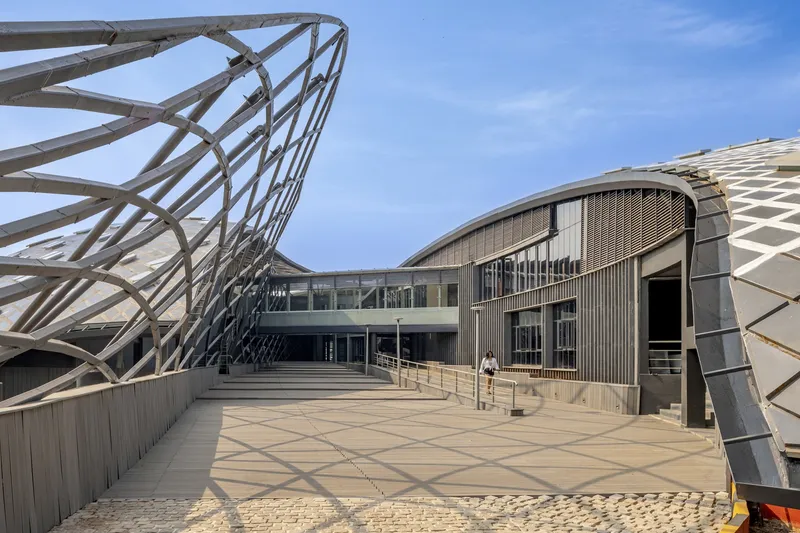

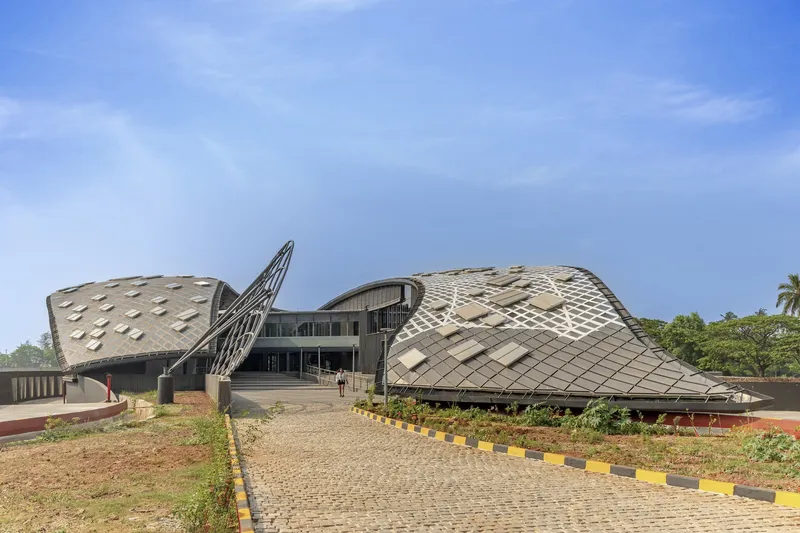
The building rewards close looking. On the roof terrace, the exposed steel lattice structure is left visible, its triangulated members casting intricate shadow patterns across the decks and glazed walls below. Steel bridges with diagonal lattice railings connect levels, and the structural bracing on the facade is expressed rather than concealed. White diagonal members cross the facade plane with an openness that recalls maritime rigging.
From the approach, the sculptural wing-like roof volumes rise above a paved entry plaza, their scale registering somewhere between institutional gravitas and organic fluidity. The building is undeniably large at 90,000 square feet, but the curving forms and broken massing prevent it from reading as a monolith. Each wing presents a different profile depending on the angle, so the campus reveals itself gradually rather than announcing everything from a single vantage point.
Plans and Drawings

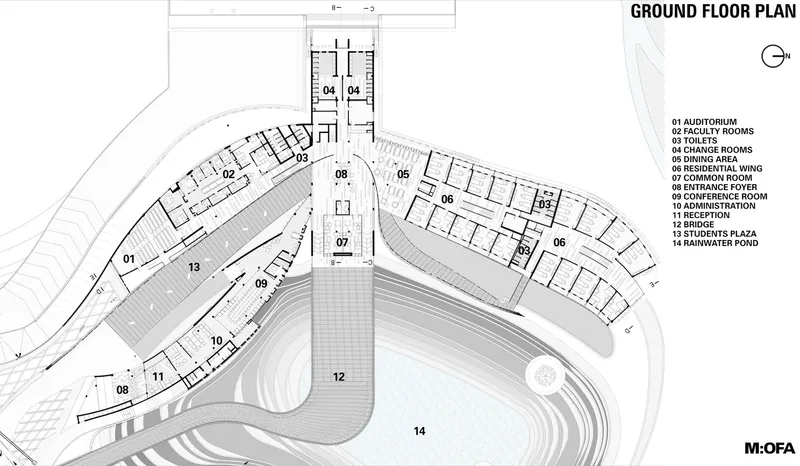


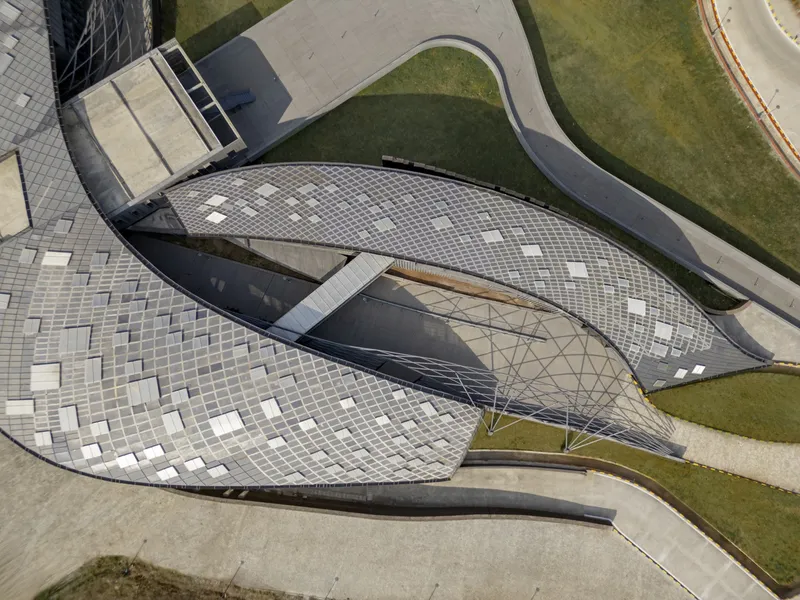
The site plan confirms what the aerial photographs suggest: the building hugs the contoured topography, with the three angular wings arranged around a central amphitheater space and a rainwater pond at the periphery. Ground and first floor plans reveal the extent to which the curving geometry is rationalized into buildable segments, with two angular wings connected by a central bridge at the upper level.
The transverse and longitudinal sections are where the building's spatial ambition becomes most legible. The auditorium and classroom interiors show varied ceiling heights that respond to program, while the wall section details lay bare the construction logic of the roof drainage, residential wing, and pool-side assemblies. These drawings make a persuasive case that the building's complexity is organized, not arbitrary.
Why This Project Matters
The National Institute of Water Sports matters because it demonstrates that public institutions in India can be architecturally ambitious without being imported spectacles. M:OFA Studios managed to deliver a structurally adventurous gridshell, a climate-responsive campus plan, and a materially grounded palette within the constraints of a government commission that ran for over a decade. The combination of CNC digital fabrication with manual on-site assembly is a replicable model for complex geometries in contexts where heavy construction equipment is scarce or expensive.
More broadly, the project challenges the assumption that sports architecture must default to either generic shed or branded icon. Here, the wave-form roof is not decoration layered onto a box; it is the environmental system, the structural system, and the spatial identity of the campus all at once. That integration of performance and expression is what separates good buildings from memorable ones. Thirteen years from competition to completion is a long time, but the building that emerged is worth the wait.
National Institute of Water Sports by M:OFA Studios. Miramar, Goa, India. 12,075 m² (approximately 90,000 sq. ft.). Completed 2023. Photography by Vinay Panjwani.
About the Studio
Share Your Own Work on uni.xyz
If projects like this are the kind of work you want to make, uni.xyz is a place to publish your own, find collaborators, and enter design competitions.


Popular Articles
Popular articles from the community


Faces of the Soviet Avant-Garde: Turning Moscow's Street Names into an Open-Air Museum
A network of sculptural installations across a Moscow residential district transforms forgotten architect names into spatial encounters with cultural memor

Manzana Morphosis: Stretching Barcelona's Grid into a Living Landscape for 2050
A radical reworking of the Eixample manzana turns density into a tool for generous public space, vertical ecology, and environmental performance.

Opera on the Sea: Driftwood Logic Shapes a Timber Opera House on Estonia's Coast
Trevor Orgill's opera house translates the entangled drift of floating timber into a civic building where wood, water, and music converge.
Extended Shell: Retrofitting Kolkata's Balconies as Living Urban Thresholds
A modular retrofit system recovers the social and environmental intelligence of Kolkata's historic verandas for contemporary Park Street residents.

Similar Reads
You might also enjoy these articles

FAMM Arquitectura Organizes Ten Villas Around Courtyards and Jungle in Nosara, Costa Rica
El Molino pairs two elongated volumes with deep overhangs and timber louvers to build a compact coastal community five minutes from the beach.
Oscar Niemeyer's Ibirapuera Park Pavilions Define São Paulo's Cultural Identity in Concrete and Curve
A constellation of modernist volumes set within São Paulo's most important urban park, conceived for the city's 400th anniversary in 1954.
Sanjay Puri Architects Wraps a Jaipur Office Tower in Capsule-Shaped Green Buffers
A nine-level climate-responsive workplace near Jaipur Airport uses stacked planter terraces and aluminium screens to fight 40°C heat.
RHO Converts a Berlin Spree-Side Industrial Courtyard into Enkime's 1,000 m² Agency Headquarters
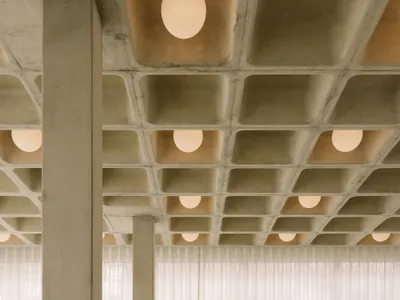
A social media agency's new home in Charlottenburg trades glossy branding for concrete waffle ceilings, glazed tile, and sheer curtains.

Explore Sports Architecture Competitions
Discover active competitions in this discipline

Challenge to design a barrier free sports center

Challenge to design an outdoor ice-rink and park

Challenge to reimagine the Iron Throne

Photograph architecture without architects
Comments (0)
Please login or sign up to add comments
No comments yet. Be the first to comment!