

Inside Out: Sustainable Architecture Rooted in Faith, Forest, and Community
Inside Out reimagines Eco-Chapel as sustainable architecture where faith, forest restoration, bamboo craft and community life grow together.


Inside Out is a shortlisted entry of the Eco-Chapel competition, designed by Raghav KR, Ramya Asokan, and Avni Gupta. The project presents a deeply layered vision of sustainable architecture, where sacred space, ecological restoration, community livelihood, and local material intelligence are brought together into one cohesive architectural system.
Rather than treating the chapel as an isolated religious building, Inside Out expands its role into a living ecological and social center. It is imagined as a center of faith, forest, and nature, working across the built, unbuilt, and human dimensions of the site. The project responds to the urgent environmental condition of Ethiopia, where forests have survived most strongly around chapels due to their cultural and spiritual protection. Inside Out builds from this observation and asks a critical architectural question: can a chapel not only preserve a forest but also actively help restore it?
The answer is expressed through a spatial system that turns the forest into the heart of the design. The project establishes the forest inside out of the built form, allowing architecture to become a protective frame for nature rather than a replacement for it. Through this approach, Inside Out becomes a model for sustainable architecture that is spiritual, climatic, material, and community-driven.


A Chapel Designed Around the Forest
The central idea of Inside Out comes from the relationship between Ethiopian faith and forest ecology. Traditionally, many Ethiopian chapels and churches are surrounded by sacred forests. These forested areas are often protected because of their religious importance, making them crucial ecological pockets in regions facing deforestation and desertification.
Inside Out uses this cultural pattern as the foundation for its architectural concept. The chapel is not designed merely as a place of worship. It becomes a catalyst for revegetation, farming, seed preservation, skill development, and community gathering.
The project follows a traditional three-tier concentric organization. Only the priest is permitted to access the core of the chapel, creating a sacred spatial hierarchy. The design includes separate entries, with women entering from the left and men from the right, reflecting a specific ritual order within the chapel plan. At the center lies the Maqdas, the most sacred core where the tabot is kept. Around it, the Qiddist and Qene Mehlat create layered zones for communion, assembly, and public participation.
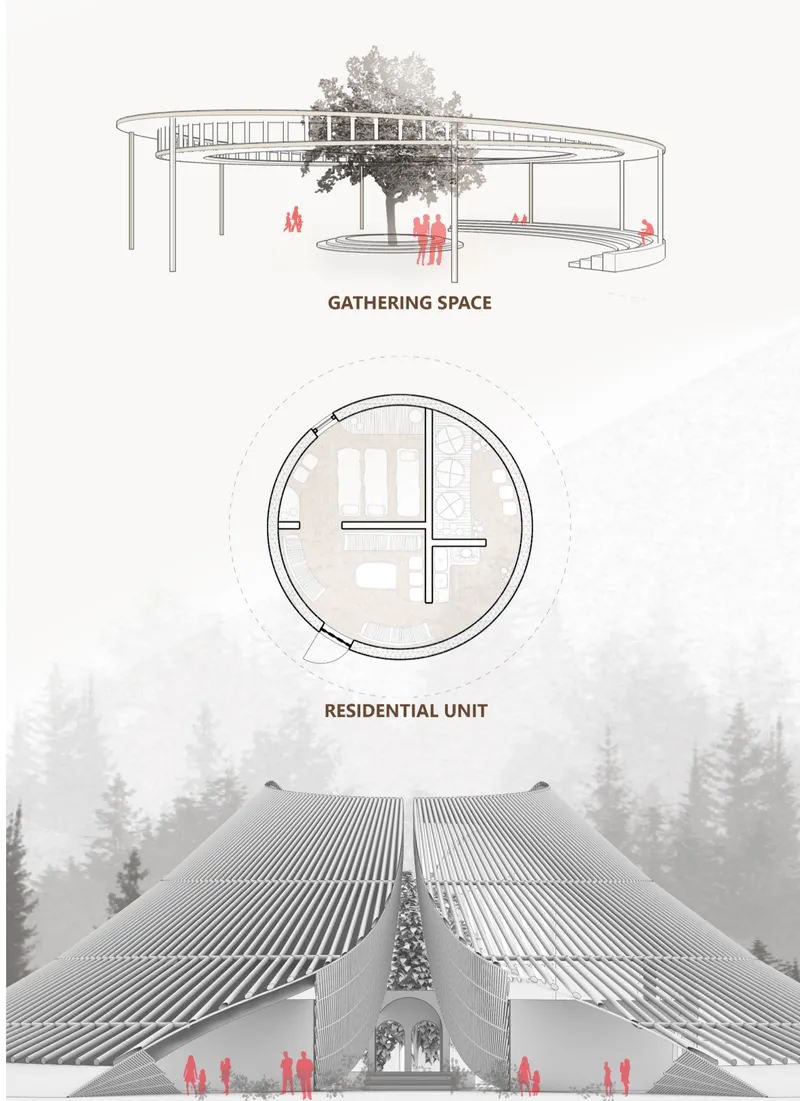
This concentric organization is not only religious. It is also ecological. The built form surrounds and protects trees, vegetation, and shaded courtyards, placing nature at the center of the architectural experience.
Sustainable Architecture Through Local Materials
Inside Out uses sustainable architecture strategies from the scale of the masterplan to the smallest material decisions. The built units are designed with locally available materials such as bamboo, mud, and brick. These materials reduce dependence on imported construction systems while supporting a more context-sensitive building process.
Bamboo plays a major architectural role in the project. It forms an outer shell that filters light, creates shade, and gives the chapel a symbolic expression of serenity. The bamboo roof structure allows daylight to spread across the chapel interior, producing dramatic shadow patterns that change throughout the day. These filtered shadows create a spiritual atmosphere while also improving thermal comfort.
Mud and brick are used to regulate temperature and provide a grounded, tactile quality to the space. Their thermal mass helps moderate internal conditions, making the built environment more responsive to the climate of Addis Ababa. Instead of depending heavily on mechanical systems, the project uses form, material, vegetation, and shade as passive environmental strategies.
The organic curved geometry of the chapel and its supporting units also responds to climate. The roof forms, shaded edges, open courtyards, and planted interiors work together to create cooler, more comfortable spaces for prayer, gathering, and daily activity.
Turning the Chapel Into a Forest Restoration Center
The most powerful aspect of Inside Out is its expansion beyond the chapel. The project includes a complete ecological and community program that supports long-term forest restoration. The site plan includes a chapel, seed bank, residence, gathering space, workshop units, cafe, agricultural plots, water-spreading bunds, and revegetation areas.
This larger program transforms the chapel into an active center for environmental recovery. The seed bank stores grain produced from agricultural land and preserves special plant seeds used for forest restoration. It becomes a practical ecological archive, ensuring that local plant species can be protected, multiplied, and reintroduced into the landscape.
The revegetation nursery supports the growth of new plants, while agricultural plots and water-spreading bunds help manage land and water more responsibly. These systems connect architecture with landscape infrastructure, making the project more than a symbolic response to deforestation. It becomes a working framework for regeneration.
Inside Out therefore moves beyond conservation. It proposes restoration. This distinction is important. Conservation protects what remains, while restoration rebuilds what has been lost. The project positions sustainable architecture as an active participant in ecological repair.
Community Livelihood as a Design Strategy
Inside Out understands that environmental restoration cannot succeed without the participation of local communities. The project includes workshops for skill development, residences for local farmers and priests, and spaces for public gathering. These programs create social and economic reasons for people to care for the forest and remain involved in its future.
The workshop units are designed to support local craft, material processing, and skill development. One of the proposed uses includes processing agricultural waste, such as rice husk, to create sustainable materials. This approach converts waste into value while creating employment opportunities for the community.
The workshops also help portray Ethiopian culture to visitors. Through craft, material reuse, and community production, the project becomes a place where local knowledge is visible and economically meaningful. Architecture here is not only a shelter for worship. It becomes a platform for livelihoods.
The residences support farmers and priests who participate in the daily life of the center. Their presence ensures continuity. The project is not imagined as a static monument but as a living campus where religious, ecological, and social activities happen together.

Spatial Experience: Light, Shade, and Sacred Atmosphere
The visual language of Inside Out is defined by curved forms, layered shells, brick arches, bamboo screens, and planted interiors. The renders show a rich play of light and shadow across the floor and walls. Bamboo members create rhythmic linear shadows, while brick arches establish a sense of permanence and ritual procession.
The chapel interior is both open and protected. The roof rises and curves around the central planted space, allowing daylight to enter while maintaining a calm, enclosed atmosphere. Trees are not decorative additions. They are structural to the spatial identity of the project. They mark the sacred center, filter views, cool the environment, and reinforce the chapel’s connection to forest life.
The view from Qene Mehlat shows a strong relationship between the assembly space and the central tree. People gather around the sacred core, while the architecture frames nature as the spiritual anchor of the project. The use of brick arches gives the space a familiar devotional character, while the bamboo shell introduces a lighter ecological layer.
This combination of weight and lightness gives Inside Out its architectural strength. Brick, mud, and arches communicate groundedness. Bamboo, filtered light, and vegetation communicate renewal. Together, they create a chapel that feels both ancient and regenerative.
A Masterplan for Faith and Ecology
The site plan shows that Inside Out is organized as a connected ecological campus. The chapel is placed as a major spiritual anchor, while the seed bank, workshop units, cafe, gathering space, residence, and revegetation site form a network of complementary functions.
The cafe creates a public-facing space where visitors and community members can pause, meet, and engage with the broader mission of the project. The gathering space provides a circular communal zone centered around a tree, reinforcing the project’s repeated theme of people assembling around nature. The workshop units support productive activity, while the agricultural plots and nurseries support ecological repair.
The circulation paths move through the site in a soft, landscape-sensitive manner. Instead of imposing a rigid grid, the project uses curved movement and organic placement to respond to topography and vegetation. This reinforces the idea that architecture should grow from the landscape rather than dominate it.
Why Inside Out Matters in Contemporary Religious Architecture
Religious architecture has historically played a major role in shaping cultural identity, collective memory, and environmental relationships. Inside Out continues this legacy but updates it for the climate crisis. The project does not reduce sustainability to material selection alone. It treats sustainability as a full system of faith, ecology, economy, climate, and community.
As a work of sustainable architecture, Inside Out is important because it refuses to separate sacred space from everyday life. The chapel is connected to farming, seeds, workshops, water, residences, and gathering. This makes the religious center socially productive and ecologically necessary.
The project also challenges the idea that environmental architecture must look purely technical or infrastructural. Inside Out remains deeply atmospheric. It creates memorable sacred spaces through light, shadow, texture, procession, and ritual hierarchy. Its ecological systems do not weaken the spiritual experience. They strengthen it.
Inside Out by Raghav KR, Ramya Asokan, and Avni Gupta is a thoughtful shortlisted entry of the Eco-Chapel competition. It offers a compelling vision for sustainable architecture that is rooted in Ethiopian faith, forest restoration, local materials, and community resilience.
The project transforms the chapel into more than a sacred enclosure. It becomes a seed bank, a workshop network, a gathering place, a livelihood center, and a landscape restoration tool. By placing the forest at the core of the built form, Inside Out creates an architecture that protects, restores, and teaches.
Its strength lies in its ability to connect ritual and regeneration. Faith is not separated from ecology. Community is not separated from architecture. The built and unbuilt are not opposites. They are part of the same living system.
Inside Out stands as a powerful example of how sustainable architecture can move beyond form-making and become a long-term framework for cultural continuity, environmental healing, and collective care.





Popular Articles
Popular articles from the community


Hill & Cross Opera: Sculptural Opera House Architecture Shaped by Tallinn’s Landscape and Identity
Hill & Cross Opera reimagines opera house architecture in Tallinn through its sculptural hill, civic plaza, glass wave and a luminous cross.
EW PARK: Sustainable Architecture Reimagines the Future of Urban Parking
EW PARK reimagines city parking as a modular wooden tower combining automation, solar energy, electric mobility, and adaptable urban design.

The Ocean Hive: Sustainable Architecture for a Self-Sufficient Civilization at Sea
The Ocean Hive imagines sustainable architecture at sea, where modular habitats, algae, wave power and ocean waste sustain a growing colony.

Conexión: Biophilic Design Reimagines High-Rise Living in Hong Kong
Conexión reimagines high-rise living in Hong Kong through biophilic design, green facades, shared spaces, daylight, water and nature within.

Similar Reads
You might also enjoy these articles

Eco Chapel: A Green Architecture Pavilion Designed in Symbiosis with the Forest
Eco Chapel uses green architecture to weave prayer, learning and reuse into a forest pavilion shaped by modular hexagonal canopies for life.
Kaffeebühnen: Coffee Shop Architecture Designed as a Civic Stage Between Vienna’s City and Park
Kaffeebühnen turns coffee shop architecture into a civic stage, linking Vienna’s park edge, urban life, warm timber yards, and coffee craft.
Healing Façade: Sustainable Architecture for Reforestation, Community, and Sacred Ecology in Ethiopia
Healing Façade reimagines sustainable architecture as a living wall that restores soil, catches water and renews Ethiopia's forest churches.


Urban Forest: A Vertical Ecosystem for 5,000 Workers in Singapore's Changi Business Park
Radially stacked pods and layered green decks turn a 7-acre plot into 47 acres of ecological workspace projected for 2040.





Comments (0)
Please login or sign up to add comments
No comments yet. Be the first to comment!