
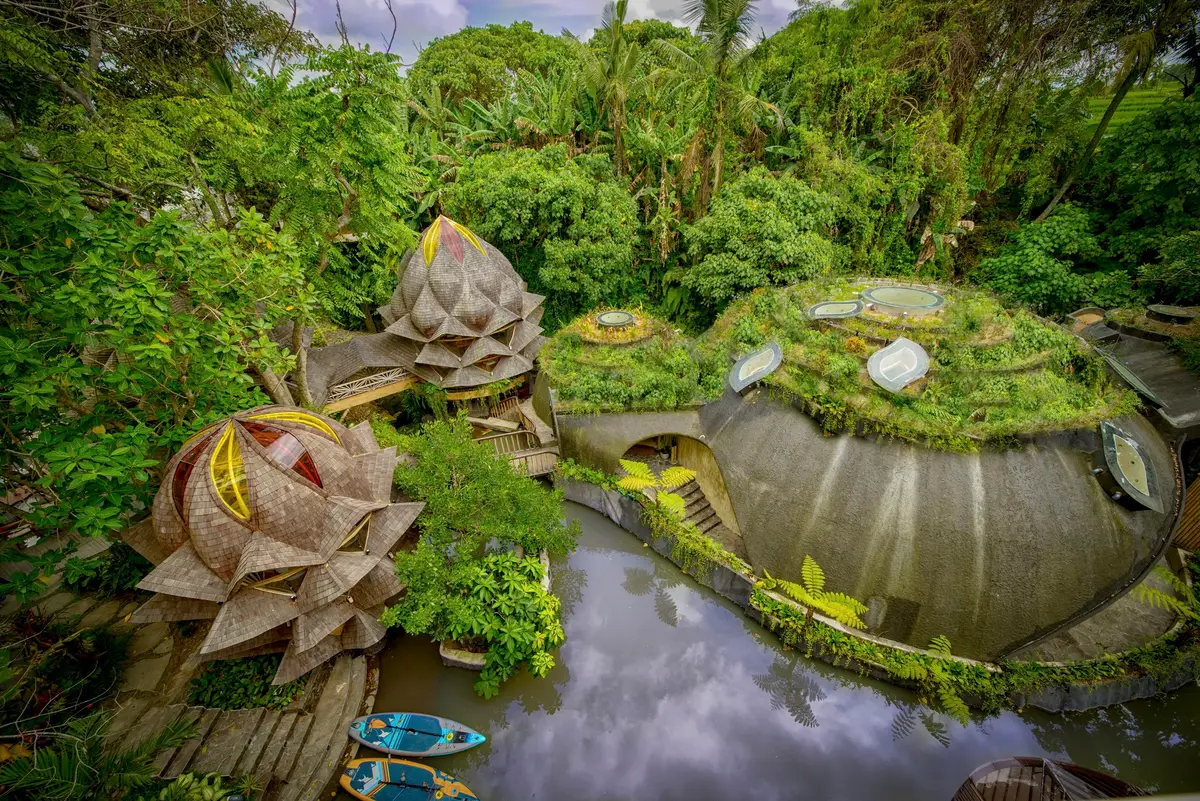
Inspiral Architecture Builds What May Be Southeast Asia's Largest Rammed Earth Resort in Bali
Ulaman Eco-Luxury Resort revives a swamp wasteland in Tabanan into a carbon-zero retreat of bamboo domes and rammed earth walls.


Most eco-resorts in Bali lean on bamboo and call it a day. Inspiral Architecture and Design Studios went further with the second phase of Ulaman Eco-Luxury Resort, constructing what is possibly the largest rammed earth project in Southeast Asia and pairing it with parabolic bamboo pavilions, composite structural insulated panels, a hydroelectric generator, and a man-made lake that doubles as a reservoir for turbines. Located in Kaba-Kaba, Tabanan, the 1,521 m² complex accommodates 20 villas for up to 47 guests across terrain that was, before construction, a blocked-off swamp prone to severe flooding.
What makes the project worth studying is the ambition of its material and energy strategy. The earth for the rammed earth walls came directly from the site. Local villagers were recruited and trained to build them. Solar panels in the parking area and a river-fed hydroelectric system supply enough energy to make the property fully carbon zero. The architecture itself, a collection of clustered domes, cantilevered pods, and vaulted corridors, functions as an environmental device: geometries shaped to channel ventilation, filter daylight, and eliminate the need for artificial lighting during the day. Phase 1 of Ulaman earned a UNESCO Prix-Versailles Award for Sustainable Architecture. Phase 2 raises the stakes considerably.
A Landscape Reclaimed from Swamp

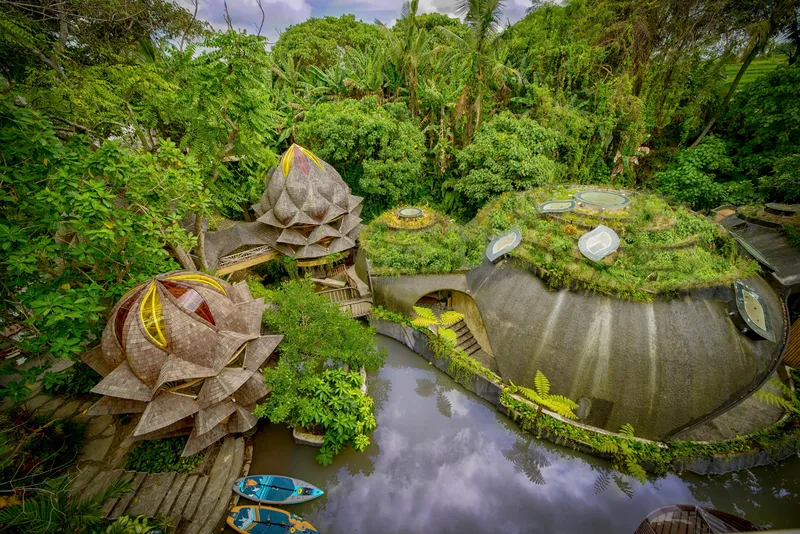
Seen from above, the resort reads less as a building complex and more as a series of organic growths emerging from the jungle canopy. Green roofs curve in shapes that echo the surrounding rice paddies, and the reflecting pools below mirror the sky through gaps in the vegetation. The site plan is deliberately non-axial: structures are distributed across the terrain as clusters rather than along corridors, forcing guests to move through the landscape rather than past it.
The most consequential design decision was hydraulic. The swamp that once caused seasonal flooding has been revived into a functioning lake, creating a micro-ecosystem that supports both the resort's energy needs and its ecological identity. Fruit trees, herbs, and vegetables grow throughout the property and feed directly into the restaurant's cuisine. The landscape is not ornamental. It is infrastructure.
Bamboo Domes as Holistic Cathedrals


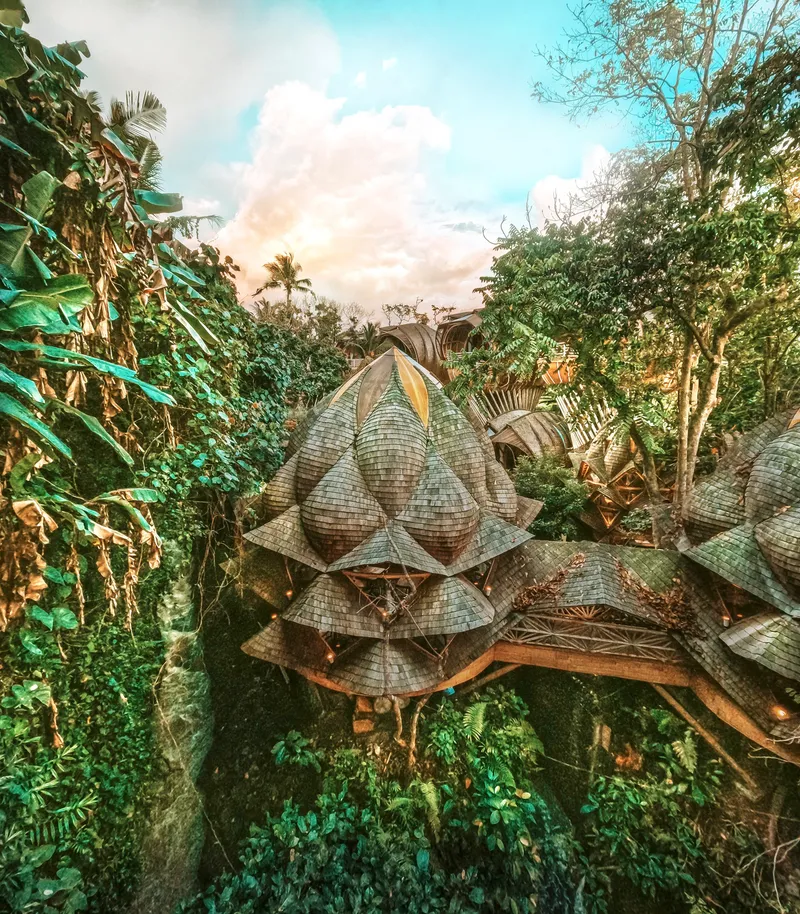
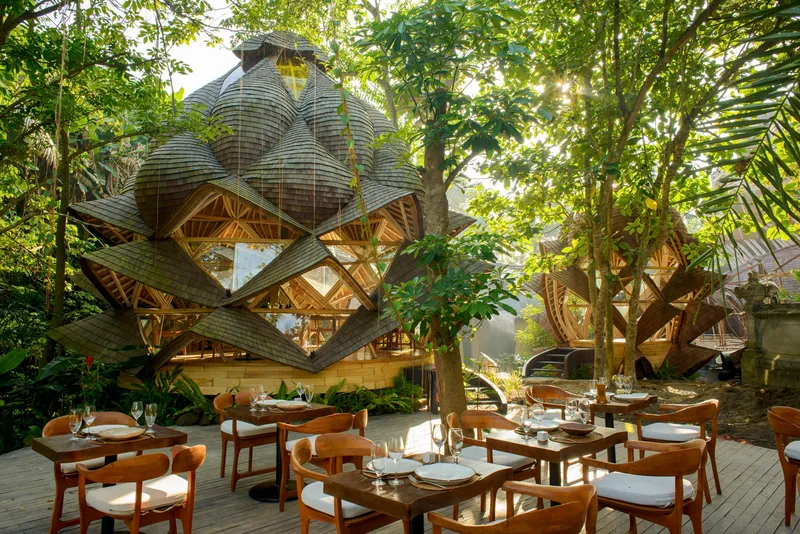
The Lotus restaurant area is organized as a series of geometric pods that Inspiral describes as "mini holistic cathedrals," and the term, while grandiose, fits. Each dining pod sits over a junction of waterfalls, and the interiors are shaped by radial timber framing that creates triangular openings to the surrounding tree canopy. The effect is simultaneously intimate and expansive: you are enclosed by structure, but the walls are mostly air and light.
The patterned timber dome ceilings with their central oculi are particularly effective. They draw the eye upward and compress the visual field, giving each pod a sense of height that belies its modest footprint. These are small rooms that feel monumental, achieved through geometry rather than scale.
Rammed Earth and Composite Panels

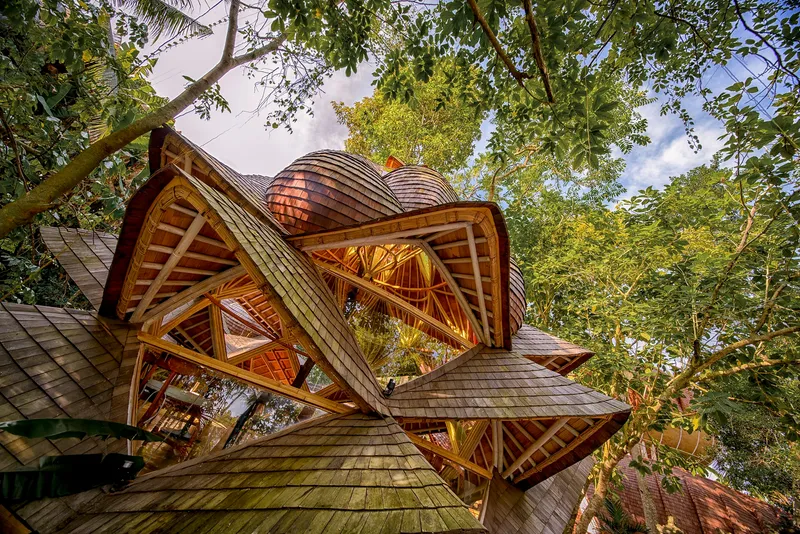

The material palette is where Ulaman's ambition becomes tangible. Rammed earth walls, built from soil excavated on site, carry loads and provide thermal mass. Above them, composite Structural Insulated Panels (SIP) made from recycled EPS with earth-based, fiber-reinforced polymer renders form the roof structures and the spa building's undulating domes. The combination is pragmatic: rammed earth handles compression and insulation at the base, while SIP panels deliver lightweight, highly insulative enclosures overhead.
Training local workers from the nearby village to construct the rammed earth was not a gesture of community engagement for a brochure. It was a structural necessity. Rammed earth at this scale requires a large, coordinated labor force, and importing skilled workers from outside Bali would have undermined the project's carbon-zero ambitions. The decision to build local capacity was as much an engineering choice as a social one.
Elevated Pods and Treehouse Living


Some of the resort's rooms are perched over the lake on slender supports. Others are raised nine meters into the tree canopy, creating the sensation of sleeping inside the forest rather than beneath it. The elevated bamboo pods, with their ribbed cladding and horizontal railings, have a quality that sits somewhere between a seed pod and a space capsule. Twisted bamboo columns anchor them to the ground, and the structural expression is left deliberately visible.
The lake-level pods are perhaps the most photogenic feature of the resort. Seen from the water, their clustered forms and their reflections create a symmetry that feels unplanned, as if they grew from the banks. A person paddleboarding beneath them looks less like a guest than like a participant in an ecosystem.
Interior Atmosphere and Filtered Light

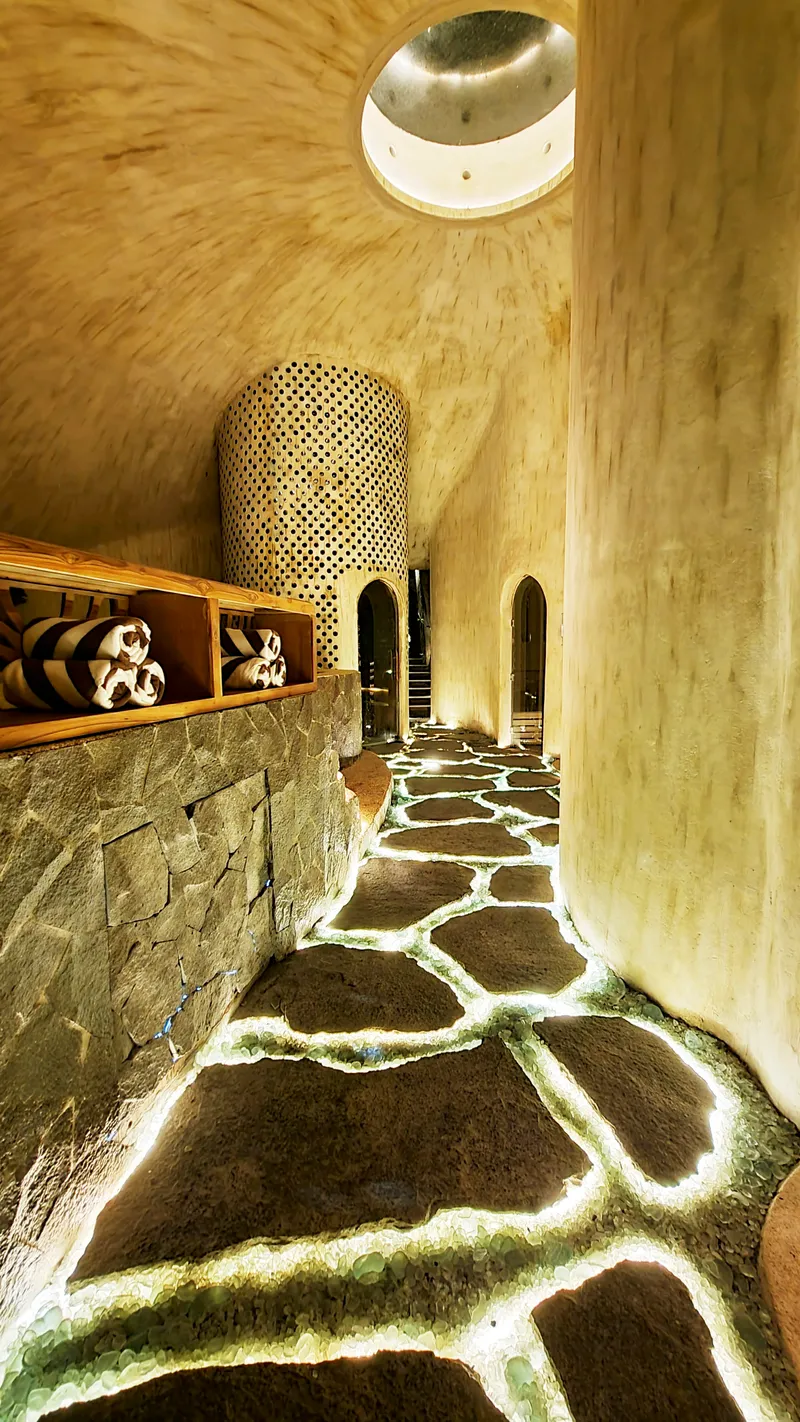
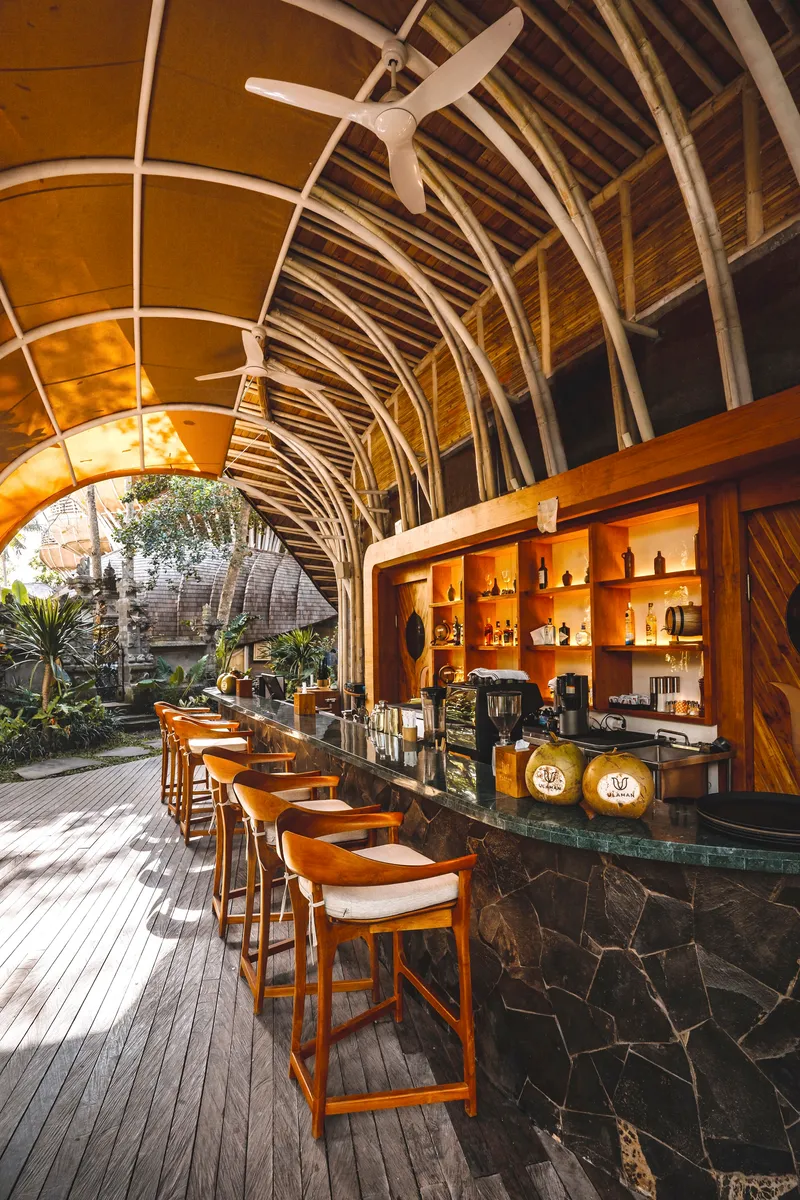
Inside the villas, the architecture delivers on its biophilic promise without resorting to the typical tropical-modern formula of white walls and floor-to-ceiling glass. Arched timber portals frame views into sleeping quarters with exposed beams and vaulted ceilings. Corridors are paved with irregular stone joints and punctuated by perforated bamboo cylinders that act as light wells beneath circular skylights. The bar area sits under arched bamboo ribs, its dark stone counter grounding an otherwise light and airy space.
The key move is the filtering of daylight. Rather than opening walls wholesale to the outside, Inspiral uses oculi, lattice screens, and layered bamboo skins to modulate light entry. The result is interiors that glow during the day without glare, eliminating the need for artificial lighting and reducing cooling loads simultaneously. It is passive design made sensual rather than technical.
Water as Infrastructure and Experience
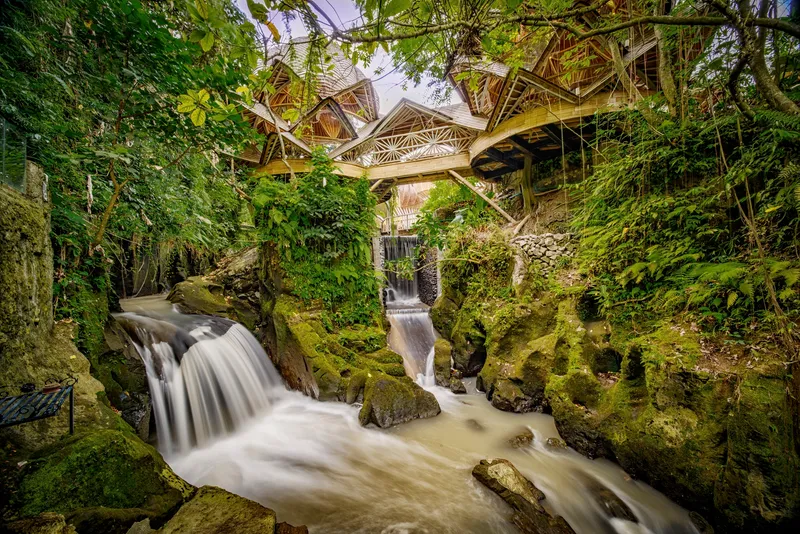

Water runs through this project in every sense. Cascading streams flow beneath timber bridges, the restaurant pods sit above waterfalls, and the lake provides both energy and atmosphere. A deck with a circular mesh net opens directly over a pond, inviting guests to lie suspended above water beneath a slatted bamboo canopy. The decision to make the hydroelectric reservoir visible and accessible, rather than hiding it behind the scenes, collapses the boundary between engineering and experience.
This is a resort where the infrastructure is the scenery. The river that powers the generator is the same river that guests hear from their beds. The lake that feeds the turbines is the same lake they paddleboard across. That integration is the project's most persuasive argument for carbon-zero hospitality: sustainability does not have to be hidden to be luxurious.
Plans and Drawings


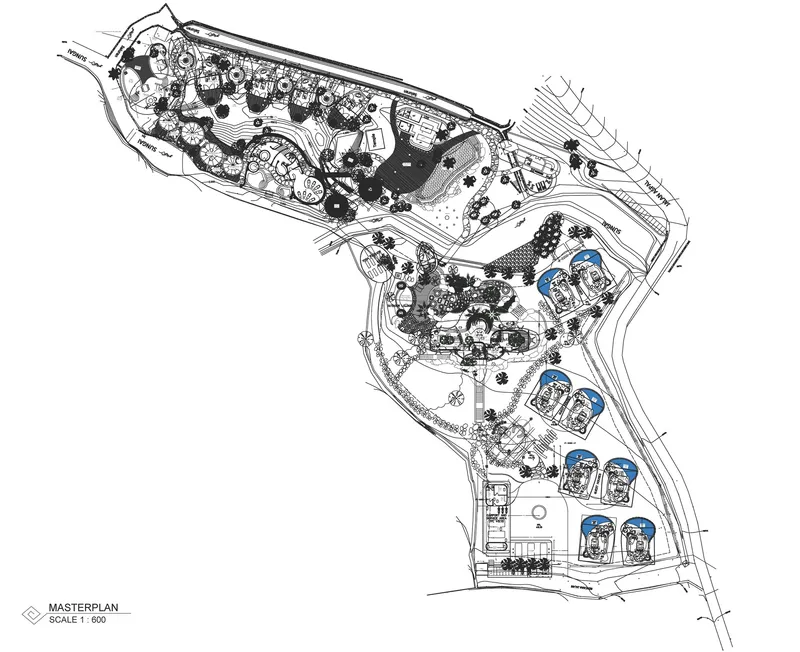


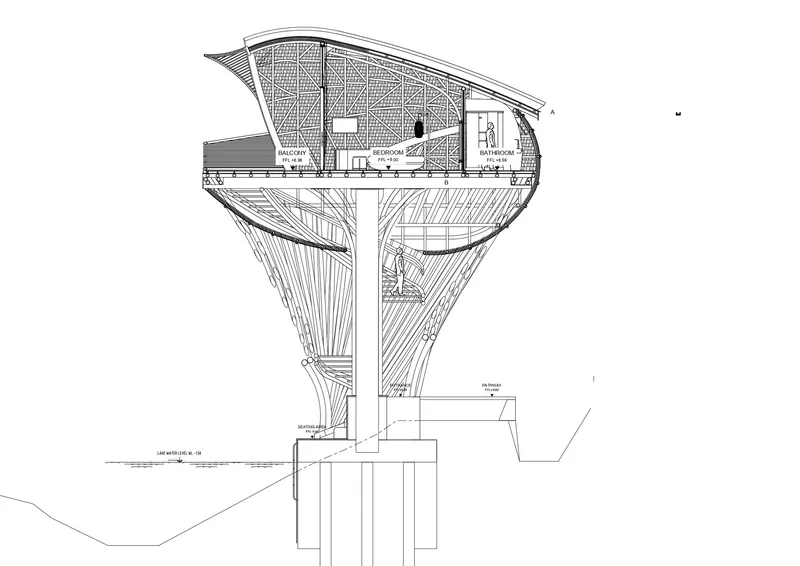


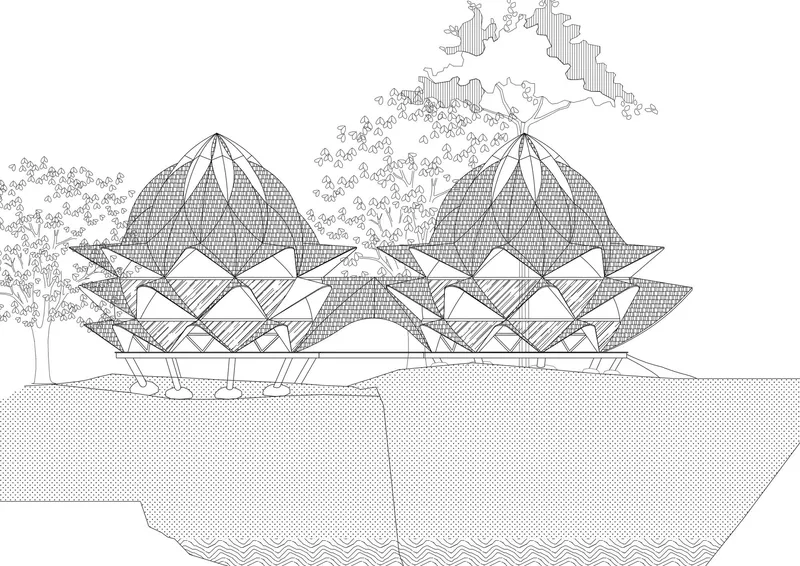
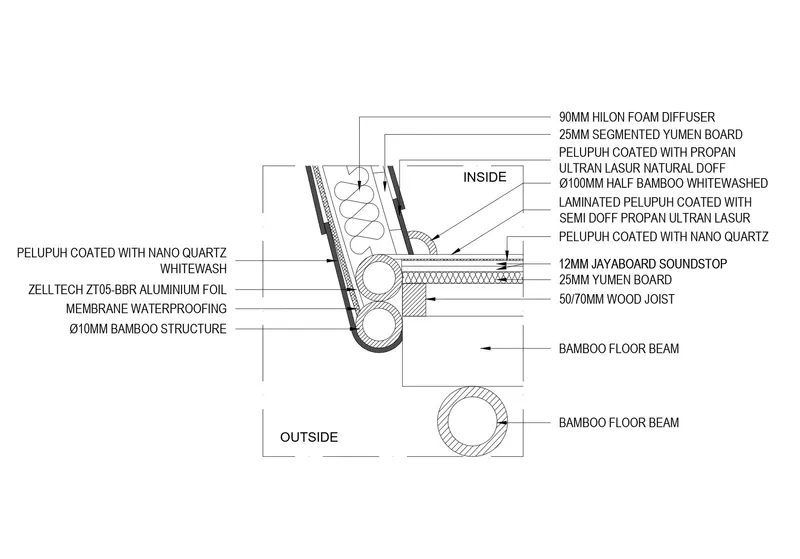
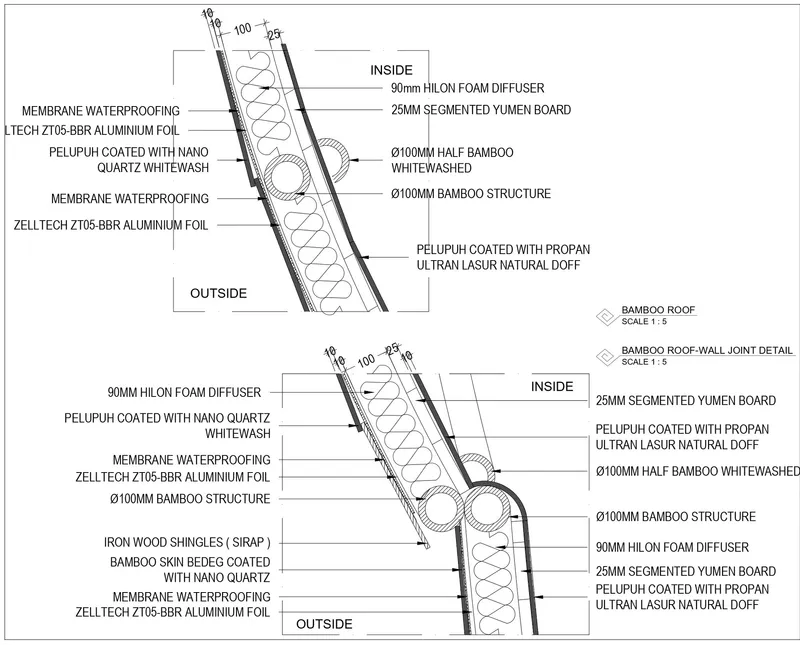
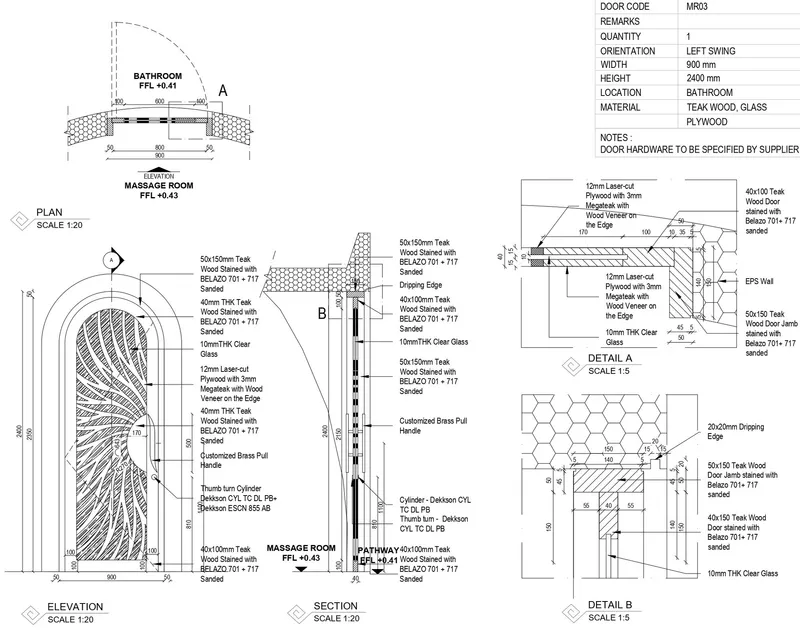
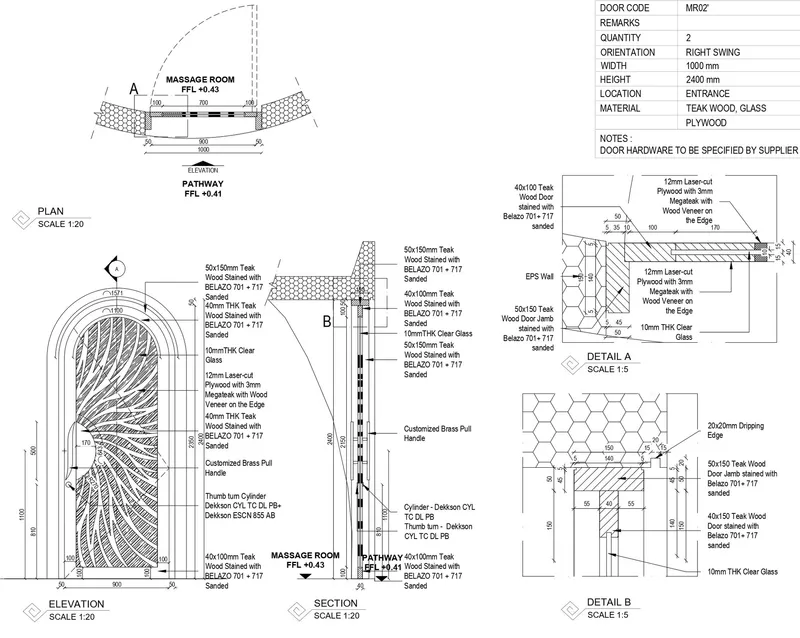
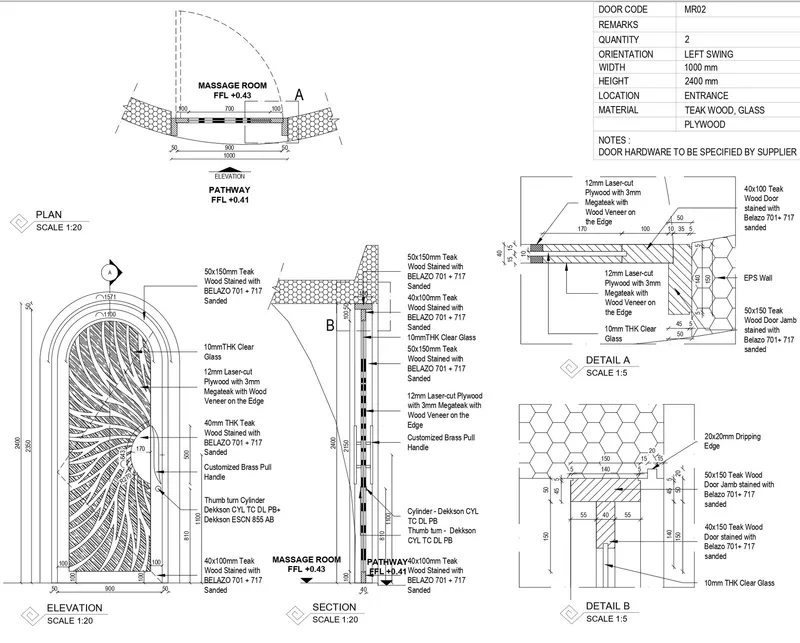

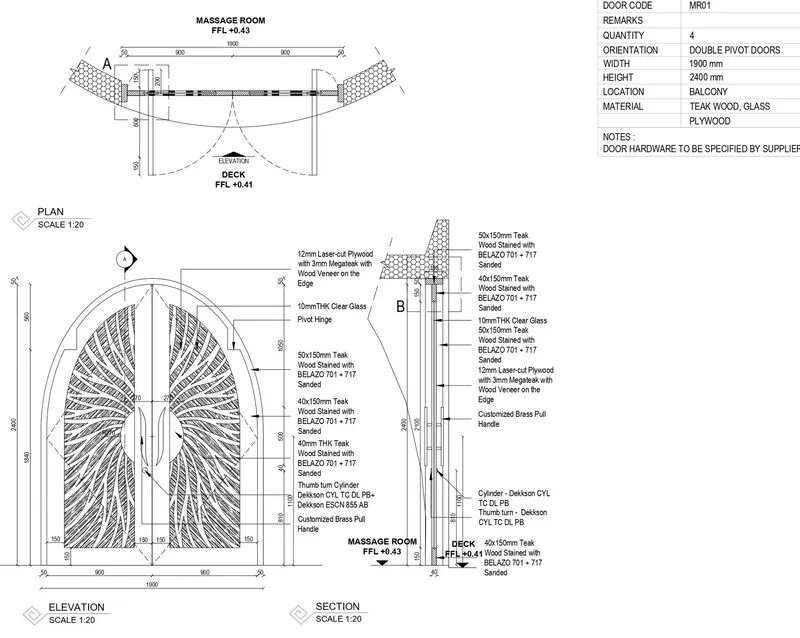

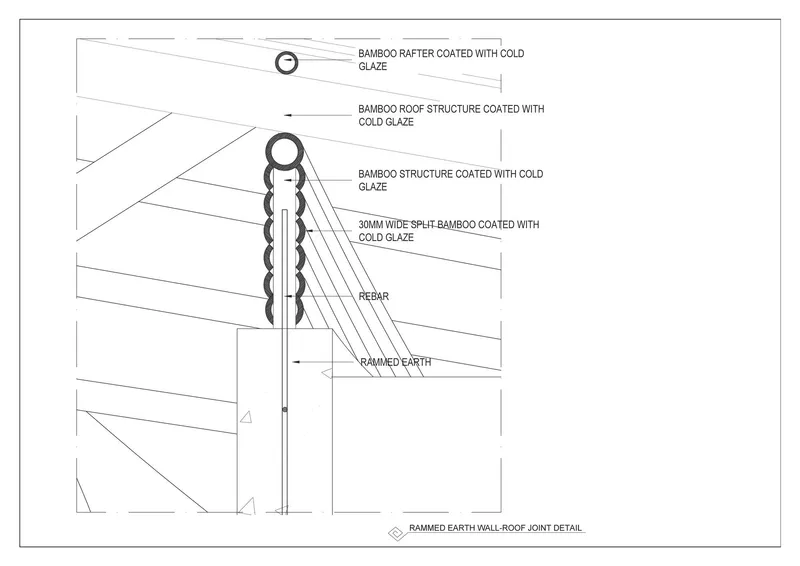

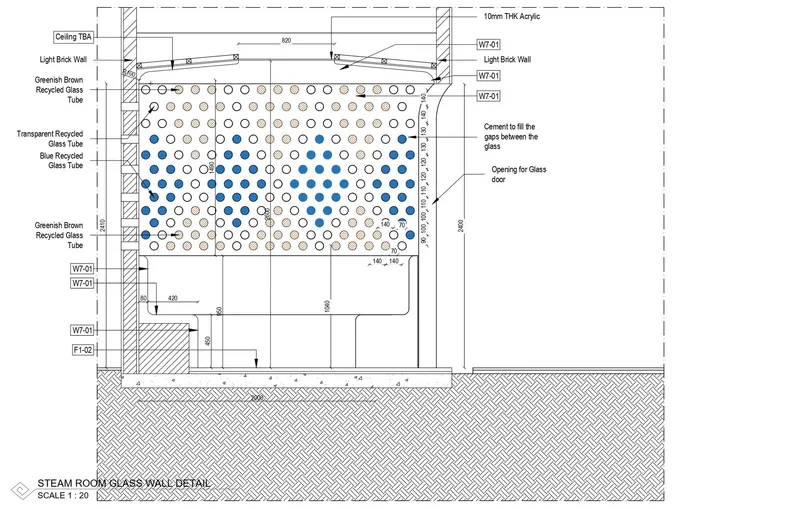

The drawing set reveals the depth of technical resolution behind the resort's organic forms. Site plans show the distribution logic: pod structures scattered across topographic contour lines, connected by pathways that follow the terrain rather than imposing a grid. Floor plans of individual villas reveal compact, oval footprints with central bedrooms, integrated bathrooms, and entry decks oriented toward views.
The sections are especially instructive. Triangulated bamboo frameworks span above excavated ground planes, and the elevated pods sit on central columns with clearly labeled interior zones. Detail drawings show how bamboo roof structures meet rammed earth walls through cold-glazed rafters, how membrane waterproofing layers integrate with pelupuh-coated finishes, and how foam insulation and aluminum foil waterproofing are sandwiched within curved bamboo roof assemblies. One of the most inventive details is a wall made from recycled glass tubes, blue and transparent, set in acrylic and arranged in a circular plan around a central wetland zone. These are not decorative drawings. They are construction documents for a building system that does not yet have an industry standard.
Why This Project Matters
Ulaman Phase 2 matters because it refuses the false choice between ecological ambition and architectural spectacle. Carbon-zero buildings are often austere, performance-driven boxes. Luxury resorts are often energy-hungry fantasies dressed in natural materials. Inspiral has produced a project that is genuinely both: a fully carbon-zero complex powered by its own river and sun, built from its own soil, staffed by its own neighbors, and shaped into forms that are as structurally inventive as they are visually compelling.
The broader lesson is about integration. The hydroelectric lake is not separate from the guest experience. The rammed earth walls are not separate from the thermal strategy. The bamboo domes are not separate from the ventilation system. Every element serves at least two purposes. In a region where "eco" is often a marketing prefix rather than a construction method, Ulaman demonstrates what the word actually demands: a building where ecology is not a feature but the operating system.
Ulaman Eco-Luxury Resort by Inspiral Architecture and Design Studios. Located in Kaba-Kaba, Tabanan, Bali, Indonesia. 1,521 m². Completed in 2022. Photography by Wanderskyy, Kevin Mirc, Bianca Blajovan, Nora Brown, and Symbiosis Studio.
About the Studio
Share Your Own Work on uni.xyz
If projects like this are the kind of work you want to make, uni.xyz is a place to publish your own, find collaborators, and enter design competitions.


Popular Articles
Popular articles from the community


Opera on the Sea: Driftwood Logic Shapes a Timber Opera House on Estonia's Coast
Trevor Orgill's opera house translates the entangled drift of floating timber into a civic building where wood, water, and music converge.

Manzana Morphosis: Stretching Barcelona's Grid into a Living Landscape for 2050
A radical reworking of the Eixample manzana turns density into a tool for generous public space, vertical ecology, and environmental performance.

Singing Woman: An Opera House That Performs Before the Curtain Rises
Ovidiu Cristian Pavel's conceptual opera house translates Estonia's choral identity into a sculpted waterfront landmark facing the Baltic Sea.


graciastudio Turns a Viewless Tijuana Lot Inward Around a Courtyard of Concrete, Timber and Trees
In Tijuana, Jorge Gracia's GA2 House stacks a timber-clad private floor over exposed concrete and replaces a missing view with a planted interior patio.

Similar Reads
You might also enjoy these articles

LAVA Architecten Gives Vocational Education a Sawtooth-Roofed Face on a Mechelen School Campus
In Mechelen, Belgium, a 2,053 m² STEM school on a 6×6 m grid turns workshops and classrooms into rooms that can be rearranged as teaching changes.

KEMA Studio Turns a Derelict Marvila Attic into a 60 m² Lighthouse Apartment Above Lisbon
In Lisbon's Marvila district, a rebuilt roof, four skylights and two plywood volumes turn an unlivable attic into a bright home facing the Tagus.

Pixel Gardens: One Repeated Module Stacked Into a Terraced Social Housing Tower for Famagusta
Salem Bader's shortlisted housing tower builds a vertical neighbourhood from one repeated module, offsetting units to carve terraces, light and air.

Bao Huynh Watercolor Atelier: A Serene Art Retreat in Hội An
Bao Huynh Watercolor Atelier in Hội An blends multifunctional art spaces, sustainable design, local materials, and family-friendly living in a serene environment.

Explore Eco-Tourism Competitions
Discover active competitions in this discipline

Challenge to reimagine the Iron Throne

Photograph architecture without architects

Illustrate the lost glory of Angkor Wat - Render Challenge

Design challenge to reuse E-waste
Comments (0)
Please login or sign up to add comments
No comments yet. Be the first to comment!