
Intersect
Reimagining Architectural Education and Practice- Agility as a way forward

THE PROBLEM:
Are the Architects, regarded as agents of change still in-charge of this change? Are they powerful, strong, financially capable and confident enough to guide the way of the Nation in its quest of developing and reaching its capability and position in the world? Is the upcoming generation getting away from practical knowledge and becoming an educated but incapable byproduct of the Current System? The answer collected via research, interviews and opinions of the citizens seems scary.
THE ATTEMPT TO ADDRESS THE ISSUE:
The concept is formed around increasing practical and hands on experience, thus improving capabilities of Students and Professionals during education and initial years of practice making them ready to be the leaders they are required to. Getting Students, Professors, Working Professionals, Local Bodies and the common man of our country under one roof to be able to contribute in each other’s growth for a better collective future. The students get spaces for learning and they help professional with their projects while also gaining valuable experience, professors get a Staff centre equipped with technology and private outdoor spaces, professionals get a workspace and they in turn contribute to the students’ learning process by teaching and guiding them, local bodies get budding excited and energised workforce for development and the citizens get a platform to express their problems and an opportunity to help in solving them using their experiences and collaborating with designers thus also understanding the contribution of these professionals in nation buildings and gives them the respect and credit they deserve, thus completing the cycle and getting a lot out of it.
THE LOCATION:
The location of the project, Mumbai University Campus, Kalina, Santacruz has many advantages, being Centrally Located in Mumbai, thus making it accessible to the various user groups coming from across the city as well as allowing a close proximity to other ancillary facilities like the University Sports Centre and ground which allows physical fitness to become an important part of the course. The North side of the side is bounded by the Santacruz Chembur Link Road which will soon become one of the important connecting nodes of the city, this Elevated Road offers an excellent view into the site thus allowing the building to make an impression on commuters and creating a sense of curiosity within them, thus gathering attention for the Architectural fraternity in a Quest to improve its identity in front of the Citizens.
THE ARCHITECTURAL SOLUTION:
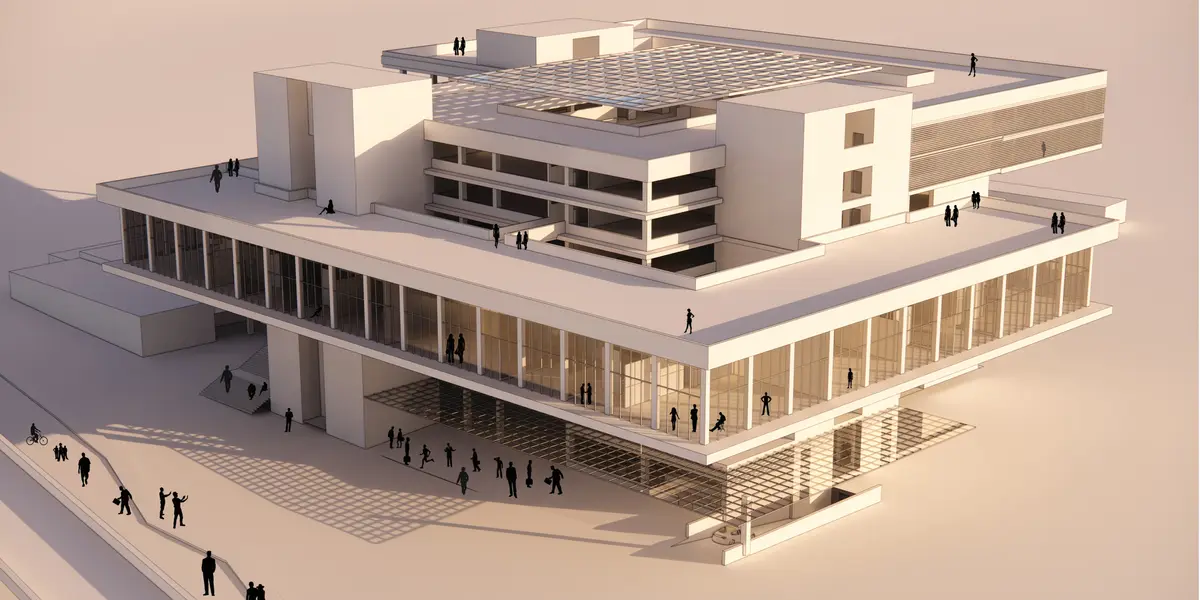
Introducing a dynamic architectural complex designed for the seamless integration of various components crucial to the spatial creation process. This innovative facility encompasses dedicated spaces for learning, exploration, critique, and execution. It serves as a multifunctional hub where individuals can engage in collaborative endeavours, foster creativity, analyse concepts, and bring ideas to fruition within a unified environment.
The architectural complex introduced represents a cutting-edge approach to spatial creation, seamlessly integrating essential components necessary for the design process. This innovative facility isn't just a building; it's a dynamic environment crafted to nurture creativity, collaboration, and exploration.
Not only does it differ from other Institutes in ideology and program but also in terms of Technology and Pedagogy. The complex demonstrates various construction technologies (onsite casting, assembly, prefabrication, customizable and flexible design), structural systems (Steel, Timber and varieties of RCC), Façade Systems, a mix of Private, Public and Semiprivate spaces and Architectural Services (Active to passive, Energy Saving to Controlled Environments) which become a source of on site, visual and experiential learning for the students and professionals in this campus.
CLIMATE AT THE FOREFRONT:
All the spaces have been planned to allow Natural Cross-Ventilation through them, thus reducing cooling costs and allowing thermal comfort. The building’s façade houses ample plantation in shaded pockets allowing further cooling of the internal spaces providing them comport in Mumbai’s hot and humid climate. The cantilever on the southern side shades most of the south facade. The building is full of voids which apart from creating an interesting façade, allow open spaces reducing the thermal mass and allowing ventilation to replace worm air with cooler fresh air. The building being located at the lowest portion of the site coincidentally in the centre of the site which allows lesser digging for the basement and foundation, and reducing the flooding in the region thus solving a suspected problem in the campus. Equipped with solar panels on its extensive roof, the building is expected to generate a significant amount of energy for a long term due to absence of any high-rise buildings on any side of the site. The project when evaluated via GRIHA V.2019 is expected to get a 5 Star Rating considering some assumptions during construction process and technologies used. This not only makes the building better but sets up a wonderful example in front of students and inspires them to make environment friendly and considerate buildings which contribute to the environment.
LEARNING:
At its core, this architectural complex comprises distinct spaces meticulously designed to cater to different stages of the creative journey. First and foremost, it features dedicated areas for learning. These spaces are equipped with state-of-the-art resources, including libraries, digital archives, and interactive displays, where individuals can immerse themselves in a wealth of knowledge spanning various architectural disciplines and historical contexts.
The 3rd and 4th floor houses Lecture Rooms which are flexible and expandable based on the requirement of the students. There are voids in between these classrooms which allow ample natural lighting and ventilation. Each lecture room has their own balcony with a breeze block facade which shades the space but allows ample and controlled ventilation thus reducing air conditioning costs and providing thermal comfort, depicting the power of design to students studying here.
The basement houses an extensive library with ample of reading spaces, work pods and digital reading spaces for research and development. A part of this library extends into the ground and first floor. This part is made of timber and supports large spans thus allowing students to learn about its properties and imitations.
STUDENT WORKSPACES:
Above the learning spaces are areas designed for exploration. Here, architects, designers, and thinkers have the freedom to experiment, brainstorm, and push the boundaries of conventional design. From flexible studios equipped with cutting-edge tools to outdoor spaces that encourage interaction with nature and the surrounding environment, these areas serve as incubators for innovation and unconventional thinking.
The 5th and 6th floors have studios - with individual student workspaces which are flexible in Size and can be easily resized as per the requirements and student strength in each year and course. The 5th Floor has Bachelor’s Studios whereas the 6th Floor has Masters’ Studios which overlook into the Bachelors’ Studios thus allowing a collaborative environment and forging vertical and inter-stream interactions between students.
JOURNEY FROM EXPERIMENTATION TO EXECUTION:
The execution spaces within the complex provide the infrastructure and support necessary to bring ideas to life. Equipped with advanced fabrication labs, prototyping facilities, and collaborative workspaces, these areas empower individuals to translate their visions into tangible reality. From model-making and digital prototyping to full-scale construction, the execution spaces cater to a diverse range of creative processes and methodologies.
The first-floor houses Material based workshops, fabrication labs and outdoor model making spaces to allow complete exploration and hands on learning for students and professionals.
The second-floor houses Technology based Laboratories and Workshops which help students and professionals get equipped with newer technologies, allowing them to work efficiently.
CRITIQUE:
Critique spaces play a pivotal role within the complex, offering environments where ideas are challenged, refined, and elevated. These spaces facilitate dialogue, debate, and constructive feedback, fostering a culture of continuous improvement and intellectual exchange. Whether through formal presentations, design charrettes, or informal discussions, individuals have the opportunity to engage with peers, mentors, and experts to refine their concepts and approaches.
All the floors in the building have outdoor common spaces which encourage critique and critical thinking.
The glass bridge in the corridor has a double glass floor, one of which is privacy glass which allows it to become a freely accessible space when required and when not in use the glass allows light into the courtyard thus keeping the space lively. This bridge is a dedicated stage for presentations, juries, discussions and showcasing new technologies, student and professional work.
The suspended staircase also acts as a space for breakout, discussions and presentations which physically and ideologically connects the Workshops, Laboratories to the Lecture spaces and Workspaces acting as a bridge between the two.
PRACTICE, EXECUTION:
This component of the facility is the centre where all the knowledge gets applied, while continuing to learn more. Large Offices, Small Studios and Individual Workspaces, Meeting and Discussion spaces provide a launchpad for budding and growing practices to develop themselves as well as contribute collectively to creating a better future.
a. Co-working spaces for freelancers, recent graduates and startups:
The 3rd Floor houses an Admin Office for the co-working space, the Co-Working Work Centre and workspaces for individual practitioners, a lecture, discussion addressal and recreation Amphitheatre, offices for small startups and sleeping pods for professionals and students. The 4th floor houses meeting rooms for the professionals working in the Co-Working Space to allow discussions with students and meetings with clients, contractors and other professionals. This is accessed internally as well as externally from the fourth-floor lobby.
b. Office Spaces for Medium-scale Growing Firms:
The third floor houses the Workspace of the Office Spaces 6 in number. These offices would be rented out for a period of 3 maximum to foster change and allow a variety of practices to be able to contribute to learning. The offices are customizable as per the needs of the firm and thus would have an open floor plate provided. Each pair of Offices share a Semi open Outdoor Space from where they have their entrances, these spaces are double height in nature and allow interaction and discussions between these offices, they also allow and encourage exhibitions, lectures for students, professionals which are also open to all. The core and common toilets for the Work staff also create chance interactions between people working at different offices thus allowing sharing of ideas and collective thinking.
The fourth floor houses the Cabins and offices for Senior Professionals for each firm allowing them a overlooking side into the workspace thus also maintaining a connect between the different positions in the setup. A staircase internally connects the lower floor to this floor thus providing easy access. The offices only occupy part of the floor plate thus allowing a double height workspace and natural light within the space. Above the Semi open Outdoor Spaces are meeting rooms which are shared by the offices as they are not in use continuously and thus need not be separate for each office.
The glass facade is an open canvas available to the practices in the campus to collaborate and make a customized facade which keeps changing as new practices come in. It also provides another avenue for collaboration.
c. The Design Cell;
The Design cell located on the Third-floor acts as a floor for collaboration between students, professors, working professionals including Architects, Planners, Engineers, Designers, Local bodies like BMC/MCGM, Mumbai University officials and the common citizens to work on a variety of projects. These include Urban Design, Street Design, solving existing problems in the city and indirectly the Nation from the grassroot level, Working on University Maintenance and Development projects. These projects would be done by students and freelancers under guidance by the professionals, professors, authorities and the people experiencing the problems providing experience and work to more people.
THE STAFF CENTRE:
It automatically becomes important to provide ample and an appropriately designed space for the professors who would be guiding students in this type of an institute. The segregation of Admin, Spaces as well as department wise Staff Spaces is important but it is also necessary to get the staff together to foster the thought process to be able to bring out the capabilities and creativity of the students who will one day serve the nation and derive and guide its path towards development.
There are staffrooms for each department in the institute as well as a common one for Maters’ courses. These have a variety of spaces but more importantly share common spaces like pantry, dining, outdoor recreation with other departments. The Centre also includes a studio classroom space for faculty members to conduct remote lectures online and a teacher training centre to equip professors and assistants to learn and get equipped with newer pedagogies and technologies involved in the teaching – learning process. Spaces for guest lecturers include lounges and rooms for rest and overnight stay. The central zone also includes various common spaces including a medical room and counsellors offices for taking care of mental health of students, professionals and professors.
CONCLUSION:
What sets this architectural complex apart is its holistic approach to design and collaboration. By seamlessly integrating learning, exploration, critique, and execution, it fosters a dynamic ecosystem where ideas flourish, boundaries are pushed, and transformative solutions emerge. It's more than just a physical space—it's a vibrant hub of creativity, innovation, and interdisciplinary exchange, driving the future of architecture and design forward.

Popular Articles
Popular articles from the community


Opera by the Sea Estonia: Three Shells Dissolving Architecture into Tallinn's Coastline
A winning opera house proposal replaces monumental form with interconnected shells that blur the boundary between building, park and Baltic Sea.

Opera on the Sea: Driftwood Logic Shapes a Timber Opera House on Estonia's Coast
Trevor Orgill's opera house translates the entangled drift of floating timber into a civic building where wood, water, and music converge.

The Amber Palace Opera: A Geological Fiction Surfaces on Tallinn's Baltic Waterfront
Pierre Brillard reimagines a Baltic legend as a public landscape, opera house, and waterfront promenade rooted in Tallinn's coastal identity.

Faces of the Soviet Avant-Garde: Turning Moscow's Street Names into an Open-Air Museum
A network of sculptural installations across a Moscow residential district transforms forgotten architect names into spatial encounters with cultural memor

Similar Reads
You might also enjoy these articles

Shakur's House: Exposed Brick as an Interior Organiser in a 168 m² Mashhad Residence
Brick moves indoors in this Mashhad residence, where masonry walls, glass partitions and teal planes sequence a compact home without closing it off.

Day and Night Park: A Time-Based Urban Newsstand in Beijing
A temporary urban newsstand in Beijing blending travel, light, and reading through poetic colors, compact form, and community-focused design.

Modernist Patio Renovation in El Masnou, Barcelona by Oliver Segura Arquitectura + Cebrià Arquitectura
Modernist patio renovation blending tradition and innovation with a movable pool, leveled floors, and Catalan materials in El Masnou.
Alto Residencial Coop: Cooperative Housing Development in Santiago de Compostela by Carbajo Barrios Arquitectos
A linear cooperative housing complex blending white volumes and perforated metal façades, enhancing community living, natural light, privacy, and urban integration.

Explore Architectural Experience Competitions
Discover active competitions in this discipline


Challenge to design public laboratory

Challenge to reimagine the Iron Throne

Photograph architecture without architects

Illustrate the lost glory of Angkor Wat - Render Challenge
Comments (0)
Please login or sign up to add comments
No comments yet. Be the first to comment!