

1-1 Architects Turns a Deformed Flagpole Lot into a Layered Countryside Home in Japan
House KJ uses split levels and narrow courtyards to build a new relationship with an irregular rural site and its neighbors.


Irregular lots in Japanese residential neighborhoods are not rare, but they are rarely treated as design opportunities. 1-1 Architects took a deformed flagpole plot in rural Japan and did exactly that with House KJ, threading a long, narrow volume through the site so that the house occupies both the "flag" and the "pole" of the lot. The result is a home that does not fight the constraints of its property lines but instead uses them to generate an internal logic of split levels, borrowed views, and intimate courtyards wedged between corrugated metal walls and neighboring boundary fences.
What makes the project genuinely interesting is its refusal to pretend the neighbors don't exist. The surrounding houses, with their retaining walls, tiled roofs, and chain-link fences, are not screened out. They are incorporated into almost every framed view, turning the mundane residential fabric of a Japanese countryside settlement into a constantly shifting backdrop. The house reads from above as a cluster of stepped white volumes dropped among the tile rooftops, but from inside it operates as a vertical landscape of timber platforms, concrete thresholds, and glass walls that dissolve the boundary between domestic life and the textures of the neighborhood.
A Narrow Volume Wedged into the Neighborhood


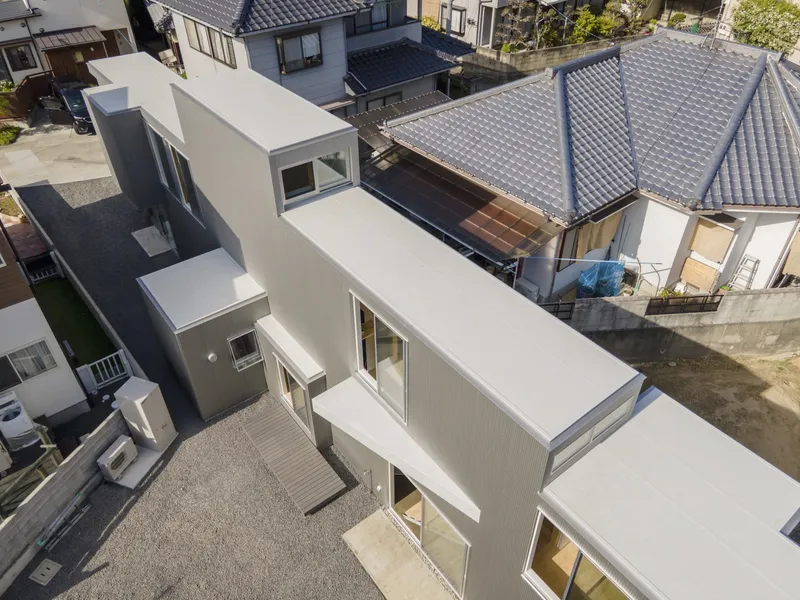
From street level, House KJ barely announces itself. A cluster of grey corrugated metal facades appears wedged between its neighbors, its profile narrow enough to fit the flagpole access road. The metal cladding is utilitarian and deliberately self-effacing, borrowing the visual language of agricultural outbuildings rather than declaring itself as a design statement. Only from the air does the full composition become legible: stepped flat-roofed volumes that cascade in section, each one sitting at a slightly different height.
The choice to run the building along a north-south axis through the depth of the lot means both the east and west exterior walls come close to the property boundaries. Rather than creating claustrophobia, these tight side conditions generate a series of narrow in-between spaces, slivers of gravel and air that separate the house from its neighbors just enough to admit light and introduce a sense of porosity.
Courtyards as Breathing Room
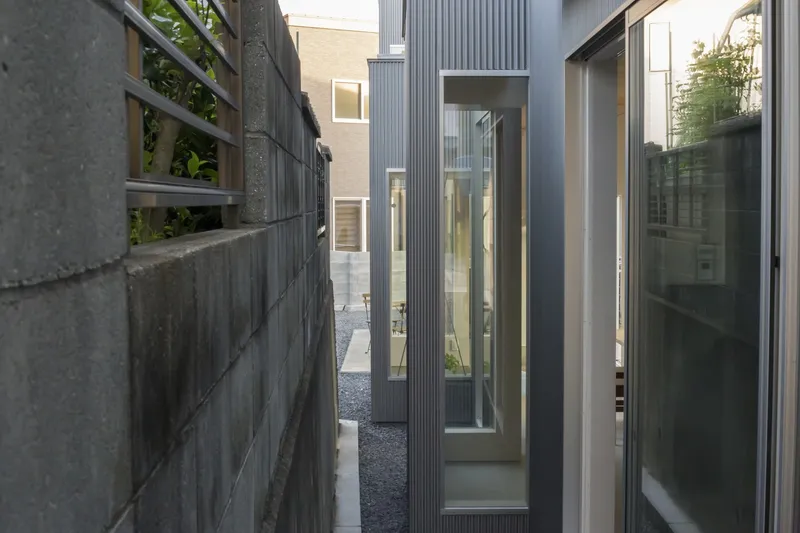
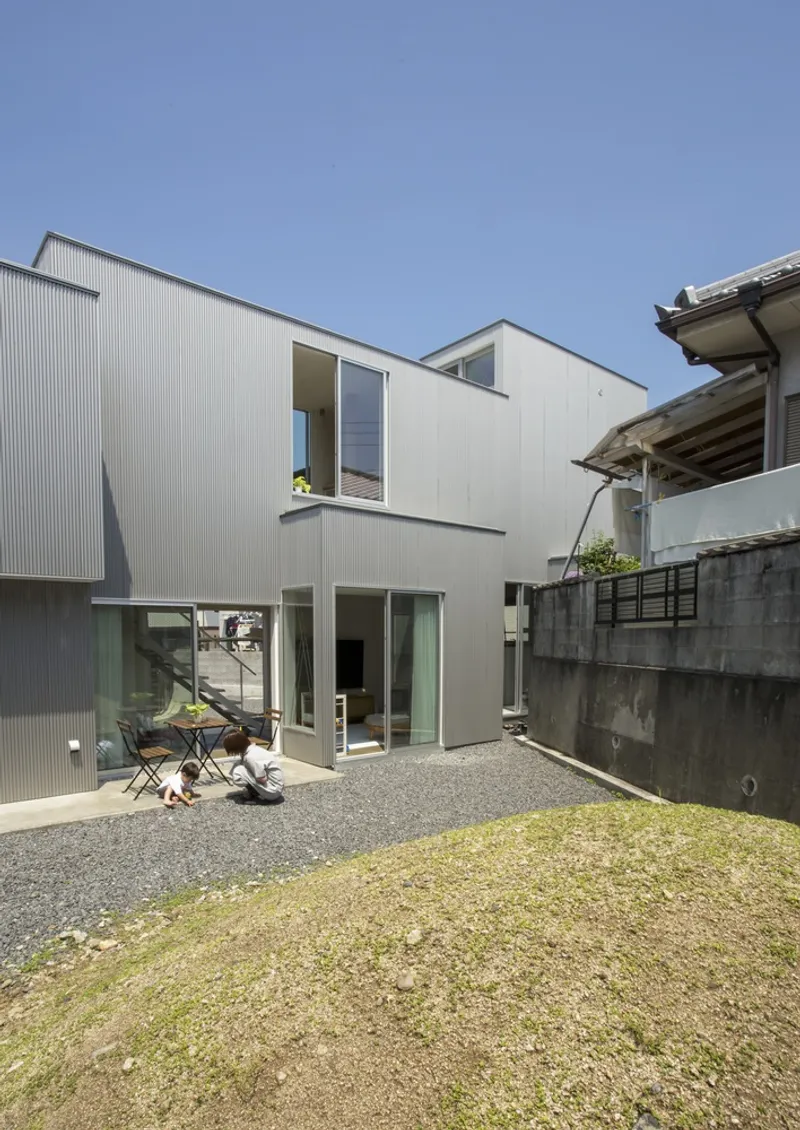
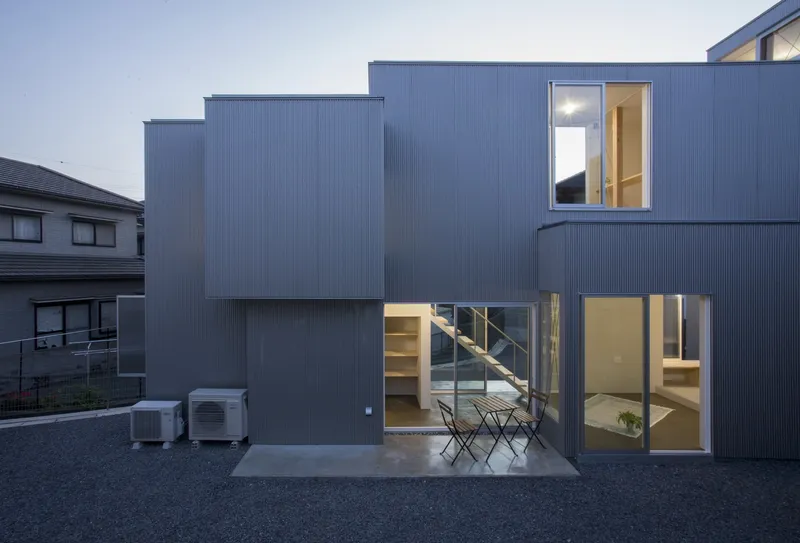
The narrow courtyards at House KJ are not ornamental. They are structural to the way the house breathes, gathers light, and mediates its relationship with the boundaries on every side. A gravel-floored gap between the corrugated metal facade and a concrete block wall creates an almost alley-like outdoor room, lit at dusk by the warm glow leaking through the glazed openings. On the rear side, the stepped white volumes open onto a broader courtyard with patches of grass, a space generous enough for outdoor furniture and children's play.
These outdoor zones are not afterthoughts carved from leftover space. They are the mechanism by which the house achieves cross-ventilation, daylight penetration on both long sides, and a visual buffer from the density of the surrounding settlement. Every window in the house looks into at least one of these interstitial voids before the eye reaches a neighbor's wall.
Split Levels and the Vertical Landscape
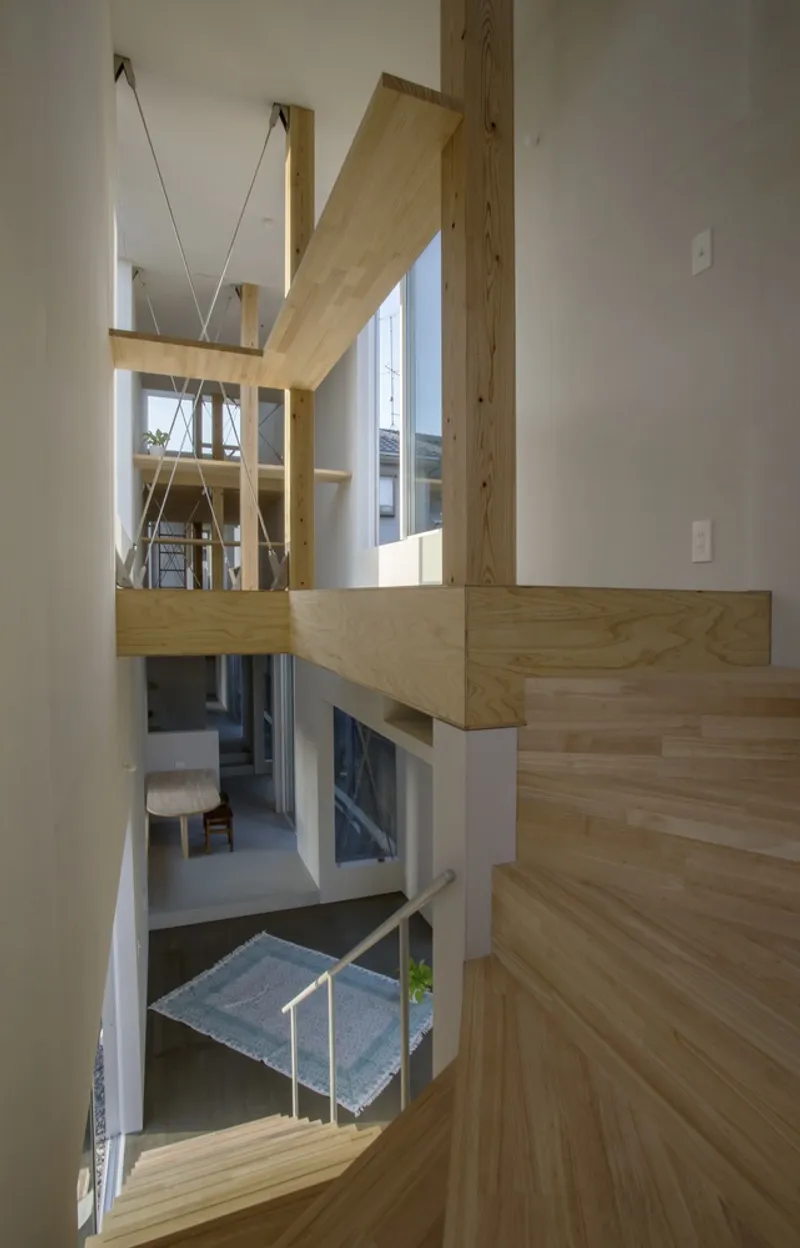

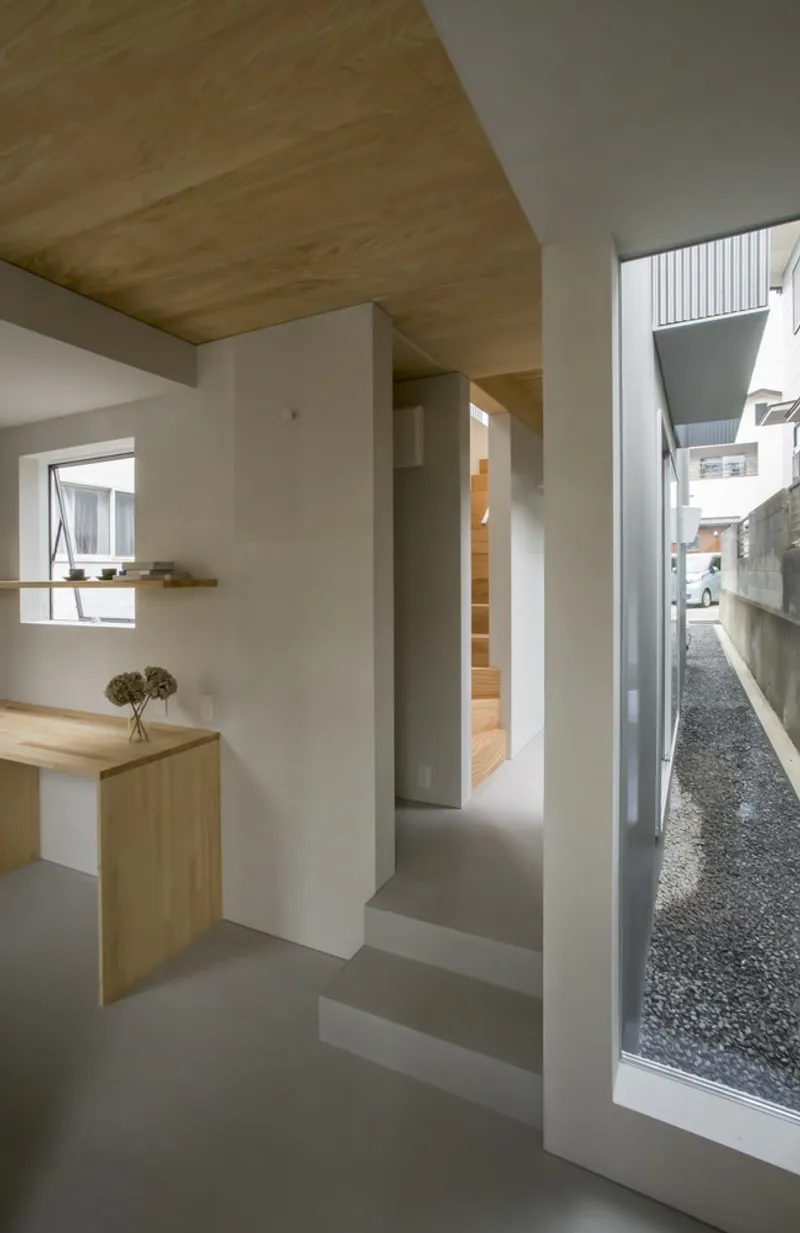
Inside, the most consequential move is the use of skipped floors. Rather than stacking conventional stories, 1-1 Architects offsets the floor plates by half a level, creating a continuous zigzag of platforms connected by short runs of stairs. The effect is spatial compression and release in rapid succession. You descend a few concrete steps past a timber desk and arrive at a gravel courtyard; you climb a timber staircase and land on a mezzanine overlooking a double-height living space below.
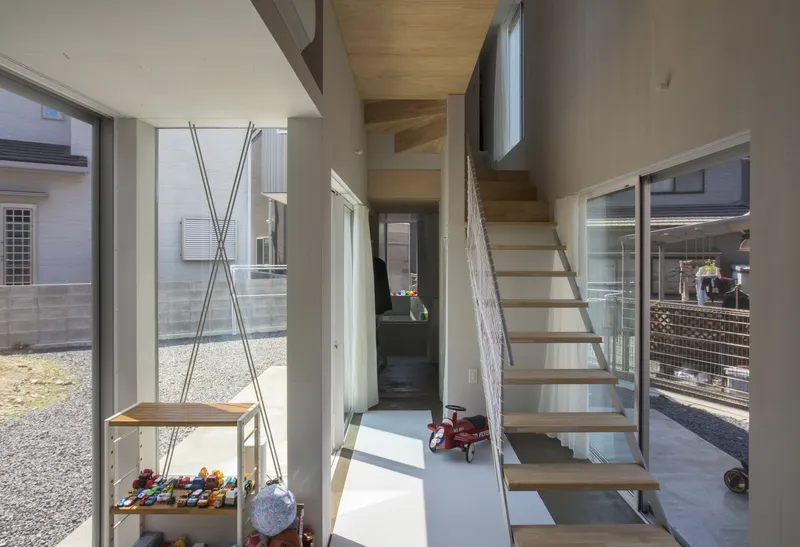
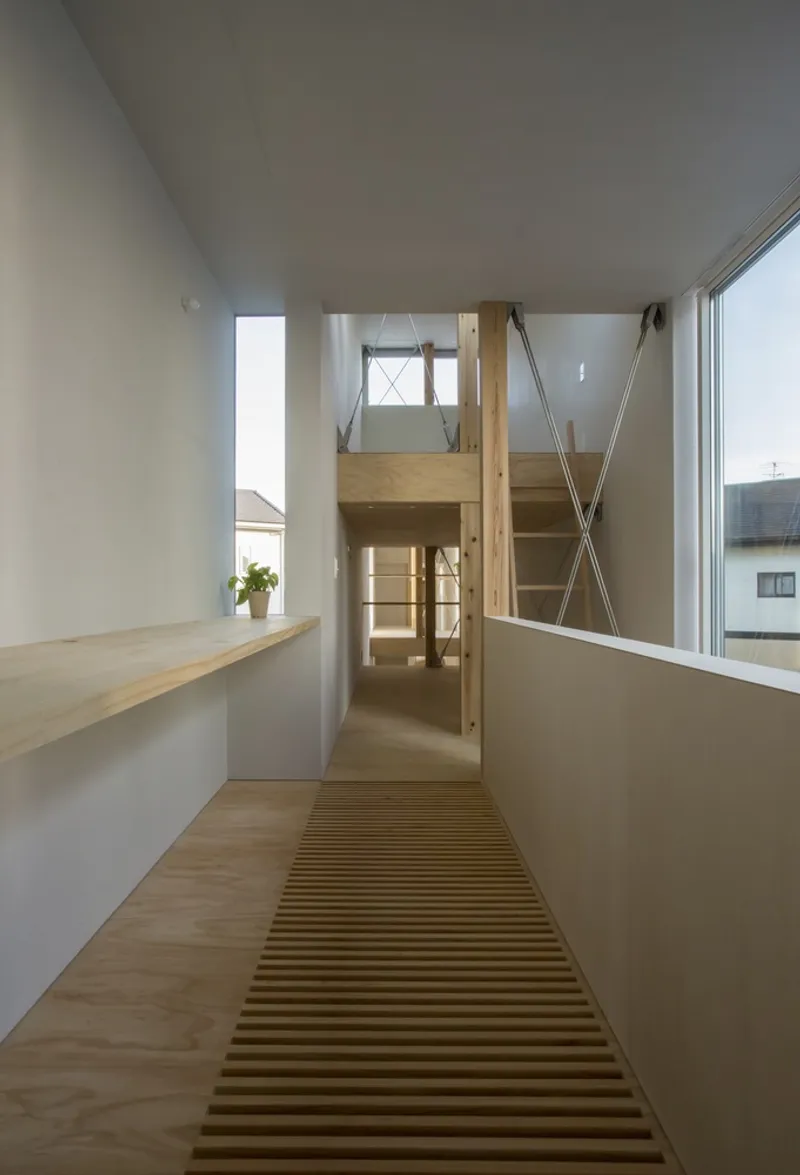
The split-level strategy does more than add visual drama. It ties the interior experience directly to the section of the site, which slopes gently. Each half-level corresponds to a different relationship with the ground plane and a different set of views, so that moving through the house vertically also means moving through a sequence of landscape encounters. The concrete floor of the entry hall sits close to the earth; the upper corridor with its slatted timber floor panels hovers above the rooftops.
Timber Structure as Spatial Framework

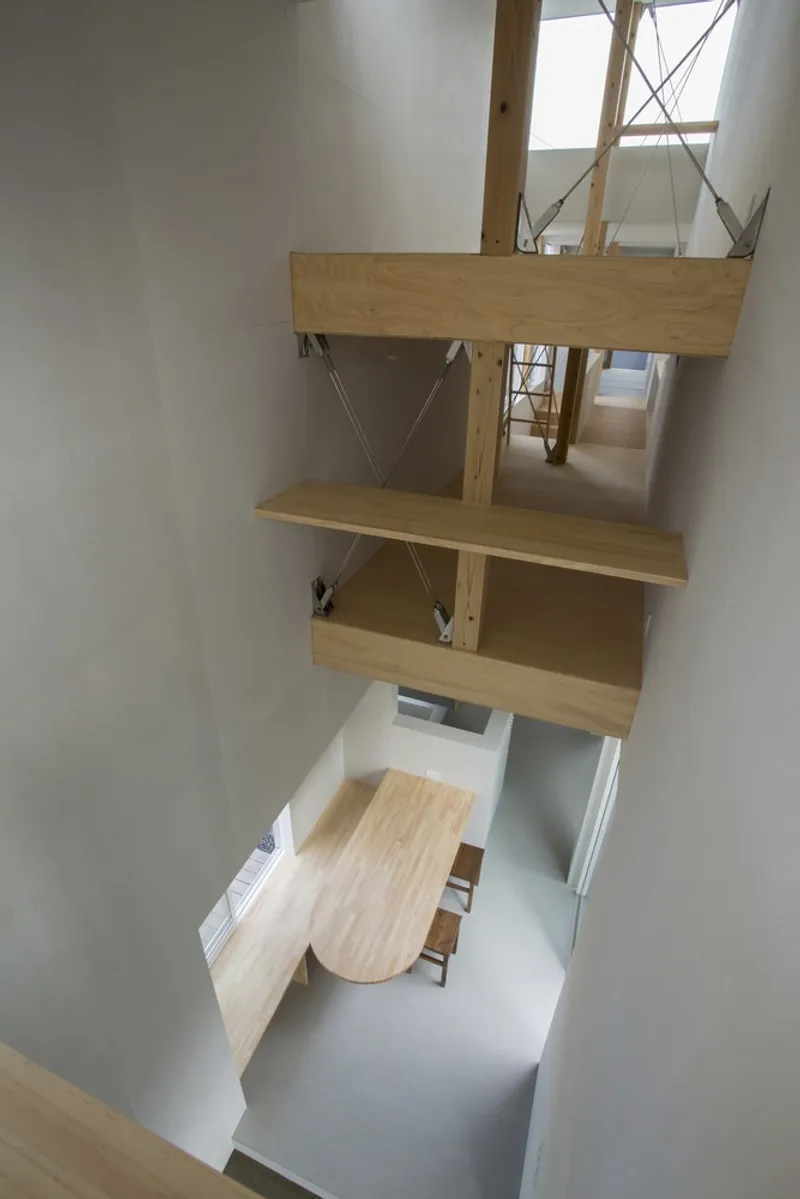
The exposed timber posts, beams, and staircase act as the visible skeleton of the house, giving legibility to the split-level organization. Steel cable railings replace solid balustrades, allowing sight lines to cut diagonally through double-height voids. From an upper platform you can look down through layers of timber structure and cable bracing to a dining area below, a single glance that reveals three or four floor levels at once.
Plywood ceiling panels soften the overhead plane in the main living space, while the stair treads and structural members are left in a warm, natural finish. The material palette is deliberately restrained: timber, concrete, corrugated metal, glass, gravel. Nothing competes for attention, and the architecture can focus entirely on spatial sequence and light.
Framing the Neighbors

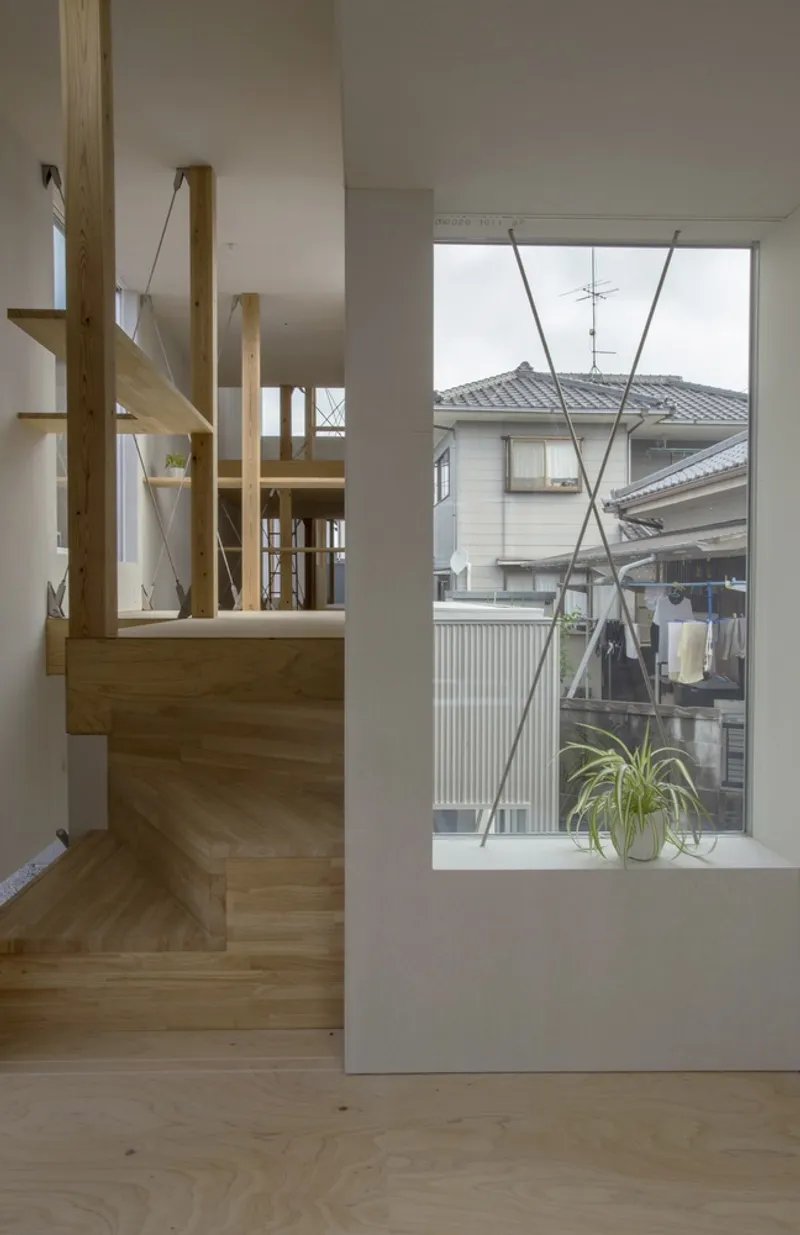
Corner windows on the upper levels frame the neighboring rooftops as deliberately as a gallery frames a painting. A white room with two perpendicular panes of glass turns the adjacent houses into a composed view, their clay tiles and corrugated walls rendered almost picturesque. From the staircase, wire railings and a window together frame a panorama of the settlement that shifts with every step up or down.
1-1 Architects treats the surrounding residential fabric not as a nuisance to be blocked but as a form of borrowed scenery, an idea with deep roots in Japanese garden design. The difference here is that the borrowed landscape is not a mountain or a temple. It is the everyday: laundry poles, gutter pipes, the slope of a neighbor's roof. The house ennobles the ordinary by choosing to look at it carefully.
Domestic Life at Ground Level
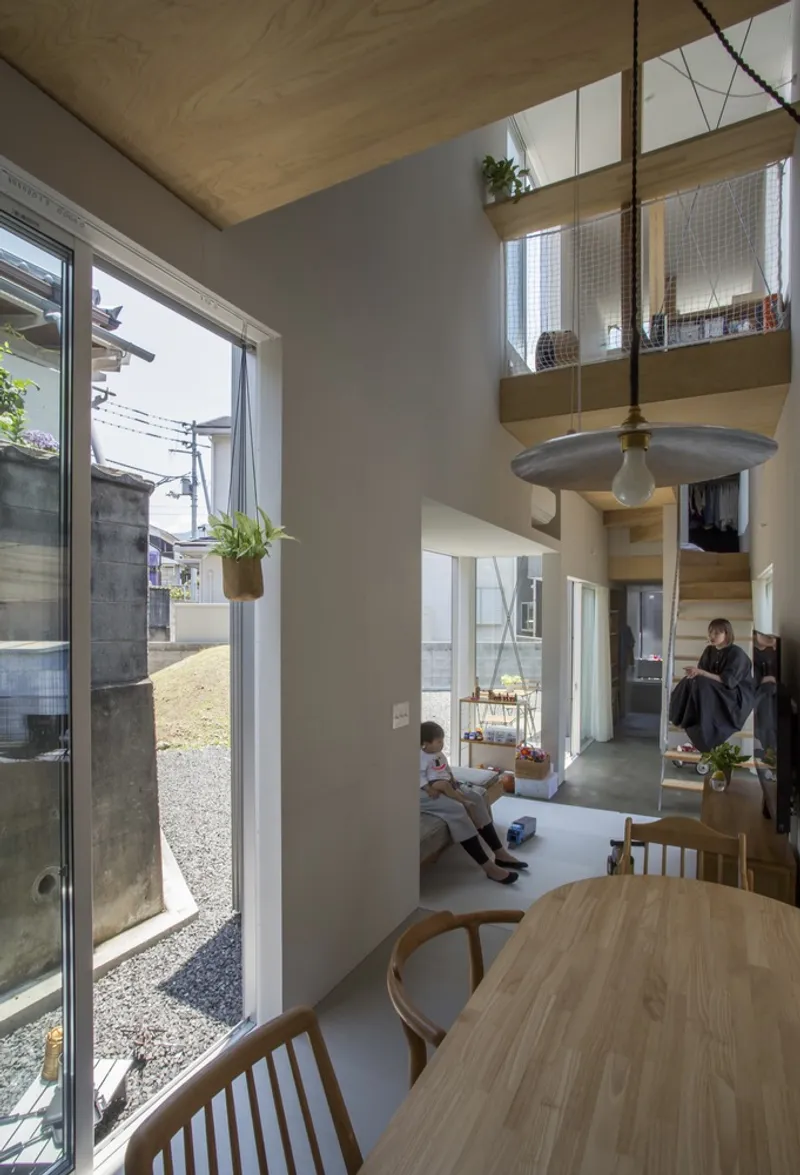
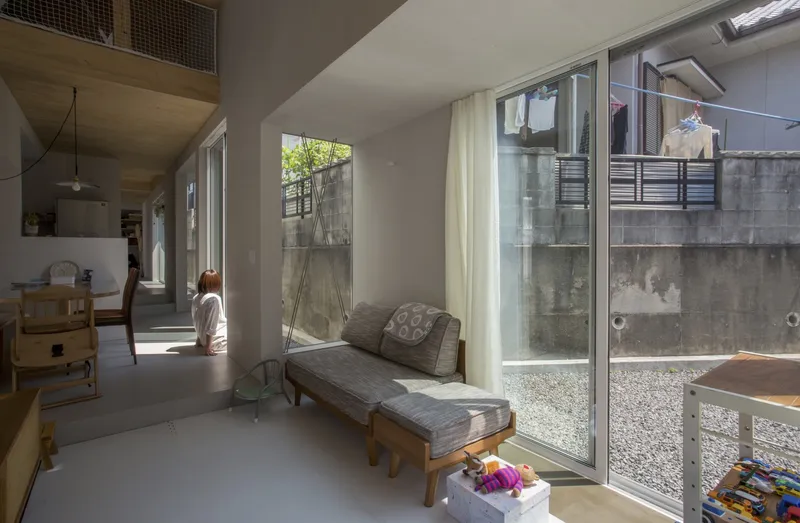

At the lowest levels, sliding glass doors dissolve the wall between the living area and the gravel courtyard. Two children sitting on the floor of the living room can see directly out to the sky, the gravel, and the courtyard wall. A timber daybed faces the glazed opening, turning the act of resting into an act of observation. These are not heroic spaces; they are calibrated for the rhythms of family life in a compact countryside house.
An outdoor terrace with folding metal chairs extends the living area further, blurring where inside ends and outside begins. The combination of polished concrete, gravel, and timber gives each threshold a different tactile quality underfoot, reinforcing the spatial transitions that the split levels establish in section.
Bridges and Overlooks
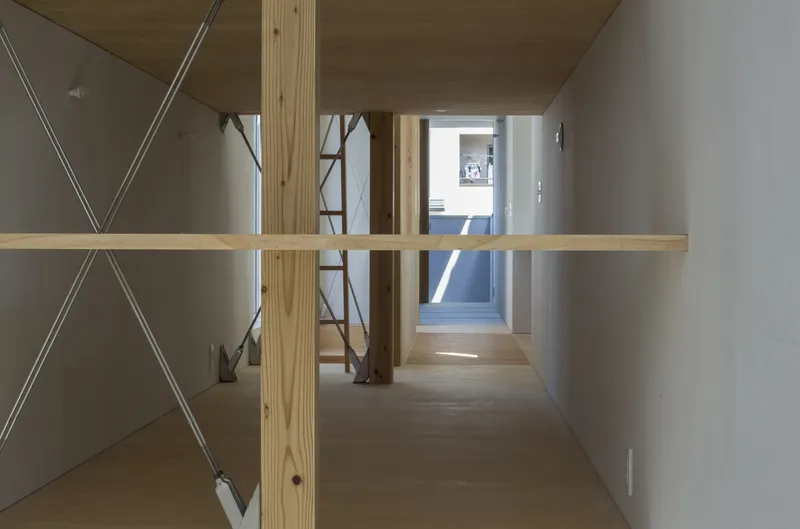
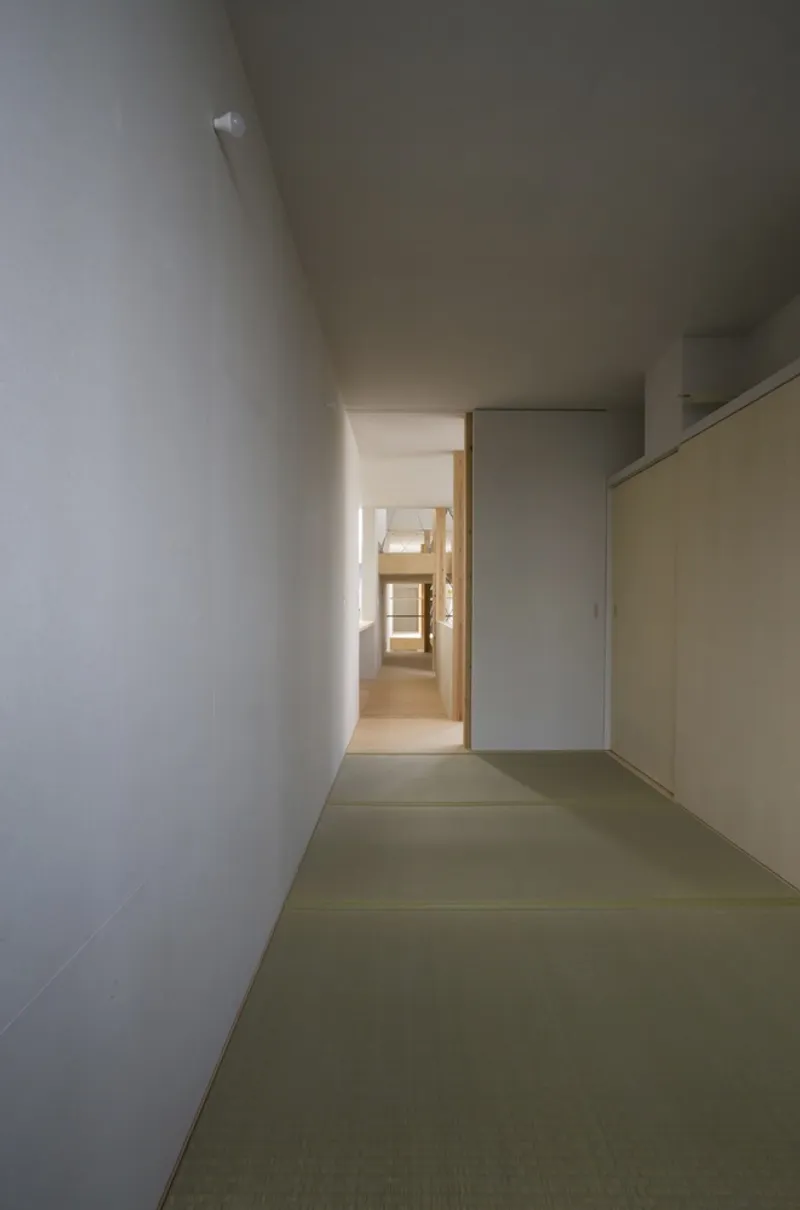
An interior bridge with a timber floor and exposed columns connects upper-level rooms across one of the double-height voids. It functions as a corridor, but it feels like a threshold between two worlds: the intimate, enclosed bedrooms and the open, daylit circulation spine. The slatted floor lets light and sound pass through, maintaining the acoustic and visual connectivity that runs through the entire house.
Why This Project Matters
House KJ is a quiet argument for the architectural potential of leftover sites. The flagpole lot, typically treated as a liability in Japanese residential development, becomes here a generative constraint that produces a section richer and more spatially diverse than many houses built on perfectly rectangular plots. 1-1 Architects proved that the tighter the site, the more inventive the architecture can become, as long as the designer is willing to work with the irregularity rather than against it.
More broadly, the project offers a model for how small-scale residential architecture in rural Japan can engage meaningfully with its context. By treating the neighboring houses as part of the scenery, by using split levels to correspond to the topography, and by letting gravel courtyards and corrugated metal do the heavy lifting, the house achieves a sophistication that never relies on expensive materials or flashy gestures. It is countryside architecture in the truest sense: built from the specifics of the place, legible only because it pays attention to what is already there.
House KJ by 1-1 Architects, rural Japan.
About the Studio
1-1 Architects
Official website of 1-1 Architects, one of the studios behind this project.
1-1arch.comShare Your Own Work on uni.xyz
If projects like this are the kind of work you want to make, uni.xyz is a place to publish your own, find collaborators, and enter design competitions.


Popular Articles
Popular articles from the community


Opera on the Sea: Driftwood Logic Shapes a Timber Opera House on Estonia's Coast
Trevor Orgill's opera house translates the entangled drift of floating timber into a civic building where wood, water, and music converge.

Temporary Home for Dogs: A Reversed Zoo Rethinks Animal Shelter Architecture
In Bucharest, a sinuous corridor and freed landscape flip the logic of containment, designing a shelter that works to make itself unnecessary.

Manzana Morphosis: Stretching Barcelona's Grid into a Living Landscape for 2050
A radical reworking of the Eixample manzana turns density into a tool for generous public space, vertical ecology, and environmental performance.

The Amber Palace Opera: A Geological Fiction Surfaces on Tallinn's Baltic Waterfront
Pierre Brillard reimagines a Baltic legend as a public landscape, opera house, and waterfront promenade rooted in Tallinn's coastal identity.

Similar Reads
You might also enjoy these articles


Hodi-Mandai Geram
Project Function: Preservation and revitalization of the Intangible heritage and socio-spatial identity of the Hodi by Housing, Cultural Memory Center, Sacred Grove, landscape, local tourism economy


Olio Towers: A Mid-Rise for Performers That Fuses Housing, Rehearsal, and Stage
Located blocks from Houston's Theater District, this modular tower stacks living units around a central performance atrium.

Oasis: Modular Green Housing Carved into Dhaka's Urban Fabric
A shortlisted Plugin Housing entry reclaims unauthorized settlements in Dhaka with stepped concrete volumes, green roofs, and ventilation-driven design.

Black Hole: A Floating Megastructure for the Post-Physical Era
Emiliano Mazzarotto envisions a spherical, self-scaling arena where e-sports, digital hotels, and holographic stadiums replace traditional public space.

Explore Traditional Japanese Competitions
Discover active competitions in this discipline

Challenge to reimagine the Iron Throne

Photograph architecture without architects

Illustrate the lost glory of Angkor Wat - Render Challenge

Design challenge to reuse E-waste
Comments (0)
Please login or sign up to add comments
No comments yet. Be the first to comment!