
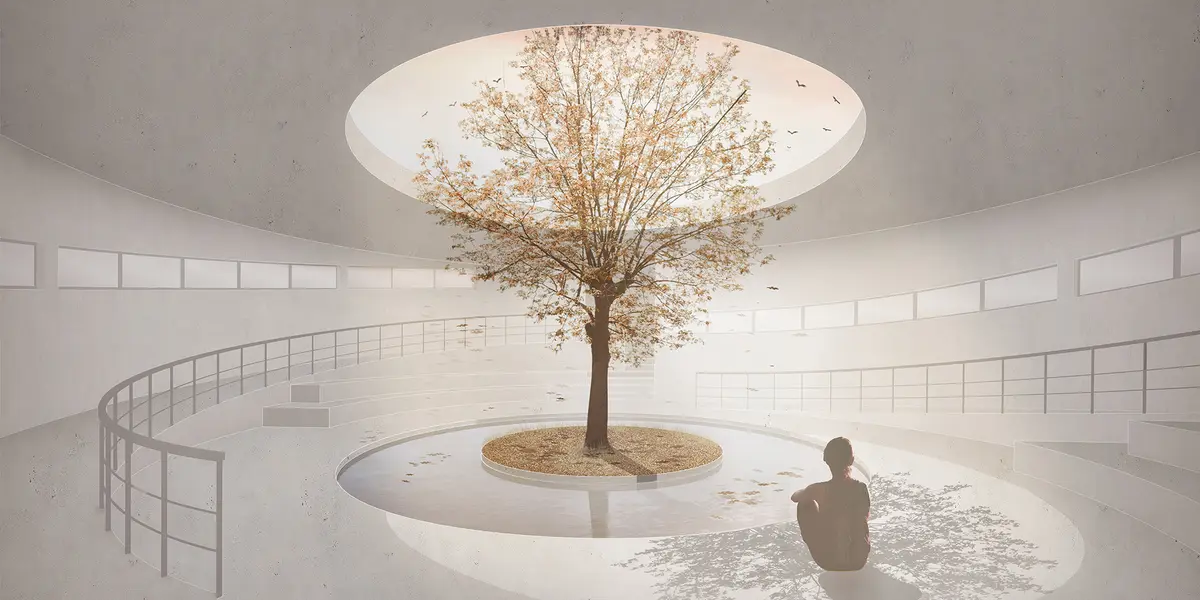
INTROVERSE
A Place to find your peace of mind


Faith, in its many interpretations, has always been closely linked to human life. In our understanding, faith is unique to each individual. Regardless of identifying it with a greater religious group or closing down to our own personal beliefs, we are convinced that faith is experienced differently by each human being and it should not be limited to strict rules and dogmas. At the end of the day, faith acts like a force that helps us overcome difficult moments in our lives or pushes us to continue fighting even when it seems that everything is lost. It is a companion to celebrate the good fortunes and a shoulder offering support through the various obstacles we face in life.
The world is becoming more connected, cultures are mixing and people are free to pursue their own understanding in life. Therefore, they start acknowledging their rights to be themselves, to seek comfort, and to see the surrounding world in a critical individual way. This individualization can also be extended to the idea of faith, of each individual or groups of individuals practicing faith in ways they most find adequate for themselves. Therefore, we propose a flexible building, where individuals can choose diverse spaces to practice their own faith.

Location
Beijing, China
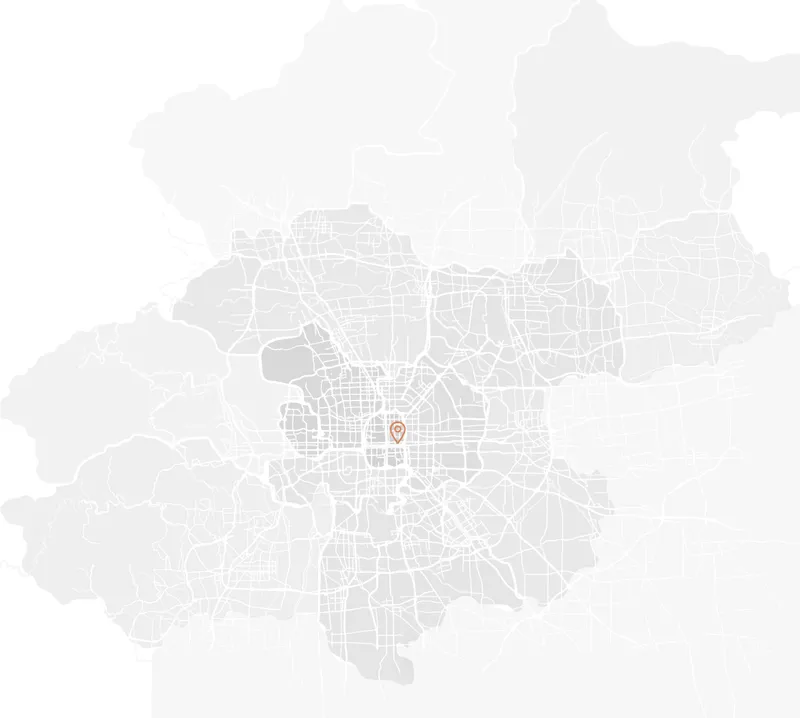 Beijing is a very densely populated city with a population of 21.5 million people. The various cultures give rise to different beliefs, some of the most commonly seen are Buddhist, Christian, Muslim, as well as a wide number of folk religions. However, more than half of the population consider themselves unaffiliated. Having in mind this growing number, the project focuses on creating space for faith without any religious restrictions.

Dongcheng District
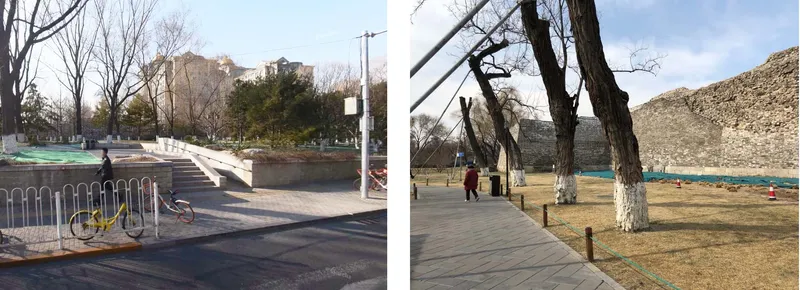
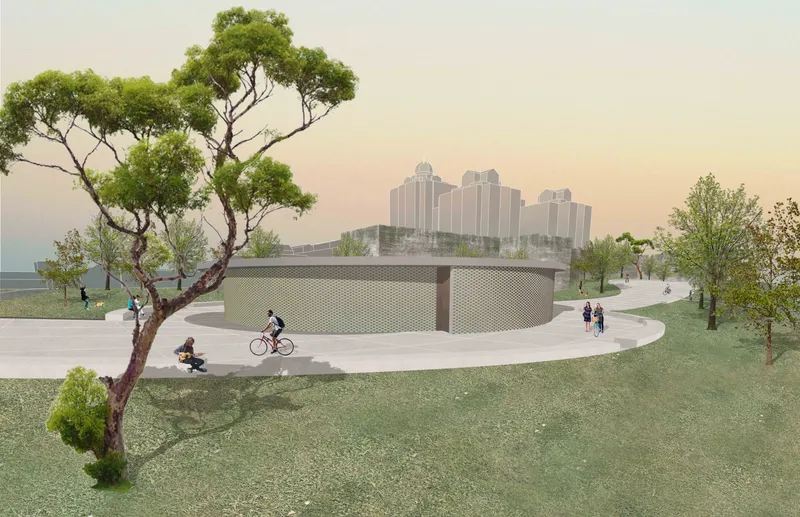
The project site is located in the Dongcheng District which is part of the urban core of Beijing, China. The site offers the city much-needed urban green and significant historic sight which continuously attracts visitors. The design benefits from its particular topography which is characterized by sloping levels assigning direction of the land. Few modifications of the topography were implemented in order to position the building and reinforce the main flow of people.
Site images provided by the organization
Topography modification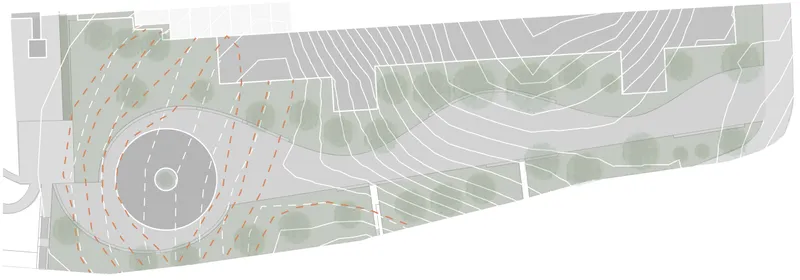
Some of the contour lines of the terrain were transformed in order to host the newly developed volume. In general, the overall topography of the site is corresponding to the main directions of flow of people we would like to emphasize upon arriving to the building’s entrance.
Flow of people

Site plan

The landscape transformations include also the implementation of additional pavement made of cement tiles, which improves the accessibility and creates additional piazza-like spaces corresponding to the main landmark - the Ming dynasty wall and the project building. Along the organic path, additional seating spaces are created in order to improve the quality of the space and provide people with the opportunity to experience the full potential of the site.
Aerial view

Urban section

A very important part of the design process was the creation of various sections with which the terrain specifications were studied in depth.
Approaching the building

Concept

1. Spiral
Since ancient times, a spiral is a form that has been associated with nature and continuity. It's pure, yet complex shape evokes access to deeper thought into our minds. It also symbolizes the unity and eternity of the natural world.
 2. Ramp
The journey begins with a ramp gradually ascending and evoking mysterious feelings. As one is walking along the path, they discover different spaces positioned at various levels that offer a unique experience.
 3. Core
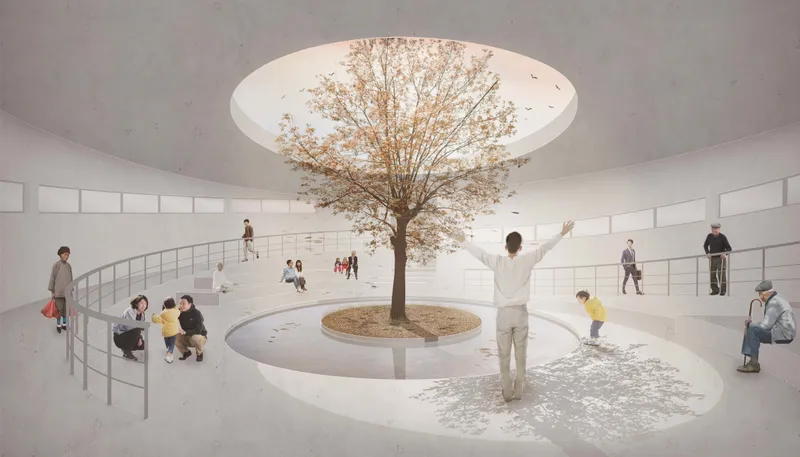
The core of the project is the central open space which acts as a unifying element to which all paths lead and rooms face. This is the ultimate stage of the spiritual experience where individuals can contemplate on nature.
Building
Building section


Upon entering the building, one is introduced to a narrow turning slope, suggesting a journey. The path also gives access to rooms of different heights and speaking of varying concepts. Finally, at the height of the slope, the visitor is finally exposed to the core, with its central green space and various rooms surrounding it. There, another gradual slope is in place, taking the user back to a lower level, reaching the oasis. The height differences, as explained, are used to intensify the experience of the journey through different spaces.

Envelope
Bioreceptive wall system
The Bioreceptive wall system is a sustainable solution to apply urban greenery in densely built environments. It is essentially a cladding system with optimal conditions to host biological activities. The application of such a system brings multiple benefits to the users as well as the environment, such as cleaner air, better worker productivity, anti-stress effect, and reduces external facade surface temperature. Compared to common green facades like LWS (Living Wall Systems), the Bioreceptive facade requires less maintenance, both in terms of cost and time. Often, Bryophytes (mosses, lichens, hornworts, and liverworts) are the target of this growth due to their tangibility and rootless structure.


Inspiration for the facade design of the building was acquired from the heritage wall ruins of the Ming dynasty. In this way, we manage to gently contextualize its silhouette to the existing surroundings, while marking the arrival of new technology and era in the most subtle and sophisticated manner.
Technology

The most relevant material properties required for Bioreceptive cladding system include pH neutrality, porosity, surface grooving, and material dimensions. Foamed Magnesium Phosphate Cement (MPC) is one of the prominent materials for this application due to its lower pH level, tangibility, and cost-efficiency. Foamed MPC act as a suitable host with plenty of porosity and surface moisture.
Mosses
The success of the Bioreceptive facade is highly reliant on the compatibility of the chosen plant to the given local environment. Therefore, thorough research on the indigenous mosses of Beijing was conducted. Four local moss species were selected by their preferred environmental conditions such as sunlight, moisture, and wind exposure.
1. Bryum dichotomum | South This type of moss is frequently growing in the forest edge, soil slope, rock thin soil, roadside, and surrounding buildings with abundant sunlight, it is relatively drought-tolerant. For this reason, its main implementation is on the southern part of the building’s facade. It is characterized by stems of 5mm which are usually dark green and during winter they have yellow, orange, or brown pigmentation. When dry, the leaves are close and not twisted. When wet, they stand upright, without an extension at the base, pocket-like, with flat edges. The upper part is whole or with fine teeth, the lower part is slightly curved.
2. Physcomitrium sphaericum | West
 The plant is mostly found on forest edges and roadsides, soil slopes at the corners of fields, and also seen on wet brick walls and stone walls. Its stem is thin and short. The leaves are ovate or lanceolate. The capsule stalk is short and thick and usually red to brown color, the spore capsule is spherical or pear-shaped.
3. Bryum capillare | North
 Those plants grow densely or sparsely on rotting wood in forests, tree bases, thin rocky soil, or woodland soil. Fruiting branches and leaves are born in clusters at the top of the stem. The leaves often shrink when dry, and gradually widen from the narrower base, into an oblong ovoid shape in wet conditions. The base is usually brown while the upper part can vary from yellow-green to bright green color.
4. Reboulia hemisphaerica | East
 This type of moss is born on stone walls and soil slopes and is highly suitable for bio receptive wall systems. It can be distributed in the northeast, north, northwest, east, south, and southwest regions. It is usually heart-shaped, 3 to 7 mm wide, and 1-4cm long. The common colors it presents are dark green on the back, purple-red on the sides. It also grows many false roots along the middle costal groove which provides better covering texture later implemented on the facade.
Biodiversity and climate analysis

Illustration shows the relationship between the changing seasons, weather conditions, behavior of vegetation, and the tourist frequency, in order to understand the most commonly observed conditions of the building and its surroundings.
External facade | Winter

External facade | Autumn
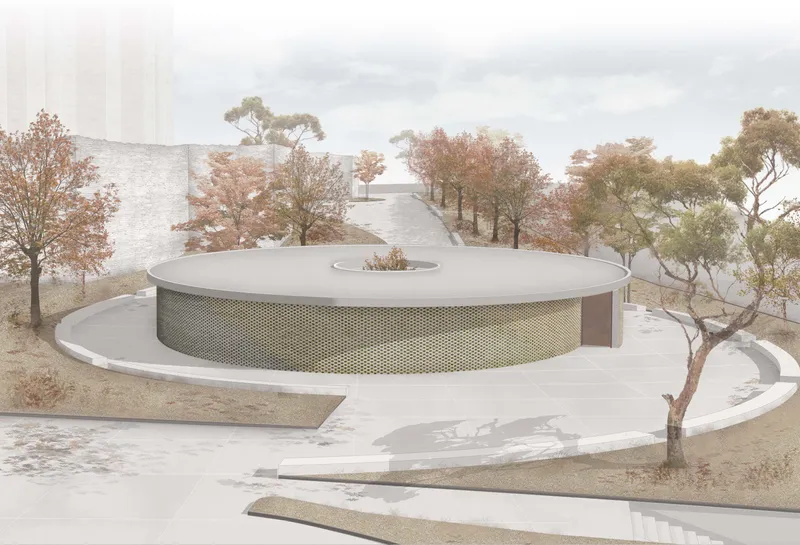
The focus on those images is to study the moss and the appearance of the building in different seasons and the atmosphere it conveys to the visitors.
Entrance view

The entrance doors are made of corten steel. This material ages gracefully with time, reminding us of the flow of time and the joy of the present. Their appearance, as a solid, dense element, marks the entrance to this spiritual experience.
The gate, containing no translucent openings, triggers the curiosity of the visitors as the inner space remains completely hidden from the outside. When opened, the door reveals a small glimpse of the mysterious ramp leading to the interior of the project.
Interior
 The organization of the interior is distributed along the ramp. This provides the possibility of shaping differently-sized spaces, which are adaptable to various configurations depending on the amount and type of users. In this way, each individual can find a room matching their personality, beliefs, and needs. The entrance of each room is highlighting its presence in the circulation space- the ramp, inviting the people to experience its atmosphere. Upon entering a room according to its function also the openings towards the courtyard space differ, creating either diffused and mysterious rays of light coming from above but not exposing the space to the surroundings or more revealing opening establishing a certain visual connection to the core of the project.

Some of the rooms are characterized by flexible furniture allowing different configurations. In this way, each room evokes a unique experience for the individual user, as they are given the possibility to shape the space according to their needs.
Corridor space Room 2.2

Courtyard view in autumn
Bibliography
1. Valencia, D. (2019, July 24). Bioreceptive Urban Facades: Integration of Bryophytes Into Facades and Their Impact on External Building Temperatures [Scholarly project]. In TU Delft. Retrieved from http://resolver.tudelft.nl/uuid:b00b4667-d238-44bf-97ab-000b18d71451
2. Blanco, S. M., Aguado, A., Segura, I., & Belie, N. D. (2014). Bioreceptivity optimisation of concrete substratum to stimulate biological colonisation (Unpublished master's thesis). Tesi doctoral - Universitat Politècnica de Catalunya. Departament dEnginyeria de la Construcció.
3. 刘, 邵, 姜, 孙, & 胡. (2010). 北京市区苔藓植物空间分布与环境关系的研究. Retrieved from https://xueshu.baidu.com/usercenter/paper/show?paperid=514ff41331699176b7f05c1aea25a66c&site=xueshu_se
4. WeatherSpark.com. (n.d.). Retrieved from https://weatherspark.com/y/131055/Average-Weather-in-Beijing-China-Year-Round
5. https://baike.baidu.com/item/%E5%8F%8C%E8%89%B2%E7%9C%9F%E8%97%93/6032163?fr=aladdin
6. https://baike.baidu.com/item/%E7%BB%86%E5%8F%B6%E7%9C%9F%E8%97%93/1584004?fr=aladdin
7. https://baike.baidu.com/item/%E7%9F%B3%E5%9C%B0%E9%92%B1/1583071?fr=aladdin
8. https://baike.baidu.com/item/%E7%AB%8B%E7%A2%97%E8%97%93/6070019?fr=aladdin


Popular Articles
Popular articles from the community


Manzana Morphosis: Stretching Barcelona's Grid into a Living Landscape for 2050
A radical reworking of the Eixample manzana turns density into a tool for generous public space, vertical ecology, and environmental performance.

Singing Woman: Contemporary Architecture Inspired by Estonia’s Voice and the Sea
Singing Woman turns Estonia’s song culture into flowing opera house architecture, blending public life, landscape, sea, and national memory.

Cloaked Colonization: A Mobile Underwater Habitat That Moves Like a Fish
Micah Abaya's shortlisted EHC Pacific entry reimagines ocean settlement as a dispersed network of self-sustaining architectural organisms.

Opera on the Sea: Driftwood Logic Shapes a Timber Opera House on Estonia's Coast
Trevor Orgill's opera house translates the entangled drift of floating timber into a civic building where wood, water, and music converge.

Similar Reads
You might also enjoy these articles

The Rhythm of Seasons
A Farmers' Market Connecting Nature and the City

More Than a Building-Designing a Living System
More Than a Building-Designing a Living System
Base Beyond
DESERT COMPOUND ARID: TOURISM OF ABSENCE AND ABUNDANCE

Explore Green Architecture Competitions
Discover active competitions in this discipline


Challenge to reimagine the Iron Throne

Photograph architecture without architects

Illustrate the lost glory of Angkor Wat - Render Challenge

Design challenge to reuse E-waste
Comments (0)
Please login or sign up to add comments
No comments yet. Be the first to comment!