
Ishimoto Architectural Wraps 300 Students Around a Courtyard in Toyo University's Ai-House Hub-4
A mixed dormitory in Tokyo's Akabane district uses a courtyard plan and layered communal spaces to bridge cultures.


Student housing projects rarely get the attention they deserve, which is a shame because few building types carry as much social weight. A dormitory is simultaneously a home, a social experiment, and an institutional statement about what kind of community a university wants to cultivate. Ishimoto Architectural's Ai-House Hub-4 for Toyo University takes this responsibility seriously. Sited on the sloped terrain of the Akabane district in Tokyo's Kita City, the 2,106 square meter building houses roughly 300 international and Japanese students and makes the act of living together its central architectural proposition.
What makes this project worth studying is how it deploys a courtyard typology, a move as old as the Roman domus, to manufacture the casual encounters that turn strangers into neighbors. The building wraps dormitory rooms along its perimeter and stacks communal spaces around a central void, establishing a gradient from private to shared that students navigate every time they leave their room. The site's four-meter elevation change, a legacy of the slope running down from the adjacent Toyo University Akabanedai Campus, adds a sectional complexity that keeps the courtyard from feeling like a simple hole punched in a box.
Concrete Grid and Street Presence
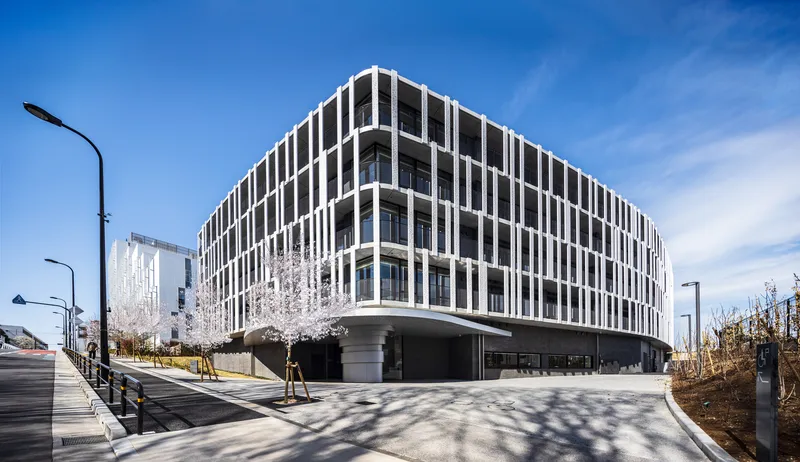
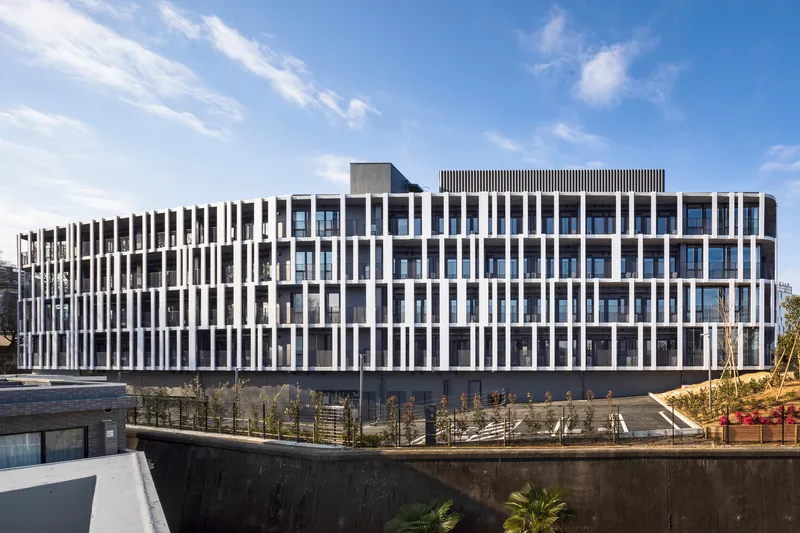
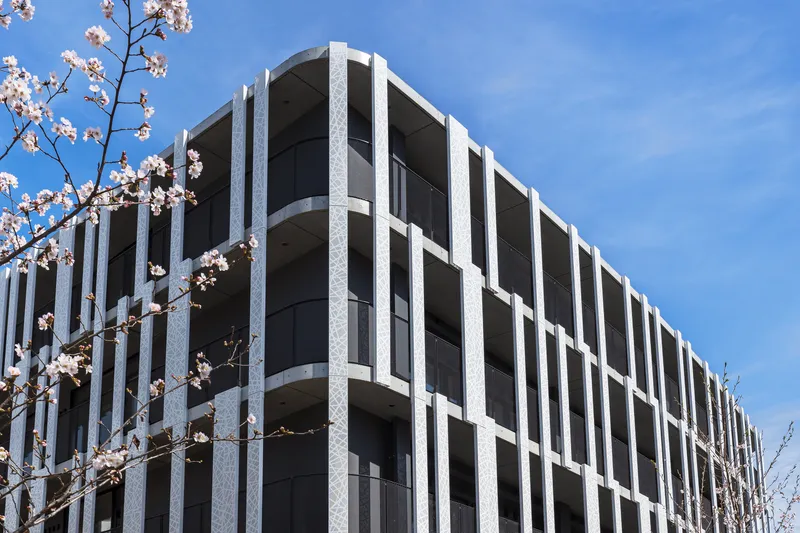
From the street, the building presents itself as a precast concrete grid: regular, rational, and deliberately restrained. The rounded corner is a welcome detail that softens the mass and signals a public sensibility unusual for dormitory architecture. Vertical brise-soleil elements, alternating between white and dark panels, modulate the facade and hint at the cellular rhythm of individual rooms behind. A concrete retaining wall negotiates the grade change at the base, anchoring the building to the hillside while young trees begin to screen the transition from campus to residential neighborhood.
There is no attempt at spectacle here, which is the right call. The facade reads as infrastructure for daily life rather than as a billboard for the university. Its consistency across elevations gives the building a calm institutional presence that will age well as the landscaping matures.
The Courtyard as Social Engine
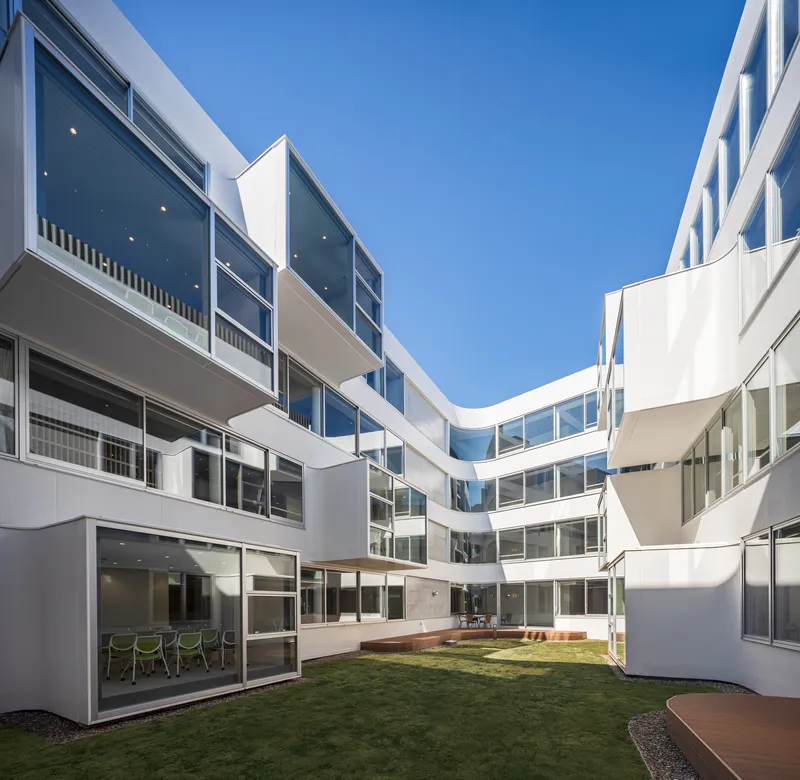
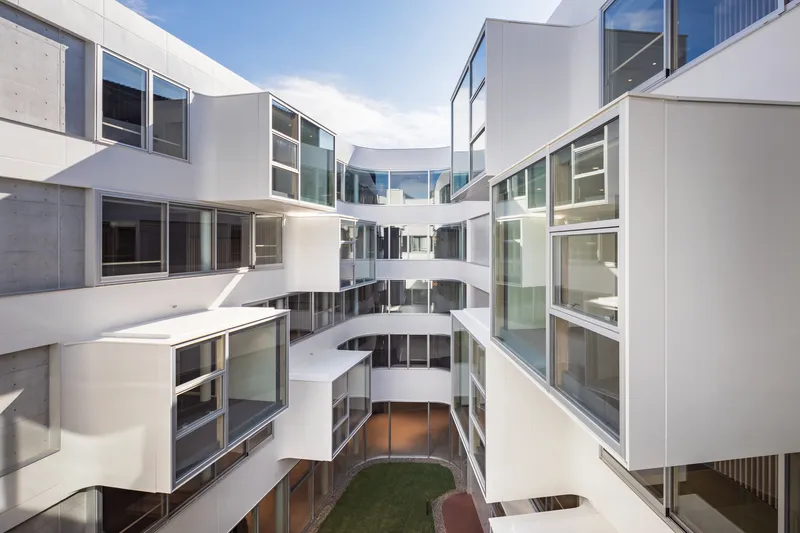
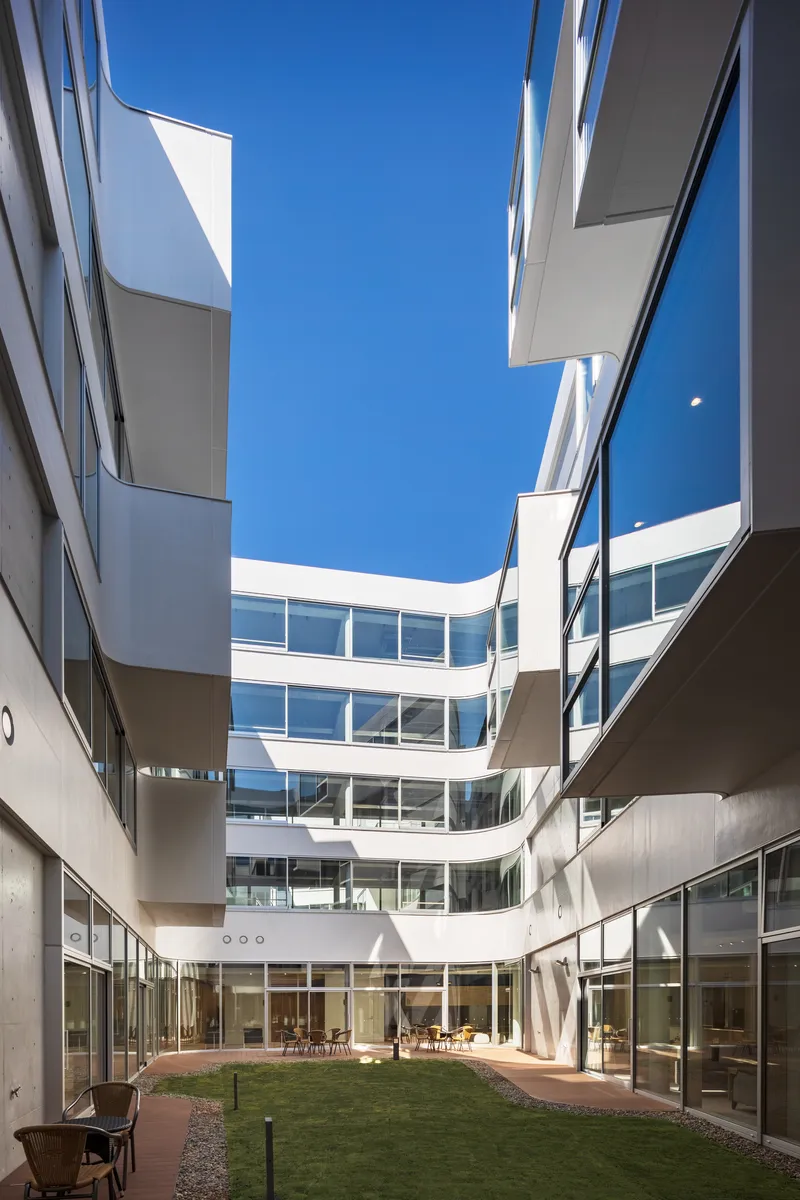
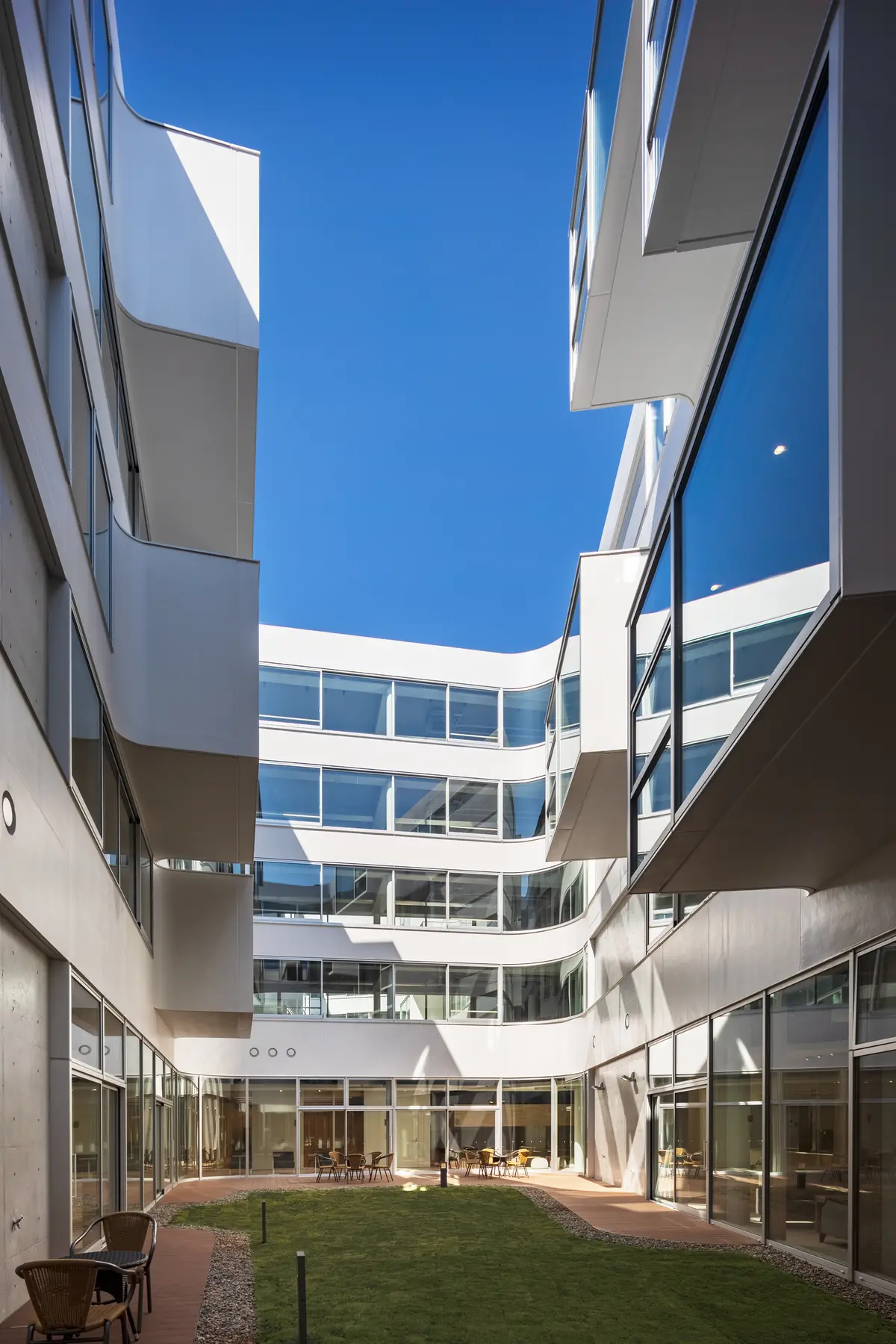
The internal courtyard is the project's most legible idea. Ringed by continuous balconies and white railings, it functions as a shared outdoor room where visual contact between floors is constant. Looking down from upper levels, you see the green lawn, the planted tree, and the activity of other residents. Looking up, the curved balcony edges frame a ribbon of sky that shifts in character with the weather. The geometry is not perfectly circular, which keeps the space from becoming monotonous and allows the section to absorb the site's natural slope.
For a building housing 300 people, the courtyard performs a critical orienting function. It gives every corridor a borrowed view and every room a sense of belonging to a collective. This is the difference between a dormitory that isolates and one that connects.
Corridors That Do More Than Circulate
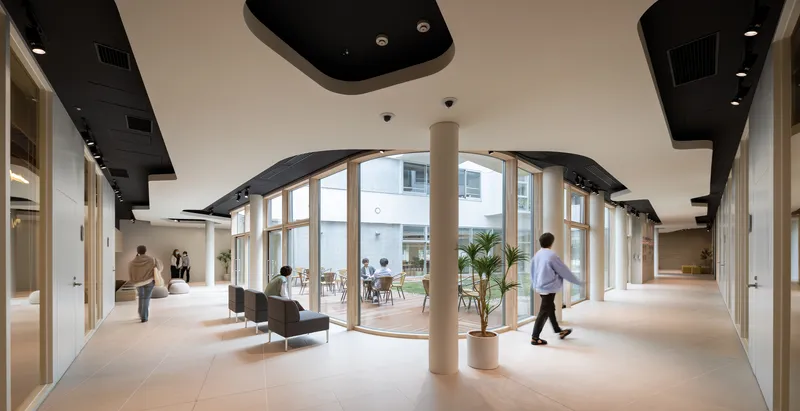
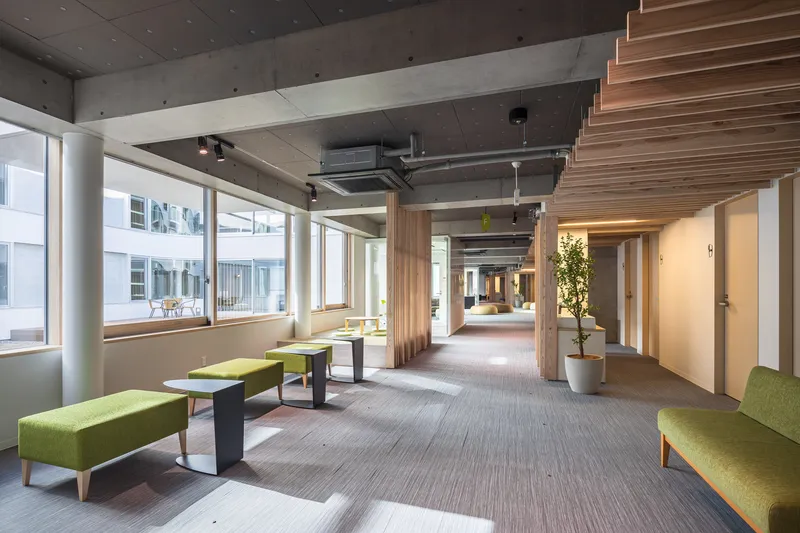
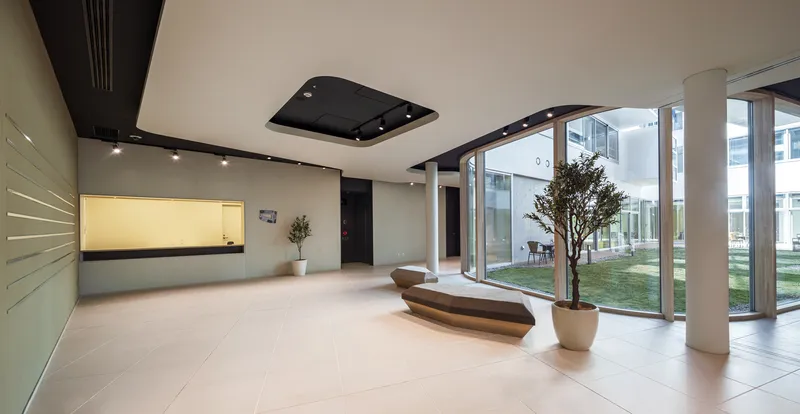
The circulation zones are among the most carefully considered parts of the building. The curved glazed corridor with its cylindrical column and dark ceiling panels is not merely a passage; it is a threshold between the dormitory's private and communal worlds. Elsewhere, corridors open up with green upholstered seating and full-height windows overlooking the courtyard, creating informal study spots that students can claim without booking a room or asking permission.
The lobby, with its large glazing onto the courtyard and its small interior tree, reinforces the building's commitment to visual transparency between inside and out. These transitional spaces matter enormously in a dormitory. They are where most cross-cultural friendships will actually begin: not in programmed events, but in the accidental overlap of daily routines.
Communal Rooms and the Texture of Shared Life
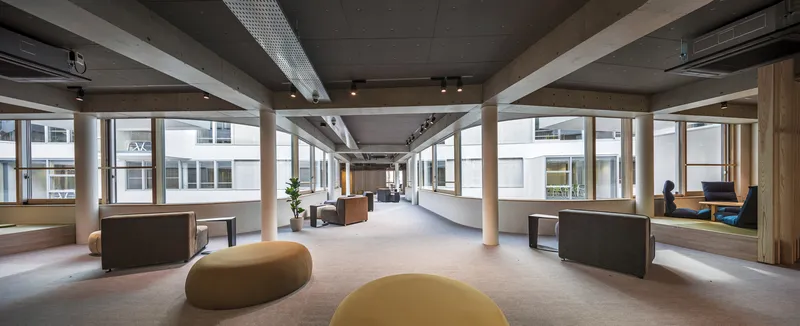
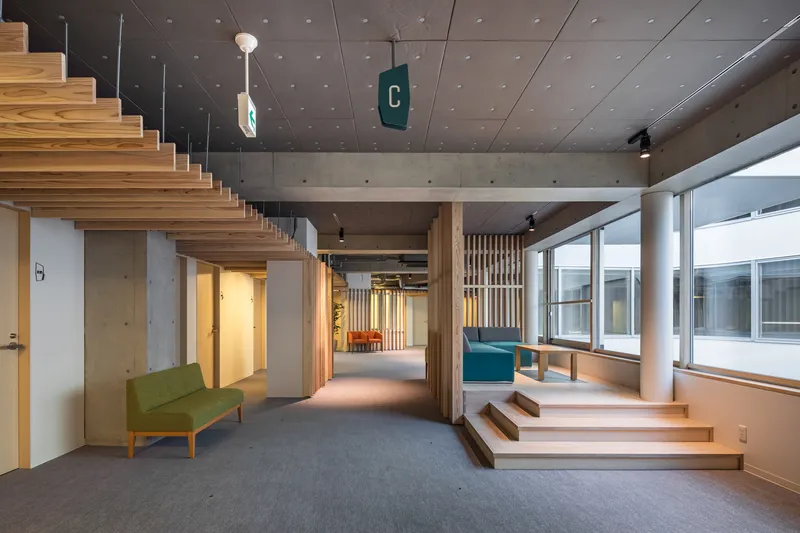
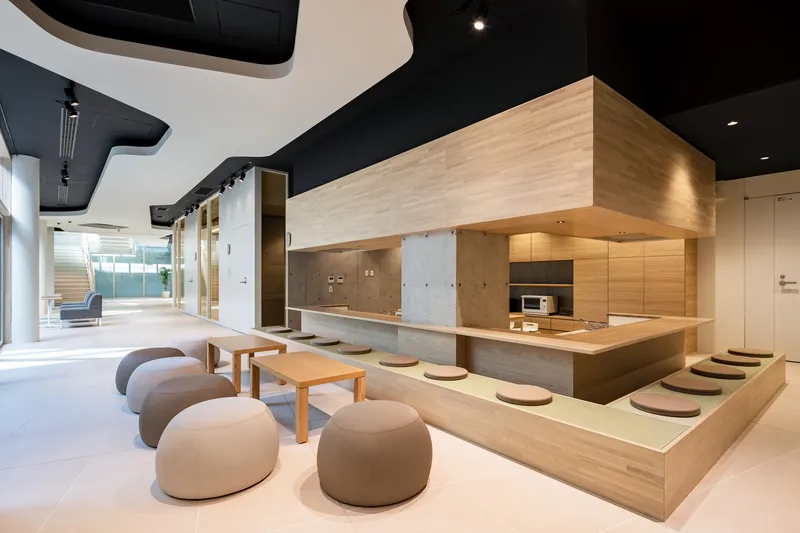
The communal interiors reveal a palette of timber posts, concrete beams, and warm surface treatments that contrasts with the cooler precast exterior. An open-plan common area with continuous windows and timber structure creates a living room scaled for a group rather than a family. Nearby, a tiered seating area with vertical slat partitions and pendant lights offers a more intimate alternative, something between a lecture hall and a reading nook. The communal kitchen and lounge, with its sculptural black ceiling, floor cushions, and low seating, borrows from Japanese domestic traditions without being literal about it.
What works here is the variety. No single communal space has to serve every mood or group size. The architects have distributed social opportunities across multiple rooms with distinct atmospheres, which gives residents real choice about how and where they engage with each other.
Private Rooms and Shared Kitchens
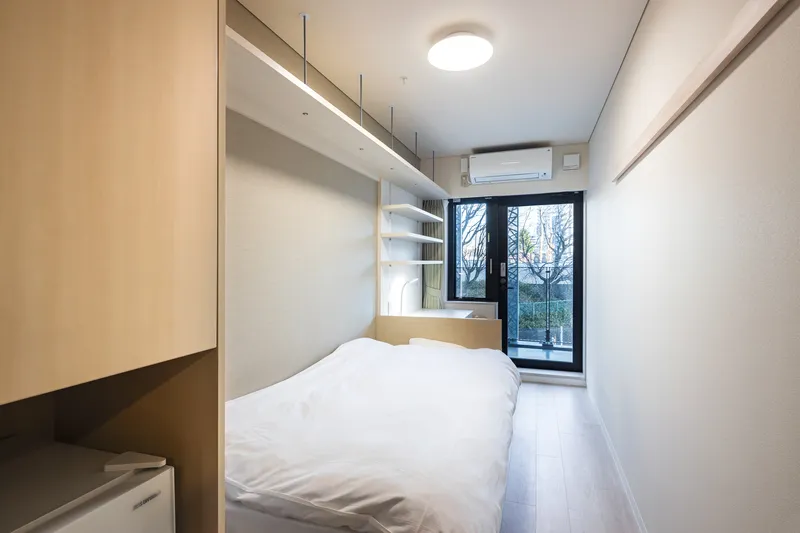
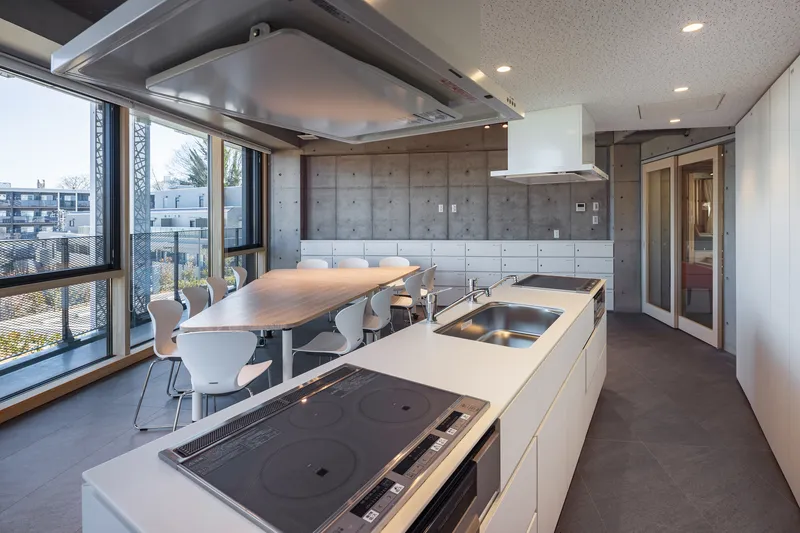
The individual rooms are compact, efficient, and intelligently detailed. Built-in plywood storage, a suspended shelf, and a window overlooking trees outside give each unit a completeness that belies its modest footprint. There is nothing luxurious here, but nothing is missing either. The shared kitchens, with their white islands, integrated cooktops, and corner windows, are generous enough to encourage cooking as a social activity rather than a chore performed in isolation.
In student housing, the ratio of private to shared space tells you everything about the architect's theory of community. Ishimoto has tilted the balance toward the communal without making the private rooms feel like afterthoughts, a difficult calibration that many dormitory projects get wrong.
Night Presence
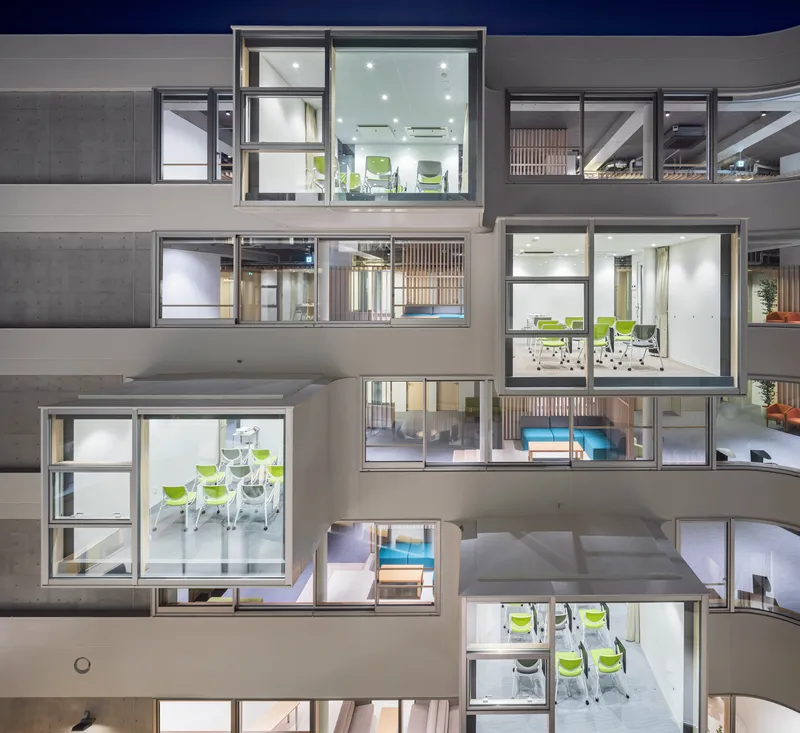
At night, the building inverts its daytime logic. The concrete grid recedes and the illuminated interiors take over, each window broadcasting a fragment of student life to the campus and the neighborhood. The stacked floors glow like a lantern, and the courtyard becomes a well of warm light rather than a well of sky. It is a reminder that a dormitory is one of the few building types that is genuinely occupied around the clock, and that its architecture should register the difference between day and night.
Plans and Drawings
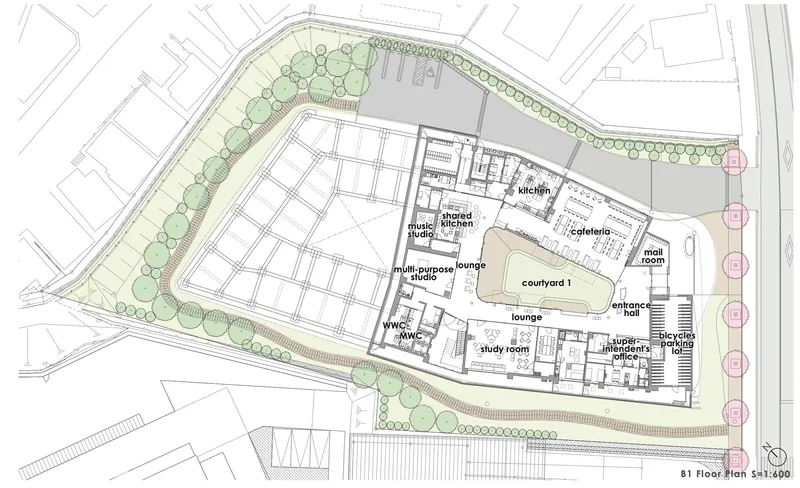
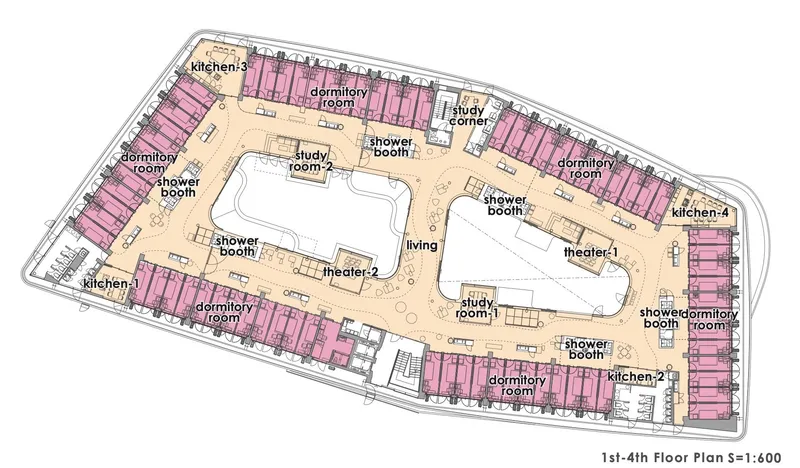
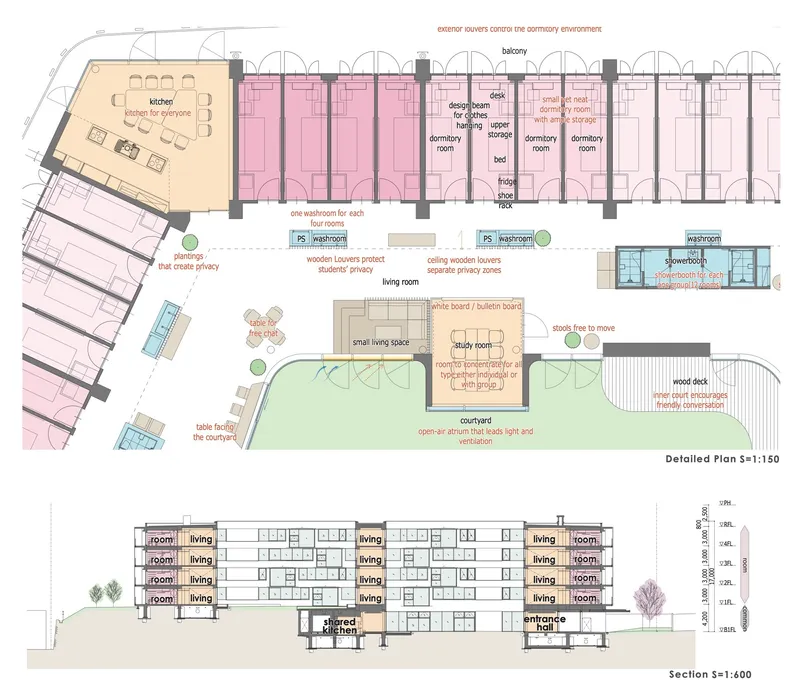
The site plan confirms the building's relationship to the Akabanedai Campus, with perimeter landscaping softening the edges and the courtyard void organizing the floor plate. The typical floor plan shows dormitory rooms arranged along the outer perimeter, maximizing natural light and views, while communal spaces cluster around the central void and at key nodes along circulation routes. The detailed section through the courtyard reveals how the four-meter grade change across the site is absorbed into the building's section, producing split levels and varied ceiling heights that enrich the interior experience.
Reading these drawings together, the organizational clarity is striking. The plan is fundamentally simple: rooms on the outside, community in the middle. But the section introduces enough variation to keep the building from feeling repetitive across its seven or more levels. The courtyard is not just a plan device; it is a sectional one, pulling light deep into the building and giving the communal floors a spatial generosity that a flat site would not have afforded.
Why This Project Matters
Universities around the world are investing in international student housing, but most of what gets built is either bland developer product or overwrought signature architecture. Ai-House Hub-4 occupies a productive middle ground. It is architecturally literate without being self-conscious, socially ambitious without being preachy, and materially honest without being austere. The courtyard plan is not a novel invention, but its deployment here, on a sloped site with a mixed population of 300 students, demonstrates that familiar typologies still have enormous untapped potential when they are executed with care.
The real test of this building will come not from critics but from residents. If the corridors fill with conversation, if the communal kitchens smell like food from three continents, if the courtyard becomes a place where students linger rather than pass through, then Ishimoto Architectural will have succeeded at the thing that matters most in dormitory design: making proximity feel like belonging.
Toyo University Ai-House Hub-4, designed by Ishimoto Architectural (lead architects: Takuma Hukuchi, Osamu Endo, Shota Yokoyama). Located in Kita City, Tokyo, Japan. 2,106 m². Completed 2022.
About the Studio
Share Your Own Work on uni.xyz
If projects like this are the kind of work you want to make, uni.xyz is a place to publish your own, find collaborators, and enter design competitions.


Popular Articles
Popular articles from the community

Opera by the Sea Estonia: Three Shells Dissolving Architecture into Tallinn's Coastline
A winning opera house proposal replaces monumental form with interconnected shells that blur the boundary between building, park and Baltic Sea.

Manzana Morphosis: Stretching Barcelona's Grid into a Living Landscape for 2050
A radical reworking of the Eixample manzana turns density into a tool for generous public space, vertical ecology, and environmental performance.

The Amber Palace Opera: A Geological Fiction Surfaces on Tallinn's Baltic Waterfront
Pierre Brillard reimagines a Baltic legend as a public landscape, opera house, and waterfront promenade rooted in Tallinn's coastal identity.

Singing Woman: An Opera House That Performs Before the Curtain Rises
Ovidiu Cristian Pavel's conceptual opera house translates Estonia's choral identity into a sculpted waterfront landmark facing the Baltic Sea.

Similar Reads
You might also enjoy these articles

Pixel Gardens: One Repeated Module Stacked Into a Terraced Social Housing Tower for Famagusta
Salem Bader's shortlisted housing tower builds a vertical neighbourhood from one repeated module, offsetting units to carve terraces, light and air.

Bao Huynh Watercolor Atelier: A Serene Art Retreat in Hội An
Bao Huynh Watercolor Atelier in Hội An blends multifunctional art spaces, sustainable design, local materials, and family-friendly living in a serene environment.

Atelier Macri Concept Store Interior Design by CASE-REAL
Atelier Macri store features a "ko" counter, walnut wood details, cork displays, blending retail, gallery, and seamless customer experiences.

Manuel Vargas Izquierdo Stadium and High-Performance Sports Center: Architectural Excellence in Jalpa de Méndez
The Manuel Vargas Izquierdo Stadium blends sustainable design, inclusive sports facilities, and cultural-inspired architecture, revitalizing Jalpa de Méndez’s public spaces.

Explore Public Hub Competitions
Discover active competitions in this discipline

Challenge to design public laboratory

Challenge to design mud housing for contemporary communities
Comments (0)
Please login or sign up to add comments
No comments yet. Be the first to comment!