

Jing’an Yuyao Road Kindergarten Branch: A Human-Centered Educational Design by Atelier Liu Yuyang Architects
Child-centered kindergarten in Shanghai featuring hexagonal modular spaces, micro-alleyway concept, playful courtyards, flexible classrooms, and nature-inspired design encouraging exploration and learning.


The Jing’an Yuyao Road Kindergarten Branch, designed by Atelier Liu Yuyang Architects (ALYA), represents an innovative approach to early childhood educational architecture in Shanghai, China. Covering approximately 2,900 square meters, the project demonstrates how thoughtful architectural design can create an inspiring and nurturing environment for young learners.
Located in the Jing’an District of Shanghai, the kindergarten sits within a modern residential neighborhood characterized by a mix of historical alleyways, mid-rise residential buildings, and contemporary high-rise developments. Since its establishment in 1957, Yuyao Road Kindergarten has built a reputation as a first-class preschool institution focused on holistic child development. The architectural design of the new branch aligns with the school’s guiding philosophy: “everything for the children.”
Atelier Liu Yuyang Architects approached the project with the goal of creating a safe, flexible, and stimulating learning environment that encourages children to explore, play, and develop curiosity about the world around them.
Urban Context and the Concept of “Micro-Alleyways”
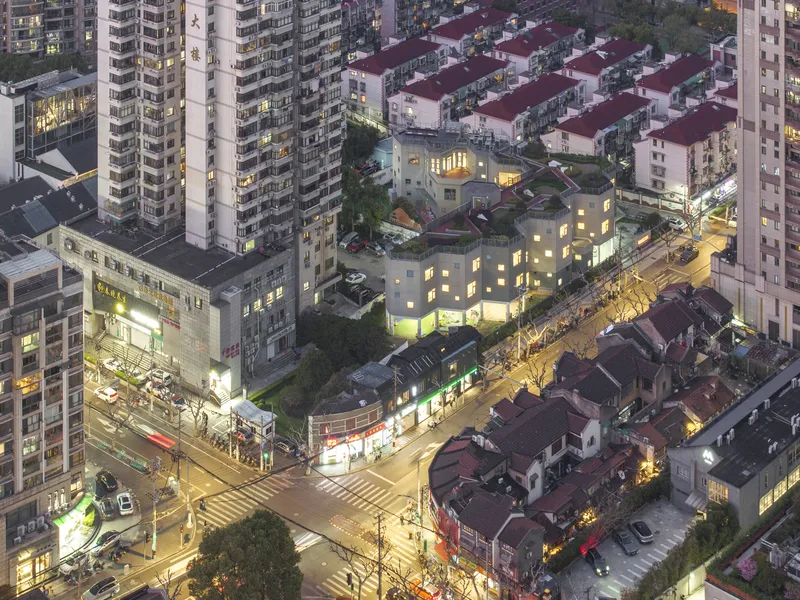
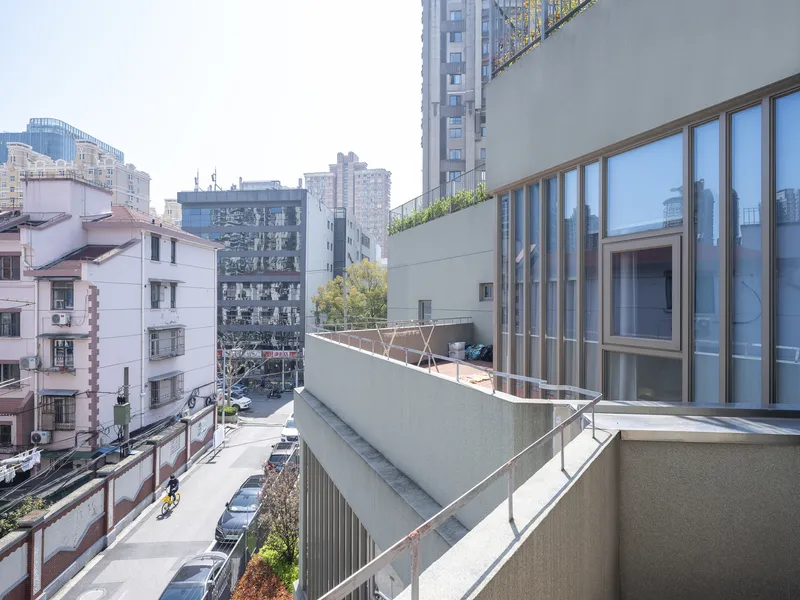
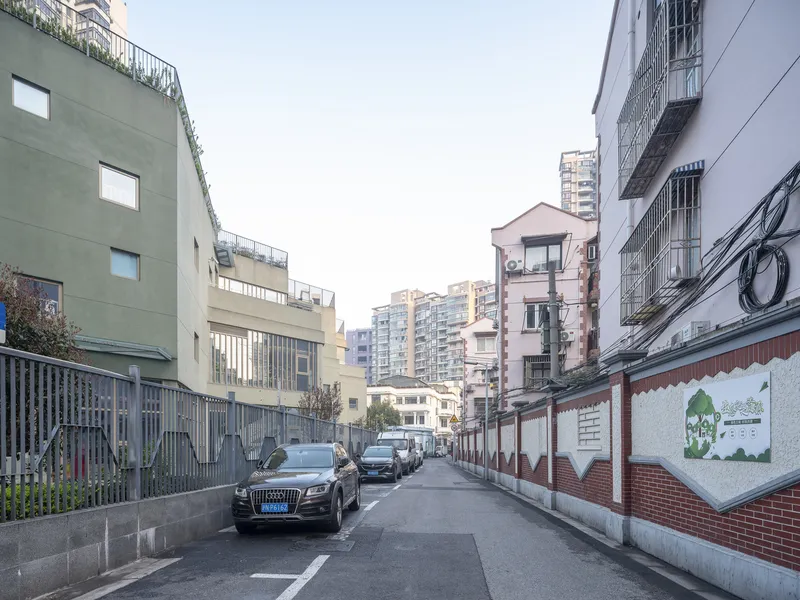
One of the most distinctive aspects of the project is its strong relationship with the surrounding urban environment. The kindergarten is located along Haifang Road, an area shaded by traditional plane trees and shaped by decades of urban transformation. The neighborhood presents a layered urban interface composed of historic alleyways, residential buildings, commercial storefronts, and modern towers.
These Shanghai alleyways, or “lilong,” are iconic urban spaces that blend social life, architecture, and community interaction. Inspired by this context, the architects developed the concept of “micro-alleyways.”
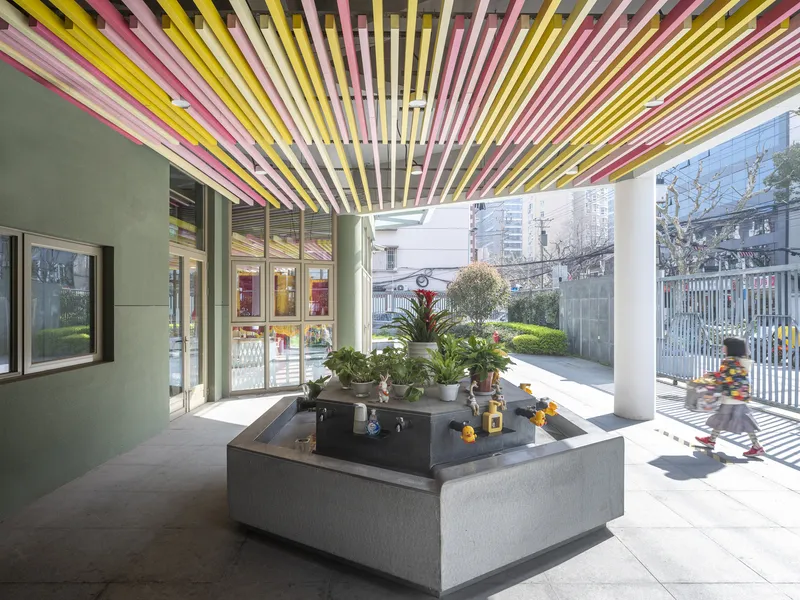
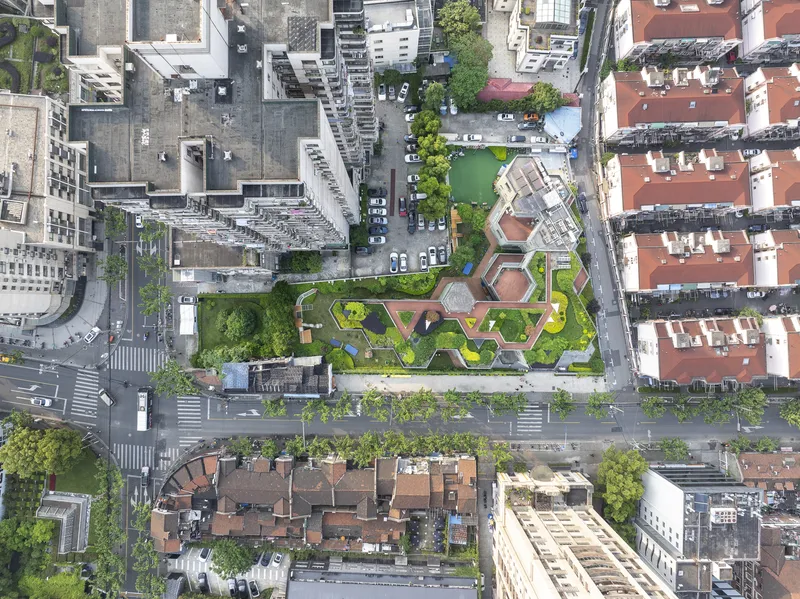
Instead of designing a large institutional building, the kindergarten is conceived as a cluster of smaller volumes that resemble the spatial rhythm of traditional alleyways. This approach reduces the perceived scale of the building and creates a more human-friendly environment suited to children.
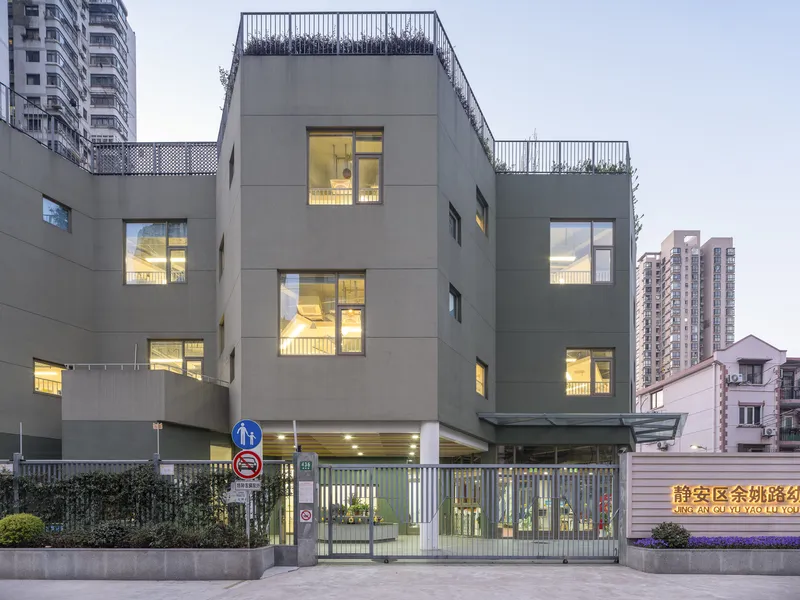
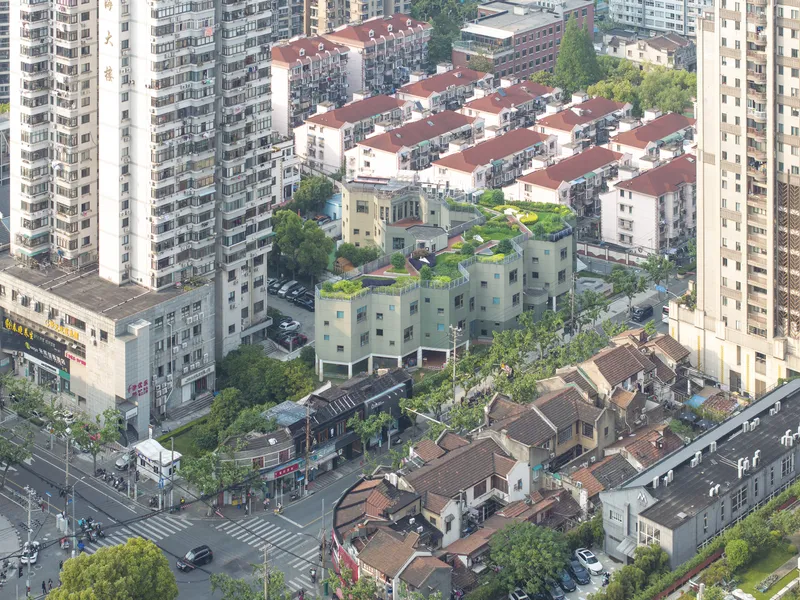
The three-story building is organized with modular volumes that create varied spatial experiences and interactive edges along the street. The façade uses a combination of dark green and grass green tones, echoing the surrounding plane trees and introducing a sense of nature into the dense urban setting. In a city increasingly dominated by megastructures, this design preserves an atmosphere of innocence, intimacy, and environmental harmony.
Educational Architecture Inspired by Geometry
A key design strategy behind the kindergarten is the concept of “Enlightened Geometry.” The architects drew inspiration from the educational value of geometric forms, recognizing that shapes, patterns, and spatial relationships play an important role in how children perceive and understand the world.
Traditional kindergarten design often follows standardized layouts dictated by functional regulations. However, these standards can sometimes lead to repetitive and homogeneous spatial configurations. To challenge this pattern, Atelier Liu Yuyang Architects introduced a modular geometric system inspired by puzzle games such as the Tangram.
Instead of a rigid arrangement of activity rooms, the design transforms the typical layout into flexible modular clusters. The walls shift forward and backward, creating dynamic spatial sequences and layered environments that encourage exploration and movement.
The use of irregular hexagonal units, reminiscent of a honeycomb structure, forms the basis of the building’s spatial organization. This honeycomb metaphor symbolizes collaboration, sharing, and collective intelligence, reflecting the cooperative relationships among teachers, students, and the educational community.
Through this geometric strategy, the kindergarten provides diverse spatial conditions that support learning, play, social interaction, and creativity.
Flexible Learning Spaces and Informal Activity Areas
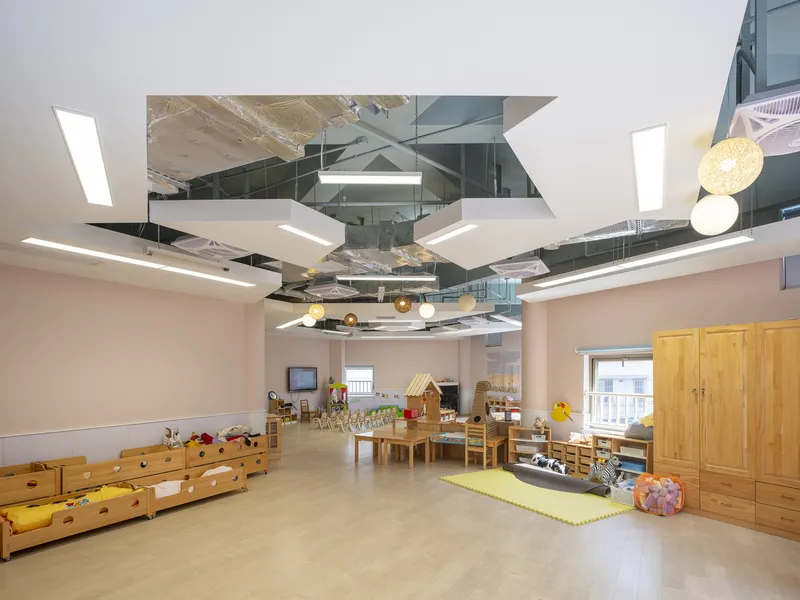
One of the central insights during the design process was the importance of informal spaces in early childhood education. While classrooms are essential for structured learning, children often spend significant time interacting and playing in transitional spaces such as corridors, entry areas, and shared zones.
To support this behavior, the kindergarten incorporates expanded corridors, open circulation areas, and multifunctional activity spaces throughout the building. These spaces serve as extensions of the classrooms, allowing teachers to adapt the environment according to different teaching scenarios.
Activity rooms are designed with recessed vestibules that act as buffers between circulation spaces and learning areas. Within each unit, movable partitions separate activity rooms and bedrooms, enabling the spaces to function independently or merge into larger areas depending on daily needs.
This level of flexibility ensures that the kindergarten can support a wide range of educational activities, group interactions, and daily routines.
Architecture as a Playground: Exploring Boundaries
Children naturally learn through play, and the architectural design of the Yuyao Road Kindergarten embraces this idea by turning the entire campus into a playful spatial landscape.
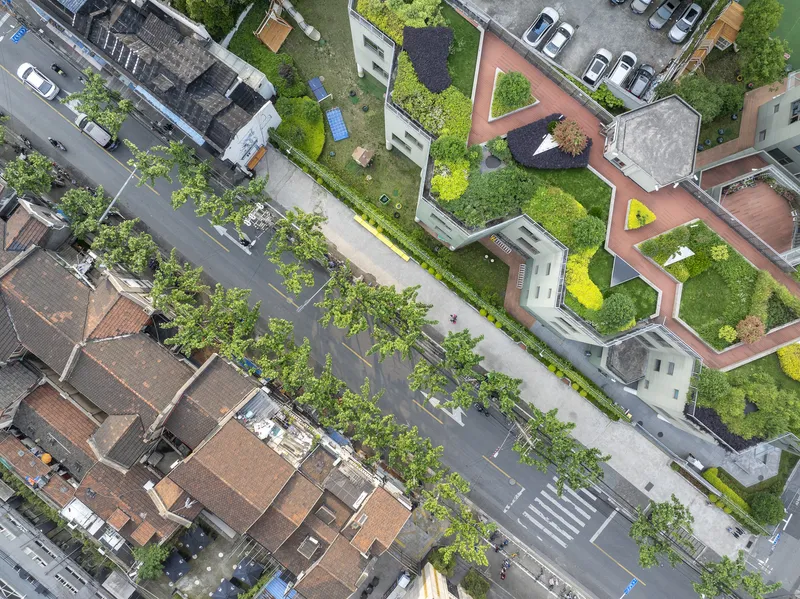
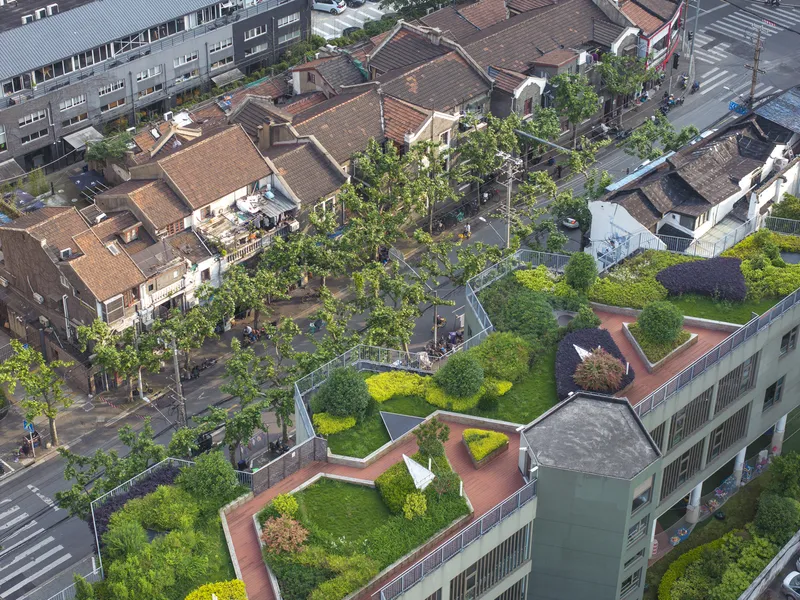
The building is arranged in a C-shaped layout, forming a central courtyard that acts as the heart of the kindergarten. The geometry of the building, including zigzag exterior walls and layered micro-terrain landscapes, introduces visual and spatial variety.
Outdoor areas are distributed throughout the campus, including:
- Central courtyard play areas
- Class-specific outdoor activity zones
- Rooftop gardens and nurseries
These outdoor spaces allow children to interact with nature while remaining within a safe environment. The combination of architectural geometry and landscape design encourages exploration, movement, and sensory discovery.
For children, even a simple line, curve, or circle can become an invitation to explore. By incorporating geometric patterns into the landscape and architecture, the kindergarten transforms everyday movement into a playful learning experience.
Safety, Visibility, and the Idea of “Guarding Distance”
Safety is a fundamental concern in educational architecture, especially for young children. However, the design of Yuyao Road Kindergarten approaches safety not as isolation but as balanced spatial protection.
The architects introduced the concept of “guarding distance,” which establishes layered boundaries between the campus, the surrounding community, and the children themselves. Instead of rigid barriers, the design creates multidimensional spatial transitions that allow visual openness while maintaining security.
Several design strategies support this approach:
- The first-floor lobby merges with widened corridors, creating open activity zones while maintaining clear lines of sight for teachers.
- Large windows allow natural light and visual connection with the outdoor environment.
- Built-in cabinetry in upper-floor corridors provides areas for rest, display, and interaction.
These features allow teachers to easily supervise children while giving students a sense of freedom and spatial independence.
Interior Design for Child Development
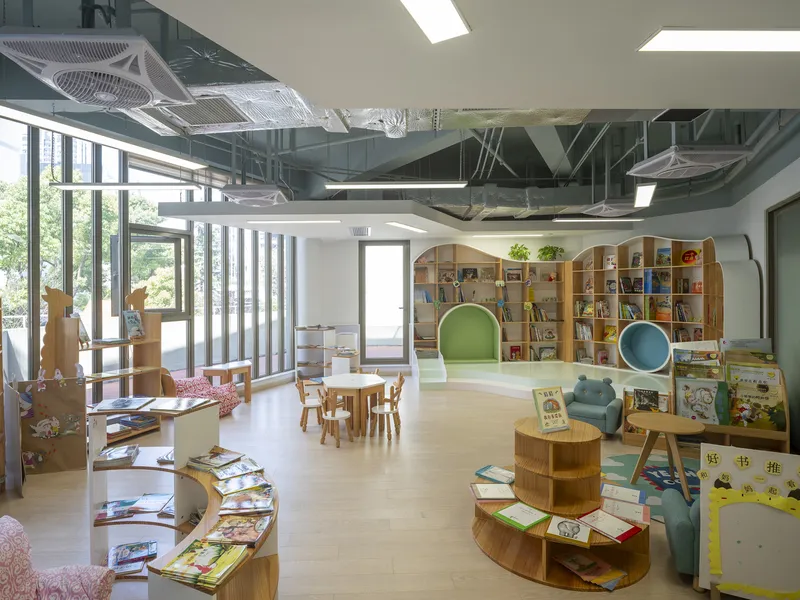
Inside the kindergarten, every design element considers the physical scale and developmental needs of young children. According to the project team, kindergarten design must address not just square meters but every square centimeter.
Interior details include:
- Child-scaled wainscoting and decorative panels
- Interactive storage and display systems
- Soft edges and tactile materials
Bedrooms are designed with pull-out beds, allowing spaces to transform throughout the day. In the morning, activity rooms function as classrooms. By afternoon, the beds are deployed, turning the same spaces into comfortable resting areas.
This multifunctional approach maximizes spatial efficiency while supporting the daily rhythm of preschool life.
Outdoor Play and Sensory Experience
Outdoor activity is an essential part of the kindergarten’s educational philosophy. The school dedicates two hours each day to outdoor play and sports, encouraging physical development and social interaction.
The playground surfaces use a variety of materials, including:
- Composite wood decking
- Grass landscapes
- Soft surfaces
These varied textures provide children with different tactile experiences, stimulating their sensory development and helping them better understand the physical world.
The outdoor environment thus becomes a learning landscape, where architecture, nature, and play merge into a unified educational experience.
Revisiting the Project: Lessons from Real Use
Although the kindergarten was completed in 2020, the architects revisited the project in 2024 to observe how the building functions in daily use. This visit allowed the design team and the school’s principal, Tan Yanwen, to discuss how the architecture has influenced teaching practices and student experiences.
The revisit revealed that successful architecture depends not only on design strategies but also on how users adapt and evolve the space over time. Teachers and administrators made several adjustments to furnishings and interior arrangements, demonstrating how buildings continue to evolve after construction.
The project also provided valuable lessons regarding building regulations and safety standards, such as the addition of extra railings and protective nets on staircases to meet updated educational guidelines.
Architecture that Supports Childhood Exploration
The Jing’an Yuyao Road Kindergarten Branch demonstrates how architecture can play a meaningful role in shaping early childhood education. By combining urban sensitivity, geometric exploration, flexible spaces, and child-centered design, Atelier Liu Yuyang Architects created an environment that nurtures curiosity, imagination, and social interaction.
Rather than functioning solely as a school building, the kindergarten becomes a small urban community where children live, learn, and grow. Every corridor, courtyard, and classroom contributes to a spatial experience that supports exploration and creativity.
In the context of rapidly growing cities like Shanghai, the project offers an inspiring model for human-scaled educational architecture that prioritizes the emotional and developmental needs of children.
All photographs are works of
Fangfang Tian, ALYA


Popular Articles
Popular articles from the community


GROUP A Strips a 1969 Rotterdam Harbor Headquarters to Its Frame and Wraps It in Timber Louvers
In Rotterdam's M4H harbor district, Ferro Offices reuses a 1969 frame, adds one timber storey and reaches BREEAM-NL Outstanding.

David Macias Steps a Doorless Stone and Plaster House Down a Tropical Colombian Hillside
In the humid hills of Colombia, Threshold House replaces the front door with an open void and terraces its 850 m² down the slope instead of fighting it.

Architekt Andreas Gruber Scatters 23 Dark Timber Chalets Across a South Tyrolean Forest Edge
In Molini di Tures, Amonti Chalets breaks a resort into a hamlet of gabled timber houses, with parking, storage and services pushed into the slope.

U.GA Architects Wraps an Oval Rooftop Pool in Curved Board-Formed Concrete on Busan's Jeollidan-gil
In Busan's Jeonpo-dong, a 454 m² mixed-use block stacks a neighborhood facility, guest rooms and an oval rooftop pool inside spiraling concrete walls.

Similar Reads
You might also enjoy these articles

Gil Mello Arquitetura Tilts a Single Roof Toward the Waterfalls on a Plateau Above Aiuruoca, Brazil
In Aiuruoca, Minas Gerais, a 200 m² house of local labor and reclaimed poles pairs a low valley veranda with a tall mountain one.
U.GA Architects Wraps an Oval Rooftop Pool in Curved Board-Formed Concrete on Busan's Jeollidan-gil
In Busan's Jeonpo-dong, a 454 m² mixed-use block stacks a neighborhood facility, guest rooms and an oval rooftop pool inside spiraling concrete walls.

Felipe Hess Arquitetos Turns a Blind Stone Wall to the Street and Opens a Brazilian House onto a Courtyard and Canal
A canal-front house in Brazil hides behind painted stone and planting, then opens to an olive-tree courtyard, a reed-ceilinged porch and a curving pool.
David Macias Steps a Doorless Stone and Plaster House Down a Tropical Colombian Hillside
In the humid hills of Colombia, Threshold House replaces the front door with an open void and terraces its 850 m² down the slope instead of fighting it.

Explore Educational Building Competitions
Discover active competitions in this discipline

Challenge to design public laboratory

Challenge to reimagine the Iron Throne

Photograph architecture without architects

Illustrate the lost glory of Angkor Wat - Render Challenge
Comments (0)
Please login or sign up to add comments
No comments yet. Be the first to comment!