

Jiri Strasky and DOWL Sling a Stress-Ribbon Deck Between Twin Arches Over a Salem Slough
A 154-meter tied-arch pedestrian bridge in Salem, Oregon, reconnects downtown to 1,300 acres of island parkland across the Willamette.


Most pedestrian bridges treat the act of crossing as a corridor: straight, flat, forgettable. The Peter Courtney Minto Island Bridge does something rarer. Designed by structural engineer Jiri Strasky and engineering firm DOWL, it bends through plan and section simultaneously, curving its first three spans along a 70-meter radius while lifting the deck into a crest vertical curve across the main 93.9-meter arch span. The result is a bridge that doesn't just get you across the Willamette River slough; it choreographs a slow reveal of the landscape on either side.
Completed in 2018 in Salem, Oregon, the bridge stitches downtown Riverfront Park to Minto-Brown Island Park, one of the largest urban parks in the Pacific Northwest, with more than 30 miles of trail and 1,300 acres of wetland habitat. Before it existed, reaching the island by foot or bicycle meant a long detour on busy roads. Now the connection is car-free, ADA-compliant, and, critically, engineered to sit above the 100-year flood elevation in a FEMA-designated floodway. It is infrastructure doing what infrastructure should: unlocking access without imposing damage.
A Structural Hybrid
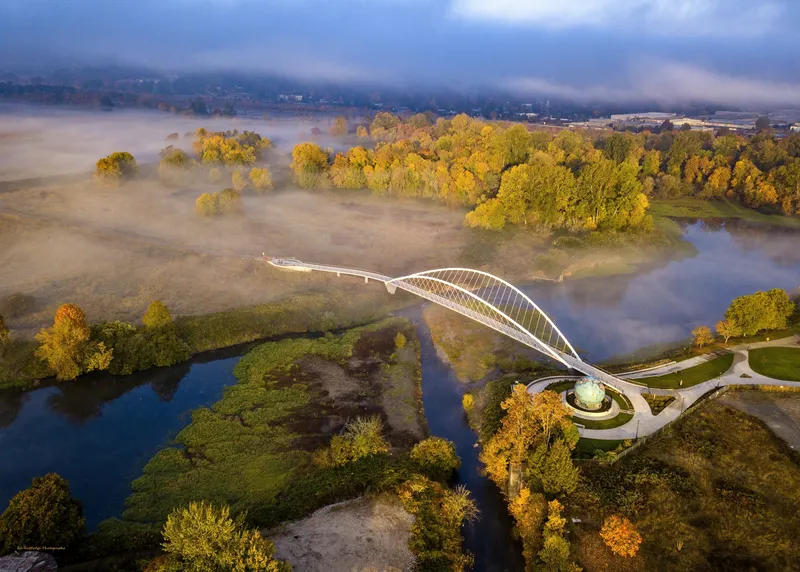

The bridge's engineering is a deliberate fusion of two structural types: the tied arch and the stress ribbon. A conventional tied arch uses its deck as a tension tie between the arch springings, resolving the horizontal thrust internally. Here, Strasky takes that logic further by suspending the concrete deck from two steel-pipe arches that lean outward from vertical, widening the bridge's visual and structural footprint. The outward inclination is not decorative; it provides lateral stiffness against wind and asymmetric pedestrian loading, eliminating the need for bulky lateral bracing.
The stress-ribbon concept appears in the deck itself. Rather than a rigid girder, the deck drapes in a gentle catenary between supports, pre-tensioned and post-tensioned to achieve its finished profile. The combination means the bridge carries load efficiently with minimal material, which matters when you are spanning nearly a hundred meters over a floodway where heavy substructure is both expensive and ecologically intrusive.
Twin Arches and the Space Between
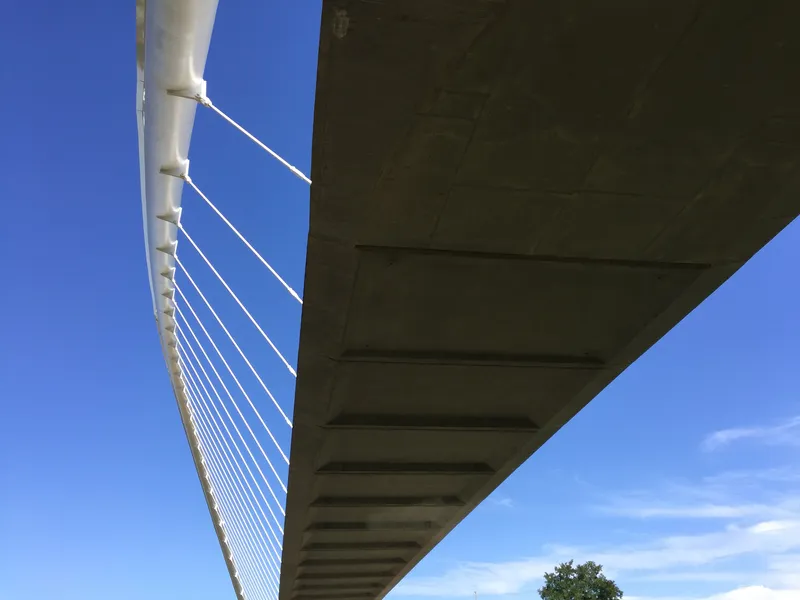
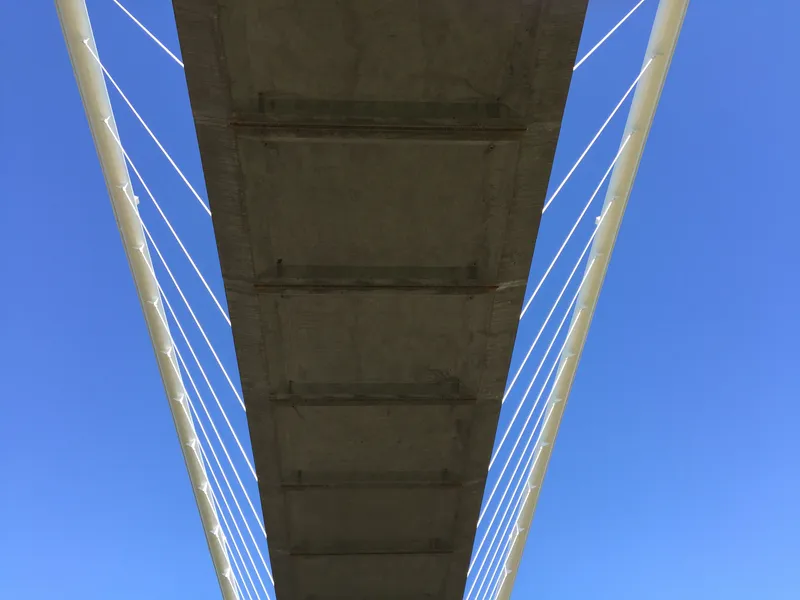

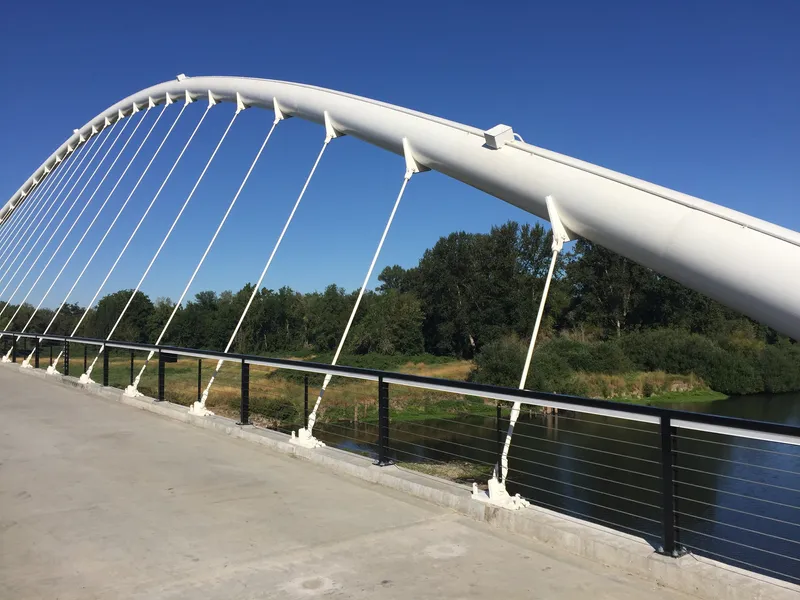
From below, the geometry becomes legible. The paired arches splay apart as they rise, framing a slice of sky between their steel ribs while the suspension cables radiate downward to the deck edges like the strings of a lyre. The effect is surprisingly light for a structure built from concrete and steel pipe. Every cable reads as a distinct line, not a web, because the arch inclination spaces their attachment points generously along the deck.
Looking up at the cable fan from the deck, you can see how the geometry shifts from a tight cluster near the arch crown to a wide spread at the springings. That graduation is a direct expression of the bending moment diagram: cables are densest where the deck needs the most vertical support, near midspan. Strasky has always been interested in making structure legible, and this bridge is a clear demonstration of that principle.
On the Deck


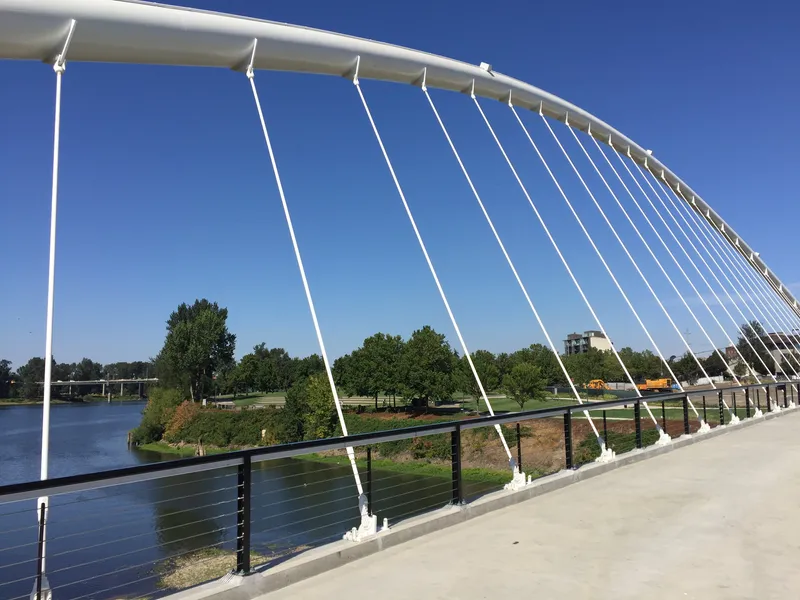
The pedestrian experience is shaped by two things: the curve in plan and the crest in profile. As you walk from the Salem side, the first three spans arc gently, so you never see the full bridge at once. The destination reveals itself incrementally. Then, as you reach the main arch span, the deck rises to its high point and the view opens to the river, the island canopy, and the Cascade foothills beyond. It is a cinematic sequence achieved entirely through geometry, with no signage or staging needed.
Horizontal metal barriers and cable railings keep the edges low and transparent. There is no overhead enclosure. The arches and cables exist above you as a canopy of structure, filtering light without blocking it. For a bridge that serves both cyclists and pedestrians, width is generous enough to avoid conflict, and the ADA-compliant grade means strollers and wheelchairs share the route comfortably.
Landing and Context
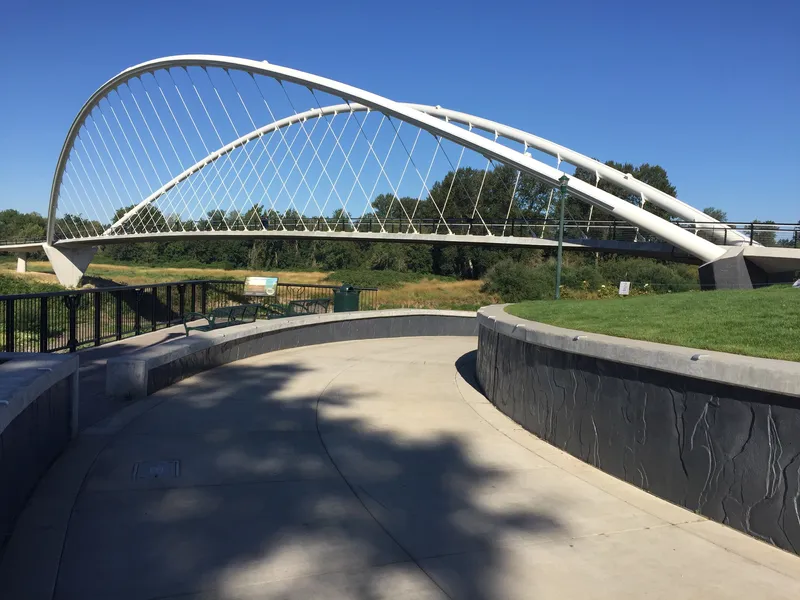

The Salem-side landing resolves into a curved concrete plaza with textured retaining walls that step down toward the water. The design had to navigate a complicated site: the bank is a former industrial zone that once processed wood pulp, and construction encountered large woody debris buried in the soil during drilled-shaft installation. A nearby ecological restoration feature, the so-called "Eco Earth" structure, had to be protected from construction impacts.
On the island side, the bridge deposits walkers and cyclists directly onto gravel trails threading through riparian forest. The transition from urban hardscape to soft trail is abrupt and deliberate. There is no parking lot, no plaza, no gift shop. The bridge simply ends and the park begins, which is exactly the right move for a connection whose whole purpose is to blur the line between city and wilderness.
Landscape and Light
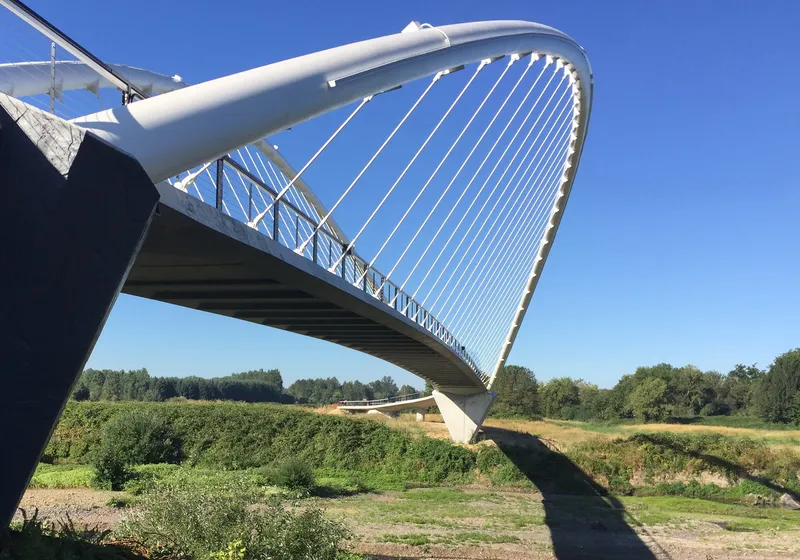


The bridge photographs differently at every hour. Morning fog rising off the slough isolates the white arches against muted greens and golds. At midday, the steel pipes throw hard shadows across the deck. In low light, the cables almost disappear and the arches read as two pale parentheses floating above the water. The white finish was a practical choice for corrosion protection, but it also guarantees visibility against every season of Oregon's saturated palette.
From the meadow on the island side, wildflowers in the foreground and the twin arches behind compose a scene that feels more pastoral than infrastructural. That tension is what makes the bridge compelling to look at: it is clearly an engineered object, yet it sits in the landscape with the ease of something that grew there.
Plans and Drawings
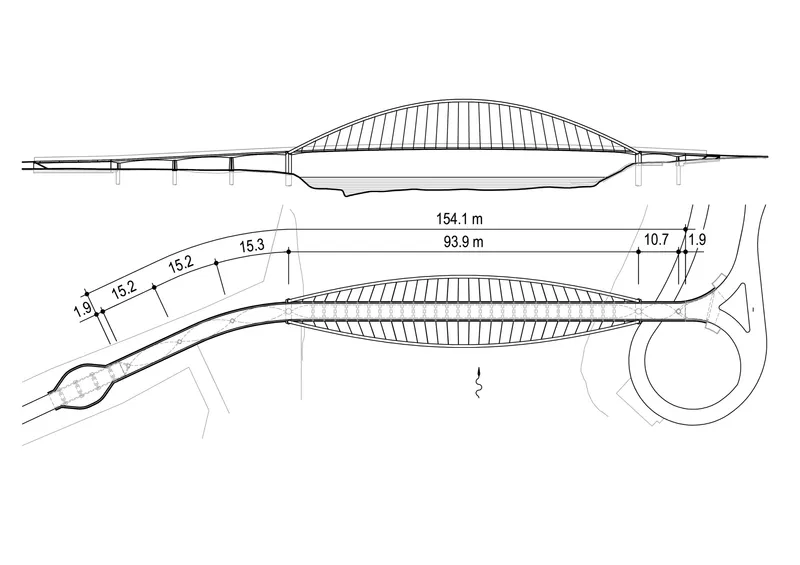
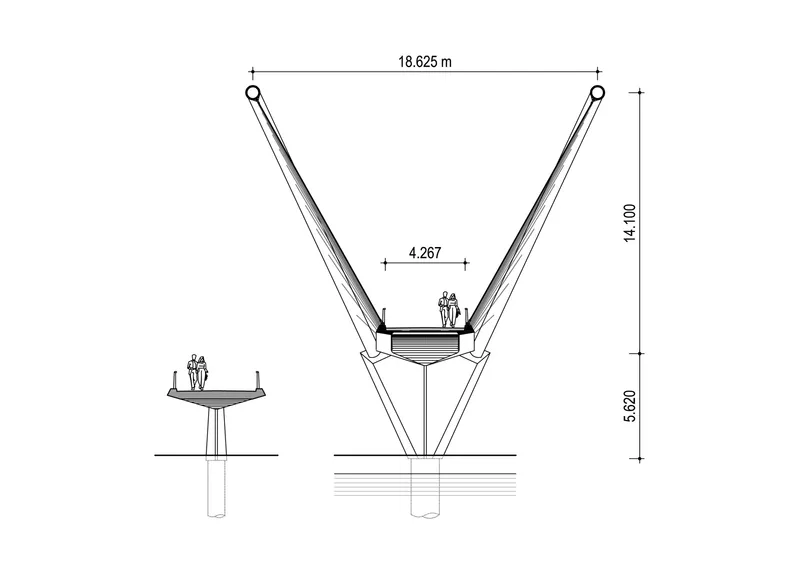

The elevation drawing reveals the full span sequence: four approach spans of roughly 10 to 35 meters stepping toward the main 93.9-meter tied arch, with the deck rising into its crest curve precisely at the arch midpoint. The section through the pylon shows how the angled support arms transfer load from the arch ribs down through a single concrete pier and into the six drilled shafts below grade. Detail sections of the deck strip away the finish to expose the layered logic of precast panels, prestressing cables, and bearing cable connections. Together these drawings confirm that nothing about the bridge's elegance is cosmetic; every visible line traces a load path.
Why This Project Matters
Pedestrian bridges are often afterthoughts, tacked onto transportation budgets and designed to minimum code. The Peter Courtney Minto Island Bridge demonstrates what happens when a city treats pedestrian infrastructure as a primary civic investment. Salem did not just build a crossing; it built a destination, a piece of public space that happens to span water. The structural ambition, a genuine engineering innovation in the fusion of tied arch and stress ribbon, is inseparable from the experiential ambition of curving the path, lifting the deck, and framing the landscape.
For other mid-sized American cities sitting on riverbanks and wondering how to reconnect to their waterfronts, this bridge is a useful case study. It proves that structural daring and ecological sensitivity are not opposing goals. The floodway is respected, the parkland is unlocked, and the city gets a landmark that earns its name not through scale but through the precision of its geometry. Jiri Strasky and DOWL have built a bridge that rewards both the engineer reading the section drawing and the cyclist gliding across it at sunset.
Peter Courtney Minto Island Bicycle and Pedestrian Bridge, designed by Jiri Strasky and DOWL. Salem, Oregon, United States. 813 m². Completed 2018. Photography by Ronald Cooper, Jiri Strasky, Ian Sane, Mark Yashinsky, Dreamstime, Scott Harrison, Matt Swain, and Edmund Ruttledge.
About the Studio
Share Your Own Work on uni.xyz
If projects like this are the kind of work you want to make, uni.xyz is a place to publish your own, find collaborators, and enter design competitions.


Popular Articles
Popular articles from the community


David Ortega Stacks a Two-Story Mexico City Penthouse Around a Steel Stair and a Pergola-Shaded Roof Terrace
In Colonia Roma, a 300 m² penthouse uses oak joinery, a planted steel stair and a slatted roof pergola to make a new-build apartment feel like a house.

Cube Design Draws an Ecological Corridor Between Two Shenzhen Hills with the Nankai Building
Beside Shenzhen's container docks, the Nankai Building pairs stacked balconies with a climbing green screen to connect two hillsides across its height.

U.GA Architects Wraps an Oval Rooftop Pool in Curved Board-Formed Concrete on Busan's Jeollidan-gil
In Busan's Jeonpo-dong, a 454 m² mixed-use block stacks a neighborhood facility, guest rooms and an oval rooftop pool inside spiraling concrete walls.

Architekt Andreas Gruber Scatters 23 Dark Timber Chalets Across a South Tyrolean Forest Edge
In Molini di Tures, Amonti Chalets breaks a resort into a hamlet of gabled timber houses, with parking, storage and services pushed into the slope.

Similar Reads
You might also enjoy these articles


LAVA Architecten Gives Vocational Education a Sawtooth-Roofed Face on a Mechelen School Campus
In Mechelen, Belgium, a 2,053 m² STEM school on a 6×6 m grid turns workshops and classrooms into rooms that can be rearranged as teaching changes.

KEMA Studio Turns a Derelict Marvila Attic into a 60 m² Lighthouse Apartment Above Lisbon
In Lisbon's Marvila district, a rebuilt roof, four skylights and two plywood volumes turn an unlivable attic into a bright home facing the Tagus.

Pixel Gardens: One Repeated Module Stacked Into a Terraced Social Housing Tower for Famagusta
Salem Bader's shortlisted housing tower builds a vertical neighbourhood from one repeated module, offsetting units to carve terraces, light and air.

Bao Huynh Watercolor Atelier: A Serene Art Retreat in Hội An
Bao Huynh Watercolor Atelier in Hội An blends multifunctional art spaces, sustainable design, local materials, and family-friendly living in a serene environment.

Explore Cycling Bridge Competitions
Discover active competitions in this discipline

Challenge to reimagine the Iron Throne

Photograph architecture without architects

Illustrate the lost glory of Angkor Wat - Render Challenge

Design challenge to reuse E-waste
Comments (0)
Please login or sign up to add comments
No comments yet. Be the first to comment!