

K. Wah Riverside E18 Residence: A New Benchmark in Shanghai's Urban Housing
K. Wah Riverside E18 Residence redefines high-density urban living with sustainable design, solar-sculpted form, green terraces, and innovative residential layouts.


Redefining High-Density Urban Living
Located in the vibrant Pudong District of Shanghai, K. Wah Riverside E18 Residence is a groundbreaking residential development that challenges the conventional norms of high-density urban housing. Designed by EID Arch, Shanghai Tianhua Architectural Design, andAedas, this multifamily housing project spans 22,883 square meters and features 114 meticulously designed apartment units. Set against a backdrop of dense residential neighborhoods, the project introduces a contemporary architectural approach that prioritizes community engagement, urban integration, and environmental responsiveness.


A Unique Architectural Identity
In an era where large-scale residential developments often conform to repetitive and homogeneous designs, E18 Residence stands out with its innovative architectural language. The design team sought to craft a distinctive urban identity by integrating site-specific considerations, natural light optimization, and contextual sensitivity. Situated at the edge of Lujiazui Financial District near the Huangpu River, the project maximizes spatial efficiency while enhancing the aesthetic and functional quality of urban living.


Solar-Sculpted Urban Form
The building’s striking form is derived from a meticulous analysis of solar angles and zoning constraints. By shaping the structure in response to sun paths, the design ensures optimal daylight penetration while preserving sunlight access for the surrounding neighborhood. The U-shaped massing configuration not only accommodates diverse residential typologies but also fosters a seamless connection with the cityscape. This approach creates a solar-sculpted urban canyon, reinforcing the relationship between the built environment and natural elements.


Integrating Nature into Vertical Living
A defining feature of K. Wah E18 Residence is its integration of multidimensional green terraces and communal outdoor spaces. Inspired by the flowing quality of the nearby river and traditional Asian landscapes, the design incorporates cascading roof terraces, intimate gardens, and a central courtyard. These elements provide residents with access to greenery, fresh air, and panoramic views of the Shanghai skyline. The vertical gardens not only enhance air quality and microclimate regulation but also promote sustainable urban living.


Human-Centric Residential Design
The project introduces a diverse range of apartment layouts, accommodating varying lifestyle needs. With 36 different unit configurations, the residences range from 90-square-meter standard apartments to spacious penthouses and duplex units. The strategic placement of west-facing units at a 45-degree rotation ensures maximum sunlight exposure and unobstructed river views. The emphasis on natural light, ventilation, and spatial efficiency enhances the overall quality of life for residents.

A New Prototype for Shanghai’s Skyline
Despite its relatively compact footprint, E18 Residence has made a significant impact on Shanghai’s architectural landscape. Its sculptural form, environmentally responsive design, and innovative spatial solutions set a new precedent for high-density urban housing. By balancing modern aesthetics with sustainability principles, the project demonstrates the potential for future-forward residential developments that prioritize both community well-being and urban dynamism.


Popular Articles
Popular articles from the community


graciastudio Turns a Viewless Tijuana Lot Inward Around a Courtyard of Concrete, Timber and Trees
In Tijuana, Jorge Gracia's GA2 House stacks a timber-clad private floor over exposed concrete and replaces a missing view with a planted interior patio.

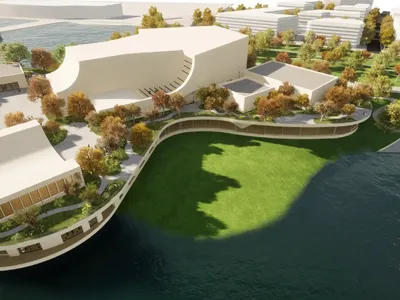
The Amber Palace Opera: A Geological Fiction Surfaces on Tallinn's Baltic Waterfront
Pierre Brillard reimagines a Baltic legend as a public landscape, opera house, and waterfront promenade rooted in Tallinn's coastal identity.
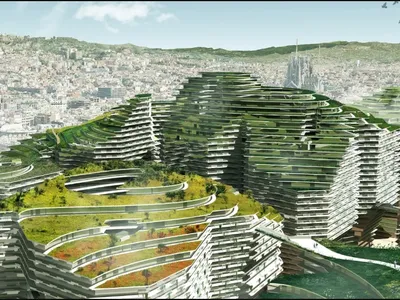
Manzana Morphosis: Stretching Barcelona's Grid into a Living Landscape for 2050
A radical reworking of the Eixample manzana turns density into a tool for generous public space, vertical ecology, and environmental performance.
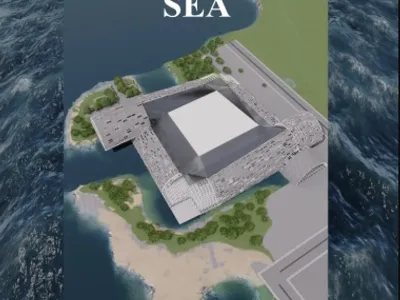
Opera on the Sea: Driftwood Logic Shapes a Timber Opera House on Estonia's Coast
Trevor Orgill's opera house translates the entangled drift of floating timber into a civic building where wood, water, and music converge.

Similar Reads
You might also enjoy these articles

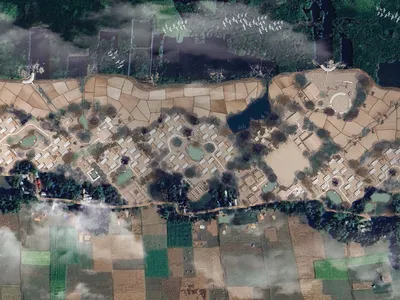
Hodi-Mandai Geram
Project Function: Preservation and revitalization of the Intangible heritage and socio-spatial identity of the Hodi by Housing, Cultural Memory Center, Sacred Grove, landscape, local tourism economy

Olio Towers: A Mid-Rise for Performers That Fuses Housing, Rehearsal, and Stage
Located blocks from Houston's Theater District, this modular tower stacks living units around a central performance atrium.
Oasis: Modular Green Housing Carved into Dhaka's Urban Fabric
A shortlisted Plugin Housing entry reclaims unauthorized settlements in Dhaka with stepped concrete volumes, green roofs, and ventilation-driven design.

Black Hole: A Floating Megastructure for the Post-Physical Era
Emiliano Mazzarotto envisions a spherical, self-scaling arena where e-sports, digital hotels, and holographic stadiums replace traditional public space.

Explore High Rise Building Competitions
Discover active competitions in this discipline

Challenge to design mud housing for contemporary communities

Challenge to reimagine the Iron Throne

Photograph architecture without architects

Illustrate the lost glory of Angkor Wat - Render Challenge
Comments (0)
Please login or sign up to add comments
No comments yet. Be the first to comment!