
Kandinsky Program: Where AI Meets Craft in a New Bauhaus for Manila
A twin-tower educational hub in Manila fuses parametric design, machine learning, and human craftsmanship into a 21st-century Bauhaus prototype.


The Bauhaus never really ended; it just kept waiting for the right technology to catch up with its ambitions. The Kandinsky Program picks up that thread and pulls it forward into the age of generative architecture, proposing a twin-tower educational hub in Manila where AI-driven design and traditional craftsmanship coexist as equal partners. Rather than treating computation as a replacement for the hand, the project frames it as an amplifier: digital fabrication laboratories sit alongside collaborative workshops, and parametric logic shapes a building that still foregrounds the human body in space.
Designed by Emil Pinaroc, Gepo de Mesa, Remil Jusayan, and Gabriel Brioso, the project was recognized as an Institutional Excellence Award entry for Bauhaus Neue. Sited within Manila's layered urban and historical fabric, the Kandinsky Program positions itself as both a prototype for the next generation of design education and a catalyst for sustainable urban regeneration, preserving cultural identity while embedding technological innovation into the city's everyday life.
Twin Volumes Stacked Against the Manila Sky
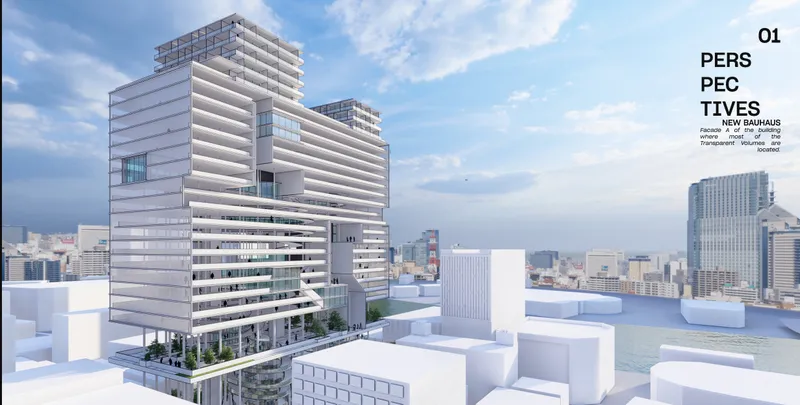
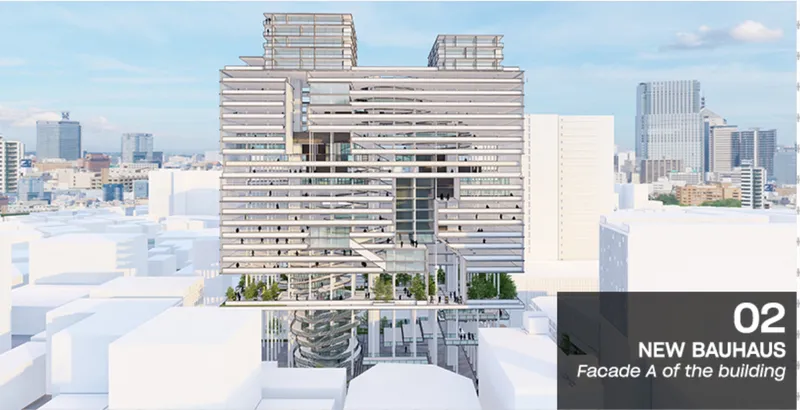
The building reads as two stacked tower volumes bound together by deep horizontal banding, a formal move that gives the facade a rhythmic, almost musical quality. Horizontal louvers wrap the exterior in a continuous screen, modulating light and views while giving the massing a sense of gravitational suspension. Between the louver bands, planted terraces push outward, introducing living green layers that break the hard geometry and signal the project's commitment to material ecologies. The head-on elevation makes the logic clear: the building is not a single monolith but a series of stacked environments, each calibrated for a different program, from learning modules to fabrication labs.
A Ground Plane That Gives the City Back Its Space
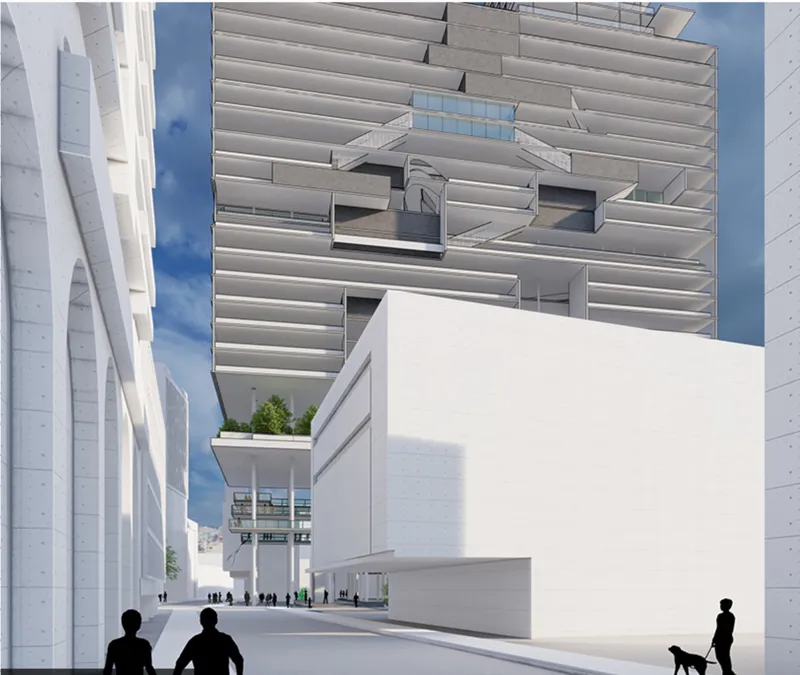
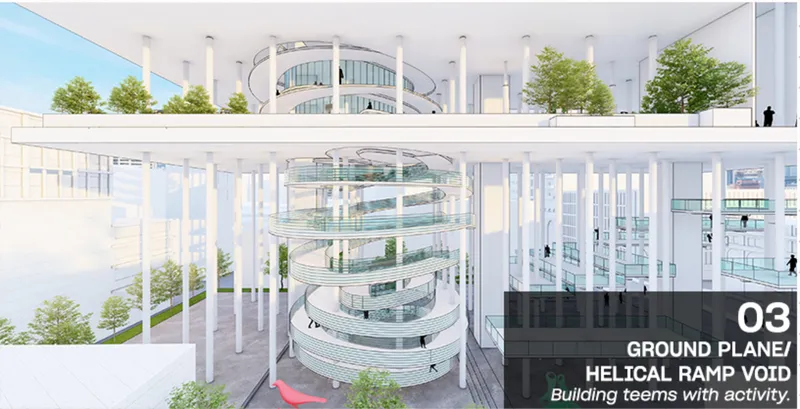
At street level, cantilevered terrace volumes hover above a porous ground plane where pedestrians, including the occasional dog walker, move freely beneath the building's mass. This lift creates a generous public threshold, an invitation rather than a boundary. The section rendering reveals the organizational spine of the project: a spiraling ramp void cuts through the center, surrounded by white columns and planted terraces that draw daylight deep into the interior. The ramp is not just circulation; it is the social armature of the building, a continuous path that connects fabrication labs, classrooms, and collaborative spaces without the segmentation of conventional floor plates.
Terraces, Drones, and the Waterfront Edge
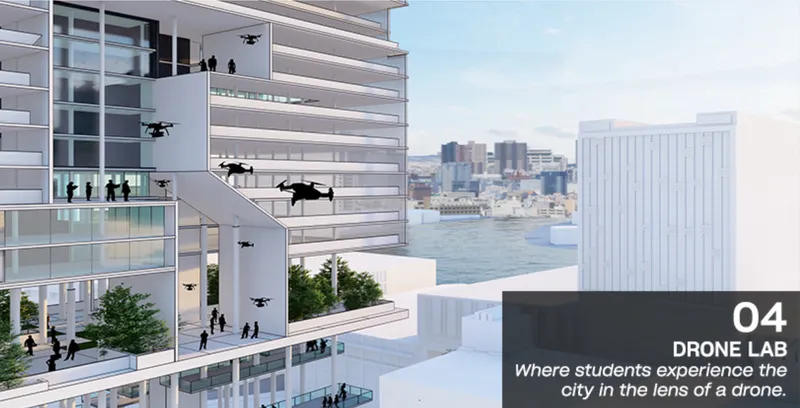
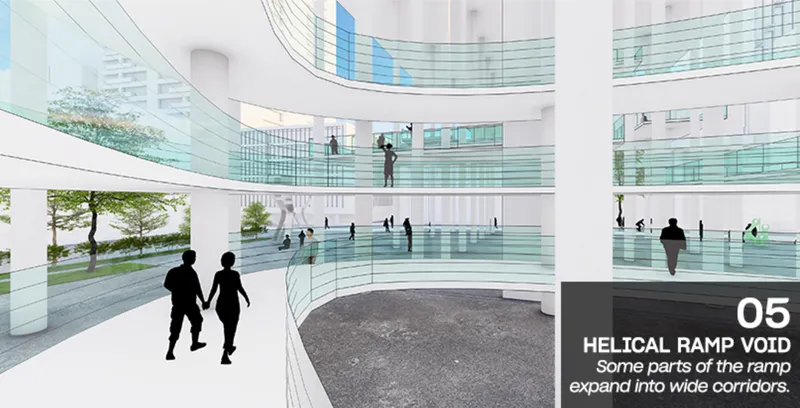
Upper terraces open toward the waterfront, creating outdoor working and gathering spaces where the urban context becomes part of the curriculum. Drones hover over these terraces in the rendering, a deliberate signal that the building's program extends beyond conventional studio pedagogy into robotics, aerial fabrication, and computational research. Below, the interior atrium anchors the base of the spiral with a dark circular floor element set beneath curved glass walls. The geometry here is unmistakably Kandinsky: circles, curves, and compositional tension translated from canvas to concrete, giving the project its conceptual name and its spatial logic.
The Spiral Atrium as Social Engine
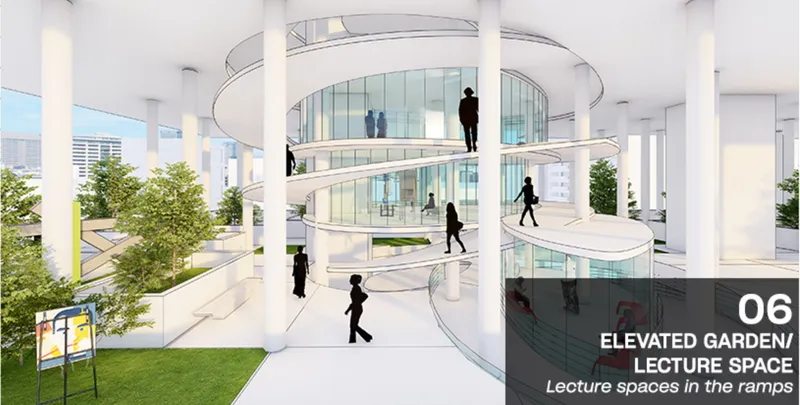
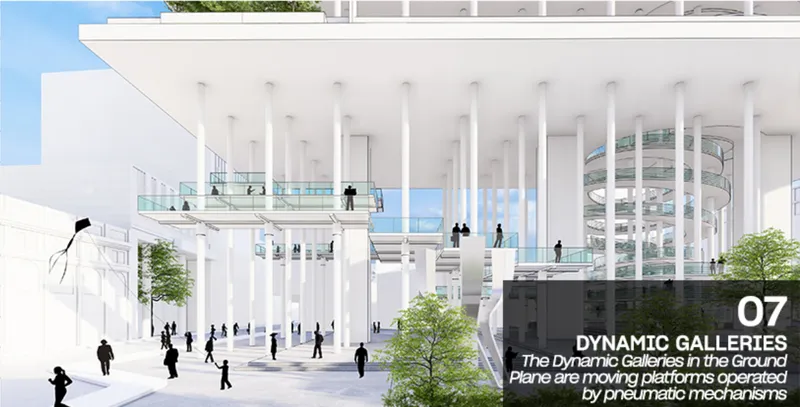
The spiraling white ramps with glass balustrades wrap around a central void, creating a vertical public space where students and visitors ascend through overlapping views of activity on every level. It is a deliberate inversion of the isolated studio: here, seeing and being seen is the point. At the covered plaza below, white columns support a network of suspended bridges connecting stacked levels under a flat roof. The structural rhythm is restrained, letting the bridges and the movement across them become the primary visual event. The interplay between open-air and enclosed zones encourages the fluid, interactive environment the designers set out to achieve.
Laboratories and Conference Rooms Tuned for Making
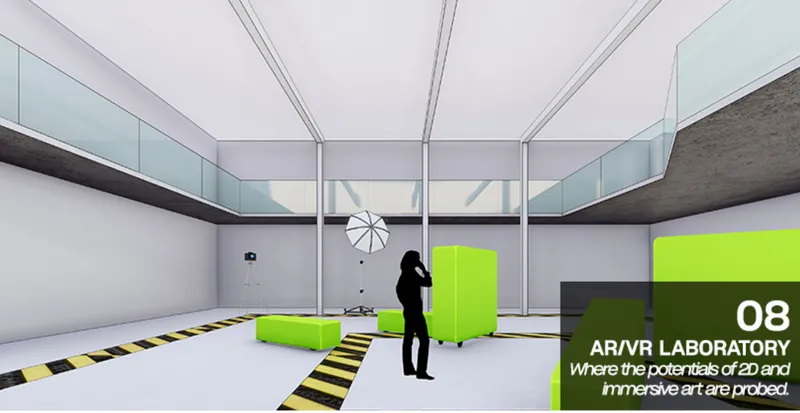
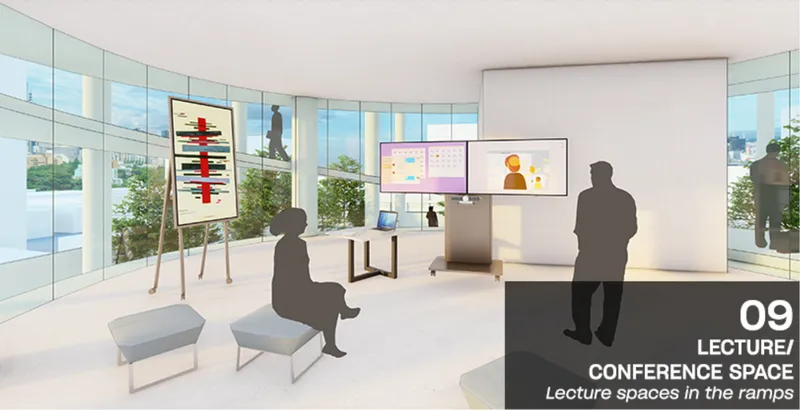
Inside the digital fabrication laboratory, a white structural frame overhead creates a lofty, factory-like atmosphere, while lime green modular furniture on a striped floor signals flexibility: the room can be reconfigured for CNC routing, robotic assembly, or a collaborative design charrette within the same afternoon. The adjacent curved conference room wraps continuous glazing around planted terraces, framing the distant Manila cityscape under soft diffused light. These are not generic office interiors. They are spaces deliberately calibrated to support the convergence of data and craft that the Kandinsky Program places at the center of its pedagogy.
Rooftop Living and the Public Ground Below
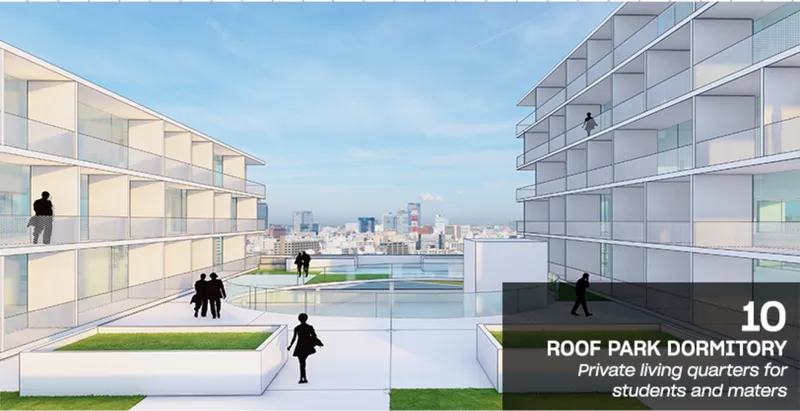
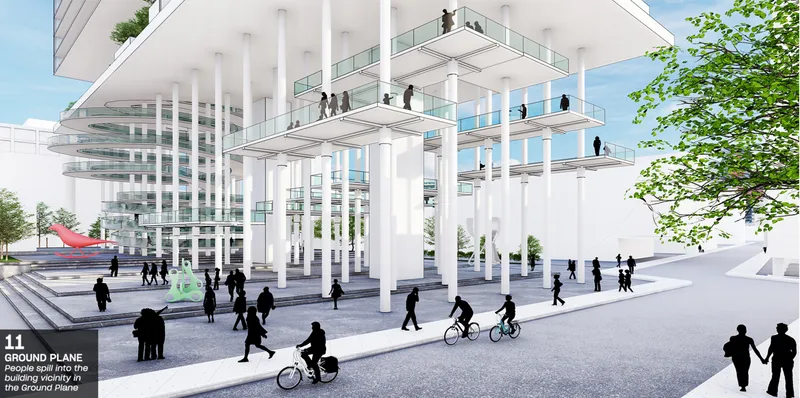
At the top, a rooftop terrace stretches between two residential wings clad in glass and panel systems, with lawn strips softening the gap between them. Silhouetted figures occupy the space casually, suggesting that the building's program extends into communal living, not just communal working. The ground level public plaza returns to the theme of urban generosity: white columns support stacked platforms overhead, while people walk beneath a tree canopy that filters Manila's tropical light. The plaza is open, shaded, and connected, a piece of urban infrastructure as much as it is a piece of architecture.
Why This Project Matters
The conversation around AI in architecture too often drifts into either utopian enthusiasm or anxious resistance. The Kandinsky Program sidesteps both by treating computation and craft as complementary forces within a single educational model. By embedding machine learning, parametric design, and digital fabrication within a building that simultaneously houses workshops, studios, and public terraces, the project argues that the 4th Industrial Revolution does not have to erase the human hand from architecture. It can extend it.
Equally significant is the choice of Manila as a site. Placing a New Bauhaus within a city rich in heritage and navigating rapid urbanization gives the project real stakes. It is not a theoretical exercise for a hypothetical European campus; it is an urban insertion that must negotiate cultural identity, tropical climate, and the social dynamics of a densely populated metropolis. That specificity is what elevates the Kandinsky Program from manifesto to prototype, and what makes it a compelling entry in the ongoing rethinking of design education worldwide.
View the Full Project
About the Designers
Designers: Emil Pinaroc, Gepo de Mesa, Remil Jusayan, Gabriel Brioso
Enter a Design Competition on uni.xyz
uni.xyz runs architecture and design competitions year-round that reward proposals with spatial conviction and real site intelligence.
Project credits: Kandinsky Program by Emil Pinaroc, Gepo de Mesa, Remil Jusayan, Gabriel Brioso Bauhaus Neue (uni.xyz).


Popular Articles
Popular articles from the community


FCC Arquitectura Expands a Portuguese Granite House with a Board-Marked Concrete Wing
In Portugal, JV House pairs a cleaned-up whitewashed and granite dwelling with a timber-shuttered concrete extension, courtyards and a garden pool.


The Amber Palace Opera: A Geological Fiction Surfaces on Tallinn's Baltic Waterfront
Pierre Brillard reimagines a Baltic legend as a public landscape, opera house, and waterfront promenade rooted in Tallinn's coastal identity.

ETEH Reworks the Shared Spaces of São Domingos School in Brazil Around Timber, Color and Hanging Plants
At São Domingos School in Brazil, 436 m² of hall, refectory and library are recast with timber joinery, a yellow and blue code and trailing greenery.

Cube Design Draws an Ecological Corridor Between Two Shenzhen Hills with the Nankai Building
Beside Shenzhen's container docks, the Nankai Building pairs stacked balconies with a climbing green screen to connect two hillsides across its height.

Similar Reads
You might also enjoy these articles

Aquadapt: An Underwater Habitat That Rewrites Its Rooms by the Hour
Curved modules ring the seabed while one shell shifts from breakfast room to cinema, farm and football pitch as residents' needs change.

Play: Fragments of Their World: Remembered Architecture Rebuilt as a Modular Playground for Refugee Camps
Tom Gardner abstracts domes, arches and towers from the homelands of displaced families into a kit of child-scaled play parts for camp settlements.
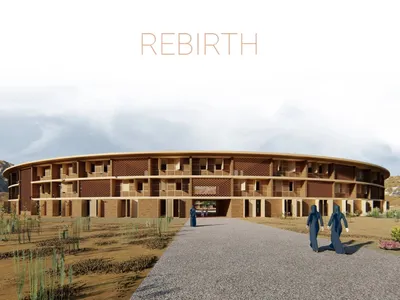
REBIRTH: A Circular Settlement Where Afghan Widows and Their Children Rebuild Life Together
A shortlisted Resile entry turns the circle into a protective ring of timber and brick, gathering homes, classrooms and gardens around a shared landscape.
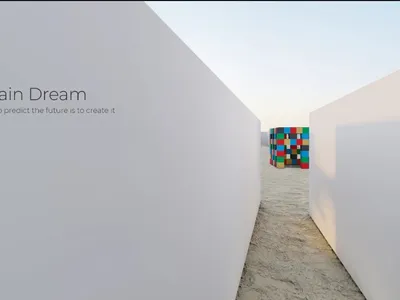
The Main Dream: A Recycled Plastic Kit That Lets Refugee Children Build Their Own Playground
Thirty-centimetre interlocking cubes that connect on three axes turn play into construction, letting children author the spaces they occupy.


Comments (0)
Please login or sign up to add comments
No comments yet. Be the first to comment!