
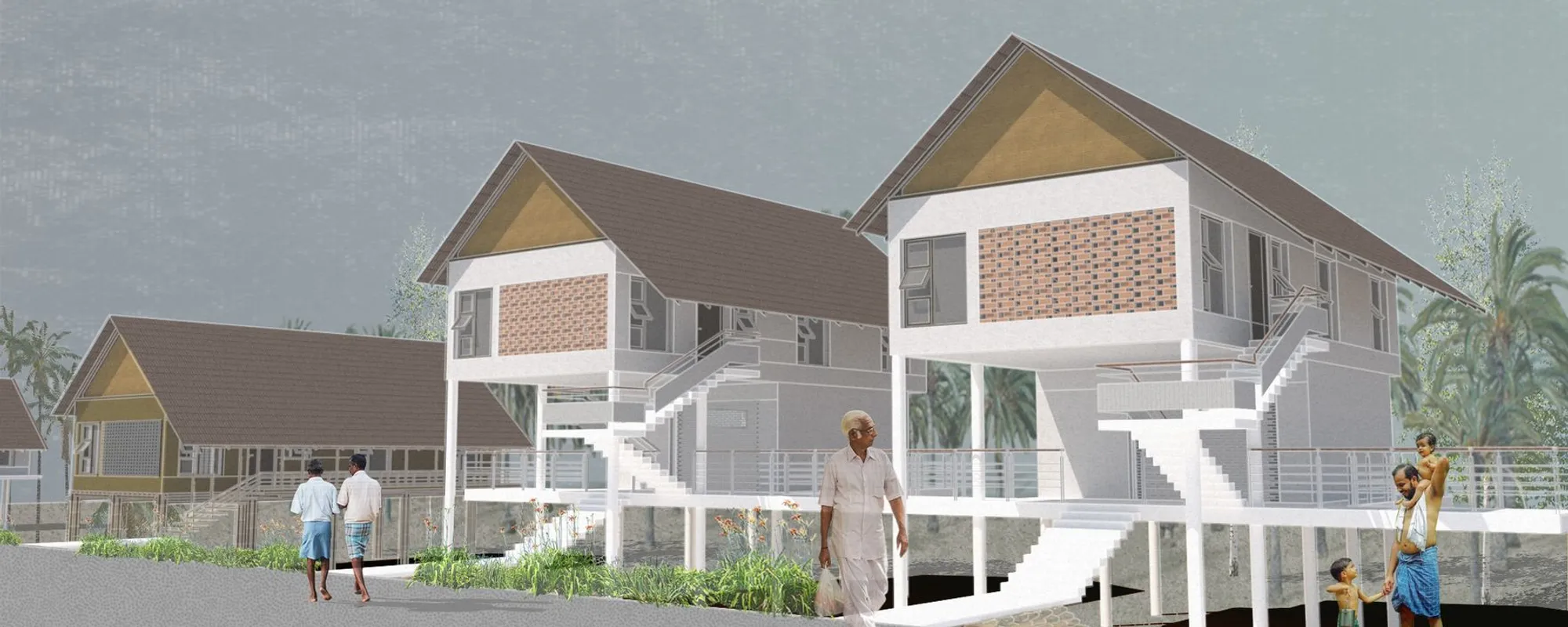
Kanikonna: Flower Anatomy as a Blueprint for Flood-Resilient Settlements in Kerala
A shortlisted HEAL+ entry maps the Kanikonna flower's petals, stem, and ovary onto community clusters designed to survive flooding.


What if a flower could teach a neighborhood how to survive a flood? In Uliyanoor, Kerala, a design team has taken the anatomy of the Kanikonna, the golden shower tree celebrated across the state for its bright yellow blossoms, and mapped its petals, stem, and ovary directly onto a community masterplan. Residential clusters become petals, roads become stems, and a central public hub becomes the ovary: the reproductive core that holds schools, clinics, and shelters. The result is a settlement pattern that encodes evacuation logic, resource distribution, and social cohesion into its very geometry.
Kanikonna was developed by Oleksandra Yeloyeva, Dandika Thanos, and Sherin Varikkatt as a shortlisted entry to the HEAL+ competition, which called for regenerative housing solutions for flood-prone communities in Kerala. The project positions itself not as a singular building but as a scalable urban prototype, where symbolic architecture meets disaster preparedness at the scale of the neighborhood.
Reading a Flower as an Urban Diagram
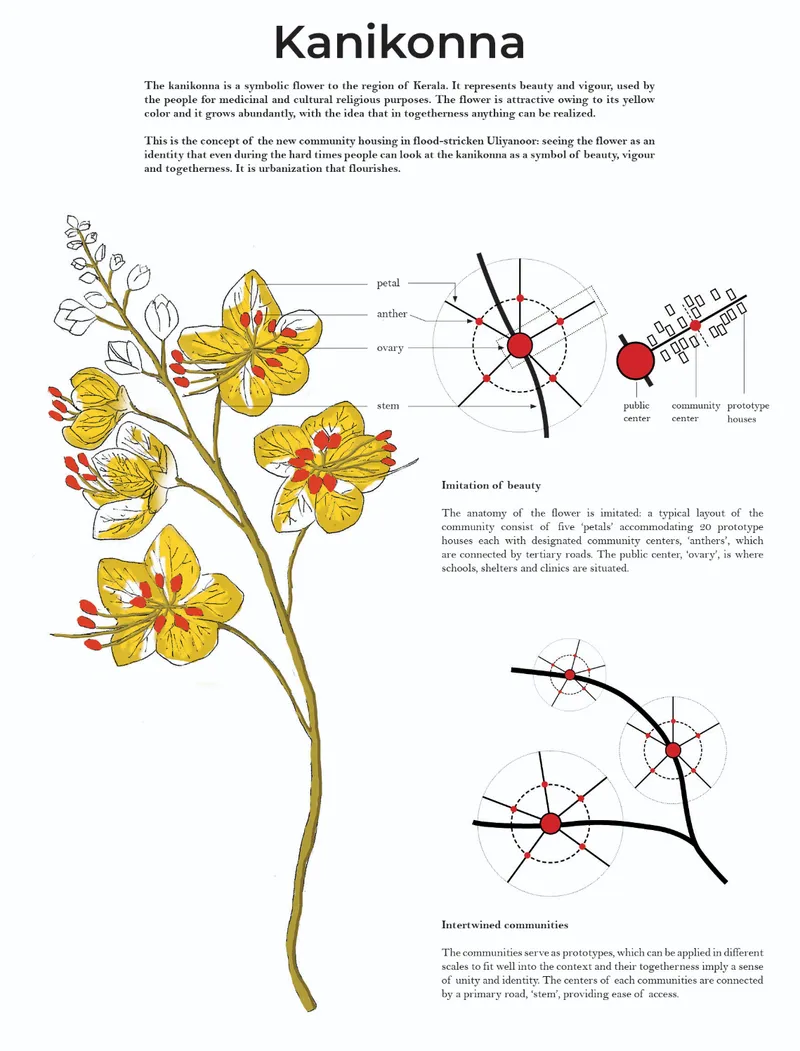
The conceptual leap here is genuinely inventive. The designers decompose the Kanikonna flower into its botanical components and assign each a programmatic role. Petals become residential clusters of 20 prototype houses. Anthers become community centers that connect smaller groups of homes. The ovary, the flower's reproductive center, becomes the public core containing schools, clinics, and emergency shelters. Stems translate into primary and secondary road networks linking these elements. The radial layout diagrams show this translation clearly: each cluster fans outward from its community center, and the clusters themselves orbit the central hub.
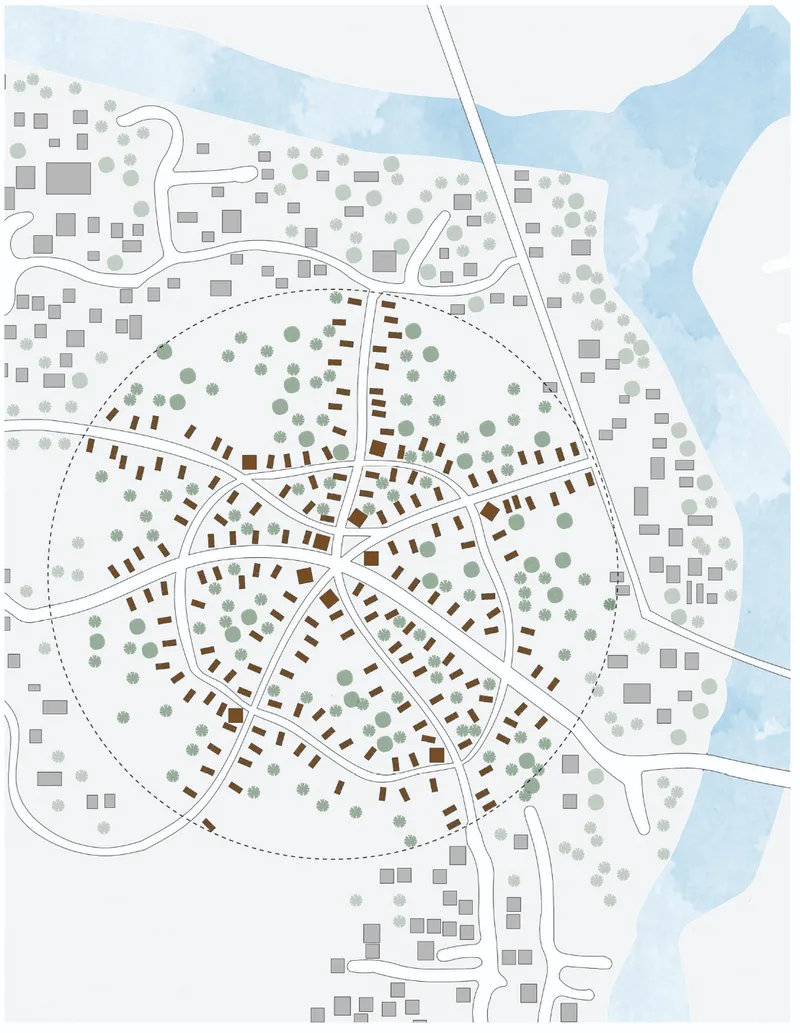
The site plan reveals how this radial logic negotiates with the existing fabric of Uliyanoor, weaving flower-shaped settlement patterns between existing buildings and waterways. The pathways radiating outward are not decorative; they serve as evacuation corridors, allowing residents to move from their homes to community centers and then to higher-ground shelters in a sequential, predictable flow. The symbolic and the functional are not separate layers here. They are the same drawing.
Two Prototypes: Bamboo Stilts and Brick Permanence
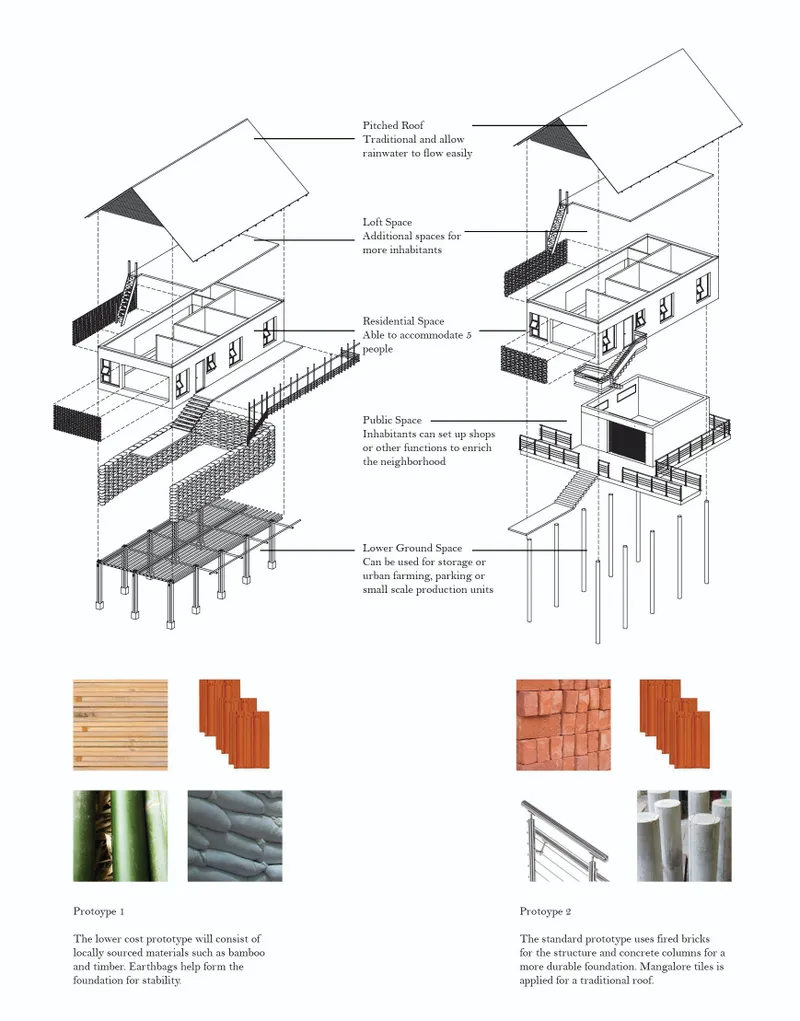
The project proposes two distinct housing prototypes, each calibrated for different economic realities and durability requirements. Prototype 1 relies on low-cost, locally sourced materials: bamboo, timber, and earthbags form the structure, elevated on stilts to reduce flood damage and provide safe evacuation routes beneath the living floor. Prototype 2 uses fired bricks, concrete columns, and Mangalore tile roofs for greater permanence, blending traditional Kerala aesthetics with modern structural resilience. The exploded axonometric drawing breaks these modules apart, showing the material palette alongside the spatial stacking: public-facing ground floors for shops or community services, residential units above.
This multi-functional layering is critical. By programming the ground floor as shared community space, the design ensures that even during non-flood periods, the architecture generates social life. Shops, clinics, and services at street level build the kind of daily interdependence that becomes mutual aid during a crisis. The architecture does not wait for disaster to justify its organization.
Clustered Housing Among Trees and Waterways
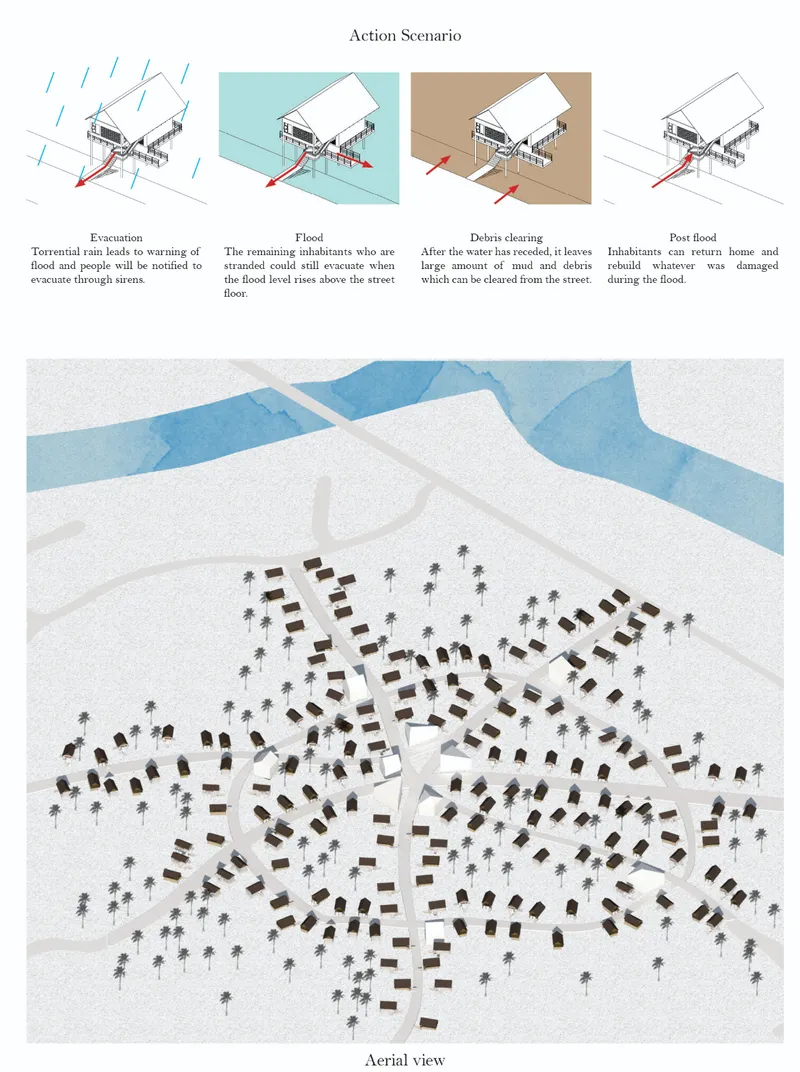
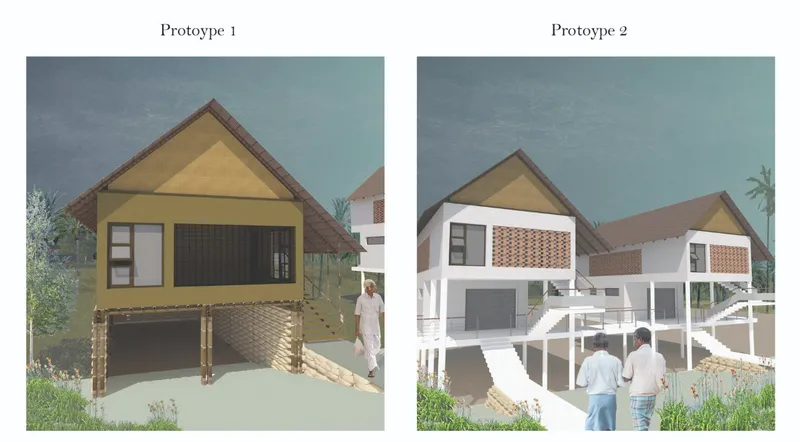
The aerial rendering shows the pitched-roof clusters dispersed among dense tree cover near blue waterways, a deliberate contrast to the dense, impervious development patterns that exacerbate flooding. The settlement breathes. Open ground between clusters absorbs water; tree canopy provides shade and soil stabilization. The elevation renderings of both prototypes side by side reveal their scale: human figures standing in front courtyards give a sense of the modest, approachable proportions. These are not monumental gestures. They are houses, lifted just enough to let the water pass beneath.
The masterplan goes beyond form to outline a sequential disaster response: evacuation to community centers, then to higher shelters; relief distribution along primary and tertiary road networks; reconstruction using materials pre-stored in community centers; and rehabilitation where residents re-establish clinics, shops, and services at ground level. Each phase maps onto the spatial structure. The flower diagram is not a metaphor layered on top of planning; it is the planning itself, organizing governance and social structure alongside walls and roofs.
Why This Project Matters
Symbolic architecture often earns skepticism, and fairly so: too many projects borrow natural forms for visual novelty without functional consequence. Kanikonna sidesteps this trap by making the symbol do real work. The flower's anatomy is not decorative overlay; it organizes evacuation sequences, distributes public services, and calibrates density. When a resident moves from their house to a community center to a central shelter, they are tracing the path from petal to anther to ovary. The cultural resonance of the Kanikonna, a symbol of resilience and renewal across Kerala, reinforces this spatial logic with shared meaning.
The project also demonstrates something important about scalability. Because the cluster pattern is modular, each petal operates as a self-sufficient unit that can be replicated and adapted to different sites and geographies. The two housing prototypes offer a spectrum from rapid, low-cost deployment to durable long-term settlement. For flood-prone regions well beyond Uliyanoor, the framework offers a transferable method: start with local identity, extract spatial logic, and build community resilience into the geometry of the neighborhood itself.
View the Full Project
About the Designers
Designers: Oleksandra Yeloyeva, Dandika Thanos, Sherin Varikkatt
Enter a Design Competition on uni.xyz
uni.xyz runs architecture and design competitions year-round that reward proposals with spatial conviction and real site intelligence.
Project credits: Kanikonna; Urbanisation that Flourishes by Oleksandra Yeloyeva, Dandika Thanos, Sherin Varikkatt HEAL+ (uni.xyz).



Popular Articles
Popular articles from the community


Lunar Spiral: Space Architecture Shaped by the Mathematics of the Universe
Lunar Spiral reimagines space architecture through Fibonacci geometry, lunar regolith, levitating habitats, and self-sustaining Moon living.

Co-Life: Senior Housing Design That Reconnects Older Adults With the City
Co-Life reimagines senior housing design through healing gardens, shared streets, workshops, and a sustainable community across generations.

The Earth Pod: 3D Printed Homes for Resilient Refugee Communities
The Earth Pod reimagines refugee housing through 3D printed homes made from clay, combining resilience, self-sufficiency, and rapid shelter.

The Ocean Hive: Sustainable Architecture for a Self-Sufficient Civilization at Sea
The Ocean Hive imagines sustainable architecture at sea, where modular habitats, algae, wave power and ocean waste sustain a growing colony.


Similar Reads
You might also enjoy these articles

Bao Huynh Watercolor Atelier: A Serene Art Retreat in Hội An
Bao Huynh Watercolor Atelier in Hội An blends multifunctional art spaces, sustainable design, local materials, and family-friendly living in a serene environment.

Atelier Macri Concept Store Interior Design by CASE-REAL
Atelier Macri store features a "ko" counter, walnut wood details, cork displays, blending retail, gallery, and seamless customer experiences.

Manuel Vargas Izquierdo Stadium and High-Performance Sports Center: Architectural Excellence in Jalpa de Méndez
The Manuel Vargas Izquierdo Stadium blends sustainable design, inclusive sports facilities, and cultural-inspired architecture, revitalizing Jalpa de Méndez’s public spaces.
KAKR Buluh Awar Hall: Revitalizing Community and Ecology Through Bamboo Architecture
Community built bamboo hall revitalizes Buluh Awar village, empowering youth, restoring ecology, celebrating vernacular craftsmanship through sustainable architecture and culture.

Explore Kerala Floods Competitions
Discover active competitions in this discipline



Challenge to reimagine the Iron Throne


Photograph architecture without architects


Illustrate the lost glory of Angkor Wat - Render Challenge


Design challenge to reuse E-waste
Comments (0)
Please login or sign up to add comments
No comments yet. Be the first to comment!