

Kareem and Ehab Aldomiaty Build a Self-Sufficient Desert House from Siwa's Own Stone and Earth
A 650-square-meter dwelling in Egypt's Siwa Oasis uses karshif construction and passive cooling to live off the grid in an ancient landscape.


Siwa Oasis sits at the western edge of Egypt's habitable land, a depression in the Libyan Desert where salt lakes, date palms, and a handful of mud-brick settlements have survived for millennia. It is not a place that tolerates imported materials or imported ideas. Construction here has always relied on karshif, a local aggregate of calcium-rich rock particles bonded with silt mortar, and any building that ignores that fact tends to cook its occupants or crumble within a decade. Kareem Aldomiaty and Ehab Aldomiaty understood the assignment. Their Gagy Self-Sufficient House, completed in 2024, is a 650-square-meter residence that reads as though it grew from the limestone plateau rather than landing on it.
What makes this project worth studying is not the romance of desert living but the discipline behind it. The house clusters its volumes into a compact, terraced mass organized around a central courtyard, a strategy that minimizes exposed surface area, channels wind, and creates deep shade without mechanical intervention. Every wall thickness, every opening size, and every roof level appears calibrated to manage solar gain and promote stack-effect ventilation. The result is a dwelling that functions off the grid not as a stunt but as a logical outcome of listening to the site.
A Village in Miniature
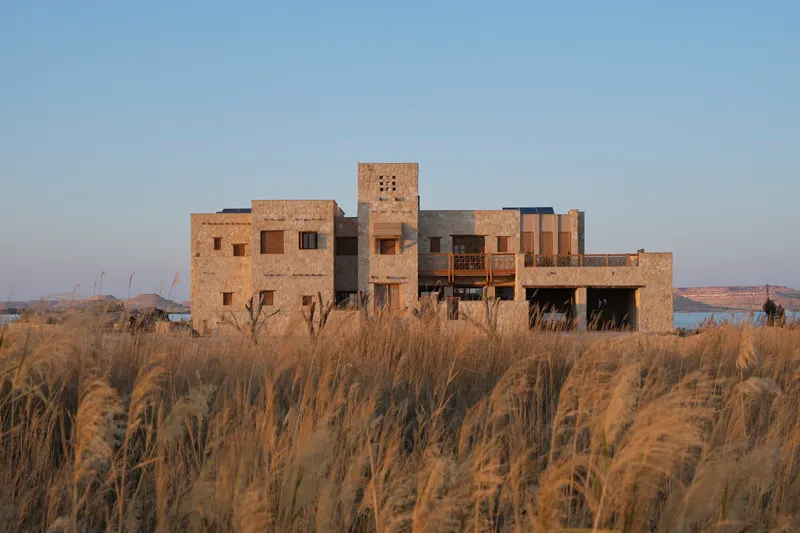
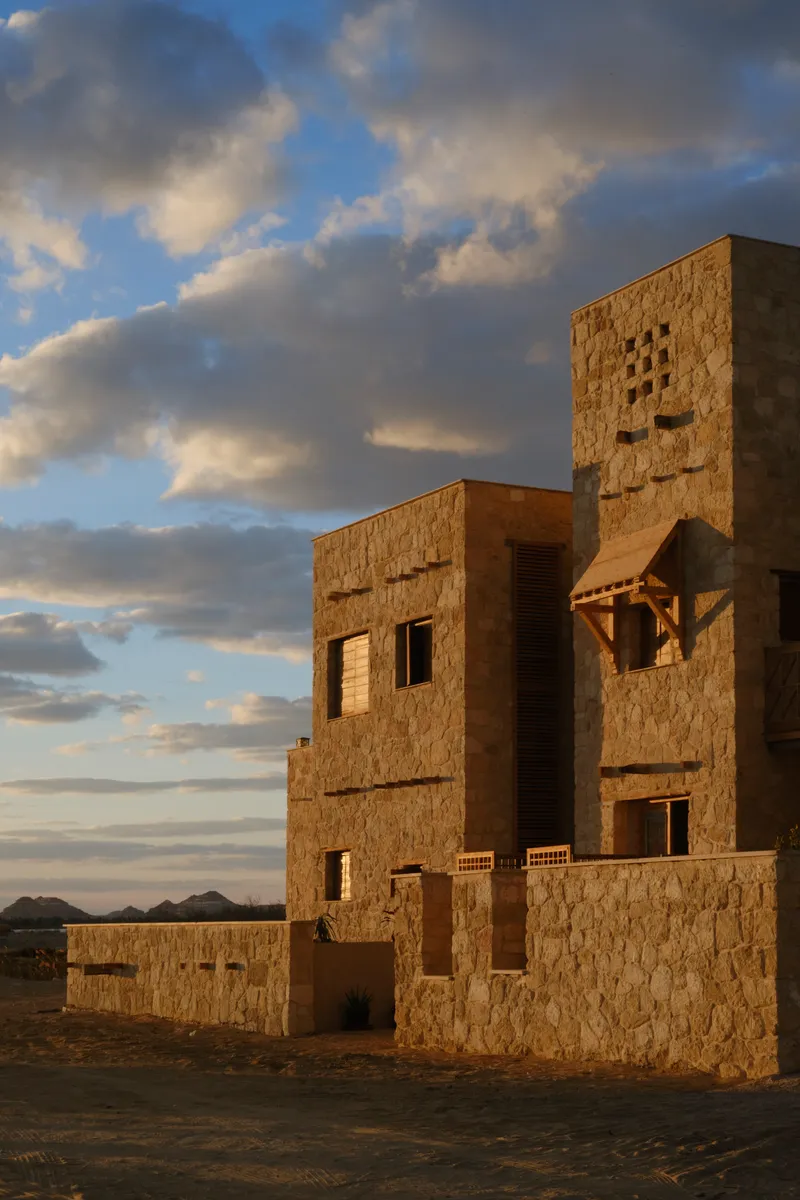
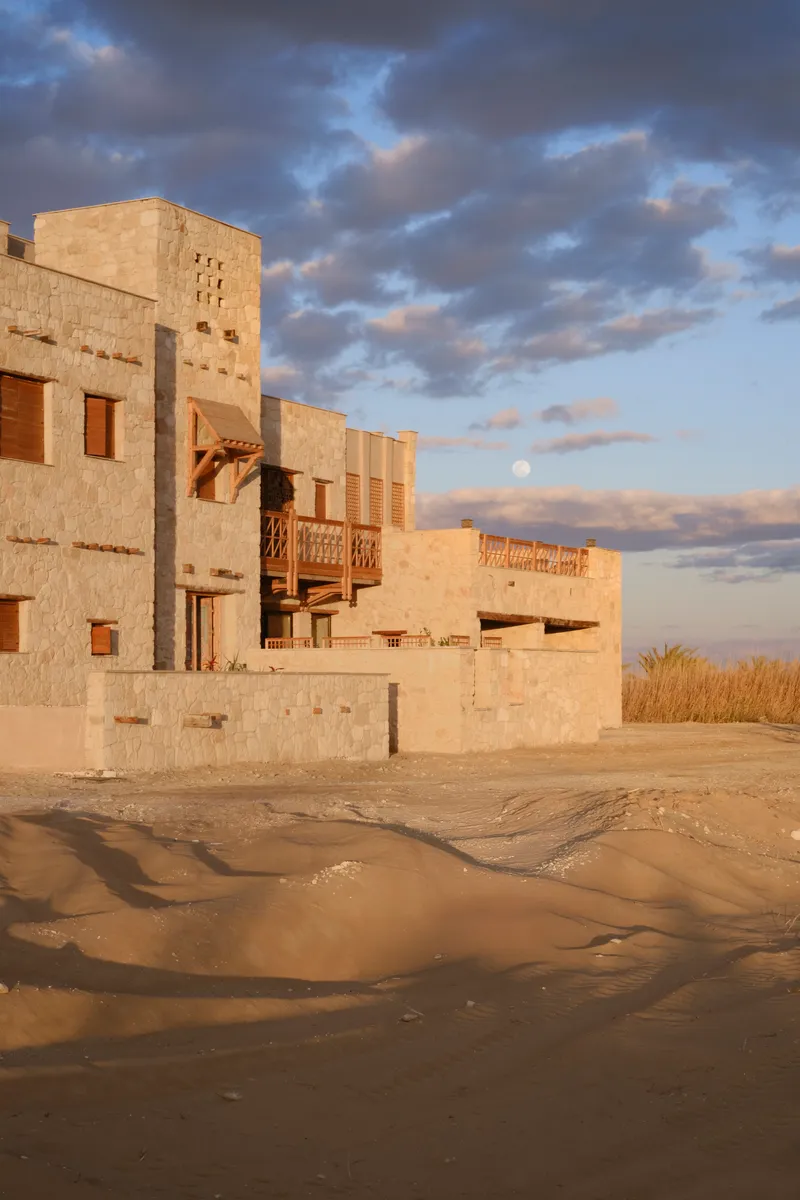
From a distance, the Gagy House looks less like a single residence and more like a fragment of a traditional Siwan settlement. Multiple volumes of varying height cluster together, connected at ground level but reading as distinct masses against the sky. A stone tower anchors one end, rising above the lower sleeping and living blocks, while the overall silhouette steps down toward the water's edge. The massing strategy is borrowed directly from the old town of Shali, where buildings piled atop one another to create self-shading walls and narrow, cool passages.
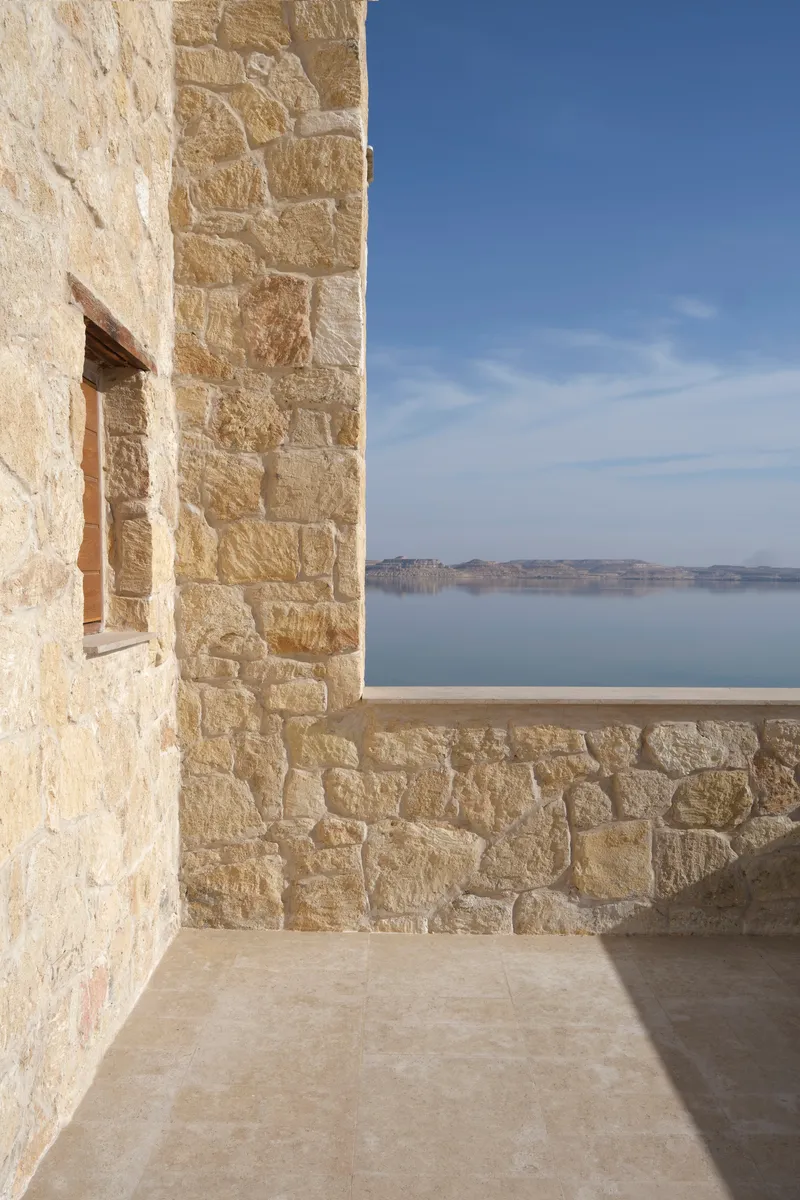
The material palette reinforces the illusion of age. Coursed limestone walls, rough-plastered surfaces, and timber lintels give the facades a texture that blends seamlessly with the surrounding rock formations. At dusk the building turns the same amber as the cliffs behind it, a camouflage that is less aesthetic choice than environmental logic: local stone has the thermal mass to absorb daytime heat and release it slowly through the cold desert night.
Arches and Vaults as Climate Machines
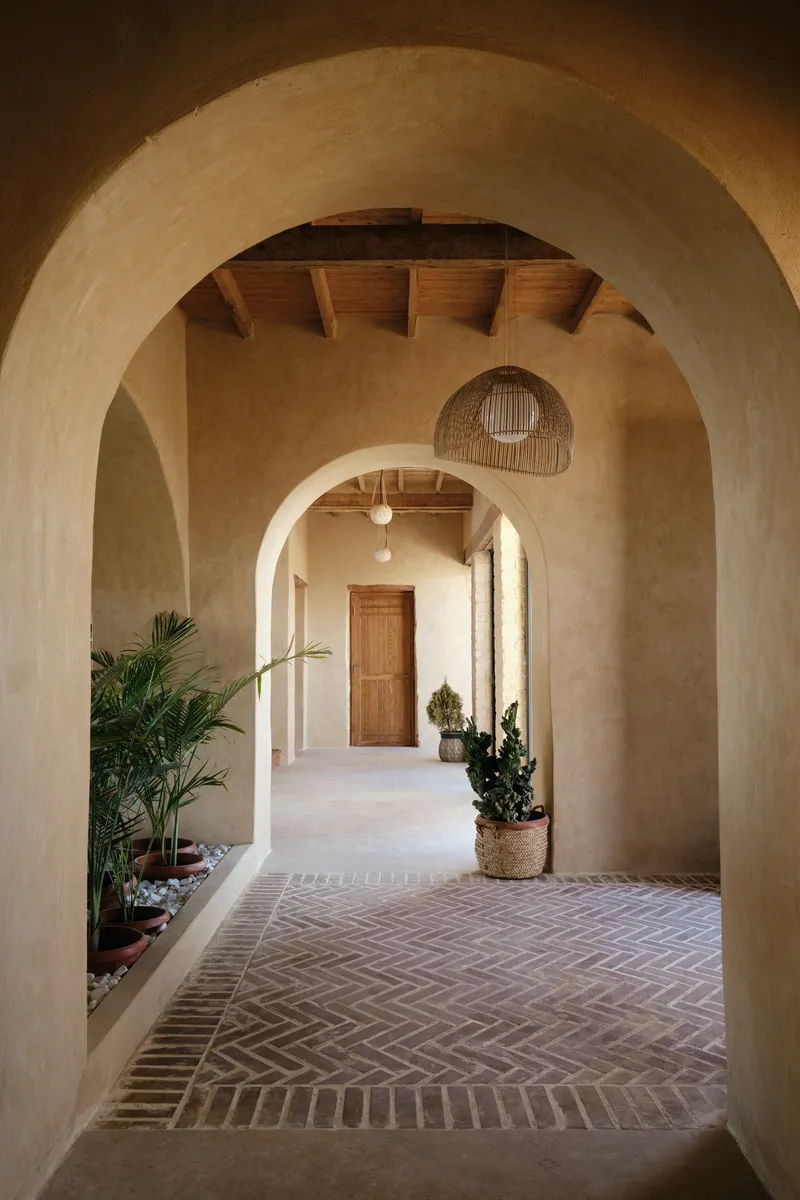
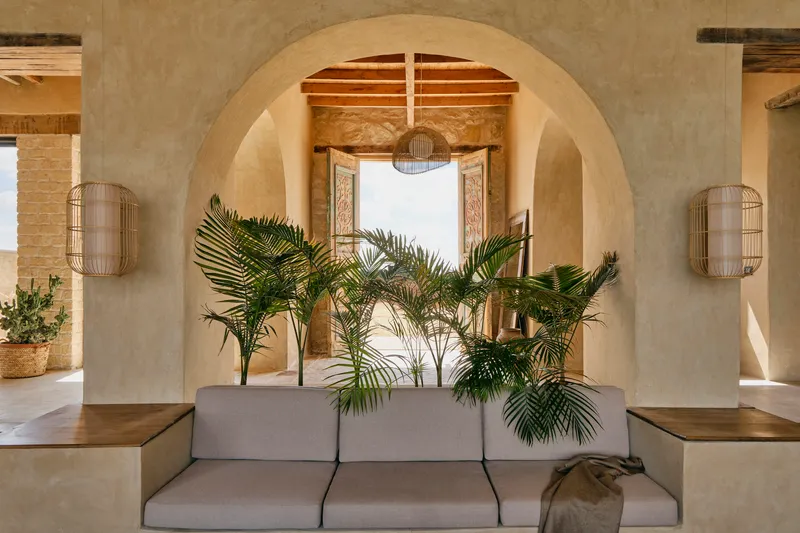
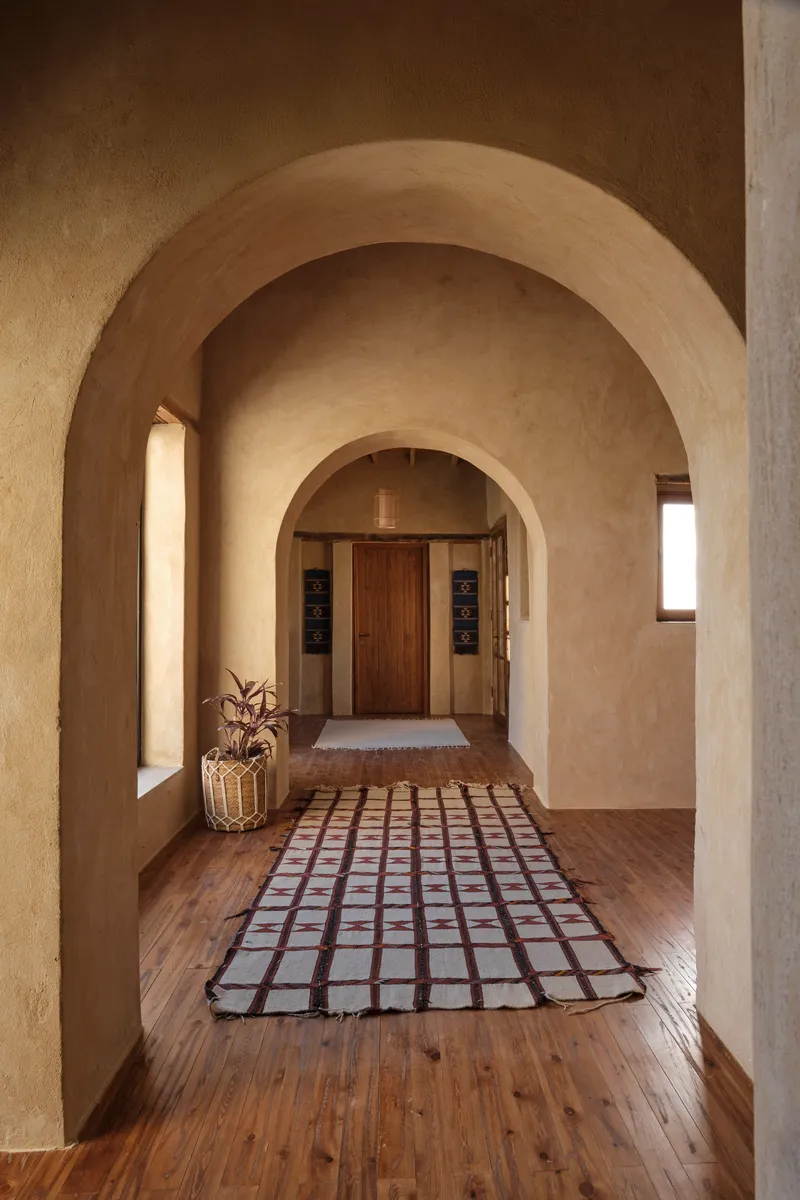
The interior circulation is defined by a sequence of plastered arches and barrel vaults that do far more than frame pretty sightlines. Arched openings between rooms allow air to move freely across the plan while maintaining visual separation. The barrel-vaulted corridors, with their continuous curved surfaces, channel cool air from the shaded courtyard into the deeper rooms. The herringbone brick floors add another layer of thermal mass underfoot, storing coolness absorbed from the earth below.
The repetition of arched forms gives the interior a rhythmic consistency that ties every room together without relying on a single open-plan gesture. It is a fundamentally different approach to domestic space than the glass-walled pavilion: instead of one dramatic view, you get a layered sequence of framed moments, each arch revealing the next space in stages. Walking through the house becomes an act of unfolding rather than surveying.
Living Spaces Rooted in Craft
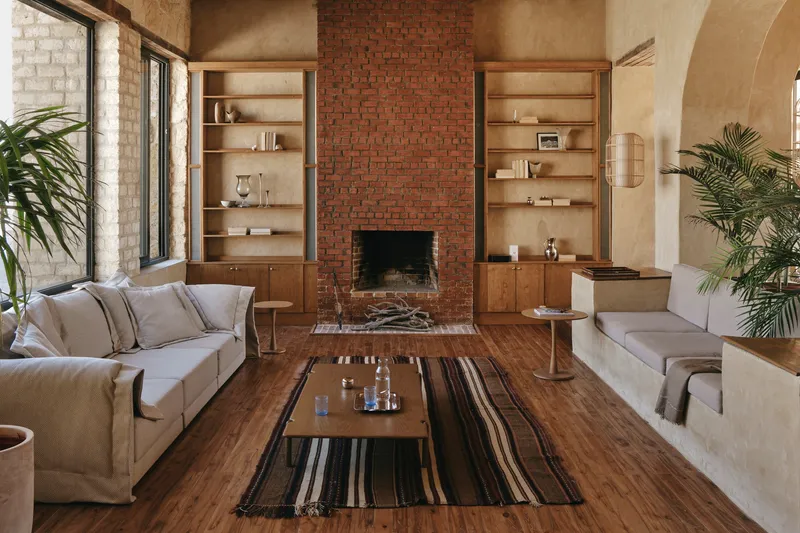
The main living room anchors itself around a red brick fireplace, a necessity in a climate where winter nights can drop below 5°C. Built-in timber shelving flanks the chimney, integrating storage into the wall thickness in a way that recalls traditional Siwan niches. Above, exposed timber beams span the ceiling with simple, functional joinery. The room makes no attempt to be minimal; it is warm, textured, and layered with materials that age well.
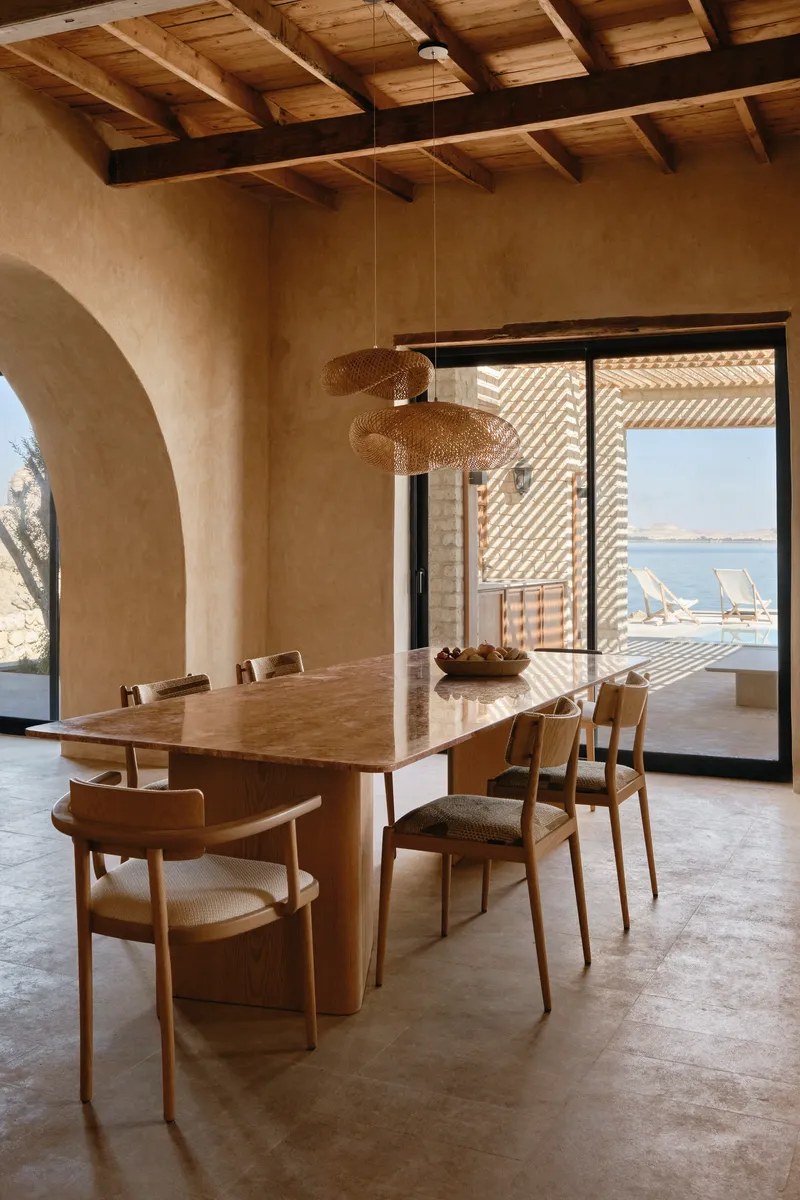
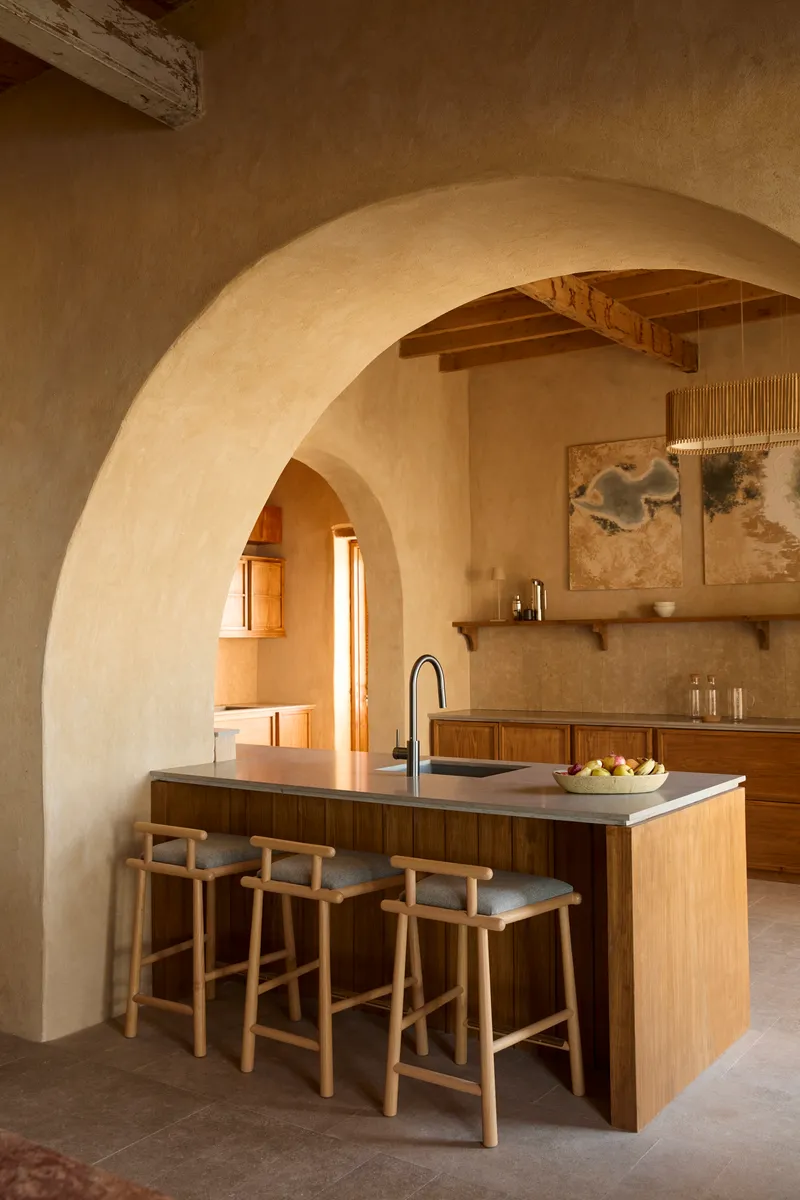
The dining room and kitchen share this material sensibility. Woven pendant lights, a detail likely sourced from local palm-leaf craft, hang above a solid timber dining table. The kitchen, visible through a rounded plaster arch, organizes itself around an island with three timber stools beneath a series of vaults. Every surface is handmade or hand-finished, and the imperfections are the point. Furniture by C Reality and lighting by Miruki Studio complement the architecture without competing with it.
Bedrooms and Bathrooms Facing the Water
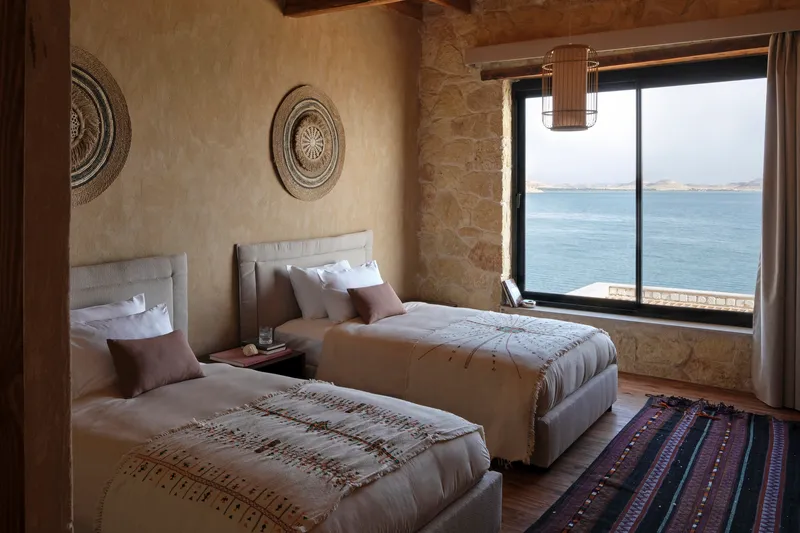
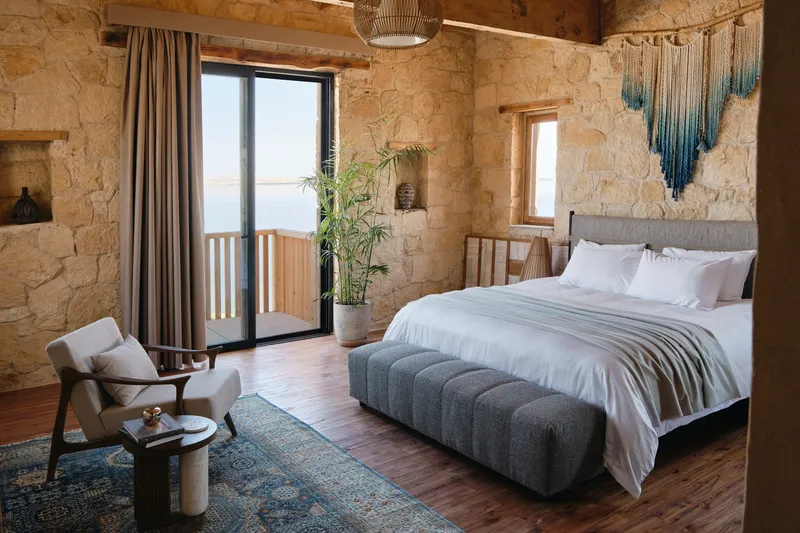
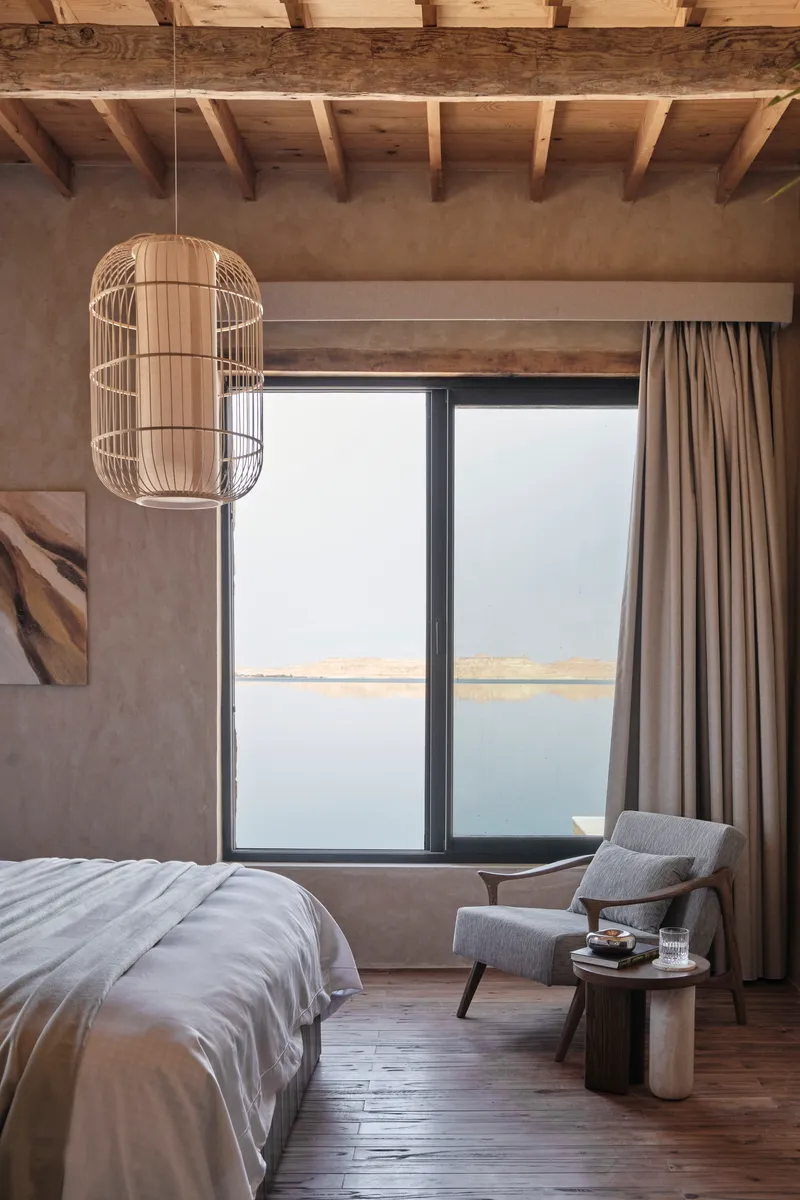
The sleeping quarters are positioned to capture views across the salt lake, with large windows and timber balcony doors that open directly onto the water. The walls here are left as rough stone, unplastered, allowing the bedrock texture to become the room's primary decoration. Exposed timber ceiling joists span the narrow rooms, their closely spaced rhythm creating a sense of shelter and compression that contrasts with the expansive views beyond.
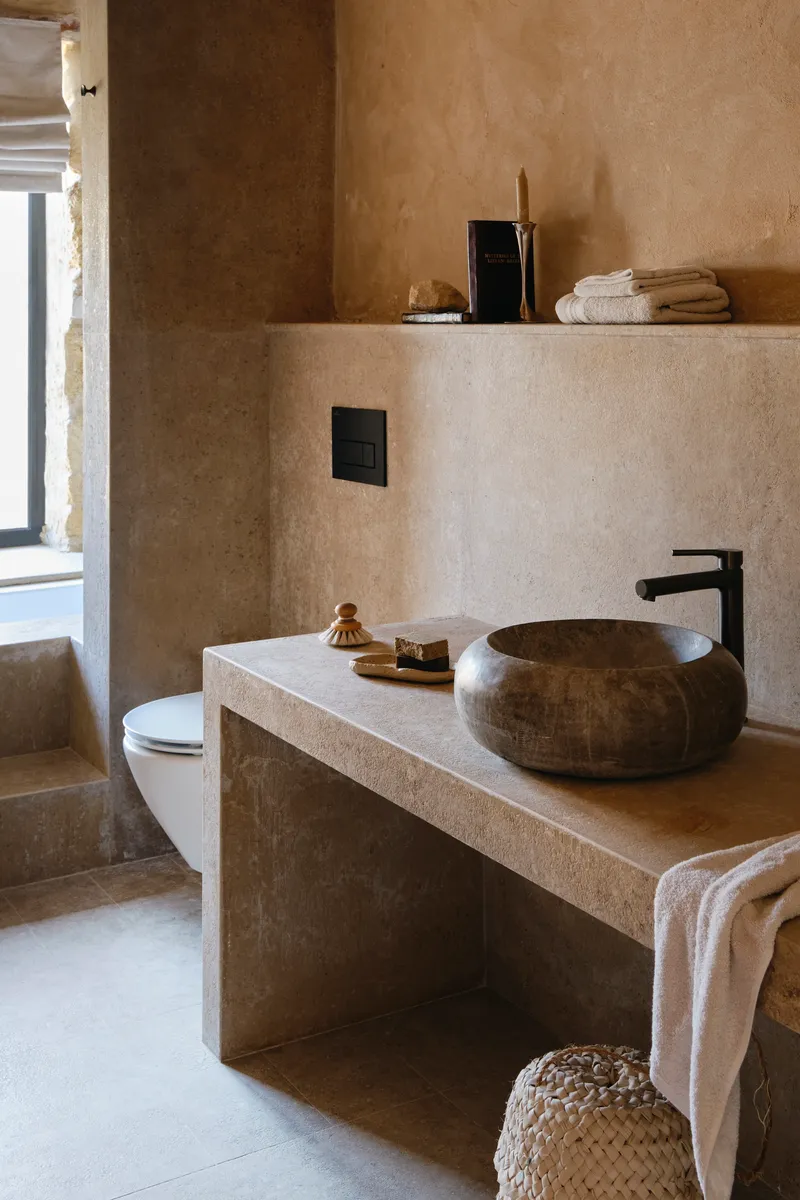
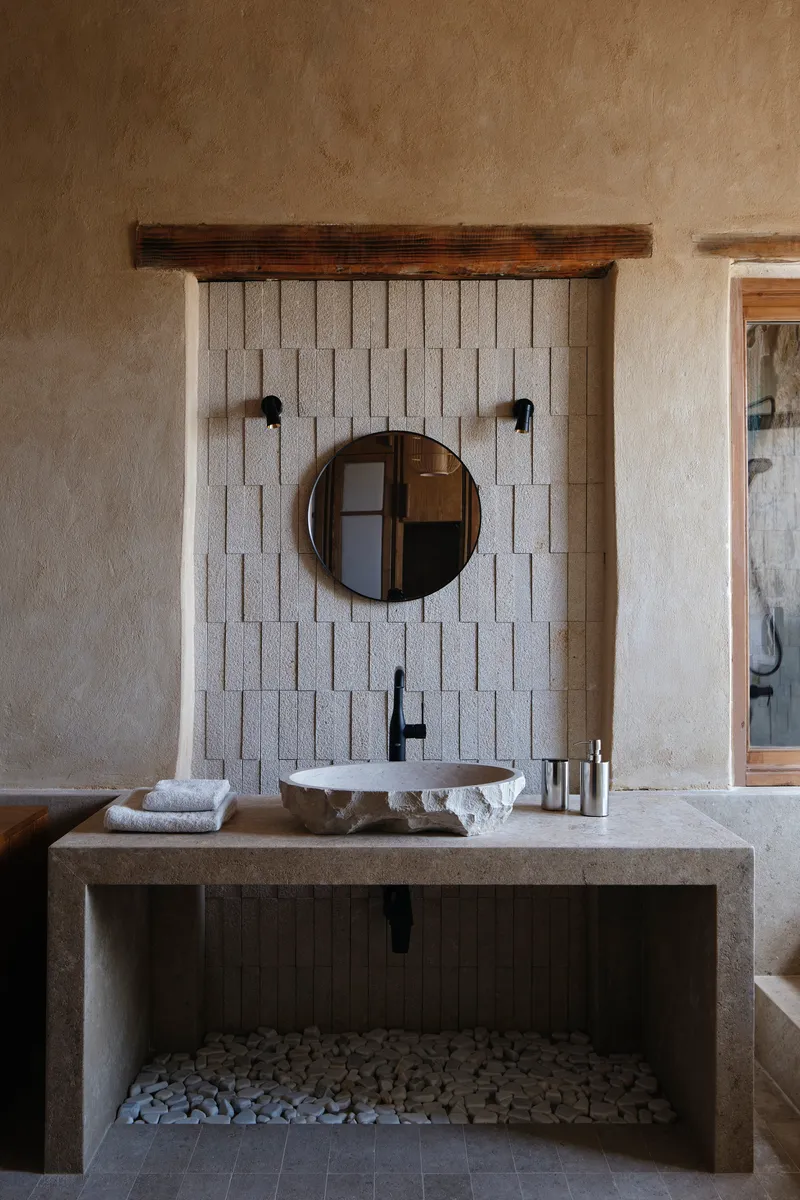
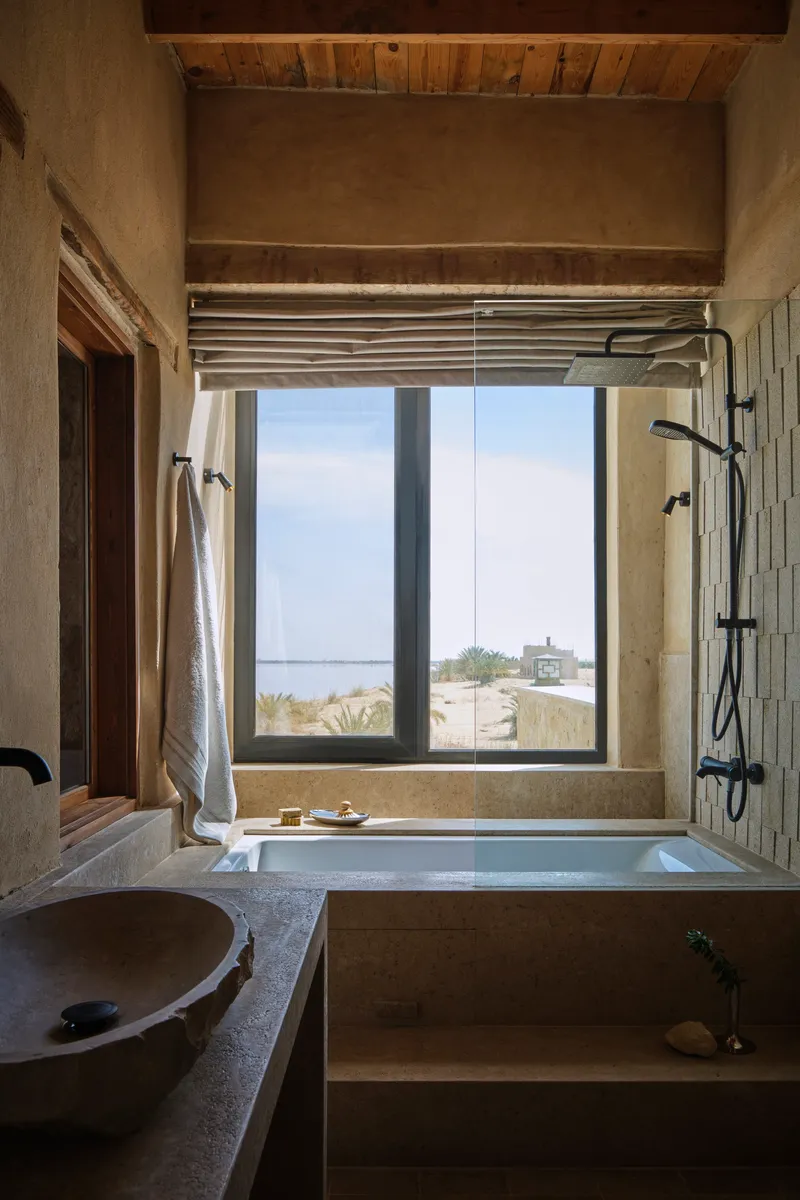
The bathrooms are among the most considered spaces in the house. Rounded stone vessel sinks sit on floating shelves integrated into thick plaster walls. One bathroom features a sunken tub positioned directly below a window framing the coastal landscape, turning bathing into a contemplative act. Textured plaster, white tile accents, and circular mirrors create interiors that feel spa-like without resorting to imported luxury finishes. The material restraint here mirrors the rest of the house: everything is local, heavy, and permanent.
Between Inside and Outside
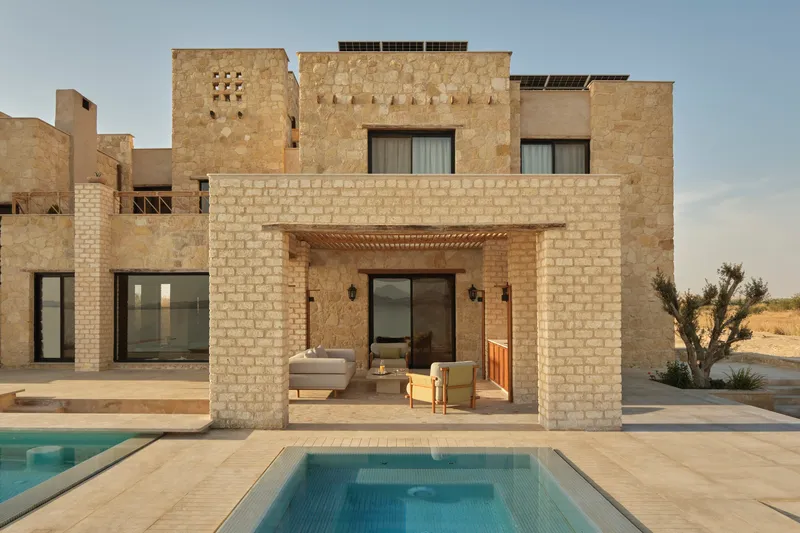
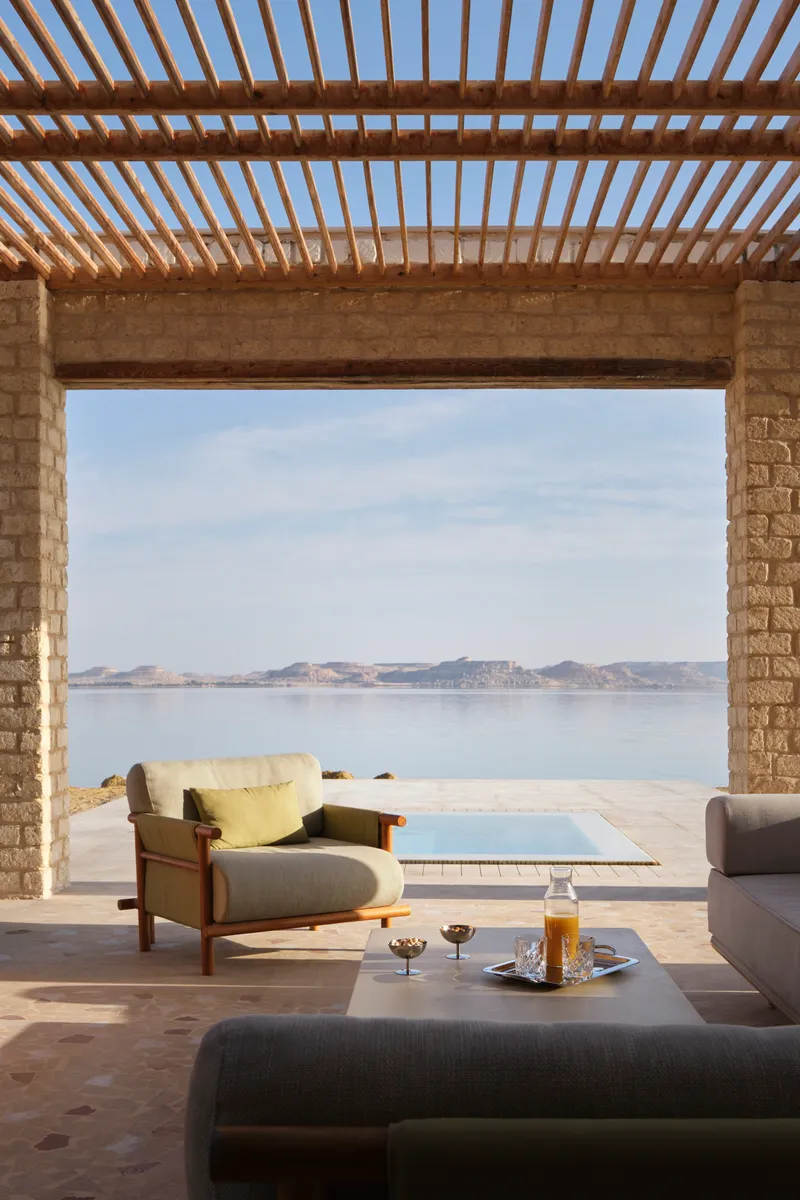
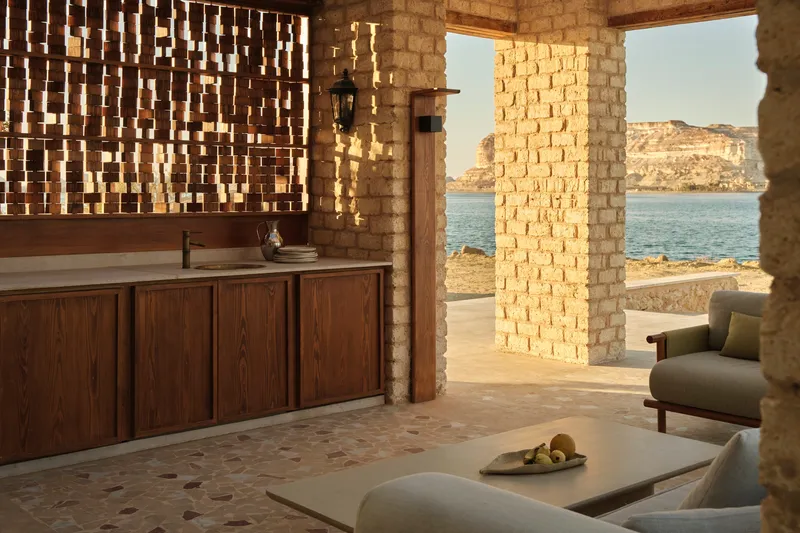
In Siwa's climate, the boundary between interior and exterior is not a line but a gradient. The Aldomiaty brothers exploit this through a series of transitional spaces: a covered terrace with limestone columns framing the pool, a timber pergola shading a seating area with views to distant hills, and an open-air lounge with a perforated brick screen wall that filters light and wind. These in-between zones are where the house truly lives. They are the rooms you use for eight months of the year.
The perforated brick screen deserves particular attention. It functions as a mashrabiya, the traditional Islamic screen that allows ventilation and filtered light while maintaining privacy. Here it separates the lounge from the open landscape while still permitting unobstructed views of the water. A timber credenza placed against it becomes a bar or serving surface for outdoor entertaining. The detail is simple, replicable, and deeply effective.
The Pool and the Plateau
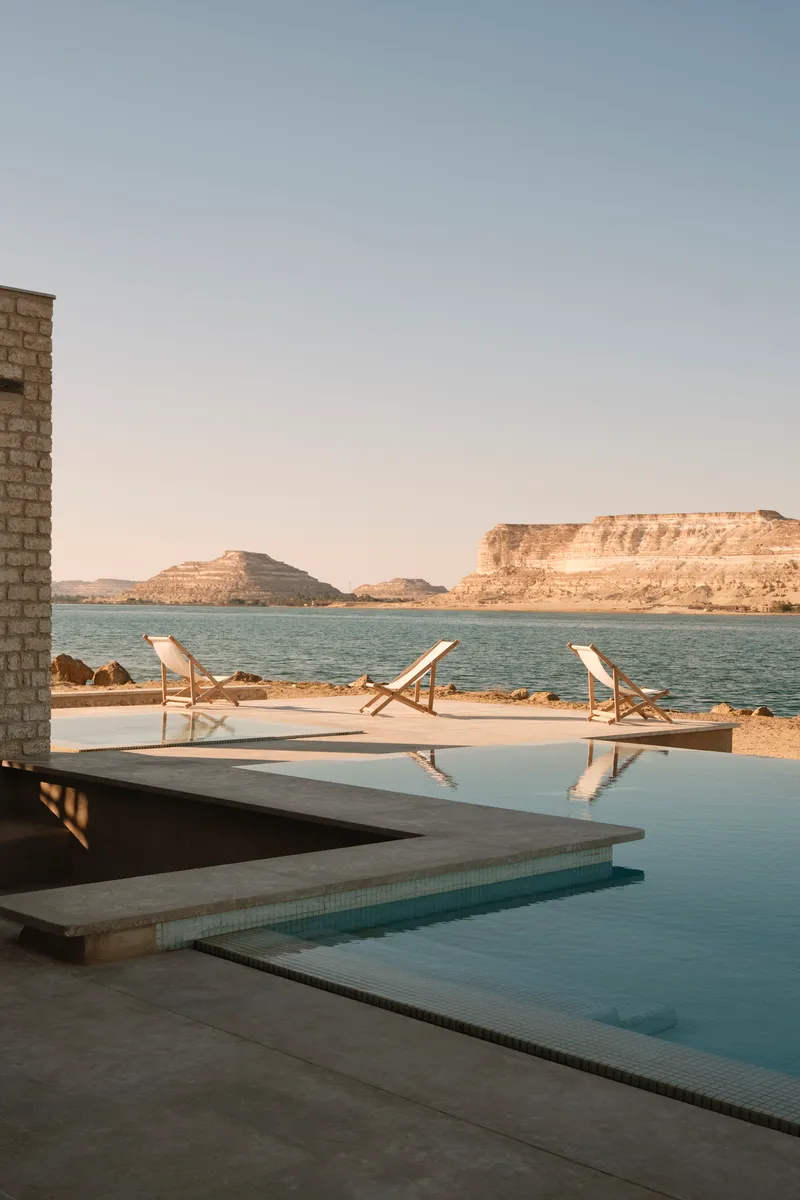
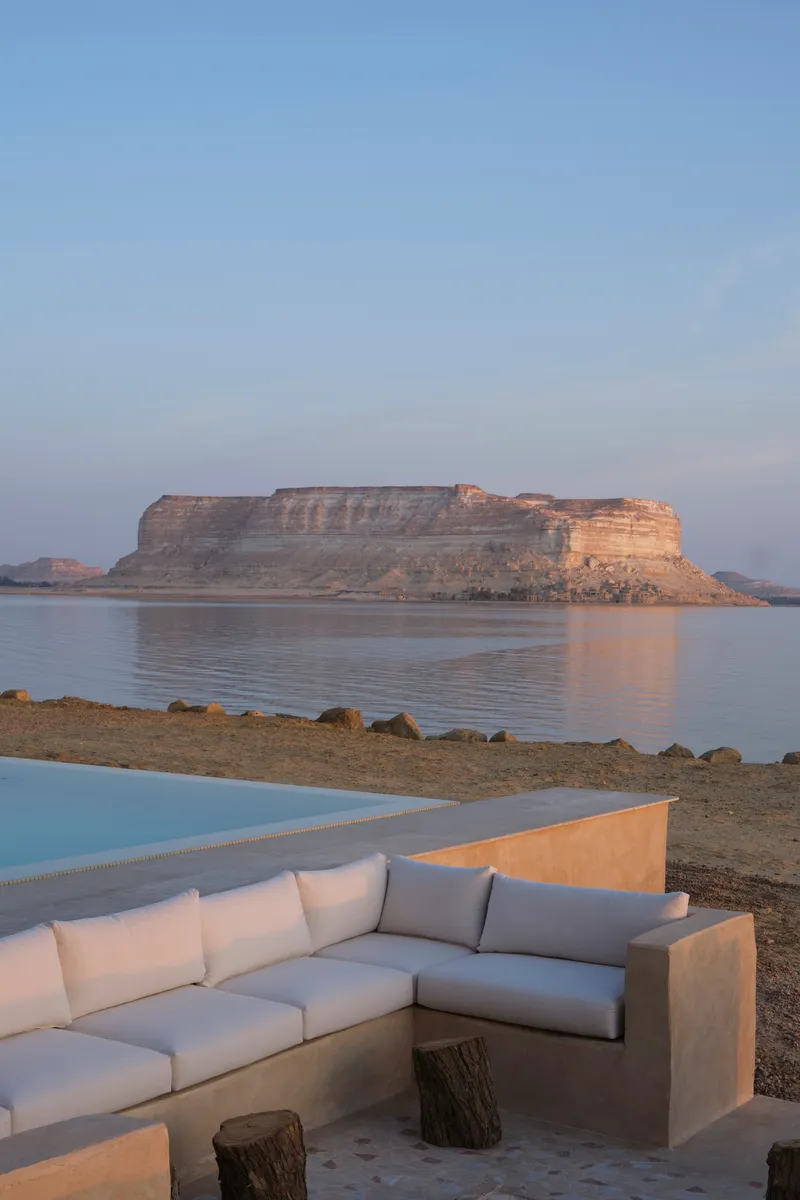

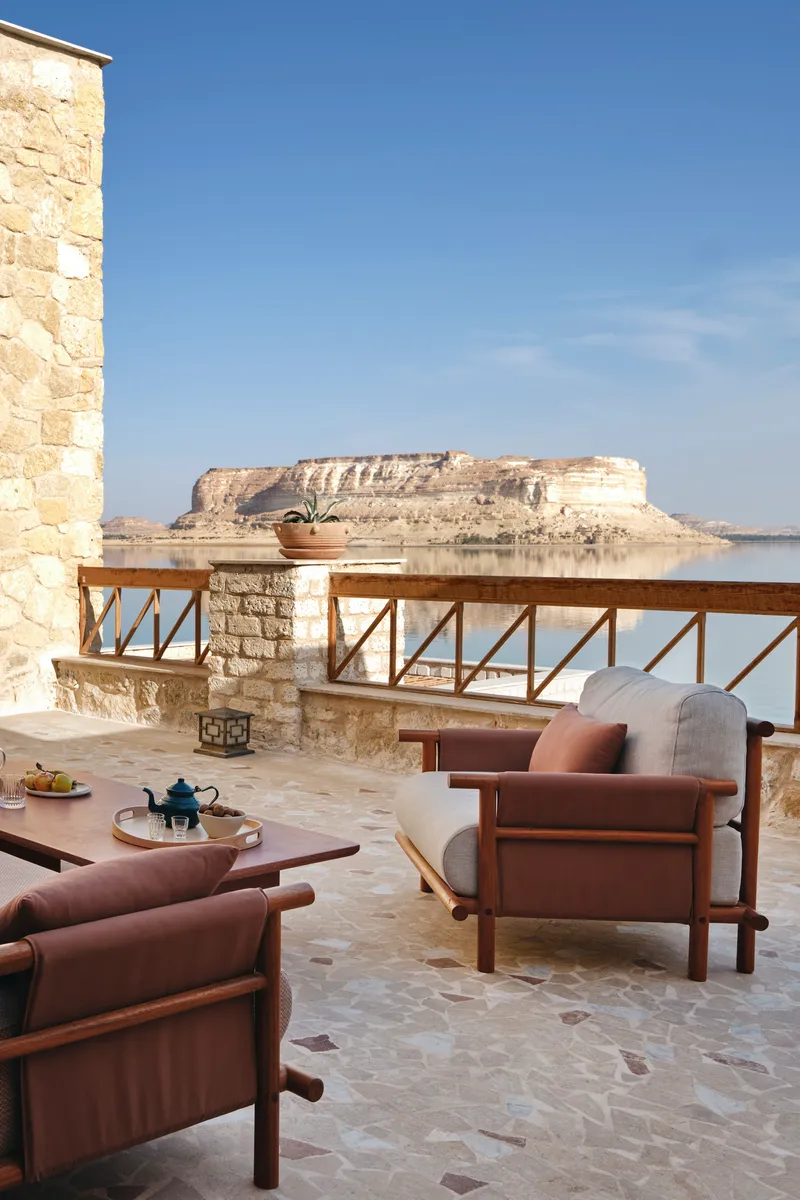
The pool extends from the building as a long infinity edge that visually merges with the salt lake beyond. At golden hour the water, the pool, and the stratified rock cliffs form a single continuous surface of reflected light. A sunken limestone seating area beside the pool drops occupants below the sight line of the house, creating a private enclosure that feels carved from the earth itself. Three canvas deck chairs face the cliffs, a gesture of minimalism that lets the landscape do the work.
The outdoor spaces are detailed with the same material seriousness as the interiors. Limestone terraces, timber armchairs, and coursed stone walls extend the architectural language seamlessly from building to landscape. There is no moment where the house stops and the garden begins. The wet sand around the base of the building at twilight dissolves the foundation line entirely, completing the illusion that the house has always been here.
Details and Thresholds
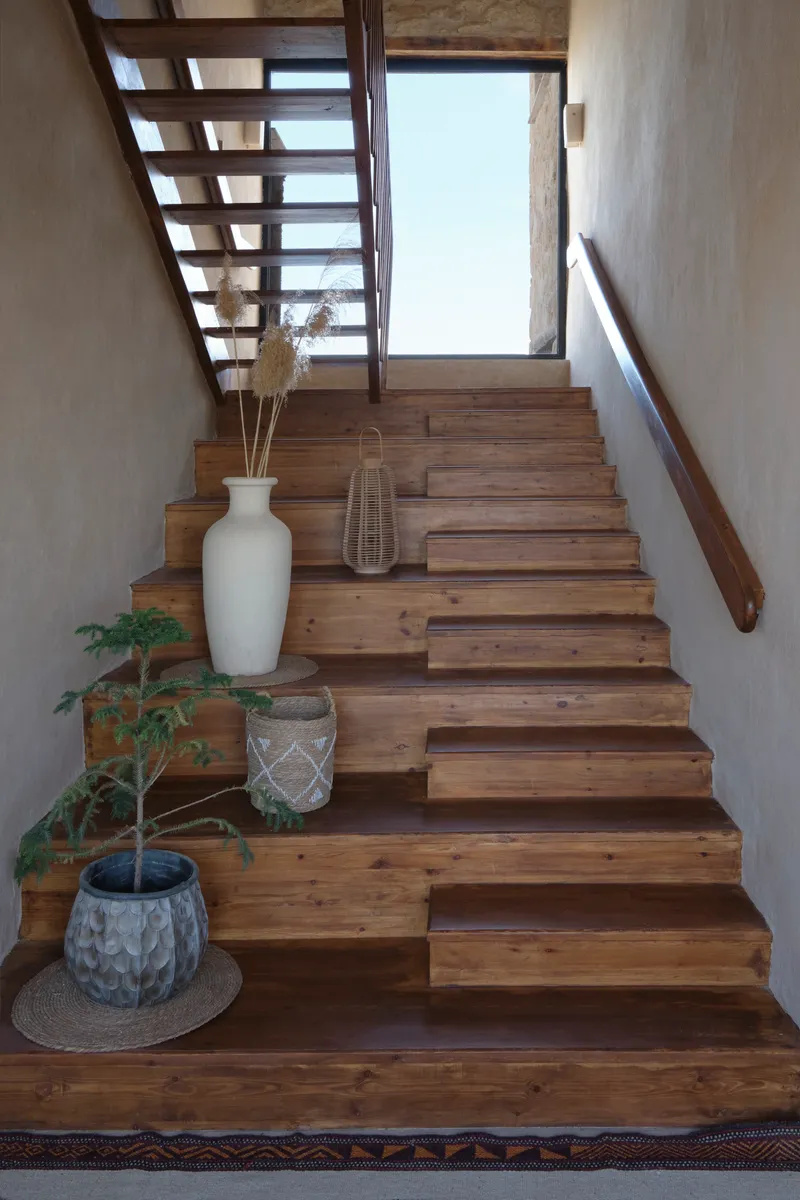

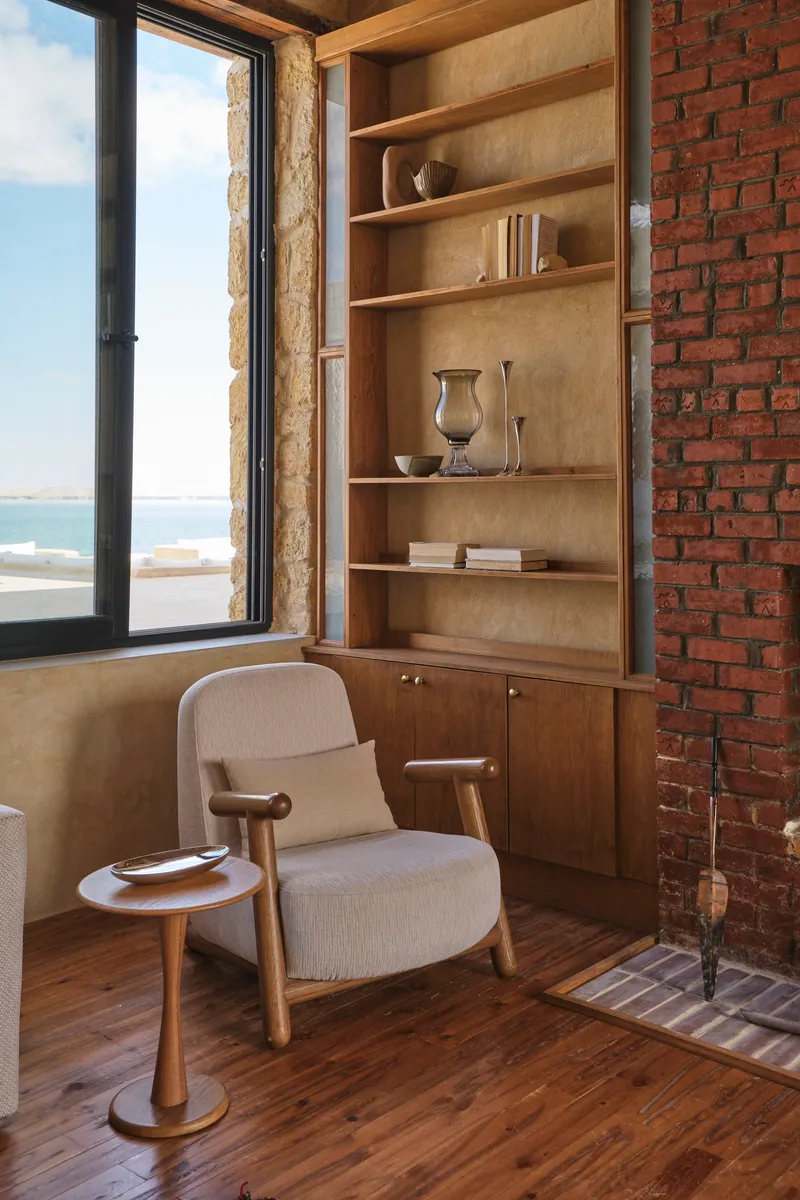
The details throughout are consistent and well-resolved. A timber staircase with open risers and planted vessels at its base becomes a small garden within the house. Weathered painted wooden double doors set into a coursed stone wall with iron brackets reference traditional Siwan joinery, complete with a heavy timber lintel. Built-in timber shelving beside an exposed brick wall, paired with an armchair near an open window, creates a reading nook that is entirely self-evident in its use.
These are not decorative flourishes. Each detail serves a dual function: the open staircase risers allow air circulation between floors, the heavy doors provide thermal insulation, and the built-in shelving eliminates the need for freestanding furniture that would obstruct airflow. In a self-sufficient house, every element needs to earn its place, and here they do.
Plans and Drawings
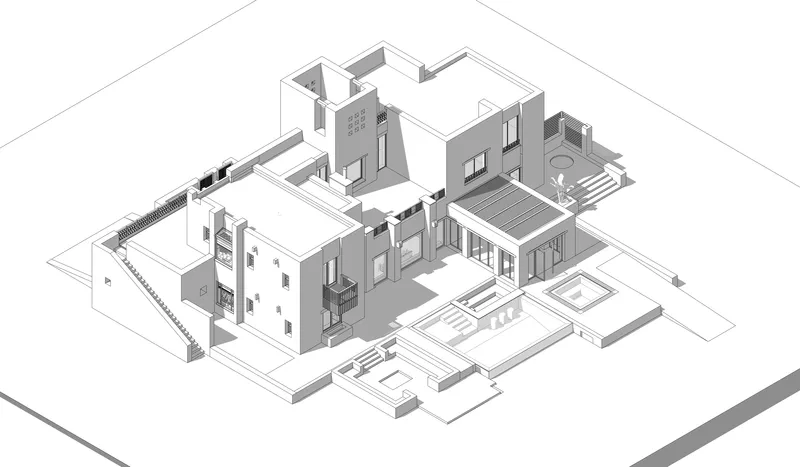
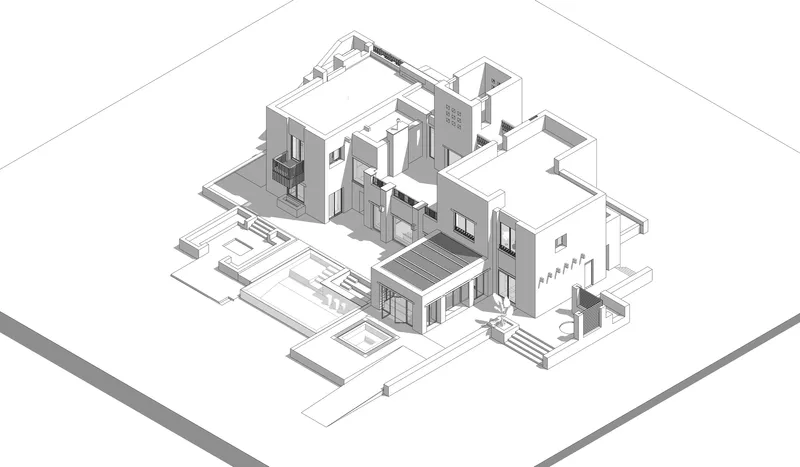
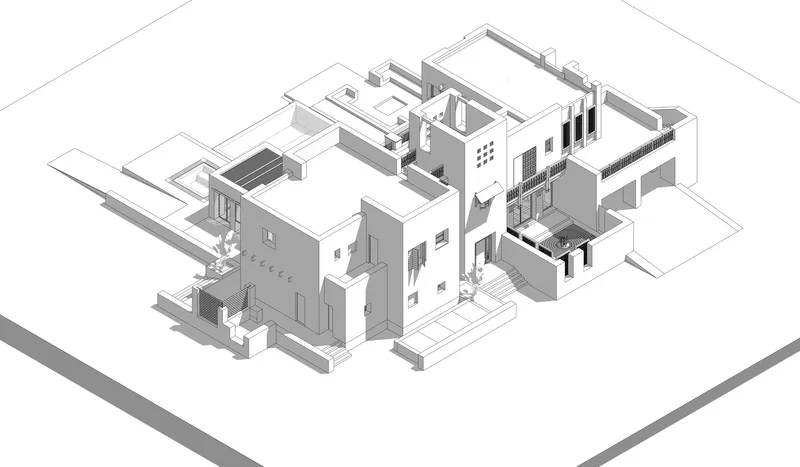
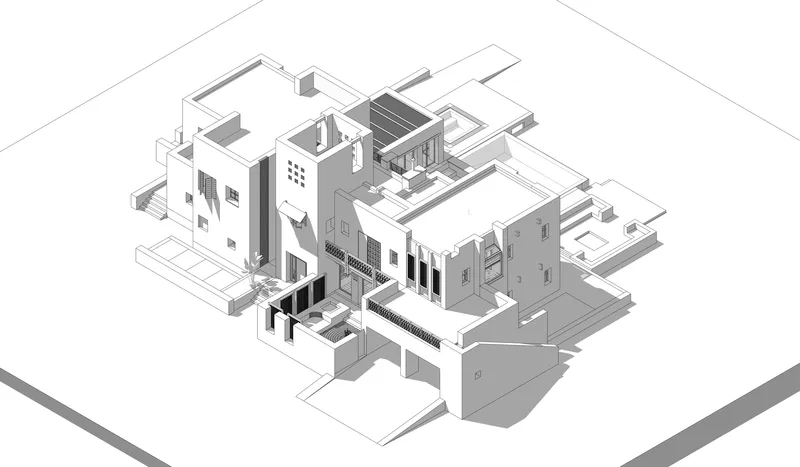
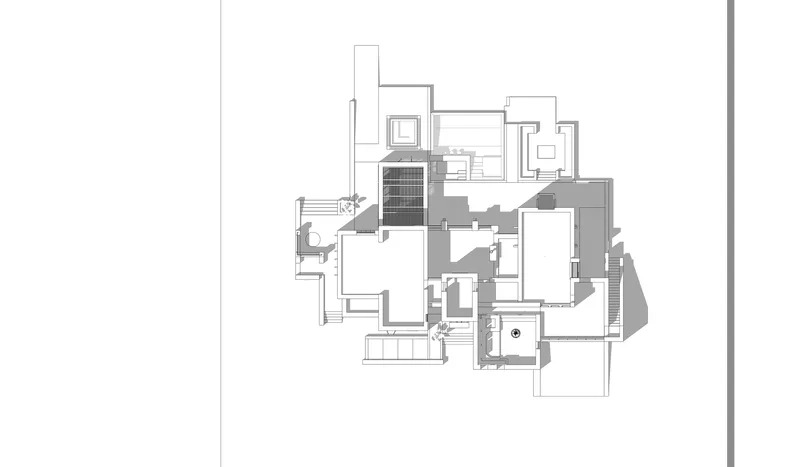

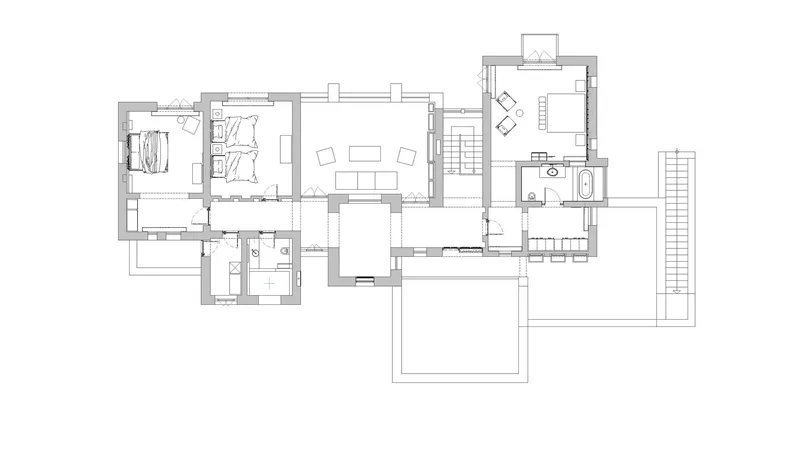
The axonometric drawings reveal the organizational logic that the photographs only hint at. The house wraps around a central courtyard, with rooms arranged to maximize cross-ventilation and shade. Stepped terraces on the roof create usable outdoor space at multiple levels, and the varying heights of the interconnected volumes allow hot air to rise and escape from clerestory openings. The floor plans show a clear hierarchy: public spaces (living, dining, kitchen) occupy the ground level closest to the pool and courtyard, while bedrooms retreat to quieter upper levels with water views.
The site plans, rendered with contour lines, reveal how carefully the building is sited relative to the natural topography. The house steps down with the terrain toward the water, avoiding the need for extensive earthwork and allowing natural drainage patterns to continue undisturbed. The courtyard acts as a thermal regulator, a light well, and an organizational spine simultaneously. It is a plan that could have been drawn a thousand years ago and still work perfectly.
Why This Project Matters
The Gagy House arrives at a moment when sustainability in architecture has become almost entirely synonymous with technology: photovoltaic panels, heat pumps, triple-glazed curtain walls, and carbon accounting spreadsheets. Kareem and Ehab Aldomiaty remind us that the most effective sustainable strategies are often the oldest. Thick stone walls, courtyard plans, perforated screens, barrel vaults, and careful orientation cost almost nothing in energy terms and have been proven over centuries in exactly this climate. The house does not need a LEED scorecard because its performance is evident in the temperature of its rooms.
More broadly, the project demonstrates that vernacular architecture can be reinterpreted without being sentimentalized. The Gagy House is not a museum piece or a nostalgic recreation. It is a contemporary dwelling that happens to use the same materials and spatial strategies as its predecessors because those strategies remain the most intelligent response to the site. In Siwa, where the landscape has not fundamentally changed in millennia, the argument for continuity is not conservative. It is radical.
Gagy Self-Sufficient House by Kareem Aldomiaty and Ehab Aldomiaty, with technical engineering by Mohamed Amin Afifi. Siwa Oasis, Egypt. 650 m². Completed 2024. Photography by SARA MAGNI.
About the Studio
Kareem Aldomiaty
Share Your Own Work on uni.xyz
If projects like this are the kind of work you want to make, uni.xyz is a place to publish your own, find collaborators, and enter design competitions.


Popular Articles
Popular articles from the community


The Amber Palace Opera: A Geological Fiction Surfaces on Tallinn's Baltic Waterfront
Pierre Brillard reimagines a Baltic legend as a public landscape, opera house, and waterfront promenade rooted in Tallinn's coastal identity.
Tsunami Convergenics: Turning Catastrophic Ocean Forces into Underwater Housing Infrastructure
A speculative underwater settlement off the coast of Onagawa, Japan, treats tsunamis and typhoons as energy sources rather than threats.
Extended Shell: Retrofitting Kolkata's Balconies as Living Urban Thresholds
A modular retrofit system recovers the social and environmental intelligence of Kolkata's historic verandas for contemporary Park Street residents.

Cloaked Colonization: A Mobile Underwater Habitat That Moves Like a Fish
Micah Abaya's shortlisted EHC Pacific entry reimagines ocean settlement as a dispersed network of self-sustaining architectural organisms.

Similar Reads
You might also enjoy these articles

Pixel Gardens: One Repeated Module Stacked Into a Terraced Social Housing Tower for Famagusta
Salem Bader's shortlisted housing tower builds a vertical neighbourhood from one repeated module, offsetting units to carve terraces, light and air.

Bao Huynh Watercolor Atelier: A Serene Art Retreat in Hội An
Bao Huynh Watercolor Atelier in Hội An blends multifunctional art spaces, sustainable design, local materials, and family-friendly living in a serene environment.

Atelier Macri Concept Store Interior Design by CASE-REAL
Atelier Macri store features a "ko" counter, walnut wood details, cork displays, blending retail, gallery, and seamless customer experiences.

Manuel Vargas Izquierdo Stadium and High-Performance Sports Center: Architectural Excellence in Jalpa de Méndez
The Manuel Vargas Izquierdo Stadium blends sustainable design, inclusive sports facilities, and cultural-inspired architecture, revitalizing Jalpa de Méndez’s public spaces.

Explore Self-Sustainable Competitions
Discover active competitions in this discipline

Challenge to design mud housing for contemporary communities

Design challenge to reuse E-waste
Comments (0)
Please login or sign up to add comments
No comments yet. Be the first to comment!