

Paradigm Design House Wraps an Amman Nursery in Orange Curves and Color Psychology
The Kawni Early Care Center uses a 830-square-meter palette of plywood arches and bold hues to shape early childhood learning in Jordan.


Most early learning centers treat architecture as a container for education. Paradigm Design House treats it as the education itself. The Kawni Early Care Center, an 830-square-meter facility completed in 2024 in Amman, Jordan, is organized around a single formal gesture: a continuous orange curve that threads through the building, linking classrooms, play zones, and rest areas into one looping narrative about growth. It is a small building with an ambitious thesis, arguing that the spaces children inhabit during their first years should be as intentional and layered as any curriculum.
Designed by Saja Nashashibi and Nadine Hussein, the project takes color psychology out of the Pinterest mood board and makes it genuinely structural. Orange, blue, green, and yellow are not accent walls. They are spatial organizers, each assigned to a distinct developmental register: calm focus, physical well-being, emotional energy, creative stimulation. The result is a building that children can read before they can read, navigating by hue and form rather than signage.
The Outdoor Ground: Play as Landscape
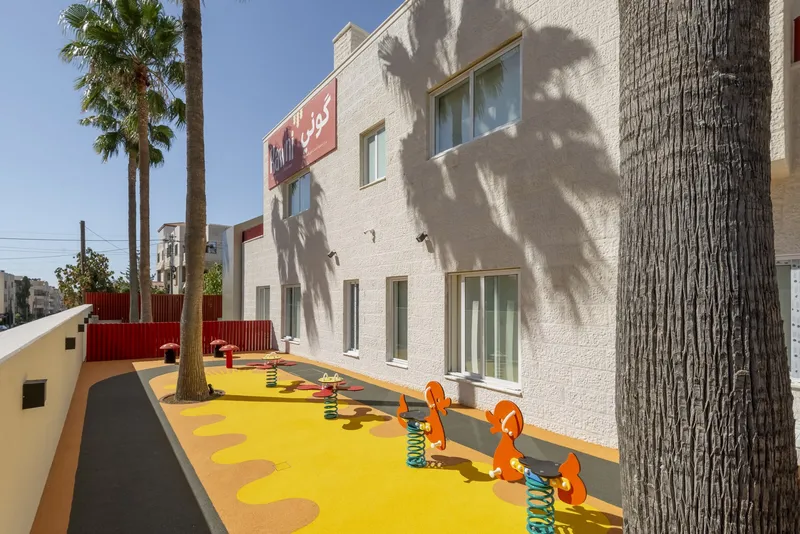
The outdoor play area is the project's most public face, and it sets the tone immediately. Yellow rubber surfacing spreads beneath orange spring riders and young palm trees, their shadows drawing shifting patterns on the white stucco perimeter walls. The palette is vivid without being chaotic: every color has a job. Yellow signals energy and activity underfoot, while the orange equipment reads as an extension of the building's signature curve rather than off-the-shelf playground furniture dropped onto a site.
What keeps this from feeling like a branded play zone is the restraint of the enclosure. The stucco walls are plain, almost austere, providing a neutral backdrop that lets the color and the children themselves become the visual event. The palms introduce a slower rhythm, their organic forms counterbalancing the geometry of the equipment. It is a compact courtyard that manages to feel generous.
Plywood Arches and the Language of Thresholds
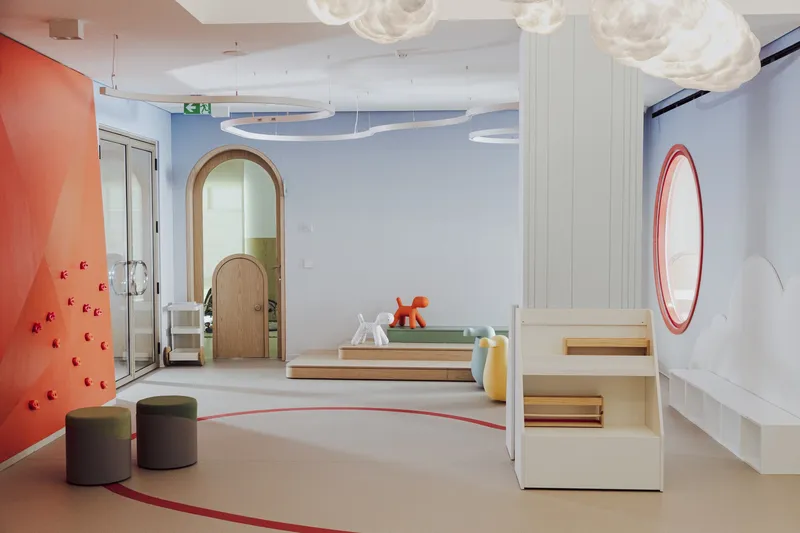
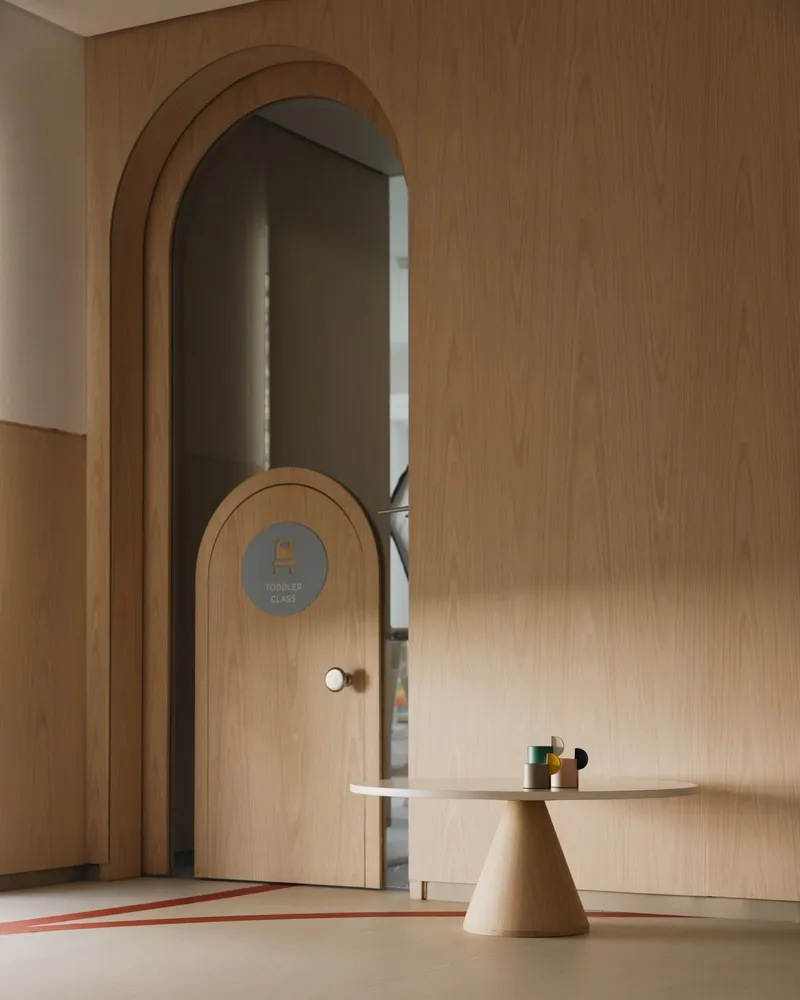
Inside, the defining architectural element is a series of arched plywood doorways that frame transitions between zones. These are not simply openings in a wall. They are thick, sculpted thresholds that children pass through physically, turning every movement from one space to the next into a small event. The warm birch-toned plywood reads as soft and approachable, a tactile counterpoint to the harder surfaces of climbing walls and stepped platforms beyond.
The arch at the center of the play space is particularly effective. It frames a coral-colored climbing wall studded with grips and anchored by a large circular red mirror at its base. Stepped white platforms cascade to one side, offering seating, staging, and improvised obstacle courses simultaneously. The mirror is a clever move: it gives toddlers a moment of self-recognition in the middle of physical exertion, blurring the line between motor development and cognitive play. Circular signage mounted on the arches uses icons rather than text, reinforcing the idea of a space legible to pre-literate users.
Sensory Interiors: Ball Pits and Suspended Clouds
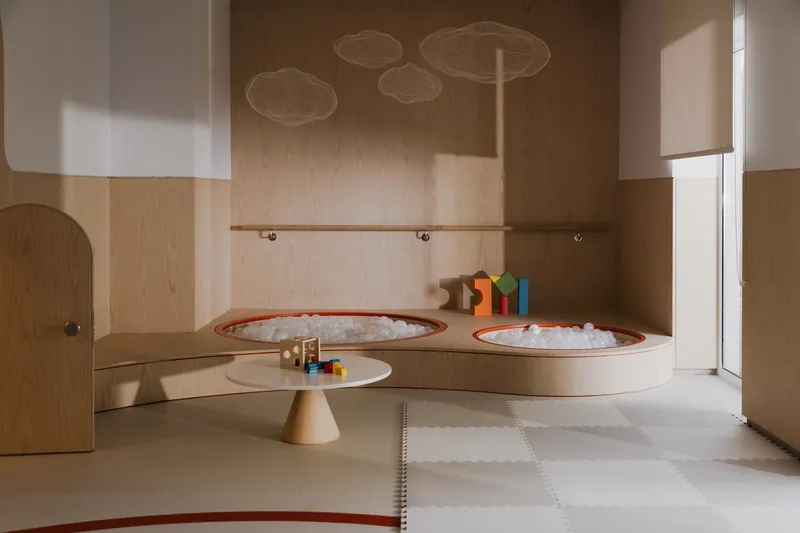
The interior play room is where the project's sensory ambitions are most concentrated. Circular ball pits with orange-trimmed rims sit within plywood-clad enclosures, creating intimate nesting zones at child scale. Above, mesh cloud fixtures hang from the ceiling, their soft, billowing forms introducing texture and visual depth without any weight or risk. The lighting is warm and diffused, filtering through the mesh to cast gentle shadows that shift as children move beneath them.
The material palette here is deliberately narrow: plywood, mesh, soft plastics, and that persistent orange. This restraint works in the project's favor. Rather than overwhelming young senses with novelty at every turn, the spaces offer variation within a consistent vocabulary. A child moving from the ball pit to the arched doorway to the climbing wall encounters different challenges and textures but never loses the thread of the whole. That continuity, the architectural equivalent of a reassuring hand, is the real achievement of the interior design.
Why This Project Matters
Educational architecture for the youngest learners is often dismissed as an exercise in cheerful decoration, a matter of rounding corners and painting walls bright colors. Kawni pushes back against that assumption with genuine spatial intelligence. The continuous orange curve is not just a brand identity; it is an organizational principle that ties rooms, corridors, and outdoor spaces into a legible sequence. The color strategy is not decorative but developmental, assigning specific psychological roles to specific hues and then embedding those hues into the structure rather than the finishes.
At 830 square meters, this is not a large building. But Paradigm Design House has treated every square meter as an opportunity to teach, comfort, or challenge a small child. In a region where purpose-built early learning architecture remains relatively rare, the Kawni Early Care Center offers a persuasive model: design the building as if the children are the most important clients you will ever have, because they are.
Kawni Early Care Center by Paradigm Design House (design team: Saja Nashashibi, Nadine Hussein). Located in Amman, Jordan. 830 m². Completed 2024.
About the Studio
Share Your Own Work on uni.xyz
If projects like this are the kind of work you want to make, uni.xyz is a place to publish your own, find collaborators, and enter design competitions.


Popular Articles
Popular articles from the community


Cube Design Draws an Ecological Corridor Between Two Shenzhen Hills with the Nankai Building
Beside Shenzhen's container docks, the Nankai Building pairs stacked balconies with a climbing green screen to connect two hillsides across its height.

Juan García Correa, John González and Claudia Rueda Sink a Circular Amphitheater into a Manizales Engineering Building
On the La Nubia campus in Manizales, Colombia, the S1 Building folds labs and offices into a hillside of ramped lawns that double as a campus route.

Architekt Andreas Gruber Scatters 23 Dark Timber Chalets Across a South Tyrolean Forest Edge
In Molini di Tures, Amonti Chalets breaks a resort into a hamlet of gabled timber houses, with parking, storage and services pushed into the slope.

David Macias Steps a Doorless Stone and Plaster House Down a Tropical Colombian Hillside
In the humid hills of Colombia, Threshold House replaces the front door with an open void and terraces its 850 m² down the slope instead of fighting it.

Similar Reads
You might also enjoy these articles


Hodi-Mandai Geram
Project Function: Preservation and revitalization of the Intangible heritage and socio-spatial identity of the Hodi by Housing, Cultural Memory Center, Sacred Grove, landscape, local tourism economy


Olio Towers: A Mid-Rise for Performers That Fuses Housing, Rehearsal, and Stage
Located blocks from Houston's Theater District, this modular tower stacks living units around a central performance atrium.

Oasis: Modular Green Housing Carved into Dhaka's Urban Fabric
A shortlisted Plugin Housing entry reclaims unauthorized settlements in Dhaka with stepped concrete volumes, green roofs, and ventilation-driven design.

Black Hole: A Floating Megastructure for the Post-Physical Era
Emiliano Mazzarotto envisions a spherical, self-scaling arena where e-sports, digital hotels, and holographic stadiums replace traditional public space.

Explore Educational Building Competitions
Discover active competitions in this discipline

Challenge to design public laboratory

Challenge to reimagine the Iron Throne

Photograph architecture without architects

Illustrate the lost glory of Angkor Wat - Render Challenge
Comments (0)
Please login or sign up to add comments
No comments yet. Be the first to comment!