

BambuBuild Wraps a Vietnamese Seafood Hall in 5,000 Pieces of Hyperbolic Bamboo
In Long Thành, a boat-shaped thatched roof rises from woven iron bamboo columns that mimic the local nipa palm.


Long Thành is a district in rural Vietnam that is growing fast. A major international airport project has turned the town into a construction zone, and BambuBuild was asked to design a seafood restaurant that could hold its own as a visual anchor in the evolving landscape. The brief called for something recognizable, something that could be built quickly, and something made from environmentally responsible materials. The result is a 400-square-meter complex anchored by a bamboo hall with a thatched roof shaped like an upturned boat and columns that look like bundled riverside palms.
What makes the project worth examining is not the material choice alone but the structural geometry BambuBuild used to make it work. The hall is constructed from over 5,000 individual bamboo poles, all straight, all iron bamboo, a local species with tensile strength that exceeds steel. The architects organized those poles into hyperbolic paraboloid surfaces, a doubly-curved geometry that is both stiff and buildable without bending a single piece. The result is a roof that reaches four meters at the gable, shelters 180 diners, and reads as a single coherent form even though it is assembled from thousands of discrete elements.
The Hyperbolic Paraboloid as Structure
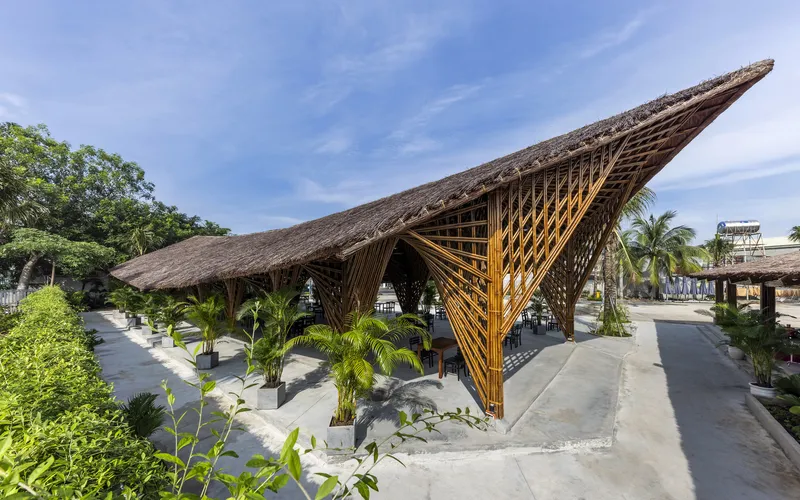
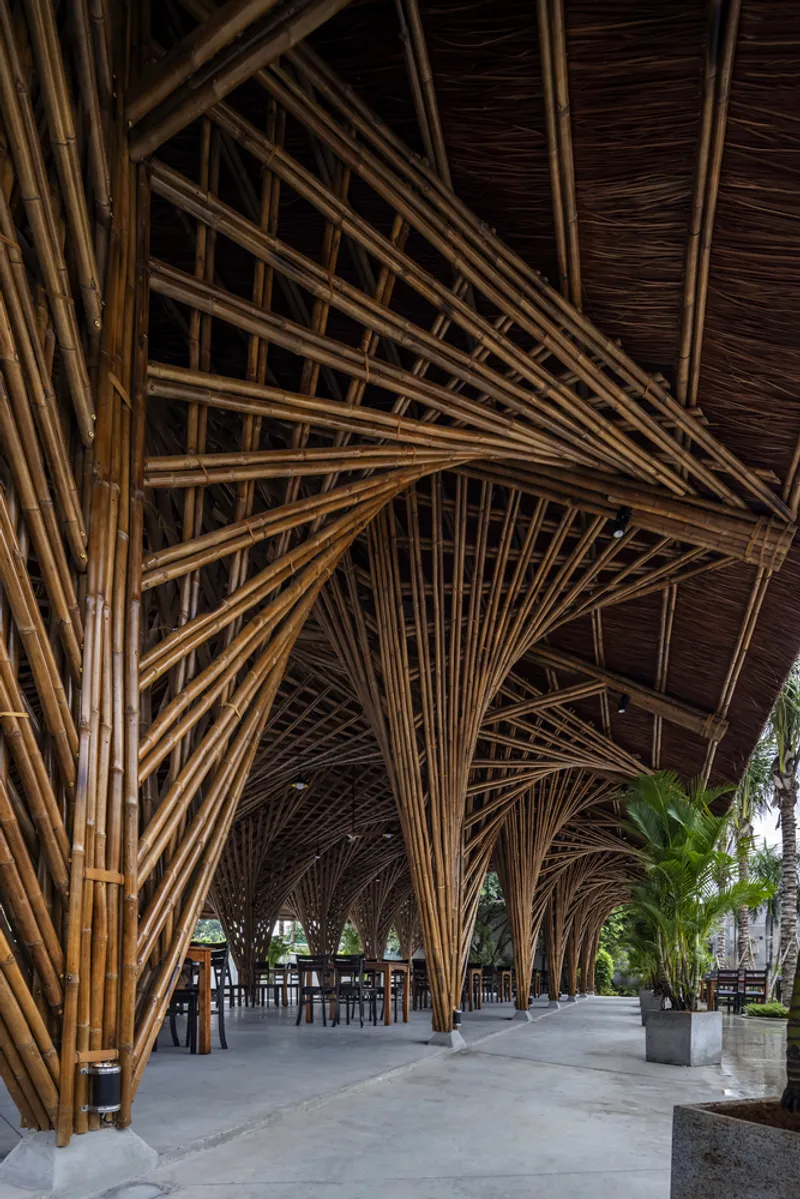
The hyperbolic paraboloid is a surface that curves in two directions at once. It is convex along one axis and concave along the other, and because it is doubly-ruled, it can be constructed entirely from straight lines. That property is what makes it buildable in bamboo. BambuBuild did not need to steam or bend the poles. They wove them together at calculated angles, and the hypar surface emerged. The columns are bundled assemblies that fan outward, echoing the shape of nipa palms, a plant that grows along the rivers in southern Vietnam. The reference is intentional, but the structure is modern. Each column is a compression element that transfers roof loads to the concrete foundation below.
The roof extends well beyond the walls, creating deep overhangs that shade the open ground floor. The open layout is a direct response to the tropical climate. There are no enclosed walls on the main dining level, just a series of hypar surfaces that define the space overhead. Conference halls, private dining rooms, and service areas are tucked into adjacent volumes, but the bamboo hall itself is a single continuous room. The two-layer roof system is a pragmatic solution to the geometry. Thatching a convex surface is straightforward, but the concave side of a hypar is more difficult. BambuBuild added trusses and purlins on the concave face to create sloped planes that could accept the natural thatch, layering the structure without compromising the visual clarity of the ceiling.
Inside the Bamboo Hall
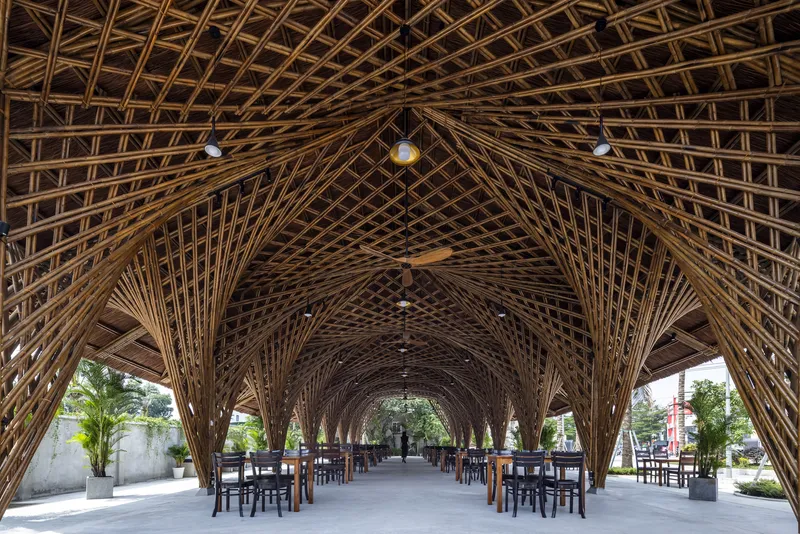
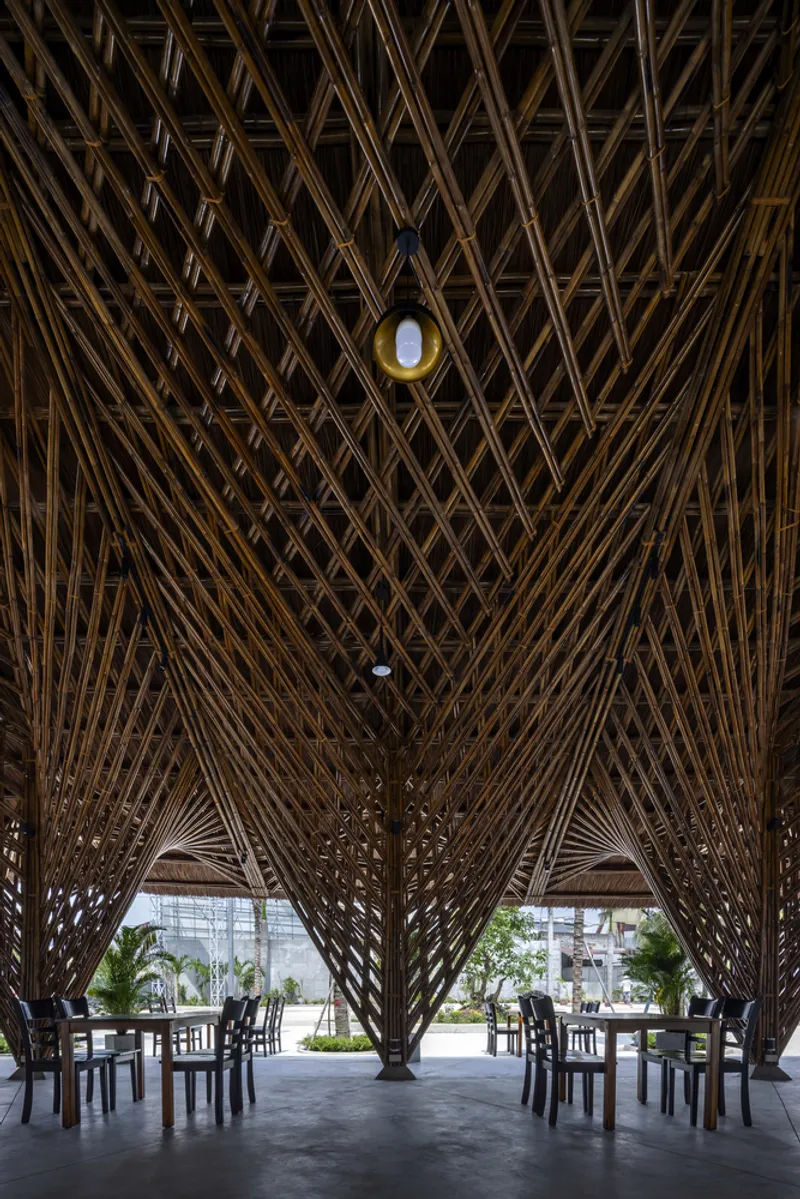
From inside, the bamboo hall reads as a series of interlocking ribs that rise and converge overhead. The lattice is dense enough to provide structure but open enough to let light filter through. A single pendant light hangs at the peak, but the space does not rely on artificial illumination during the day. The thatched roof diffuses sunlight, and the open perimeter admits air. The dining tables are arranged in rows, and the floor is polished concrete. There is no ornamentation. The bamboo does all the work.
The columns are the most expressive elements. Each one is a cluster of poles that starts tight at the base and spreads as it rises, creating a branching effect. The bundling technique is structural, but it also creates a visual rhythm. The columns are spaced evenly, and the hypar surfaces that connect them form a continuous vaulted ceiling. The effect is both orderly and organic. The geometry is rigorous, but the material is warm. That tension is what gives the project its character.
Bamboo as a Regional Building Tradition
Vietnam has a long history of building with bamboo, and BambuBuild is drawing on that tradition while pushing it forward. Iron bamboo is a durable species that has been used for posts, beams, and trusses in vernacular construction for centuries. What is new here is the scale and the precision. The hypar geometry requires exact alignment, and the assembly process demands coordination among a large crew. BambuBuild worked in collaboration with the architecture firm Tran Ba Tiep to execute the design, and the project was completed in 2023. The construction timeline was tight, which was part of the brief. The client wanted a building that could go up quickly and still make a statement.
The boat-shaped roof is a formal gesture that ties the building to the local context. Long Thành is not a coastal town, but it is close enough to the river that boats are part of the visual vocabulary. The thatched roof is another regional reference. Thatch is common in southern Vietnam, and it performs well in the heat. It insulates, it breathes, and it ages gracefully. The combination of thatch and bamboo is not novel, but the way BambuBuild has organized it is. The hypar surfaces turn a familiar material palette into something that feels both rooted and experimental.
Why This Project Matters
The Keeng Seafood Restaurant is a demonstration of what becomes possible when architects treat bamboo as a precision material rather than a rustic one. The hypar geometry is not decorative. It is the most efficient way to build a large-span roof from straight poles, and it produces a form that is visually coherent and structurally sound. BambuBuild has shown that bamboo can compete with steel and concrete on performance while offering a lower environmental footprint. The project does not romanticize the material. It uses it.
Long Thành is changing rapidly, and most of the new construction will be generic. The Keeng Seafood Restaurant is an argument for a different approach. It proves that fast construction does not have to mean anonymous architecture, and that sustainable materials can carry formal ambition. The project is not trying to be a museum piece. It is a working restaurant that seats 180 people and will be used hard. But it is also a landmark, and it will remain one as the town grows around it. That is the real achievement. BambuBuild has built something that is both functional and memorable, and they have done it with a material that is renewable, local, and structurally credible.
Keeng Seafood Restaurant, BambuBuild in collaboration with Tran Ba Tiep, Long Thành, Vietnam, 400 m², 2023. Photography by Hyroyuki Oki.
About the Studio
Share Your Own Work on uni.xyz
If projects like this are the kind of work you want to make, uni.xyz is a place to publish your own, find collaborators, and enter design competitions.



Popular Articles
Popular articles from the community


The Musturak Paradise: Senior Living Architecture for a Connected Future in Temara, Morocco
The Musturak Paradise reimagines senior living architecture in Temara via private homes, social spaces, culture, community, and shared care.

Hill & Cross Opera: Sculptural Opera House Architecture Shaped by Tallinn’s Landscape and Identity
Hill & Cross Opera reimagines opera house architecture in Tallinn through its sculptural hill, civic plaza, glass wave and a luminous cross.

Co-life: Sustainable Architecture for Age-Friendly Community Living
Co-life reimagines sustainable architecture for seniors through courtyards, rammed earth, shared gardens, and spaces designed for belonging.

Riyadh For All: Intergenerational Urban Design for Active Aging in Rabat
Riyadh For All reimagines urban design in Rabat with intergenerational co-living, adaptive courtyards, and Moroccan cultural exchange today.


Similar Reads
You might also enjoy these articles


Hodi-Mandai Geram
Project Function: Preservation and revitalization of the Intangible heritage and socio-spatial identity of the Hodi by Housing, Cultural Memory Center, Sacred Grove, landscape, local tourism economy


Olio Towers: A Mid-Rise for Performers That Fuses Housing, Rehearsal, and Stage
Located blocks from Houston's Theater District, this modular tower stacks living units around a central performance atrium.

Oasis: Modular Green Housing Carved into Dhaka's Urban Fabric
A shortlisted Plugin Housing entry reclaims unauthorized settlements in Dhaka with stepped concrete volumes, green roofs, and ventilation-driven design.

Black Hole: A Floating Megastructure for the Post-Physical Era
Emiliano Mazzarotto envisions a spherical, self-scaling arena where e-sports, digital hotels, and holographic stadiums replace traditional public space.


Explore Bamboo Construction Competitions
Discover active competitions in this discipline



Challenge to reimagine the Iron Throne


Photograph architecture without architects


Illustrate the lost glory of Angkor Wat - Render Challenge


Design challenge to reuse E-waste
Comments (0)
Please login or sign up to add comments
No comments yet. Be the first to comment!