
Kengo Kuma and TAISEI DESIGN Wrap a Yokohama School in Cedar to Make Every Space a Classroom
A 14,865-square-meter international school in Yokohama channels traditional Japanese domestic openness into a campus for children aged 3 to 18.


Most international schools treat their campuses as a sequence of sealed-off boxes: classrooms here, gym there, cafeteria somewhere else. Yokohama International School, designed by Kengo Kuma & Associates and TAISEI DESIGN Planners Architects & Engineers, does the opposite. Completed in 2021 on a greenfield site in Naka-ku, the campus folds two timber-clad buildings around a central courtyard so that movement between spaces is always visible, always shared, and always potentially educational. The architecture insists that corridors are not dead zones; they are living rooms.
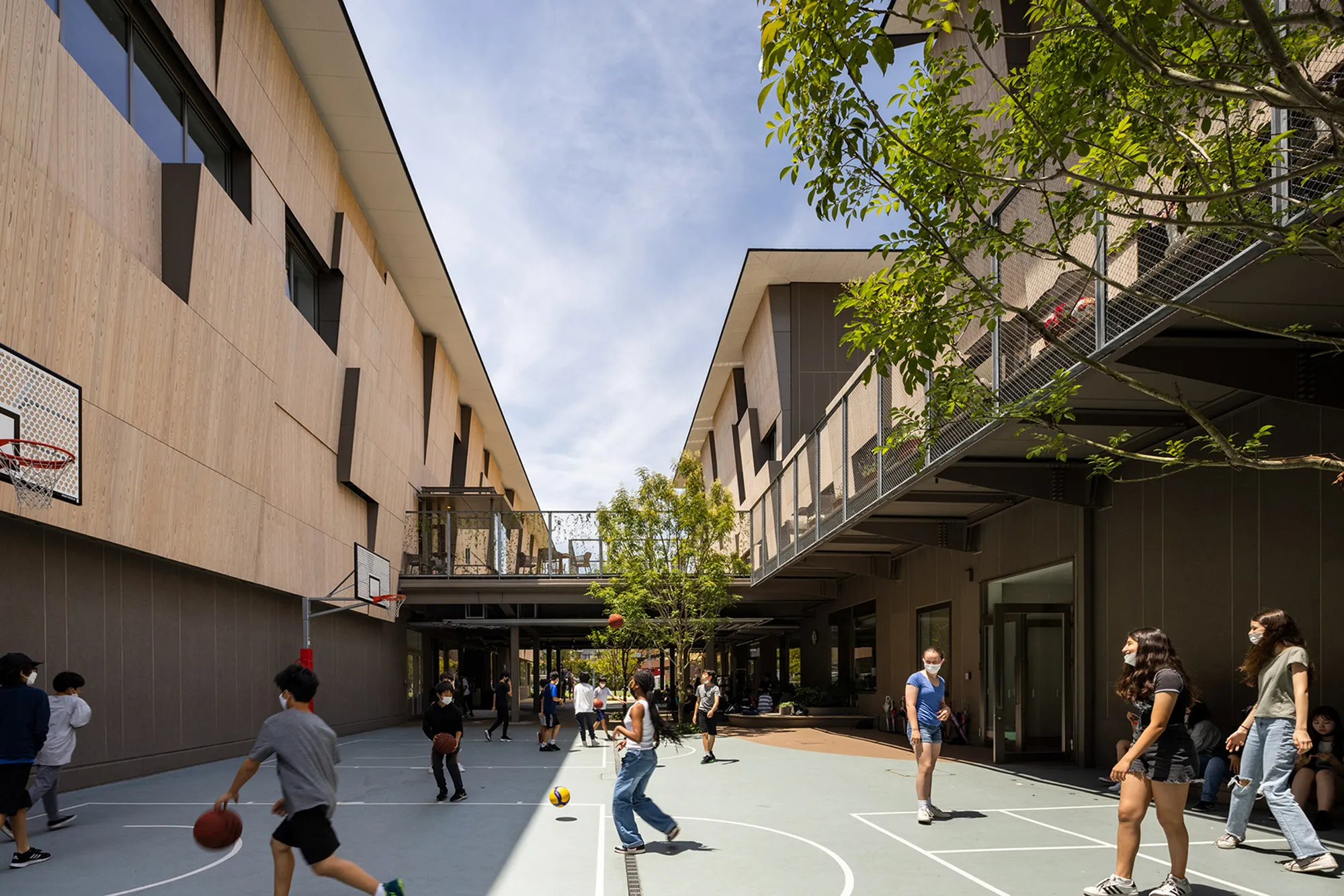
What makes the project genuinely compelling is the way it translates a domestic Japanese concept, the fusuma-and-shoji logic of sliding doors and open rooms, into a 14,865-square-meter institution serving 200 more students than the school's previous hilltop campus in Yamate. A four-story North building holds the library, classrooms, theater, administration, and a 230-seat cafeteria. A three-story South building contains the Early Learning Center, gym, and indoor pool. Between them sits a courtyard that functions as the school's civic heart: basketball, soccer, socializing, and improvised performance all happen in plain view of nearly every surrounding window.
A Facade Built from Forest Logic
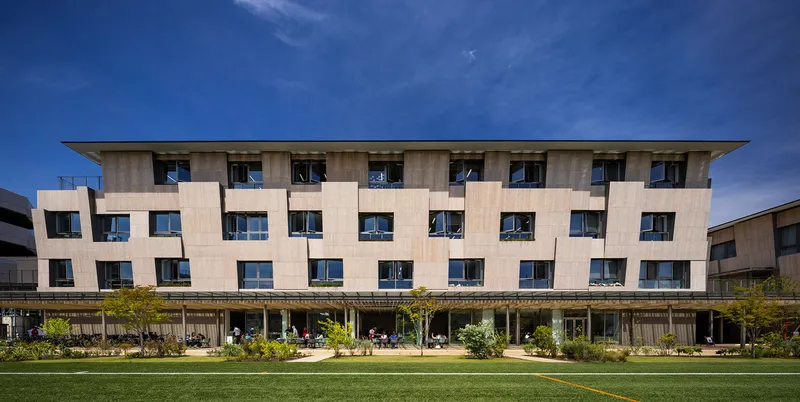
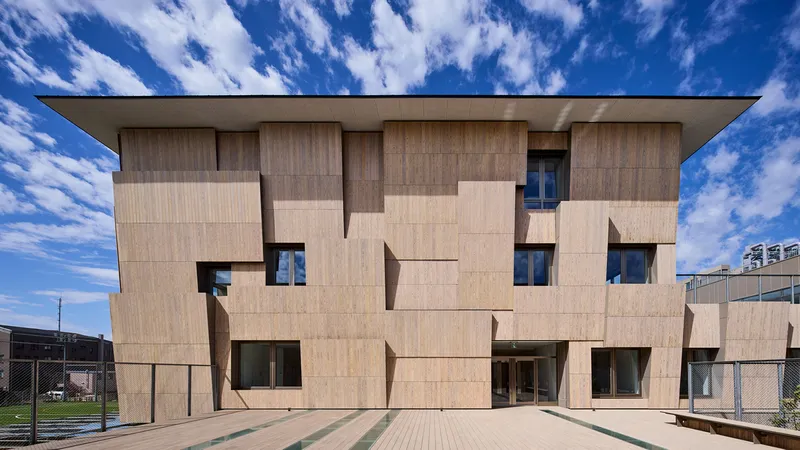
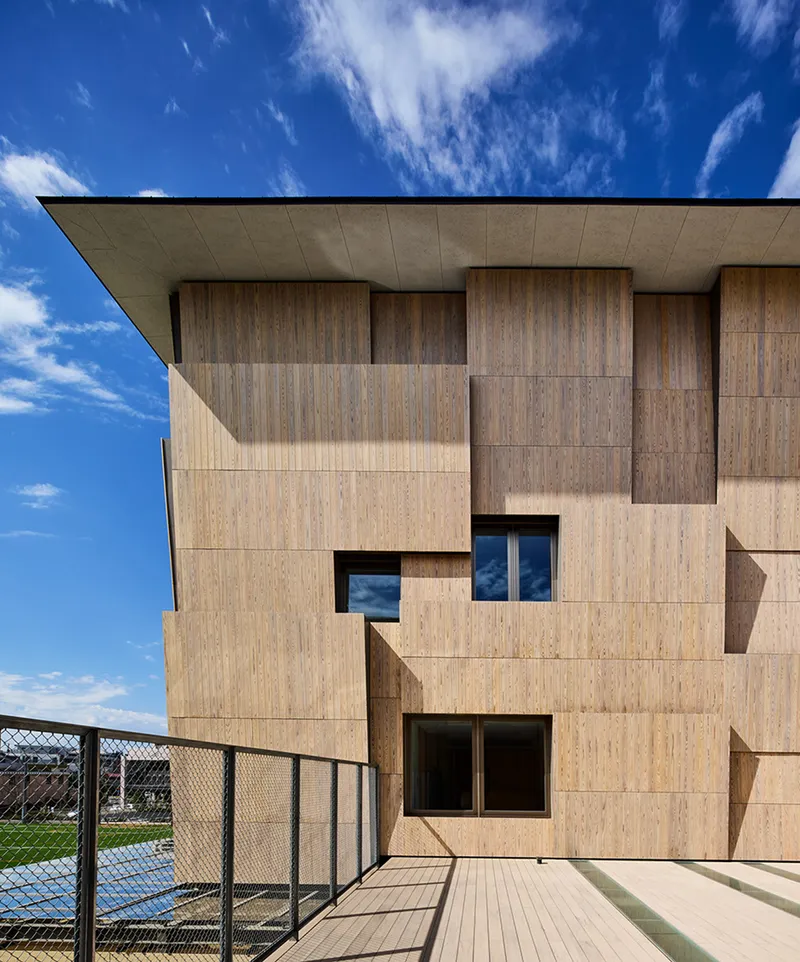
The exterior is perhaps the project's most legible gesture. Cedar panels, treated with a protective coating and mounted on steel frames over a fire-resistant substrate, are stacked and offset to create a surface that looks irregular but operates with a clear internal rhythm. Punched windows are scattered across the composition, deliberately avoiding gridded uniformity. The effect is textural rather than monumental: from a distance, the buildings read as oversized wooden volumes; up close, the grain of the cedar, the shadow lines between panels, and the slight variations in tone reveal a finer resolution.
Maintenance is an honest concern. The wood needs washing every two to three years, and some panels will require retreatment to hold their original color. That lifecycle is part of the design philosophy. A building for children should age visibly, not pretend to be permanent.
The Courtyard as Common Ground
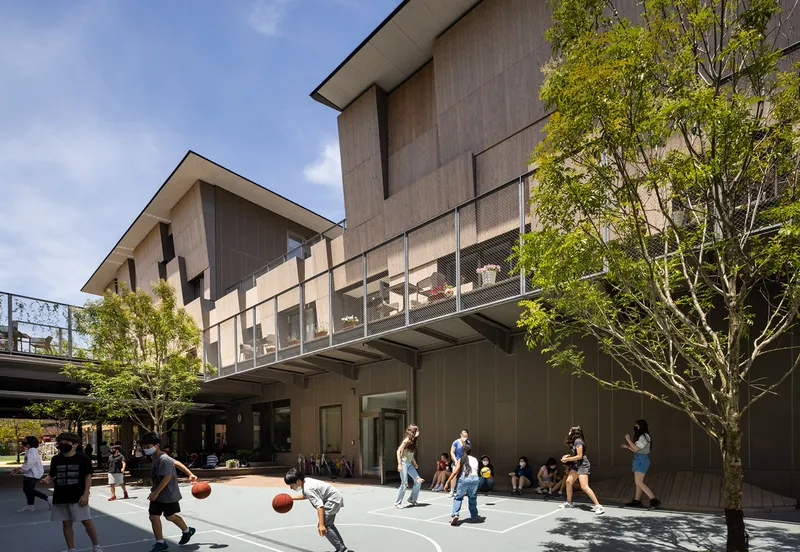
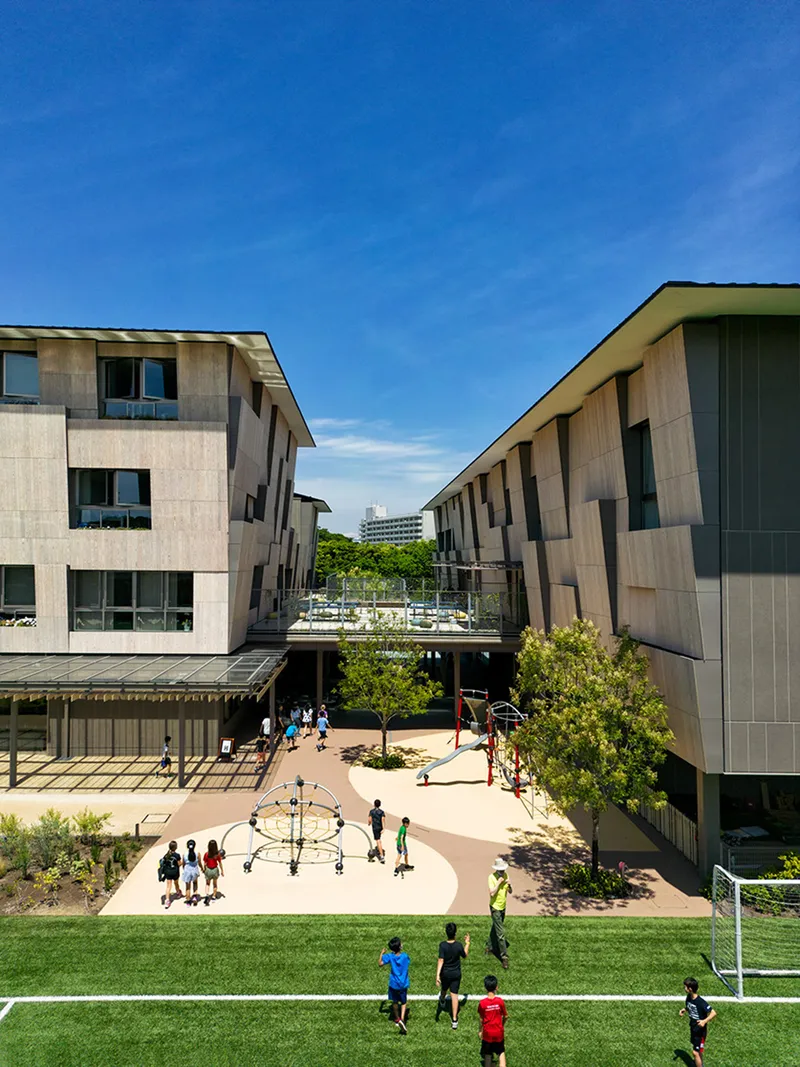
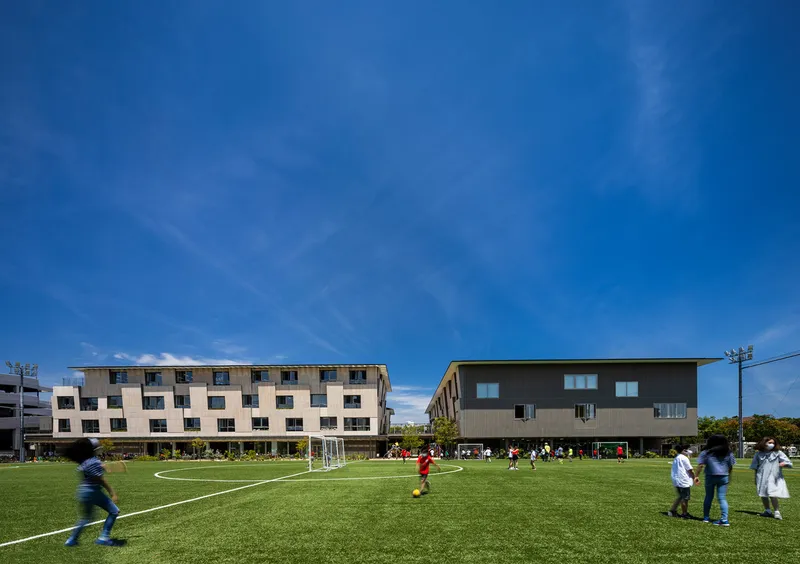
The central courtyard is where the "One School" concept stops being rhetoric and starts being spatial. Flanked by the two main buildings and connected at upper levels by an elevated bridge, the courtyard provides a synthetic-turf sports field, basketball courts, and open pavement where students of all ages cross paths. A three-year-old leaving the Early Learning Center sees eighteen-year-olds heading to chemistry. That overlap is intentional: the architects designed sightlines so that different age groups share visual territory even when their schedules diverge.
Ping-pong tables, climbing equipment, and informal seating occupy the margins of the outdoor space, creating pockets of activity that resist the monoculture of a single playing field. The courtyard is not a leftover between buildings; it is the campus's organizing principle.
Covered Thresholds and Outdoor Rooms
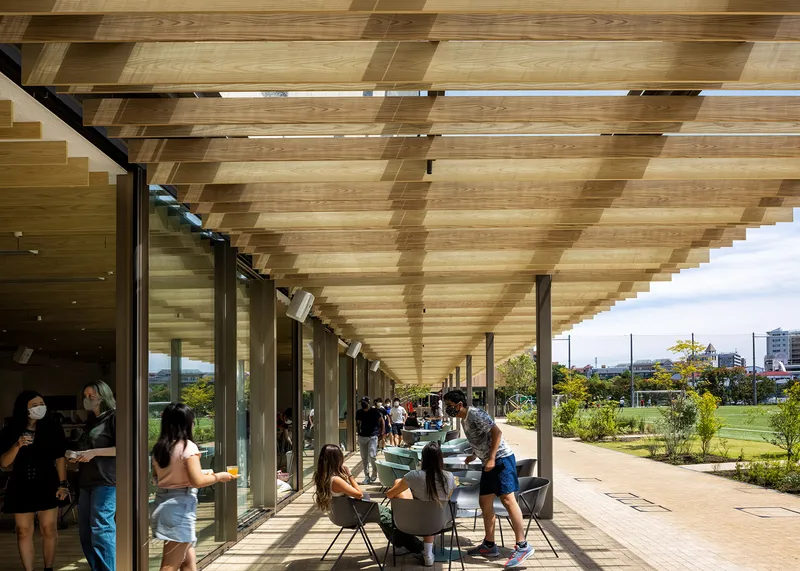
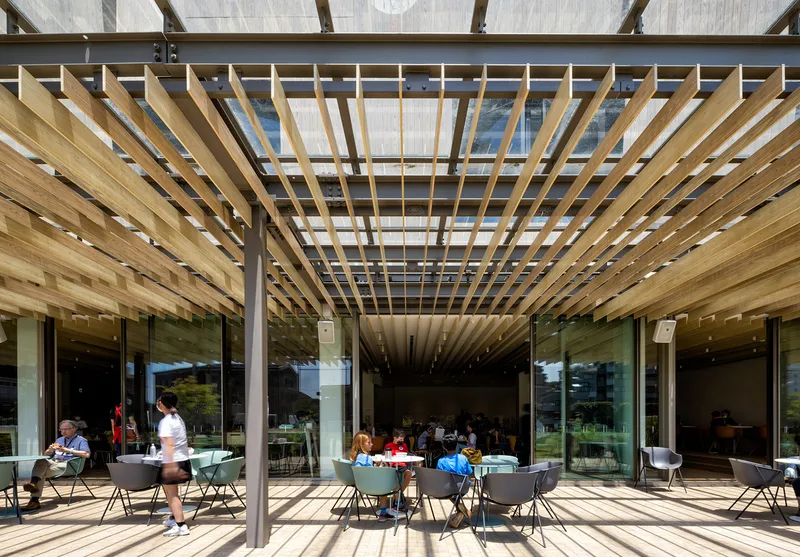
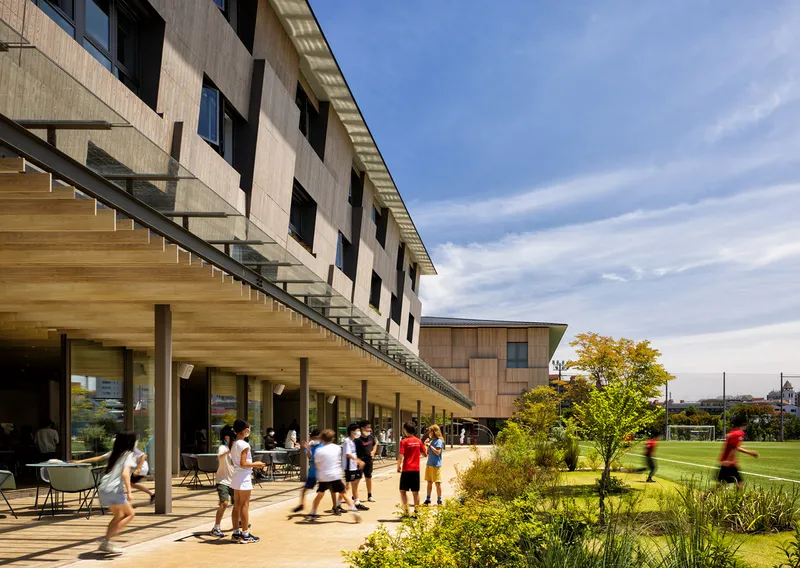
Yokohama's subtropical humidity and rainy seasons demand covered outdoor space, and the architects deliver it generously. Slatted timber pergolas cast linear shadow patterns over dining terraces. Covered walkways with alternating ceiling panels turn circulation into a sensory experience: warm light, cool shade, the smell of cedar overhead. An external glass staircase connects upper terraces to the playing fields, making vertical movement transparent and almost theatrical.
These thresholds matter because they multiply the kinds of space available to students. A shaded terrace is not a classroom, but it can host a tutorial, a quiet conversation, or a lunch break that spills into a drawing session. The campus's real square footage is not 14,865 meters; it is substantially more, once you count the zones that exist between inside and outside.
The Library as Vertical Living Room
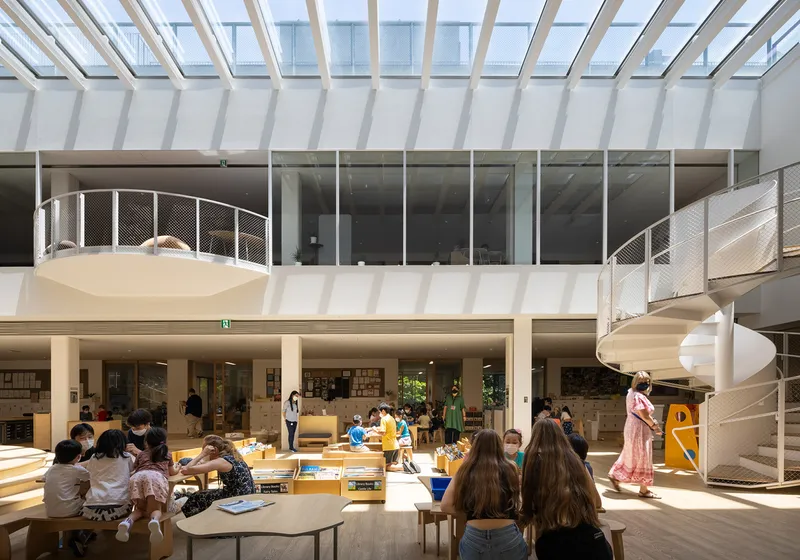
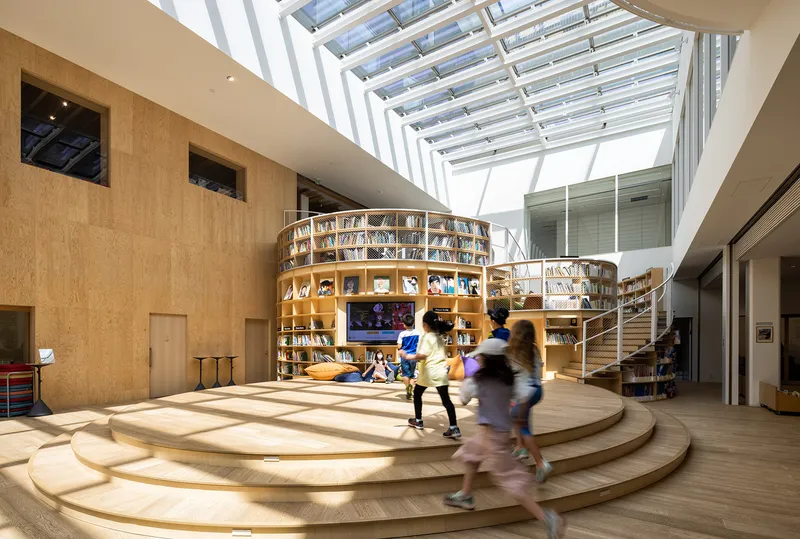
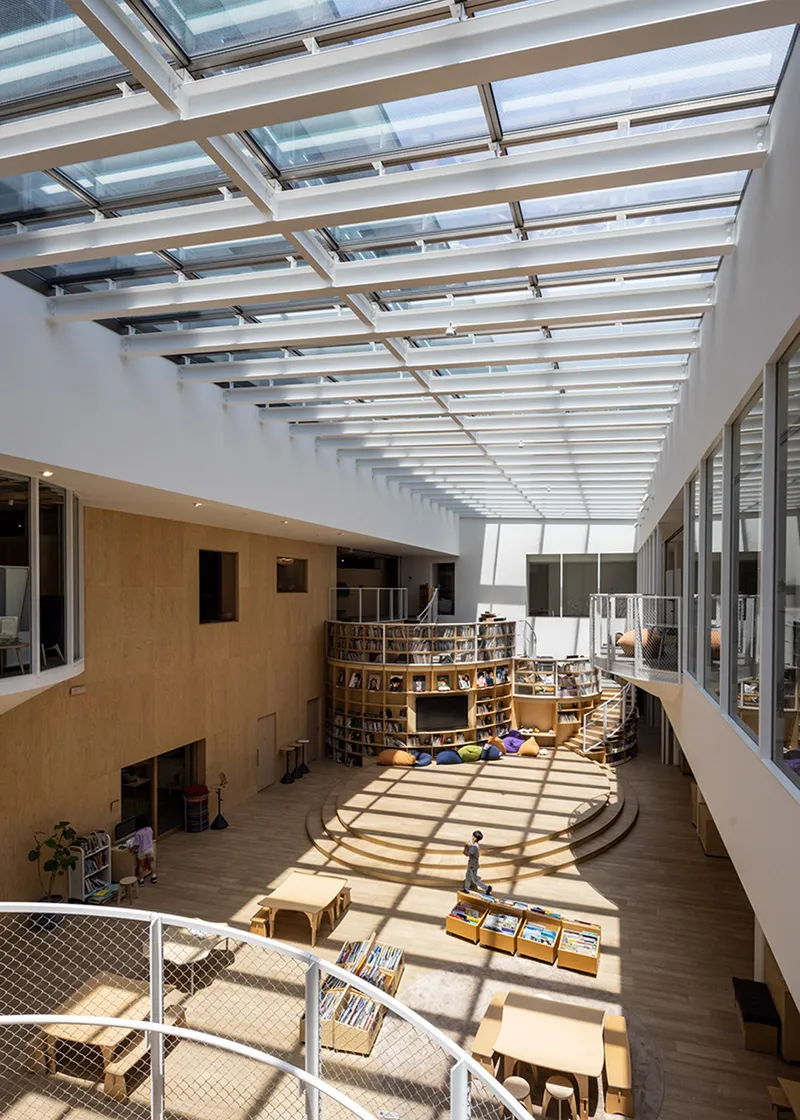
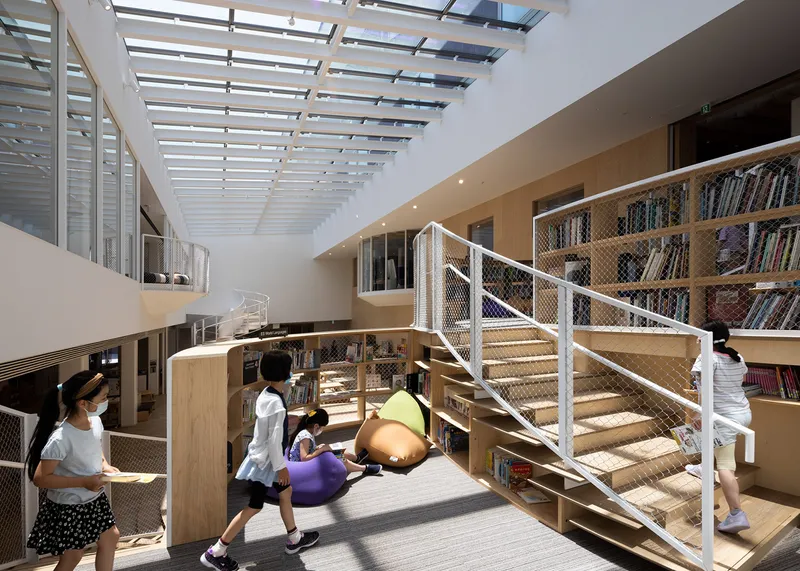
The library is the building's most spatially ambitious interior. A double-height atrium rises under a glazed skylight that washes the space in striped daylight. At its center sits a curved timber platform ringed by a circular bookshelf enclosure: part reading nook, part amphitheater, part playground. Children run through the lower level while others read on the mezzanine above. The metal spiral staircase connecting the two floors is open, ensuring that the act of moving between levels is part of the room's visual life.
The decision to treat the library as a kinetic, multi-level space rather than a silent hall is consistent with the school's educational philosophy. Every surface invites occupation. The circular enclosure is scaled for small bodies, but the mezzanine's long views and the skylight's dramatic shadows give the room a gravity that works for older students and faculty too.
Plywood Stacks and the Quieter Library Wing
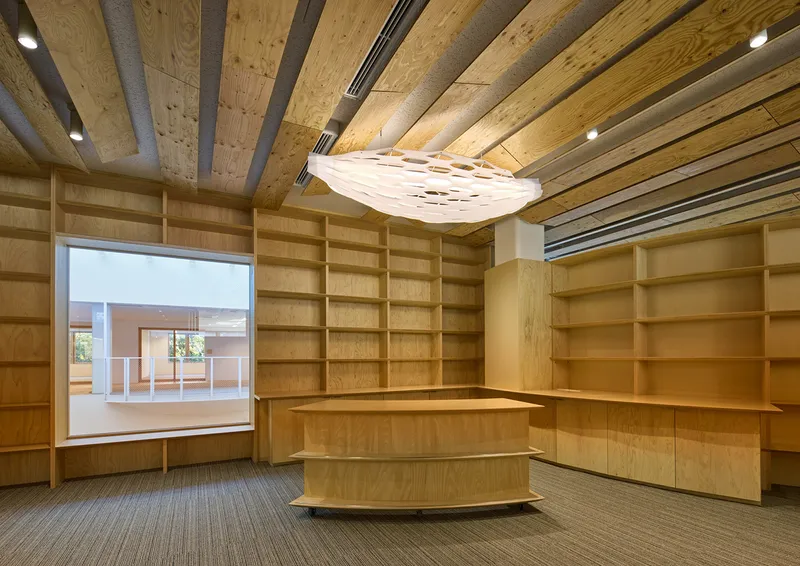
Adjacent to the atrium, a more conventional reading room offers floor-to-ceiling shelving, a central service desk, and exposed timber ceiling beams. Here the tone shifts from exuberance to concentration. The plywood lining and tight proportions create the kind of enclosed warmth associated with a study in a private house. It is worth noting that the transition between the two library zones is seamless: you move from spectacle to solitude without passing through a corridor or a door.
Performance Space and Acoustic Timber
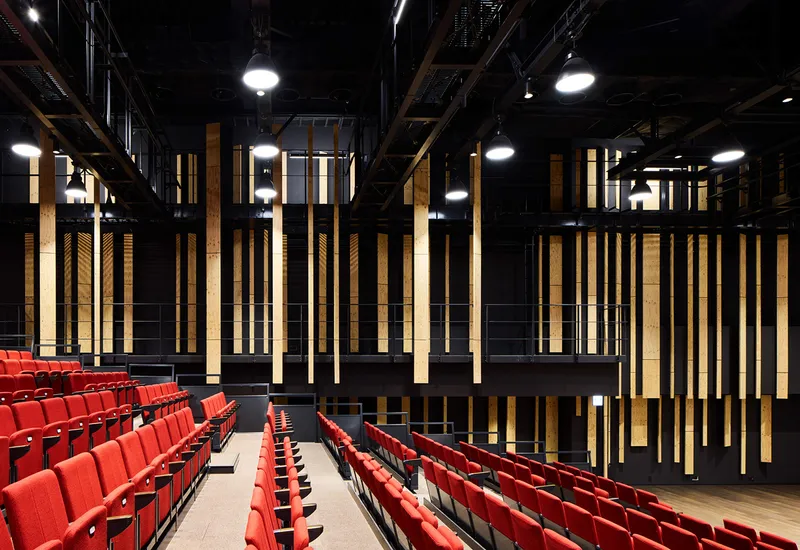
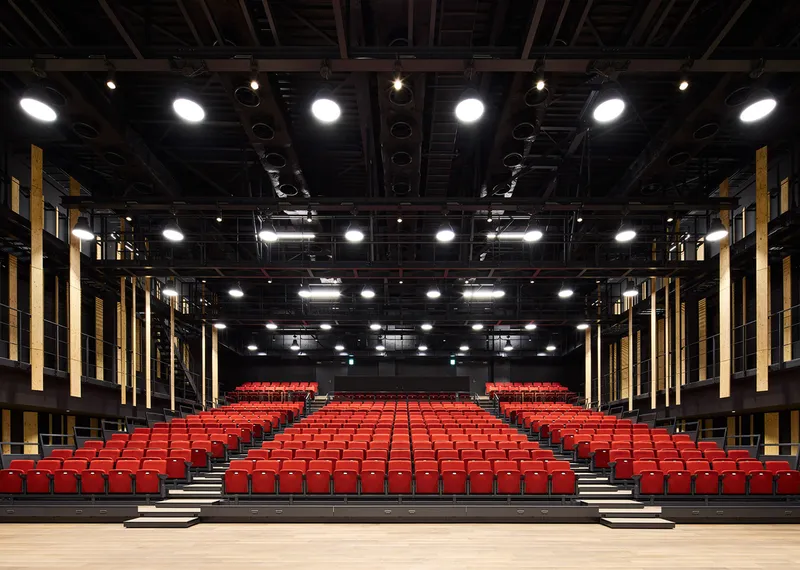
The theater occupies its own tonal register. Red tiered seating contrasts sharply with vertical timber baffles lining both walls, and an exposed black technical grid hangs above. The acoustic panels are not decorative: their vertical orientation and spacing are calibrated to diffuse sound across the room's cross-section. The result is a compact but serious performance venue, the kind of space that signals to students that their work on stage will be treated with the same rigor as the architecture that surrounds it.
Japanese Rooms Inside an International School
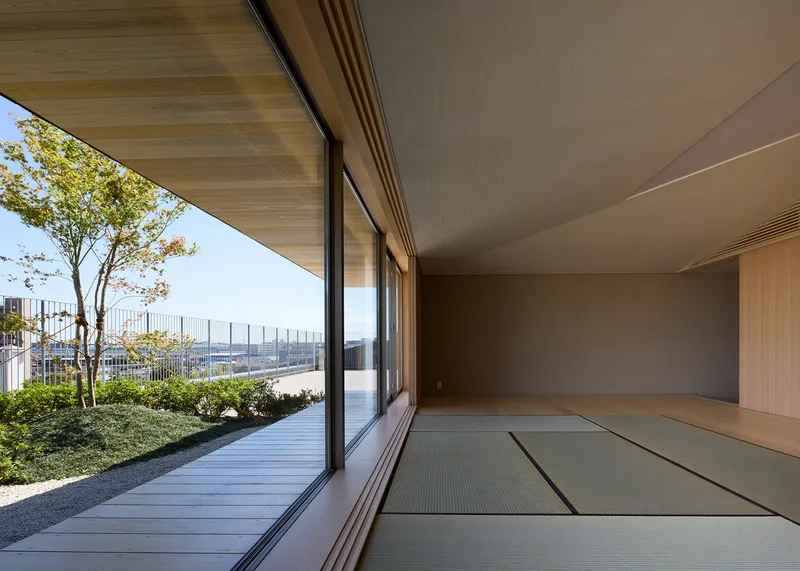
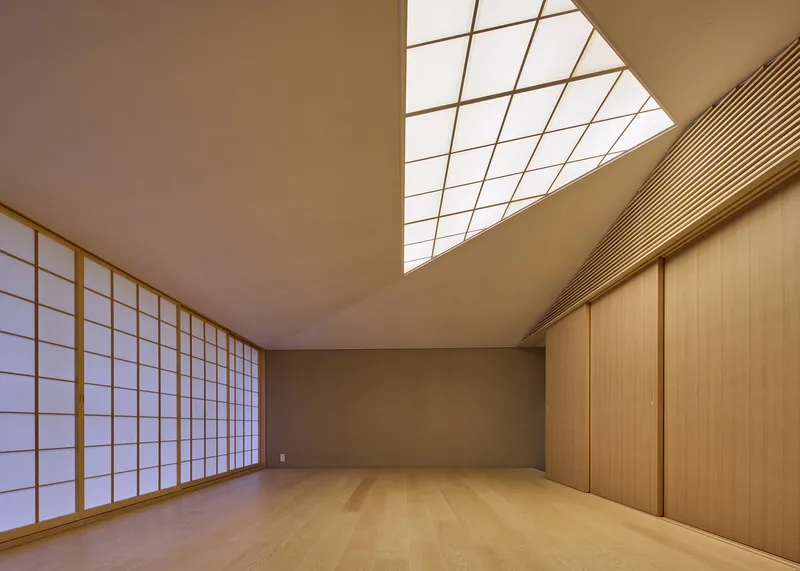
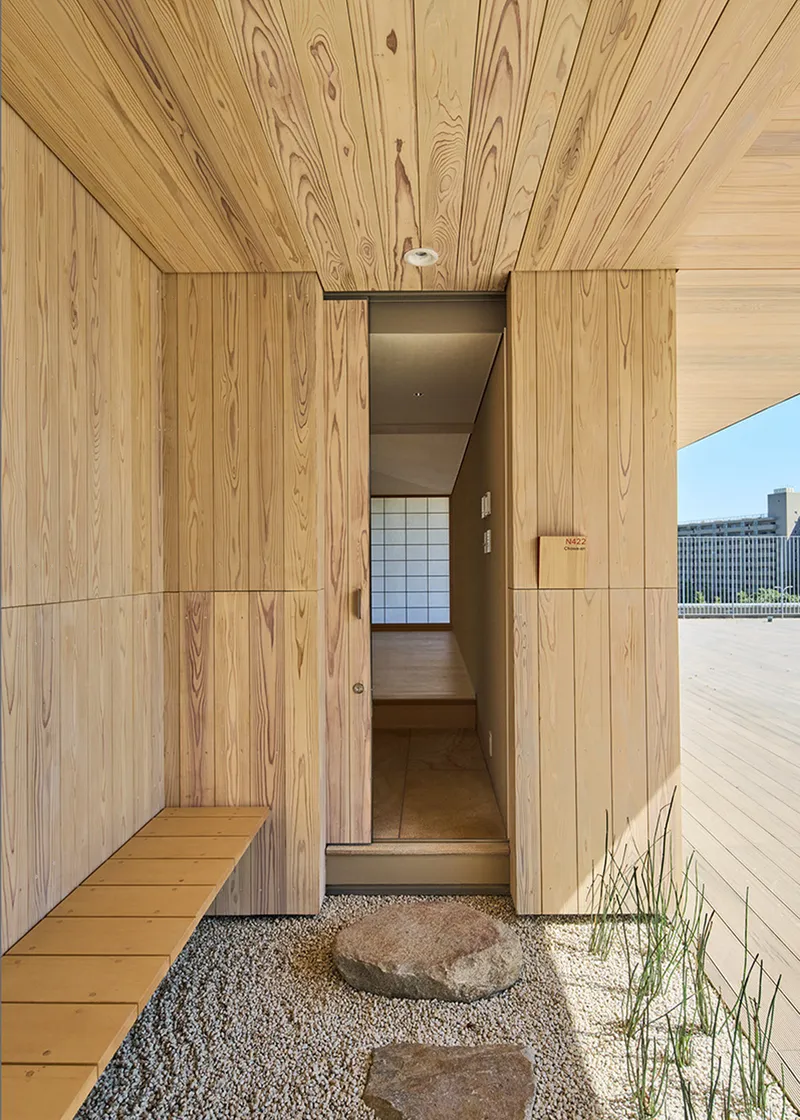
One of the project's most quietly radical moves is the inclusion of a tatami room with sliding glass doors opening onto a timber deck, and a shoji-screened room with an angular skylight that casts diagonal shadows across the floor. These spaces are not ornamental nods to locality. They are functional rooms where the traditional Japanese concept of fusuma, where opening a door dissolves a wall, is directly available to students. The campus's entrance courtyard, with its gravel garden and stepping stones under a slatted ceiling, reinforces the same principle: architecture as something you can reconfigure by simply sliding a panel.
For an international school, these rooms serve a dual purpose. They teach spatial literacy, the idea that a room can change its function by changing its boundaries, and they root the institution in its geographic context. Yokohama is not an abstract global city; it is a Japanese port town, and the school's architecture acknowledges that fact without turning it into a theme.
Facade Detail and Material Weathering
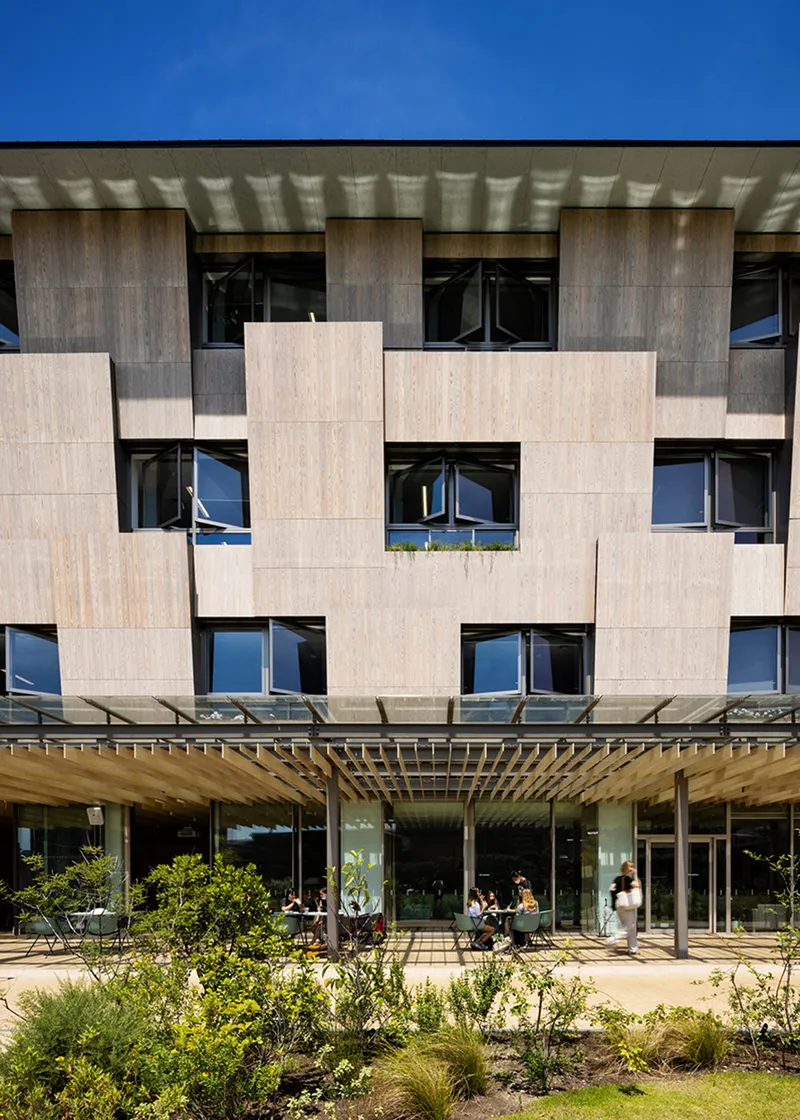
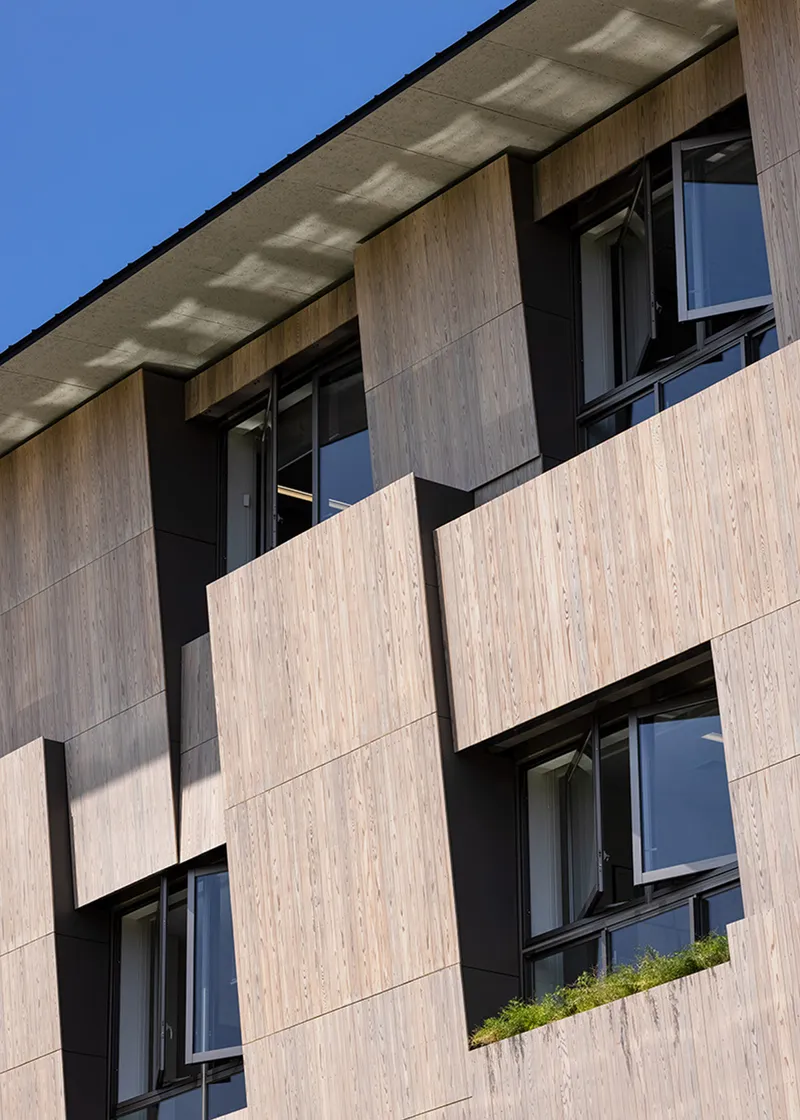
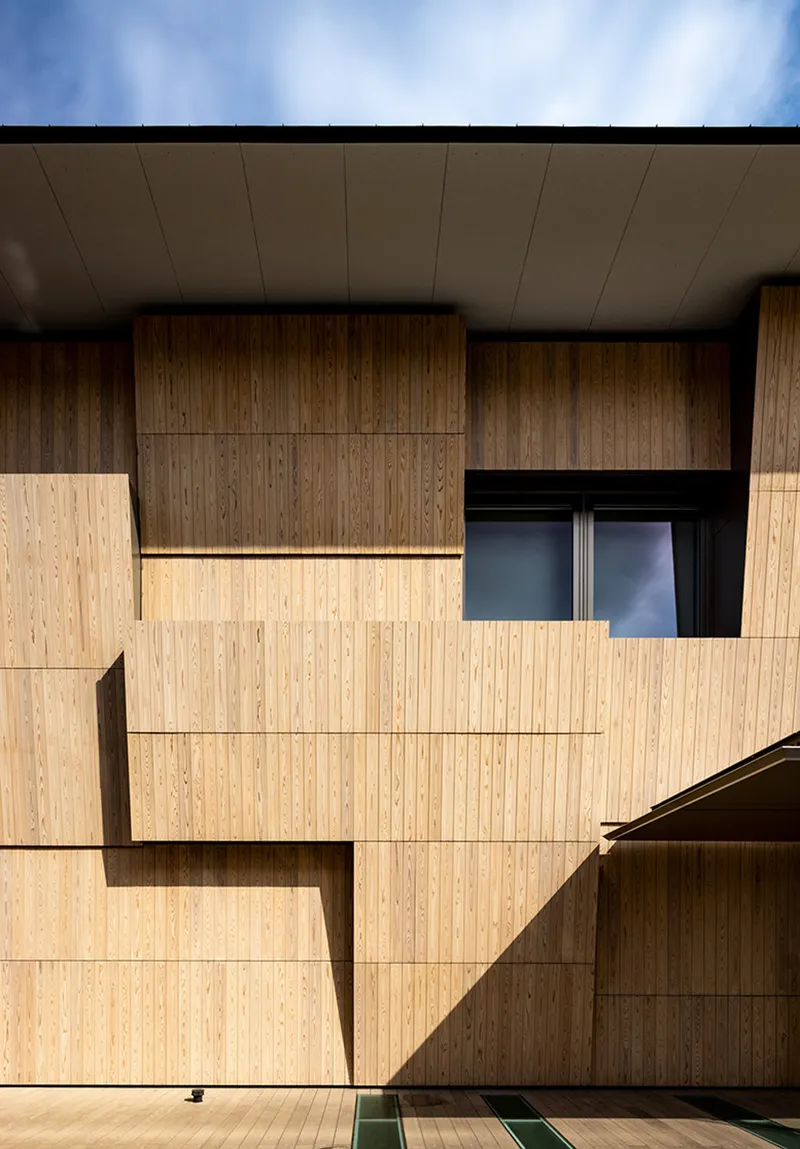
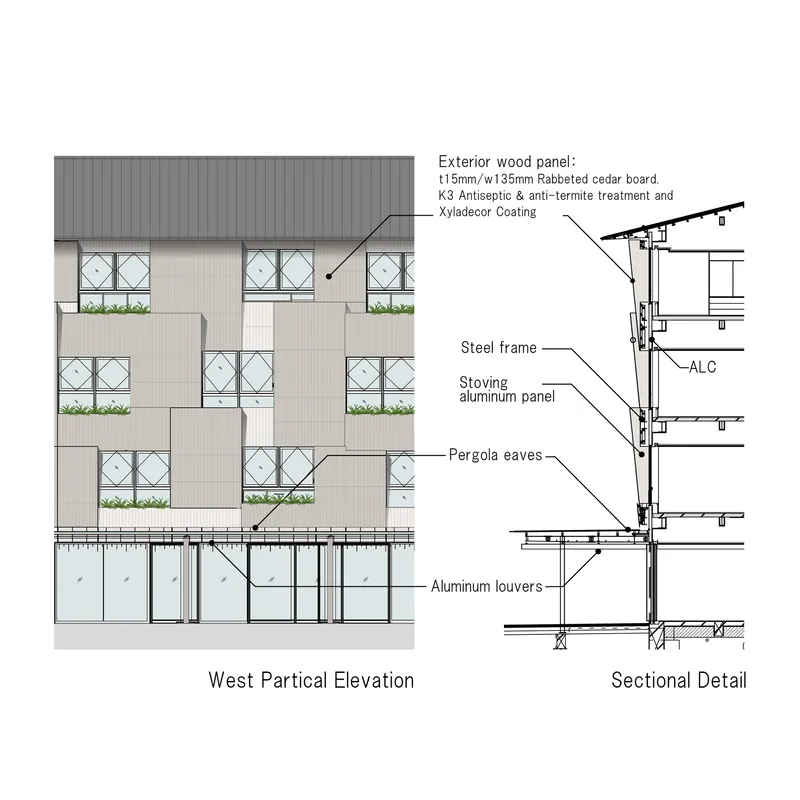
Up close, the facade system reveals its intelligence. Cedar panels overlap in staggered courses, creating deep shadows that shift throughout the day. Small planters are tucked into window edges, bringing vegetation into the wall's depth. The deep eaves above protect the panels from the worst of Yokohama's rain, extending the intervals between maintenance cycles. None of this reads as fussy: the overall impression is of a building that wears its material honestly, knowing that it will silver and darken over time.
Rooftop and Elevated Landscapes
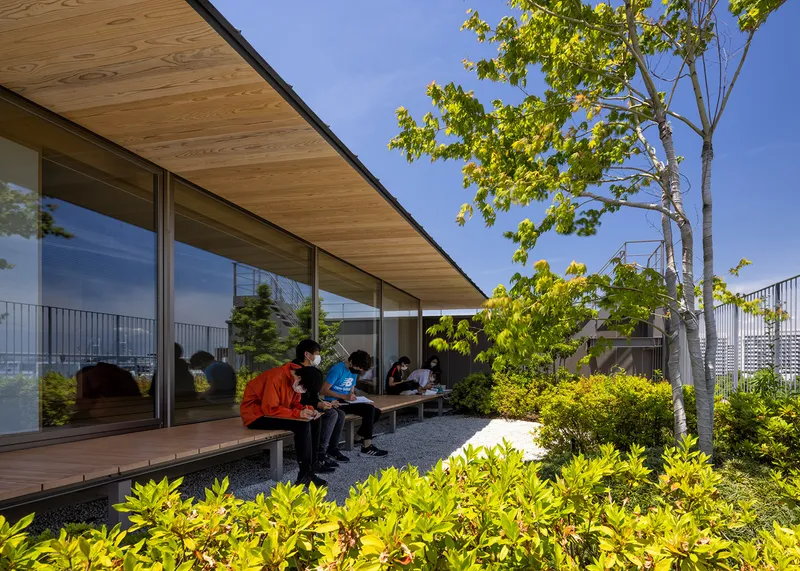
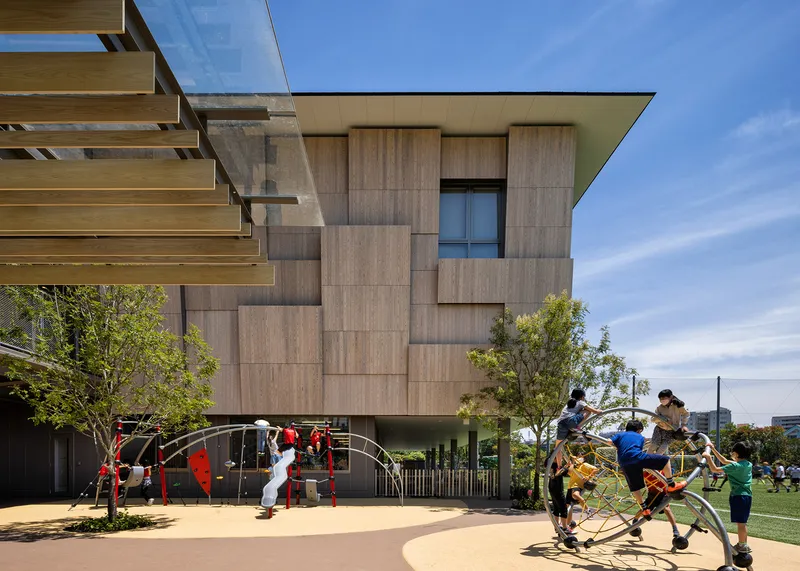
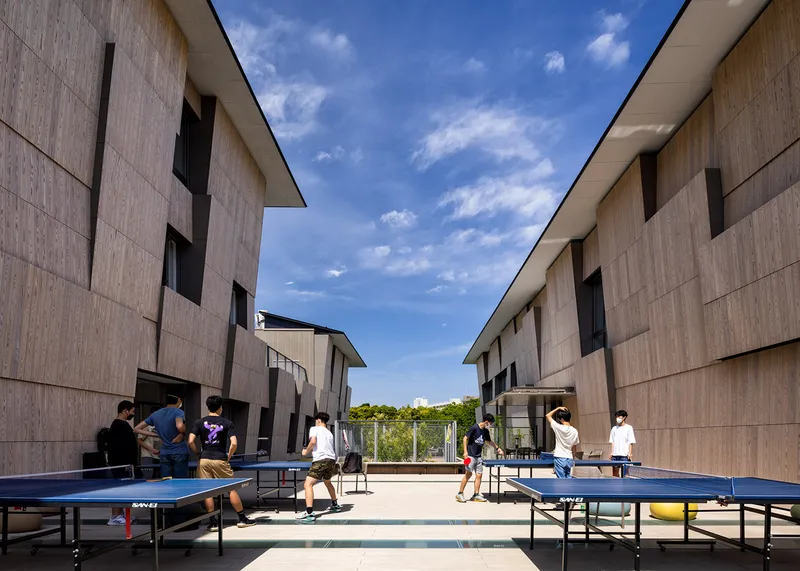
The campus stacks its outdoor spaces vertically. A third-floor rooftop garden with deciduous trees and wooden benches offers a retreat above the courtyard's energy. Below, a playground tucks under the elevated South building volume, giving the youngest students a protected space of their own. Between the two buildings at ground level, ping-pong tables and informal seating create yet another social register. The layering is deliberate: every age group gets its territory, but none of these territories is sealed off from the others.
Plans and Drawings
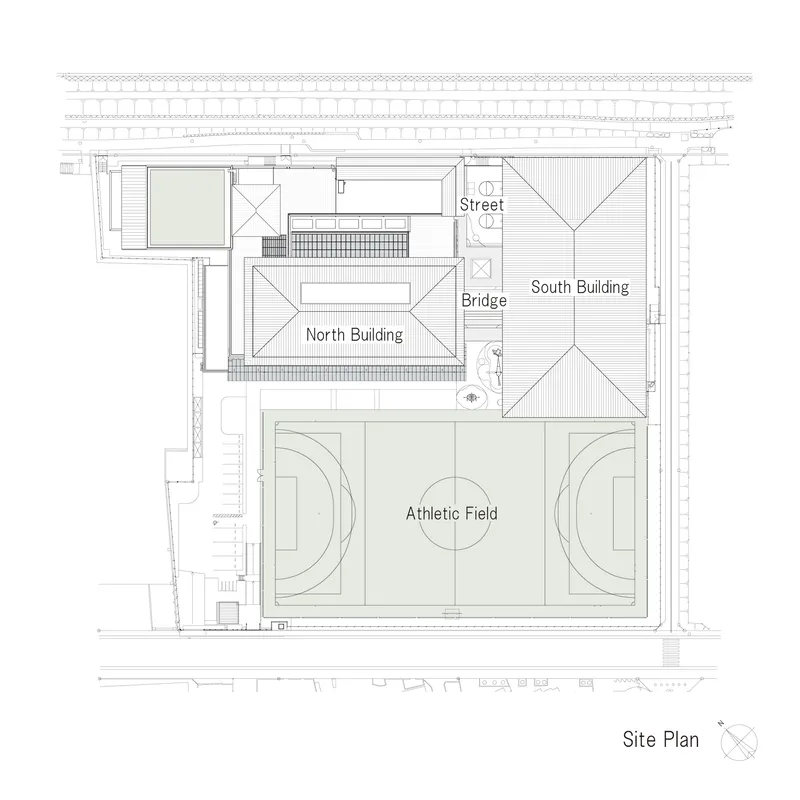
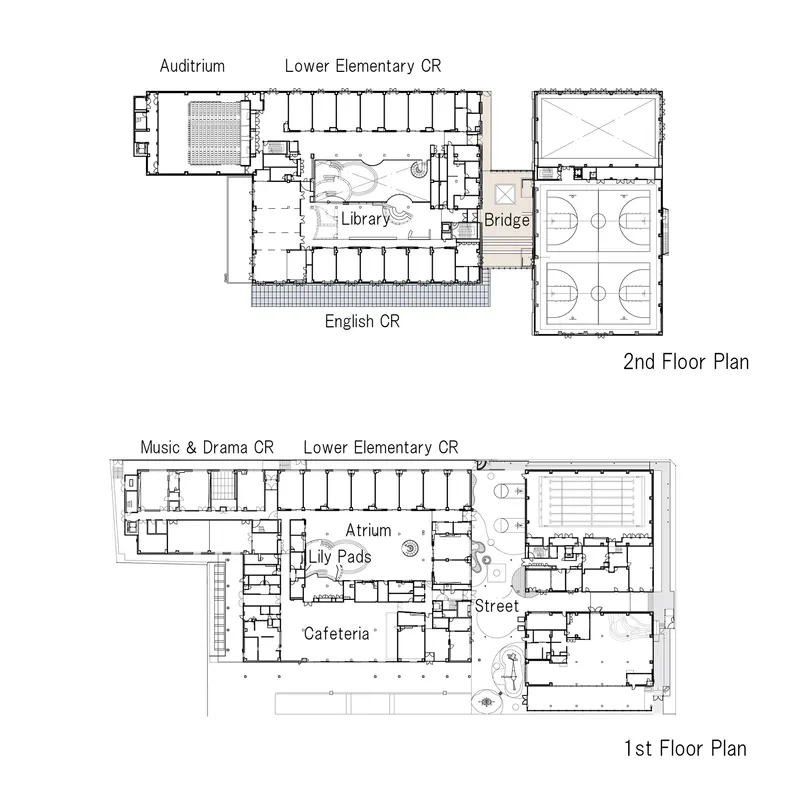
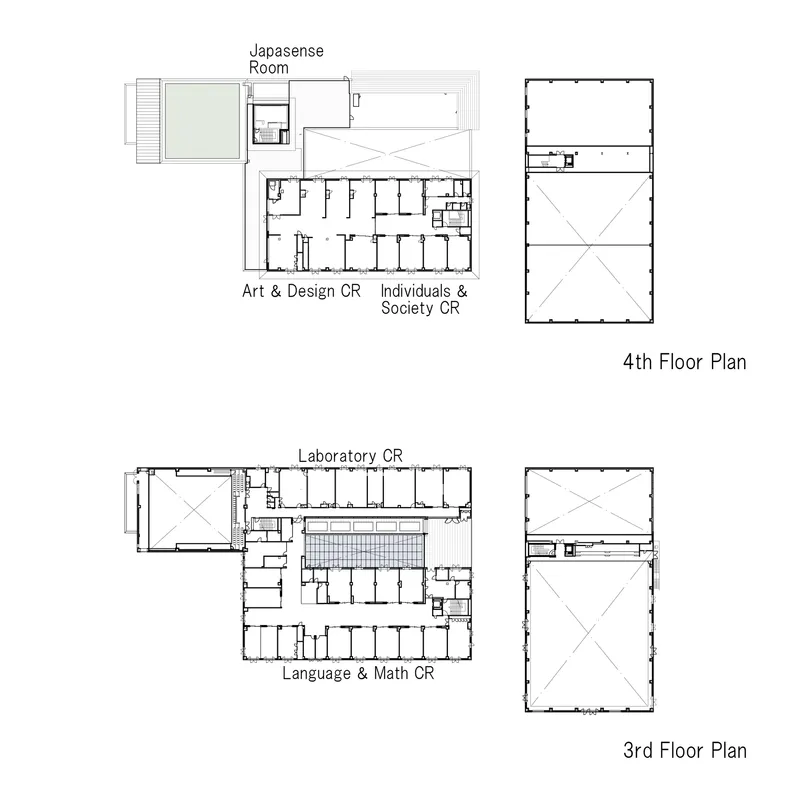
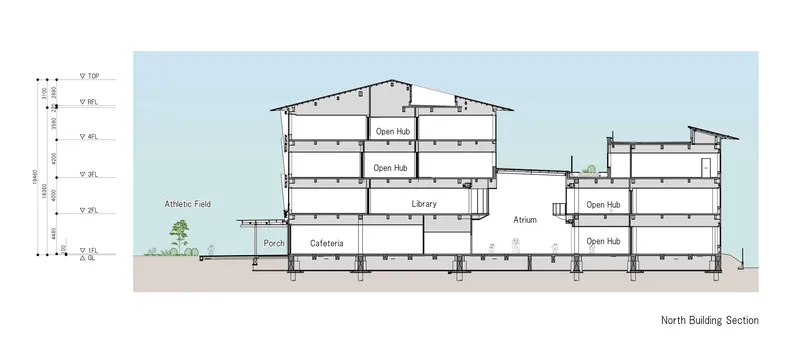
The site plan confirms what the photographs suggest: the two buildings are arranged as parallel bars flanking the athletic field, connected at an upper level by a bridge that doubles as a covered walkway. The floor plans reveal the open-hub strategy in detail. Rather than stacking classrooms along double-loaded corridors, the architects cluster teaching spaces around shared breakout zones that function as informal gathering areas. The library and cafeteria anchor the North building's lower floors, with classrooms and laboratories occupying the upper stories. The section drawing through the North building is especially revealing: it shows how the central atrium, the "Lily Pads" staircase, the library, and the cafeteria are stacked and interlocked to create continuous visual connections across four stories.
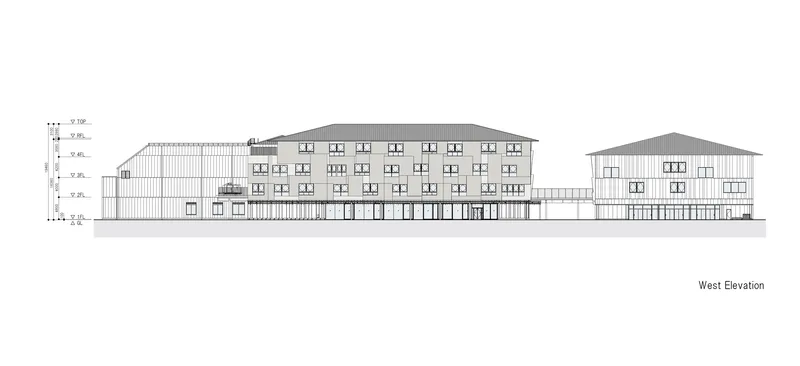
The west elevation drawing makes legible the gabled roof profiles and the vertical cladding rhythm that can be hard to parse in photographs. The sectional detail drawing, showing window bays, pergola assemblies, and the layered wall construction of cedar over steel over fire-resistant backing, is a concise summary of the project's material strategy: warmth on the outside, performance underneath.
Why This Project Matters
School design often defaults to two modes: the utilitarian box or the signature-architect spectacle. Yokohama International School occupies a third position. Its architecture is specific, opinionated, and materially committed, but it never grandstands. The cedar cladding will weather. The courtyards will get scuffed. The tatami room will absorb the sounds of children who may not fully understand what a fusuma is until years later, when the memory of a room that could change its shape becomes a reference point for thinking about flexibility, impermanence, and care.
The collaboration between Kengo Kuma & Associates and TAISEI DESIGN Planners Architects & Engineers produced a campus where the organizational intelligence of a large engineering firm and the material sensibility of a design-led practice reinforce each other. The result is not a compromise between two approaches but a synthesis: rigorous planning wrapped in warm, tactile surfaces, all in service of the idea that a school should not merely contain learning but provoke it at every turn.
Yokohama International School, designed by Kengo Kuma & Associates and TAISEI DESIGN Planners Architects & Engineers. Yokohama, Japan. 14,865 m². Completed 2021. Photography by Masaki Hamada (kkpo).
About the Studio
Share Your Own Work on uni.xyz
If projects like this are the kind of work you want to make, uni.xyz is a place to publish your own, find collaborators, and enter design competitions.




Popular Articles
Popular articles from the community


The Musturak Paradise: Senior Living Architecture for a Connected Future in Temara, Morocco
The Musturak Paradise reimagines senior living architecture in Temara via private homes, social spaces, culture, community, and shared care.

The Earth Pod: 3D Printed Homes for Resilient Refugee Communities
The Earth Pod reimagines refugee housing through 3D printed homes made from clay, combining resilience, self-sufficiency, and rapid shelter.

Conexión: Biophilic Design Reimagines High-Rise Living in Hong Kong
Conexión reimagines high-rise living in Hong Kong through biophilic design, green facades, shared spaces, daylight, water and nature within.

Hill & Cross Opera: Sculptural Opera House Architecture Shaped by Tallinn’s Landscape and Identity
Hill & Cross Opera reimagines opera house architecture in Tallinn through its sculptural hill, civic plaza, glass wave and a luminous cross.


Similar Reads
You might also enjoy these articles

Bao Huynh Watercolor Atelier: A Serene Art Retreat in Hội An
Bao Huynh Watercolor Atelier in Hội An blends multifunctional art spaces, sustainable design, local materials, and family-friendly living in a serene environment.

Atelier Macri Concept Store Interior Design by CASE-REAL
Atelier Macri store features a "ko" counter, walnut wood details, cork displays, blending retail, gallery, and seamless customer experiences.

Manuel Vargas Izquierdo Stadium and High-Performance Sports Center: Architectural Excellence in Jalpa de Méndez
The Manuel Vargas Izquierdo Stadium blends sustainable design, inclusive sports facilities, and cultural-inspired architecture, revitalizing Jalpa de Méndez’s public spaces.

KAKR Buluh Awar Hall: Revitalizing Community and Ecology Through Bamboo Architecture
Community built bamboo hall revitalizes Buluh Awar village, empowering youth, restoring ecology, celebrating vernacular craftsmanship through sustainable architecture and culture.





Comments (0)
Please login or sign up to add comments
No comments yet. Be the first to comment!