
Kibo no Sakura Cultural Center: Vernacular Architecture as Village Revival in Shirakawa-go
A winning cultural center proposal uses gassho-zukuri timber tectonics and cherry blossom symbolism to anchor a fading UNESCO village.


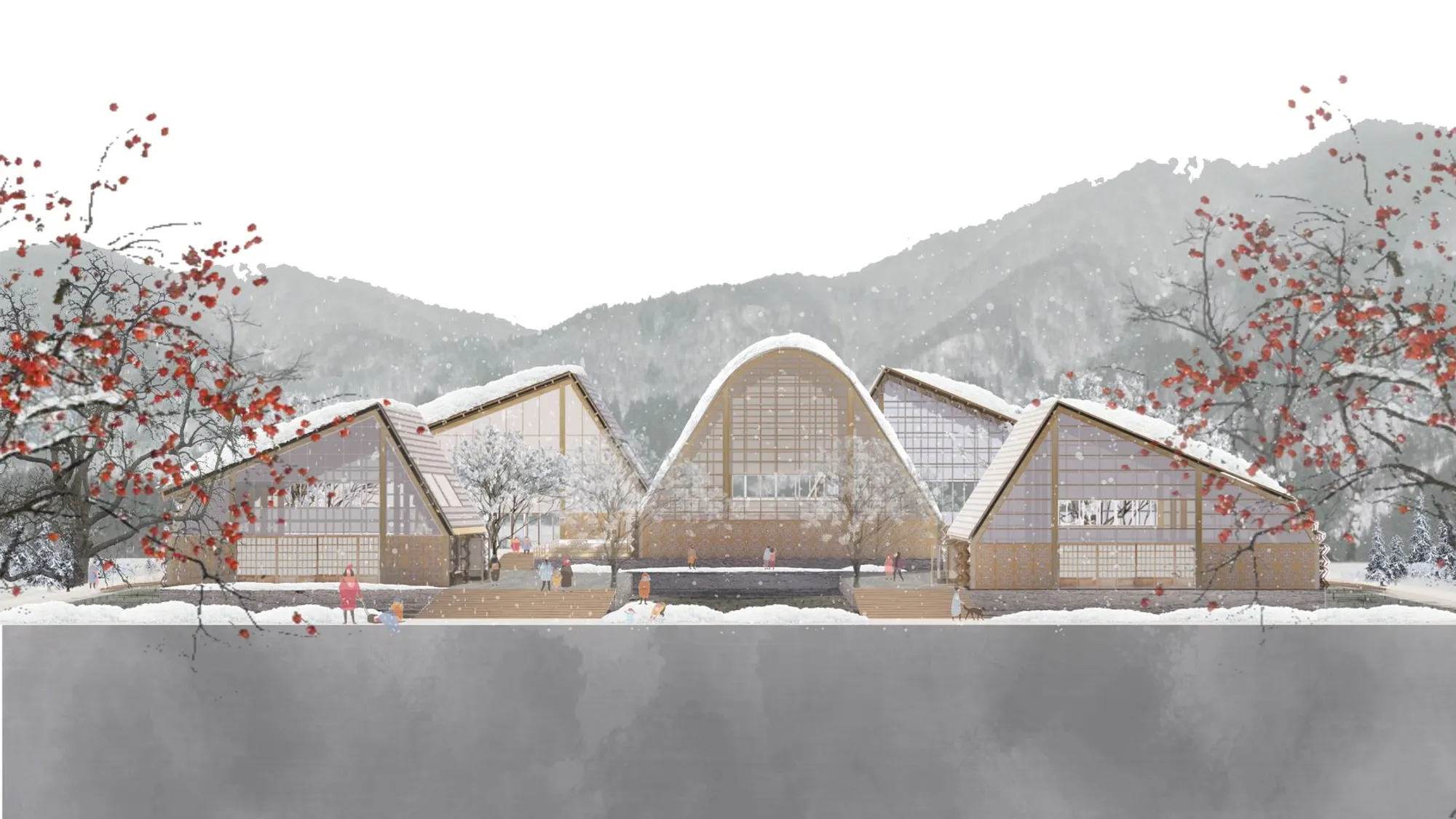
When a UNESCO World Heritage village begins converting its centuries-old farmhouses into souvenir shops and guesthouses, what does preservation actually mean? Kibo no Sakura Cultural Center proposes an answer that goes beyond freezing architecture in amber. Instead, it rebuilds the social infrastructure that made Shirakawa-go's gassho-zukuri houses meaningful in the first place: communal gathering, intergenerational knowledge transfer, and a material culture rooted in oak, thatch, and handmade rope. The name translates to "Hope of Cherry Blossoms," and the design treats that metaphor with architectural seriousness, culminating in a ceramic-tiled roof that forms a mosaic of Sakura petals visible from above.
Designed by Maimuna Babar and Lijiana Ma, the project won the Cultural Conserve competition on uni.xyz. The site is Shirakawa-go, a mountain village in Japan facing population decline as younger residents leave for educational and employment opportunities elsewhere. Commercial tourism has filled the void, but at the cost of authentic village character. Kibo no Sakura responds by reintroducing vernacular spatial logic, not as heritage theatre, but as a functioning cultural center with programs, exhibits, and hands-on workshops that keep intangible heritage alive.
Lattice Screens That Build Rooms Out of Light
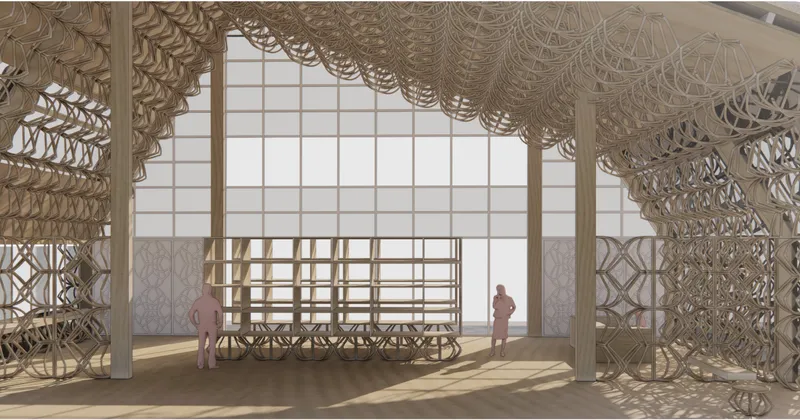
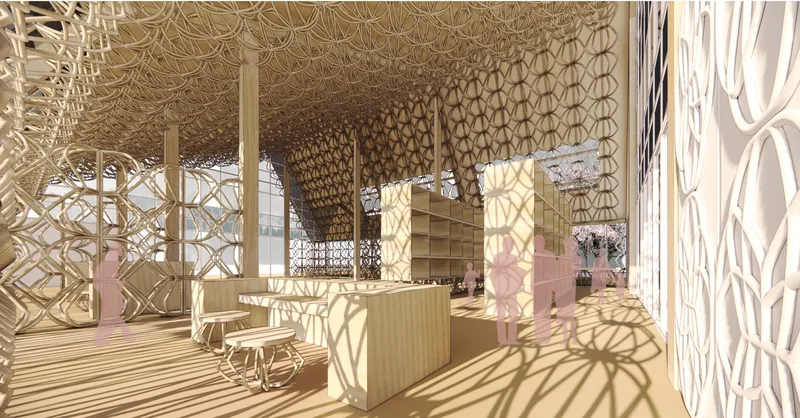
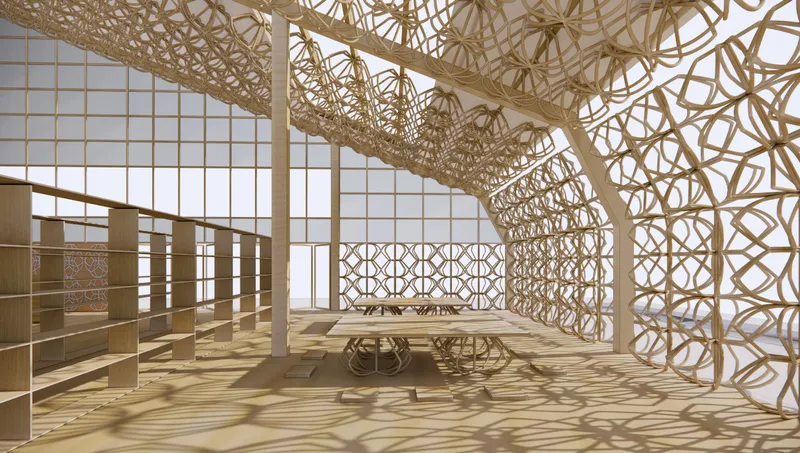
The interior renderings reveal a spatial strategy built on parametric timber lattice screens that do far more than partition rooms. In the reception area, a patterned lattice ceiling and wall system filters natural light into shifting geometric patterns across the floor, creating an atmosphere that changes with the sun's angle throughout the day. The effect continues in the library, where timber lattice screens cast sharp geometric shadows across the floor and service counter. These are not decorative appliqués; they are structural expressions of the post-and-beam system central to the project's design philosophy.
The designers use polycarbonate sheeting on the southeastern facade to temper solar heat gain while maintaining a light-diffusing quality. Combined with the lattice, the result is a layered modulation of daylight that gives each room a distinct character without relying on artificial lighting during daytime hours. Secondary materials like expansive glass panels blur the boundary between interior and landscape, reinforcing the concept of openness that runs through every space.
Reading Among Cherry Blossoms: Landscape as Interior Finish
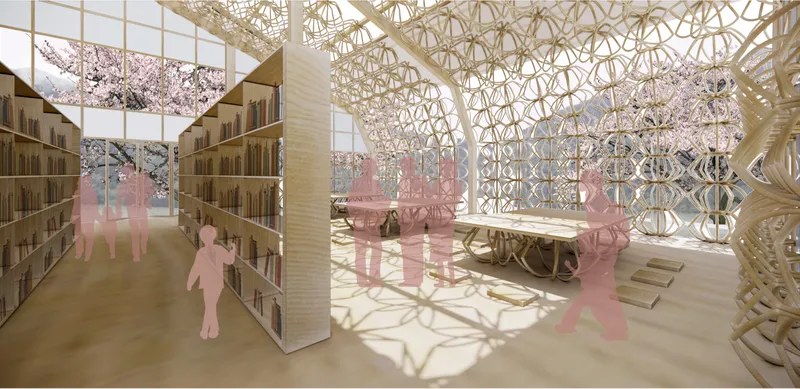
Two of the project's most compelling images show the reading room and an adjacent curved lattice corridor. In the reading room, floor-to-ceiling glazing frames cherry blossom trees so directly that the pink canopy becomes an extension of the interior. Bookshelves line the opposite wall, and the timber lattice structure overhead mediates between the solidity of the collection and the ephemerality of the blossoms outside. It is a room calibrated to make seasonal change part of the reading experience.
Along the curved parametric lattice wall, integrated bookshelves and low seating create a continuous reading zone bathed in dappled light. The curvature of the wall recalls the organic, non-orthogonal spatial logic of traditional village layouts rather than the rigid grids of institutional architecture. Tertiary materials, including silk, handmade paper, and layers of thatch, are deployed as modular elements that can be adjusted seasonally to respond to climatic conditions, adding texture and warmth while referencing Shirakawa's craft traditions.
Gassho-Zukuri Reimagined: Converging Axes and a Communal Heart
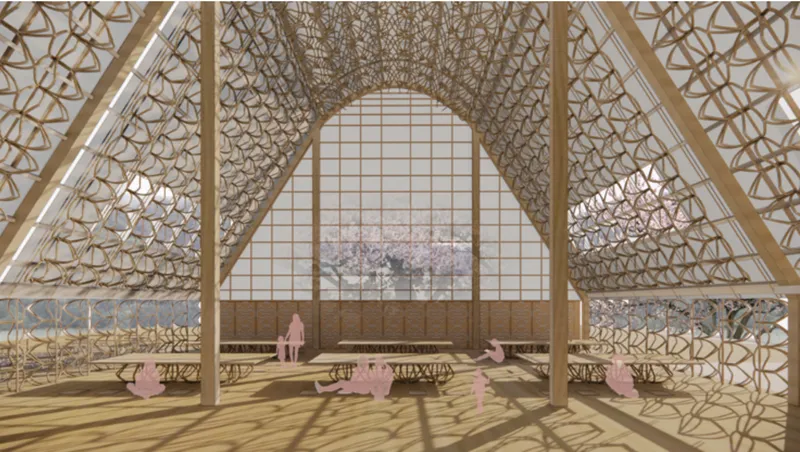
The arched interior space, with its geometric timber lattice ceiling arching over rows of benches, is where the gassho-zukuri reference becomes most legible. Gassho-zukuri means "hands in prayer," and the sloping roof forms arranged in parallel alignment create symbolic gathering points beneath their apex. All structural axes in the complex converge toward a communal café envisioned as the heart of the center, mimicking the social cohesion of traditional Shirakawa neighborhoods where collective effort defined daily life.
Cherry blossom views again occupy the glazed end wall, making the gathering hall feel open to the landscape while the timber lattice overhead provides a sense of enclosure and intimacy. The wooden tectonic expression here is not nostalgic pastiche; it is a contemporary reinterpretation that uses the structural logic of post-and-beam construction to achieve spans and forms that the original farmhouses never attempted.
Clustered Pavilions Scattered Across the Agricultural Grid
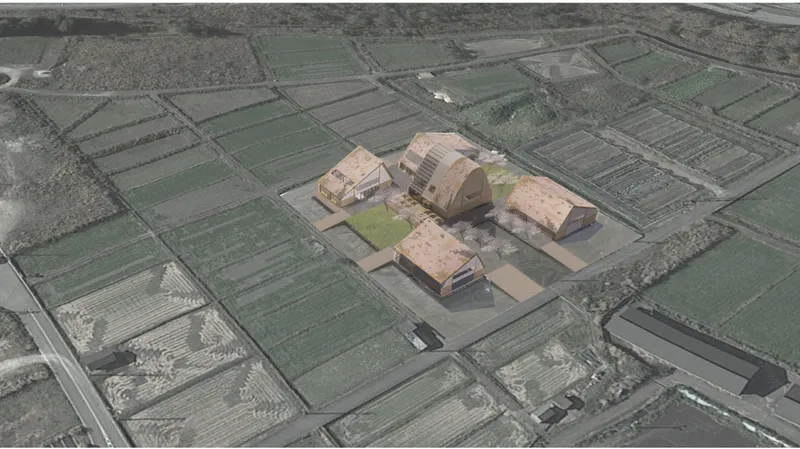
The aerial rendering reveals the project's masterplan strategy: a cluster of timber pavilions distributed among agricultural fields and connected by pathways that echo the informal circulation patterns of the existing village. Rather than consolidating the program into a single monolithic building, the designers fragment the cultural center into a constellation of smaller volumes. This decision preserves the grain and scale of Shirakawa-go while allowing the landscape, including rice paddies and footpaths, to flow through and around the architecture.
The ceramic-tiled flat roofs, designed to accommodate practical snow accumulation while reading as a cherry blossom mosaic from above, become visible as a collective pattern at this scale. From the ground, each pavilion feels intimate and village-scaled. From the air, the roofs compose a single landscape artwork that signals cultural identity across the valley. It is a dual reading that speaks to both the resident who walks these paths daily and the tourist approaching from the mountain road.
Why This Project Matters
Kibo no Sakura Cultural Center refuses the false choice between preservation and progress. Where many heritage-adjacent projects either freeze traditional forms in resin or abandon them entirely for contemporary spectacle, Babar and Ma extract the operative principles of gassho-zukuri construction, the social patterns of village life, and the material palette of the region, then reassemble them into a program that addresses present-day problems: youth outreach, cultural education, craft employment, and authentic tourism. The use of locally sourced oak, thatch, and handmade rope supports the regional economy while maintaining material continuity with the UNESCO-listed houses nearby.
The project's strength lies in its refusal to treat architecture and community as separate design problems. By fragmenting the program into village-scaled pavilions, routing circulation through agricultural fields, and centering the plan on a communal café rather than an exhibition hall, the designers position culture not as something displayed behind glass but as something practiced daily. For a village losing its young residents to urban centers, that distinction is existential. Kibo no Sakura does not memorialize Shirakawa-go; it argues that the village still has a future worth building.
View the Full Project
About the Designers
Designers: Maimuna Babar, Lijiana Ma
Enter a Design Competition on uni.xyz
uni.xyz runs architecture and design competitions year-round that reward proposals with spatial conviction and real site intelligence.
Project credits: Kibo no Sakura Cultural Center by Maimuna Babar, Lijiana Ma Cultural Conserve (uni.xyz).



Popular Articles
Popular articles from the community


Co-Life: Senior Housing Design That Reconnects Older Adults With the City
Co-Life reimagines senior housing design through healing gardens, shared streets, workshops, and a sustainable community across generations.

Hill & Cross Opera: Sculptural Opera House Architecture Shaped by Tallinn’s Landscape and Identity
Hill & Cross Opera reimagines opera house architecture in Tallinn through its sculptural hill, civic plaza, glass wave and a luminous cross.

Lunar Spiral: Space Architecture Shaped by the Mathematics of the Universe
Lunar Spiral reimagines space architecture through Fibonacci geometry, lunar regolith, levitating habitats, and self-sustaining Moon living.

Conexión: Biophilic Design Reimagines High-Rise Living in Hong Kong
Conexión reimagines high-rise living in Hong Kong through biophilic design, green facades, shared spaces, daylight, water and nature within.


Similar Reads
You might also enjoy these articles

Day and Night Park: A Time-Based Urban Newsstand in Beijing
A temporary urban newsstand in Beijing blending travel, light, and reading through poetic colors, compact form, and community-focused design.

Modernist Patio Renovation in El Masnou, Barcelona by Oliver Segura Arquitectura + Cebrià Arquitectura
Modernist patio renovation blending tradition and innovation with a movable pool, leveled floors, and Catalan materials in El Masnou.

Alto Residencial Coop: Cooperative Housing Development in Santiago de Compostela by Carbajo Barrios Arquitectos
A linear cooperative housing complex blending white volumes and perforated metal façades, enhancing community living, natural light, privacy, and urban integration.

Vil Genis School by BPA ARCHITECTURE – Massy, France
Vil Genis School in Massy, France, features sustainable design, south-facing classrooms, community integration, accessible spaces, and modern educational architecture.


Explore Cultural Architecture Competitions
Discover active competitions in this discipline



Challenge to reimagine the Iron Throne


Photograph architecture without architects


Illustrate the lost glory of Angkor Wat - Render Challenge


Bring back Drive In's
Comments (0)
Please login or sign up to add comments
No comments yet. Be the first to comment!