

Masahiro Katsume and Mette Fredskild Build Eight Japandi Summer Houses on a Lithuanian Lake
Konga Village clusters identical timber cabins along the shore of Glūkas lake in Dzūkija, merging Japanese spatial fluidity with Scandinavian warmth.


In the forests of Dzūkija, Lithuania, eight identical gabled houses sit quietly along the shore of Glūkas lake. They are dark, sharp, and deliberately modest, each one 75 square meters plus a terrace that opens toward the water and the tree line. Konga Village is a residential project that takes the concept of a summer colony and strips it down to its essentials: shared ground, individual shelter, and the landscape in between.
What makes this project worth studying is the unlikely collaboration behind it. Japanese architect Masahiro Katsume designed the spatial organization and architectural form, while Danish architect Mette Fredskild, whose decade of working in Japan left a visible mark on her sensibility, handled the interiors. The result is a legible hybrid: Japandi not as a branding exercise, but as an actual negotiation between two design cultures playing out across 10,000 square meters of lakefront forest.
Dark Volumes in a Light Forest


The houses present themselves as dark corrugated metal forms, their pitched roofs and blackened materiality giving them the character of refined agricultural buildings rather than vacation homes. Standing seam roofing meets blackened brick chimneys, a combination that reads as both industrial and domestic. The decision to clad every house identically is not a cost-saving shortcut; it is the architectural expression of Katsume's stated commitment to democratic design. No unit is more prominent than another. The village hierarchy is flat.
Against the backdrop of evergreens and wildflower gardens, the dark volumes recede rather than compete. The buildings absorb light instead of reflecting it, which has the counterintuitive effect of making the surrounding greenery feel more vivid. It is a landscape strategy disguised as a material choice.
The Interior as a Single Warm Room
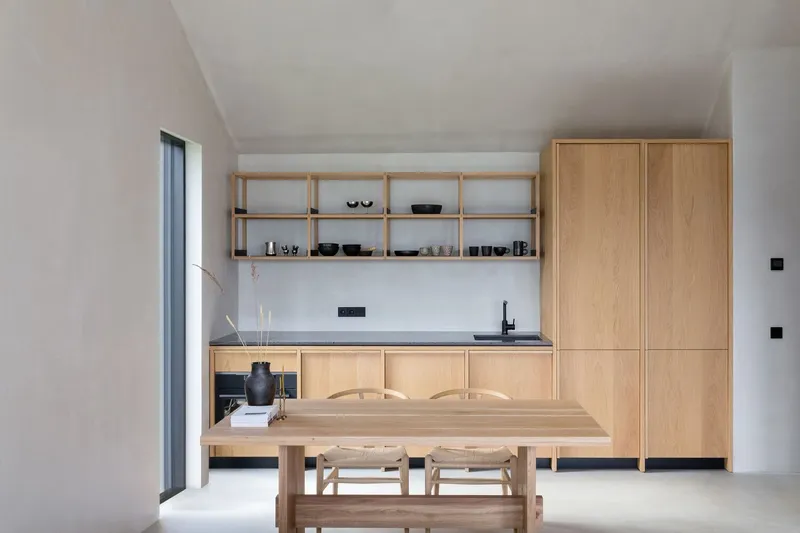

Step inside and the palette flips entirely. Where the exterior is black metal, the interior is oak and plywood, warm-toned and tactile. Fredskild's interiors treat each 75-square-meter house as essentially one room, organized by furniture rather than walls. Open shelving defines the kitchen zone, tall storage cabinets structure the edges, and a vaulted white ceiling ties everything together overhead. The sloped ceilings follow the roofline faithfully, which gives even the smallest nook a sense of vertical generosity.
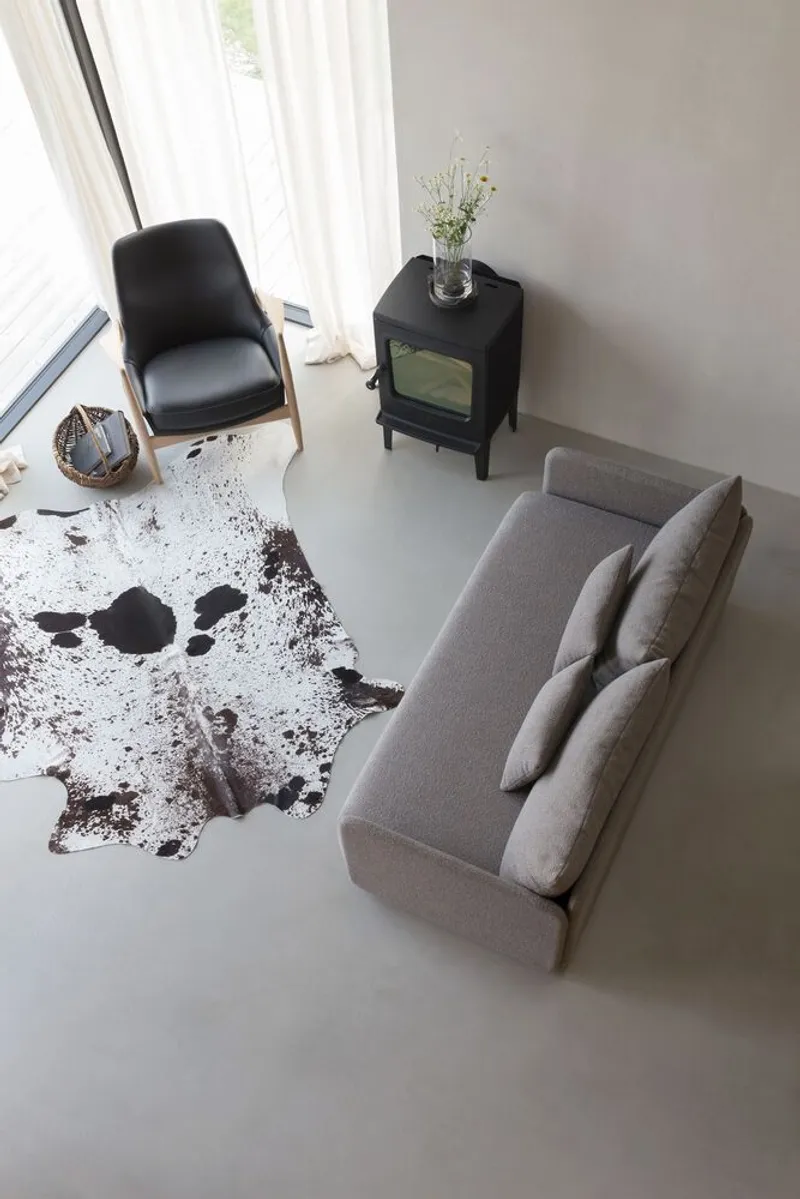
The living area is deliberately casual: a grey sofa, a black armchair, a wood stove, a cowhide rug on polished concrete. Nothing here is precious. The Japandi label applies because the space genuinely embodies both traditions: Japanese spatial fluidity, where one zone flows into the next without hard boundaries, and Scandinavian functionalism, where every object earns its place. There is no excess, but there is also no austerity. The rooms feel lived in rather than curated.
Threshold Moments
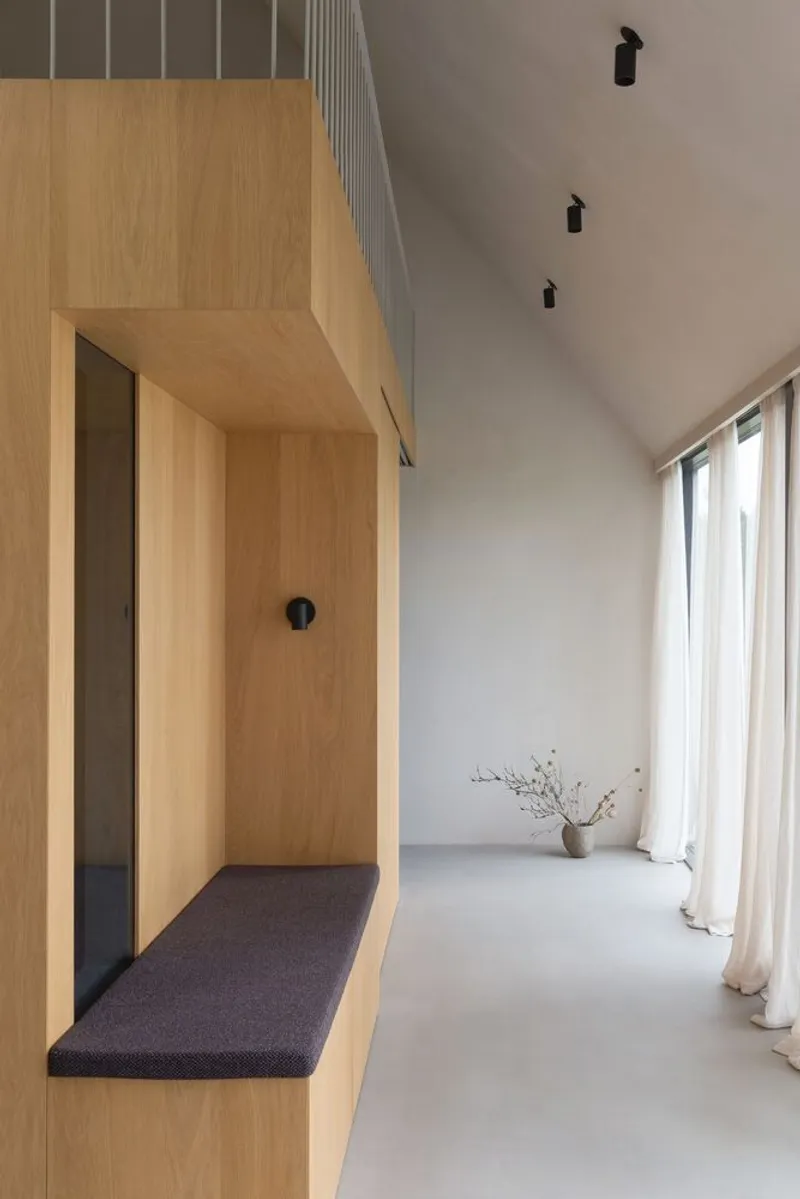
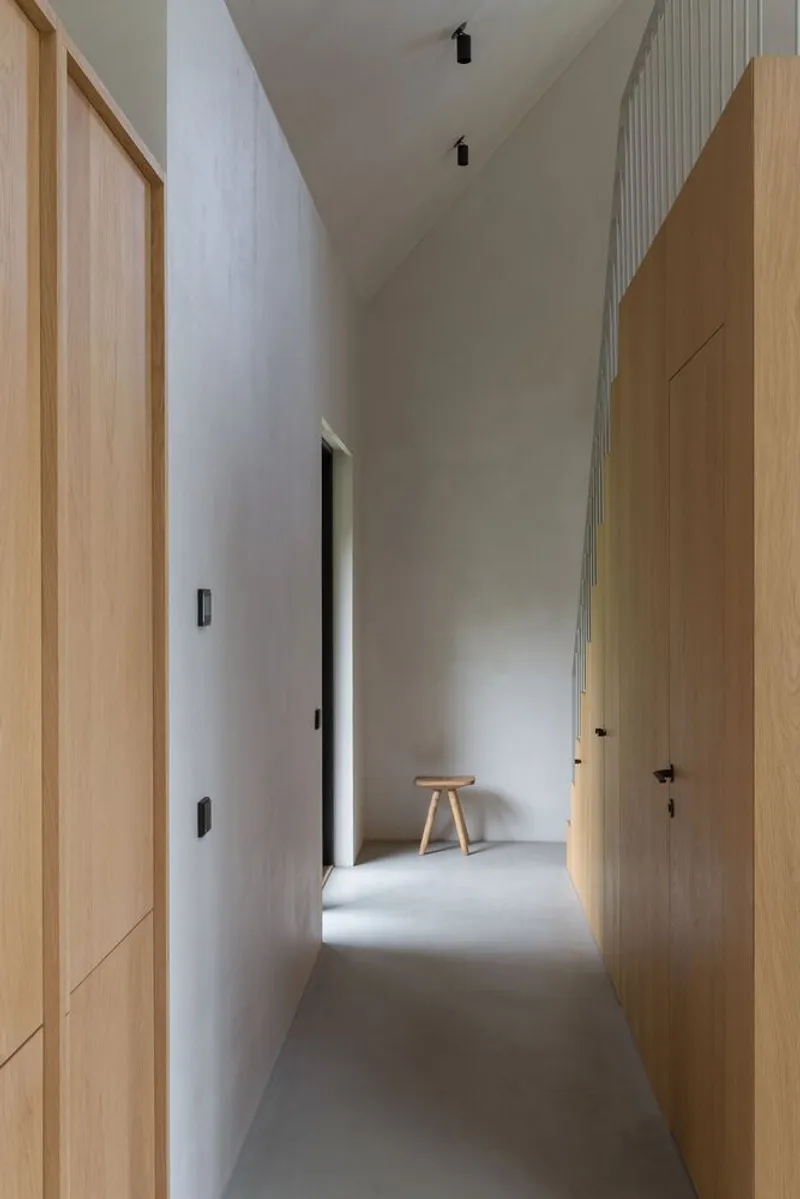
Some of the most considered moves happen in the transitional spaces. A plywood-clad entry nook with an integrated bench, set beneath the pitched ceiling and softened by sheer curtains, operates as an airlock between outside and inside. It is a compression point: low, warm, contained. A narrow corridor lined with oak cabinetry and white walls leads to a stool bathed in natural light at its end, turning circulation into a sequence rather than a corridor.
These threshold conditions are where Katsume's Japanese spatial thinking is most legible. In traditional Japanese residential design, the transition from public to private is choreographed through a series of intermediate zones. Here, the same principle plays out with Scandinavian materials and a pitched-roof vernacular. It is cultural translation at the scale of a doorway.
Framing the Lake
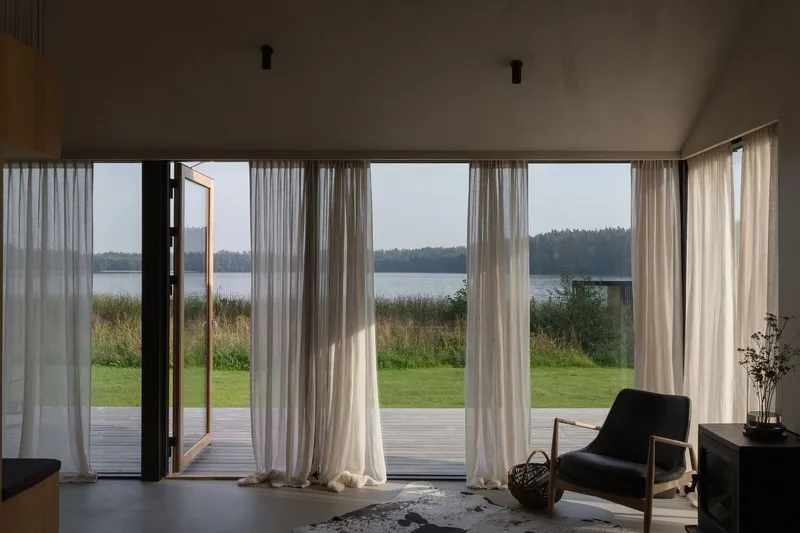
Floor-to-ceiling glazing wraps the lake-facing side of each house, and the architects pair it with sheer curtains that filter light without blocking views. The effect is of a scrim between domestic life and the landscape: lawn, reeds, then water. The terrace extends the living space outward, but the glazing wall is the real design move. It turns the lake into a permanent fixture of the interior, a backdrop that shifts with weather and season.
Crucially, the houses do not compete for the best view. Because all eight are identical in plan and orientation, the relationship between building and lake is consistent across the village. This reinforces the communal ethos: shared boats, a floating sauna, a collective fireplace area, and children's play zones occupy the common ground between the houses and the water. The private realm is the house. Everything between the front door and the shoreline belongs to the group.
Why This Project Matters
Konga Village matters because it takes two overused concepts, Japandi aesthetics and community-driven living, and delivers both with genuine rigor. The collaboration between Katsume and Fredskild is not decorative fusion. It is a design argument: that Japanese spatial principles and Scandinavian material honesty share enough DNA to produce architecture that belongs to both traditions and neither. The result feels specific to its Lithuanian lakefront site in a way that purely Scandinavian or purely Japanese designs would not.
More importantly, the project offers a credible model for collective leisure. Eight identical houses, none elevated above the others, organized around shared infrastructure rather than private amenity. It is a quiet rebuke to the trophy cabin. In a market flooded with bespoke retreats designed for Instagram, Konga Village suggests that the more interesting architectural question is not what your house looks like, but what happens in the space between your house and your neighbor's.
Konga Village, designed by Masahiro Katsume (architecture) and Mette Fredskild (interiors). Dzūkija, Lithuania. 10,000 m² site; eight houses of 75 m² each. Completed 2024. Photography by Dovalde Butenaite.
About the Studio
Share Your Own Work on uni.xyz
If projects like this are the kind of work you want to make, uni.xyz is a place to publish your own, find collaborators, and enter design competitions.


Popular Articles
Popular articles from the community


GROUP A Strips a 1969 Rotterdam Harbor Headquarters to Its Frame and Wraps It in Timber Louvers
In Rotterdam's M4H harbor district, Ferro Offices reuses a 1969 frame, adds one timber storey and reaches BREEAM-NL Outstanding.

Juan García Correa, John González and Claudia Rueda Sink a Circular Amphitheater into a Manizales Engineering Building
On the La Nubia campus in Manizales, Colombia, the S1 Building folds labs and offices into a hillside of ramped lawns that double as a campus route.

LT2A and OPEN Architectes Thread a Brick and Glass High School Through a Wooded Belgian Campus
In Braine-l'Alleud, a 3,000 m² wing for Collège Cardinal Mercier pairs pale brick with a glazed colonnade, deferring to a small chapel and a dense wood.

Architekt Andreas Gruber Scatters 23 Dark Timber Chalets Across a South Tyrolean Forest Edge
In Molini di Tures, Amonti Chalets breaks a resort into a hamlet of gabled timber houses, with parking, storage and services pushed into the slope.

Similar Reads
You might also enjoy these articles


Hodi-Mandai Geram
Project Function: Preservation and revitalization of the Intangible heritage and socio-spatial identity of the Hodi by Housing, Cultural Memory Center, Sacred Grove, landscape, local tourism economy


Olio Towers: A Mid-Rise for Performers That Fuses Housing, Rehearsal, and Stage
Located blocks from Houston's Theater District, this modular tower stacks living units around a central performance atrium.

Oasis: Modular Green Housing Carved into Dhaka's Urban Fabric
A shortlisted Plugin Housing entry reclaims unauthorized settlements in Dhaka with stepped concrete volumes, green roofs, and ventilation-driven design.

Black Hole: A Floating Megastructure for the Post-Physical Era
Emiliano Mazzarotto envisions a spherical, self-scaling arena where e-sports, digital hotels, and holographic stadiums replace traditional public space.

Explore Architecture Competitions
Discover active competitions in this discipline

Challenge to reimagine the Iron Throne

Photograph architecture without architects

Illustrate the lost glory of Angkor Wat - Render Challenge

Design challenge to reuse E-waste
Comments (0)
Please login or sign up to add comments
No comments yet. Be the first to comment!