

Kouichi Kimura Layers Overlapping Gables into a Light-Sculpted House on a Historic Japanese Trade Route
In Shiga, Japan, a three-story residence channels light through cascading roof forms along one of the old Five Routes.


The old Five Routes of Japan, the network of highways that once connected Edo to the provinces, still leave their mark on the towns they pass through. In Shiga, one such road fronts the site of Leading House, a 226 m² residence designed by FORM | Kouichi Kimura Architects. The challenge is familiar: how do you build a home on a street that carries the memory of public life, where the instinct for privacy conflicts with the desire for light and outward connection? Kimura's answer is a house that turns its back to the road with a high corrugated metal wall, then opens skyward through a series of overlapping gable roofs that pull daylight deep into the interior.
What makes this project genuinely interesting is not just its defensive posture toward the street, which is common enough in Japanese residential design, but the way its roof geometry becomes the primary architectural instrument. The overlapping gables are not decorative. They generate a cascade of clerestory windows that track the sun's movement, casting sharp beams of light that migrate across white walls and concrete ceilings throughout the day. The house functions almost as a sundial: the high wall that shields it from the road also mediates dappled shade, and the interior volumes shift in character from hour to hour. A three-story atrium stitches the split levels together, creating circular routes through the house and long diagonal views that make 226 square meters feel significantly larger than the number suggests.
A Defensive Exterior with Quiet Confidence
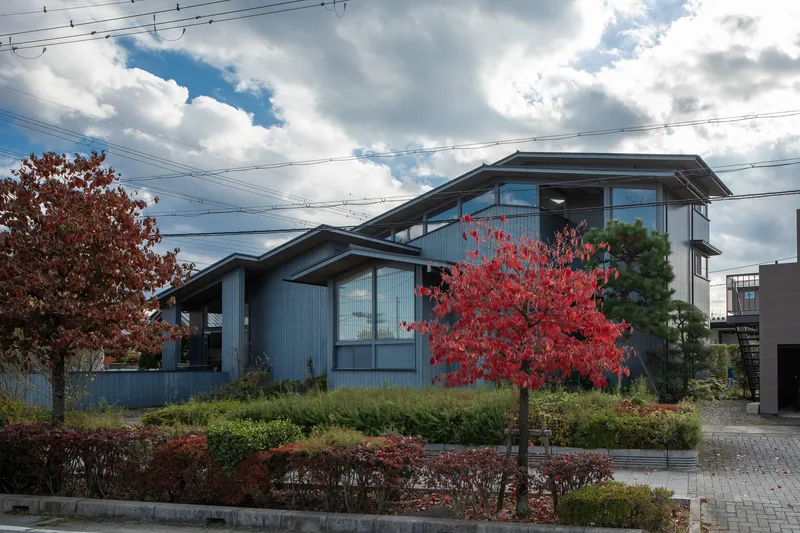
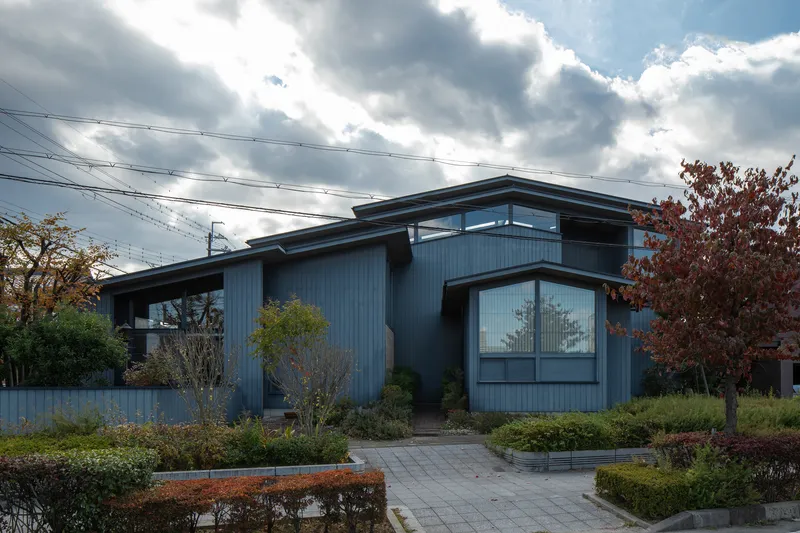

From the street, Leading House reads as a sequence of interlocking volumes clad in dark vertical metal siding, punctuated only by narrow clerestory windows that hint at interior life without revealing it. The corrugated metal fence runs along the road edge, absorbing the house into a composition that feels almost industrial. There is no front door performance here, no welcoming gesture. The deep overhangs and layered massing evoke the pitched roofs of the merchant houses that once lined this route, but the material language is plainly contemporary. It is an abstraction of memory rather than a reproduction of it.
A planted pathway leads to the entrance, softening the threshold between public road and private domain. The hedge line at street level reinforces the buffer. Kimura uses height strategically: the wall is tall enough to block sightlines from pedestrians and vehicles, but the gable peaks above it catch the eye from a distance, giving the house a presence on the streetscape without exposing its inhabitants.
Entering Through Light and Texture
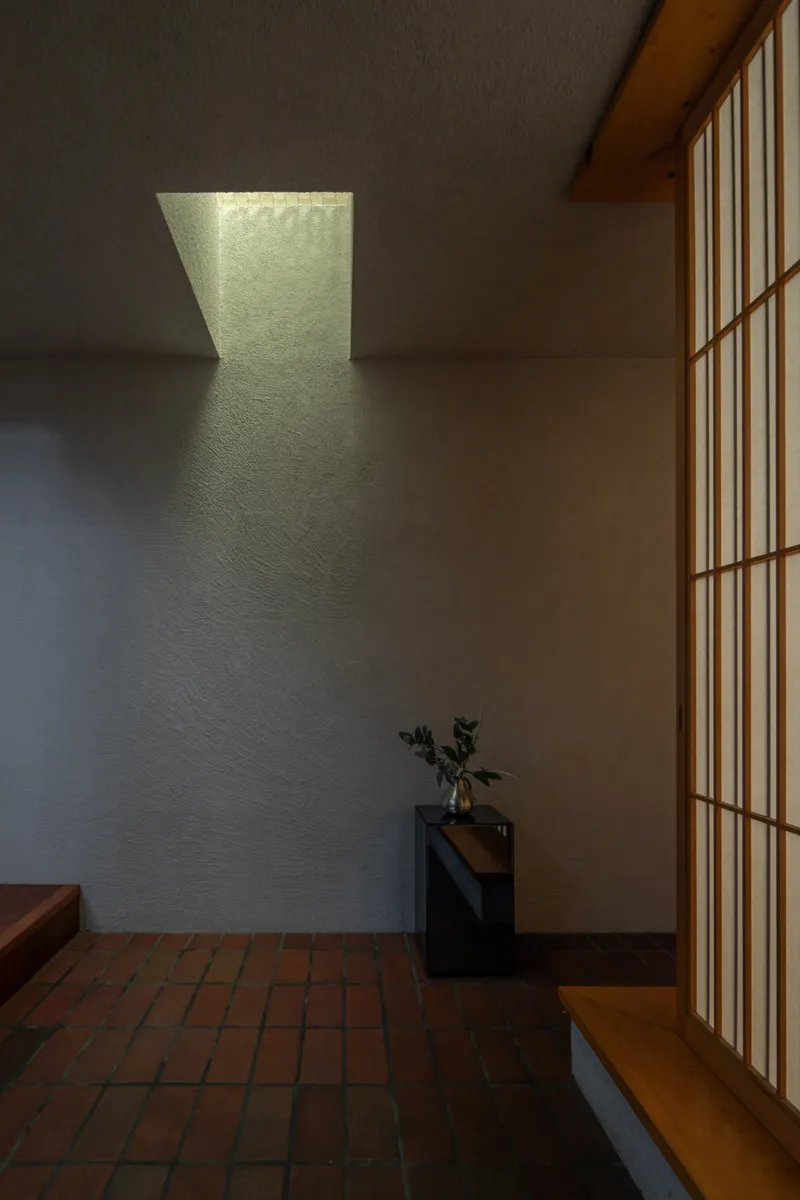
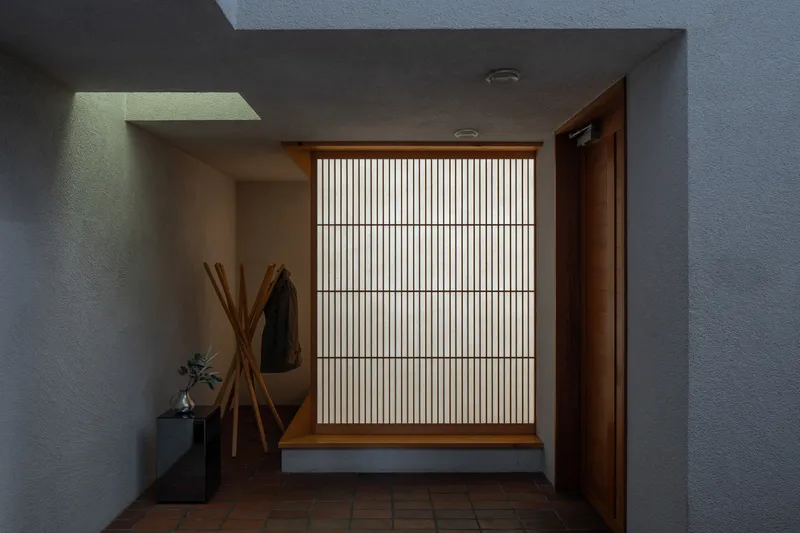
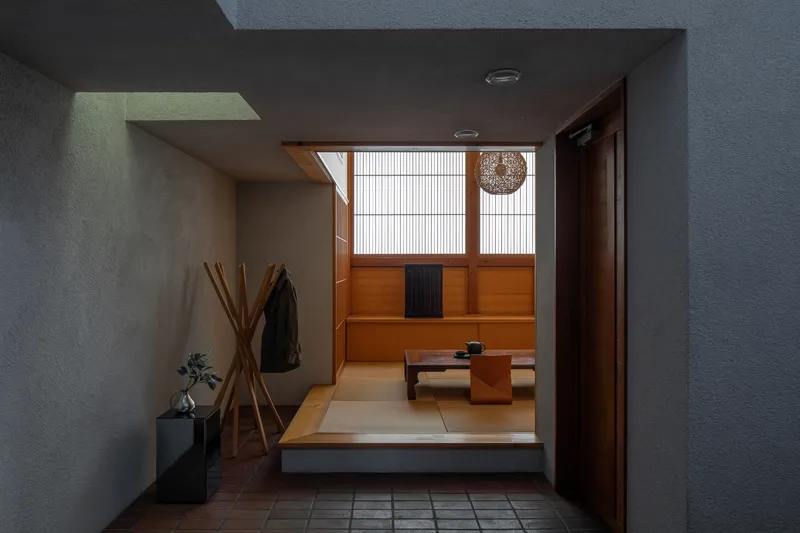
The entry sequence is carefully orchestrated. A trapezoidal skylight throws geometric shadows onto a textured plaster wall, immediately signaling that light will be the house's primary material. A slatted wooden screen filters views deeper into the plan, and terracotta tile underfoot establishes a grounding warmth before the palette shifts to timber and concrete. The foyer is compressed, deliberately tight, setting up the spatial release that follows.
Through the vestibule, a doorway opens onto a tatami room with a low table and pendant light, a traditional gesture placed right at the threshold of the house. The vaulted ceiling and paired translucent screens in this room carry the strongest echo of the site's historical context, a nod to the merchant houses and travelers' inns that once populated this corridor. It is a room that acknowledges the past without being held captive by it.
The Atrium as Vertical Engine
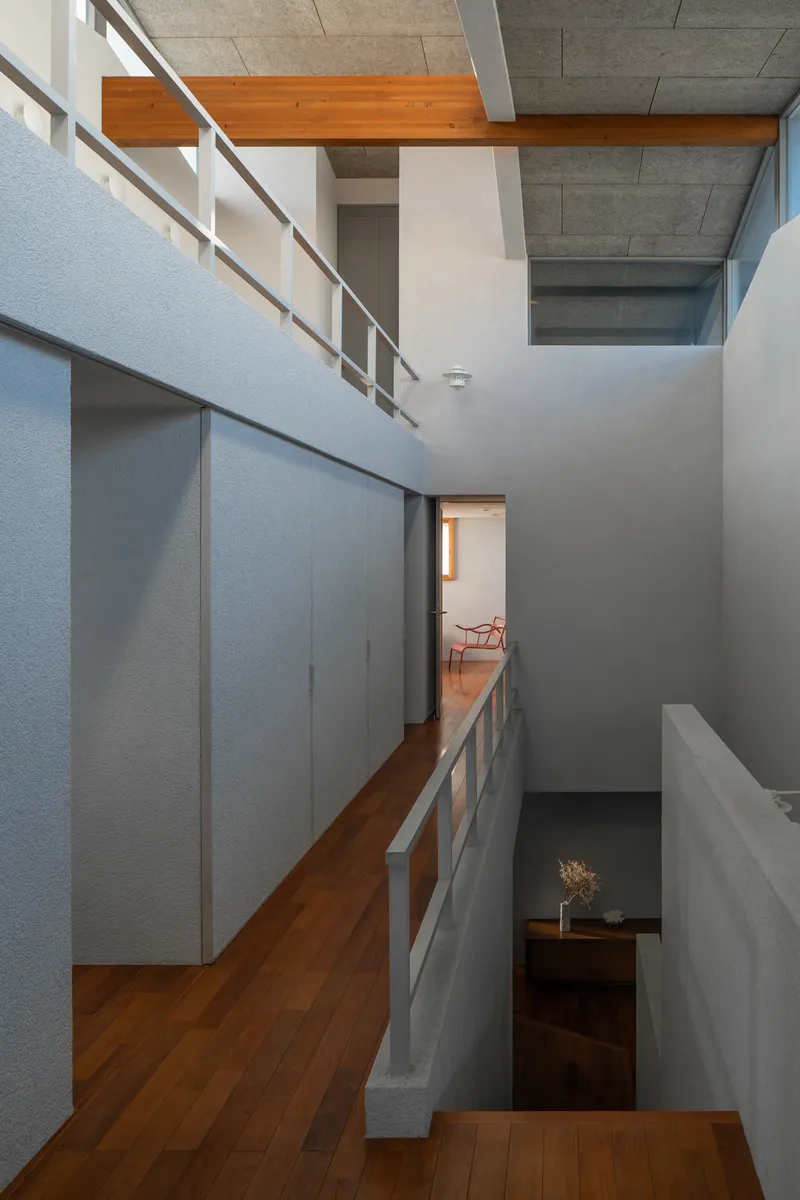
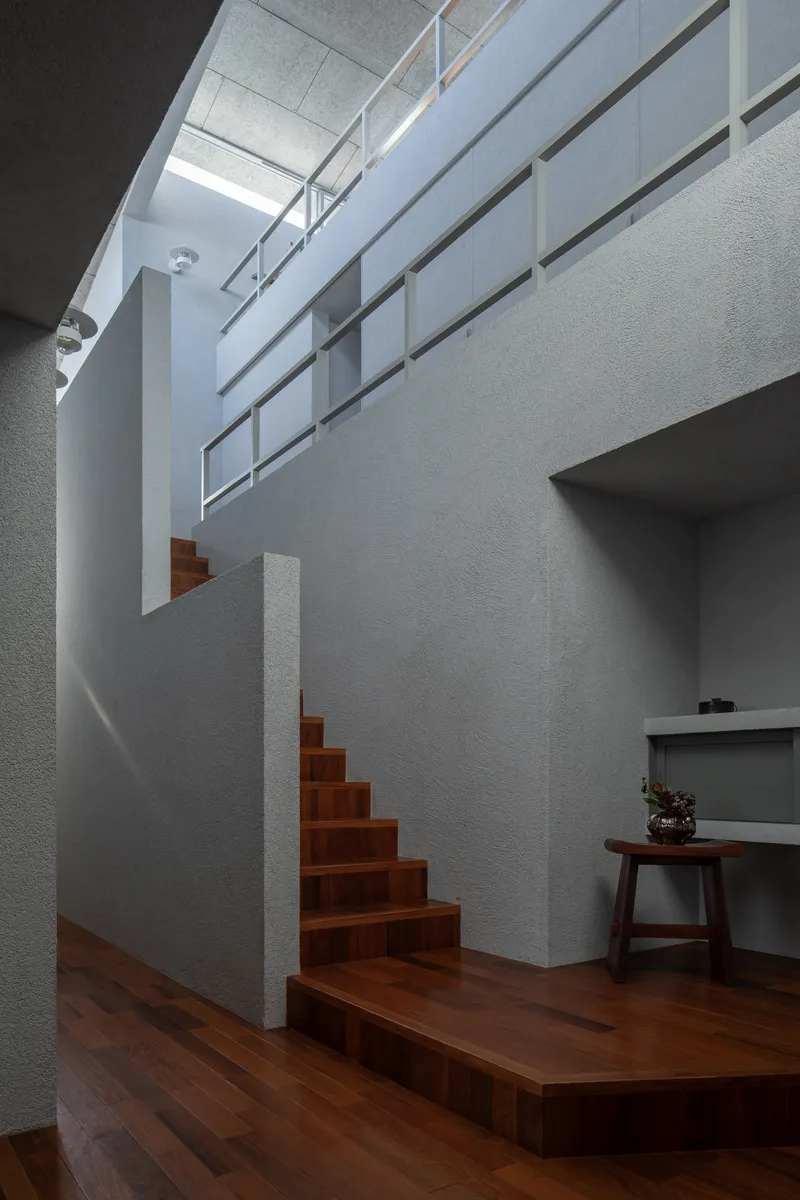
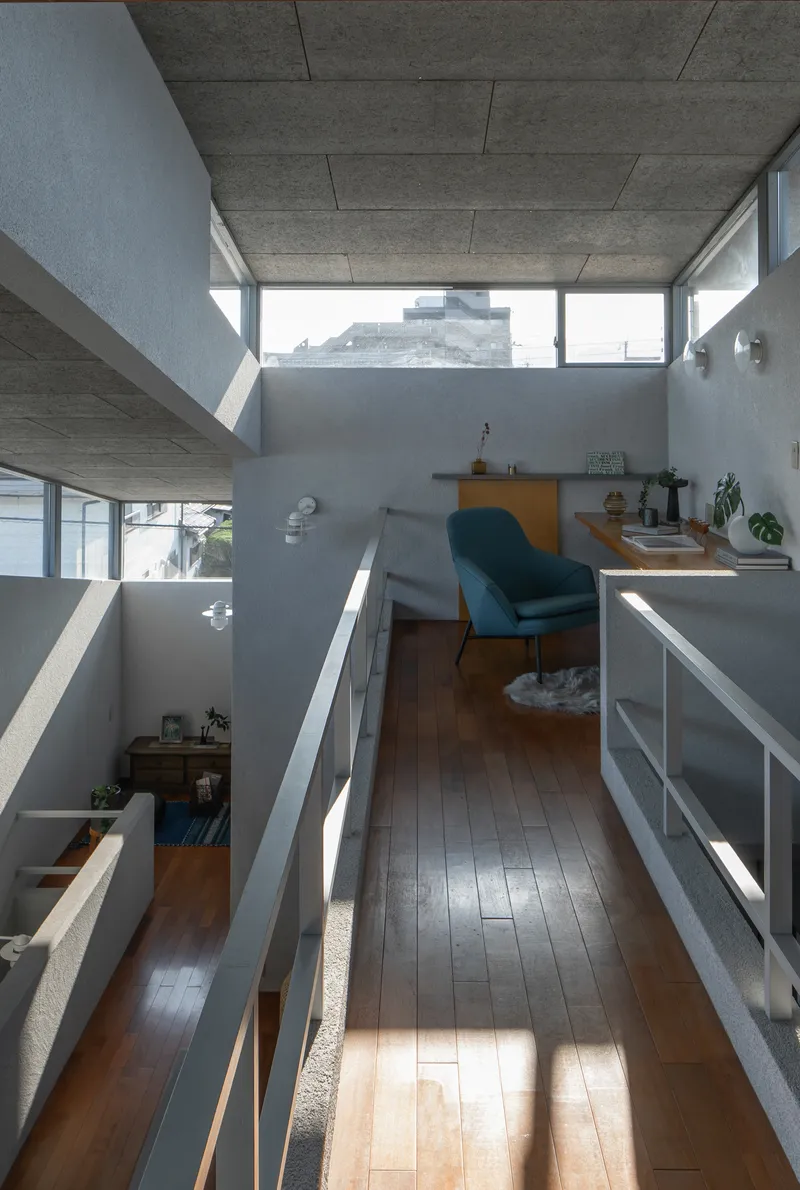
The three-story atrium is the organizational heart of the house, and it works harder than most residential voids. A timber walkway bridges the upper levels, metal railings keep the edges minimal, and exposed concrete ceiling beams give the space a structural legibility that prevents it from feeling merely decorative. From the ground floor, you can look up through two levels of the house. From the top, you can look down. The circular flow that Kimura establishes around this void means there is no dead-end corridor, no room that feels isolated from the rest of the house.
The staircase ascending through white-walled corridors is more than circulation. It is a sequence of framed views: a figure below caught in natural light, a skylight casting bright midday shadows on timber treads, diagonal beams of sun raking across concrete. The stairs are where the house's section becomes legible as experience rather than diagram. You feel the split levels shifting beneath you as you climb.
Light as the Primary Material
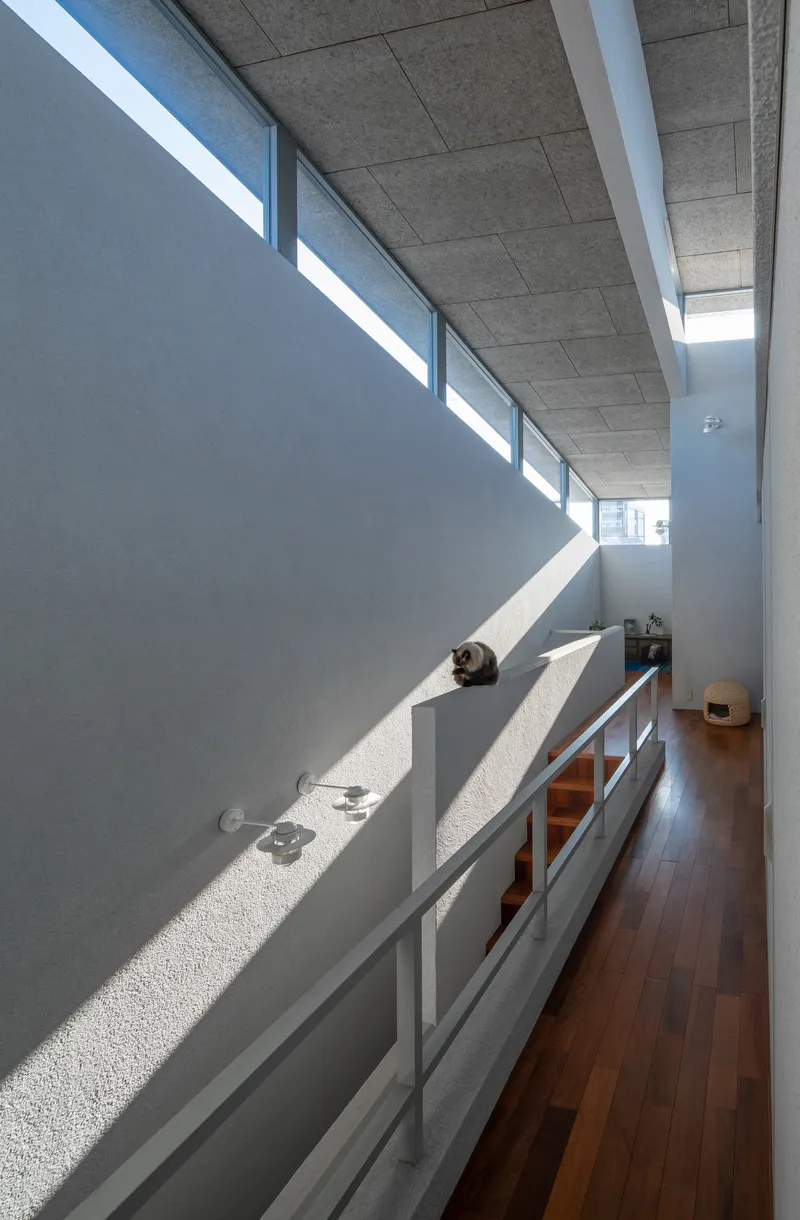
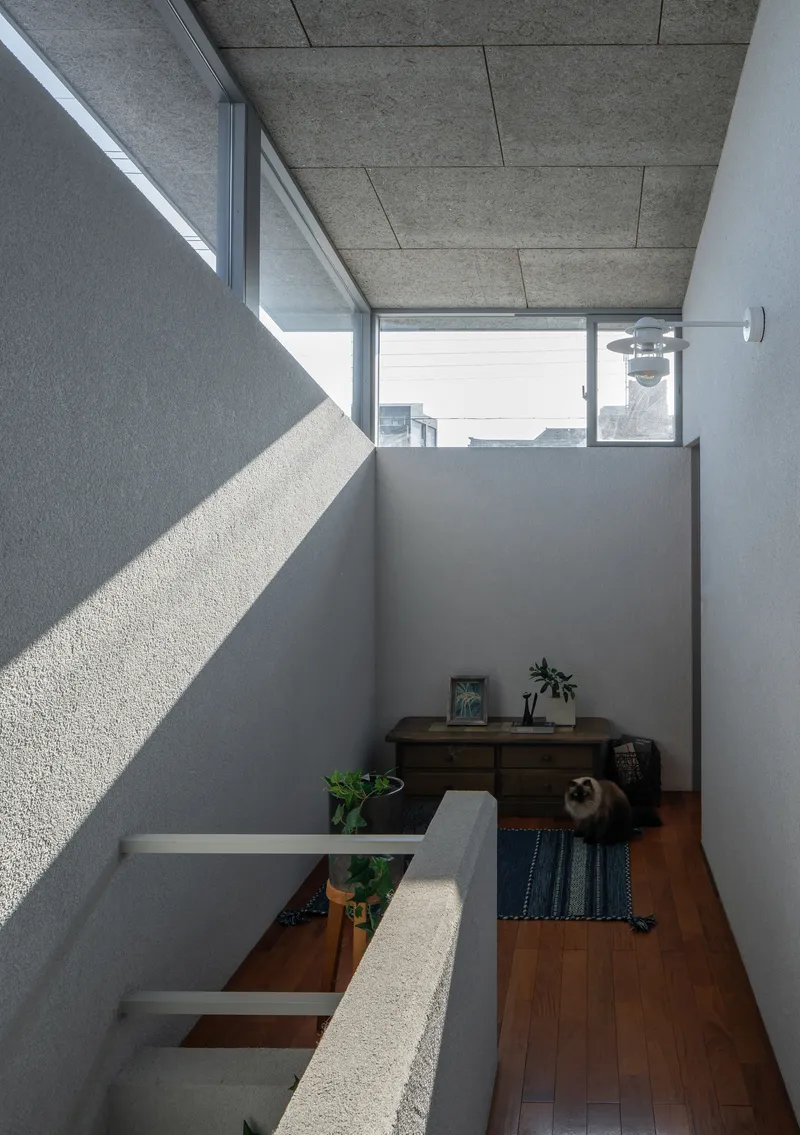
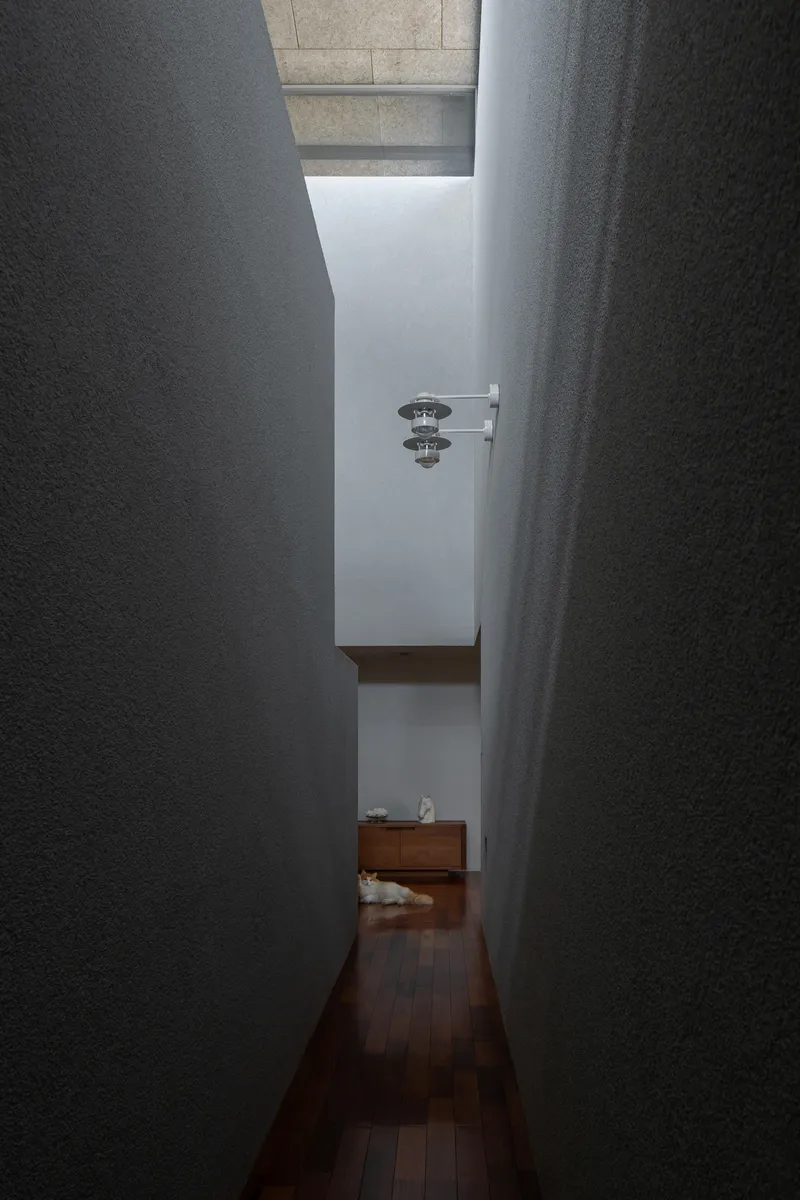
Kimura treats the clerestory windows not as generic openings but as calibrated instruments. They follow the slope of each roof, so the angle of incoming light changes with each gable. In the upper hallway, sharp diagonal beams cut across white walls beneath concrete ceilings. In the stepped seating nook, angled sunlight warms the concrete bench and timber floor. In the narrow corridor, textured plaster catches and scatters light from a skylit space beyond. Every surface is chosen for its relationship to illumination: smooth concrete reflects, plaster diffuses, timber absorbs.
The effect is a house that never looks the same twice. Morning light enters from one set of clerestories, afternoon light from another. The high wall on the street side doubles as a surface that casts dappled, moving shadows into the lower rooms. It is a sophisticated passive strategy dressed up as poetic intention, and it works on both levels.
Living Spaces That Breathe Outward


The double-height living space anchors the ground floor with an exposed concrete ceiling, glass pendant lights, and a board-formed concrete accent wall that carries the texture of its formwork. The kitchen is open and practical, with timber cabinetry and a dining table positioned beneath clerestory windows. Where the street side is sealed, the garden side opens generously: floor-to-ceiling glazing frames an autumn tree and an outdoor terrace, connecting the dining area to the landscape.
This asymmetry, closed to the road and open to the garden, is what gives the house its character. The public face is austere. The private face is warm, porous, and planted. The dusk view of the living room, with its concrete wall glowing in pendant light, reveals how the interior transforms at night from a house animated by sun to one shaped by artificial warmth.
Upper Rooms and Distant Views
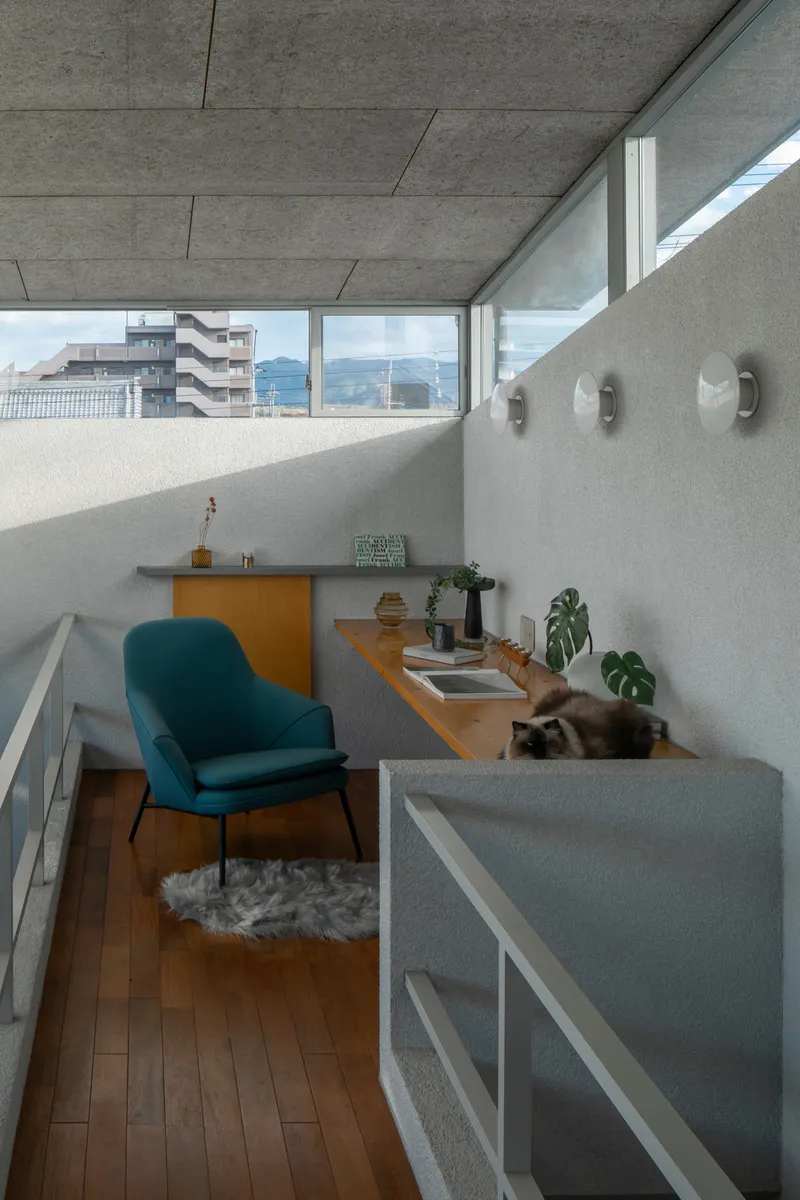
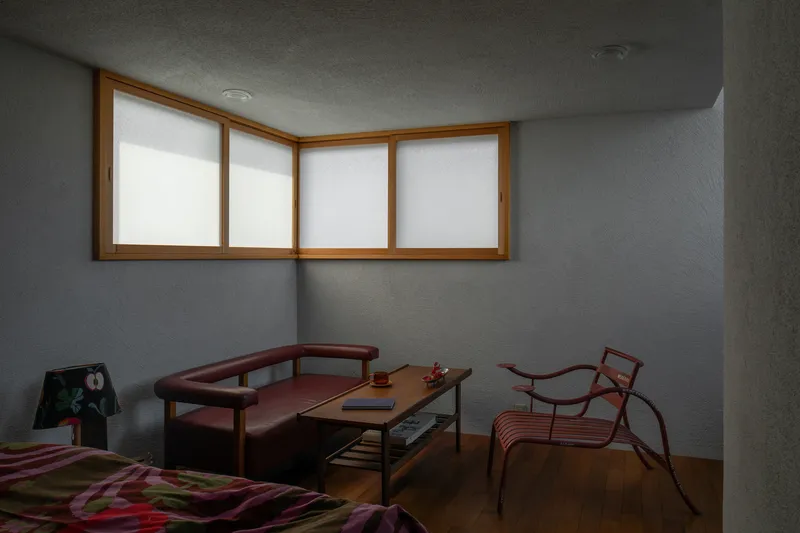
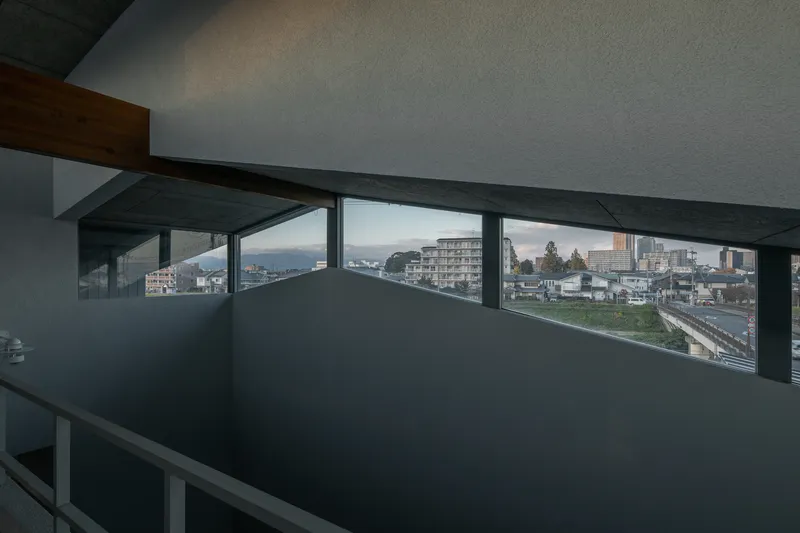
The upper levels reward the climb. A mezzanine workspace with a concrete countertop and clerestory windows overlooks distant mountains, a river, and the landscape beyond the road. The bedroom offers a horizontal ribbon window framed in timber, delivering diffused natural light without sacrificing privacy. At dusk, the upper corridor's band windows frame the mountains and the residential neighborhood in a panoramic strip, placing the house in its geographic context even as its street presence denies it.
These are rooms designed for someone who spends time at home. The study corners, the workspace, the teal-walled room where a cat rests on a daybed: they speak to domestic life lived slowly, with attention to where the sun falls and what the window frames. The house was designed for a cat lover, and that sensibility, the appreciation of warm patches of light, elevated perches, and circular routes, permeates the architecture.
Night Presence


At twilight, the house reveals its second identity. The dark vertical siding dissolves into the evening sky, and the window frames glow from within, transforming the facade into a lantern of warm rectangles. Low plantings soften the base. The circular wall sconces along the upper hallway illuminate textured plaster beneath exposed timber beams, turning the interior corridors into spaces of quiet drama. The house that hides during the day announces itself gently at night.
Plans and Drawings


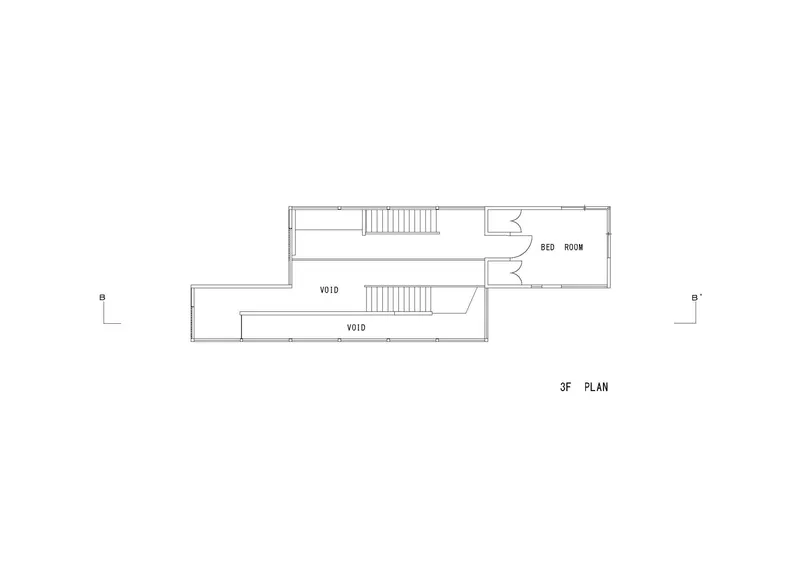
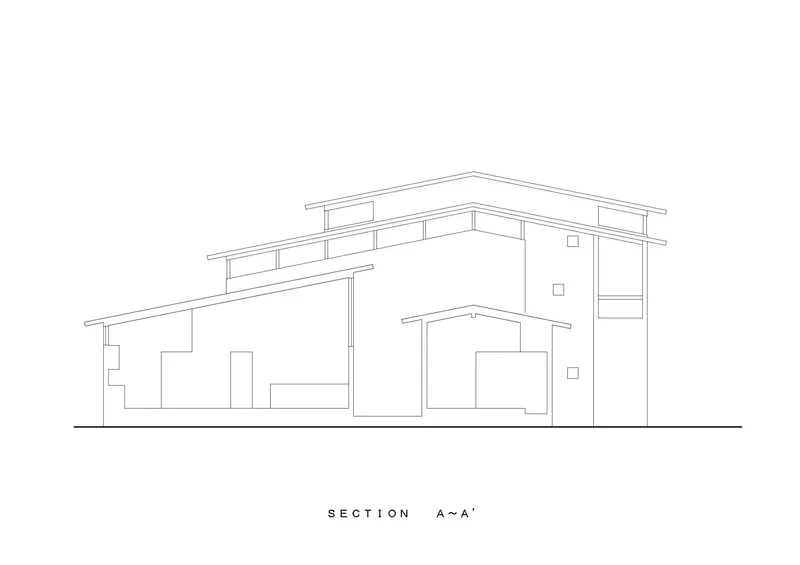

The floor plans reveal the split-level logic that the experience of the house makes intuitive. The ground floor organizes living and dining around the tatami room and terraces. The second floor places two bedrooms on either side of the void, connected by a bridge. The third floor isolates a single bedroom between double-height voids flanking the staircase. The sections are where the design becomes fully legible: the stepped rooflines, the cascading clerestory windows, and the way each interior volume nests beneath a different gable slope. It is a house that cannot be understood from any single floor plan; only the section tells the whole story.
Why This Project Matters
Leading House belongs to a lineage of Japanese residential architecture that treats the section as the primary design tool. Where plan-driven houses organize rooms horizontally, Kimura's project organizes experience vertically, using overlapping gable roofs to generate a cascade of spatial conditions from a compact footprint. The result is a house that feels generous without excess, private without isolation, and rooted in its historical context without nostalgia. The roof is not a hat placed on finished rooms. It is the generator of every interior quality the house possesses.
In a broader sense, the project demonstrates that the single-family house remains one of architecture's most productive laboratories. The constraints are real: a public road, privacy concerns, a client who loves cats, a site with distant mountain views but immediate exposure. Kimura does not resolve these tensions by choosing one priority over another. He resolves them spatially, through height, slope, and the precise placement of openings. The house is a reminder that good architecture does not eliminate complexity. It gives it form.
Leading House, designed by FORM | Kouichi Kimura Architects (lead architect: Kouichi Kimura). Located in Shiga, Japan. 226 m². Completed in 2022. Photography by Kenta Kawamura.
About the Studio
Share Your Own Work on uni.xyz
If projects like this are the kind of work you want to make, uni.xyz is a place to publish your own, find collaborators, and enter design competitions.


Popular Articles
Popular articles from the community


Jaramillo Van Sluys Arquitectura and Urbanismo Turn a Demolished Registry Lot in Quito into an Orchard Plaza
In Quito's Centro Histórico, a 2,800 m² plaza exposes the San Agustín convent wall and redraws its lost Augustinian orchard in volcanic stone.

David Ortega Stacks a Two-Story Mexico City Penthouse Around a Steel Stair and a Pergola-Shaded Roof Terrace
In Colonia Roma, a 300 m² penthouse uses oak joinery, a planted steel stair and a slatted roof pergola to make a new-build apartment feel like a house.

longwave studio Reorganizes a 112 m² Tainan Apartment Around the Daily Routines of a Family and Two Cats
In Tainan, Taiwan, birch plywood, rust-red furniture and a freestanding plaster wall link arrival, storage, work and family life in one apartment.

Architekt Andreas Gruber Scatters 23 Dark Timber Chalets Across a South Tyrolean Forest Edge
In Molini di Tures, Amonti Chalets breaks a resort into a hamlet of gabled timber houses, with parking, storage and services pushed into the slope.

Similar Reads
You might also enjoy these articles


LAVA Architecten Gives Vocational Education a Sawtooth-Roofed Face on a Mechelen School Campus
In Mechelen, Belgium, a 2,053 m² STEM school on a 6×6 m grid turns workshops and classrooms into rooms that can be rearranged as teaching changes.

KEMA Studio Turns a Derelict Marvila Attic into a 60 m² Lighthouse Apartment Above Lisbon
In Lisbon's Marvila district, a rebuilt roof, four skylights and two plywood volumes turn an unlivable attic into a bright home facing the Tagus.

Pixel Gardens: One Repeated Module Stacked Into a Terraced Social Housing Tower for Famagusta
Salem Bader's shortlisted housing tower builds a vertical neighbourhood from one repeated module, offsetting units to carve terraces, light and air.

Bao Huynh Watercolor Atelier: A Serene Art Retreat in Hội An
Bao Huynh Watercolor Atelier in Hội An blends multifunctional art spaces, sustainable design, local materials, and family-friendly living in a serene environment.

Explore Household Competitions
Discover active competitions in this discipline

Challenge to design mud housing for contemporary communities

Challenge to reimagine the Iron Throne

Photograph architecture without architects

Illustrate the lost glory of Angkor Wat - Render Challenge
Comments (0)
Please login or sign up to add comments
No comments yet. Be the first to comment!