

Kripya Dhyan Dijiye: Rethinking Mumbai's Urban Fabric Through Synchronized Transit
A transit-oriented development strategy that reimagines Mumbai as a circuit of connected nodes, aligning mobility architecture with digital systems by 2030


What if the most powerful piece of architecture in Mumbai isn't a building at all, but a timetable? "Kripya Dhyan Dijiye," which translates to "Please Pay Attention," asks exactly that. The proposal treats Mumbai's entire transit network as a single design problem, arguing that cyclic scheduling, digital interfaces, and station-area densification can collectively reshape how 20 million people move, work, and live. Rather than pouring concrete into new highways, the project synchronizes what already exists: local trains, metro lines, and bus routes, binding them into one cohesive, clock-face system that could reduce passenger load by up to 40%.
Designed by Alankrita Sarkar, Sahil Kanekar, Rahul Dewan, and Sumanth S. Rao, the project received an Honorable Mention in the Hyperlocal competition on uni.xyz. Its strength lies not in a single iconic form but in a systems-level vision: transport architecture as the scaffolding for an entire city's spatial and social reorganization, with Andheri Station serving as the pilot node for a 2030 rollout.
A City Designed Around the Rhythm of Trains

The illustrated storyboard above traces a commuter's journey through the proposed system, sketching figures as they navigate metro platforms, interchange corridors, and station concourses. What stands out is the emphasis on temporal design: the cyclic timetable creates a predictable, repeating pattern of train movements that commuters can internalize, the way Londoners internalize the Tube map. Predictability becomes a spatial quality. When you know exactly when the next connection departs, you move through the station differently. Corridors shrink psychologically, waiting areas become optional rather than mandatory, and the architecture of dwell time changes.
Supporting this rhythm is the M-Suvidha smart card system, which enables seamless intermodal transitions between trains, metros, and buses. The designers understand that a fare gate is a piece of architecture too: every tap, every transfer penalty, every confusing signage board either accelerates or obstructs the flow of a city. By flattening the friction between modes, the proposal turns Mumbai's fragmented transit operators into a single legible network.
Nodes, Not Zones: Mixed-Use Density Around Transit Hubs
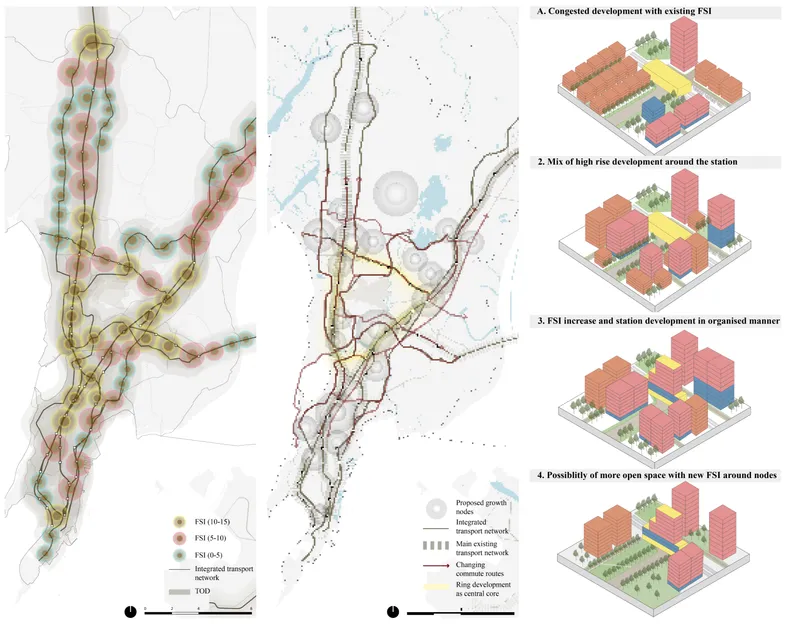

The urban planning diagrams lay out the proposal's second major move: Transit-Oriented Development (TOD) as a strategic redistribution tool. Instead of treating Mumbai's southern business district as the sole employment magnet, the design redistributes commercial, residential, and office programs to nodes along central and northern transit corridors. Each node grows vertically under a regulated Floor Space Index (FSI) that increases density near stations while preserving open space at ground level. The isometric scenarios show how a single transit hub can anchor a micro-ecosystem of housing, retail, and workspace within walking distance.
The route optimization diagram reinforces this with granular detail: GPS-enabled bus shelters, real-time tracking displays, and network connectivity illustrations show how last-mile transport feeds into the larger circuit. The designers are careful to treat buses not as a lesser mode but as an essential capillary system. Without functioning bus shelters and reliable feeder routes, even the best metro line produces a crowd at its exits and empty seats at its periphery. The proposal addresses this by making buses digitally visible and operationally synchronized with rail schedules.
The Circuit System: Work, Live, Play as a Loop
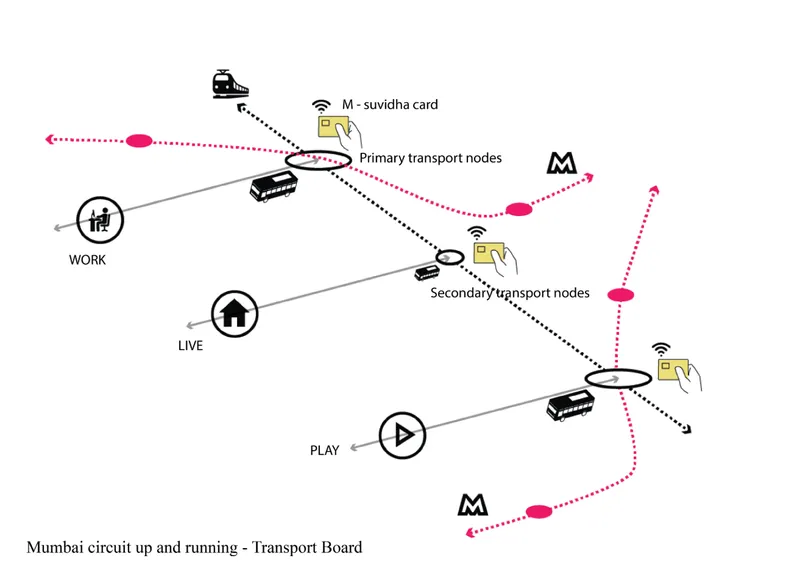
By 2030, the designers envision Mumbai's transport network as a circuit: a loop of connectivity linking work, home, and recreation. The transit integration diagram maps this clearly, with transport nodes connected by dotted lines to destinations categorized as "work," "live," and "play." It reads less like a conventional masterplan and more like a wiring diagram for a city-scale operating system. Each node is a micro-ecosystem, and the lines between them carry not just passengers but economic energy, distributing opportunity more evenly across the metropolitan region.
The architecture in this framework is deliberately non-monumental. The pilot transformation at Andheri Station integrates metro, bus, and pedestrian movement into a single coherent flow, but its ambition is operational rather than formal. Public spaces around the station accommodate vendors, commuters, and digital information interfaces, reflecting what the designers call a "democratic use of urban space." The measure of success here is not a photograph but a statistic: shorter travel times, reduced congestion, and better multimodal access.
Digital Interfaces as New Public Spaces
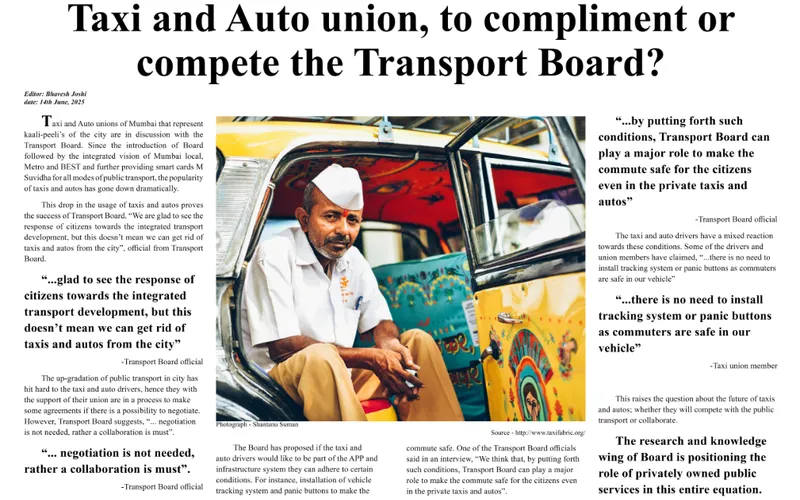
One of the proposal's most provocative claims is that apps and interfaces constitute a new kind of public space. The editorial layout above, pairing a photograph of a taxi driver with policy text, grounds this idea in reality. Mumbai's transport ecosystem includes millions of informal operators, auto-rickshaw drivers, and taxi services whose livelihoods depend on how formal systems are designed. A digital Transport Board that integrates citizen feedback, real-time GPS data, and mobile route planning doesn't just optimize commutes; it mediates between the formal city and the informal one.
The designers extend architecture into this digital realm deliberately. When a commuter tracks a bus on their phone, they are engaging with infrastructure as directly as when they walk through a turnstile. The proposal argues that designing these touchpoints with the same care as physical stations can fundamentally alter the relationship between citizens and their city's mobility systems.
Why This Project Matters
"Kripya Dhyan Dijiye" matters because it refuses to treat transit as an engineering problem with an architectural wrapper. Instead, it positions architecture as the discipline capable of synthesizing scheduling, digital systems, land-use policy, and spatial design into a unified urban strategy. The cyclic timetable is as much a design intervention as the Andheri Station redevelopment. The FSI regulation is as consequential as the bus shelter. By holding all of these elements in a single frame, the team demonstrates a systems literacy that is increasingly essential for anyone designing in dense, fast-growing cities.
The project also offers a quiet but important corrective to the spectacle-driven instincts of competition culture. There is no swooping parametric canopy here, no hero render of a glowing tower. What there is, instead, is a rigorous argument that the most transformative architecture in a city like Mumbai may be invisible to the eye but deeply felt in the daily experience of millions. That argument, backed by concrete strategies for Andheri and a scalable vision for 2030, earned its Honorable Mention honestly.
View the Full Project
About the Designers
Designers: Alankrita Sarkar, Sahil Kanekar, Rahul Dewan, Sumanth S. Rao
Enter a Design Competition on uni.xyz
uni.xyz runs architecture and design competitions year-round that reward proposals with spatial conviction and real site intelligence.
Project credits: Kripya Dhyan Dijiye by Alankrita Sarkar, Sahil Kanekar, Rahul Dewan, Sumanth S. Rao Hyperlocal (uni.xyz).


Popular Articles
Popular articles from the community


David Macias Steps a Doorless Stone and Plaster House Down a Tropical Colombian Hillside
In the humid hills of Colombia, Threshold House replaces the front door with an open void and terraces its 850 m² down the slope instead of fighting it.

Architekt Andreas Gruber Scatters 23 Dark Timber Chalets Across a South Tyrolean Forest Edge
In Molini di Tures, Amonti Chalets breaks a resort into a hamlet of gabled timber houses, with parking, storage and services pushed into the slope.

longwave studio Reorganizes a 112 m² Tainan Apartment Around the Daily Routines of a Family and Two Cats
In Tainan, Taiwan, birch plywood, rust-red furniture and a freestanding plaster wall link arrival, storage, work and family life in one apartment.

GROUP A Strips a 1969 Rotterdam Harbor Headquarters to Its Frame and Wraps It in Timber Louvers
In Rotterdam's M4H harbor district, Ferro Offices reuses a 1969 frame, adds one timber storey and reaches BREEAM-NL Outstanding.

Similar Reads
You might also enjoy these articles


Aquadapt: An Underwater Habitat That Rewrites Its Rooms by the Hour
Curved modules ring the seabed while one shell shifts from breakfast room to cinema, farm and football pitch as residents' needs change.

Play: Fragments of Their World: Remembered Architecture Rebuilt as a Modular Playground for Refugee Camps
Tom Gardner abstracts domes, arches and towers from the homelands of displaced families into a kit of child-scaled play parts for camp settlements.
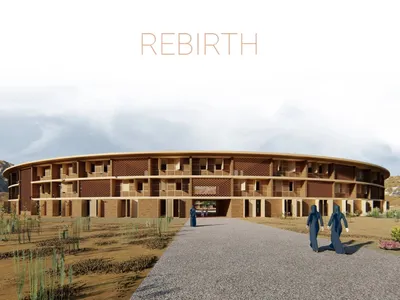
REBIRTH: A Circular Settlement Where Afghan Widows and Their Children Rebuild Life Together
A shortlisted Resile entry turns the circle into a protective ring of timber and brick, gathering homes, classrooms and gardens around a shared landscape.
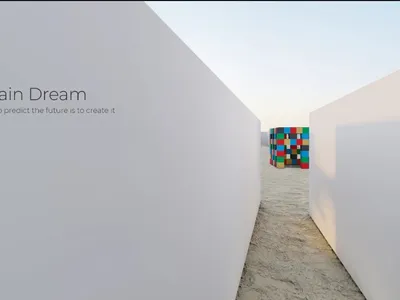
The Main Dream: A Recycled Plastic Kit That Lets Refugee Children Build Their Own Playground
Thirty-centimetre interlocking cubes that connect on three axes turn play into construction, letting children author the spaces they occupy.

Comments (0)
Please login or sign up to add comments
No comments yet. Be the first to comment!