
La Cabina de la Curiosidad Suspends Two Bedroom Nests from the Ceiling of a Converted Warehouse in Ecuador
In rural Perucho, a block-walled storage building becomes a layered home through a new bamboo roof and hanging sleeping lofts.


Thirty-five kilometers from Quito, in the rural parish of Perucho, a cinder-block warehouse had been accumulating domestic life for years. Patched, fixed, and gradually inhabited, the building carried the familiar logic of incremental self-construction: walls went up first, a roof went on, and rooms were carved out as needs arose. When La Cabina de la Curiosidad, Marie Combette, and Daniel Moreno Flores took on the project, they chose not to tear the warehouse apart but to work with its bones, treating the existing block walls as a given and the roof as the real design opportunity.
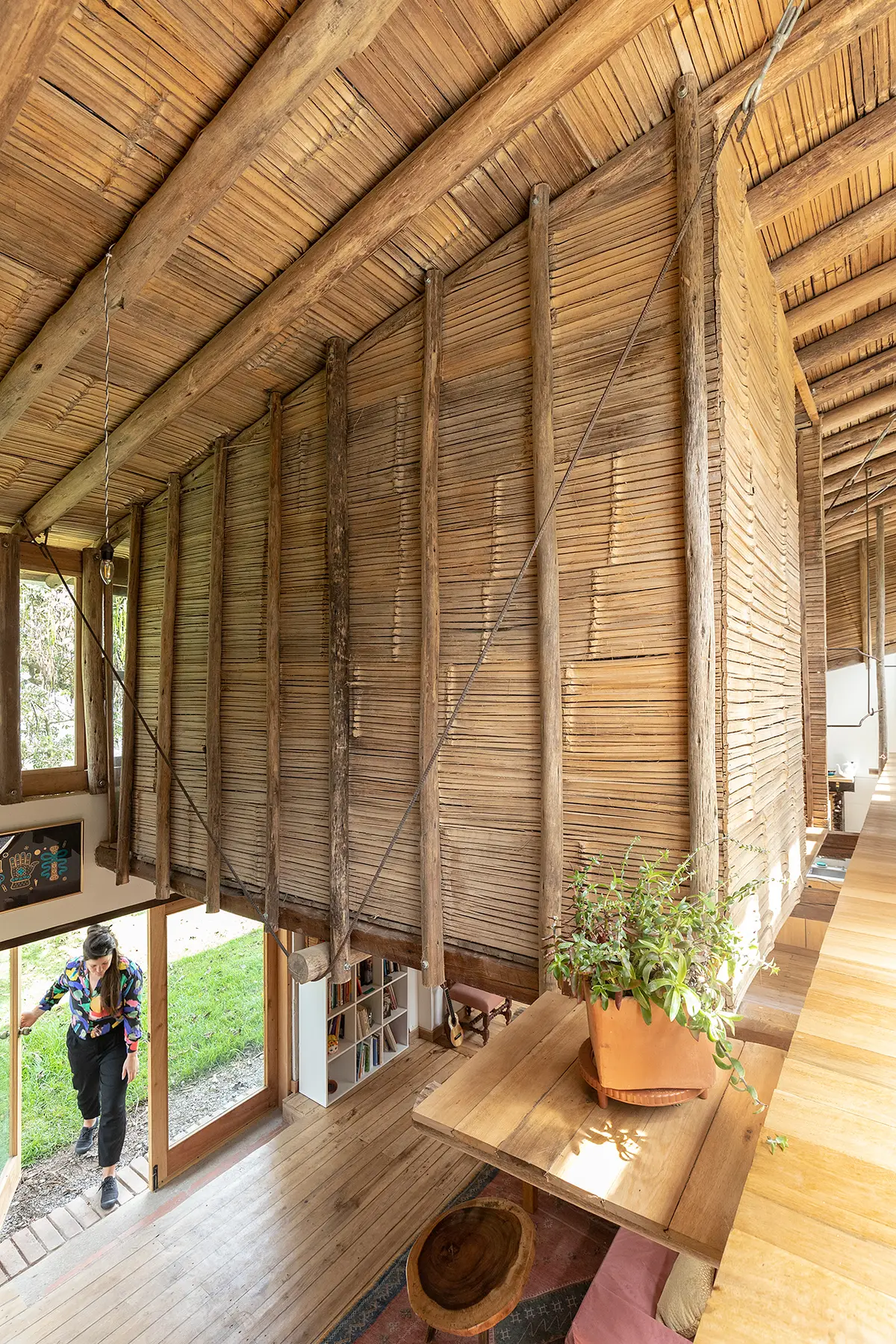
What makes Cholan Nests House genuinely compelling is the decision to hang rather than stack. Instead of subdividing the double-height volume with a conventional second floor, the team suspended two bedroom pods from the roof structure, freeing the ground plane and turning the entire section into a single interconnected space. The new roof, lighter and taller than the original, is the engine of the whole intervention: eucalyptus pingo beams, chopped cane lining, coconut-fiber thermal insulation, and egg-tray acoustic panels work together in a layered assembly that is both structurally honest and thermally serious. It is a 105-square-meter house that reads as much larger, because the section never stops.
A Warehouse Wearing Its History
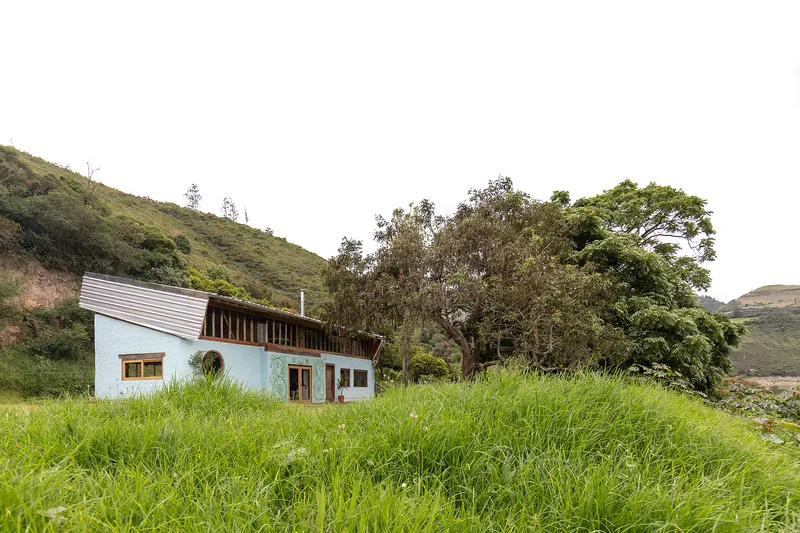
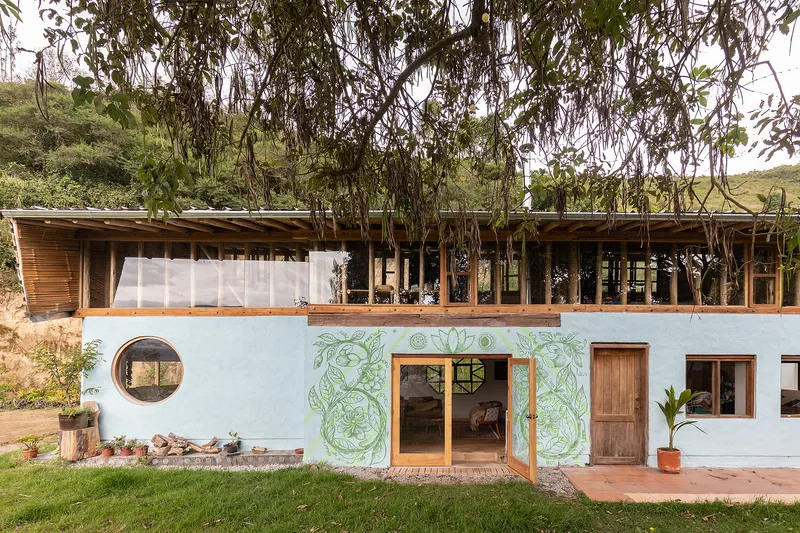
From the outside, the house doesn't announce itself as a design project. The corrugated metal roof, the painted block walls, and the grassy hillside setting all belong to the vernacular of Perucho's rural landscape. What signals that something different has happened are the details: a circular window punched through a mural-painted facade, a timber-framed upper level that sits lightly on the masonry below, and eucalyptus trunks that double as structural columns and shade canopy.
The architects kept the exterior deliberately modest. There is no performative contrast between old and new, no glass box erupting from a ruin. The intervention reads from the street as a house that has simply been lived in more carefully. That restraint is the right call: it lets the real spatial drama remain interior, discovered rather than displayed.
The Bamboo Canopy Above
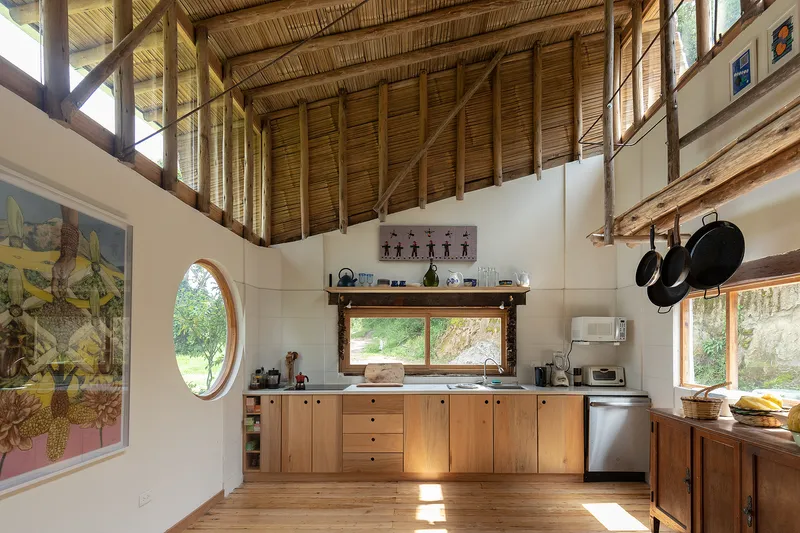
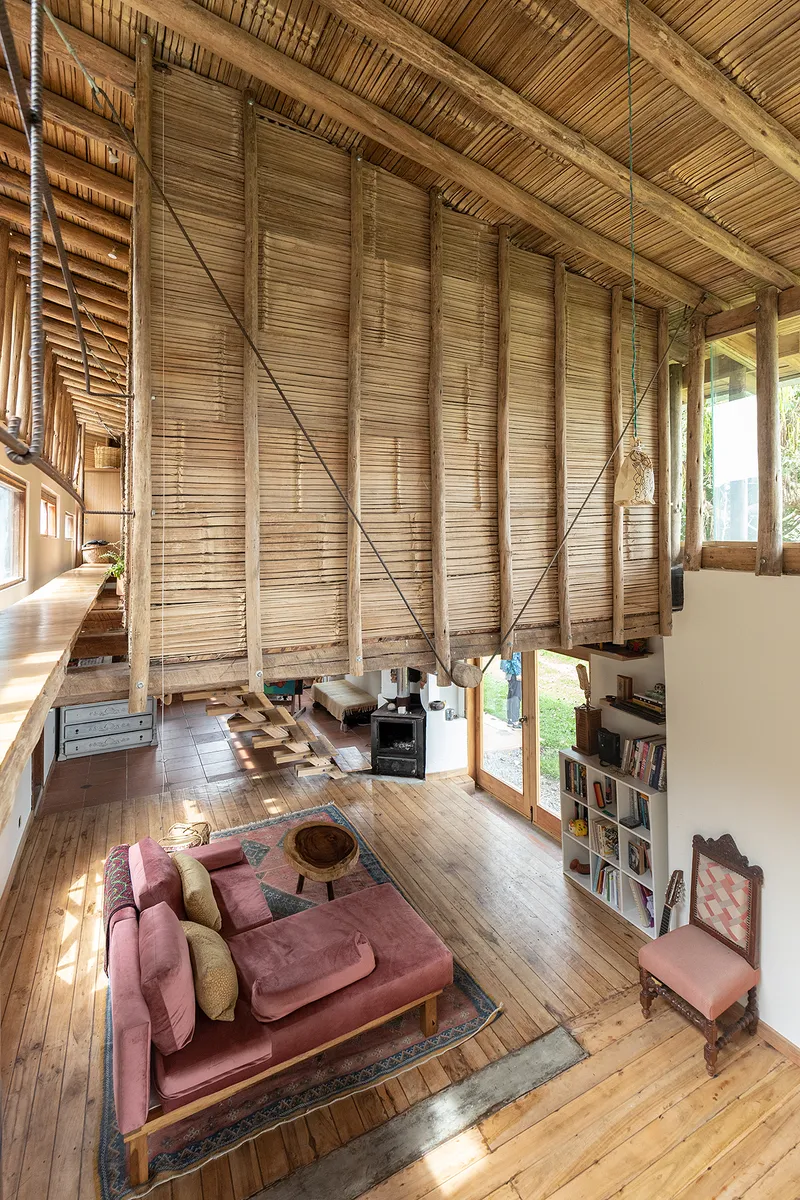
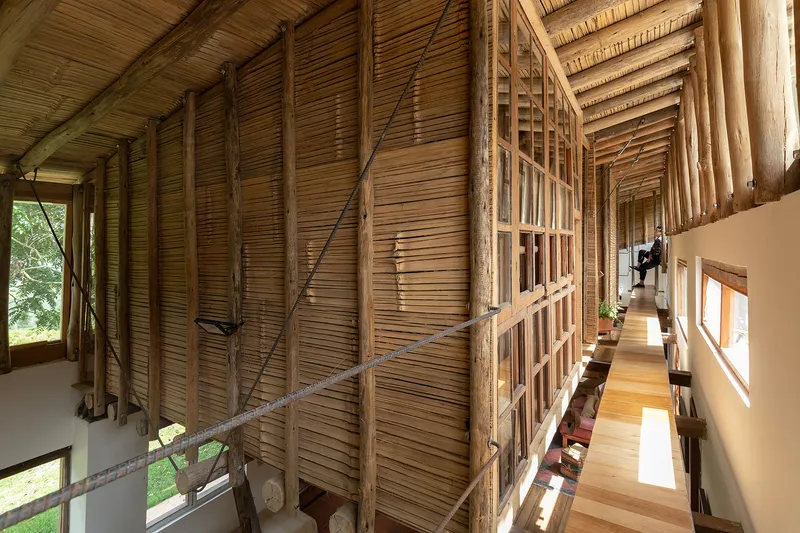
The bamboo-slat ceiling is the dominant material experience of the house. Chopped cane lines the underside of the roof in tight, rhythmic courses that catch raking light and give the interior a warm amber tone regardless of the hour. Above this visible layer sit the functional strata: coconut fiber for thermal regulation and egg trays for acoustic damping, a lo-fi sandwich that performs well in Perucho's subtropical climate without relying on industrial insulation products.
The exposed eucalyptus beams that span the volume are left round and unfinished, still legible as the trees they recently were. Combined with diagonal timber bracing, they give the ceiling a tectonic directness that more refined joinery would have obscured. You read every force path, every connection. In a 105-square-meter house, that structural transparency is what makes the space feel generous rather than cramped.
Hanging the Nests
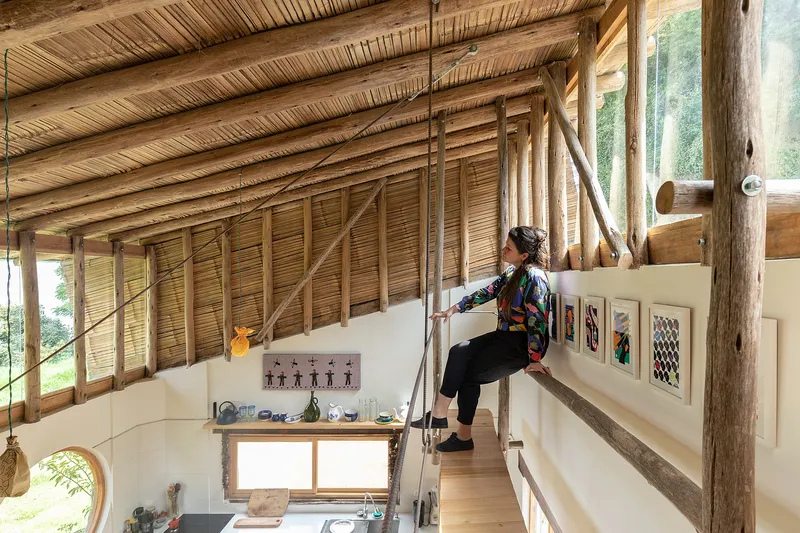
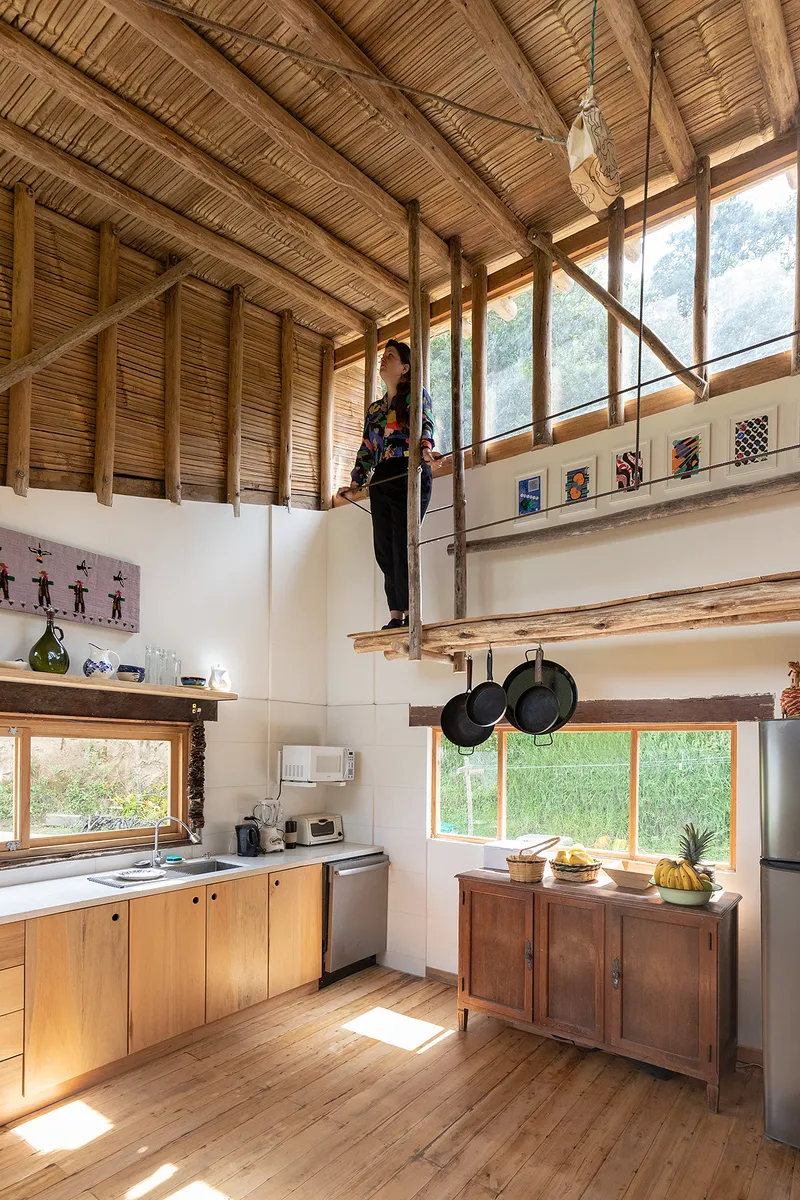
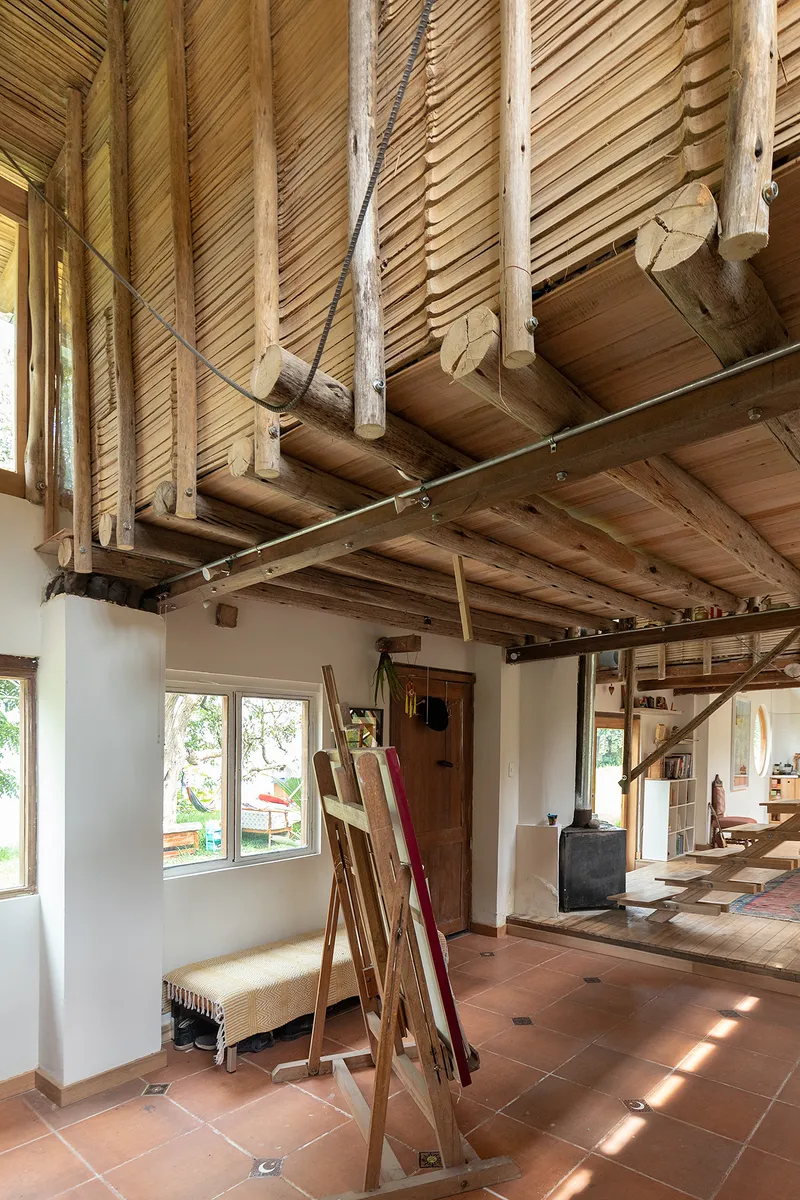
The project's defining move is the pair of suspended sleeping lofts, the "nests" of the title. Rather than building a full mezzanine slab, the architects hung two timber platforms from the roof beams, creating enclosed bedrooms that float within the double-height volume. The result is a sectional game where the kitchen, living room, and workspaces below maintain visual and acoustic continuity while the bedrooms above gain privacy through elevation alone.
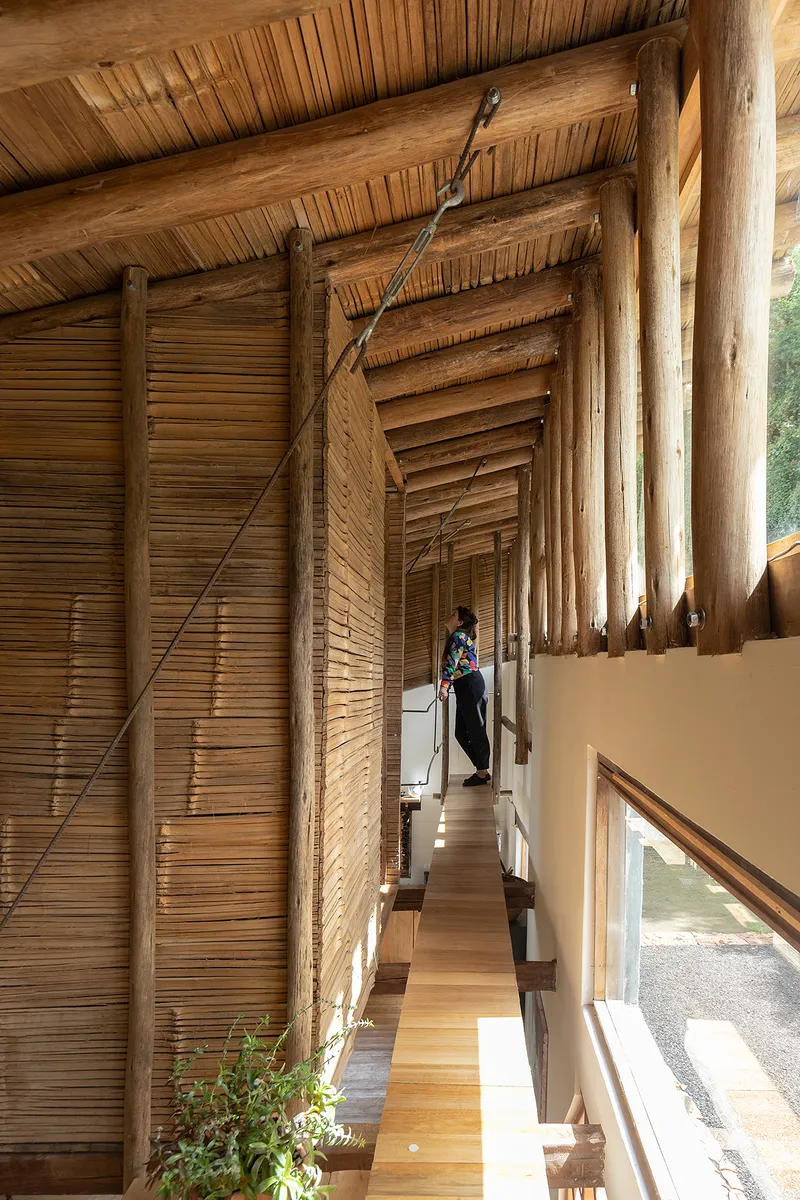
Structurally, the existing beams do the heavy lifting. The nests are timber-framed boxes, light enough to be carried by the eucalyptus pingo structure without requiring new foundations or columns below. Walking on the suspended timber walkways that connect them produces a slight flex underfoot, a physical reminder that you are occupying a structure held in tension rather than resting on compression. It is an honest sensation, and one that most residential projects would engineer out.
Living Below, Working Between
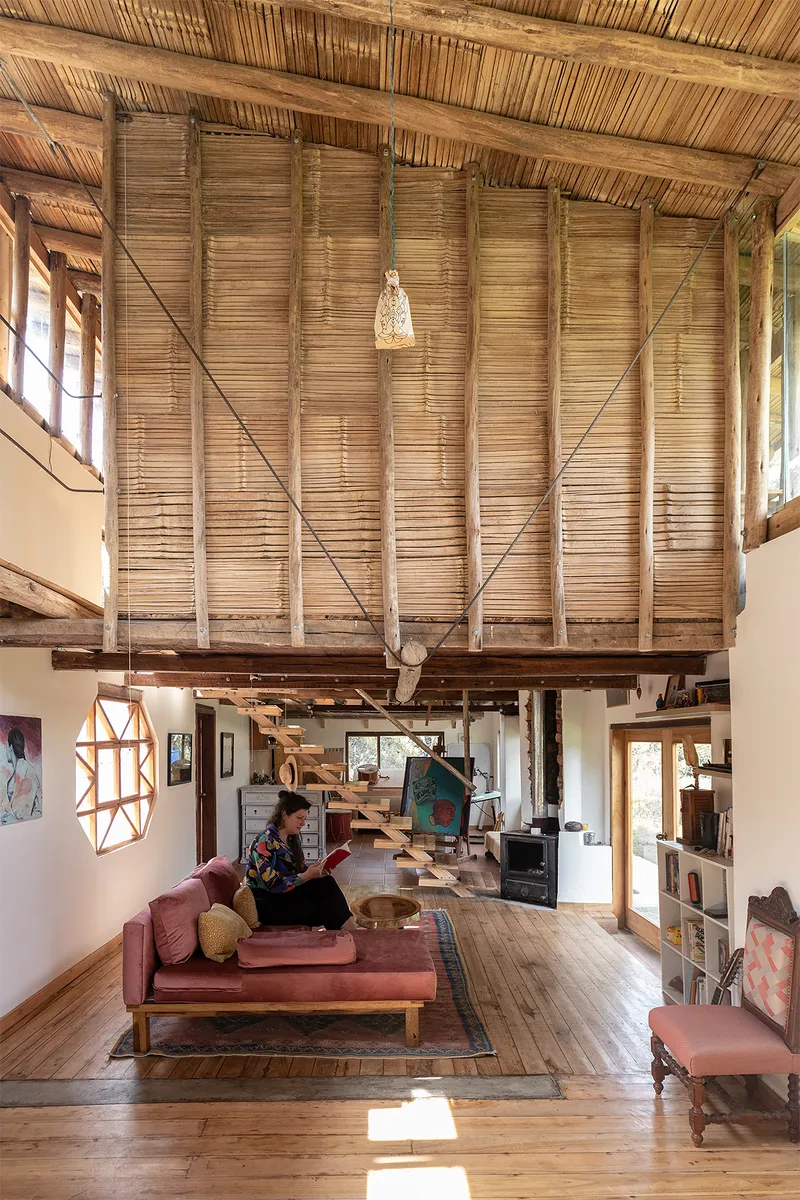
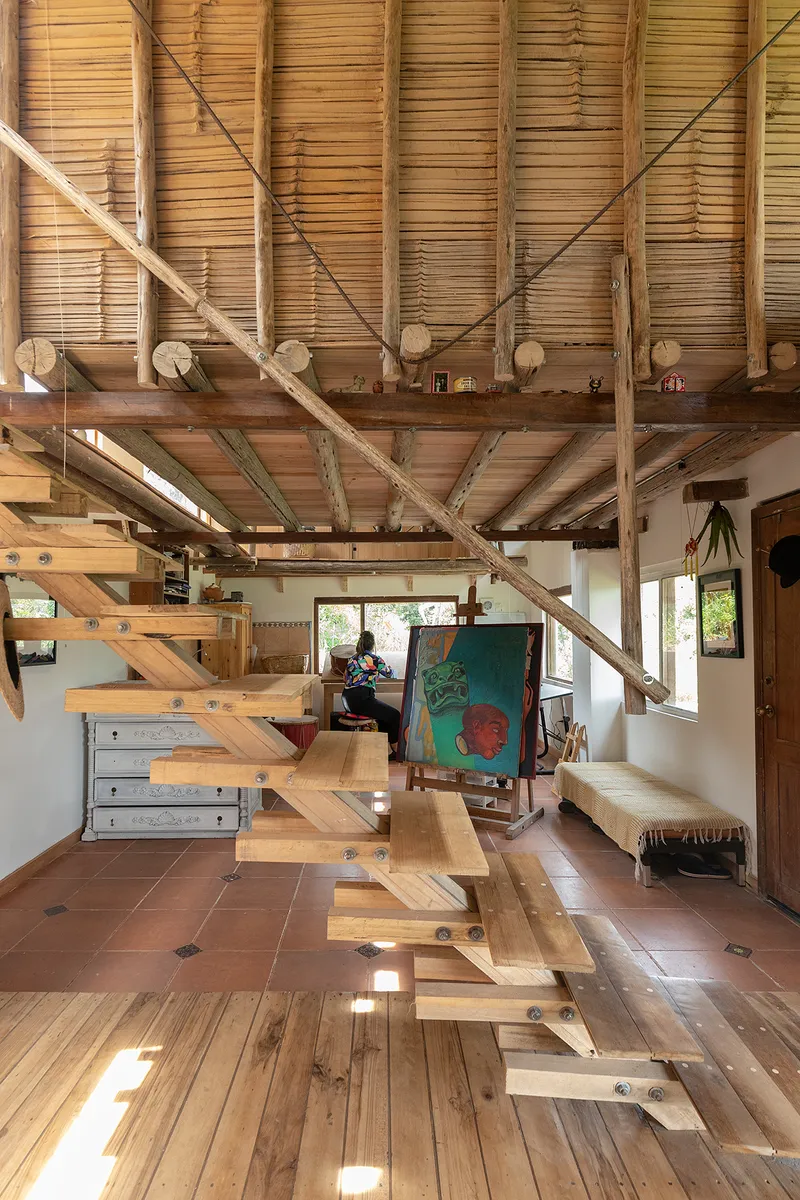
The ground floor reads as a continuous domestic landscape: kitchen at one end, living area at the center, with terracotta tile flooring grounding the palette against the warm timber and bamboo above. A pink sofa anchors the living room, an unapologetic pop of color that signals comfort over austerity. Afternoon light fills the double-height volume through clerestory openings and glazed doors, keeping the space bright without overheating the cane-lined ceiling.
The mezzanine level is not purely for sleeping. Workspaces and study alcoves are distributed along the timber walkways, taking advantage of the elevated vantage point and the quality of light at ceiling height. A person at a desk up here looks out through horizontal windows that frame the garden and the hillside beyond, while remaining connected to the domestic activity below through the open section. The house collapses the boundary between living and working not through open plan rhetoric but through vertical layering.
Light, View, and the Garden Frame
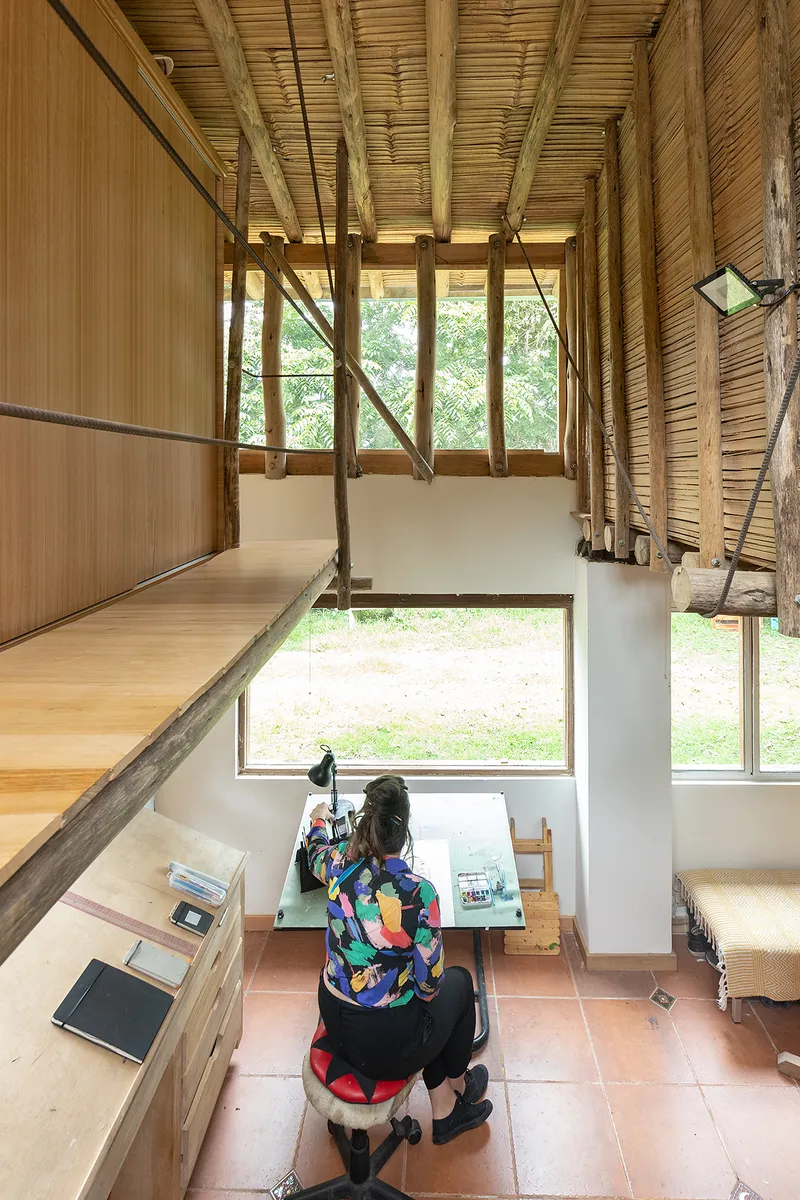
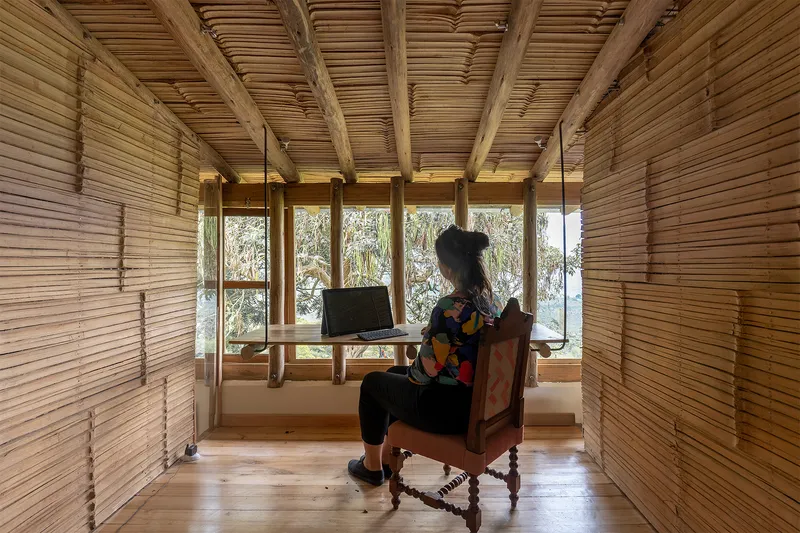
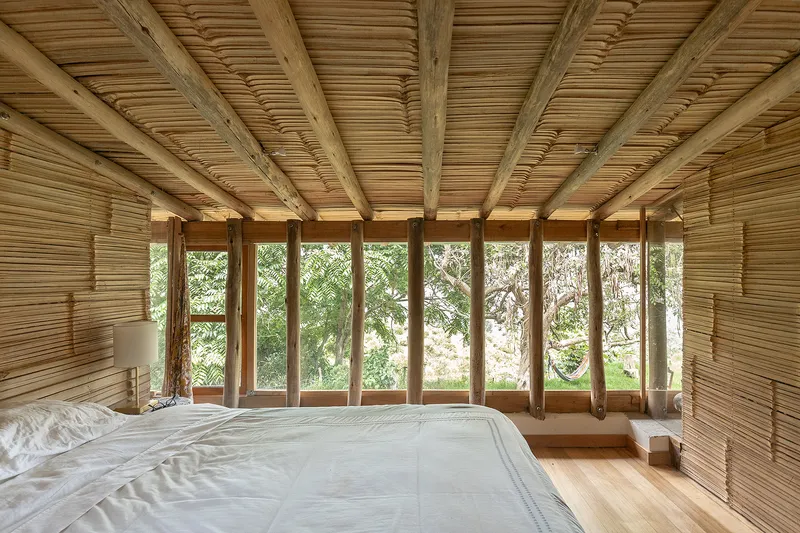
Throughout the house, openings are sized and placed to do specific work. The study alcove gets a clerestory band that washes the desk with even light while keeping the wall surface available for shelving. The bedroom receives floor-to-ceiling glazed doors that dissolve the boundary with the garden, turning the room into a screened porch when open. The mezzanine workspace gets a single horizontal slot that frames the landscape like a letterbox, compressing the view into a panoramic strip.
These are not large openings; there is no curtain wall moment. The architects worked within the thickness of the existing block walls and the logic of the new timber framing to place windows where they would do the most with the least material. It is a measured approach to daylight that respects the thermal realities of the site while still delivering moments of real visual pleasure.
Plans and Drawings
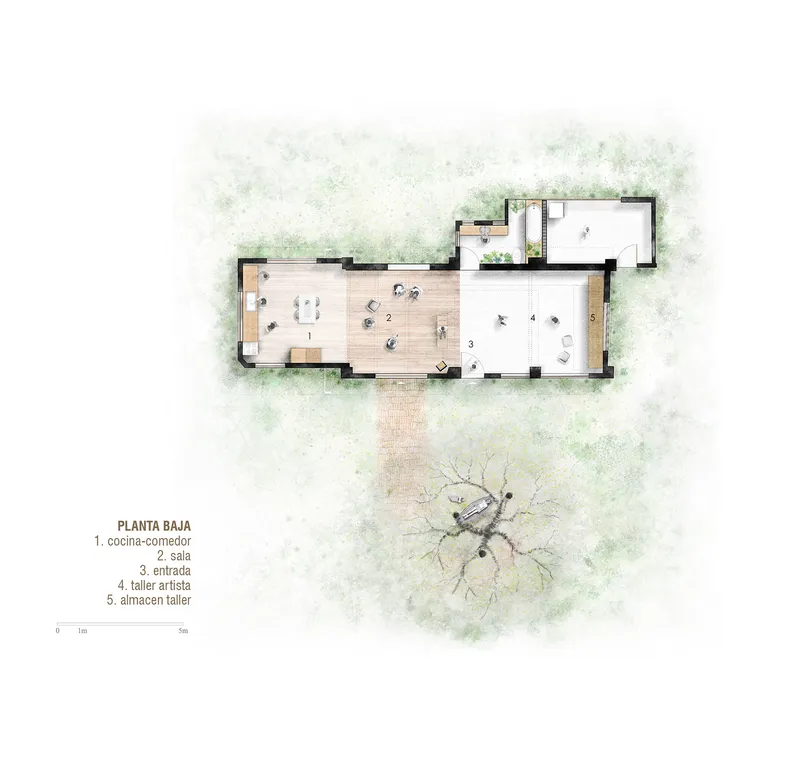
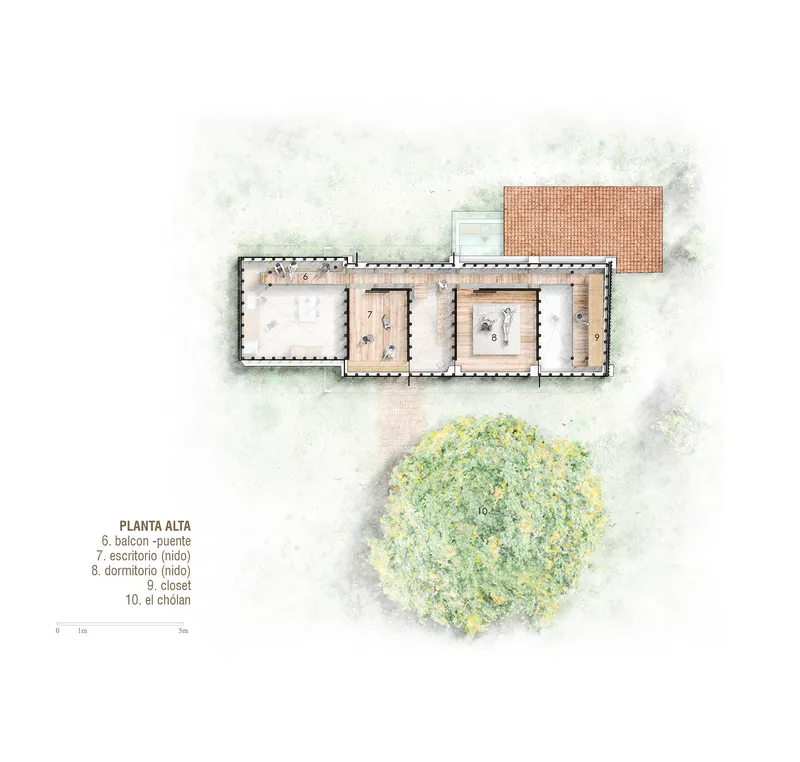
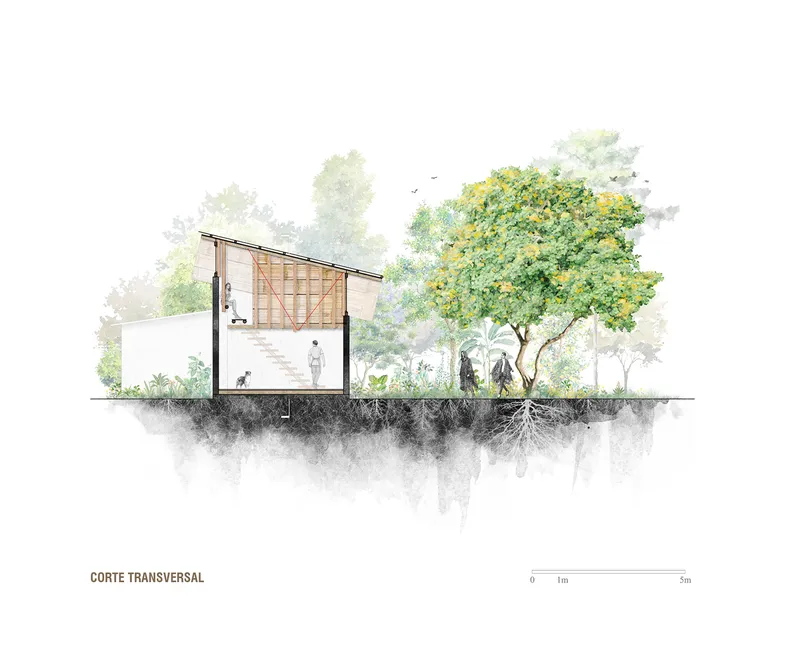
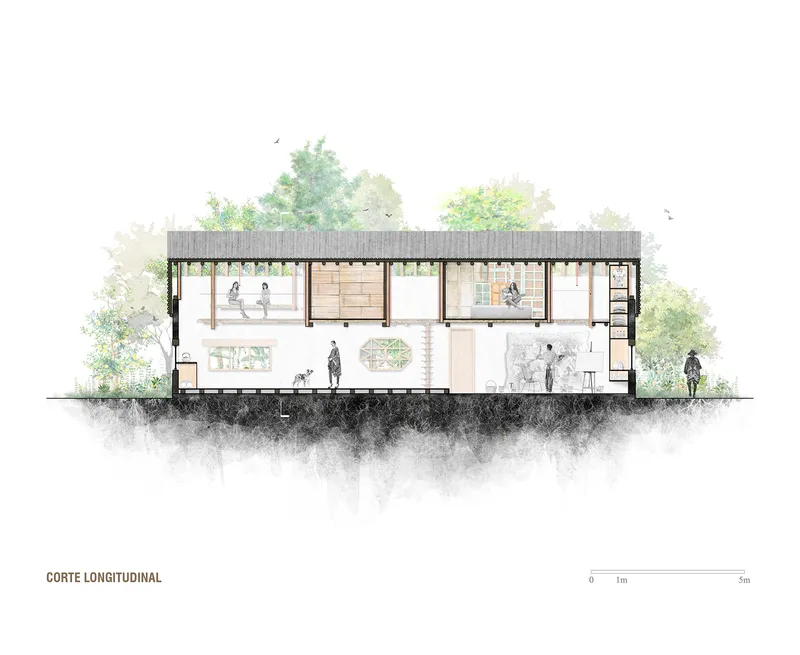
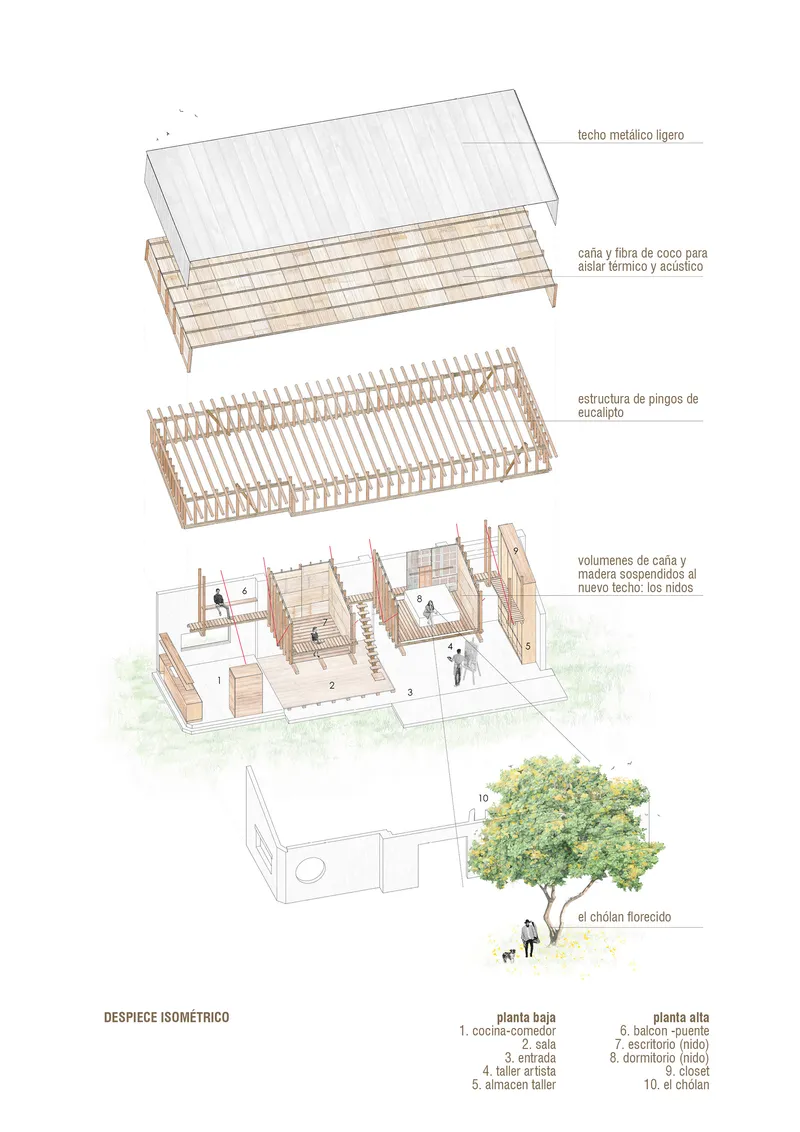
The floor plans confirm the elongated rectangular footprint of the original warehouse, with the suspended nests appearing on the upper plan as compact timber platforms within the larger volume. The transverse section is the most revealing drawing: it shows exactly how the bedroom pods hang from the roof beams, how the double-height space is preserved below, and how the new roof rises above the original wall height to create the expanded interior volume. The exploded isometric breaks the layered roof assembly into its constituent parts, from corrugated metal skin down through cane, fiber, and egg-tray insulation, making the construction logic legible in a single image.
Why This Project Matters
Cholan Nests House is a counterargument to two common tendencies in contemporary practice: the impulse to demolish and rebuild, and the assumption that small budgets produce small architecture. By keeping the existing block walls and concentrating all design energy on the roof and the section, the team delivered a spatially rich home within a 105-square-meter footprint using materials that are locally available, low-cost, and thermally appropriate. The suspended bedrooms are not a formal gesture; they are a practical response to the constraint of a narrow rectangular plan and the opportunity of a tall interior volume.
The project also demonstrates that collaboration across studios can produce coherent work rather than compromise. La Cabina de la Curiosidad, Marie Combette, and Daniel Moreno Flores share authorship of a house that feels singular in its logic and generous in its spatial ambition. For anyone working on adaptive reuse in rural contexts, with tight budgets and available natural materials, the lesson here is clear: redesign the roof, rethink the section, and let the walls stay where they are.
Cholan Nests House by La Cabina de la Curiosidad, Marie Combette, and Daniel Moreno Flores. Perucho, Ecuador. 105 m². Completed 2022. Photography by JAG Studio, Marie Combette, and Marie Combette + Daniel Moreno Flores.
About the Studio
Share Your Own Work on uni.xyz
If projects like this are the kind of work you want to make, uni.xyz is a place to publish your own, find collaborators, and enter design competitions.


Popular Articles
Popular articles from the community


Singing Woman: An Opera House That Performs Before the Curtain Rises
Ovidiu Cristian Pavel's conceptual opera house translates Estonia's choral identity into a sculpted waterfront landmark facing the Baltic Sea.

Opera on the Sea: Driftwood Logic Shapes a Timber Opera House on Estonia's Coast
Trevor Orgill's opera house translates the entangled drift of floating timber into a civic building where wood, water, and music converge.

The Amber Palace Opera: A Geological Fiction Surfaces on Tallinn's Baltic Waterfront
Pierre Brillard reimagines a Baltic legend as a public landscape, opera house, and waterfront promenade rooted in Tallinn's coastal identity.


graciastudio Turns a Viewless Tijuana Lot Inward Around a Courtyard of Concrete, Timber and Trees
In Tijuana, Jorge Gracia's GA2 House stacks a timber-clad private floor over exposed concrete and replaces a missing view with a planted interior patio.

Similar Reads
You might also enjoy these articles

LAVA Architecten Gives Vocational Education a Sawtooth-Roofed Face on a Mechelen School Campus
In Mechelen, Belgium, a 2,053 m² STEM school on a 6×6 m grid turns workshops and classrooms into rooms that can be rearranged as teaching changes.

KEMA Studio Turns a Derelict Marvila Attic into a 60 m² Lighthouse Apartment Above Lisbon
In Lisbon's Marvila district, a rebuilt roof, four skylights and two plywood volumes turn an unlivable attic into a bright home facing the Tagus.

Pixel Gardens: One Repeated Module Stacked Into a Terraced Social Housing Tower for Famagusta
Salem Bader's shortlisted housing tower builds a vertical neighbourhood from one repeated module, offsetting units to carve terraces, light and air.

Bao Huynh Watercolor Atelier: A Serene Art Retreat in Hội An
Bao Huynh Watercolor Atelier in Hội An blends multifunctional art spaces, sustainable design, local materials, and family-friendly living in a serene environment.


Comments (0)
Please login or sign up to add comments
No comments yet. Be the first to comment!