

La Carbonería Renovation: Reviving Barcelona's Urban Memory through Adaptive Reuse
Historic Barcelona building revived with sky paths, passive design, and rooftop pool, blending heritage restoration with sustainable urban living.


Architects: Office for Strategic Spaces
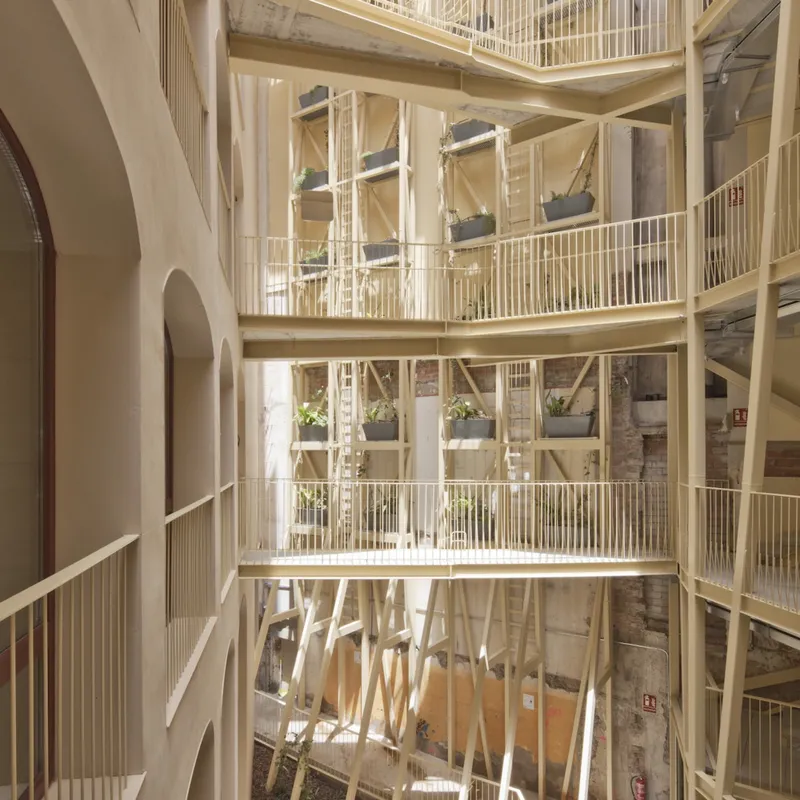
Reclaiming a Heritage Icon in the Heart of Barcelona
Once a modest 19th-century apartment block, La Carbonería has been reborn as a landmark of architectural renovation and urban memory. Originally built in 1864 and gaining political and cultural notoriety during the 2008 squatters’ movement, the building was vacated in 2014. Today, thanks to the strategic design interventions by the Office for Strategic Spaces, it stands as a vibrant example of adaptive reuse in Barcelona.
In 2015, the Barcelona City Council declared La Carbonería a protected heritage building, recognizing it as the oldest surviving structure in the Eixample district—the iconic urban extension imagined by Ildefons Cerdà. Caught historically between differing urban visions, the building's four facades were originally conceived to safeguard against an uncertain future boulevard. Ironically, the most spectacular of them remained hidden in a backyard for over 150 years.

Designing with History: Structure, Circulation, and Heritage
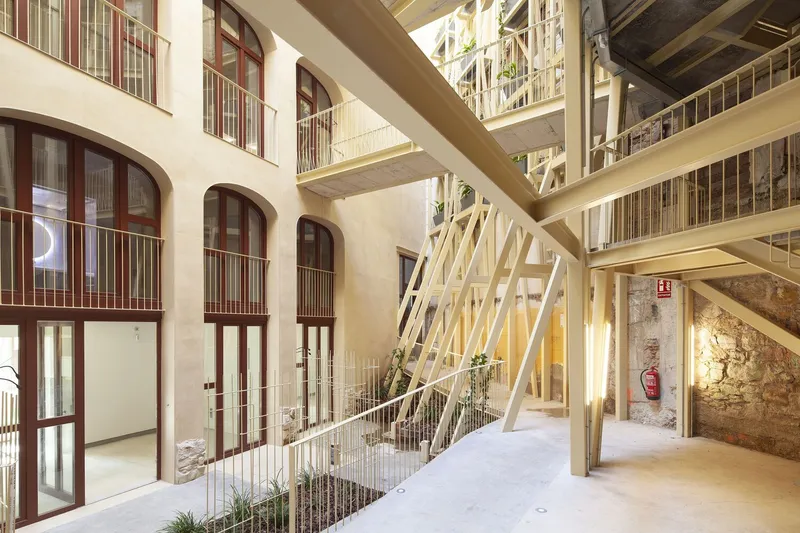
Restoring the structure to its original essence while introducing contemporary living standards formed the crux of the architectural challenge. With the original staircase removed long ago, the architects reimagined vertical circulation by building a new staircase and elevator in the farthest corner of the inner patio. These were linked to apartments through elevated “sky paths”, floating walkways that traverse the site like the boulevard that was never realized.
These sculptural bridges—appearing to levitate—are supported by a cross-beam structure, allowing for maximum openness and structural clarity. Their strategic placement unlocks new spatial arrangements and even enabled the addition of an extra apartment, optimizing the internal volume.
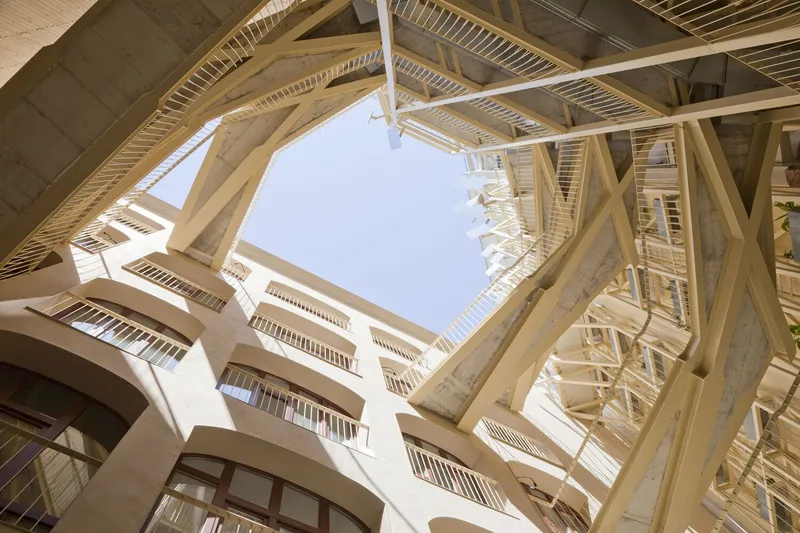
Revitalizing the Interior: Passive Design and Sustainable Materials
The original structural system was preserved wherever possible, with necessary reinforcements including the replacement of deteriorated Catalan roof slabs. The load-bearing capacity was optimized to accommodate a walkable roof and even a 1-meter-deep plunge pool, creating an unexpected oasis above the city.
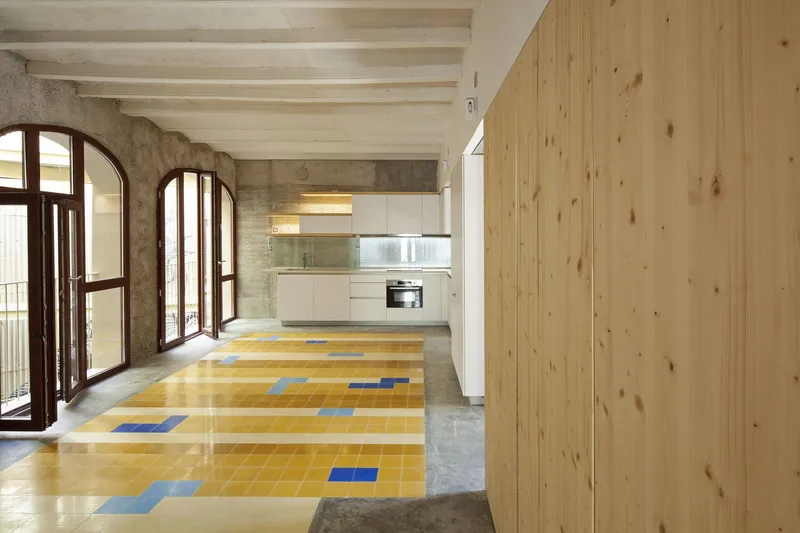
Internally, a strong focus on sustainable design principles guided material choices and passive environmental strategies. The central wall was emphasized as an organizing element, integrating storage, services, and vertical apertures for cross ventilation and natural lighting. This configuration enhances energy efficiency and establishes a visual connection between the inner courtyard and the surrounding Cerdà grid.
Finishes were deliberately kept breathable and low-impact—pine wood treated with oil and wax was used extensively to ensure indoor air quality and a tactile, natural atmosphere. Glazing and carpentry were specially designed for thermal and acoustic insulation, mitigating the noise from nearby Carrer d'Urgell without compromising the building’s facade integrity.
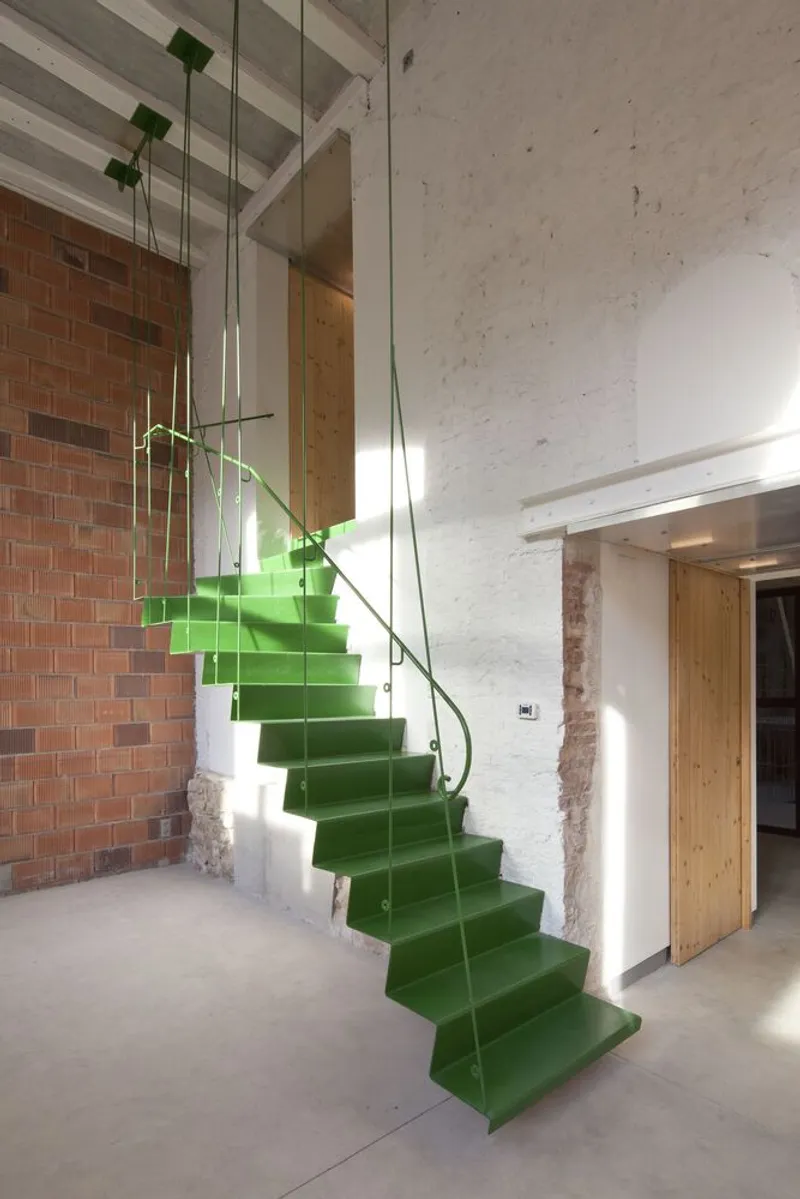
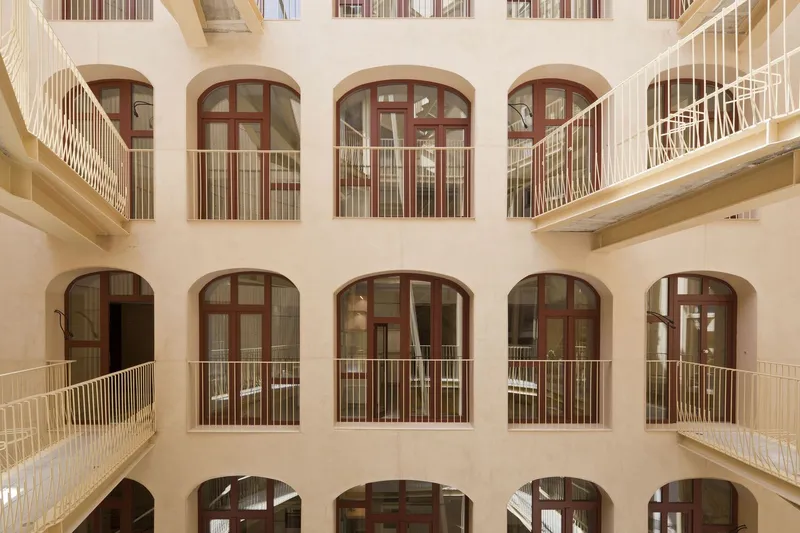
Balancing Conservation and Innovation
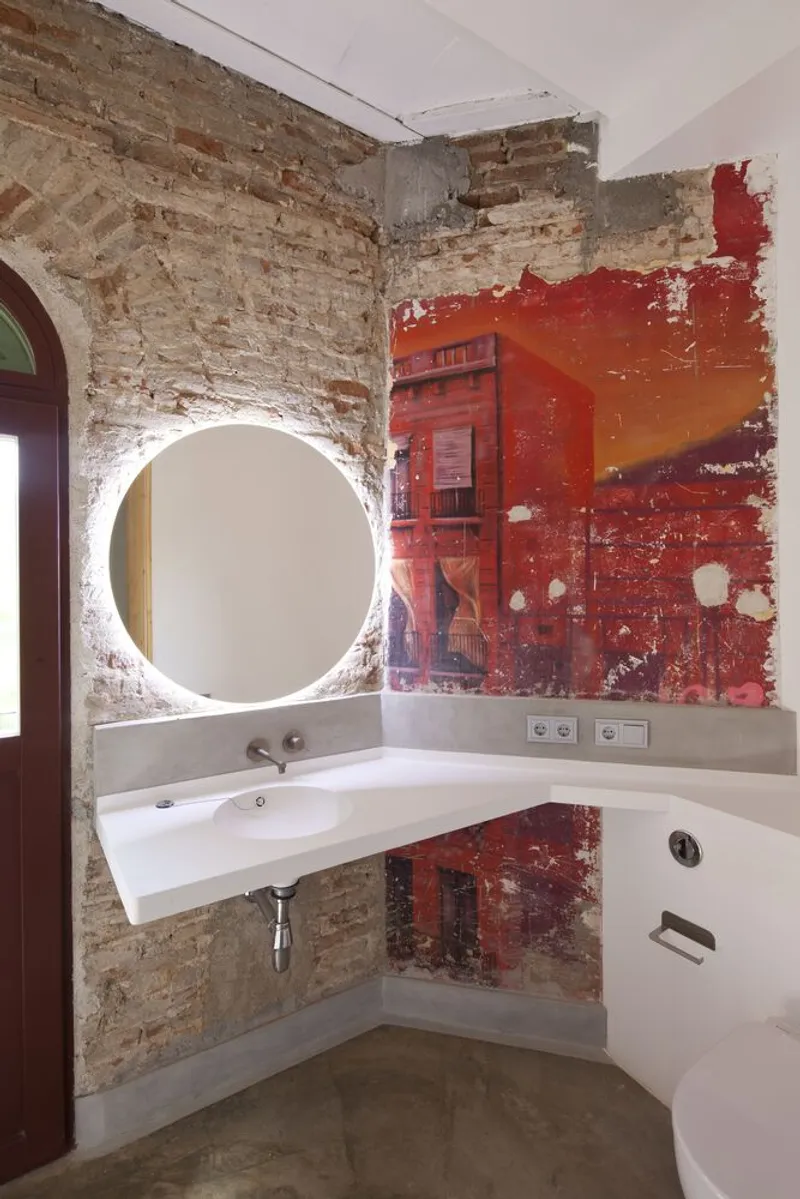
A major heritage constraint required the restoration of the building’s original facades, including the courtyard side, which now faces blind party walls. Although the murals painted during the 2008 occupation had to be removed due to the deterioration of the stucco, the project carefully preserved the cultural memory embedded in the building, including the traditional furniture store operated by Mr. Garriga on the ground floor.
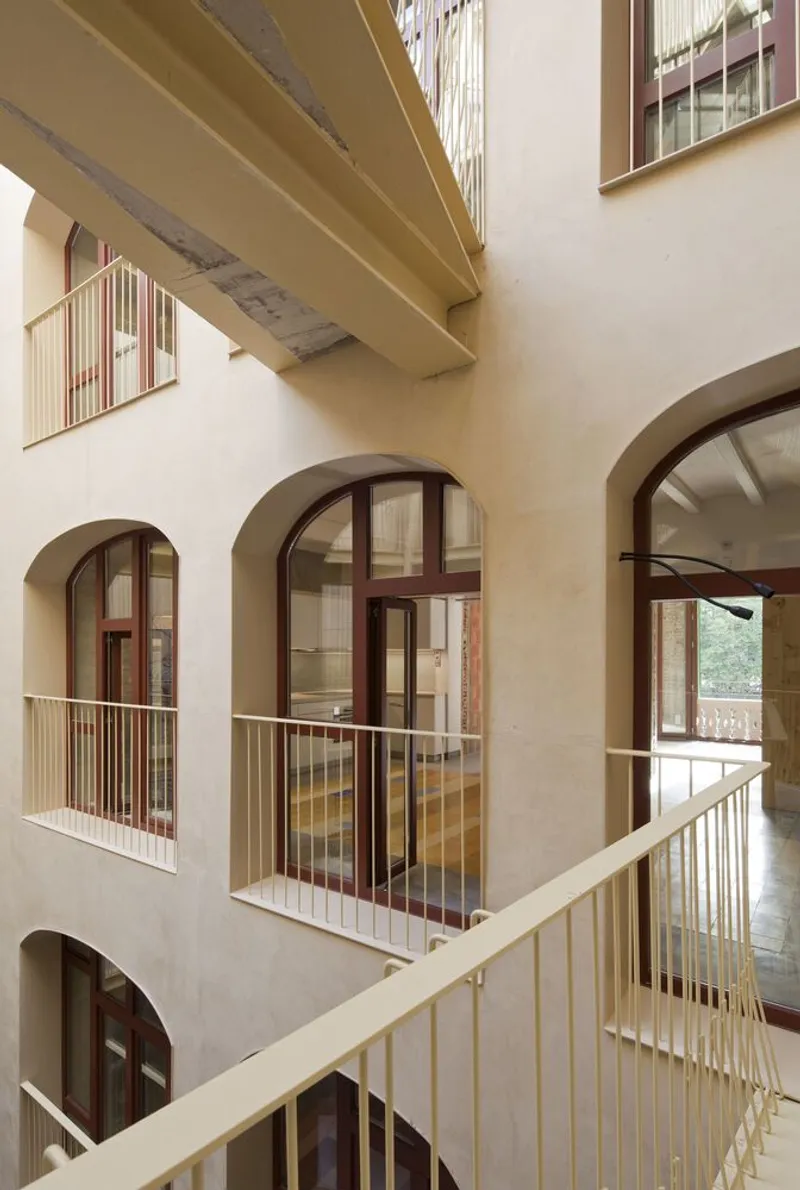
All photographs are works of Simona Rota


Popular Articles
Popular articles from the community


LT2A and OPEN Architectes Thread a Brick and Glass High School Through a Wooded Belgian Campus
In Braine-l'Alleud, a 3,000 m² wing for Collège Cardinal Mercier pairs pale brick with a glazed colonnade, deferring to a small chapel and a dense wood.

Architekt Andreas Gruber Scatters 23 Dark Timber Chalets Across a South Tyrolean Forest Edge
In Molini di Tures, Amonti Chalets breaks a resort into a hamlet of gabled timber houses, with parking, storage and services pushed into the slope.

David Macias Steps a Doorless Stone and Plaster House Down a Tropical Colombian Hillside
In the humid hills of Colombia, Threshold House replaces the front door with an open void and terraces its 850 m² down the slope instead of fighting it.

Juan García Correa, John González and Claudia Rueda Sink a Circular Amphitheater into a Manizales Engineering Building
On the La Nubia campus in Manizales, Colombia, the S1 Building folds labs and offices into a hillside of ramped lawns that double as a campus route.

Similar Reads
You might also enjoy these articles


Hodi-Mandai Geram
Project Function: Preservation and revitalization of the Intangible heritage and socio-spatial identity of the Hodi by Housing, Cultural Memory Center, Sacred Grove, landscape, local tourism economy


Olio Towers: A Mid-Rise for Performers That Fuses Housing, Rehearsal, and Stage
Located blocks from Houston's Theater District, this modular tower stacks living units around a central performance atrium.

Oasis: Modular Green Housing Carved into Dhaka's Urban Fabric
A shortlisted Plugin Housing entry reclaims unauthorized settlements in Dhaka with stepped concrete volumes, green roofs, and ventilation-driven design.

Black Hole: A Floating Megastructure for the Post-Physical Era
Emiliano Mazzarotto envisions a spherical, self-scaling arena where e-sports, digital hotels, and holographic stadiums replace traditional public space.

Explore Architecture Competitions
Discover active competitions in this discipline

Challenge to reimagine the Iron Throne

Photograph architecture without architects

Illustrate the lost glory of Angkor Wat - Render Challenge

Design challenge to reuse E-waste
Comments (0)
Please login or sign up to add comments
No comments yet. Be the first to comment!