

La Fontaine Kindergarten by ALTA
A nature-inspired kindergarten in Tours featuring timber and straw construction, bioclimatic design, and child-centered spaces integrating landscape, light, and sustainability.


La Fontaine Kindergarten, designed by ALTA, represents a contemporary rethinking of educational architecture in France, where sustainability, sensory comfort, and landscape integration form the foundation of design. Completed in 2024 in Tours, this 1,948 m² kindergarten replaces a 1960s school building, responding to a rapidly evolving urban context while paying tribute to the natural and architectural heritage of the Loire Valley.
Commissioned by the municipality of Tours in 2020, the project emerged from a public tender calling for the demolition and reconstruction of the existing school. Located in the city’s northeast, the site sits within a heterogeneous urban fabric defined by varying scales, residential typologies, and fragmented public spaces. ALTA’s proposal brings clarity and identity to this context, transforming the school into a recognizable civic landmark while reinforcing connections to its environment.
Architecture Rooted in the Landscape of the Loire
The design draws inspiration from the green and blue networks that define the Loire and Cher river territories. Wooded hillsides, gardens, and parks become guiding references, influencing both architectural form and landscape strategy. Working alongside FAAR Paysage, ALTA developed outdoor spaces that merge ecological management, biodiversity enhancement, and children’s play, creating a living learning environment that extends beyond classroom walls.
Construction began in December 2022 and concluded in April 2024, including the renovation of the existing gymnasium. The result is a cohesive educational campus that integrates architecture, landscape, and pedagogy.

The School as a Refuge: A Cabin-Inspired Concept
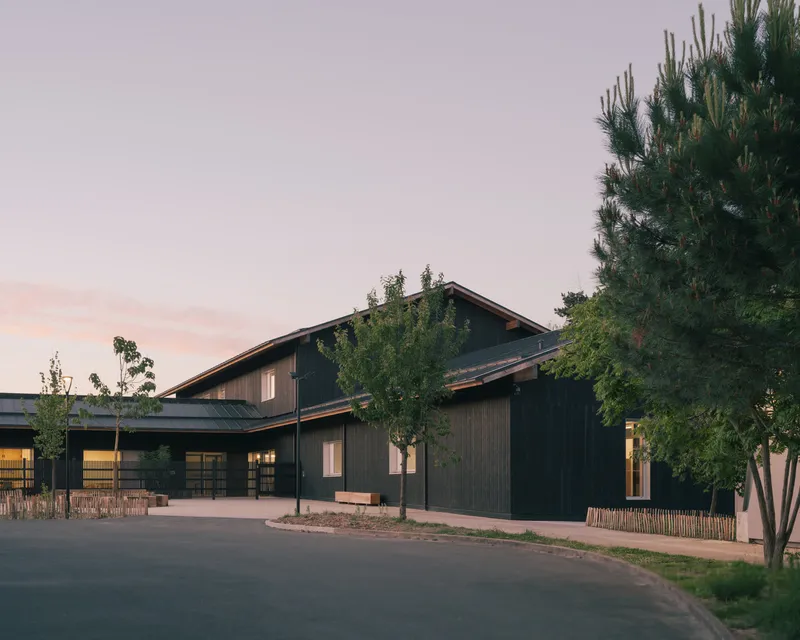
ALTA envisioned the kindergarten as a protective refuge, drawing on the archetype of the cabin, an image deeply rooted in regional vernacular, from river barges along the Loire to garden sheds scattered throughout private landscapes. This symbolic reference translates into the project’s volumetry, composed of three horizontally articulated building bodies housing the classrooms, dining hall, and gymnasium.
Low rooflines, overlapping volumes, and pronounced roof overhangs define the school’s silhouette, giving it a calm, grounded presence within the narrow, elongated site. The fragmented massing softens the building’s scale and enhances its relationship with the street, while reinforcing a child-friendly architectural language.
Spatial Sequence and Educational Experience
The spatial organization unfolds as a carefully choreographed sequence, strengthening the relationship between architecture and daily use. The entrance forecourt acts as a generous threshold, welcoming students while serving as a shared public space for parents and local residents. Set back from Rue du Colombier, it provides both safety and openness.
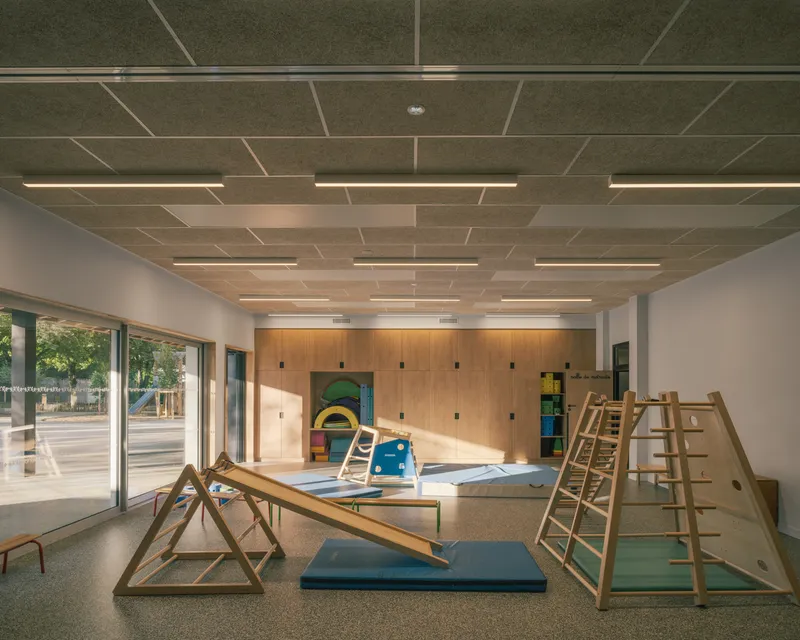
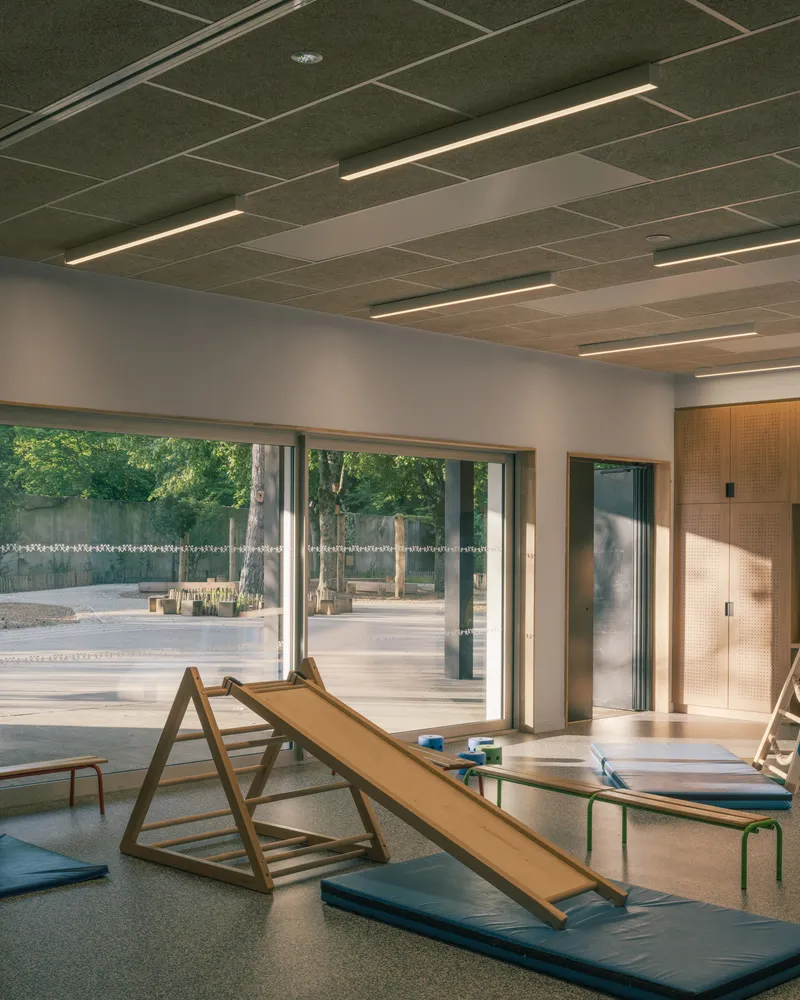
Beyond the forecourt lies the educational building, where classrooms benefit from framed views of the surrounding landscape. Large openings create visual continuity between interior spaces and nature, supporting early learning through observation and sensory engagement. The school also functions as a transition between public and private realms, gradually leading children from the urban edge to the sheltered playground.
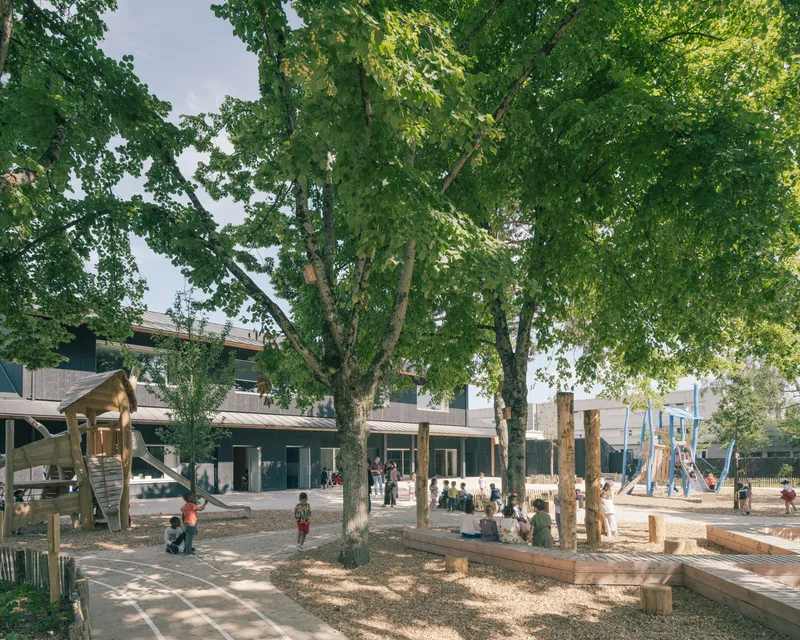
The playground, positioned at the rear of the site, is conceived as an organic, vegetated environment that contrasts with the rational geometry of the forecourt. Existing trees are preserved and highlighted, transforming the space into a fertile ground for play, rest, and environmental education.
User Comfort Through Bioclimatic Design
At the core of the project is a strong commitment to user comfort and well-being, for both children and staff. The broken-line layout enables cross-ventilation and dual orientations, optimizing natural light and thermal comfort throughout the day. Southeast and northwest exposures ensure balanced daylight conditions while reducing overheating risks.
Material choices reinforce this bioclimatic strategy. The building envelope combines a timber frame structure with straw insulation, marking a first in Tours and positioning the project as a local pioneer in low-carbon construction. All materials are biobased, non-polluting, free from volatile organic compounds, and sourced locally whenever possible, supporting circular economy principles and prefabrication.
Wood, Straw, and Sustainable Construction Innovation
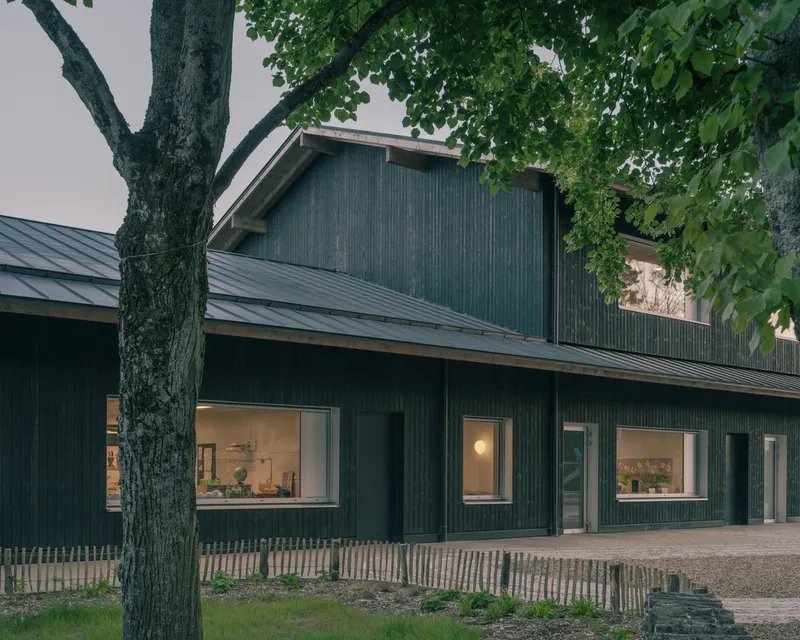
The use of straw insulation, both modest and radical, challenges standardized construction practices and emphasizes the project’s experimental yet pragmatic approach. Vertical cladding made from Northern Pine references neighborhood constructions while ensuring durability through thermal treatment and staining. Its dark hue was intentionally selected for its convective properties, contributing to passive solar gains during colder months.
Generous roof overhangs provide natural protection against rain and excessive sun exposure. In summer, they work in tandem with surrounding vegetation to shade facades and large glazed openings. Slim aluminum window frames allow expansive glazing, flooding classrooms with high-quality daylight and offering uninterrupted views of the landscaped courtyards.
Low-Tech Climate Strategy and Energy Performance
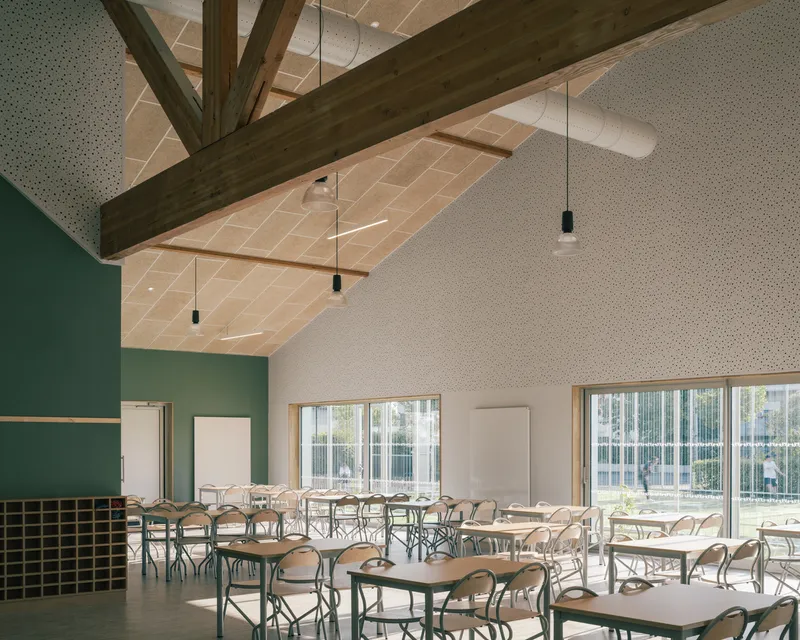
In terms of environmental engineering, ALTA prioritized simplicity and efficiency. The school is heated using a biomass wood-fired boiler, significantly reducing reliance on fossil fuels. Cooling strategies rely on natural ventilation, particularly on the upper floors, avoiding energy-intensive mechanical systems.
By combining passive design principles, renewable energy sources, and a bio-based envelope, La Fontaine Kindergarten achieves exemplary environmental performance. The project has been awarded the E+C- label, earning a Positive Energy level 3 and Carbon reduction level 1, confirming its role as a benchmark for sustainable educational buildings in France.
A Model for Contemporary Educational Architecture
La Fontaine Kindergarten stands as a thoughtful synthesis of architecture, ecology, and pedagogy. Through its sensitive integration into the landscape, innovative material choices, and low-tech environmental strategies, the project demonstrates how educational spaces can foster well-being, environmental awareness, and architectural identity, setting a precedent for future schools in both urban and regional contexts.


All photographs are works of C. Broyez


Popular Articles
Popular articles from the community


LT2A and OPEN Architectes Thread a Brick and Glass High School Through a Wooded Belgian Campus
In Braine-l'Alleud, a 3,000 m² wing for Collège Cardinal Mercier pairs pale brick with a glazed colonnade, deferring to a small chapel and a dense wood.

U.GA Architects Wraps an Oval Rooftop Pool in Curved Board-Formed Concrete on Busan's Jeollidan-gil
In Busan's Jeonpo-dong, a 454 m² mixed-use block stacks a neighborhood facility, guest rooms and an oval rooftop pool inside spiraling concrete walls.

Jaramillo Van Sluys Arquitectura and Urbanismo Turn a Demolished Registry Lot in Quito into an Orchard Plaza
In Quito's Centro Histórico, a 2,800 m² plaza exposes the San Agustín convent wall and redraws its lost Augustinian orchard in volcanic stone.

Juan García Correa, John González and Claudia Rueda Sink a Circular Amphitheater into a Manizales Engineering Building
On the La Nubia campus in Manizales, Colombia, the S1 Building folds labs and offices into a hillside of ramped lawns that double as a campus route.

Similar Reads
You might also enjoy these articles


Hodi-Mandai Geram
Project Function: Preservation and revitalization of the Intangible heritage and socio-spatial identity of the Hodi by Housing, Cultural Memory Center, Sacred Grove, landscape, local tourism economy


Olio Towers: A Mid-Rise for Performers That Fuses Housing, Rehearsal, and Stage
Located blocks from Houston's Theater District, this modular tower stacks living units around a central performance atrium.

Oasis: Modular Green Housing Carved into Dhaka's Urban Fabric
A shortlisted Plugin Housing entry reclaims unauthorized settlements in Dhaka with stepped concrete volumes, green roofs, and ventilation-driven design.

Black Hole: A Floating Megastructure for the Post-Physical Era
Emiliano Mazzarotto envisions a spherical, self-scaling arena where e-sports, digital hotels, and holographic stadiums replace traditional public space.

Explore Educational Building Competitions
Discover active competitions in this discipline

Challenge to design public laboratory

Challenge to reimagine the Iron Throne

Photograph architecture without architects

Illustrate the lost glory of Angkor Wat - Render Challenge
Comments (0)
Please login or sign up to add comments
No comments yet. Be the first to comment!