
Learning and Innovation Center: A Rotunda in Brussels
evr-Architecten and A229 built a compact academic library in Brussels with a sunken entry, a central helical-stair rotunda, and a disciplined glass facade.

Ixelles is a dense district in central Brussels, home to the main campuses of ULB (Universite libre de Bruxelles) and VUB (Vrije Universiteit Brussel). The campuses were built up gradually during the 20th century in a mix of late-modernist concrete slabs and ad-hoc additions. Learning and Innovation Center, designed by evr-Architecten with A229, is a new 9,910-square-metre academic building inserted into this fabric. It houses the central library, reading rooms, an auditorium, group study spaces, and a cafe under one compact glass-and-steel volume, anchored around a sunken central rotunda that doubles as the main entry plaza.
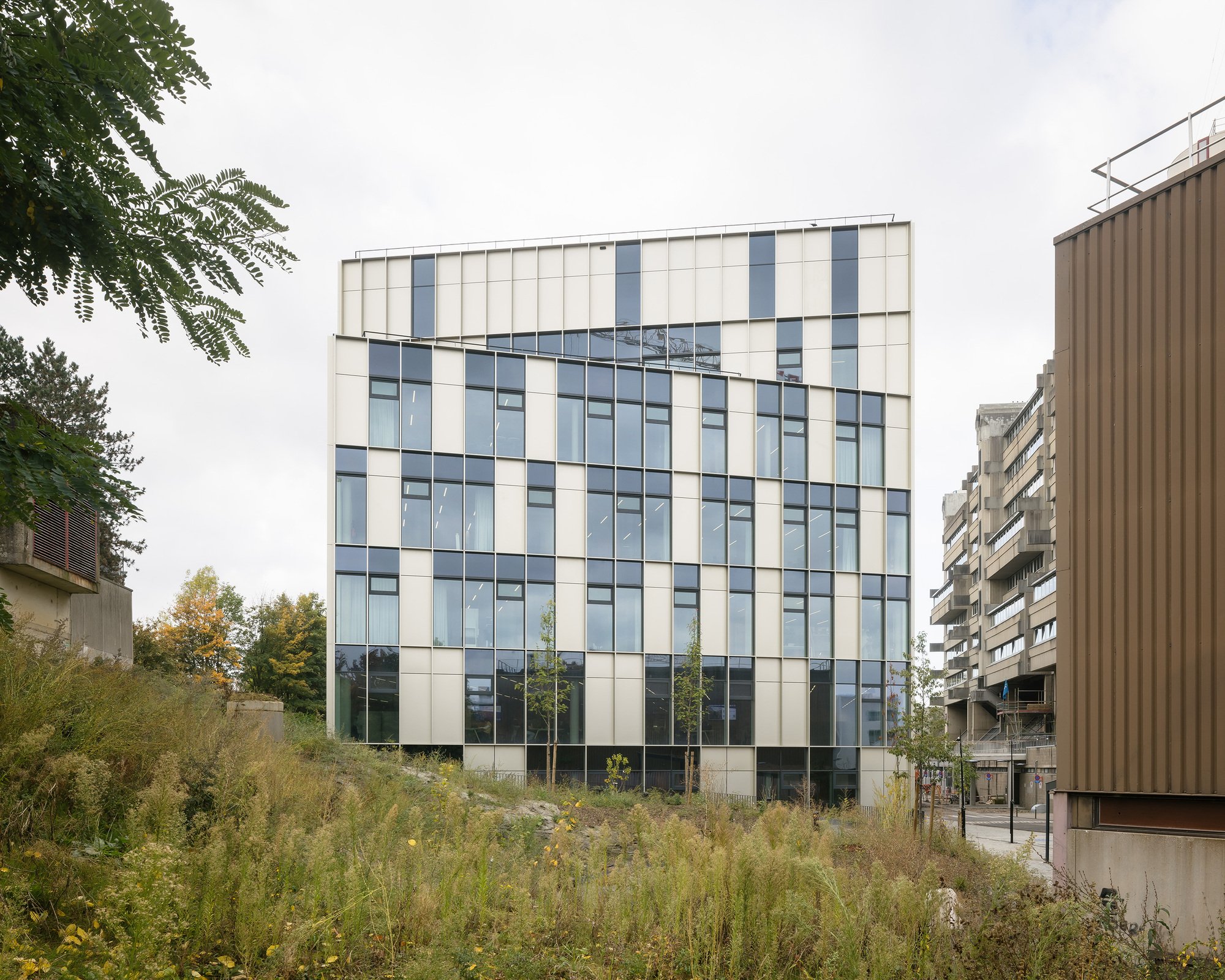
The project is almost the opposite of a statement building. The brief was generous but the site was tight, and the architects chose precision over spectacle. The facade is a disciplined grid of yellow-tinted glazing, beige metal, and black steel. The plan is a square with a circular rotunda carved out of the centre. The atmosphere inside is white concrete, oak panelling, white helical stairs, and daylight from every direction.
The Facade and the Sunken Entry
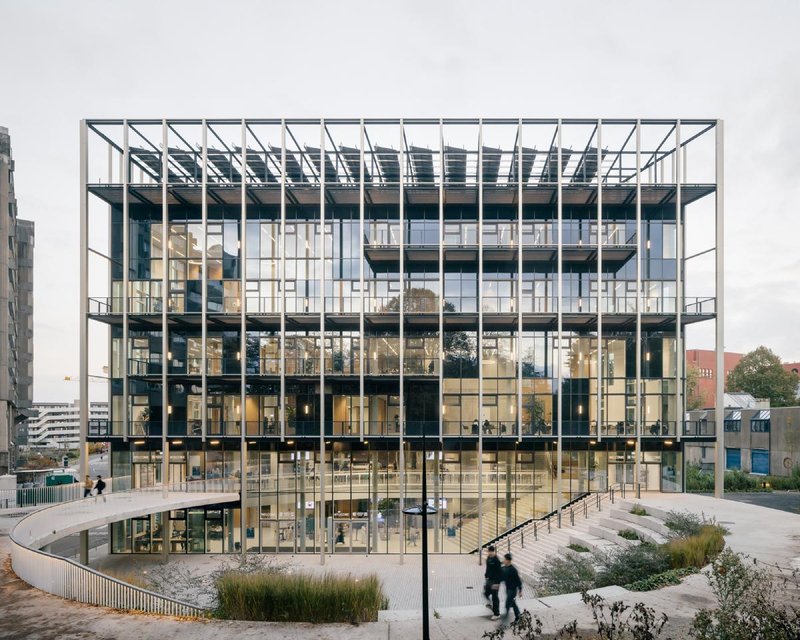
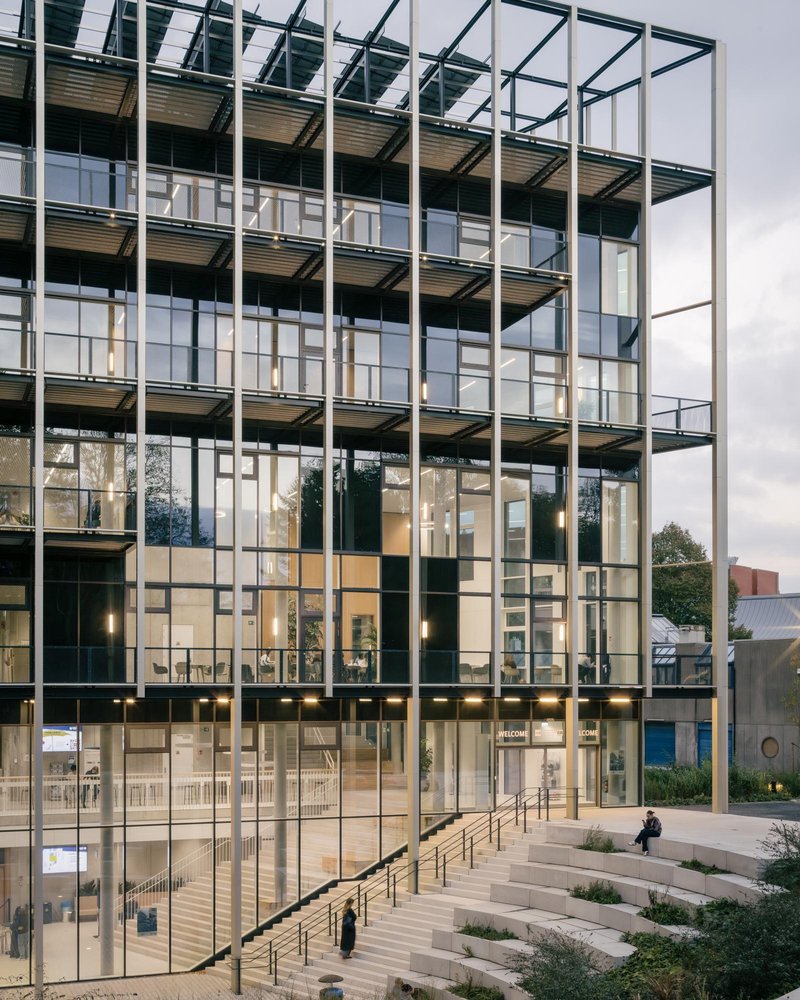
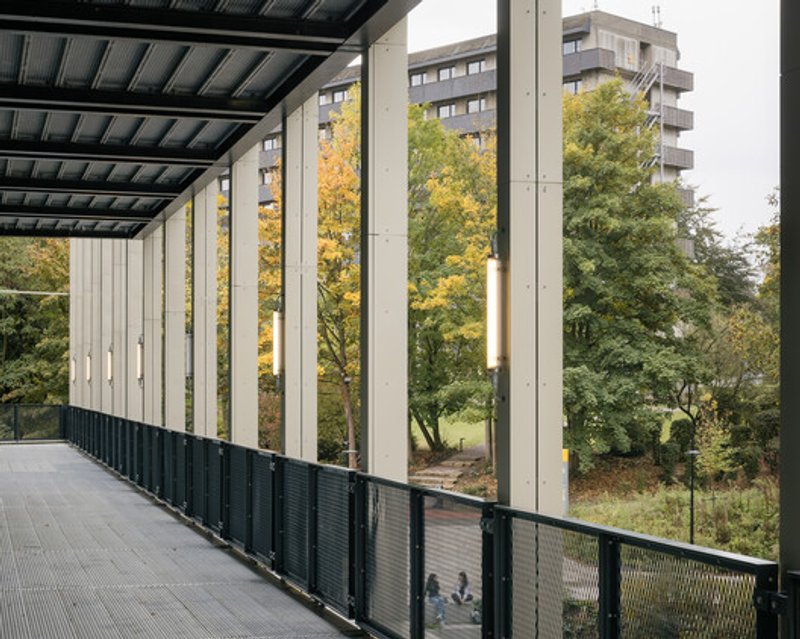
The most visible move is the sunken amphitheatre at the entry. The ground in front of the building steps down in wide concrete terraces that work as both circulation and informal seating, lowering the ground floor half a level below the street. Above this landscape, the full-height glass facade reads as a transparent cube wrapped in a rhythm of vertical black steel fins, with the reading rooms, atrium, and cafe visible through the glass. At dusk, the interior becomes a lantern above the stepped terraces.
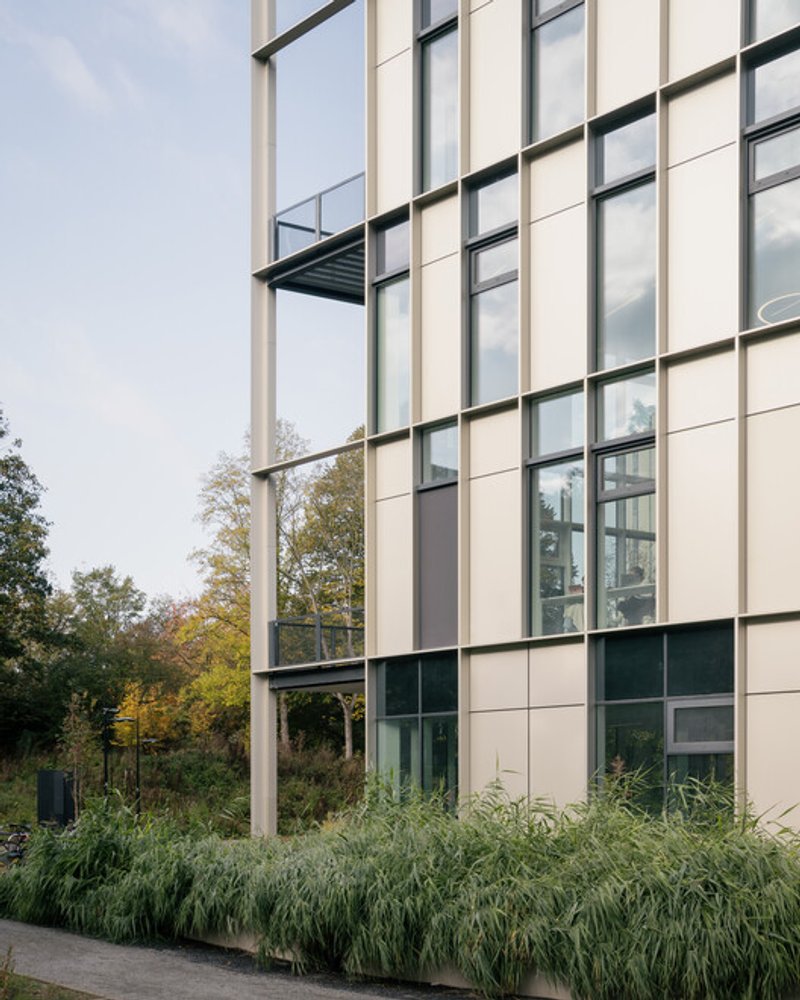
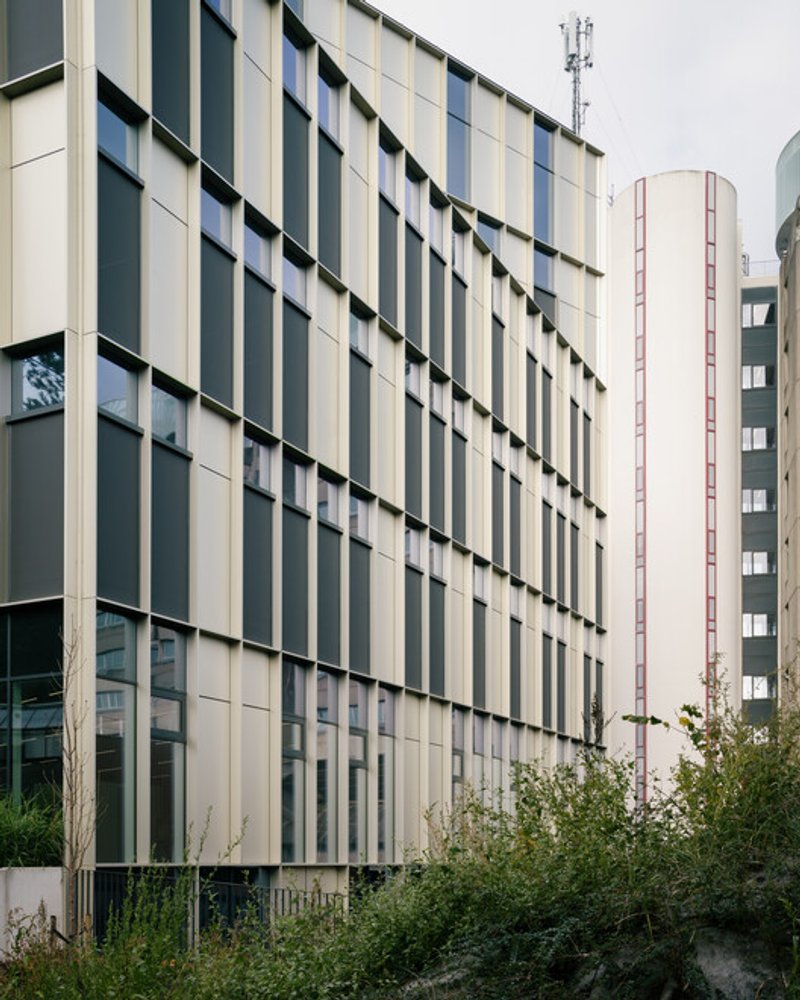
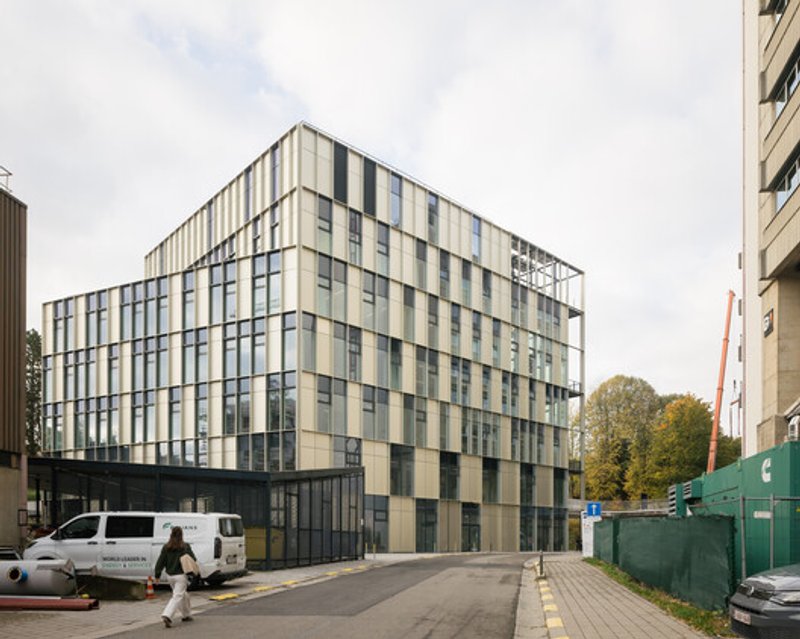
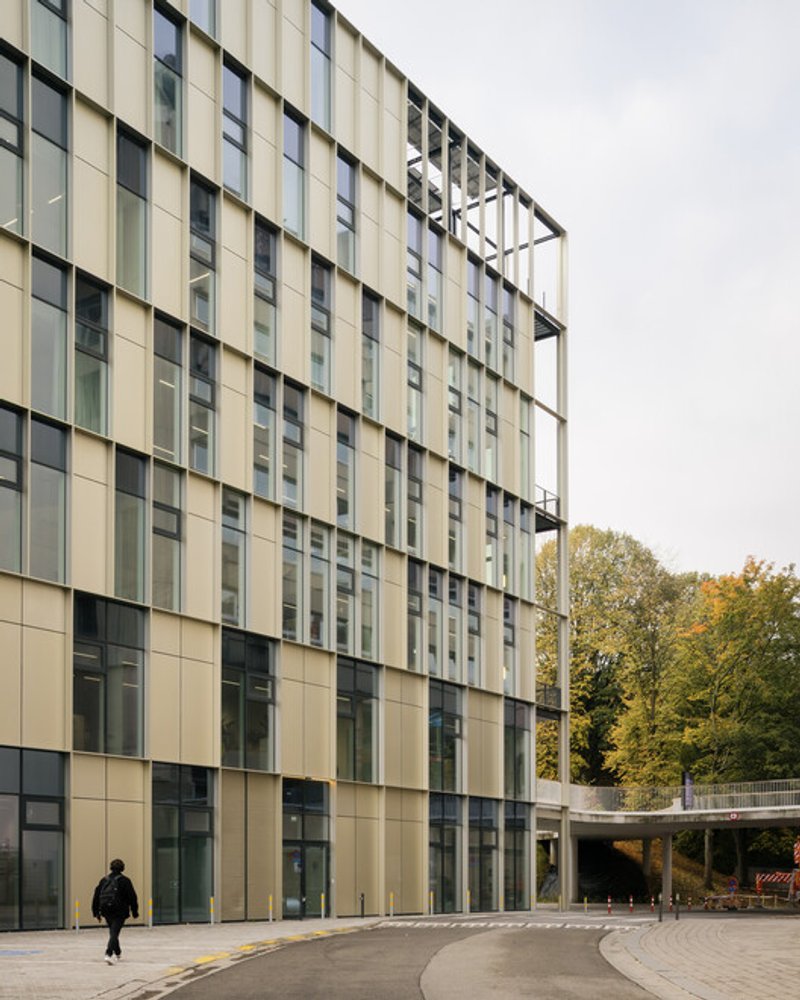
The other facades are more restrained: a grid of yellow-tinted glazing panels alternating with beige metal cladding, sized to match the rhythm of the floors inside. From the adjacent campus streets, the building reads as a calm, disciplined volume that slots into the existing block without dominating it.
The Rotunda and the Atrium
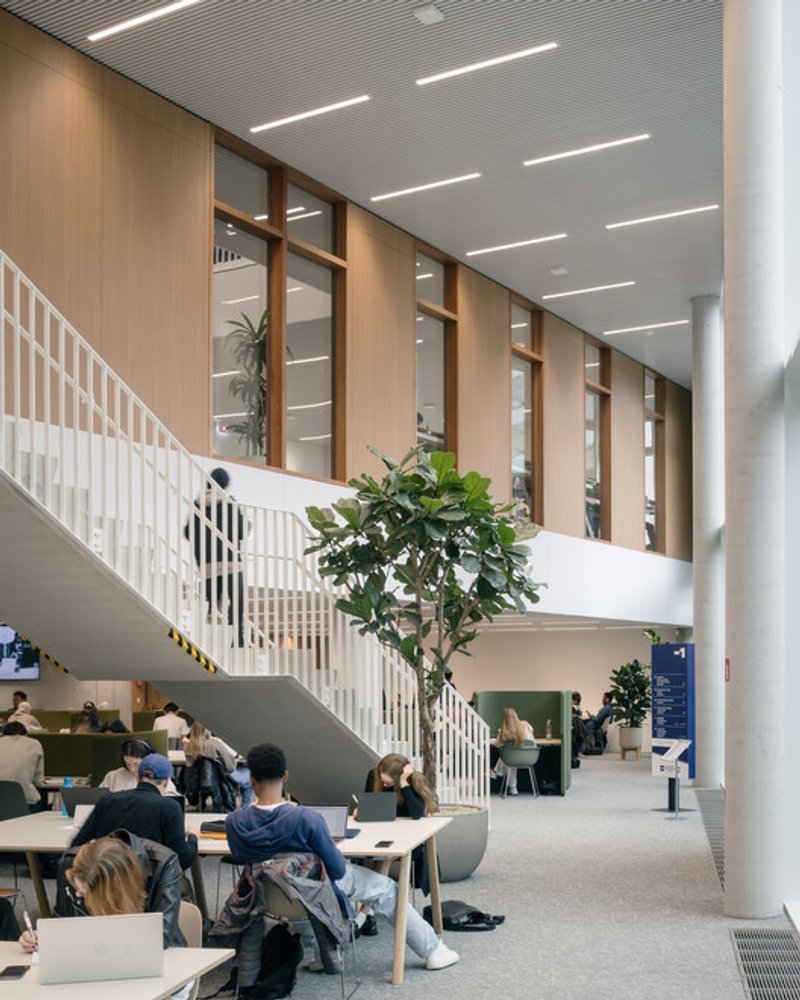
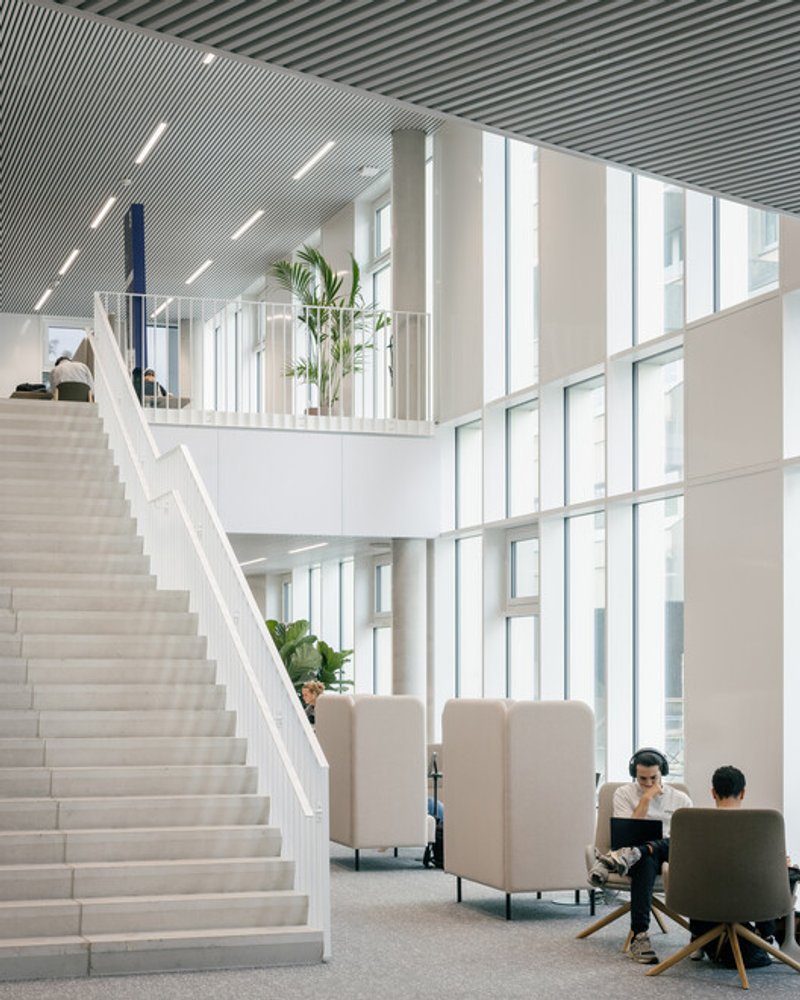
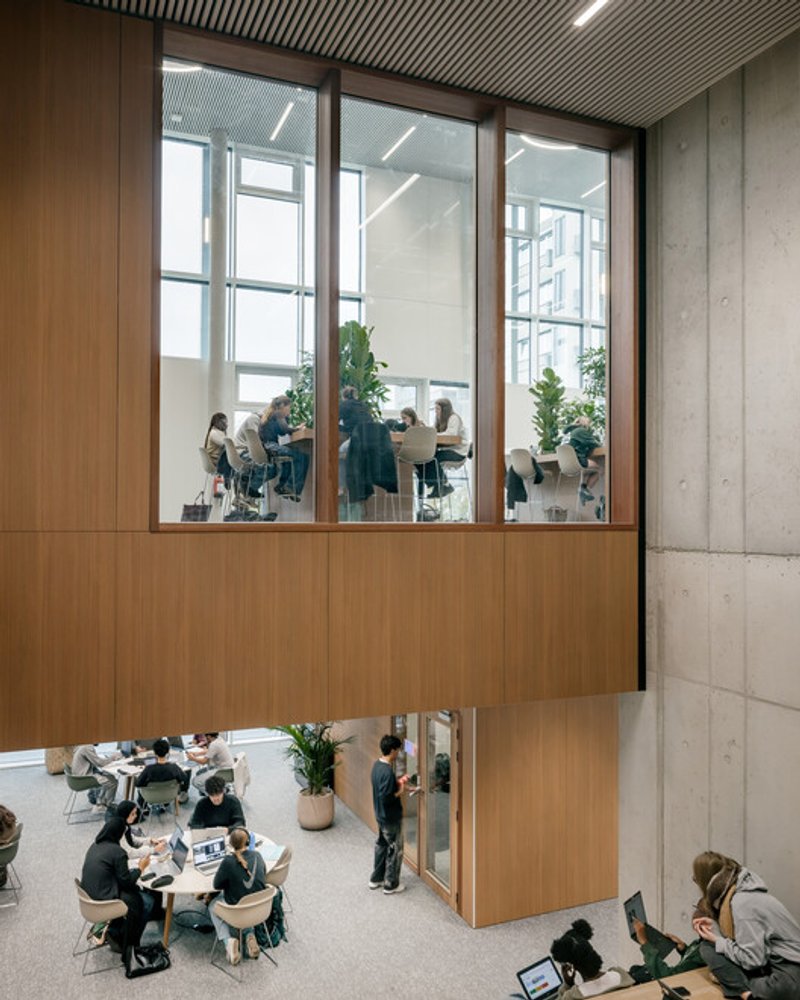
At the centre of the plan is a circular rotunda cut through the full height of the building. A white helical stair rises through the void, connecting the ground-floor cafe to the upper reading rooms and study lounges. Oak-panelled walls line the surrounding meeting rooms. Planted trees grow from the ground-floor floor up into the volume. The rotunda is the building's spatial anchor: it organises circulation, brings daylight deep into the plan, and creates a single legible heart for a building that holds multiple programmes.
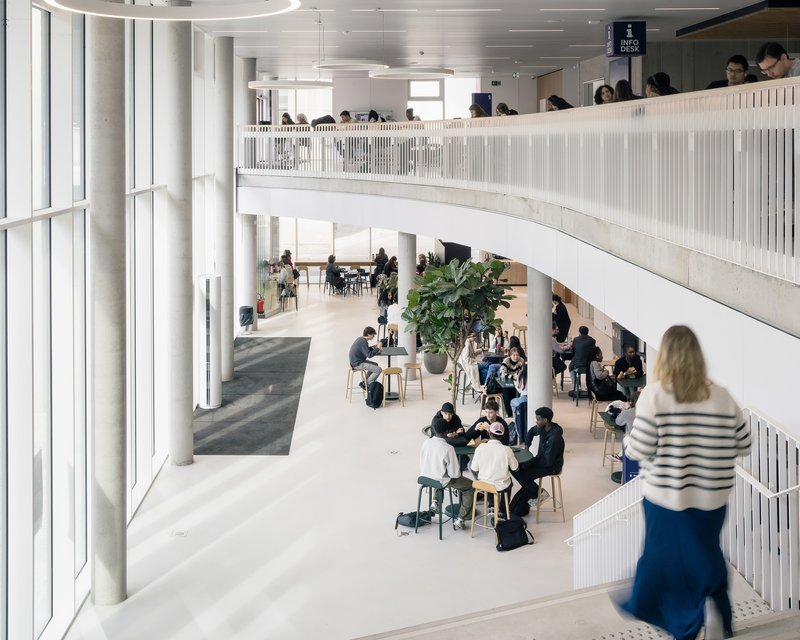
The cafe sits at the base of the rotunda with white floors, pale stools, and an info desk tucked under the mezzanine. The curved white balustrade above marks the edge of the first-floor gallery. Students cluster around the tables. The atrium reads as both a circulation space and a social hub.
Reading Rooms, Galleries, and Group Study
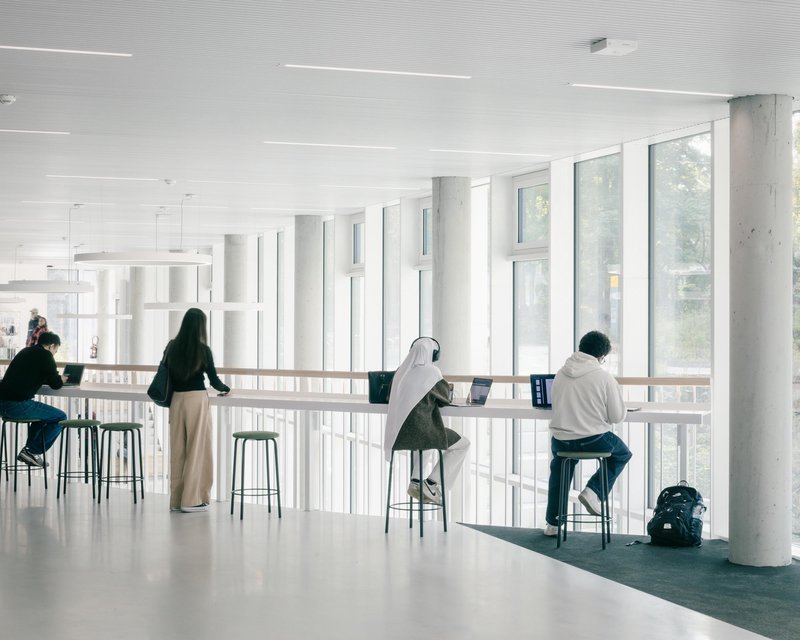
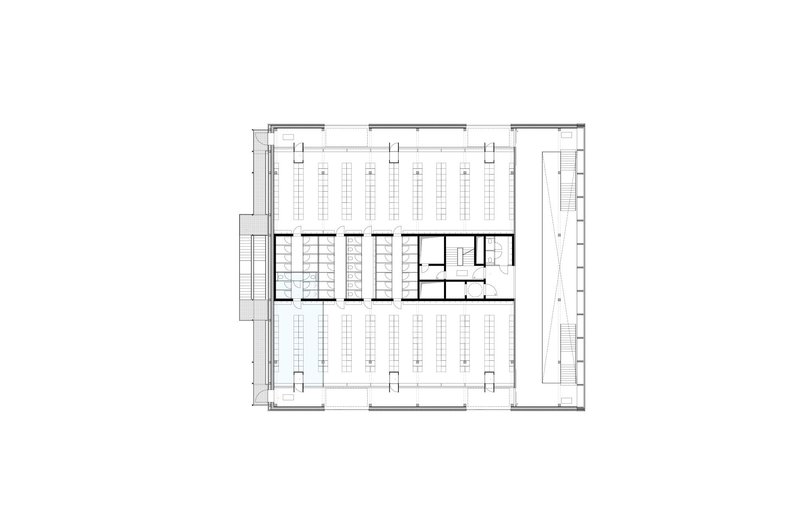
The upper floors hold the library's main reading rooms, arranged along the perimeter of the plan with continuous study desks running along the glazed facade. The palette is white concrete walls and soffits, pale timber desks, and black steel window frames. Slender mushroom columns support the soffit without interrupting the open space. The rows of bookshelves occupy the central zone of each floor, with group study rooms and meeting rooms clustered around the core. The second-floor plan shows this organisation clearly: reading desks at the perimeter, shelves in the middle, core and rotunda at the left.
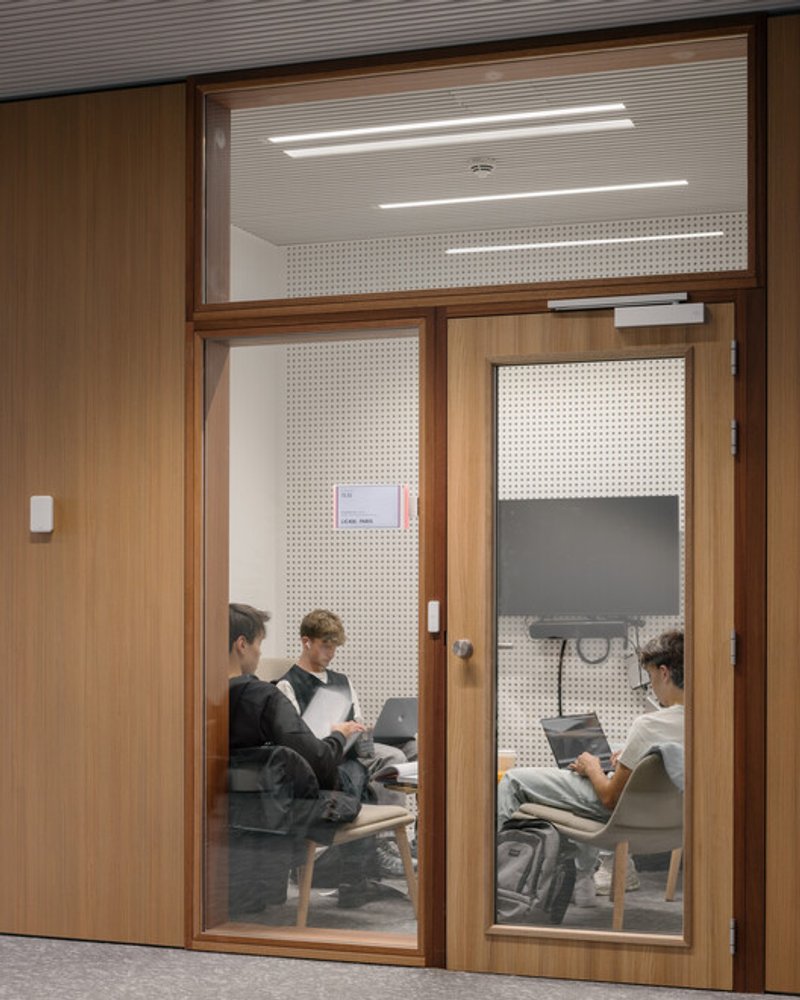
Group study rooms have timber doors, acoustic panels, and small timber tables that fit two or three students. The scale is domestic rather than institutional: a quiet place to work without the formality of a traditional library cubicle.
The Auditorium and Connection to the Existing Campus
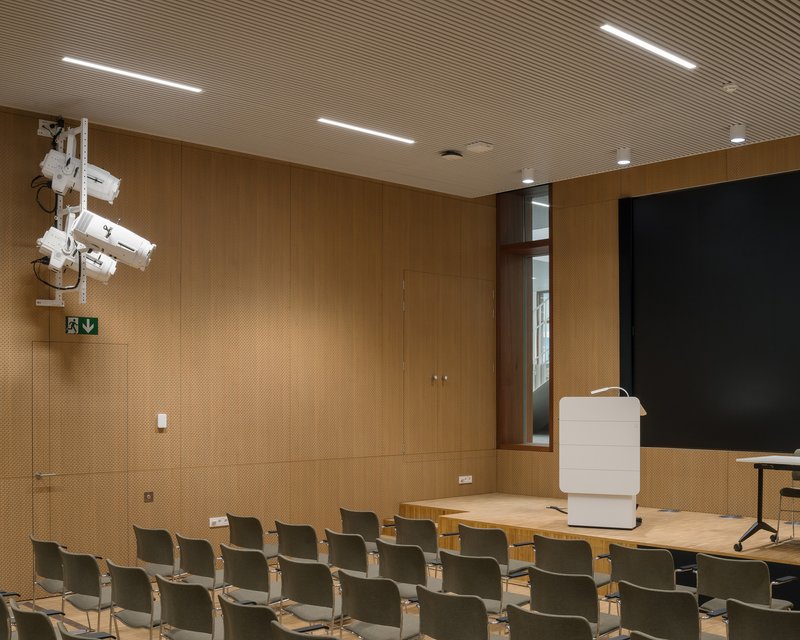
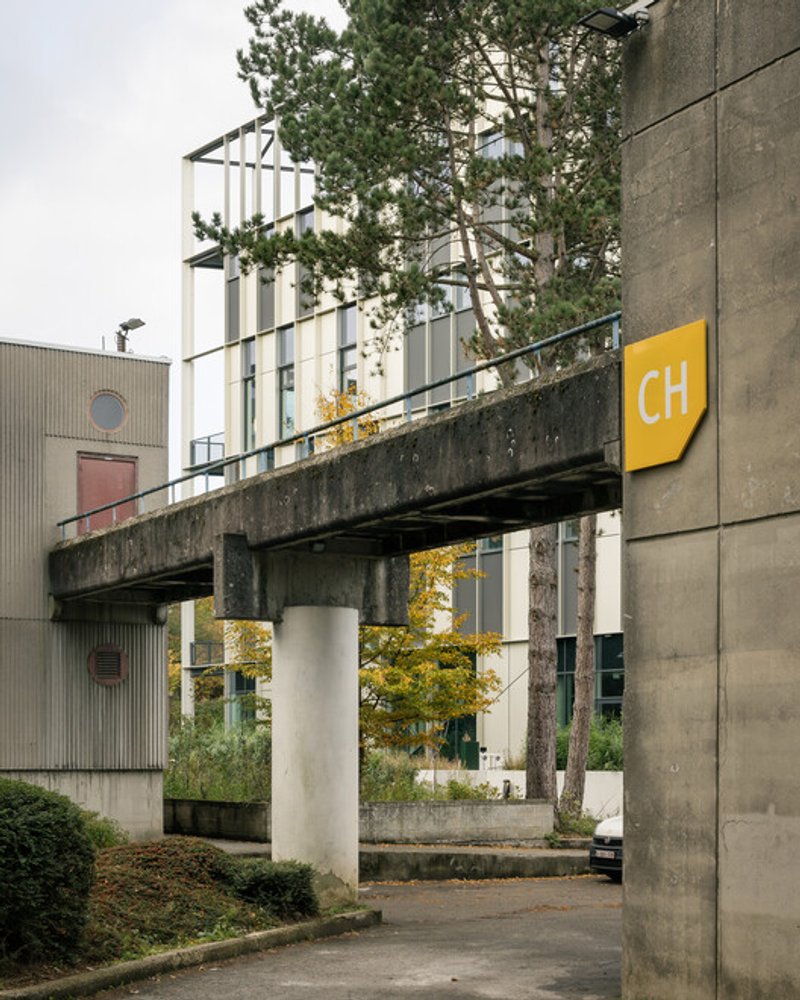
The auditorium is a timber-lined room with linear recessed lights and a low timber stage. The palette is warm and acoustically soft, designed for lectures and small events rather than large conferences. A new lift tower with a yellow door reconnects the centre to an existing concrete stair from the adjacent campus building, stitching the new building into the circulation of the older blocks without demolishing or rebuilding the existing access.
Drawing
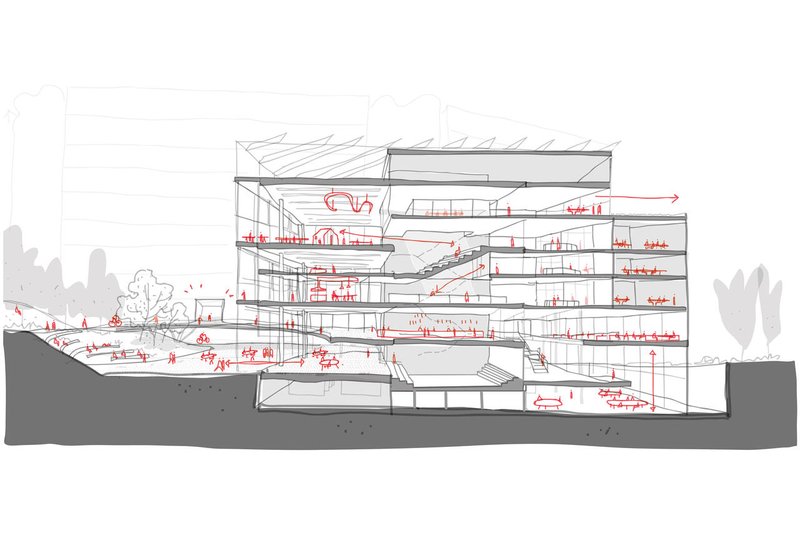
The section drawing, marked up in red by the architects as a working document, shows the full logic of the building in one image: the exterior amphitheatre stepping down to the sunken entry at the left, the rotunda atrium at the centre rising through the full height, the upper reading rooms arranged around the void, and the vertical circulation cores tying the floors together. The section is the clearest explanation of how a tight square plan can contain a library, an auditorium, a cafe, and a central atrium without feeling crowded.
Why This Project Matters
Campus libraries in Europe are a well-established typology but a difficult one: they need to hold quiet study, social gathering, book storage, lecture space, and informal circulation in a single building, and most solutions default to either a monumental reading room or a mall-like atrium with no character. The Learning and Innovation Center is neither. The sunken entry, the central rotunda, and the disciplined facade produce a building that feels both formally precise and genuinely student-friendly. The sustainability features, near energy-neutral design, helophyte filter for greywater, and compact footprint, are integrated into the architecture rather than applied afterwards.
If you are designing a campus library, an academic building, or any multi-programme compact structure, this project is worth studying for how a square plan with a central circular void can organise complex programme into a legible whole.
About the Studios
Share Your Own Work on uni.xyz
If you are working on academic architecture, campus libraries, or learning-centre design, uni.xyz is a place to publish your work and connect with a global design community.
Project credits: Learning and Innovation Center by evr-Architecten and A229. Ixelles, Brussels, Belgium. Photographs: Stijn Bollaert.



Popular Articles
Popular articles from the community

Milan Crossover: Sustainable Architecture for a New Fashion Culture in Milan
Milan Crossover transforms fashion culture through sustainable architecture, linking material libraries, remake studios, and public runways.

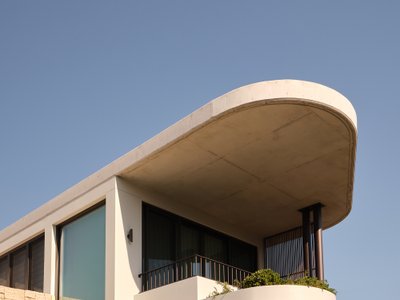
Stanton Architects Sculpts a Curving Family Home into Sydney's Inner West Fabric
Five Dock House uses cantilevers, curved concrete, and layered courtyards to carve out privacy on a tight suburban lot in Sydney.
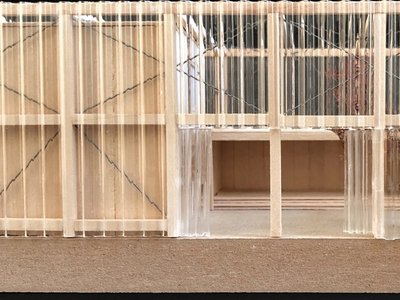
Kaffeebühnen: Coffee Shop Architecture Designed as a Civic Stage Between Vienna’s City and Park
Kaffeebühnen turns coffee shop architecture into a civic stage, linking Vienna’s park edge, urban life, warm timber yards, and coffee craft.
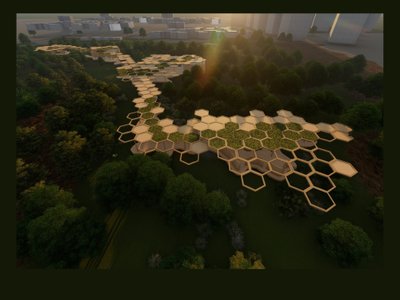
Eco Chapel: A Green Architecture Pavilion Designed in Symbiosis with the Forest
Eco Chapel uses green architecture to weave prayer, learning and reuse into a forest pavilion shaped by modular hexagonal canopies for life.


Similar Reads
You might also enjoy these articles
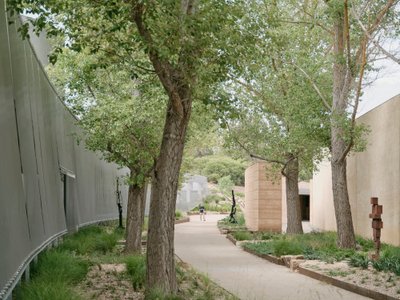
Kerstin Thompson Architects Buries a Cultural Center Beneath Its Own Car Park in the Yarra Valley
The Eva and Marc Besen Centre at TarraWarra hides 2,375 square metres of gallery and archive space under a reinstated landscape in Healesville, Australia.
Kerry Kounnapis Packs 800 Daily Coffees into a 43-Square-Metre Melbourne Laneway Bar
Palace Coffee channels Pellegrini's and European standing bars through oxide-red steel and spotted gum timber in a Ridgway Place sliver.
Nikken Sekkei Stacks a Three-Dimensional Lilong Atop Shanghai's Historic Alleyways
A 180-meter tower and restored heritage houses on Nanjing West Road reimagine communal lane life as a vertical mixed-use district.
PLATAFORMArq Folds a Concrete Roof Over the Portuguese Mountains in House #474
A 220-square-meter residence in Teixoso, Portugal, wraps board-formed concrete into an angular canopy that frames the Serra da Estrela foothills.


Explore Educational Building Competitions
Discover active competitions in this discipline




The International Standard for Design Portfolios


The Global Benchmark for Architecture Dissertation Awards


The Global Benchmark for Graduation Excellence


Challenge to design public laboratory
Comments (0)
Please login or sign up to add comments
No comments yet. Be the first to comment!