

Learning for Life: A Single Green Roof That Turns a School Into a Landscape of Seven Buildings
Misak Terzibasiyan's shortlisted school scatters specialised buildings beneath one green roof, letting daylight and water shape how students learn.


Most school buildings still assume that learning happens at a desk, in a room, at a fixed hour. Learning for Life starts from the opposite premise. If technology has made knowledge continuous, decentralised and personal, the school should stop behaving like a container and start behaving like terrain. The proposal breaks the institution into seven distinct structures and draws a single continuous roof over them. The result reads less like a building and more like a landscape that students move through, occupy and claim.
Designed by Misak Terzibasiyan, the project was shortlisted in the School of Thought 2020 competition, which asked entrants to imagine the architecture of future education. Terzibasiyan does not commit to a single pedagogical model. He builds a spatial framework for a spectrum of learning styles and rhythms, on the understanding that students will have to keep reinventing themselves as technology and society shift around them.
The Roof Becomes the Schoolyard
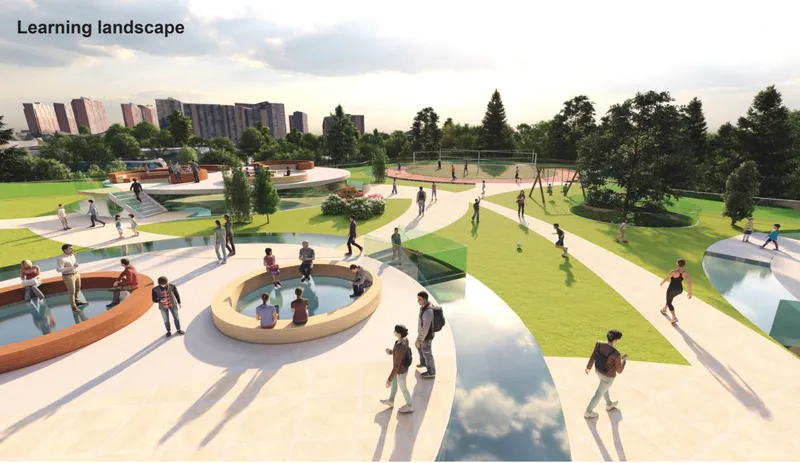
The rooftop rendering makes the project's central move legible at once. The shared roof is not a lid; it is ground. Round sunken pools, curving paths and lawns turn the top surface into an occupied landscape where students walk and play in the evening light. The source text describes circular courtyards, open plazas, sports areas and green zones woven through the campus, and here they combine into one continuous field rather than a set of fenced-off amenities.
This roof also does environmental work. Planted as a green roof, it insulates the buildings below, limiting heat gain in summer and holding warmth in winter, while giving students accessible outdoor space. Trees and vegetation reduce particulate matter and improve the local microclimate. The move is efficient: one gesture unifies seven buildings, conditions their interiors and doubles the usable outdoor area of the school.
Light Falling Through the Canopy
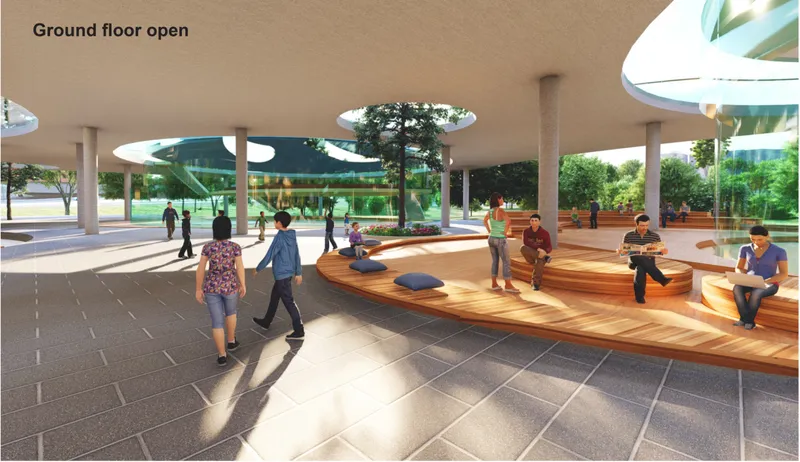
Beneath the roof, the ground floor opens up. Round skylights punctured through the flat slab throw dappled daylight onto curved timber benches, where readers settle in loosely arranged clusters. The space works as a covered plaza, a reading room and a circulation route at the same time. Terzibasiyan's claim that indoor and outdoor boundaries dissolve under the roof becomes concrete here: you cannot tell whether you are inside a building or in the shade of one.
The skylights carry the argument about daylight that runs through the proposal. Together with glass façades, they draw natural light deep into the plan, and the designer connects that brightness directly to concentration and well-being. The circular openings echo the round courtyards and pools above, so the geometry of the roof landscape is readable from below.
Water and Timber in the Sports Hall

The indoor pool shows how the material palette holds steady across very different programmes. A timber deck, a wood-lined ceiling and a sculptural white staircase frame the water, and the ceiling opens toward the trees, keeping swimmers visually tied to the landscape outside. Sport is not pushed into a windowless box at the edge of the site; it sits within the same daylit, planted world as the classrooms.
Water appears throughout the scheme, from the sunken pools on the roof to this hall, and the designer treats these elements as part of a sensory connection to nature rather than as decoration. Physical activity, in this reading, belongs to the curriculum as much as anything taught at a screen.
Tiered Seating as a Learning Tool
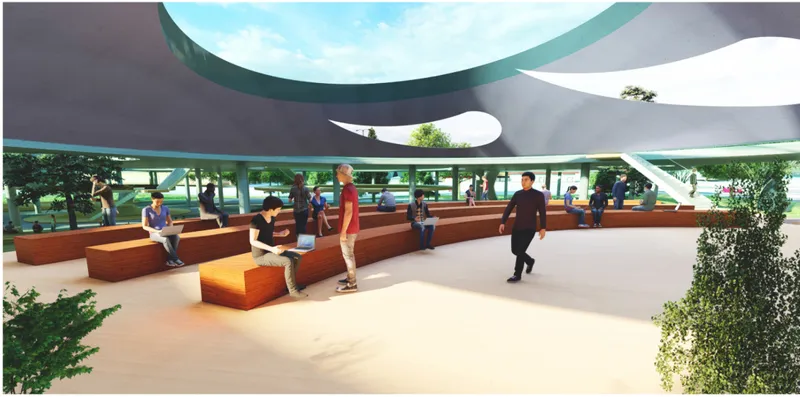
The tiered timber seating is the clearest image of student-centred learning in the set. Students work on laptops across broad curved steps under a roof cut with oval openings, choosing their own height, neighbour and degree of privacy. The same steps could host a lecture, a group critique or an afternoon of solo work. Nothing about the furniture fixes a front of the room.
This connects to the flexibility Terzibasiyan describes for the wider campus. Each building is dedicated to a domain, such as science, technology, arts, sports or social interaction, but movable partitions, open floor plans and modular furniture let spaces change as teaching methods change. The stepped landscape is the architectural version of that idea: a single form that supports collaborative, independent and presentation-based learning without being rebuilt.
Pavilions Read Layer by Layer
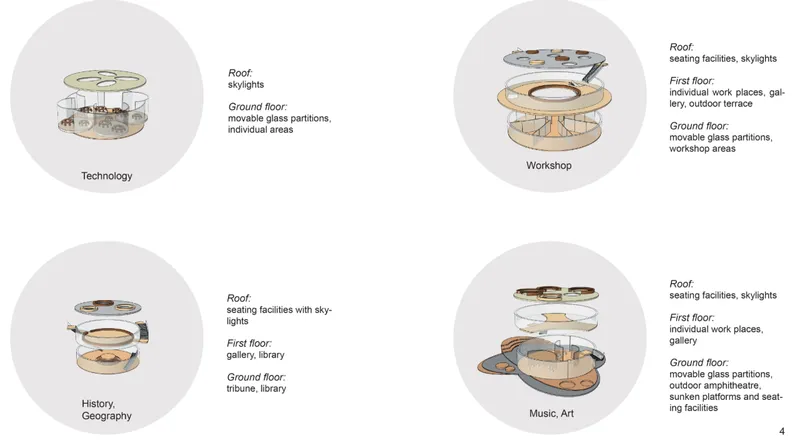
The exploded axonometrics split four of the circular pavilions into roof, first floor and ground floor, with notes on how each level is used. The diagrams show the logic beneath the soft renderings: each pavilion is a self-contained programmatic unit, and the stacked layers make clear how the roof landscape, upper rooms and open ground plane relate within each one.
Seen together, the pavilions explain why the campus avoids becoming a monolith. Specialisation happens at the scale of the individual building, while the shared roof and ground plane keep the whole connected. It is a sensible way to organise a school that has to serve many disciplines without isolating them from each other.
Why This Project Matters
Proposals about future schools often stall at the level of slogans: flexible, green, student-centred. Learning for Life gives those words a structure. Gathering seven specialised buildings under one inhabited roof answers a hard question in a single move: how to let a school diversify its spaces without breaking into disconnected parts. The roof organises, insulates, shades and becomes a playground, and that economy of means is the project's strongest quality.
Some questions remain open, particularly how the continuous roof would handle the practical demands of security, acoustics and maintenance across so many programmes. Still, Terzibasiyan makes a persuasive case that the architecture of learning should look more like a landscape than a corridor of classrooms. For a generation expected to keep learning throughout their lives, a school that invites movement, choice and contact with nature is a convincing starting point.
View the Full Project
About the Designers
Designer: Misak Terzibasiyan
Enter a Design Competition on uni.xyz
uni.xyz runs architecture and design competitions year-round that reward proposals with spatial conviction and real site intelligence.
Project credits: Learning for Life by Misak Terzibasiyan Thought 2020 (uni.xyz).


Popular Articles
Popular articles from the community

Faces of the Soviet Avant-Garde: Turning Moscow's Street Names into an Open-Air Museum
A network of sculptural installations across a Moscow residential district transforms forgotten architect names into spatial encounters with cultural memor

Singing Woman: An Opera House That Performs Before the Curtain Rises
Ovidiu Cristian Pavel's conceptual opera house translates Estonia's choral identity into a sculpted waterfront landmark facing the Baltic Sea.

Manzana Morphosis: Stretching Barcelona's Grid into a Living Landscape for 2050
A radical reworking of the Eixample manzana turns density into a tool for generous public space, vertical ecology, and environmental performance.
Extended Shell: Retrofitting Kolkata's Balconies as Living Urban Thresholds
A modular retrofit system recovers the social and environmental intelligence of Kolkata's historic verandas for contemporary Park Street residents.

Similar Reads
You might also enjoy these articles

Healing Façade: A Modular Chapel System That Restores Ethiopia's Sacred Forests
Winner of the Eco-Chapel competition, this circular timber façade collects water from air to rebuild soil and reforest degraded Ethiopian landscapes.
Kaffeebühnen: Where Coffee Shop Architecture Becomes a Civic Stage in Vienna
A linear sequence of timber boxes, transparent shells, and open yards turns the Viennese café tradition into a public performance space.
Eco Chapel: A Modular Forest Pavilion That Grows Like the Landscape It Protects
Hexagonal timber modules weave through existing trees, turning a chapel into a living system for prayer, education, and reforestation.


Urban Forest: A Vertical Ecosystem for 5,000 Workers in Singapore's Changi Business Park
Radially stacked pods and layered green decks turn a 7-acre plot into 47 acres of ecological workspace projected for 2040.

Explore Mes School Of Architecture Competitions
Discover active competitions in this discipline

Challenge to design public laboratory

Challenge to reimagine the Iron Throne

Photograph architecture without architects

Illustrate the lost glory of Angkor Wat - Render Challenge
Comments (0)
Please login or sign up to add comments
No comments yet. Be the first to comment!