
Learning Garden Journal
A biophilic design that brings learning outdoors

Concept
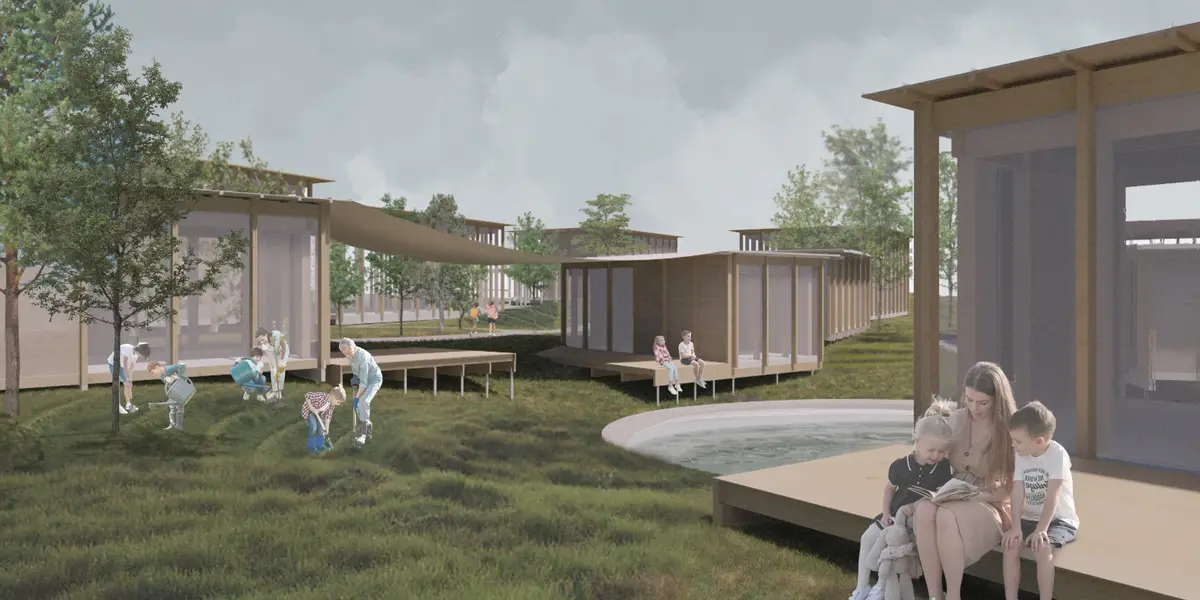
In the Learning Garden, we decided to redefine a typical biophilic school. Instead of incorporating greenery indoors, we are bringing classrooms outside. The Learning Garden becomes a place of continuous growth, a place where children grow up, knowledge increases, and vegetation develops.
We propose a school, where circulation takes place entirely outside and children follow a system of paths between the buildings.
Nature is not just a passive element, merely an outdoor area, it plays a crucial role in educational activities. Students learn how to grow plants and vegetables in the veggie garden, which later are used to prepare their meals. And in the outdoor woodworking area, students use materials that grow in their immediate environment.
The concept of the Learning Garden strives to minimise architectural footprint and maximise the landscape.
Organisation
Architectural interventions and site landscape are very much intertwined. We manipulated the topography of the site to create a more hilly landscape, which would inform the placement of the paths, direction of water collection and add an element of playfulness to an otherwise dull plot’s surroundings. The positioning of the architectural interventions was based on a typical day in the life of a primary school student. Starting with a drop-off, first classes, then a session in the gym, followed by lunch and ending in an after school play area. Admin building was placed to create a barrier between the busy roads around and the learning area, ensuring a calmer and safer learning environment.
Process
At the beginning of the process, we did thorough research on both New Zealand’s culture and education system, and the concept of a biophilic school. Our design process started with a traditional school typology - one, large block that accommodates all of the school functions. The structure was open to the outdoors and accommodated vegetation indoors. First, alteration of the concept came while we tried reducing the size of the building. We focused on creating multifunctional rooms and increasing the size of the grounds. From that, the idea for a learning garden emerged. The final alteration focused on redefining a school altogether. Instead of creating a school building, we designed a garden fostering educational activities and maximising exposure to the outside, with small, simple architectural interventions scattered around it.
Investigation
Our investigation started with gaining an understanding of the architectural, cultural and climatic context of New Zealand. With that, we thoroughly researched the concept of biophilia, particularly in the context of education. We relied on scientific and academic papers describing the influence of biophilia on the learning experience. After that, we prepared a site analysis, focusing on surrounding typologies, noise sources, traffic and safety, existing topography and sun exposure.
Materials
As the Learning Garden follows sustainability objectives, it was very important to us to incorporate locally sourced materials to reduce the costs, embodied energy and time of the construction. Materials were also picked to simplify the process of construction, which would not require heavy machinery or elaborate tools.
We decided to use timber as our main structural and furnishing materials, due to its renewable properties, price and importance in New Zealand architecture. The two main species we picked were radiata pine and douglas fir, both locally grown. We also incorporated polycarbonate sheets because of their lightness and high insulating performance.
Change over time
Newly planted vegetation will undergo a major transformation. The idea is that every student gets to plant and take care of their sapling as they join the school. With passing years, the landscape of the Learning Garden will evolve and grow. Hedges were planted around the plot to create a noise barrier from the traffic and a visual barrier from the neighbouring distribution warehouse. With years those barriers will become stronger.
Thanks to an easy and modular construction, classrooms have an opportunity to expand and host more students, if the school continues to grow. Similarly, the existing classrooms could be moved and arranged to allow for the creation of larger outdoor classrooms.
References
- Why kids need to spend time in nature. Child Mind Institute. (2021, September 21). Retrieved April 9, 2022, from https://childmind.org/article/why-kids-need-to-spend-time-in-nature/
- Kuo, M., Barnes, M., & Jordan, C. (1AD, January 1). Do experiences with nature promote learning? converging evidence of a cause-and-effect relationship. Frontiers. Retrieved April 9, 2022, from https://www.frontiersin.org/articles/10.3389/fpsyg.2019.00305/full#B13
- NLI. (n.d.). Retrieved April 9, 2022, from https://naturalearning.org/Designing_School_Grounds_Webinar
- 14 patterns of biophilic design - green plants for green ... (n.d.). Retrieved April 9, 2022, from https://greenplantsforgreenbuildings.org/wp-content/uploads/2015/01/14-Patterns-of-Biophilic-Design-Terrapin-2014e.pdf
- Select an account to login to TU Delft Library EZProxy server hosted by OCLC. SURFconext - Select an account to login to TU Delft Library EZProxy server hosted by OCLC. (n.d.). Retrieved April 9, 2022, from https://www-tandfonline-com.tudelft.idm.oclc.org/doi/full/10.1080/00094056.2018.1451690

Popular Articles
Popular articles from the community


Temporary Home for Dogs: A Reversed Zoo Rethinks Animal Shelter Architecture
In Bucharest, a sinuous corridor and freed landscape flip the logic of containment, designing a shelter that works to make itself unnecessary.

Opera on the Sea: Driftwood Logic Shapes a Timber Opera House on Estonia's Coast
Trevor Orgill's opera house translates the entangled drift of floating timber into a civic building where wood, water, and music converge.
Extended Shell: Retrofitting Kolkata's Balconies as Living Urban Thresholds
A modular retrofit system recovers the social and environmental intelligence of Kolkata's historic verandas for contemporary Park Street residents.
Faces of the Soviet Avant-Garde: Turning Moscow's Street Names into an Open-Air Museum
A network of sculptural installations across a Moscow residential district transforms forgotten architect names into spatial encounters with cultural memor

Similar Reads
You might also enjoy these articles

The Rhythm of Seasons
A Farmers' Market Connecting Nature and the City

More Than a Building-Designing a Living System
More Than a Building-Designing a Living System
Base Beyond
DESERT COMPOUND ARID: TOURISM OF ABSENCE AND ABUNDANCE

Comments (0)
Please login or sign up to add comments
No comments yet. Be the first to comment!