

Atelier WOA Wraps a Timber and Stone Library in a Perforated Veil at Herblay-sur-Seine
L'échappée pairs quarry stone, French-processed spruce, and perforated aluminum to give a Paris suburb its first true cultural anchor.


Herblay-sur-Seine sits 23 kilometers northwest of Paris, a municipality of around 30,000 people whose Bayonnes neighborhood was built almost entirely for residential purposes. Schools, a swimming pool, and a gymnasium cluster along the Esplanade des Frères Lumière, but until 2023 there was no real cultural destination. L'échappée, designed by Atelier WOA and delivered after 21 months of construction for 8 million euros, fills that gap with 2,227 square meters of library, auditorium, and open community space. The name translates loosely as "escapade" or "breakaway," and the building earns it: this is a place that refuses the cold institutional language of so many French public buildings, reaching instead for warmth, permeability, and a genuine invitation to linger.
What makes the project worth studying is the deliberate paradox at its core. Atelier WOA wanted a landmark, a building visible and legible as a civic presence, but one that simultaneously dissolves into its surroundings. The strategy is material: roughly 400 cubic meters of massive stone from the Saint-Maximin quarry anchor the base, while 650 cubic meters of French spruce and Douglas fir form the structure above. A thermocoated perforated aluminum skin veils the glazed facades on the north and south, filtering light into dappled patterns that the architects compare to a forest understory. The green roof, 30 centimeters of earth with no technical equipment on its surface, turns the building into a planted hill when seen from the apartment blocks nearby. Civic ambition and contextual humility coexist here, and neither one blinks.
The Perforated Veil
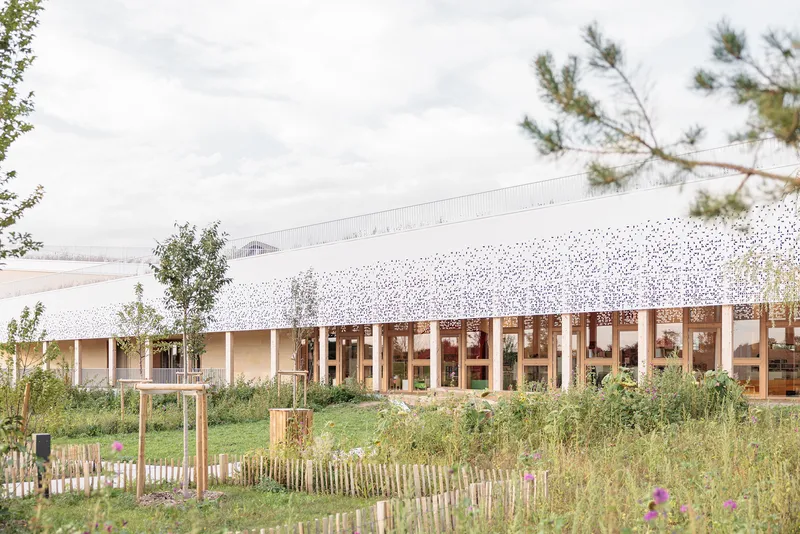
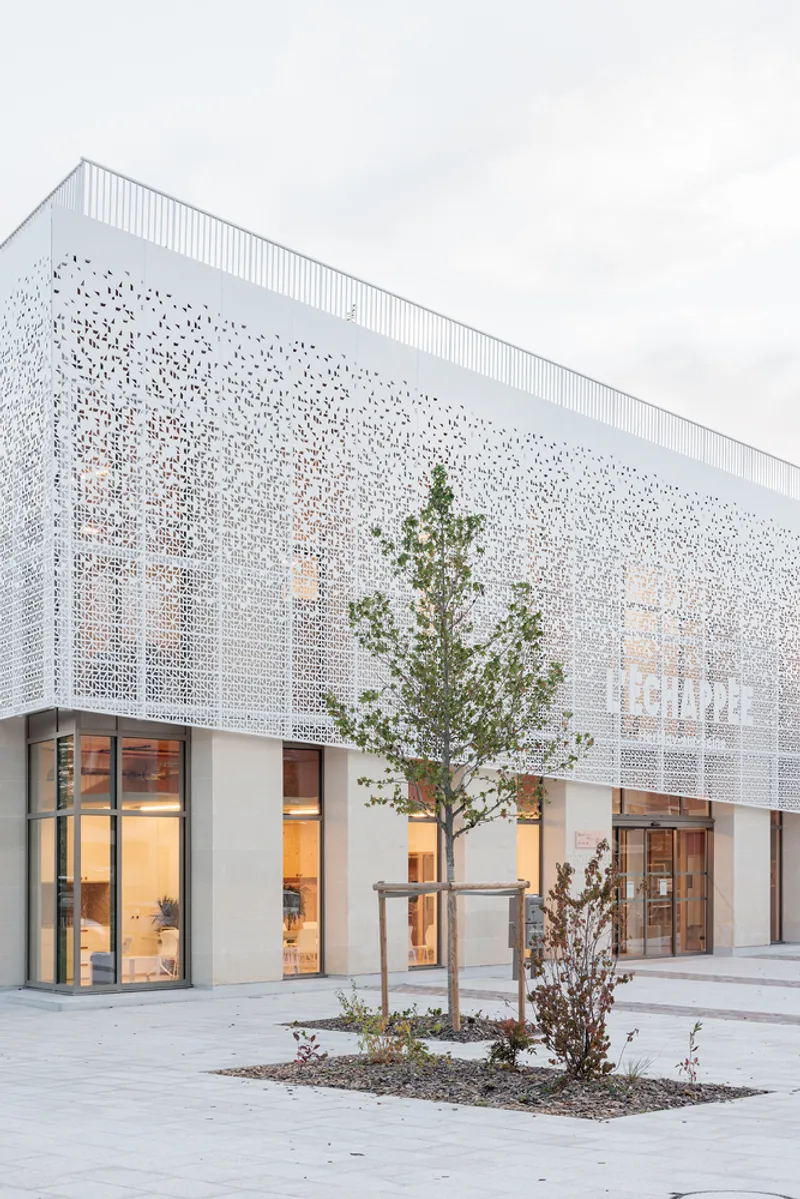
The most immediately striking gesture is the perforated aluminum screen that wraps the long north and south elevations. Set outboard of fully glazed walls, the panels create a 3.5-meter-deep outdoor gallery on each side, a threshold zone that is neither inside nor outside. The perforation pattern scatters daylight into soft, shifting patches, while at dusk the interior glow reverses the effect, turning the facade into a luminous lantern. It is a pragmatic move as much as an aesthetic one: the mesh provides solar shading that lets the architects use generous glazing without overheating the interior, and the depth of the gallery means the building can serve as a cool refuge during heat waves, a pressing concern in the Île-de-France summers.
Wildflower planting runs right up to the base of the screen, softening the transition between architecture and the 3,000-square-meter garden that surrounds the building. The aluminum is white, which keeps the material recessive against overcast skies and allows the timber columns behind it to read as warm vertical accents. It is a facade that changes personality with the weather and the hour, which is exactly the kind of slow visual reward that keeps a civic building interesting over decades rather than months.
The Covered Gallery and Garden
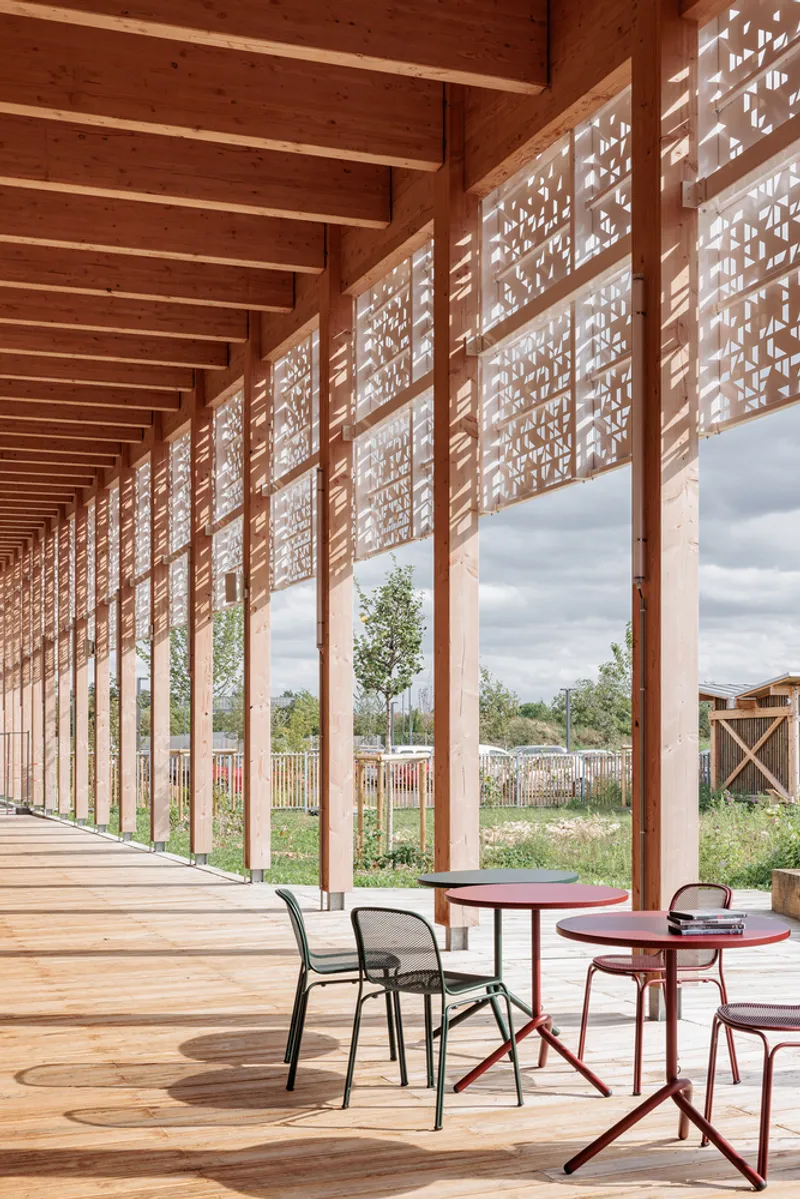
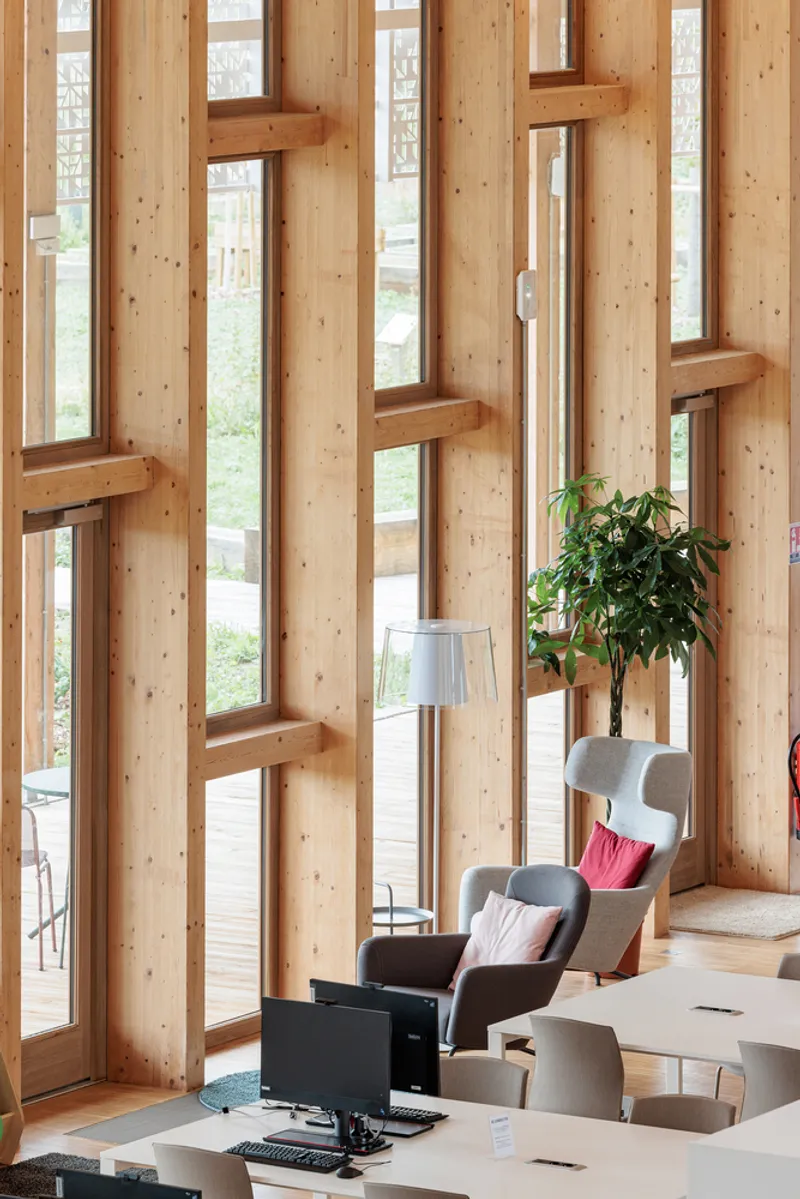
Step inside the 3.5-meter gallery and you find timber columns, scattered seating, and unobstructed views over the meadow garden. This is one of the most generous gestures in the project: a publicly accessible covered outdoor room that costs no energy to condition and invites use year-round. The garden itself is conceived as an educational landscape with fruit trees, vegetable beds, and spaces for observing flowering plants, programming that ties the library's cultural mission to hands-on engagement with the natural world.
Inside, the relationship to landscape continues through staggered vertical windows cut into the stone and timber walls. These narrow apertures frame individual views, creating intimate reading nooks where a single chair and a potted plant feel like a complete world. The contrast with the wide-open glazing on the gallery side is deliberate: Atelier WOA differentiates between collective transparency and private focus, using the depth of the wall to mediate between the two.
Timber Structure and Open Interior


The structural logic is a succession of timber portals spanning 18 meters, using spruce glued-laminated beams from Briand Bois Construction and CLT panels from Piveteaubois. The roof assembly achieves a structural depth of just 6 centimeters, a remarkable figure that keeps the ceiling plane taut and clean while carrying 30 centimeters of planted earth above. Concrete bracing elements handle lateral loads, but the visual language inside is overwhelmingly wood: warm, directional, and rhythmic.
The 2,000 square meters of open-plan space are organized simply. A 120-seat auditorium occupies the east end, offices sit to the west, and services anchor the building's extremities. The large central lobby can be reconfigured for events, exhibitions, or everyday library use. Five custom furniture modules, themed around the concepts of cave, cabin, arena, and castle, give different zones distinct spatial characters without relying on permanent partitions. Tiered seating doubles as performance grandstands and comfortable reading areas, and a 45-square-meter reading net, reportedly the largest in a French public facility, adds an element of play. Exposed beams, integrated lighting, and the blue modular cushions on the tiered seats create an atmosphere closer to a well-designed co-working space than a traditional municipal library.
Stone, Wood, and Regional Logic
Herblay-sur-Seine has a historic constructive tradition tied to stone, and the Saint-Maximin quarry that supplied material for the base sits just 30 kilometers from the site. The self-supporting stone piles, each 130 centimeters wide and 50 centimeters deep, give the lower register of the building a geological weight that reads as permanence. Above, the timber takes over, and the architects frame the pairing as a deliberate echo of Haussmannian construction, where stone and wood each play to their structural strengths.
All of the wood was processed in France, a detail that matters for carbon accounting and for the argument that public architecture can drive demand for local forestry supply chains. The combination of CLT for the mezzanine floor, roof, and bathroom core with glue-laminated portals for the primary structure shows a mature understanding of engineered timber, using each product where it performs best rather than defaulting to a single system. At an overall cost of roughly 3,600 euros per square meter excluding tax, the project demonstrates that material ambition and fiscal discipline are not mutually exclusive.
Plans and Drawings
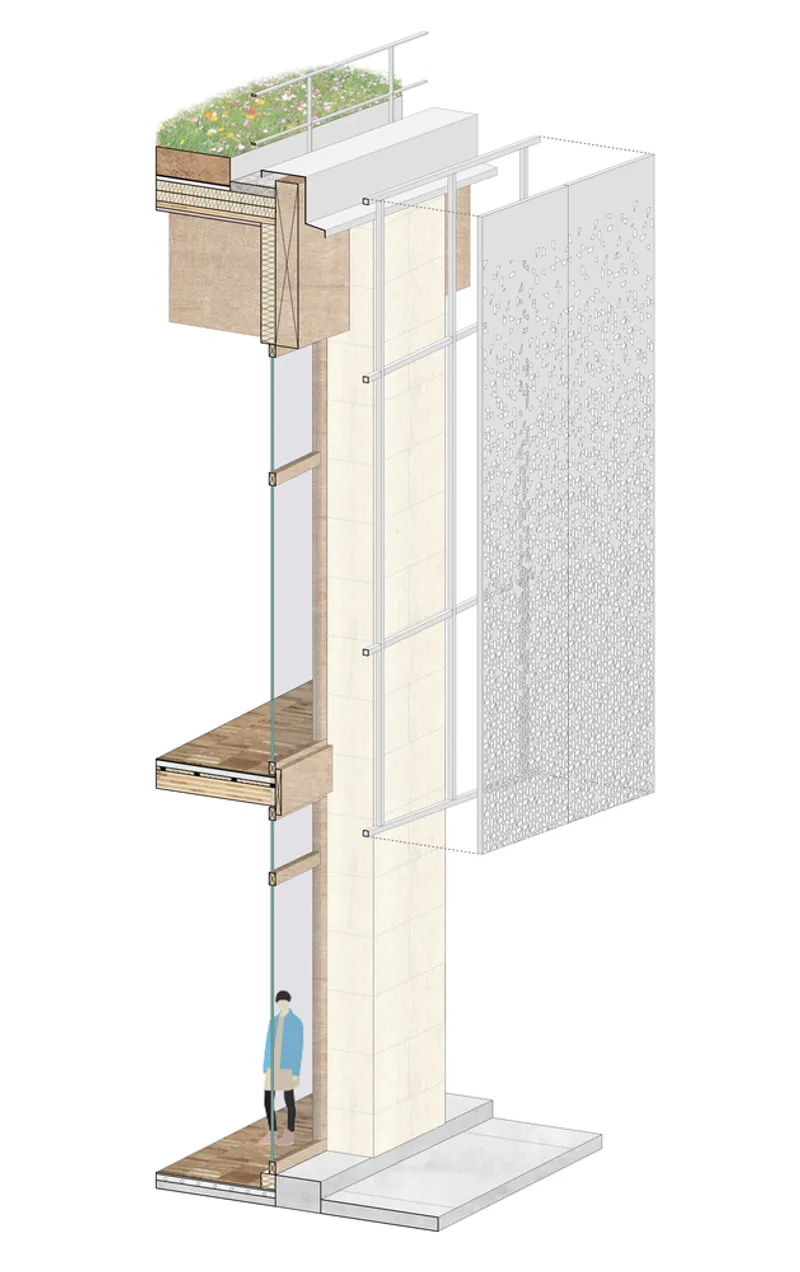
The axonometric wall assembly drawing reveals the layered logic of the envelope: timber framing and insulation sit behind the perforated aluminum cladding, while the green roof detail shows the 30-centimeter soil layer resting on the CLT deck. What the drawing makes legible is how thin and precise each layer is. The 6-centimeter structural roof, the calibrated insulation depth, and the gap between the metal veil and the glazing all work together to produce a building that breathes, shades, and grows. It is a section that could be taught in a structures class and a sustainability seminar simultaneously.
Why This Project Matters
L'échappée matters because it takes seriously the idea that a suburban library should be as architecturally ambitious as any urban cultural institution, without resorting to spectacle. Atelier WOA did not drop a sculptural object into the Bayonnes neighborhood. They grew a building out of the site's topography, wrapped it in local stone and French-processed timber, and gave it a planted roof that returns the footprint to the landscape. The perforated veil manages solar loads, creates generous outdoor rooms, and gives the facade a visual life that changes by the minute. Every move serves at least two purposes.
For studios and students working on civic programs in peripheral locations, the project offers a clear lesson: specificity beats abstraction. The stone comes from a quarry with local historical ties. The timber supply chain is entirely domestic. The garden teaches botany. The reading net invites children to sprawl. The auditorium seats 120 for a town of 30,000. None of these decisions are generic, and together they produce a building that belongs to its community in a way that a more "universal" design never could. L'échappée is an escapade worth paying attention to.
L'échappée, designed by Atelier WOA. Herblay-sur-Seine, France. 2,227 m². Completed 2023. Photography by Salem Mostefaoui.
About the Studio
Share Your Own Work on uni.xyz
If projects like this are the kind of work you want to make, uni.xyz is a place to publish your own, find collaborators, and enter design competitions.



Popular Articles
Popular articles from the community


Hill & Cross Opera: Sculptural Opera House Architecture Shaped by Tallinn’s Landscape and Identity
Hill & Cross Opera reimagines opera house architecture in Tallinn through its sculptural hill, civic plaza, glass wave and a luminous cross.

Co-life: Sustainable Architecture for Age-Friendly Community Living
Co-life reimagines sustainable architecture for seniors through courtyards, rammed earth, shared gardens, and spaces designed for belonging.

Conexión: Biophilic Design Reimagines High-Rise Living in Hong Kong
Conexión reimagines high-rise living in Hong Kong through biophilic design, green facades, shared spaces, daylight, water and nature within.

The Earth Pod: 3D Printed Homes for Resilient Refugee Communities
The Earth Pod reimagines refugee housing through 3D printed homes made from clay, combining resilience, self-sufficiency, and rapid shelter.

Similar Reads
You might also enjoy these articles


Hodi-Mandai Geram
Project Function: Preservation and revitalization of the Intangible heritage and socio-spatial identity of the Hodi by Housing, Cultural Memory Center, Sacred Grove, landscape, local tourism economy


Olio Towers: A Mid-Rise for Performers That Fuses Housing, Rehearsal, and Stage
Located blocks from Houston's Theater District, this modular tower stacks living units around a central performance atrium.

Oasis: Modular Green Housing Carved into Dhaka's Urban Fabric
A shortlisted Plugin Housing entry reclaims unauthorized settlements in Dhaka with stepped concrete volumes, green roofs, and ventilation-driven design.

Black Hole: A Floating Megastructure for the Post-Physical Era
Emiliano Mazzarotto envisions a spherical, self-scaling arena where e-sports, digital hotels, and holographic stadiums replace traditional public space.
Explore Architecture Competitions
Discover active competitions in this discipline



Challenge to design public laboratory


Challenge to reimagine the Iron Throne


Photograph architecture without architects


Illustrate the lost glory of Angkor Wat - Render Challenge
Comments (0)
Please login or sign up to add comments
No comments yet. Be the first to comment!