

L'Empreinte Design Architecture Perches a Timber Home in a Quebec Maple Grove
La Cadrée Perchée nestles into a Laurentian mountainside, using fence boards, bleached concrete, and radical glazing to dissolve into the trees.


Building a house for yourself is a different proposition than building one for a client. The stakes are more personal and the temptations are more dangerous: self-indulgence, overthinking, the paralysis of infinite options. Pier-Olivier Lepage, founder of L'Empreinte Design Architecture, seems to have navigated these risks by committing to a single, disciplined idea. La Cadrée Perchée is a house designed to disappear into a maple grove on a mountainside above Lac Franc in Morin-Heights, Quebec. Every decision, from the cladding material to the floor finish, serves that premise.
The interesting move here isn't transparency for its own sake. Plenty of glass houses exist. What sets this project apart is the way the building's form is conceived as a radiator, its faceted exterior walls and wooden frames increasing surface area to absorb winter sun and bounce light deep into the interior. The house doesn't just look at the forest; it performs thermally in dialogue with it. Fence boards clad the exterior in a raw, openwork finish that mimics the bark of the surrounding maples, while bleached concrete floors inside turn white enough to vanish into snow during Quebec's long winters. The boundary between shelter and landscape is deliberately, almost aggressively, blurred.
A House that Mimics Its Trees

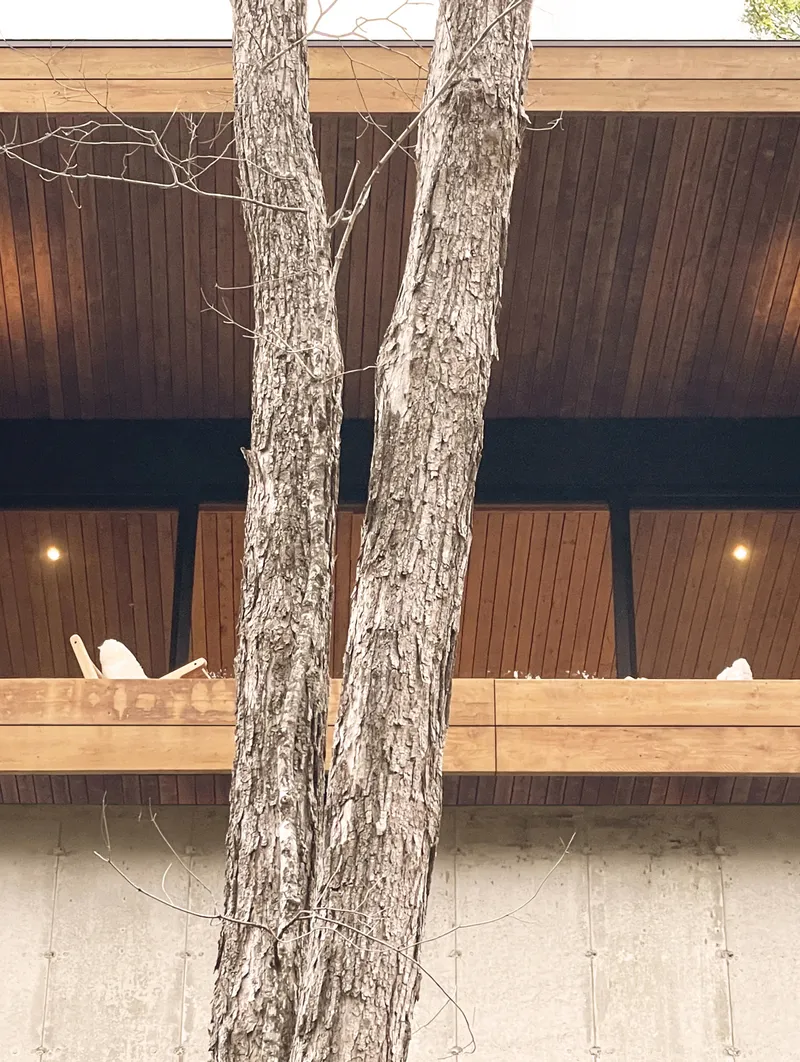
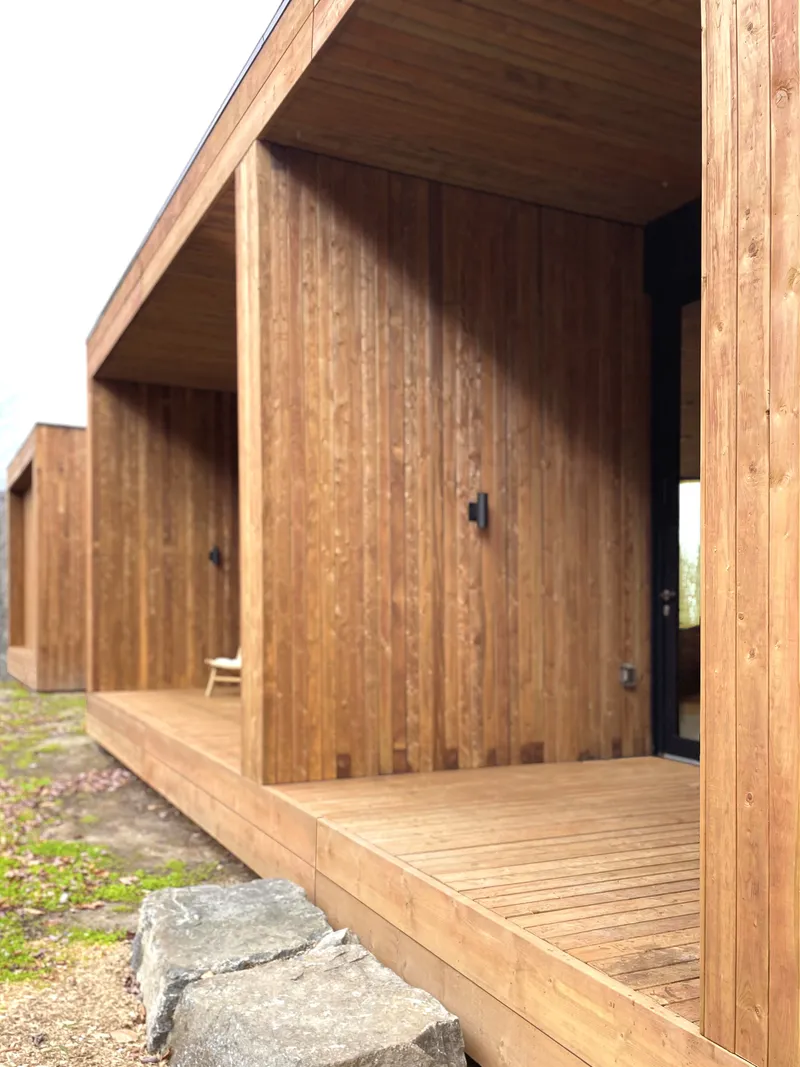
La Cadrée Perchée sits on a sloped site, elevated on a concrete base that lifts the timber volumes into the canopy of surrounding maples. The decision to use fence boards as exterior cladding is economical and quietly clever: their rough, vertical grain and warm tone echo the character of maple bark, so the house reads as a kind of built tree trunk from a distance. Up close, the relief of the openwork finish gives the facade a tactile, almost textile quality that feels artisanal rather than industrial.
The tiered balconies and post-and-beam structure visible on the exterior reinforce a sense of the house stepping up through layers of vegetation. Existing tree trunks rise directly in front of railings, confirming that the building was carefully sited to coexist with mature growth rather than clear it. The concrete base anchors everything to the slope without pretending to be natural; it's honestly structural, letting the wood above it do the work of contextual camouflage.
Framing the Forest on Every Axis
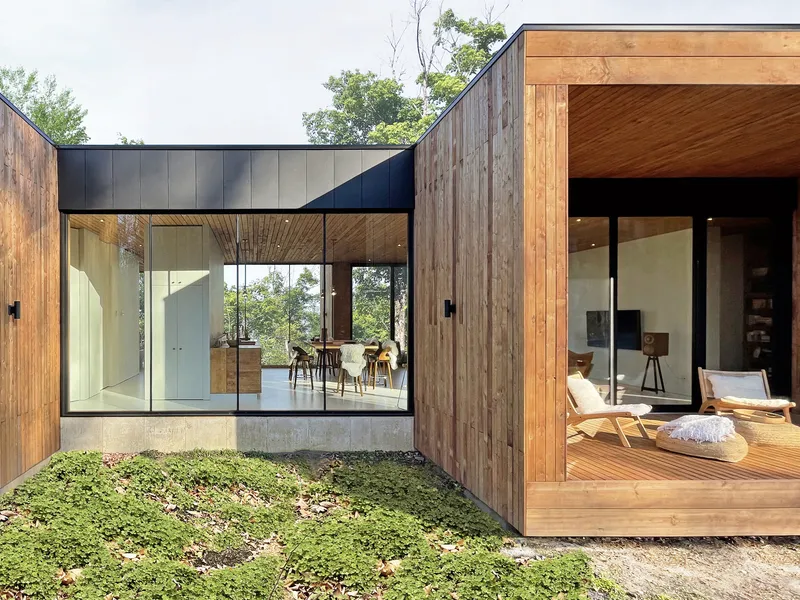

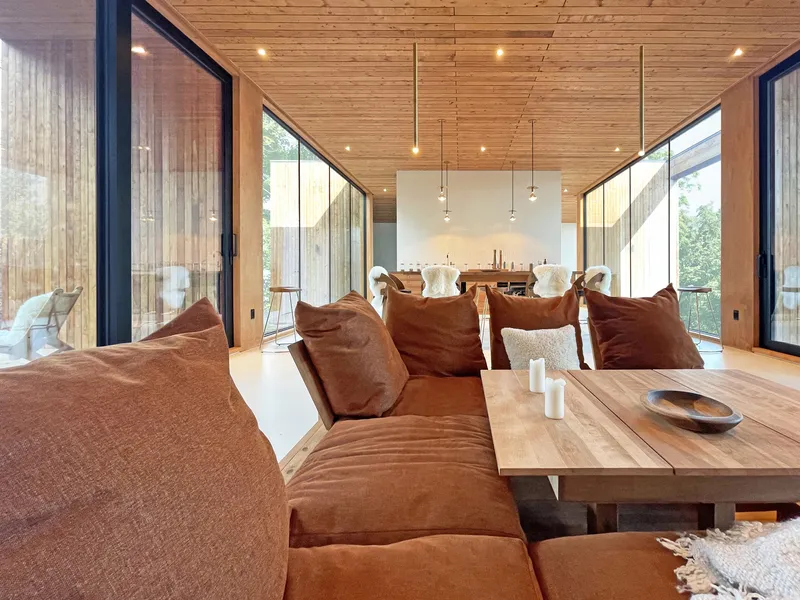
The east-west orientation of the house is not incidental. It gives the occupant sunrise on one end and sunset on the other, while the two terraces set in alcoves at the front and back create outdoor rooms that pull light into the center of the plan. The courtyard view between the two timber-clad volumes reveals how the massing is split to admit daylight and ground-level planting into the heart of the scheme, a strategy that avoids the dark core problem common in compact houses.
Mullionless windows appear throughout, but the project also uses black steel mullions strategically to subdivide larger openings into frames that compose the forest view like a series of vertical paintings. The timber soffit above the glazing pulls the ceiling plane toward the outdoors, extending interior space perceptually. The open living area with its corner glazing is perhaps the most successful room: the mounting furring strip ceiling wraps overhead while two walls of glass meet at the corner, eliminating any sense of enclosure on the forest side.
The Sunken Living Room and Japanese Influence


The sunken seating pit is the most unexpected gesture in the house. Inspired by the Japanese kotatsu, a low heated table around which people sit on the floor, the recessed sofa drops occupants below the window sill line so the view becomes entirely sky and treetops. The diagonal wood planking of the ceiling adds kinetic energy to a space that is otherwise horizontal and grounded. It's a room designed for winter: hunker down, stoke the fire, watch snow settle on branches at eye level.
A freestanding fireplace nearby faces floor-to-ceiling windows, turning fire-watching and forest-watching into a single, simultaneous act. Deck chairs sit just outside, visible through the glass, suggesting that the threshold between the heated interior and the cold terrace is meant to be crossed casually and often. The house doesn't treat outdoors as scenery to be observed from a safe distance; it treats it as an extension of domestic life.
Raw Materials, Refined Restraint

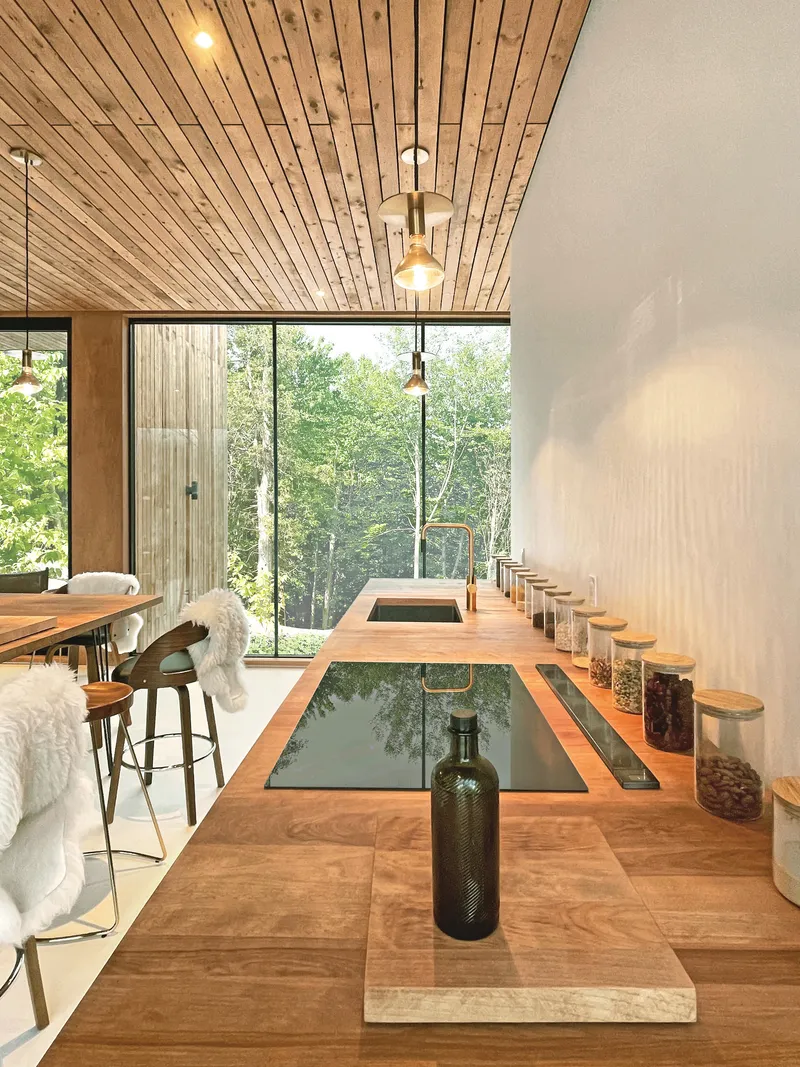
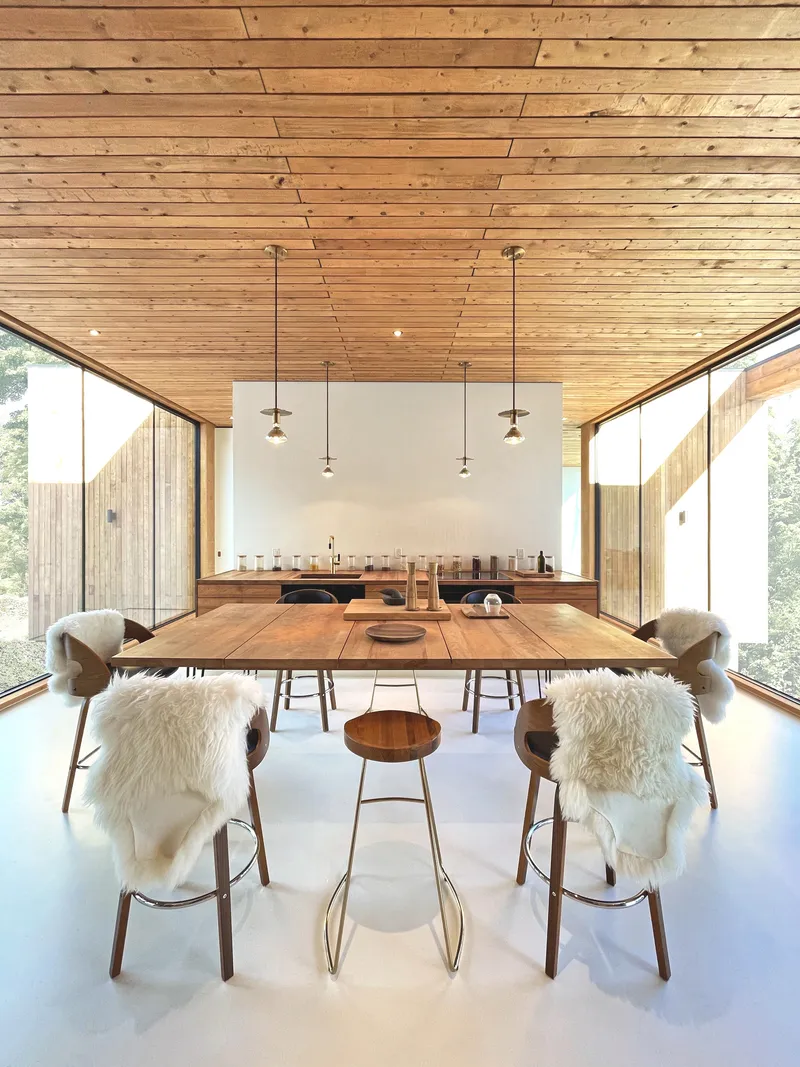
Inside, the material palette is limited to three things: raw wood, bleached concrete, and white surfaces. The corridor shots reveal how polished white floors reflect daylight from distant windows, stretching the sense of depth and luminosity through the plan. Timber plank walls line the circulation zones, providing warmth and acoustic absorption without requiring any applied finish. The effect is monastic but not cold, because the wood's grain and color variation do the decorative work that paint or wallpaper would do elsewhere.
The minimalist kitchen is worth noting. A long timber counter with a glass insert reflects trees outside the glazed wall, collapsing the distinction between work surface and landscape. Storage units are grouped into circulation islands rather than wall-mounted cabinets, keeping the perimeter of the house free for glazing. The pendant lights in the dining room hang from the angled timber ceiling at varying heights, their wires following the slope of the roof structure. It's a room where every element has been considered, but nothing looks labored.
Bedrooms and Bathing in the Canopy
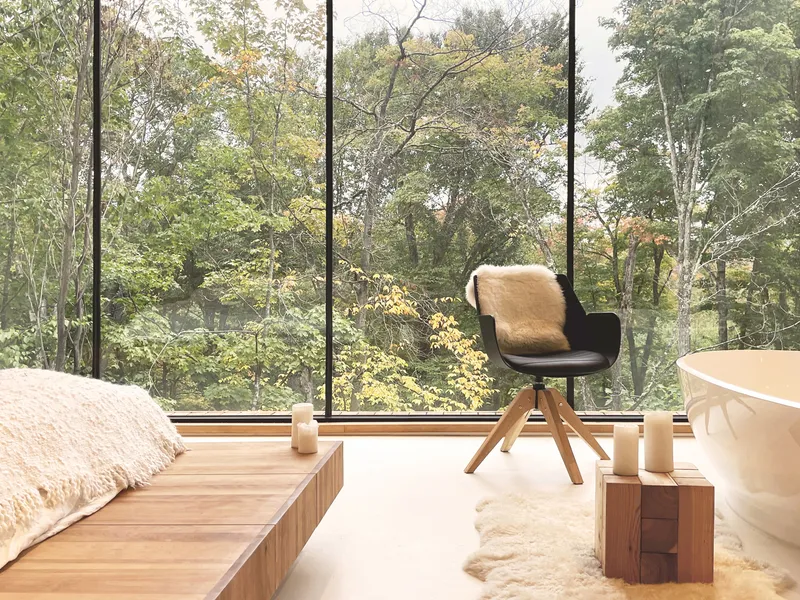
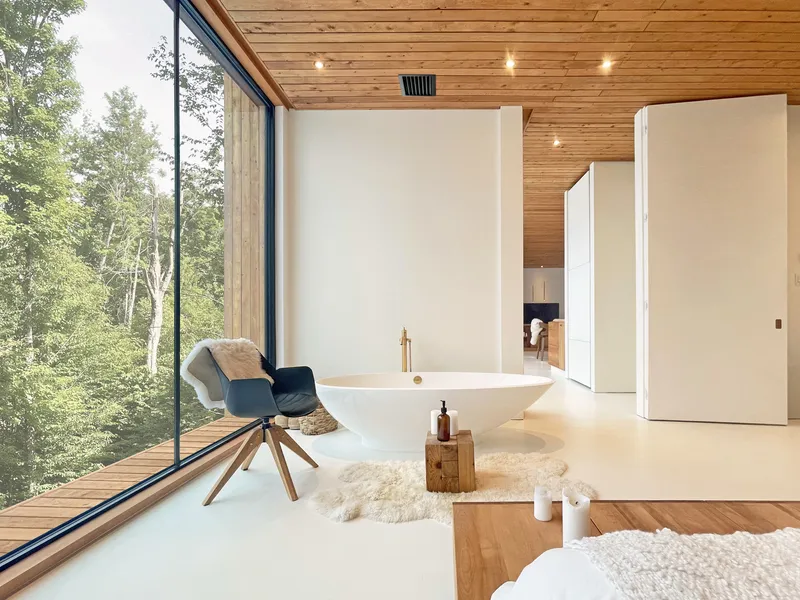
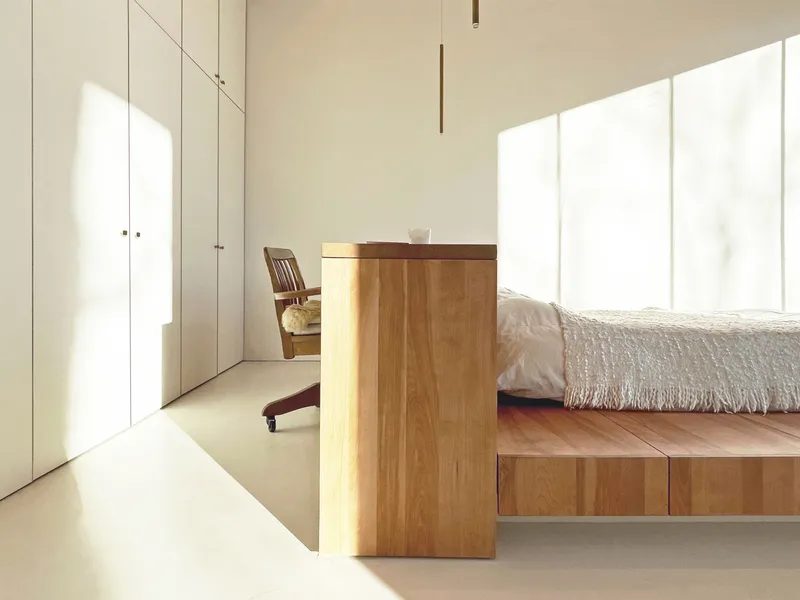
The bedrooms push the indoor-outdoor thesis to its most intimate extreme. One bedroom places a timber platform bed directly in front of a full-height window wall overlooking autumn woodland, with no curtain track visible. Another combines the bed with floor-to-ceiling white storage cabinetry, using natural light as the only decoration. The message is consistent: simplicity highlights wood and landscape as the main design components, and anything that competes with those two elements has been removed.
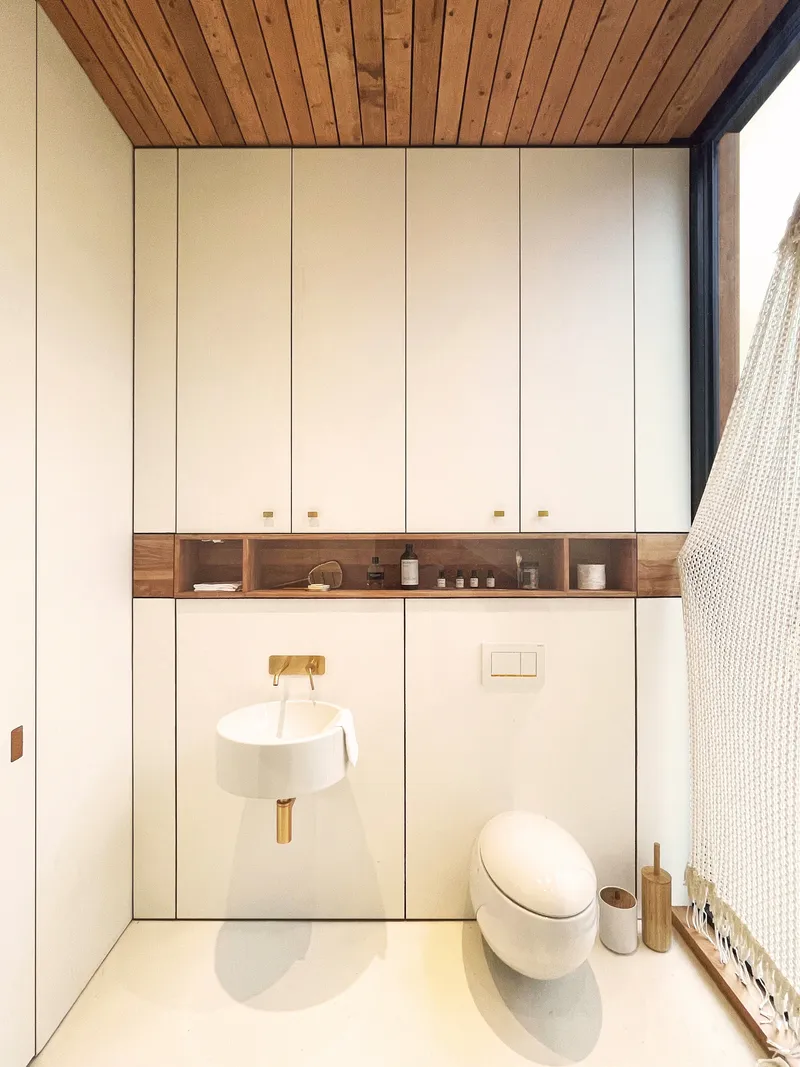
The freestanding bathtub placed beneath the timber ceiling with full-height glazing to the forest is perhaps the project's signature image. It collapses bathing, viewing, and resting into a single act performed at canopy level. A built-in desk nearby suggests this is also a workspace, which makes the room a kind of total environment rather than a single-function bedroom. The compact bathroom elsewhere proves that the same material discipline can scale down: white fixtures, timber ceiling, recessed shelving, nothing extraneous.
Living Between the Terraces


The two terraces are critical to the plan. Set in alcoves at the front and back of the house, they function as decompression chambers between the heated interior and the wild mountainside. A lounge chair and side table face a forest clearing in one; a sliding glass door opens directly from the bedroom to a timber deck in the other. The terraces are not afterthoughts or leftover space. They are rooms without walls, carefully proportioned and shaded by the building's own overhangs.
The sliding door threshold between deck and bedroom shows how cleanly the floor plane extends outward: the timber deck sits flush with the interior, and the glazing panel, when open, eliminates the wall entirely. It's a detail that requires precision in construction and a willingness to live with thermal bridging risk in a climate where winter temperatures regularly drop well below freezing. That the architect chose to live here himself lends credibility to the claim that the passive strategies, sun control, natural ventilation, and the radiator-like form, actually work.
Plans and Drawings
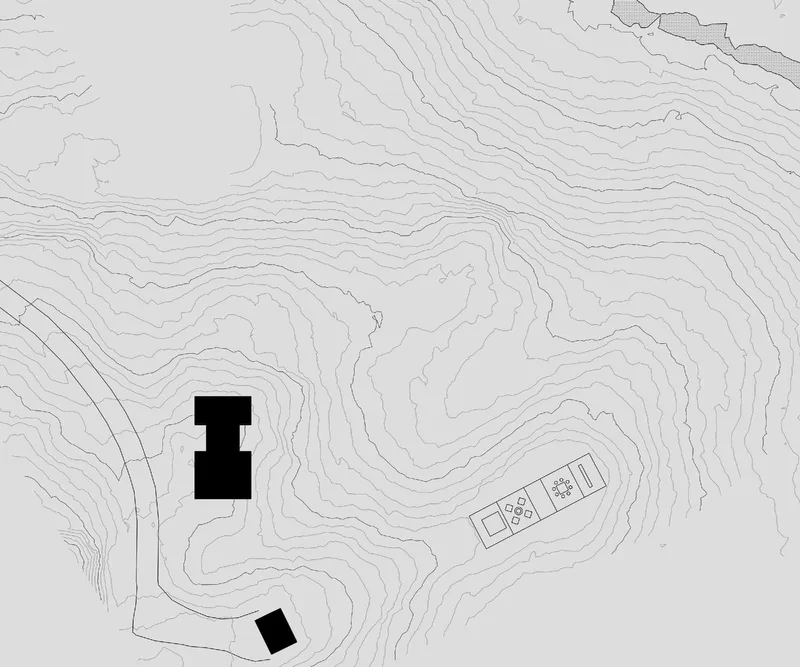

The site plan reveals the building's careful placement within the topographic contours of the slope, confirming that the massing responds to the terrain rather than flattening it. The footprint is compact, with the two volumes separated by the courtyard visible in the photographs. The floor plan makes the organizational logic legible: two terraces flank a central salon and dining area, with bedrooms and service spaces pushed to the periphery. Storage islands define circulation routes without blocking sightlines to the glazed perimeter. At 195 square meters, the house is modestly sized, but the plan's openness and the generous fenestration make it feel substantially larger.
Why This Project Matters
La Cadrée Perchée is a useful counterpoint to the tendency in contemporary residential design to treat natural settings as luxury backdrops. The house doesn't just sit in a forest; it absorbs and reflects the forest's light, color, and texture through its material choices, its radiator-derived form, and its relentless commitment to transparency. The decision to clad the exterior in fence boards and finish the floors in bleached concrete demonstrates that artisanal, economical solutions can produce architecture as spatially rich as anything built with a larger budget.
The project also raises a question worth considering: does architecture benefit when the architect is also the inhabitant? Lepage lived on this property before the house was completed, and the intimacy of the design, the sunken sofa calibrated to treetop views, the bathtub positioned for maximum canopy immersion, suggests a level of site knowledge that a conventional client-architect relationship rarely achieves. The risk is narcissism; the reward is precision. In this case, the reward won.
La Cadrée Perchée House by L'Empreinte Design Architecture, Morin-Heights, Canada. 195 m² (2,100 sq ft). Completed 2022. Photography by Pier-Olivier Lepage.
About the Studio
Share Your Own Work on uni.xyz
If projects like this are the kind of work you want to make, uni.xyz is a place to publish your own, find collaborators, and enter design competitions.


Popular Articles
Popular articles from the community


David Ortega Stacks a Two-Story Mexico City Penthouse Around a Steel Stair and a Pergola-Shaded Roof Terrace
In Colonia Roma, a 300 m² penthouse uses oak joinery, a planted steel stair and a slatted roof pergola to make a new-build apartment feel like a house.

Architekt Andreas Gruber Scatters 23 Dark Timber Chalets Across a South Tyrolean Forest Edge
In Molini di Tures, Amonti Chalets breaks a resort into a hamlet of gabled timber houses, with parking, storage and services pushed into the slope.

longwave studio Reorganizes a 112 m² Tainan Apartment Around the Daily Routines of a Family and Two Cats
In Tainan, Taiwan, birch plywood, rust-red furniture and a freestanding plaster wall link arrival, storage, work and family life in one apartment.

David Macias Steps a Doorless Stone and Plaster House Down a Tropical Colombian Hillside
In the humid hills of Colombia, Threshold House replaces the front door with an open void and terraces its 850 m² down the slope instead of fighting it.

Similar Reads
You might also enjoy these articles


LAVA Architecten Gives Vocational Education a Sawtooth-Roofed Face on a Mechelen School Campus
In Mechelen, Belgium, a 2,053 m² STEM school on a 6×6 m grid turns workshops and classrooms into rooms that can be rearranged as teaching changes.

KEMA Studio Turns a Derelict Marvila Attic into a 60 m² Lighthouse Apartment Above Lisbon
In Lisbon's Marvila district, a rebuilt roof, four skylights and two plywood volumes turn an unlivable attic into a bright home facing the Tagus.

Pixel Gardens: One Repeated Module Stacked Into a Terraced Social Housing Tower for Famagusta
Salem Bader's shortlisted housing tower builds a vertical neighbourhood from one repeated module, offsetting units to carve terraces, light and air.

Bao Huynh Watercolor Atelier: A Serene Art Retreat in Hội An
Bao Huynh Watercolor Atelier in Hội An blends multifunctional art spaces, sustainable design, local materials, and family-friendly living in a serene environment.
Explore Residential Building Competitions
Discover active competitions in this discipline

Comments (0)
Please login or sign up to add comments
No comments yet. Be the first to comment!