
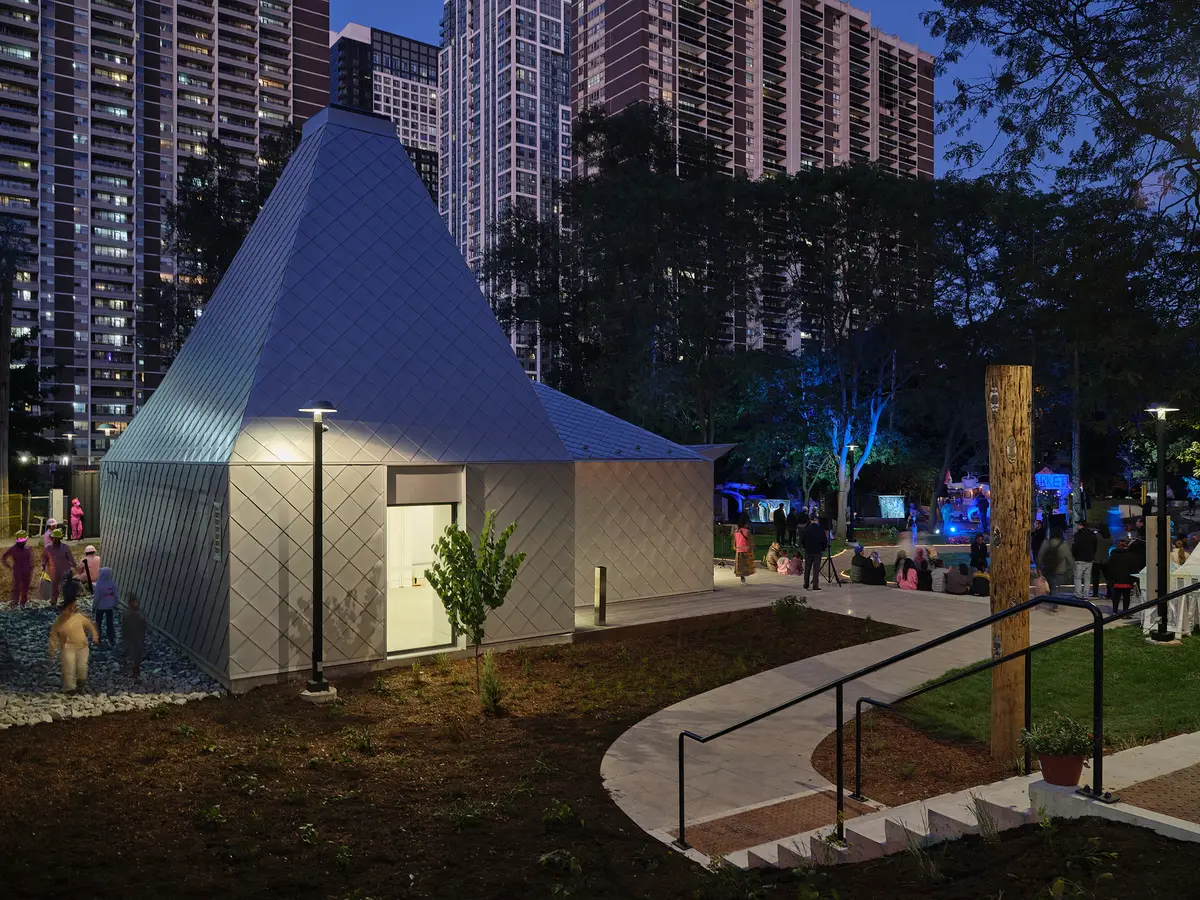
LGA Architectural Partners Builds a Tiny Pavilion That Serves 4,000 Residents in Toronto's Etobicoke District
A 120-square-metre community hub clad in diamond-shaped aluminum shingles becomes a beacon for a neighborhood long denied gathering space.


Sixteen years is a long time to wait for a building. For the roughly 4,000 residents living in seven residential towers around Mabelle Park in Toronto's Etobicoke district, many of them low-income newcomers to Canada, the wait produced something worth the patience: a 120-square-metre pavilion by LGA Architectural Partners that refuses to look or act like typical social infrastructure. Opened in the fall of 2025, the building is the culmination of a sustained urban renewal effort led by Mabelle Arts, a community organization that spent over a decade building trust, programming, and cultural identity in a neighborhood that had almost none of the amenities its density demanded.
What makes this project genuinely interesting is not its size but its posture. In a context where institutional buildings often arrive armored with bollards, security cameras, and bars on windows, LGA made the deliberate choice to design a structure that is open, reflective, and whimsical. The pavilion's twin peaked roofs, clad in semi-reflective diamond-shaped aluminum shingles, are visible from the balconies of the surrounding towers. That visibility is the point. The building announces itself as a shared asset, not a fortified one, and its flexible interior can shift from workspace to gallery to performance stage within the span of an afternoon.
A Skin That Resists Without Repelling
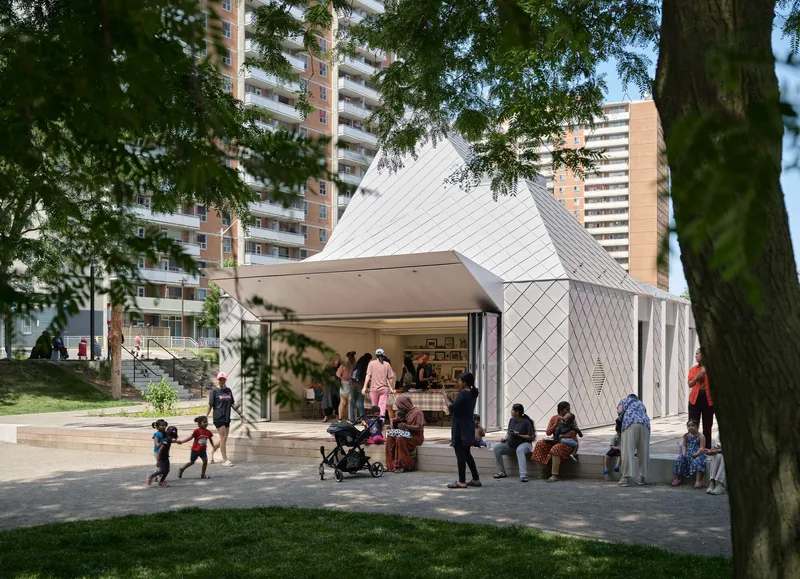

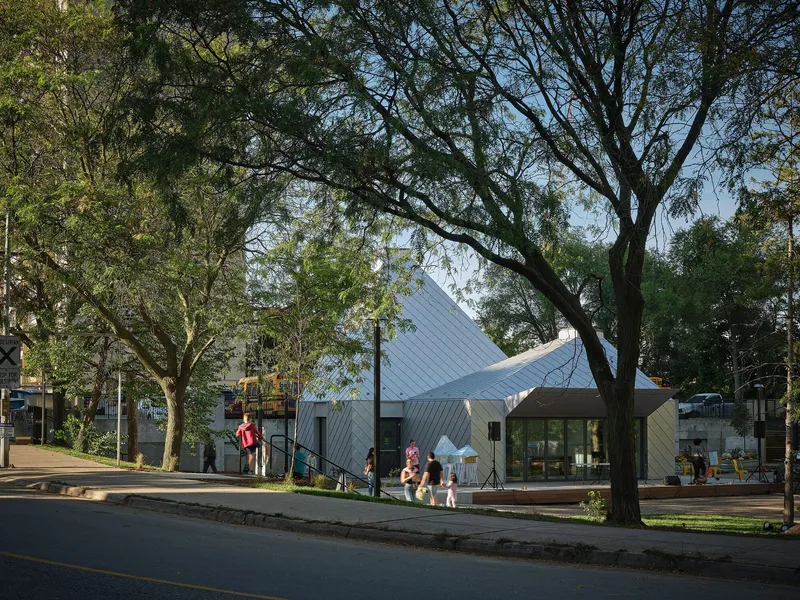
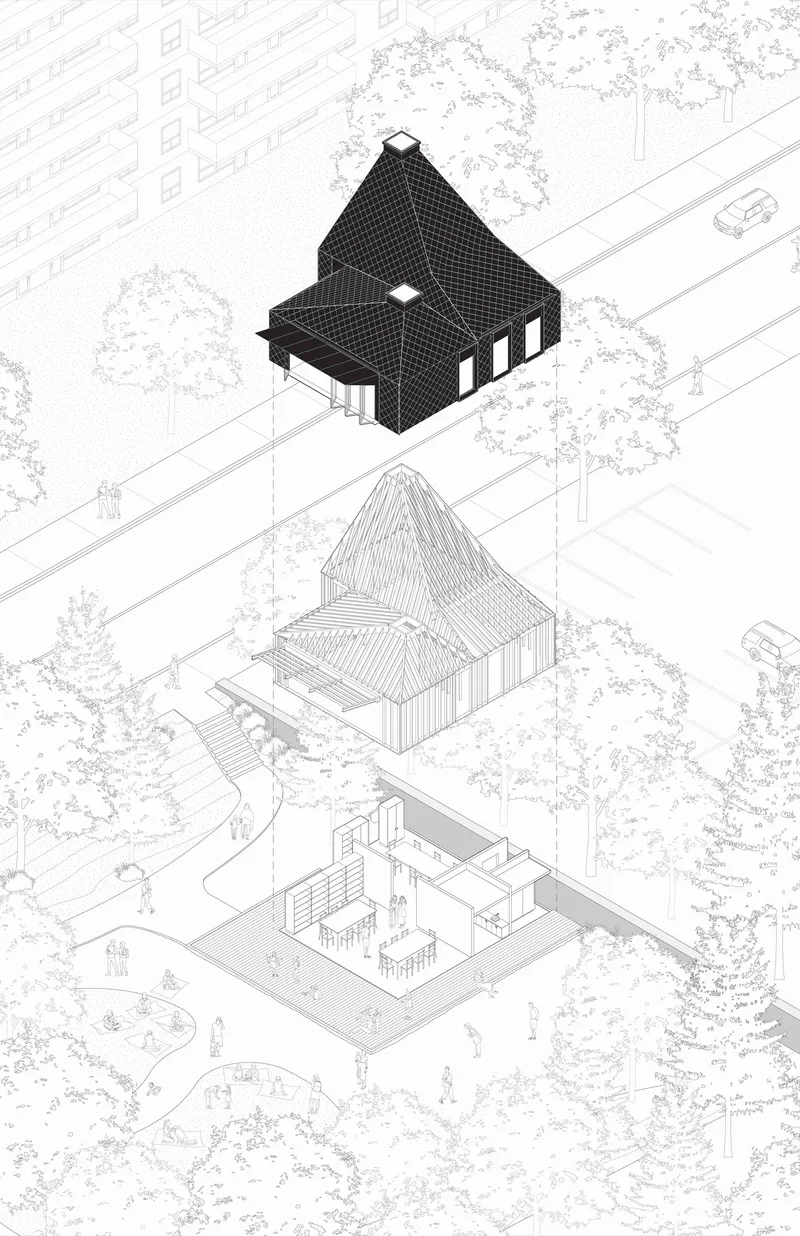
The aluminum shingles that wrap the pavilion are set at a 45-degree angle, creating a diamond pattern that catches light and reflects the surrounding foliage in shifting tones throughout the day. The material is practical: a graffiti-resistant coating protects the surface, and the shingles are tightly fitted to prevent tampering. But the effect is not defensive. The seamless installation, with no trim pieces on corners and the pattern folding continuously from plane to plane, gives the building the quality of a sculpted object rather than a guarded box.
This is the essential tension LGA resolved well. The building needed to survive hard use in a public park with limited oversight, but it also needed to welcome people who have been historically excluded from well-designed public space. The diamond shingles achieve both: they are vandal-resistant by engineering and inviting by appearance, a combination that too few civic projects manage.
Peaked Roofs as Community Beacon
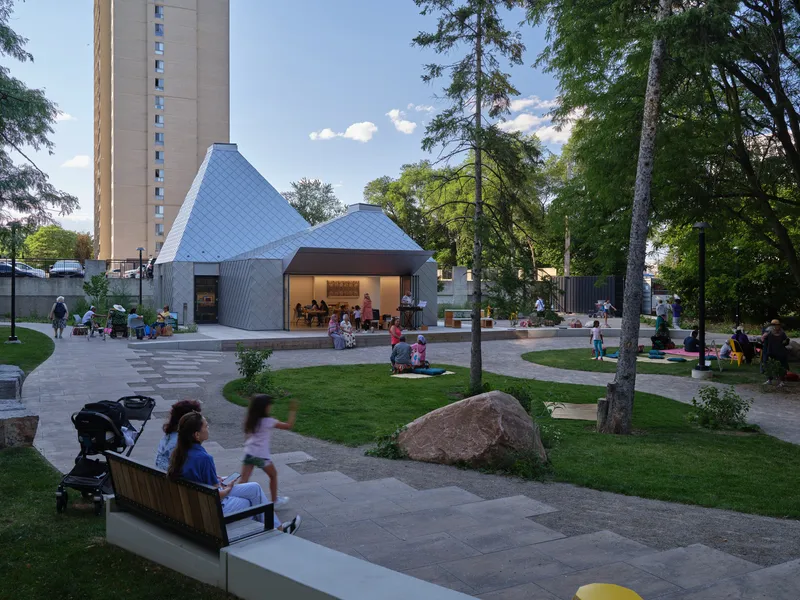
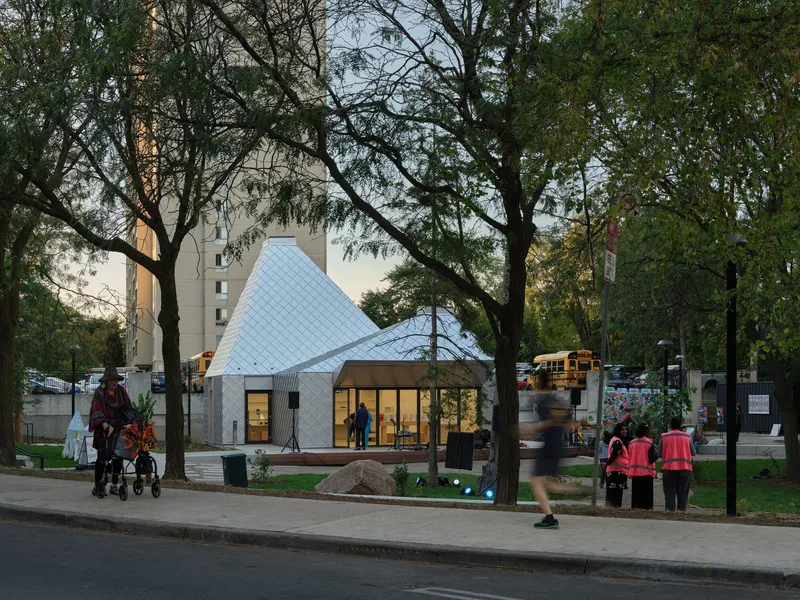

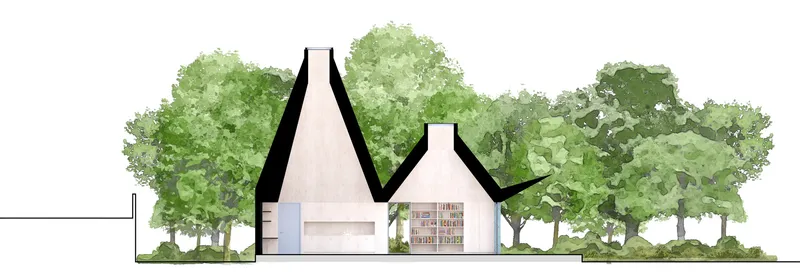
The pavilion's most recognizable gesture is its pair of dramatically tapered rooflines, rectangular volumes that funnel upward into pyramidal peaks. From the aerial view, they read as faceted gray forms nestled among the tree canopy and wooden decking. From the ground, particularly at dusk, they rise above the park like lanterns. The substructure beneath the shingles is fortified with increased blocking and strapping, a necessity given the steep geometry and exposure to wind.
The peaked forms serve a dual purpose. They are iconic enough to function as landmarks for residents looking down from upper-floor apartments, a visual confirmation that the park has something worth visiting. And they house operable skylights that draw light and air deep into the interior, making the small footprint feel generous and connected to the sky.
Maximum Flexibility in Minimum Space


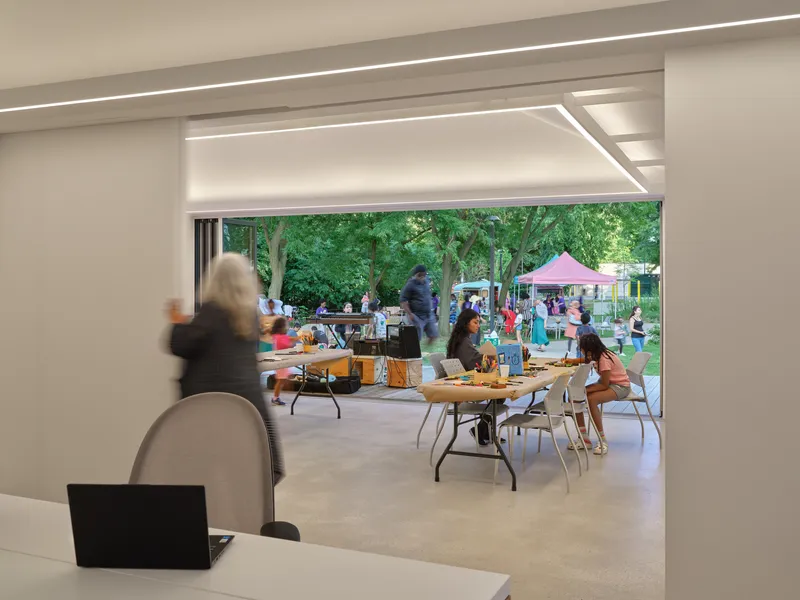
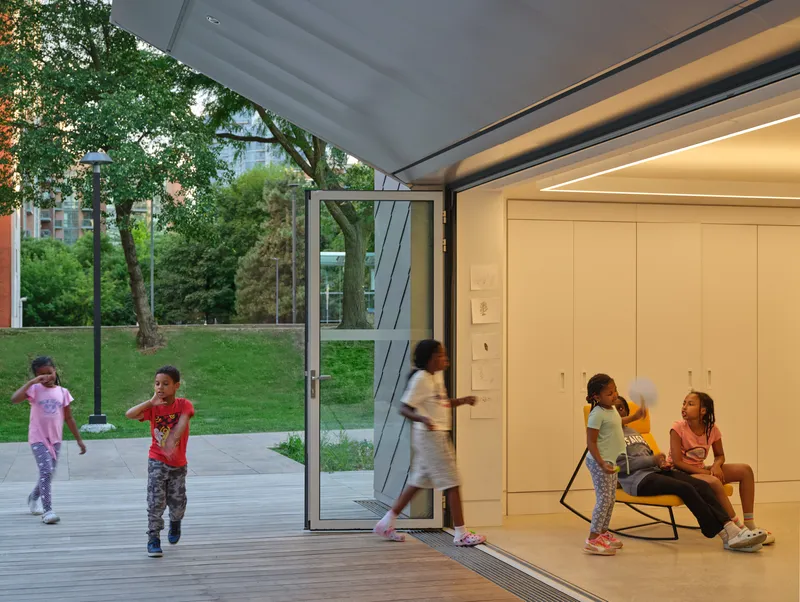
Inside, the 120 square metres are divided into two primary rooms connected by an open divider. The back-end office supports Mabelle Arts staff with workstations, a kitchenette, and a universal washroom. The front-end community space is deliberately unspecified. Folding glass doors dissolve the boundary between interior and a front-facing timber deck, which itself doubles as a porch and a performance stage. When fully opened, the building becomes an open-air pavilion; when closed, it is a sealed, climate-controlled room.
LGA's commitment to flexibility here is not just spatial rhetoric. The seven-year collaboration with Mabelle Arts included extensive community consultation, with the building footprint literally staked out using colored painter's tape and bamboo sticks so residents could walk through and react to proposed room sizes. The resulting plan hands maximum agency to users, letting them decide whether the space hosts a workshop, a dinner, a gallery show, or a neighborhood meeting.
Interior Light and the Vaulted Ceiling
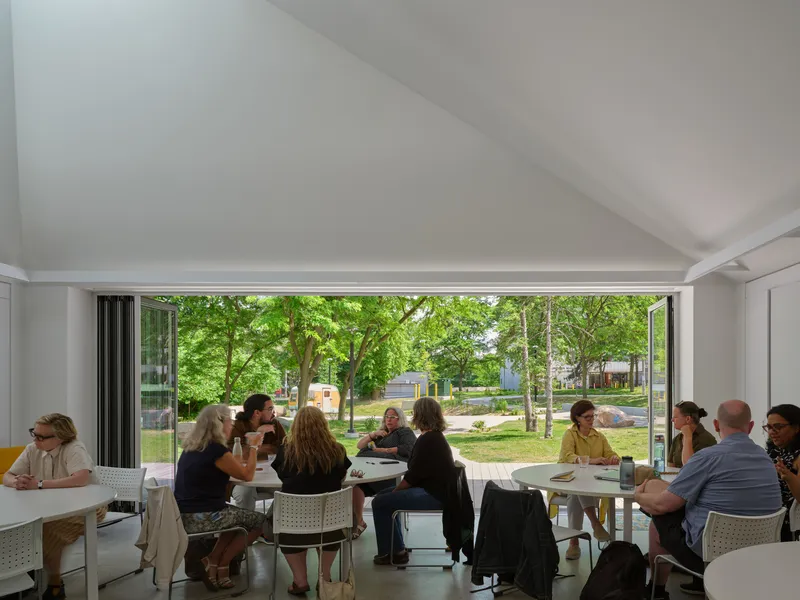
The sloped white ceilings inside amplify whatever daylight the skylights and glazed walls deliver. Recessed lighting coves trace the ceiling geometry, providing even illumination after dark without the harshness of exposed fixtures. The polished concrete floor grounds the space with a material that is durable, easy to clean, and visually calm against the brightness overhead.
There is a restraint to the interior palette that works in the building's favor. White walls, concrete floors, and large expanses of glass let the park itself become the decoration. Framed views of mature trees fill the windows, and when the doors are open, the sounds and smells of the garden flow through. The architecture steps back so the community and its landscape can step forward.
A Park That Plants Memory
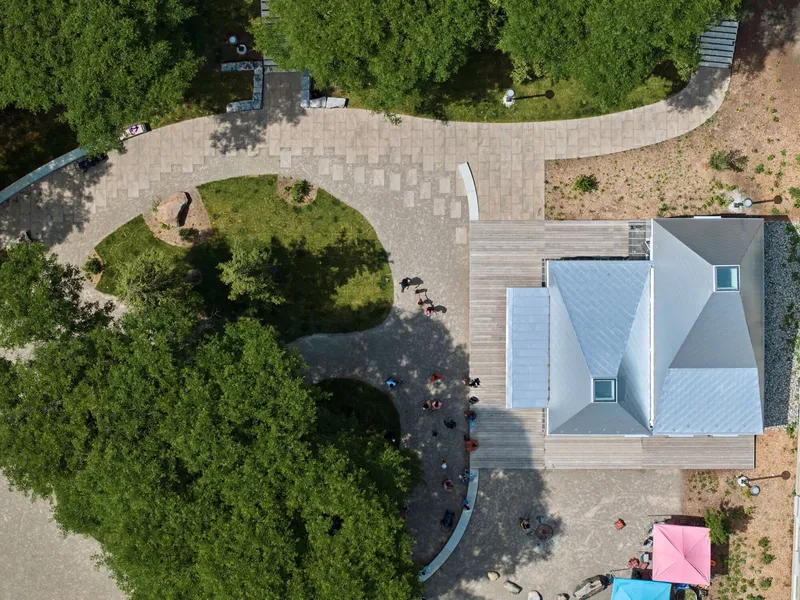


The half-acre park, designed by SHIFT Landscape Architects, transforms what was previously an eroded shortcut between a subway station and a school into a genuine public landscape. The planting strategy is quietly radical: gardens combine native species like sumac and sage with plants sourced from the home regions of local residents, many of whom are newcomers from across the globe. The result is a landscape that literally grows from the cultural memory of the people who use it.
Co-created public artworks are scattered throughout the park, and a covered water feature anchors the site alongside the pavilion. On warm evenings, the lawn steps facing the building fill with families, and the pavilion's illuminated facade turns the park into an informal amphitheater. The crowd gathered in the afternoon light around the gray metal-clad volumes feels less like a programmed event and more like a neighborhood living room that happens to be outdoors.
Co-Design as Real Process, Not Performance
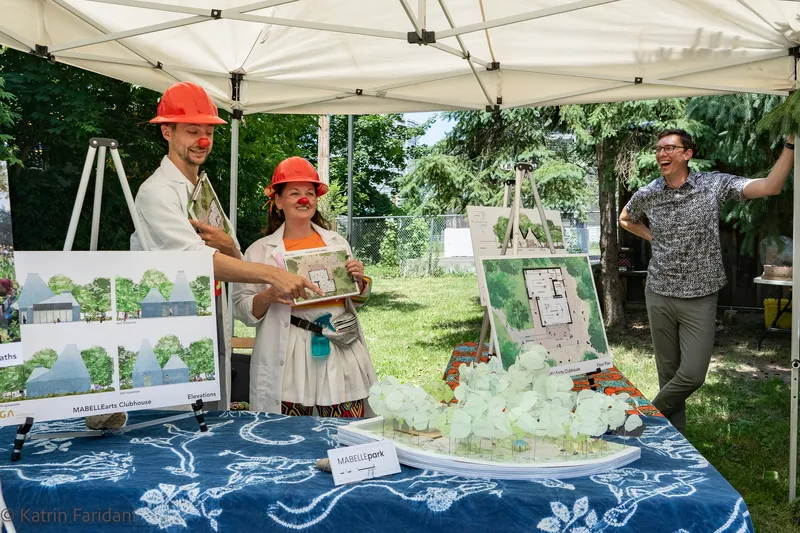


Community engagement is easy to claim and hard to do well. The images from Mabelle Park's design process show what genuine co-design looks like: site models and renderings reviewed under tents, colorful paper models with pyramidal roofs built by participants, and groups of residents holding architectural drawings outdoors. These are not polished renderings presented for rubber-stamp approval. They are working sessions where the building's form was debated, revised, and collectively shaped over years.
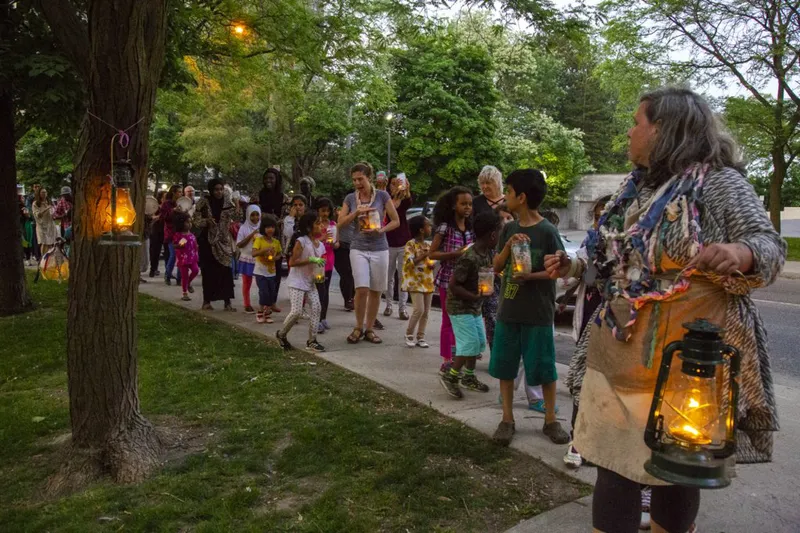
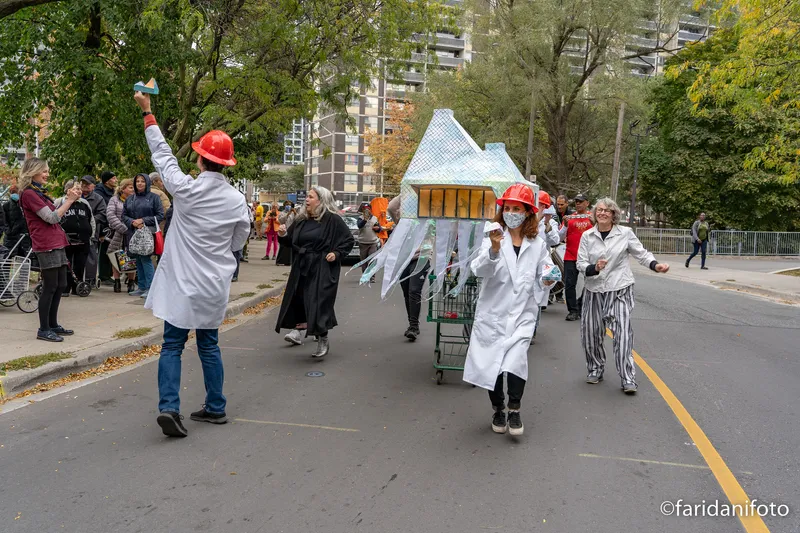
The cultural life of the neighborhood was already active long before the pavilion arrived. Evening lantern processions and street parades with costumed participants wheeling paper architectural models through autumn leaves speak to a community that had been making art in public space for years. The building is not the origin of that energy; it is its infrastructure.
Dusk and the Building's Second Life


The pavilion transforms at twilight. The diamond-patterned aluminum, which reads as a muted silver in daylight, begins to glow as interior lighting spills through the glazed openings. The residential towers in the background, usually the dominant forms in this landscape, recede as the small building commands attention through warmth and transparency. It is a useful inversion: the pavilion, at less than 1,300 square feet, temporarily outweighs seven towers.
Children playing on boulders near the side facade, families gathering on the deep overhang, pedestrians drifting through the park: the building's threshold condition, neither fully inside nor outside, is its most successful spatial idea. The cantilevered canopy shelters without enclosing, and the folding glass doors erase the line between program and landscape. At dusk, with the doors open and the skylights lit from within, the building is simultaneously a room and a clearing.
Plans and Drawings

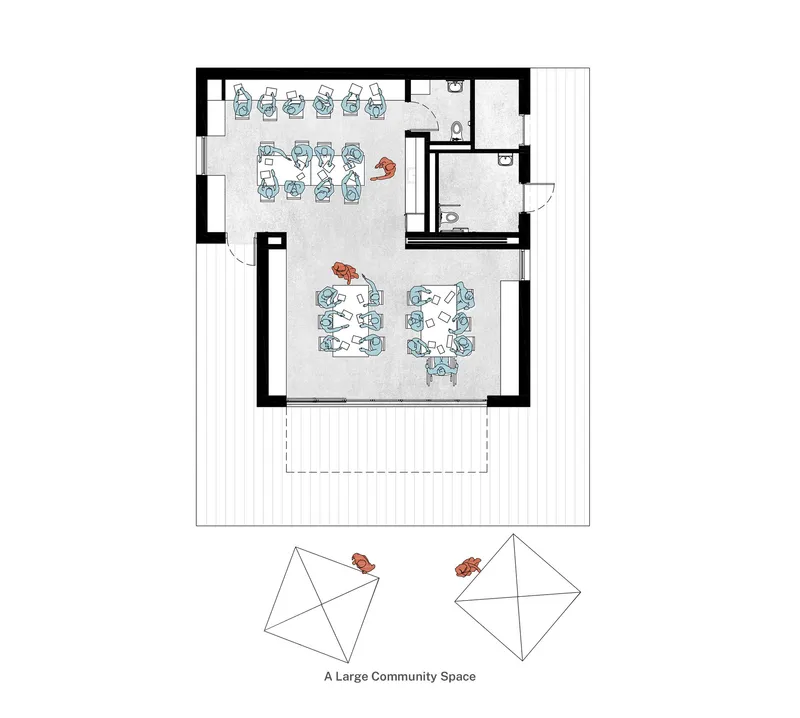


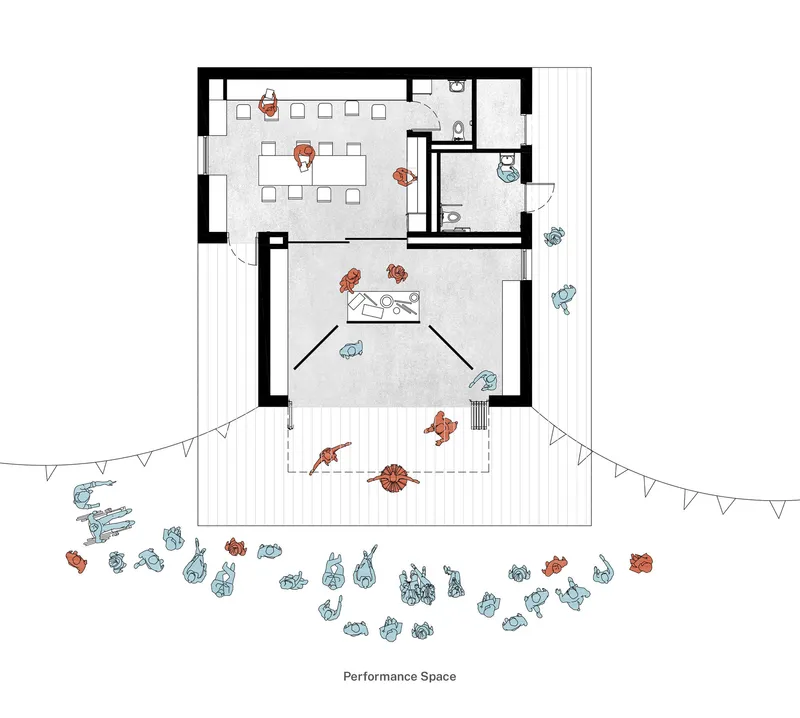

The drawings reveal LGA's approach to the pavilion as a series of scenarios rather than a fixed plan. Each floor plan variation shows the same two-room footprint populated differently: classroom seating with tables and chairs, gallery spaces with scattered figures and outdoor bunting, dining and workshop configurations, a conference room paired with a performance space. The message is clear. The building was designed not for one use but for all the uses its community might invent.
The watercolor site plan situates the small structure among curving pathways and seasonal trees, emphasizing the park as the true project and the pavilion as its anchor point. Elevation drawings show the pitched roofs nestled among mature foliage, nearly absorbed by the canopy. The exploded axonometric breaks the building into its constituent layers: gridded roof structure, vertical siding, and landscape, making legible the simplicity of the construction system that supports such a distinctive form.
Why This Project Matters
Mabelle Park matters because it demonstrates that design quality and social equity are not competing priorities. A 120-square-metre building serving 4,000 residents in a low-income neighborhood received the same level of material care, spatial intelligence, and formal ambition that typically flows toward cultural institutions with fifty times the budget. The diamond aluminum cladding, the operable skylights, the seamless detailing: none of this was inevitable for a community pavilion on public housing land. LGA and Mabelle Arts insisted on it, and the result is a building that treats its users as deserving of architecture, not just shelter.
The project also offers a model for how architects can work with communities over extended timescales without losing design rigor. Seven years of collaboration did not produce a building designed by committee; it produced a building refined by listening. The peaked roofs are whimsical because the community is creative. The doors fold open because the community gathers outdoors. The plants reflect homelands because the community is global. Every design decision traces back to a conversation, and the architecture is stronger for it. In a city increasingly defined by the speed and uniformity of its development, Mabelle Park is a small, bright counterargument.
Mabelle Park, designed by LGA Architectural Partners with landscape design by SHIFT Landscape Architects. Located in Toronto, Canada. 120 square metres. Completed in 2025. Photography by doublespace photography and Katrin Faridani.
About the Studio
Share Your Own Work on uni.xyz
If projects like this are the kind of work you want to make, uni.xyz is a place to publish your own, find collaborators, and enter design competitions.


Popular Articles
Popular articles from the community


Cube Design Draws an Ecological Corridor Between Two Shenzhen Hills with the Nankai Building
Beside Shenzhen's container docks, the Nankai Building pairs stacked balconies with a climbing green screen to connect two hillsides across its height.

ETEH Reworks the Shared Spaces of São Domingos School in Brazil Around Timber, Color and Hanging Plants
At São Domingos School in Brazil, 436 m² of hall, refectory and library are recast with timber joinery, a yellow and blue code and trailing greenery.

Manzana Morphosis: Stretching Barcelona's Grid into a Living Landscape for 2050
A radical reworking of the Eixample manzana turns density into a tool for generous public space, vertical ecology, and environmental performance.

FCC Arquitectura Expands a Portuguese Granite House with a Board-Marked Concrete Wing
In Portugal, JV House pairs a cleaned-up whitewashed and granite dwelling with a timber-shuttered concrete extension, courtyards and a garden pool.

Similar Reads
You might also enjoy these articles

LAVA Architecten Gives Vocational Education a Sawtooth-Roofed Face on a Mechelen School Campus
In Mechelen, Belgium, a 2,053 m² STEM school on a 6×6 m grid turns workshops and classrooms into rooms that can be rearranged as teaching changes.

KEMA Studio Turns a Derelict Marvila Attic into a 60 m² Lighthouse Apartment Above Lisbon
In Lisbon's Marvila district, a rebuilt roof, four skylights and two plywood volumes turn an unlivable attic into a bright home facing the Tagus.

Pixel Gardens: One Repeated Module Stacked Into a Terraced Social Housing Tower for Famagusta
Salem Bader's shortlisted housing tower builds a vertical neighbourhood from one repeated module, offsetting units to carve terraces, light and air.

Bao Huynh Watercolor Atelier: A Serene Art Retreat in Hội An
Bao Huynh Watercolor Atelier in Hội An blends multifunctional art spaces, sustainable design, local materials, and family-friendly living in a serene environment.

Explore Public Park Competitions
Discover active competitions in this discipline

Challenge to design a portable theatre

Challenge to design a portable music platform

Challenge to design an open learning module for the elderly
Comments (0)
Please login or sign up to add comments
No comments yet. Be the first to comment!