
Liberty Utopian Network: Modular Spheres That Rethink the Vertical City
A speculative vertical urbanism built from interconnected spherical hubs that grow, adapt, and resist the rigidity of conventional towers.


What happens when the skyscraper stops being a fixed object and starts behaving like a living organism? The Liberty Utopian Network, or LUN, proposes exactly that: a vertical city composed of spherical modular hubs that connect, disconnect, and reconfigure according to the needs of their inhabitants. Rather than stacking floors in a sealed extrusion, the project assembles clusters of programmable environments along a tri-core vertical spine, creating a cityscape that can organically expand in three dimensions. It is speculative architecture with a sharp thesis: in a future increasingly governed by centralized AI, the built environment must actively protect personal autonomy and spatial freedom.
Designed by Alessandro Cece, Dina Muneer Nemer Alhasan, and Alaa Moustapha El-Khatib, this concept received the Institutional Excellence Award at Hybrid Futures '19 - Work x Fly. The competition asked participants to reimagine hybrid architectures for working and living in an age of automation. LUN responds not with efficiency optimization but with a radical rethinking of what urban structure could look like when decentralization, adaptability, and human well-being drive every design decision.
Tri-Core Spines and Water Elevators
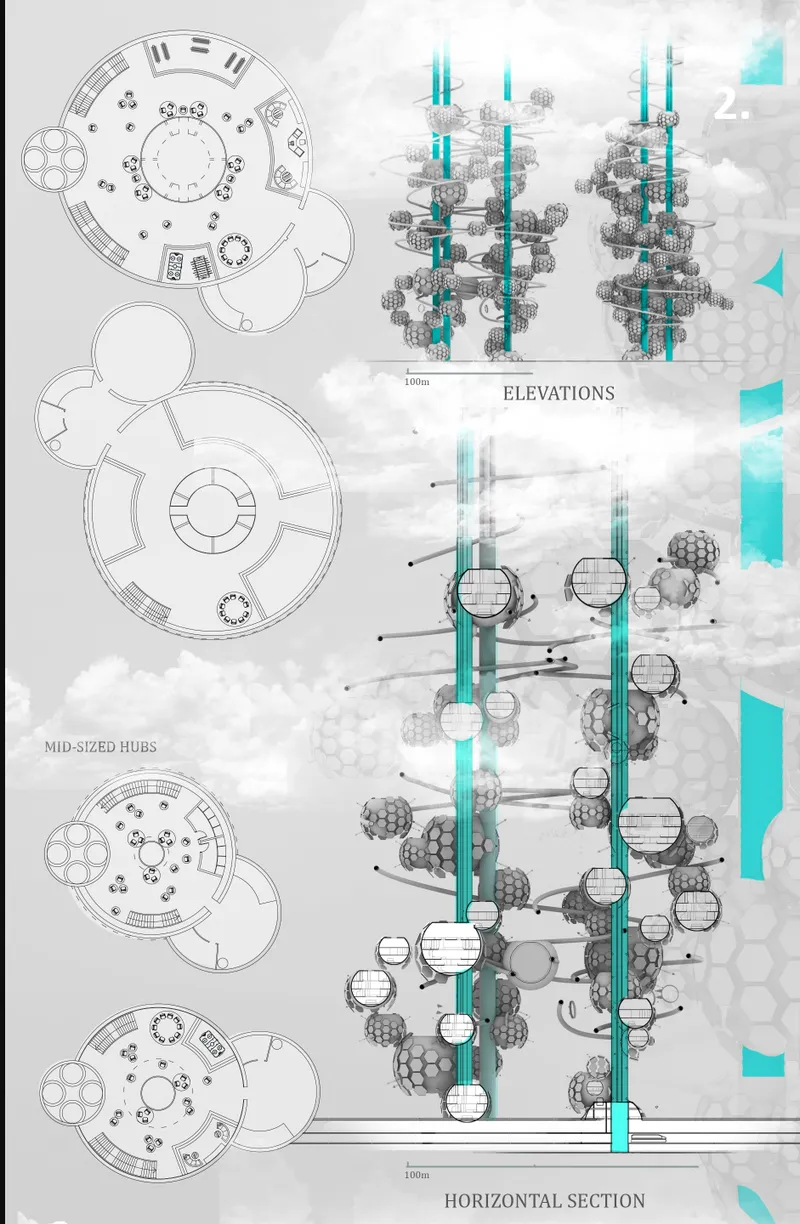
The floor plans and elevation drawings reveal the structural logic holding LUN together. Three vertical circulation spines form the backbone of the tower, supporting both movement and infrastructure distribution. What sets these apart is the use of water-based elevators, conceived not merely as transport mechanisms but as calming, sensory-rich environments that introduce the presence of water and natural light into daily vertical transit. The elevators double as spatial decompression chambers, a deliberate counterpoint to the sterile efficiency of conventional high-rise circulation.
This tri-core arrangement allows the spherical hubs to plug in at multiple elevations and orientations, avoiding the rigid floor-plate repetition of standard skyscrapers. The result is a building section that reads less like a tower and more like a branching network, where each node retains structural independence through a self-supporting metal truss system while benefiting from shared infrastructure.
Inside the Spheres: Fluid Programs Without Vertical Silos
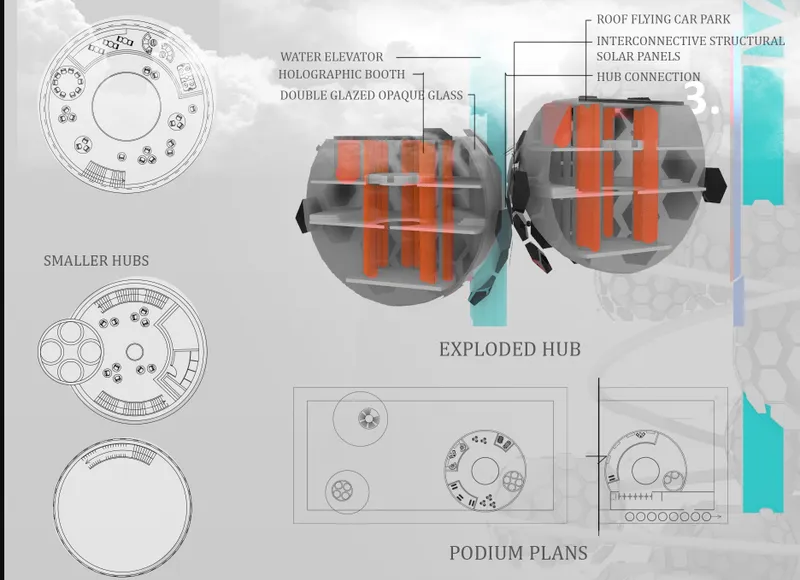
The exploded axonometric peels apart one of LUN's spherical modules to expose its interior organization. Orange partition walls subdivide the curved volume into distinct zones, while interconnecting bridges link adjacent hubs laterally. The drawing makes clear that these are not single-use capsules. Residential, commercial, cultural, and recreational programs coexist within the same continuous volume, dismantling the conventional approach of dedicating entire floors to a single function.
This free-flowing spatial planning supports what the designers describe as responsive living units: environments that can be scaled or reprogrammed for individuals, families, or communities as demographic and economic conditions shift. The architecture becomes a framework for negotiation rather than a fixed prescription. Indoor theme parks, immersive holographic environments, and vertical aquariums sit alongside workspaces and homes, embedding entertainment and discovery into everyday life rather than relegating them to separate destinations.
A Cluster That Grows in Three Dimensions
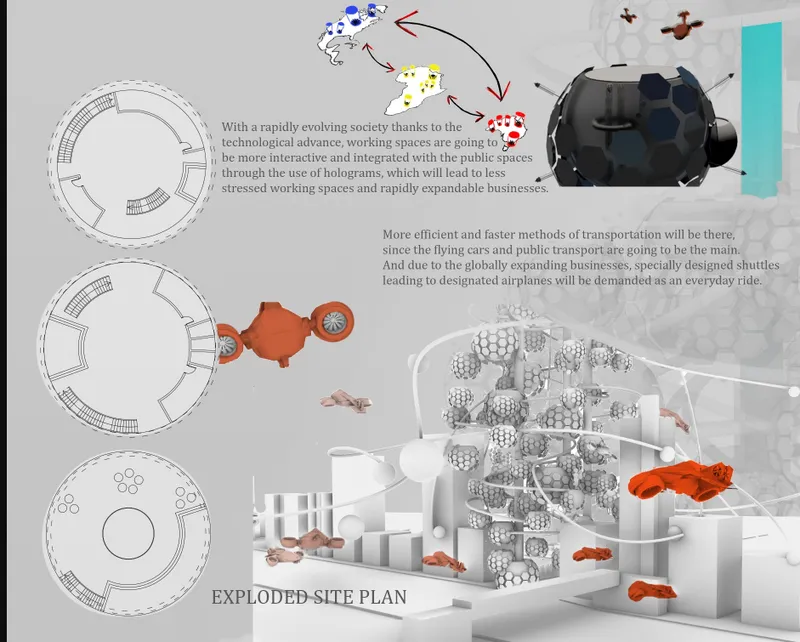
The conceptual site plan pulls back to show the full vertical cluster in context. Spherical modules aggregate along the spines, connected not only vertically but horizontally and diagonally through magnetic field technologies that enable three-dimensional linkages. Orange flying vehicles circulate along defined paths around the structure, suggesting an integrated mobility ecosystem where the boundary between building and city dissolves. The drawing captures the project's core ambition: urban geometries that refuse linear stacking in favor of adaptive, branching growth.
Each hub is clad in solar-paneled enclosures, ensuring operational energy independence even as modules participate in the broader network. This distributed energy model is a direct response to the risks of AI-managed centralized infrastructure. If one node fails or is removed, the rest continue functioning. The city, in LUN's vision, is not a monolith but a resilient constellation.
Hexagonal Skins and Tubular Connections
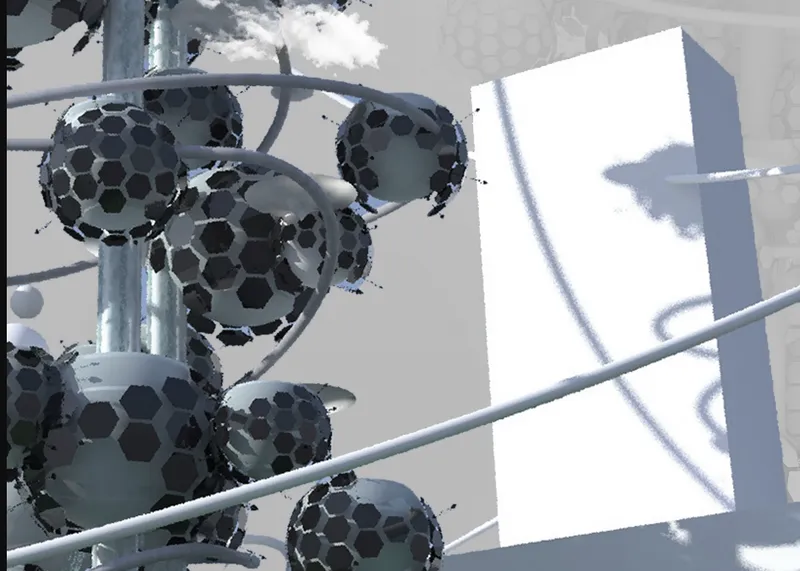
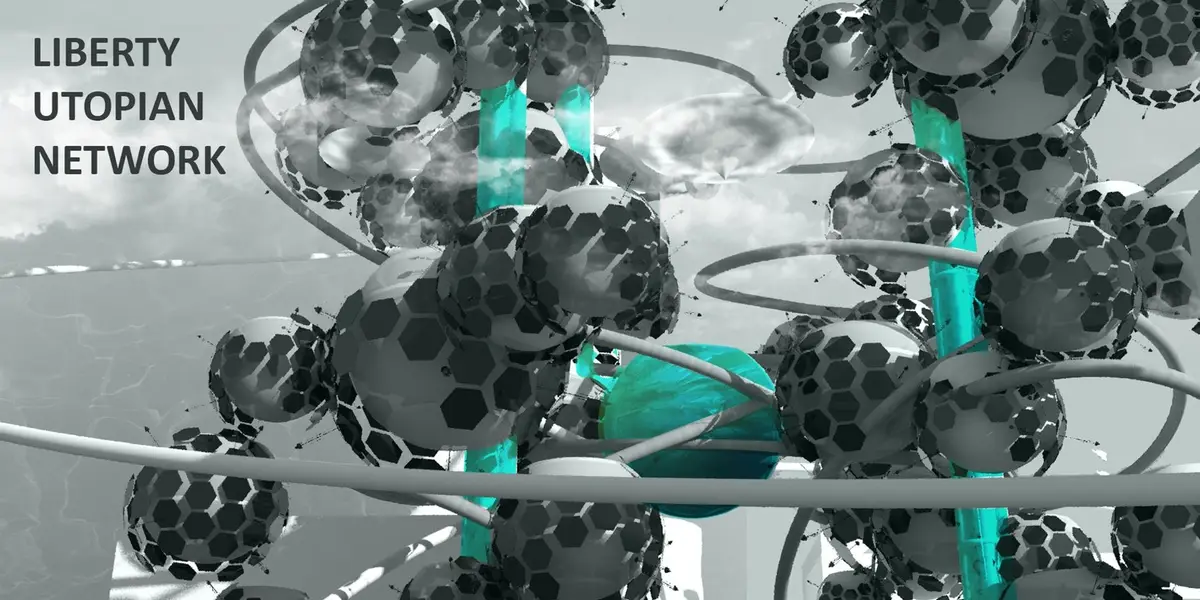
The close-up view reveals the material resolution of the spherical modules: hexagonal panels wrap each hub, creating a tessellated skin that accommodates curvature while providing structural rigidity and solar energy capture. Tubular bridges connect the spheres, casting precise shadows on adjacent surfaces that hint at the complex interplay of light and geometry the cluster would produce throughout the day. The image demonstrates that LUN is not just a diagrammatic concept; it proposes a tactile architectural language with real implications for fabrication and assembly.
The hexagonal cladding system serves a dual purpose. It acts as the energy-generating envelope, housing solar panels within its modular grid, and it provides the visual identity for the hubs, distinguishing them from the connective tissue of bridges and spines. The result is a legible hierarchy of parts: self-contained spheres, linking tubes, and vertical cores, each performing a distinct role in the larger urban organism.
Why This Project Matters
LUN operates at the intersection of architectural speculation and political argument. By framing decentralization not as an engineering convenience but as a spatial right, the project challenges the assumption that efficiency and centralized control should be the primary drivers of future city design. The modular, self-supporting hubs are architectural embodiments of autonomy: each one can function independently, yet all gain strength from connection. That duality, between independence and interdependence, gives the project a philosophical weight that elevates it beyond formal experimentation.
As an Institutional Excellence Award winner at Hybrid Futures '19, LUN stands as a provocation worth taking seriously. It asks a question that the profession too rarely confronts: if AI and automation reshape how we work, play, and govern, should architecture merely accommodate those changes, or should it actively resist the concentration of power they enable? The answer here is a vertical cluster of spheres that breathe, shift, and expand, refusing to be anything as simple as a building.
View the Full Project
About the Designers
Designers: Alessandro Cece, Dina Muneer Nemer Alhasan, Alaa Moustapha El-Khatib
Enter a Design Competition on uni.xyz
uni.xyz runs architecture and design competitions year-round that reward proposals with spatial conviction and real site intelligence.
Project credits: Liberty Utopian Network (LUN) by Alessandro Cece, Dina Muneer Nemer Alhasan, Alaa Moustapha El-Khatib Hybrid Futures '19 - Work x Fly (uni.xyz).


Popular Articles
Popular articles from the community


Singing Woman: An Opera House That Performs Before the Curtain Rises
Ovidiu Cristian Pavel's conceptual opera house translates Estonia's choral identity into a sculpted waterfront landmark facing the Baltic Sea.
Manzana Morphosis: Stretching Barcelona's Grid into a Living Landscape for 2050
A radical reworking of the Eixample manzana turns density into a tool for generous public space, vertical ecology, and environmental performance.
Cloaked Colonization: A Mobile Underwater Habitat That Moves Like a Fish
Micah Abaya's shortlisted EHC Pacific entry reimagines ocean settlement as a dispersed network of self-sustaining architectural organisms.

Opera on the Sea: Driftwood Logic Shapes a Timber Opera House on Estonia's Coast
Trevor Orgill's opera house translates the entangled drift of floating timber into a civic building where wood, water, and music converge.

Similar Reads
You might also enjoy these articles

Pixel Gardens: One Repeated Module Stacked Into a Terraced Social Housing Tower for Famagusta
Salem Bader's shortlisted housing tower builds a vertical neighbourhood from one repeated module, offsetting units to carve terraces, light and air.

Bao Huynh Watercolor Atelier: A Serene Art Retreat in Hội An
Bao Huynh Watercolor Atelier in Hội An blends multifunctional art spaces, sustainable design, local materials, and family-friendly living in a serene environment.

Atelier Macri Concept Store Interior Design by CASE-REAL
Atelier Macri store features a "ko" counter, walnut wood details, cork displays, blending retail, gallery, and seamless customer experiences.

Manuel Vargas Izquierdo Stadium and High-Performance Sports Center: Architectural Excellence in Jalpa de Méndez
The Manuel Vargas Izquierdo Stadium blends sustainable design, inclusive sports facilities, and cultural-inspired architecture, revitalizing Jalpa de Méndez’s public spaces.


Comments (0)
Please login or sign up to add comments
No comments yet. Be the first to comment!