

LIFTED GROUND: BETWEEN THE SUBLIME AND DOMESTIC
Farm, winery, and home for family of six

At the homestead, the realms of nature, production, and domestic meet under one roof. The boundaries are blurred between a wild “sublime” nature, worked agricultural land, and the domestic sheltered interior. Simultaneously a farm, winery, and a home for a family of six, the homestead registers the passage of time through various cases of transformative processes–the overgrowth of unmanicured landscapes, the production and aging of wine, and the growth of the family. Inspired by themes of earth’s “temporal rhythms” from geologist Marcia Bjornerud’s book Timefulness, the project takes earth’s non-static processes of change as critical considerations for the site, expressing the earth’s inherent tendency toward a wildness and erasure of man’s controlled agricultural production.

Figure 1: Concept sketch depicting spectrum of land conditions in a homestead, from “natural” raw sublime state, to “engineered” worked land, to “controlled” domestic protected from its surrounding environment

Roof: preservation of land
A circle inscribed within the site boundary designates the ground to be preserved. The circle is lifted and tilted to serve as the roof of the homestead, keeping the agricultural grain of the existing site before cultivation. As time passes, the land separated from the ground is allowed to grow without artificial interference. Overgrowth of the unmanicured green roof produces a dreamy alternative future- an agricultural landscape is free of cultivation and is instead the home of plants and flowers already in the region. The roof’s overgrowth contrasts with the farm and winery from which its ground originated; on the farm below, the perceived pace of time is cyclical with the growth, harvesting, and dormancy of vines with the season.

Figure 2: Site aerial enlarged, showing center pivot irrigation circles in the distance, an early inspiration for a circle cut into the ground as a figural boundary for the project / image by Google Earth
Ground: two grains of order
The roof is supported jointly by farm production and storage space, as well as domestic living and bedrooms on the ground floor. While the typical farmstead keeps the main house for living separate from farm sheds and barns, this project explores a potential hybrid type of farmstead, where the two realms of domestic and farm production are situated adjacent to one another and share a singular roof.
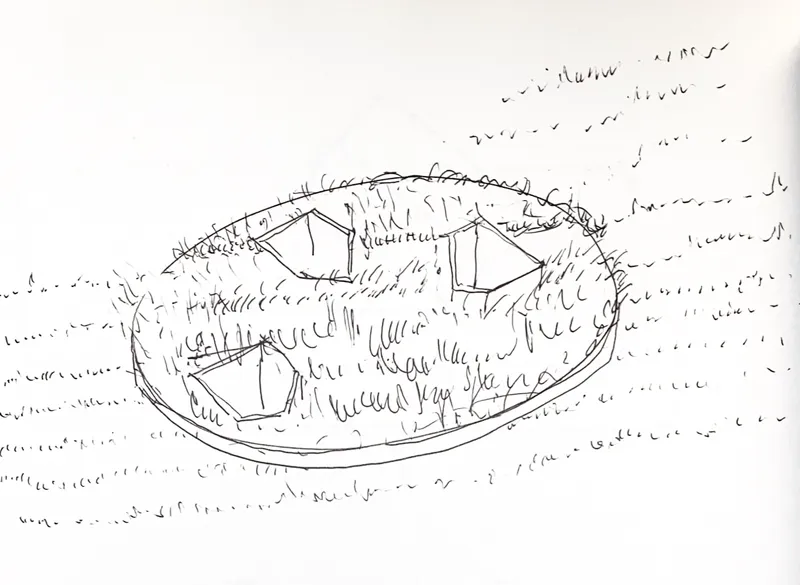
 Figures 3 & 4: Concept sketches depicting roof with overgrown vegetation above the site’s agricultural grain–still, the site grain is visible even with the roof’s growth. Volumes below support and protrude open to above.
In plan, the merging of the farm and domestic program is ordered by two grains–the grain of the existing site, and that of its opposite street neighbor. Here, grain refers to the repeated measure that determines the form of the architecture. Upon approaching this project, we were struck by the graphic potential of the lines in the landscape produced from the shadows of crop and towed earth. This served as our basis for the granularity of the architecture. The logic of the plan follows from a careful accommodation of these grains as they met below the circular roof.
Farm tools and equipment, as well as the space procured for the cultivation of wine follows the grain of its immediate site. Objects and spaces of domesticity follow the grain of the street. Together, the confluence of the two grains form a relationship with both the land of its agricultural production as well as the urban street network. The domestic programming is divided, with living and dining spaces as inscribed figures within farm production volumes at the heart of the plan, and bedrooms in their respective individualized locations.

Figure 5: Early concept sketch showing adjacent domestic and farm program in plan
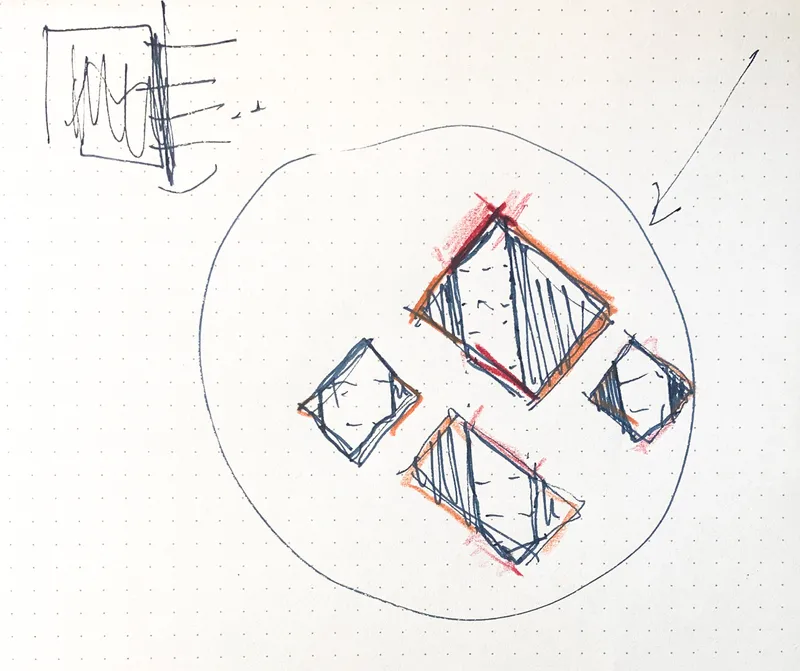
Figure 6: Early plan concept sketch showing the confluence of two grains within the circular boundary
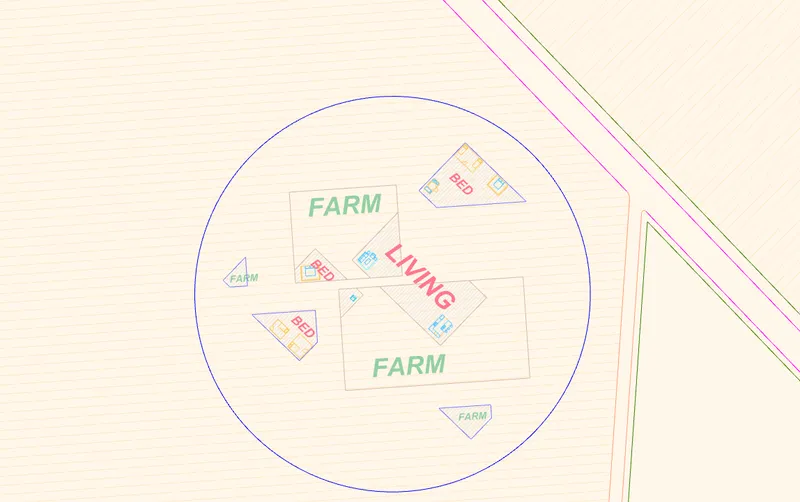
Figure 7: Plan development, showing the layered grains of domestic living and bed with the farm processing and storage space.
The circular figure also reappears at the scale of the bedroom, serving as a mechanism to pivot between two grains at adjacent corners. In the bedrooms, spiral stairs tangent to the walls pivot between the orientation of ground floor beds and upper floor beds.
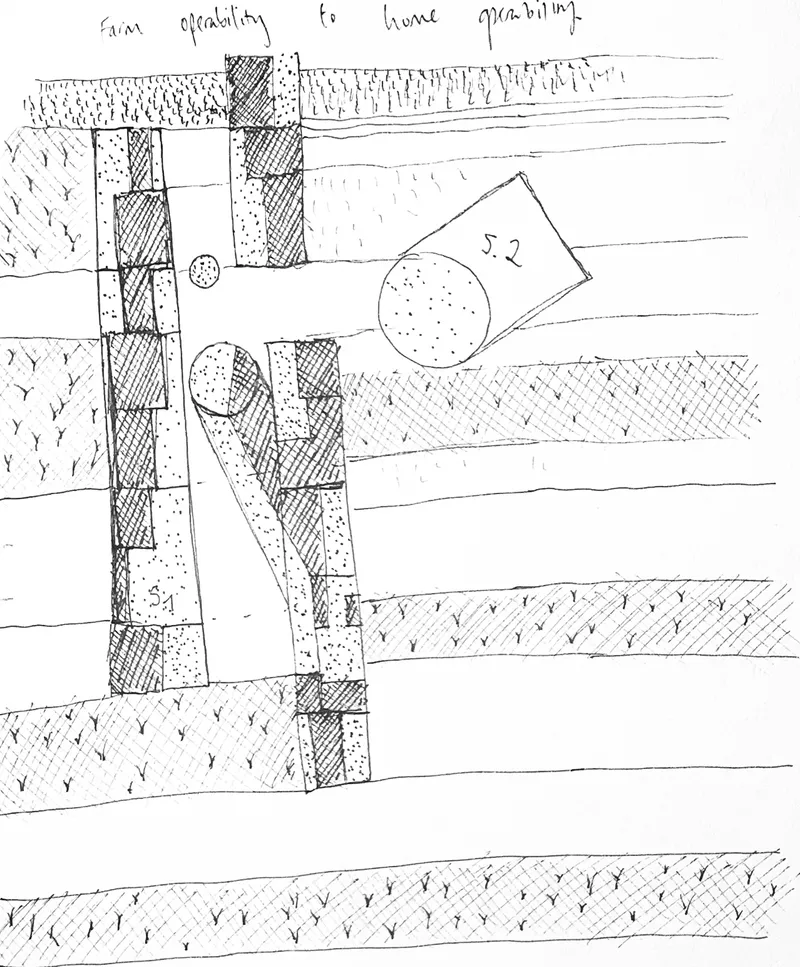
 Figures 8 & 9: Concept sketches depicting the confluence of site and street grain, and circular grain silos as devices for pivoting between the two grains.

Figure 10: Early plan iteration depicting a spiral stair embedded in a corner of a bedroom, shifting bed orientations between floors.
Walls: preservation of material and form
The roof lifting above the site was an effort to encompass the architecture in a geometric form that would simultaneously preserve the grain of the landscape and elevate its status as a moment of the Sublime natural landscape. In this sense, the architectural gesture becomes the mediator between agricultural measures of time and cultivation, and the Sublime wilderness that is immeasurable yet still tangible. As we approached the materiality of the project, we intended for the architecture to be assembled with an integer number of Cross Laminated Timber (CLT) panels that are standardized to measure 9’ x 50.’ Entire sheets of CLT panels are used to minimize waste, resulting in CLT pavilion-like volumes of different heights. The CLT volumes protrude through the circular roof to produce light-filled spaces with skylights open to above.
Space in plan used to cultivate the wine and grape plants are housed in thick rammed earth walls, formed with the earth of the existing site excavated during construction. Within these rammed earth inscribed rectangles lie domestic rectangular figures which are also formed of rammed earth. These rammed earth enclosures support the roof plane from below. Because the domestic and farm program follow two different grains, as detailed above, their confluence produces irregular polygonal geometries. These irregular geometries are repeated on the outside of the rammed earth masses and are transcribed as the CLT pavilions described above.
Since the CLT pavilions are unitized to a specific standard panel, the dimensions of the rammed earth are subject to the same length and dimension limitations as the CLT. Figures of the domestic are identical between rammed earth and CLT–each domestic space mimics the same form in different materials. Here, we find that the architecture is the result of scales of material and methods of construction.
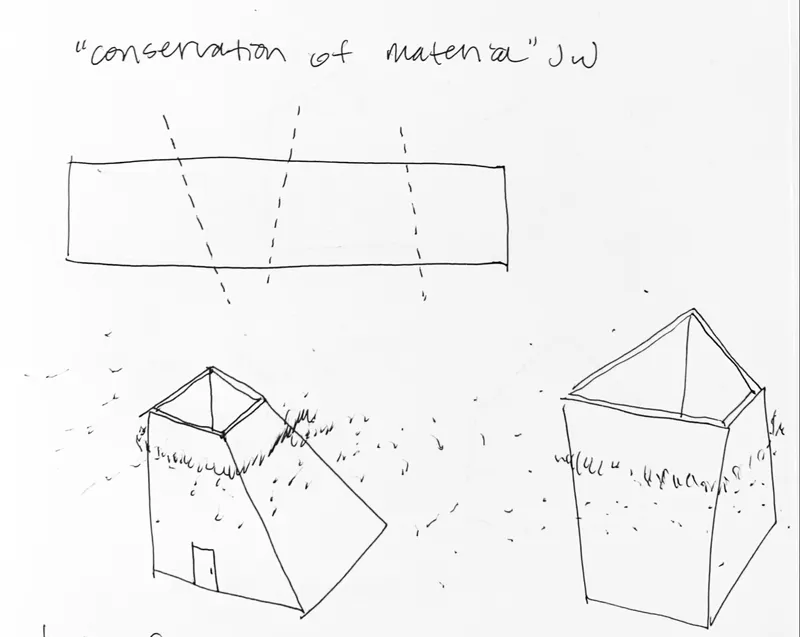
Figure 11: Early concept sketch depicting CLT panel cuts to form bedroom volumes that pierce through the roof plane.

Figure 12: Concept sketch showing a rammed earth wall with apertures into adjacent living and farm production space. CLT beams following the grain of the site create gaps in the roof to allow light into the interior.
Rammed earth and CLT meet at the corners of the CLT pavilions, where vertical CLT panels are joined together with horizontally laid layers of rammed earth which round off the corner on the interior.

Popular Articles
Popular articles from the community


Co-Life: Senior Housing Design That Reconnects Older Adults With the City
Co-Life reimagines senior housing design through healing gardens, shared streets, workshops, and a sustainable community across generations.

Play: Fragments of Their World
Familiar architecture becomes modular playground design, creating safe spaces where displaced children can learn, connect, imagine and play.

The Musturak Paradise: Senior Living Architecture for a Connected Future in Temara, Morocco
The Musturak Paradise reimagines senior living architecture in Temara via private homes, social spaces, culture, community, and shared care.

The Ocean Hive: Sustainable Architecture for a Self-Sufficient Civilization at Sea
The Ocean Hive imagines sustainable architecture at sea, where modular habitats, algae, wave power and ocean waste sustain a growing colony.

Similar Reads
You might also enjoy these articles

Day and Night Park: A Time-Based Urban Newsstand in Beijing
A temporary urban newsstand in Beijing blending travel, light, and reading through poetic colors, compact form, and community-focused design.

Modernist Patio Renovation in El Masnou, Barcelona by Oliver Segura Arquitectura + Cebrià Arquitectura
Modernist patio renovation blending tradition and innovation with a movable pool, leveled floors, and Catalan materials in El Masnou.

Alto Residencial Coop: Cooperative Housing Development in Santiago de Compostela by Carbajo Barrios Arquitectos
A linear cooperative housing complex blending white volumes and perforated metal façades, enhancing community living, natural light, privacy, and urban integration.
Vil Genis School by BPA ARCHITECTURE – Massy, France
Vil Genis School in Massy, France, features sustainable design, south-facing classrooms, community integration, accessible spaces, and modern educational architecture.

Explore Sustainable Farm Competitions
Discover active competitions in this discipline


Challenge to reimagine the Iron Throne

Photograph architecture without architects

Illustrate the lost glory of Angkor Wat - Render Challenge

Design challenge to reuse E-waste
Comments (0)
Please login or sign up to add comments
No comments yet. Be the first to comment!