
McLeod Bovell Cantilevers a Concrete House over West Vancouver's Rocky Seashore
Liminal House uses board-formed concrete, Accoya wood, and an 8-meter cantilever to inhabit the threshold between suburb and Pacific coast.


There is a particular stretch of West Vancouver where manicured suburban lots meet the stony Pacific shoreline without much ceremony. McLeod Bovell Modern Houses chose exactly that threshold for Liminal House, a 1,016-square-meter residence whose name is also its operating principle. The word "liminal" describes the space between two states, and the project takes the idea literally: the building sits on a steep plot caught between neighbourhood and ocean, and its architecture choreographs constant transitions between enclosure and exposure, solid and void, earth and water.
What elevates Liminal House beyond a well-sited luxury home is its refusal to treat the view as a trophy. Rather than a single panoramic gesture, the house is organized scenographically, as a walk around a central courtyard across three levels. Spaces do not climax at one big window; they unfold. An 8-meter cantilever on the upper floor projects six suites toward the ocean while sheltering the main-floor terrace below, and a series of internal courtyards and light wells pull the landscape deep into the plan. The result is a house you understand through movement, not from a photograph.
Concrete and Cantilever


The building's most dramatic structural move is the upper-floor cantilever. Five-meter concrete fin walls, planted deep into the hillside and joined by a massive concrete beam, make the 8-meter overhang possible. From the waterside, the house reads as a series of stacked horizontal planes in board-formed concrete, the texture of the formwork giving the surfaces a grain that catches low coastal light. Gravel beds and native grasses lap at the base, blurring the line between built surface and rocky shore.
The cantilever is not just a feat of engineering for its own sake. It produces long, oblique sightlines through the landscape from the upper rooms while creating a generous covered terrace on the main level, effectively doubling usable outdoor space without increasing the building's footprint on a constrained, steeply sloping site.
Threshold Dining

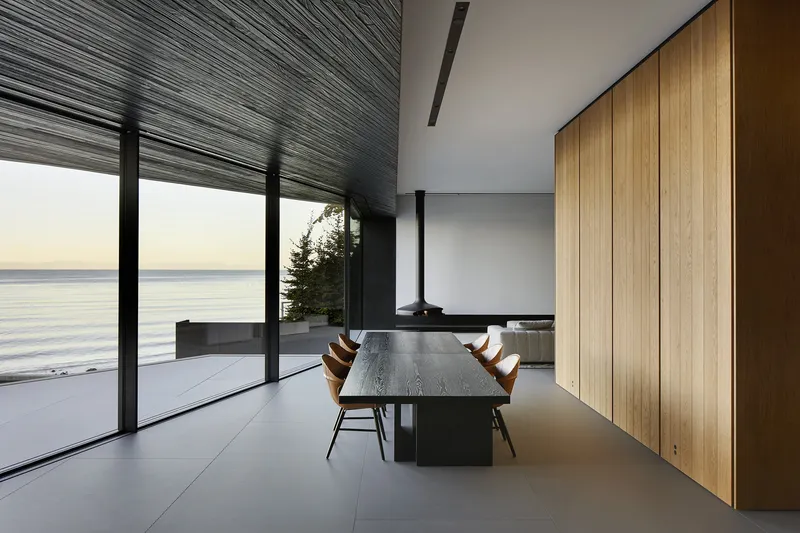
The main-level dining area captures the liminal thesis in miniature. Floor-to-ceiling glazing set into concealed frames dissolves the wall between interior and the calm water beyond, while a ribbed soffit in warm timber runs continuously from inside to out, refusing to acknowledge the boundary. At dusk, the glass becomes a double-sided mirror: you see the ocean, and the ocean sees oak millwork and a suspended fireplace.
The material palette here is deliberately restrained. Lapitec sintered stone covers the floor and kitchen surfaces, and the countertop of the kitchen island appears to grow directly from the floor plane. Timber paneling and the rhythmic ceiling ribs provide acoustic warmth without competing with the view. It is a room designed to recede so the seascape can advance.
The Covered Terrace as Outdoor Room
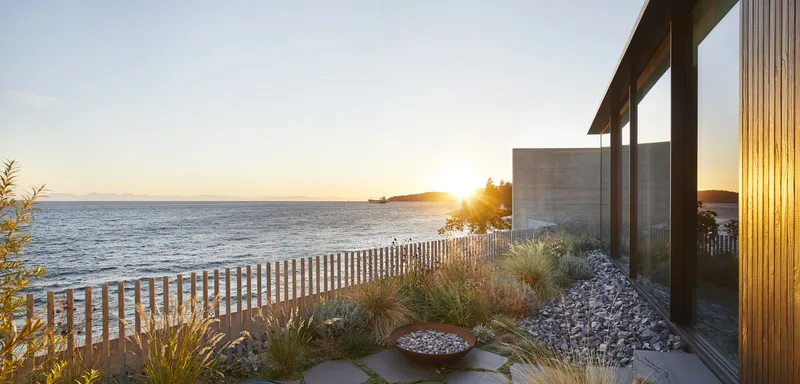
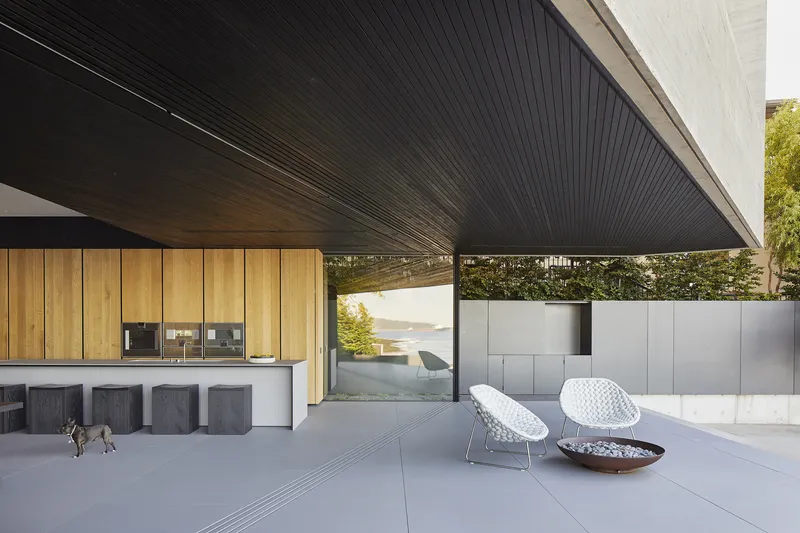
West Vancouver's coastal climate is beautiful and punishing in equal measure: salt air, driving rain, persistent moisture. McLeod Bovell addresses this with a deep covered terrace sheltered by the cantilever above. The terrace houses an outdoor kitchen finished in the same timber cabinetry found indoors, reinforcing the idea that exterior space here is not an afterthought but a fully serviced room. A timber screen at the edge provides wind attenuation without blocking the sunset.
Material choices across the exterior were made for endurance. Black-stained Accoya wood, a modified timber that is biodegradable, recyclable, and carbon-neutral, clads vertical surfaces. Coated aluminum plate handles the most exposed areas. Together with the concrete, these three materials form a protective shell that acknowledges the corrosive reality of living at the ocean's edge while maintaining a palette that feels cohesive rather than armoured.
Courtyard and Light Well

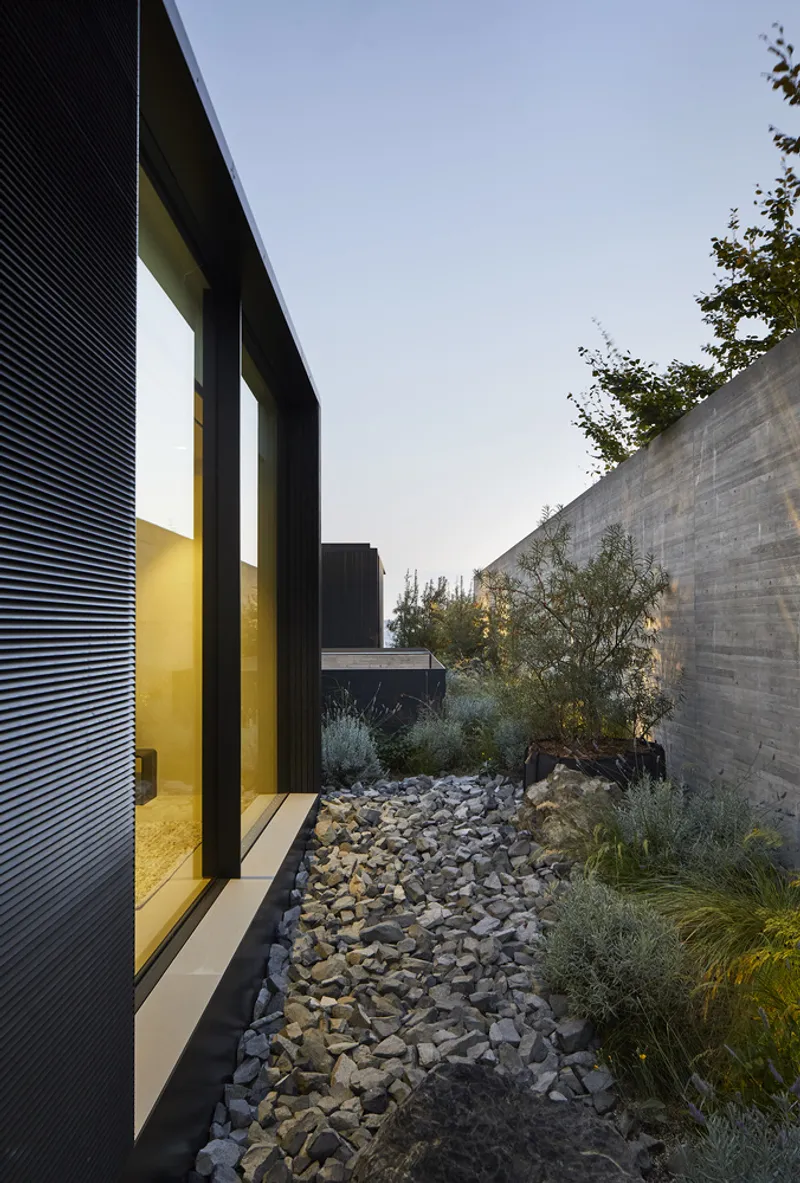
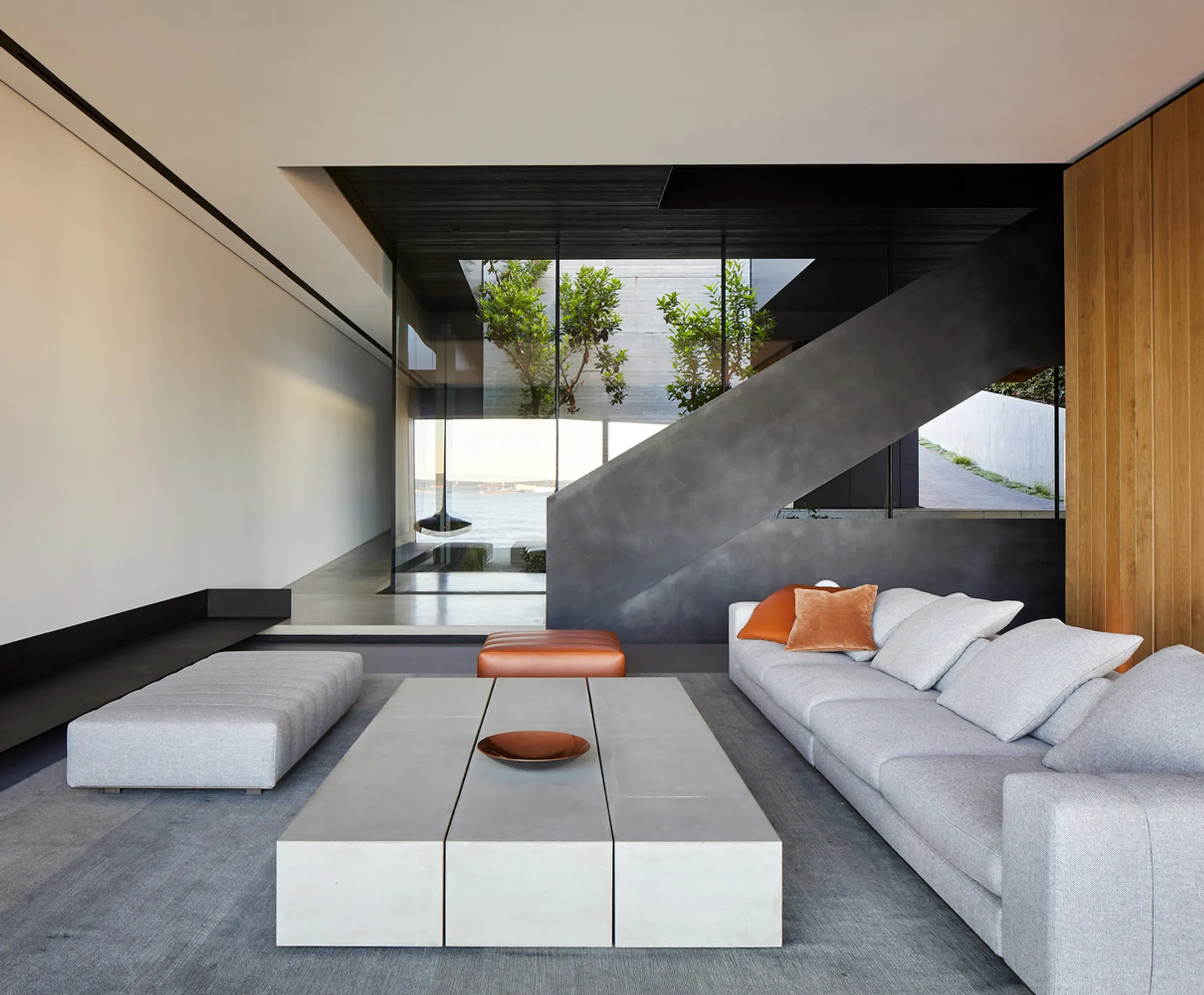
The organizational heart of the house is not a room but a void: a planted courtyard around which circulation wraps on every level. In the double-height living space, a concrete stair ascends alongside clerestory windows that wash the courtyard garden in natural light. River rock beds and native grasses fill the gap between the black Accoya facade and board-formed concrete walls, creating an interior landscape that reads as a slice of the shoreline brought inside.
This courtyard, along with two additional glazed garden patios, solves a practical problem as well. On a steep, narrow plot with tight adjacencies to neighbours, borrowed views are limited. By pulling landscape into the centre of the plan and introducing a light well to the basement level, McLeod Bovell ensure that even the lower-floor guest suite, office, and recreational spaces receive daylight and a connection to planting.
Craft in the Details
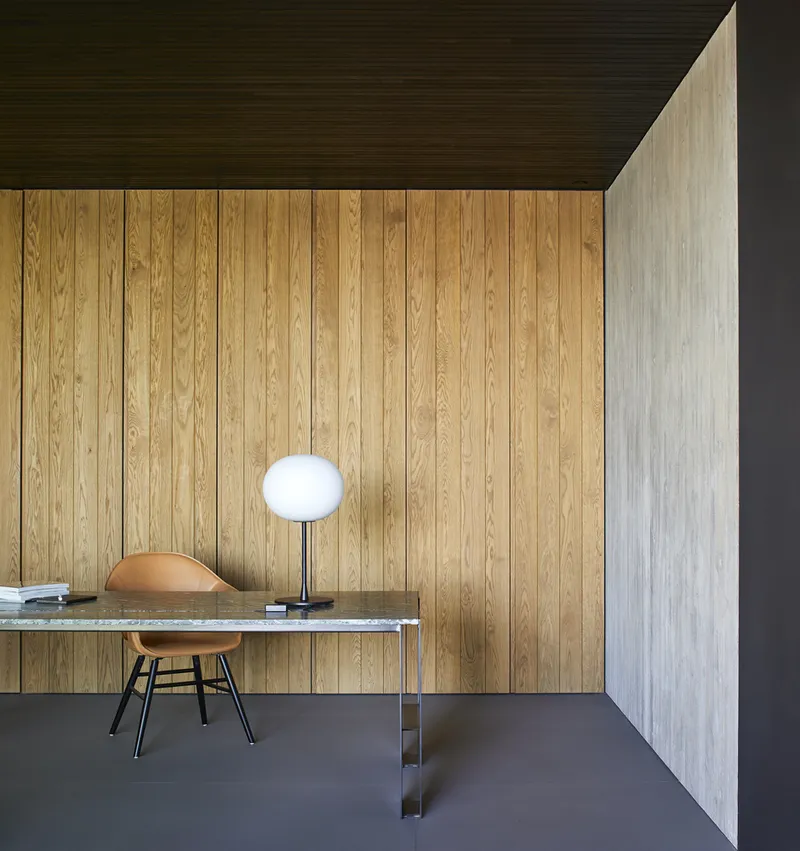

Two moments stand out for their quiet precision. A lower-level workspace is lined in vertical timber cladding with dark wood ceiling panels, creating a cocoon that contrasts sharply with the transparency elsewhere. The proportions are tight, the mood focused. It is a room that understands not every space in a house needs to perform openness.
The timber staircase connecting levels uses a glass balustrade with an integrated handrail, set beneath a slatted black ceiling. The detailing here is rigorous: the handrail emerges from the glass without visible brackets, and the slats above conceal lighting and services. These are the kinds of junctions that separate a well-conceived house from a merely expensive one, and they suggest a builder, Hart + Tipton Construction, working at a high level of craft alongside the architects and Ennova Structural Engineering.
Why This Project Matters
Liminal House earned International Residential Architecture Awards recognition in 2023, and it is easy to see why. The project does not treat the Pacific view as a commodity to be maximized; it treats the relationship between land and water as a spatial narrative to be inhabited. The scenographic organization, the deliberate use of courtyards rather than corridors, the cantilever that gives back as much shelter as it claims in view: these are design decisions rooted in a specific site condition, not imported from a generic modernist playbook.
For architects working on coastal residential projects, the material strategy alone is worth studying. The combination of board-formed concrete, modified Accoya wood, and sintered stone surfaces demonstrates that durability in a marine environment does not require aesthetic compromise. More broadly, Liminal House makes a persuasive case that the most interesting domestic architecture happens when the brief aligns with the site's inherent tension, and when the architect is willing to organize the entire plan around that tension rather than simply framing it in glass.
Liminal House by McLeod Bovell Modern Houses, West Vancouver, Canada. 1,016 m². Completed 2022. Photography by Hufton+Crow.
About the Studio
Share Your Own Work on uni.xyz
If projects like this are the kind of work you want to make, uni.xyz is a place to publish your own, find collaborators, and enter design competitions.




Popular Articles
Popular articles from the community


Co-Life: Senior Housing Design That Reconnects Older Adults With the City
Co-Life reimagines senior housing design through healing gardens, shared streets, workshops, and a sustainable community across generations.
EW PARK: Sustainable Architecture Reimagines the Future of Urban Parking
EW PARK reimagines city parking as a modular wooden tower combining automation, solar energy, electric mobility, and adaptable urban design.

Conexión: Biophilic Design Reimagines High-Rise Living in Hong Kong
Conexión reimagines high-rise living in Hong Kong through biophilic design, green facades, shared spaces, daylight, water and nature within.

Hill & Cross Opera: Sculptural Opera House Architecture Shaped by Tallinn’s Landscape and Identity
Hill & Cross Opera reimagines opera house architecture in Tallinn through its sculptural hill, civic plaza, glass wave and a luminous cross.


Similar Reads
You might also enjoy these articles


Hodi-Mandai Geram
Project Function: Preservation and revitalization of the Intangible heritage and socio-spatial identity of the Hodi by Housing, Cultural Memory Center, Sacred Grove, landscape, local tourism economy


Olio Towers: A Mid-Rise for Performers That Fuses Housing, Rehearsal, and Stage
Located blocks from Houston's Theater District, this modular tower stacks living units around a central performance atrium.

Oasis: Modular Green Housing Carved into Dhaka's Urban Fabric
A shortlisted Plugin Housing entry reclaims unauthorized settlements in Dhaka with stepped concrete volumes, green roofs, and ventilation-driven design.

Black Hole: A Floating Megastructure for the Post-Physical Era
Emiliano Mazzarotto envisions a spherical, self-scaling arena where e-sports, digital hotels, and holographic stadiums replace traditional public space.


Explore Housing Competitions
Discover active competitions in this discipline



Challenge to reimagine the Iron Throne


Photograph architecture without architects


Illustrate the lost glory of Angkor Wat - Render Challenge


Design challenge to reuse E-waste
Comments (0)
Please login or sign up to add comments
No comments yet. Be the first to comment!