

LIS Design Studio Carves a Second Chapter for Lviv's Mitte Café in 68 Square Meters
Walnut millwork, terracotta alcoves, and navy curtains shape an intimate sequel café on a Lviv sidewalk.


When a café owner comes back for round two, the design brief is no longer about first impressions. It is about trust, refinement, and the accumulated knowledge of what actually works when a small room fills with people every morning. Mitte Café 2.0 is the second collaboration between LIS design studio, led by designers Shpelyk Roman and Andriy Lutsa, and the Pavlenko brothers, Artem and Mykhailo. The original Mitte, which opened in 2021, occupied a 36-square-meter ground floor space in a new Lviv neighborhood and proved that rigorous material choices could give even the smallest café a sense of gravity. The sequel nearly doubles the footprint to 68 square meters, and the design language has matured accordingly.
The name Mitte, German for "center," signals an ambition to be a neighborhood anchor rather than a novelty. What makes this project genuinely interesting is the way it builds atmosphere through layering rather than spectacle. There is no single hero gesture here. Instead, LIS stacks a vocabulary of walnut paneling, navy fabric dividers, terracotta tile, ribbed glass pendants, and brass hardware into a sequence of intimate zones that feel discovered rather than designed. In a city where wartime resilience has made everyday gathering places more important than ever, the care invested in this tiny interior reads as an act of civic optimism.
A Street Presence Built on Restraint
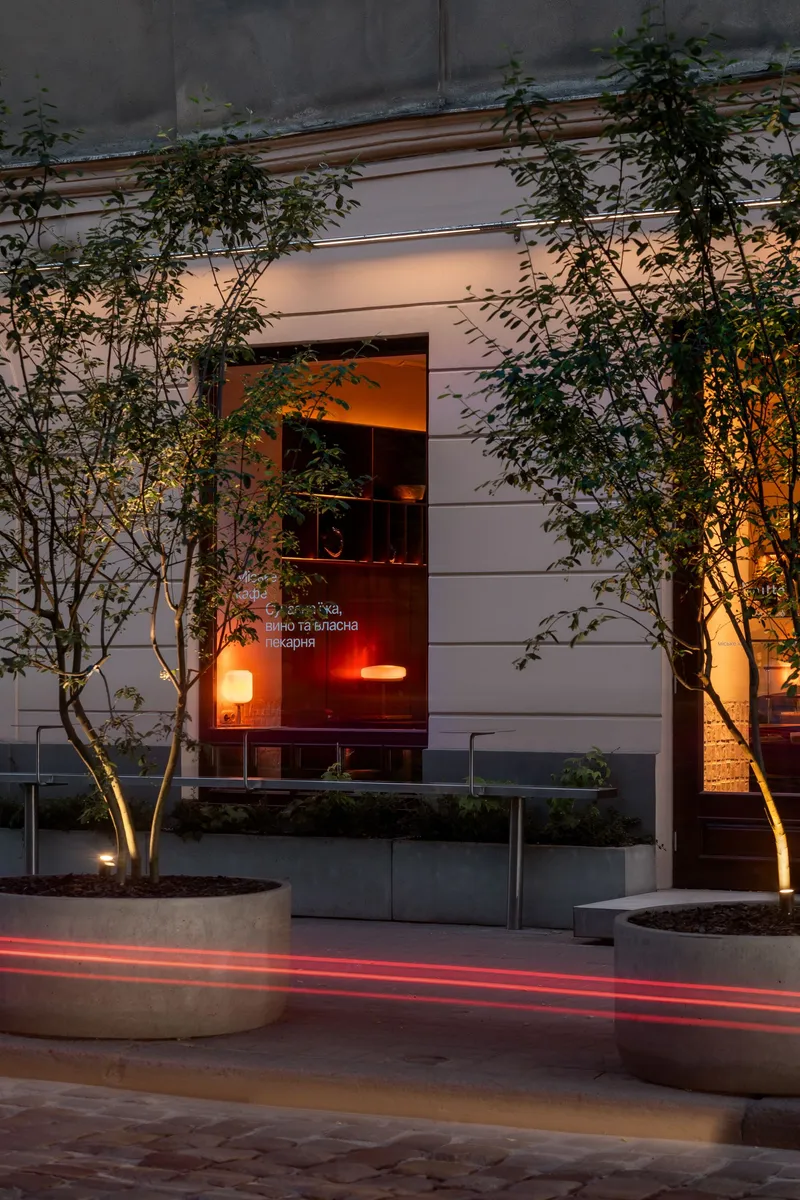
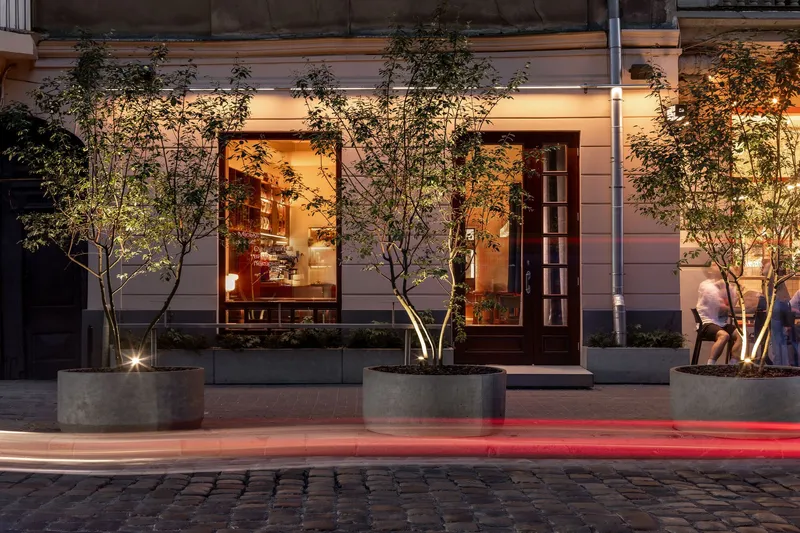
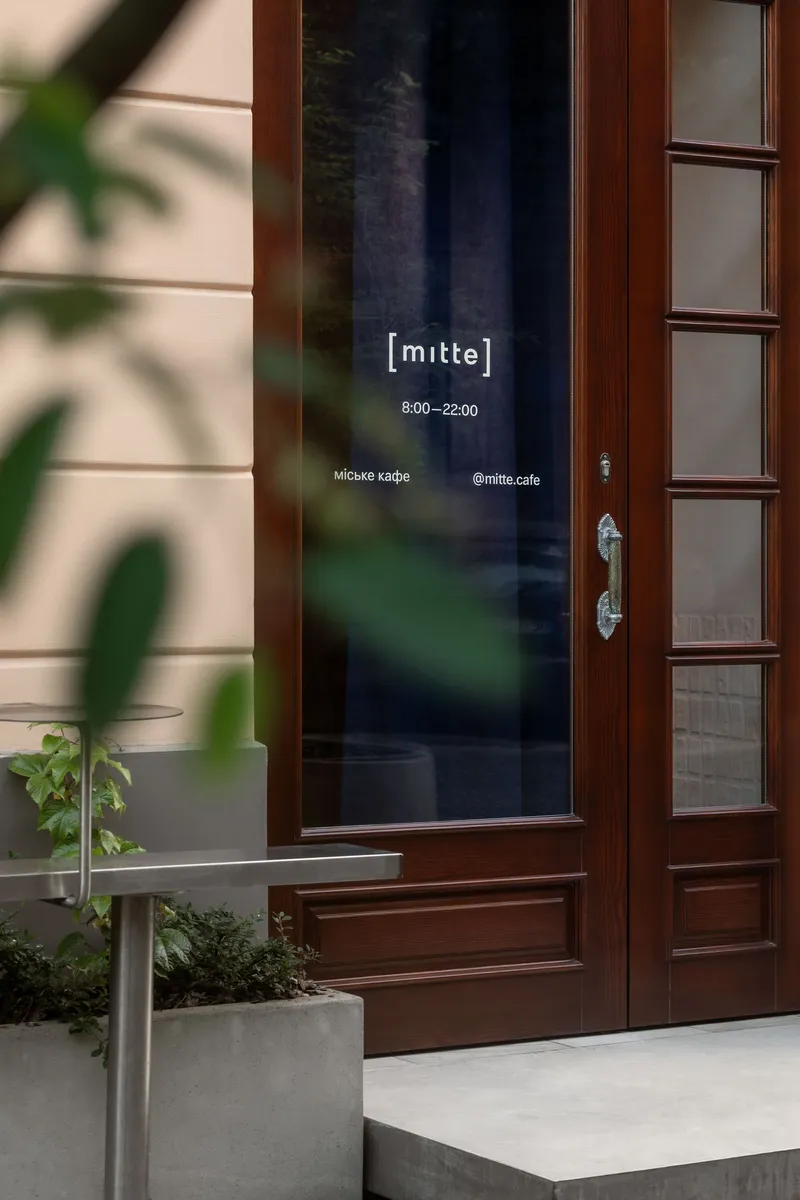
The facade strategy is deliberately understated. Concrete planters hold young trees that are uplighted at dusk, casting soft shadows against the timber-framed entrance. There is no signage screaming for attention, no oversized glazing dissolving the boundary between inside and out. Instead, a glazed door panel and flanking potted plants create a threshold that feels domestic, almost residential. The warm interior glow leaking through the doorframe does the marketing.
That restraint is strategic. The Pavlenko brothers clearly understand that a café in Lviv competes not on visibility but on word of mouth. The entrance promises something worth stepping into, and the blurred pedestrians passing at dusk suggest a building that belongs to its sidewalk without imposing on it.
Walnut and Glass: A Material Vocabulary with Memory
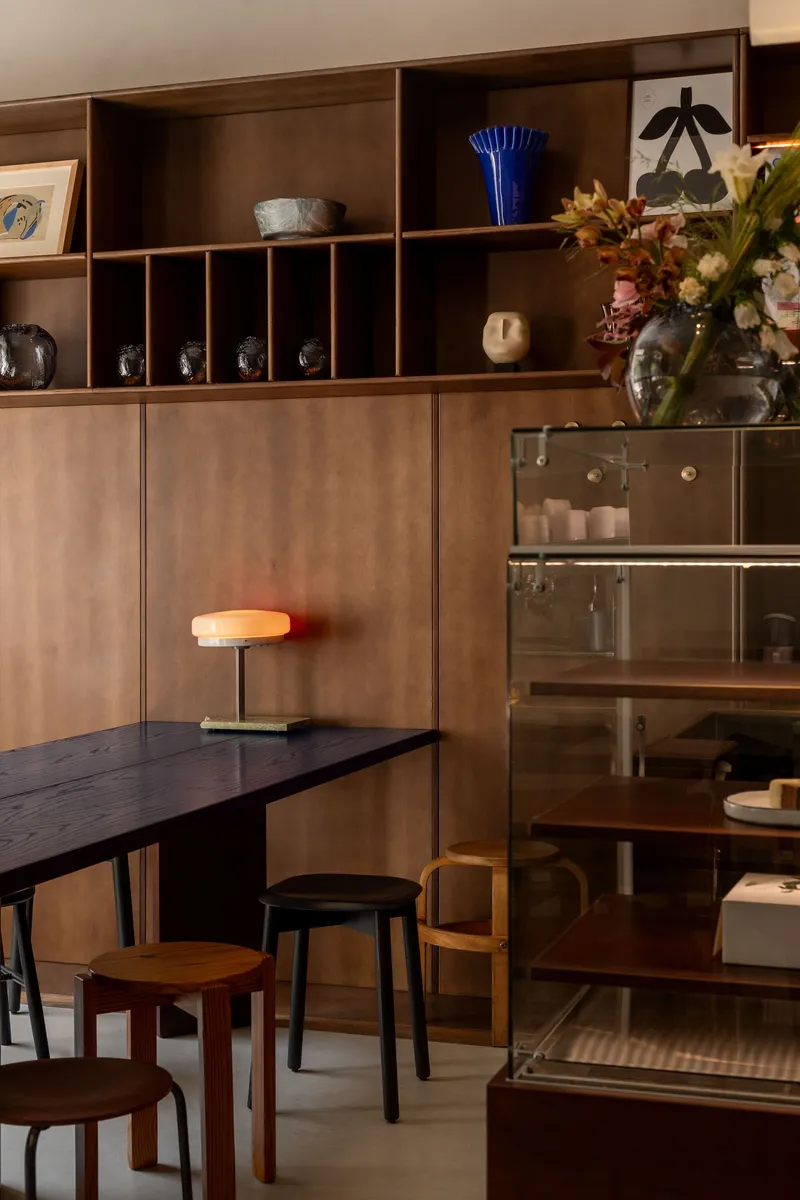
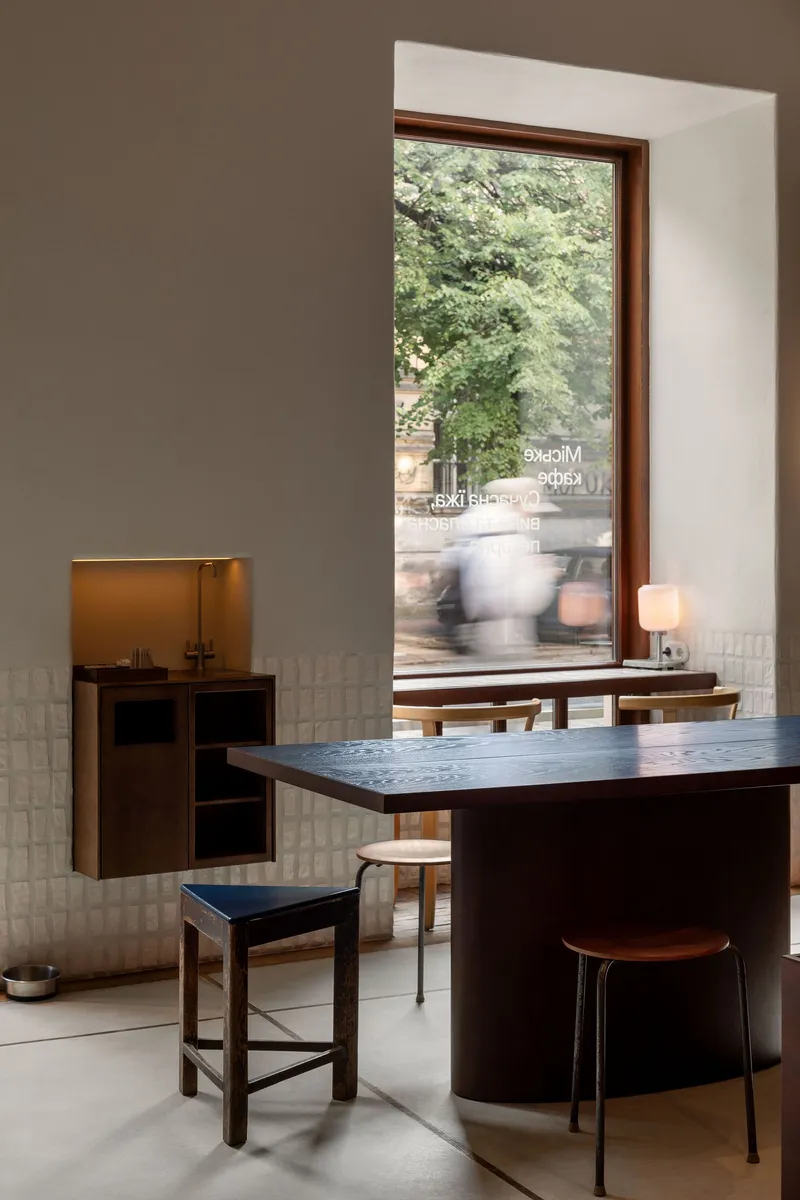
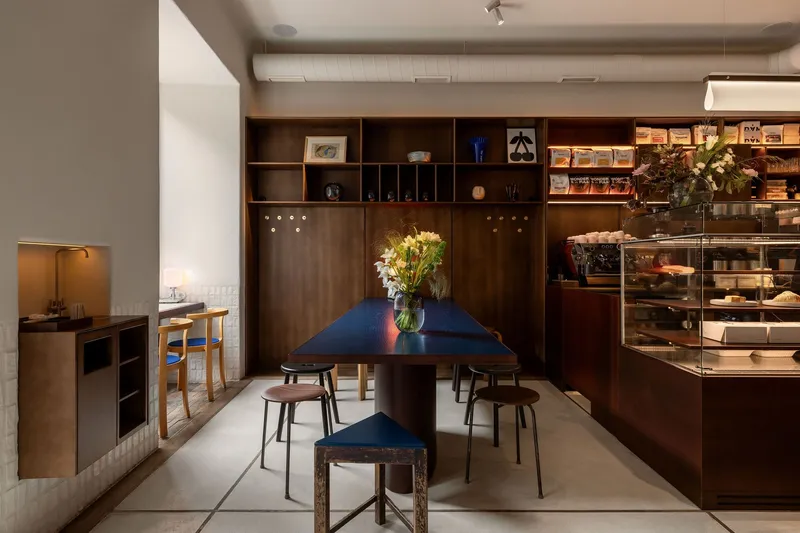
The original Mitte relied on birch plywood finished in veneer. This time, the palette has deepened. Walnut millwork dominates the display wall, its dark grain paired with brass door pulls and glass-fronted vitrines that showcase ceramics and glassware as carefully as any gallery. The timber-framed windows are backed by textured glass tile wainscoting, a detail that filters daylight into something soft and diffused while giving the lower wall zone a tactile richness.
LIS design studio treats materials as furnishings from HAY and Object Therapy sit within a framework of custom joinery. The central dining table anchored by a timber shelving wall reads as a single composition, the glass display cases acting as both functional storage and visual weight. Nothing here is arbitrary. The shift from birch to walnut between the two Mitte iterations signals a studio growing more confident in richness, willing to let warmth come from material depth rather than applied color.
Navy Curtains and the Art of Soft Division


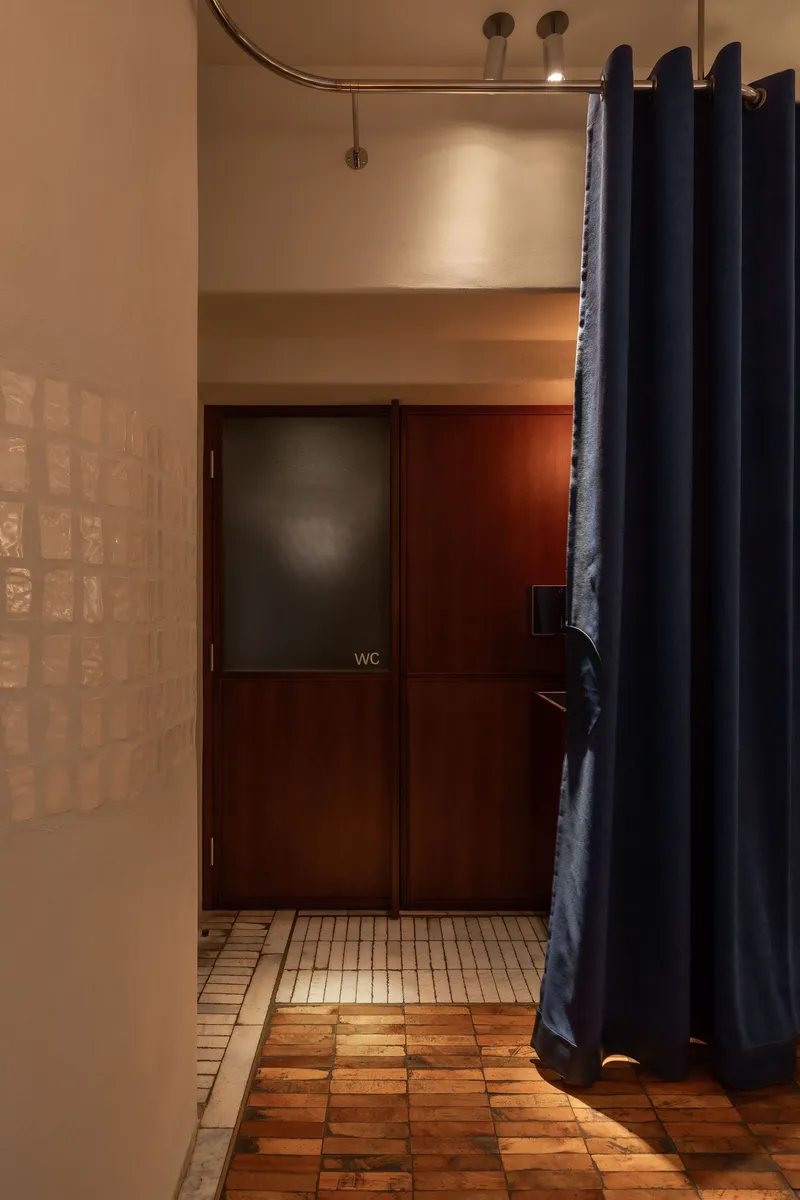
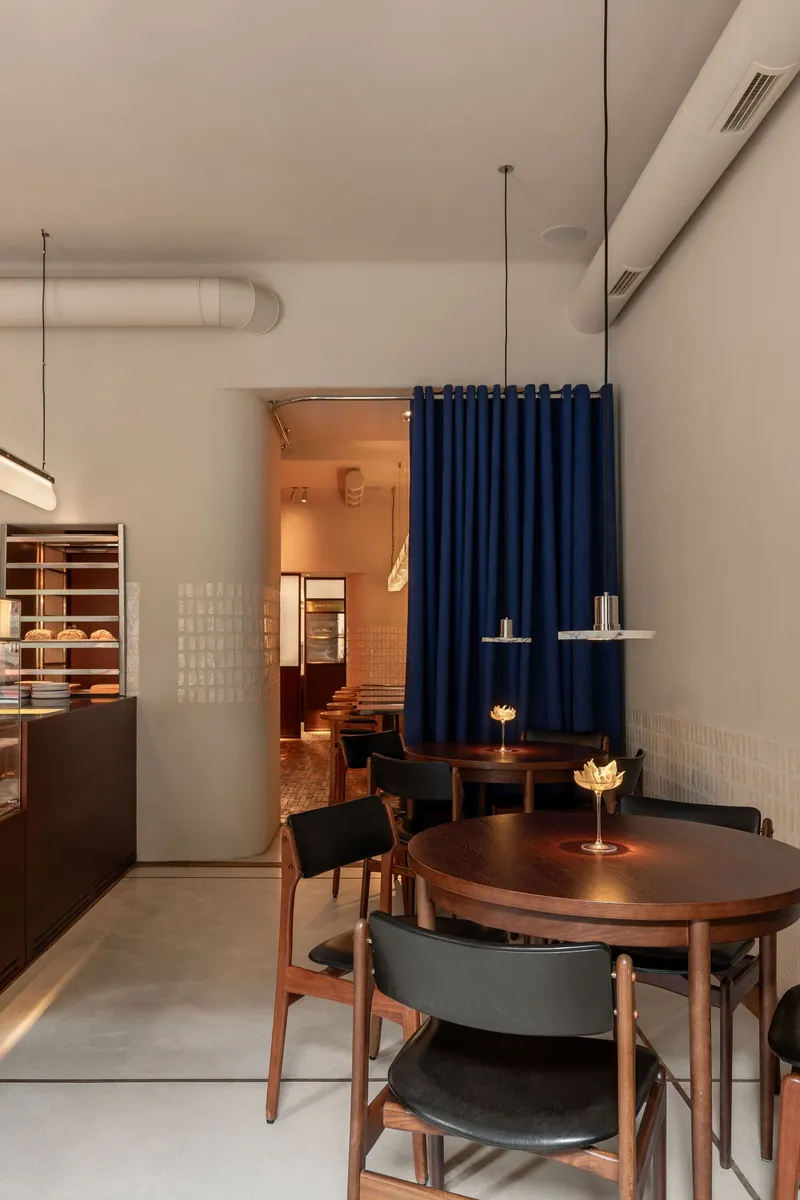
In 68 square meters, walls are expensive. LIS solves the zoning problem with navy fabric curtains hung from curved brass rails, a device that is both spatially efficient and theatrically effective. The curtains can close to create privacy or part to reveal deeper alcoves, giving the café a sense of depth that its actual footprint cannot justify. A terracotta vaulted archway framed by navy drapes pushes this logic further, suggesting a passage between rooms where none technically exist.
The corridor leading to the restroom is lined with clay tile flooring and terminates at a walnut door, the curved brass curtain rail overhead acting as a gentle ceiling gesture. These textile boundaries also do acoustic work, softening the clatter that hard surfaces would amplify in a room this compact. It is a low-tech solution that delivers high spatial complexity.
Alcoves That Reward Lingering
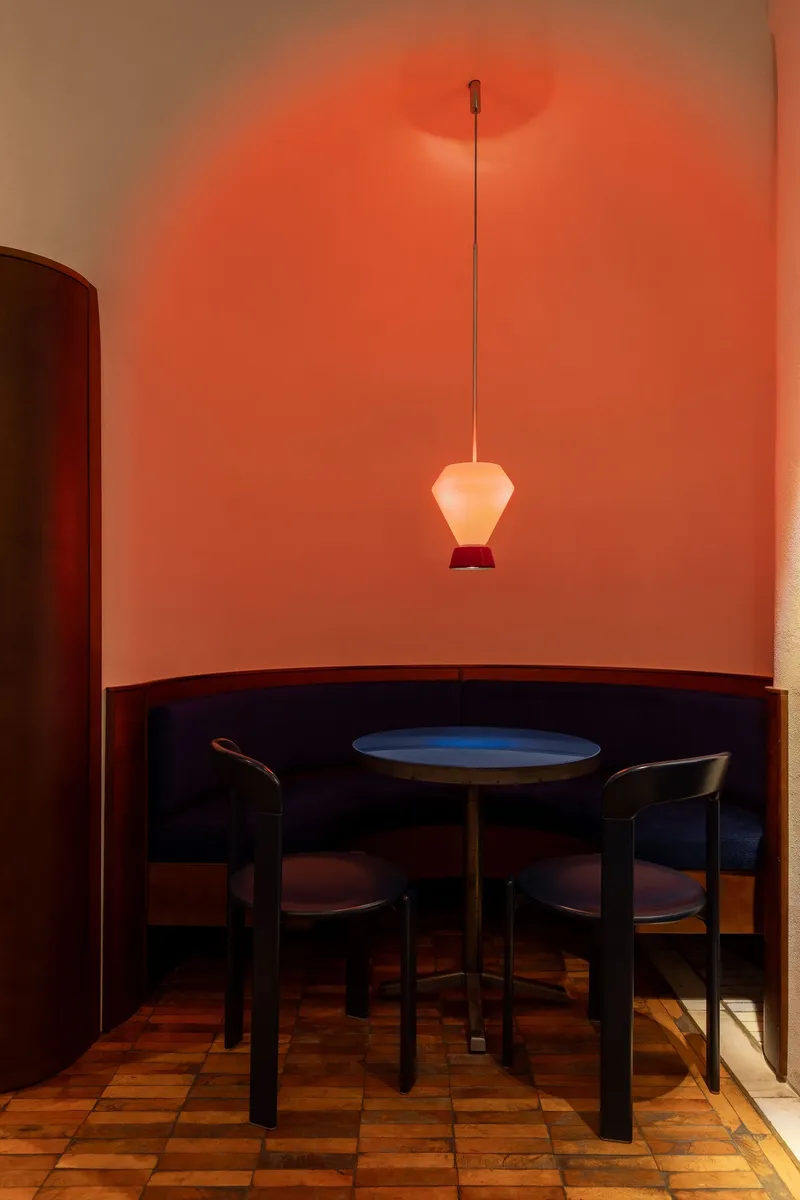
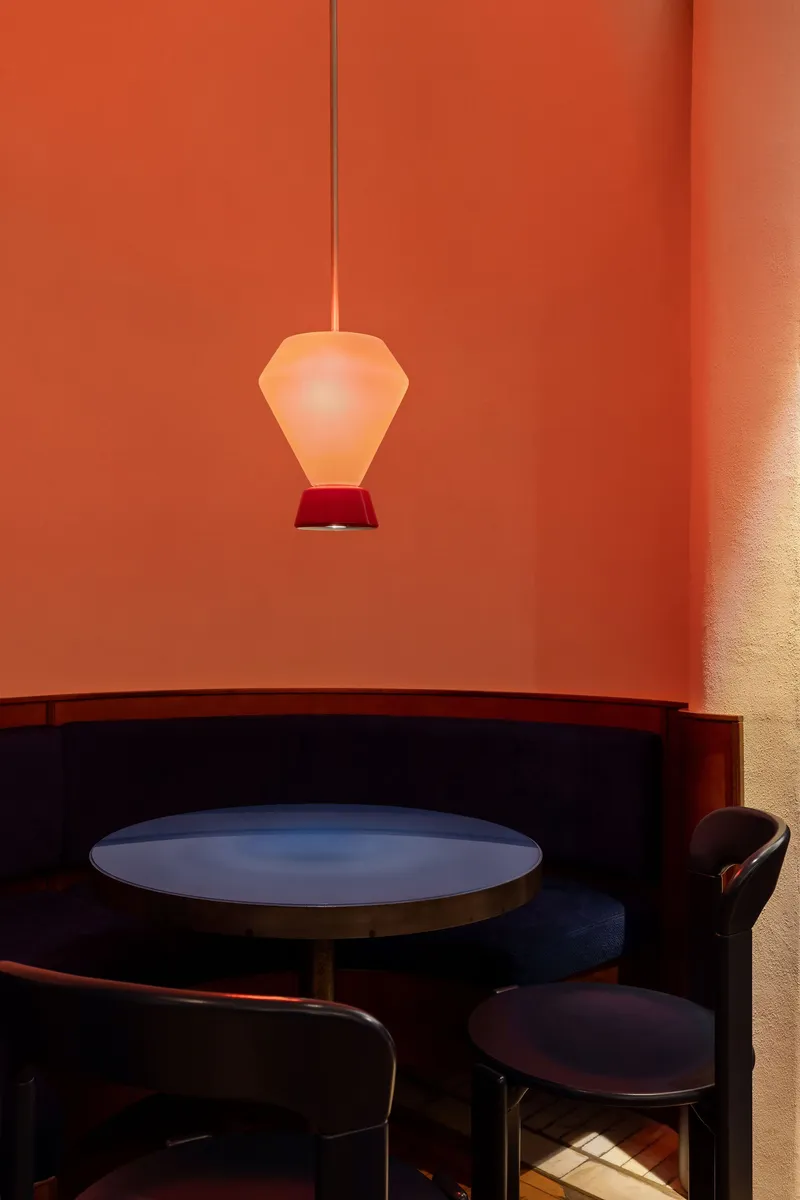
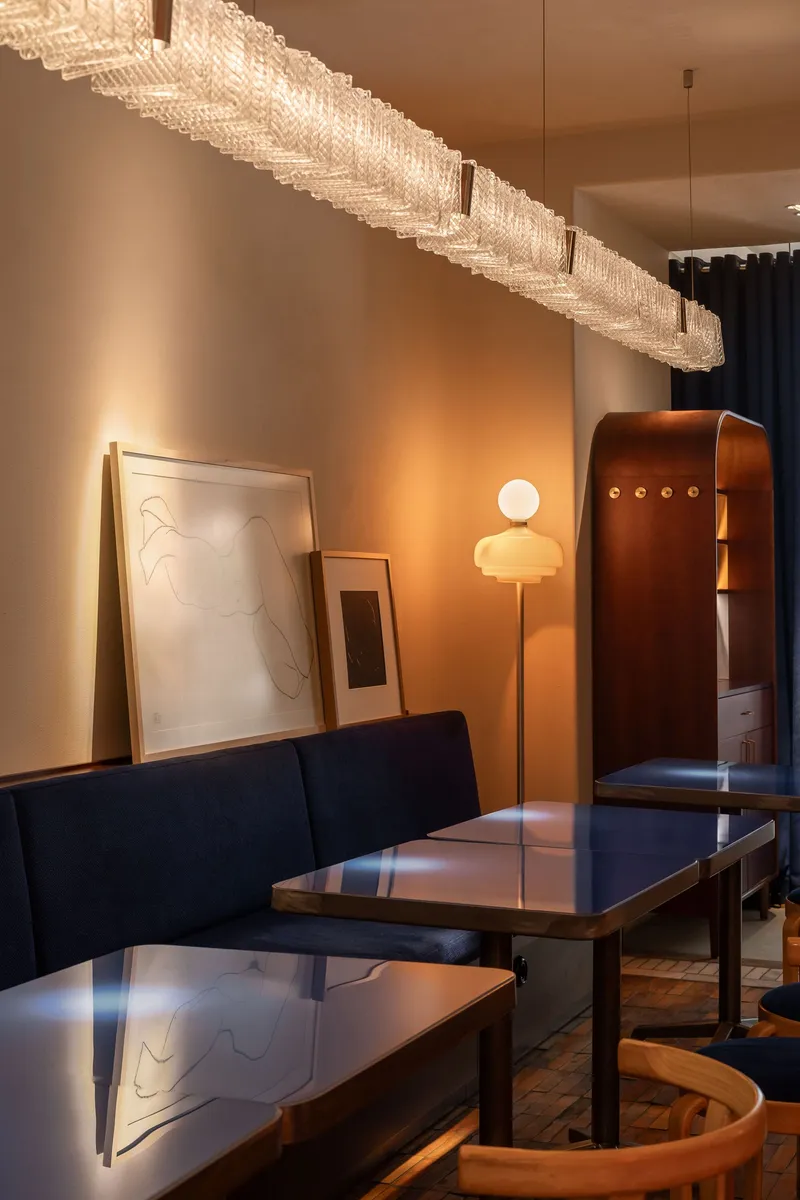
The strongest moves in the café are its alcoves. A banquette nook bathed in coral paint sits beneath a frosted glass pendant, its warmth almost absurdly inviting. Another alcove uses terracotta mosaic flooring and a single pendant lamp to create a pocket of red-toned intimacy. A third pairs leaning artwork with a long ridged glass pendant that casts ruled shadows across parquet flooring. Each alcove operates on its own color temperature, its own mood.
This is where the 2.0 upgrade is most legible. The original Mitte used a semicircular bathroom entrance to squeeze efficiency from its 36 square meters. Here, the extra area lets LIS create distinct emotional registers within a single room. You can choose your atmosphere by choosing your seat, which is a rare luxury in a space this size.
Light as Material

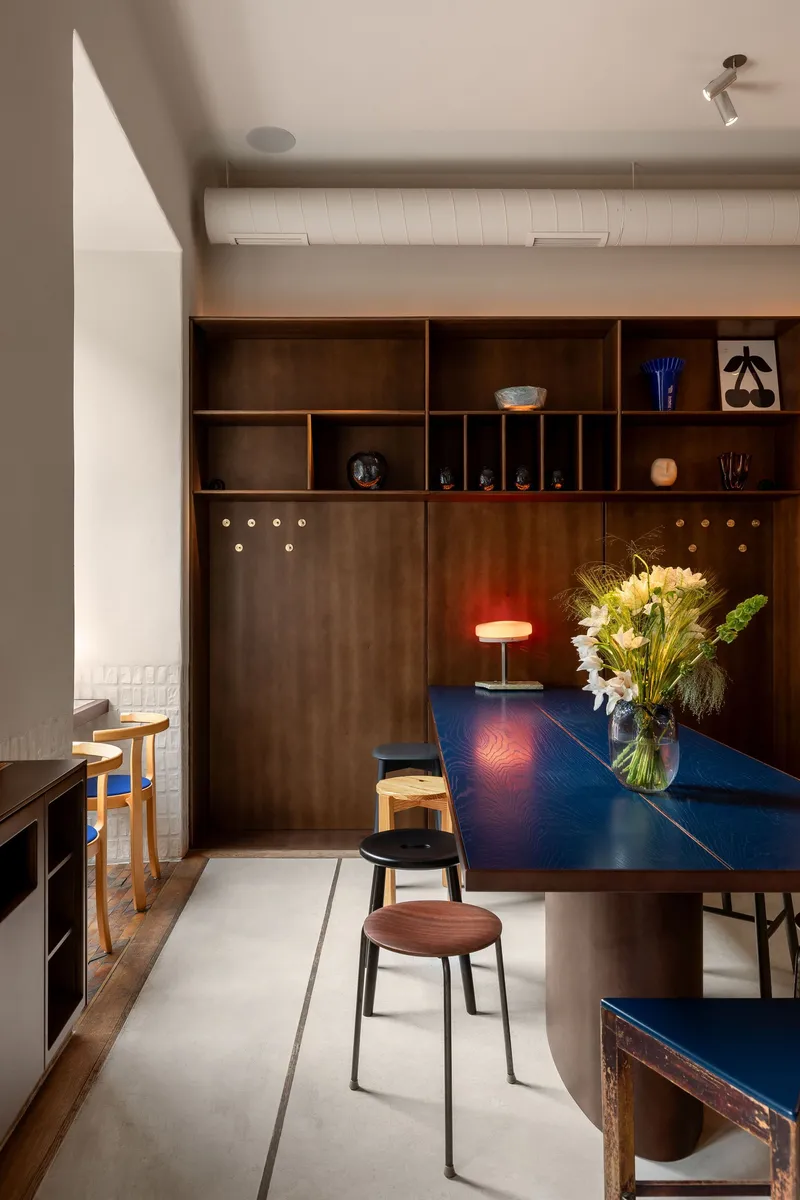
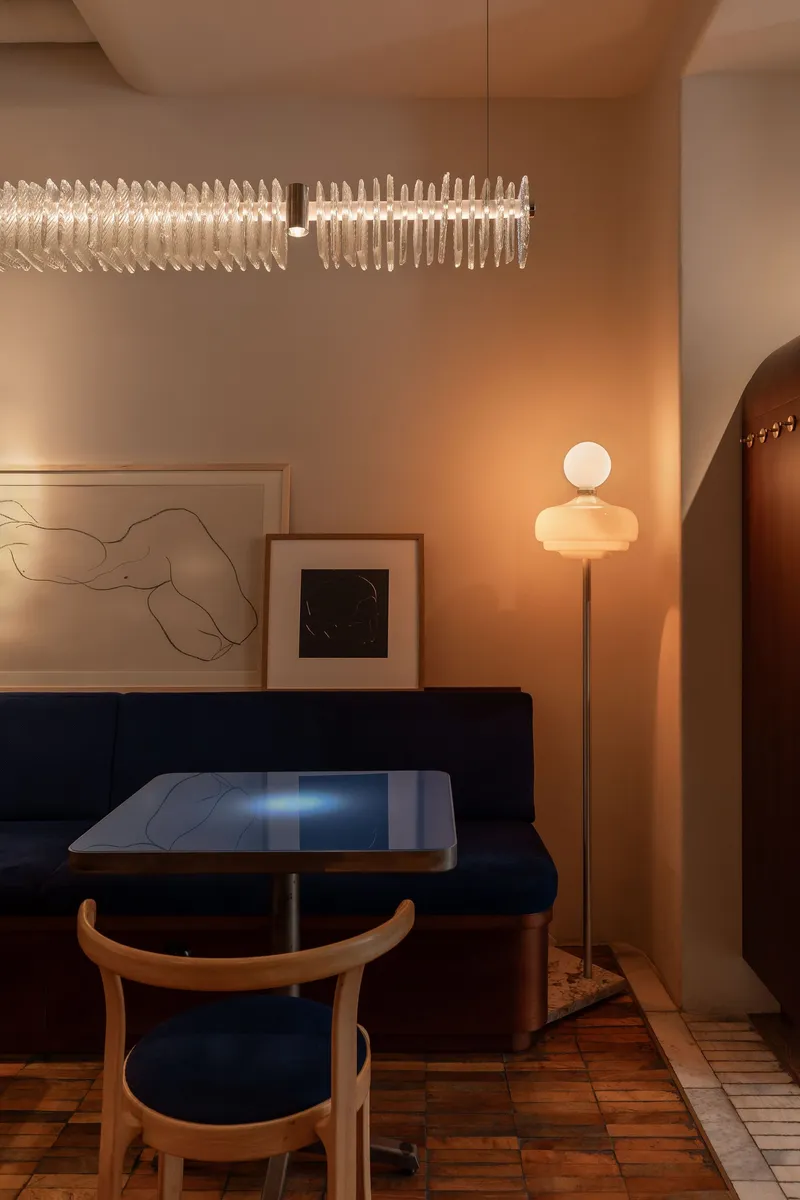
The pendant lights deserve their own discussion. Textured glass fixtures with rippled surfaces appear throughout, each one casting a slightly different quality of light depending on its position and the surrounding surfaces. Against the wood-paneled wall, a single pendant reads as sculptural. Over the deep blue lacquered table, a linear glass fixture draws the eye along the room's length beneath white ribbed ceiling panels. In the dining nook, a sculptural pendant becomes the focal point above navy banquette seating.
LIS seems to understand that in a café without windows on multiple walls, artificial light must do double duty: illuminating the space and creating the illusion of varied natural conditions. The ribbed and rippled glass surfaces scatter light in organic patterns that feel almost aquatic, pulling the eye up and away from the compact floor area.
Thresholds and Floor Transitions
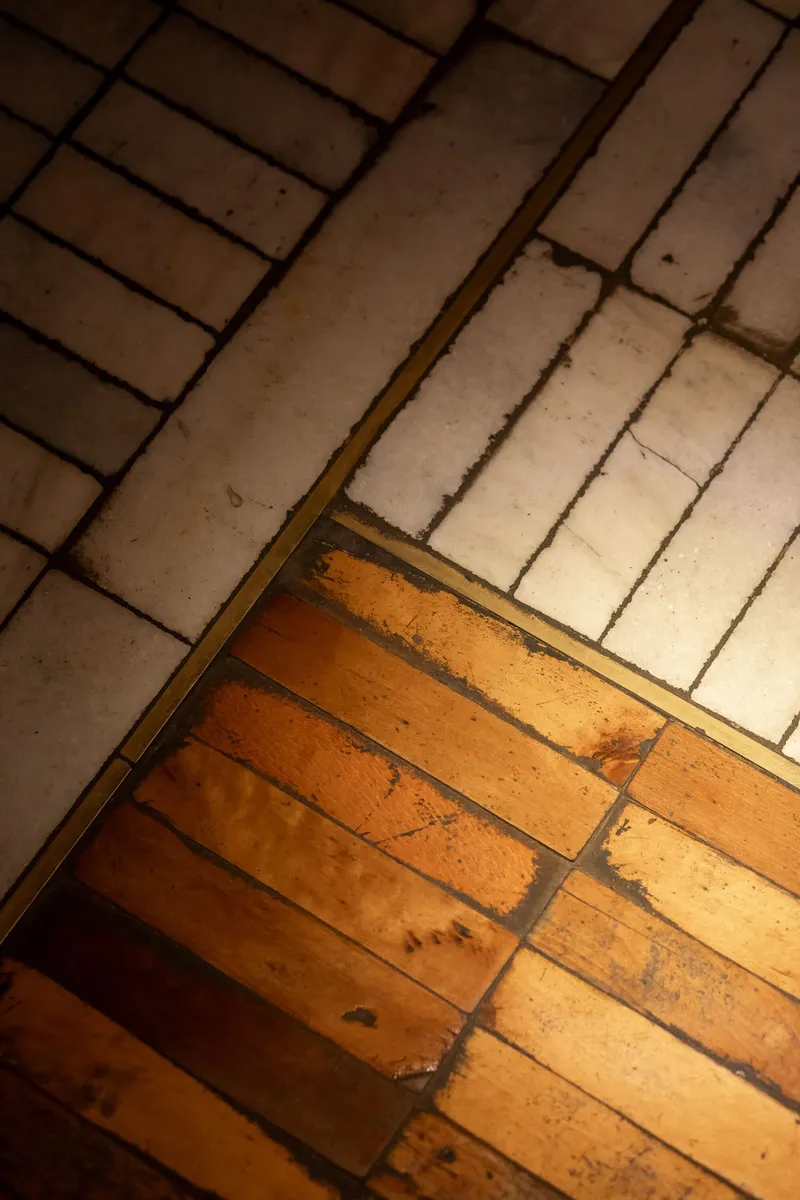
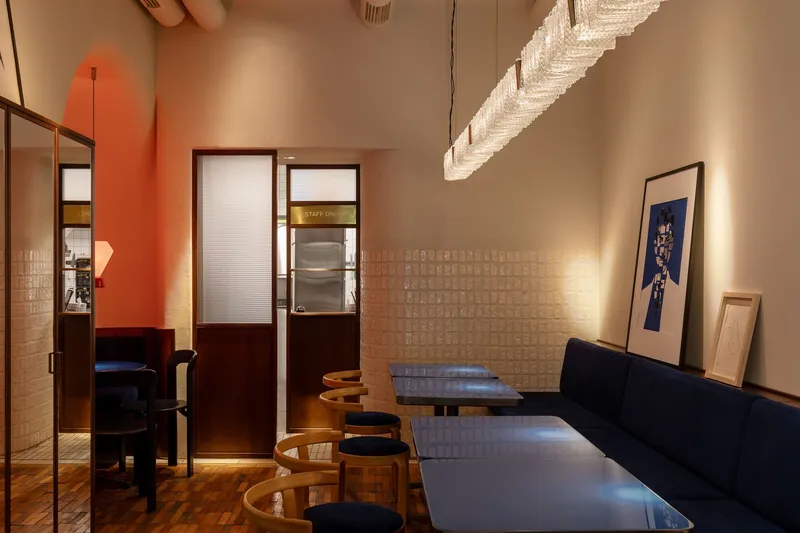
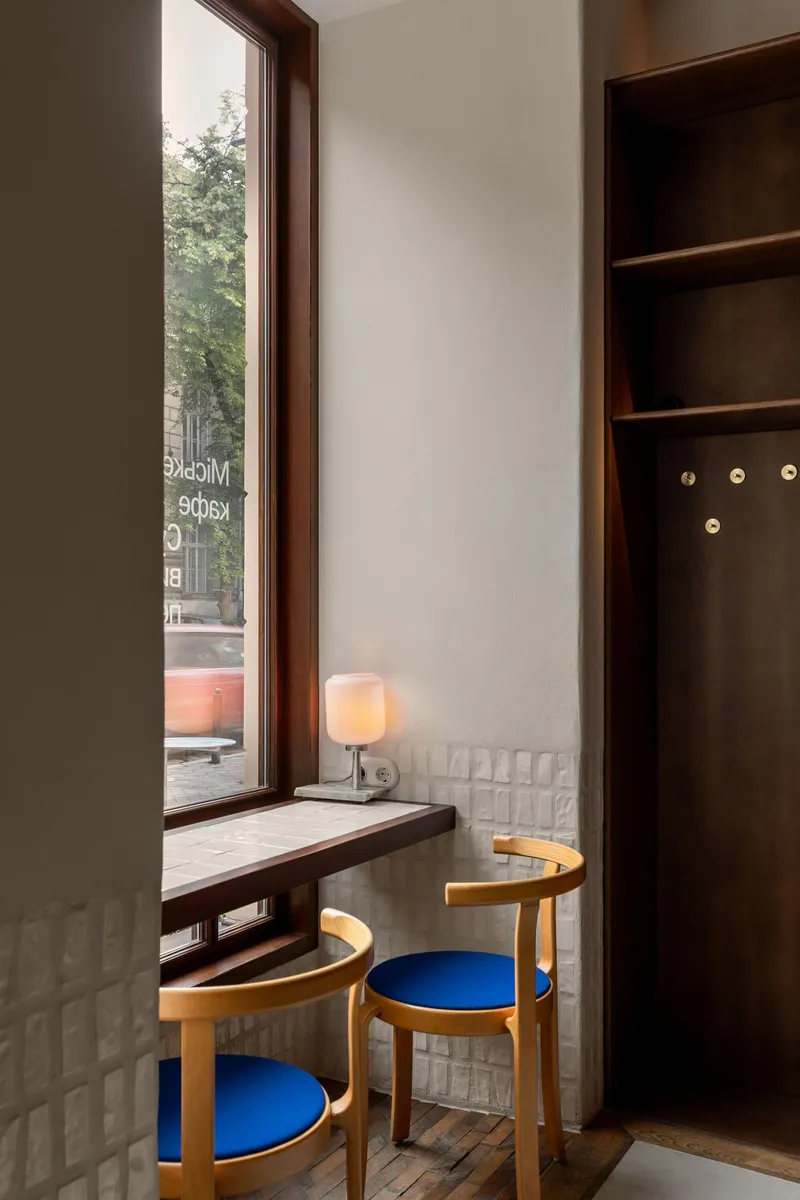
A telling detail: the diagonal threshold where weathered timber floorboards meet white ceramic tiles at differing orientations. This is a joint that most designers would resolve with a metal strip and move on. LIS leaves it exposed, celebrating the collision of two floor zones as a deliberate compositional moment. The change in material angle signals a shift in program without any vertical barrier.
Similar care appears in the window seat, where cream tile wainscoting rises to meet a dark wood frame, and in the seating nook with its translucent glazed door reflecting an orange painted wall. Every transition between material, color, or light is treated as an event. In a linear plan with limited square meters, these micro-moments of change are what keep the space from feeling like a corridor.
Utility with Character
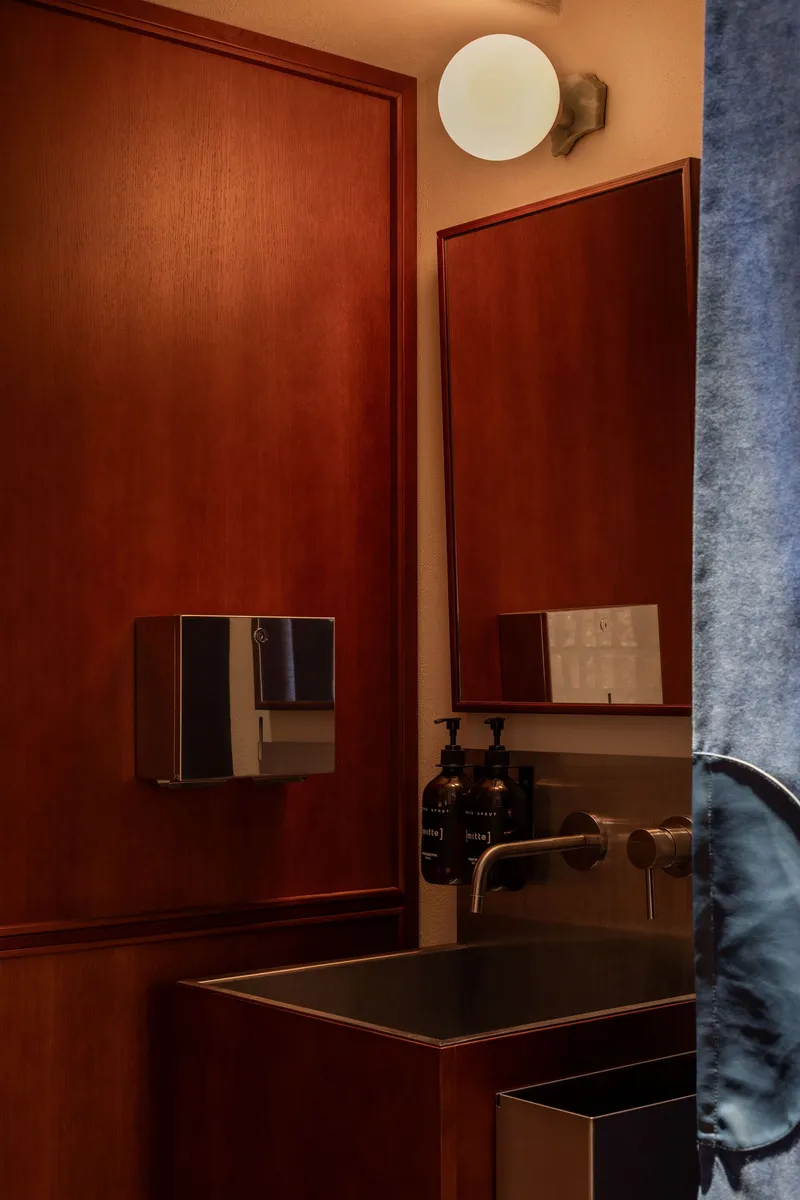
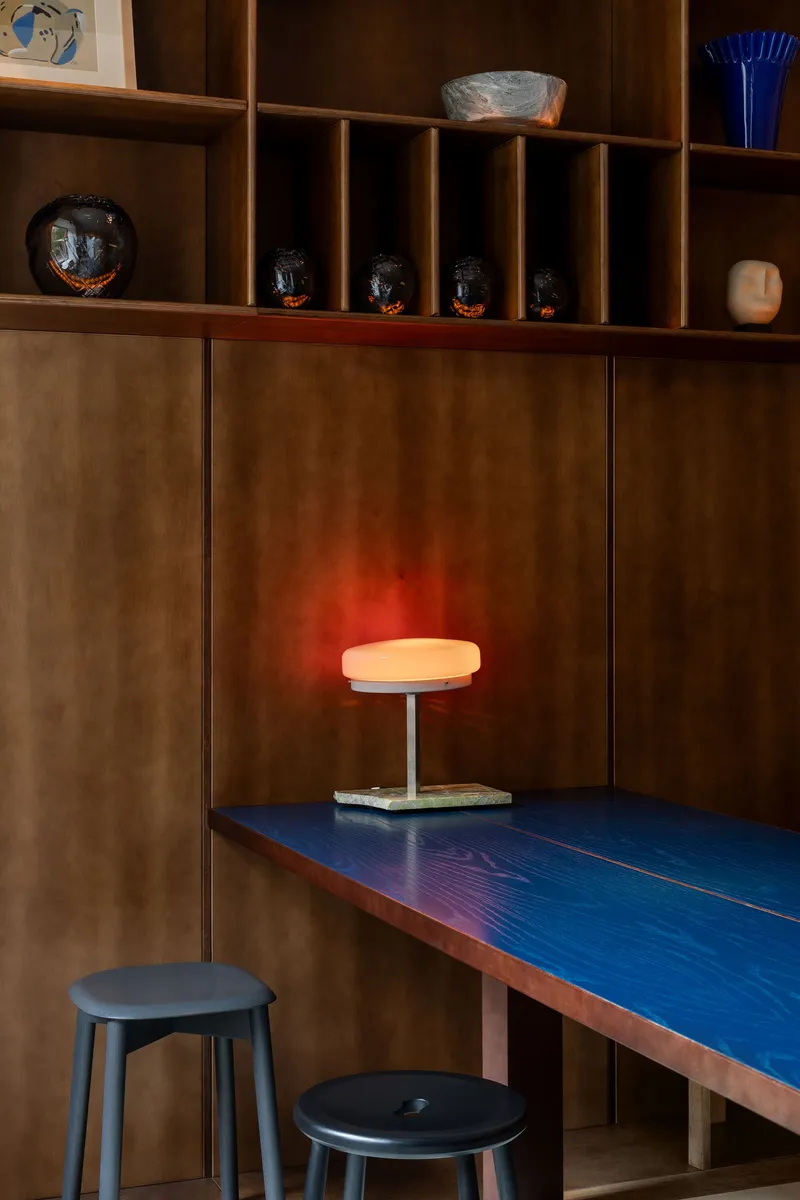
Even the bathroom gets the full treatment: wood paneling, a brass faucet, a black basin, and a circular wall-mounted light fixture that belongs in a hotel rather than a 68-square-meter café. A built-in desk elsewhere in the plan, finished in blue laminate with a glowing lamp and timber shelving displaying ceramic objects, suggests that Mitte 2.0 accommodates laptop workers as comfortably as espresso drinkers.
The main room, with its exposed ductwork and blue fabric divider visible in the ceiling plane, shows that LIS is comfortable leaving infrastructure visible where the budget demands it. The white ribbed ceiling panels conceal services in some zones and expose them in others, creating a rhythm of polish and honesty that prevents the interior from feeling precious.
Plans and Drawings
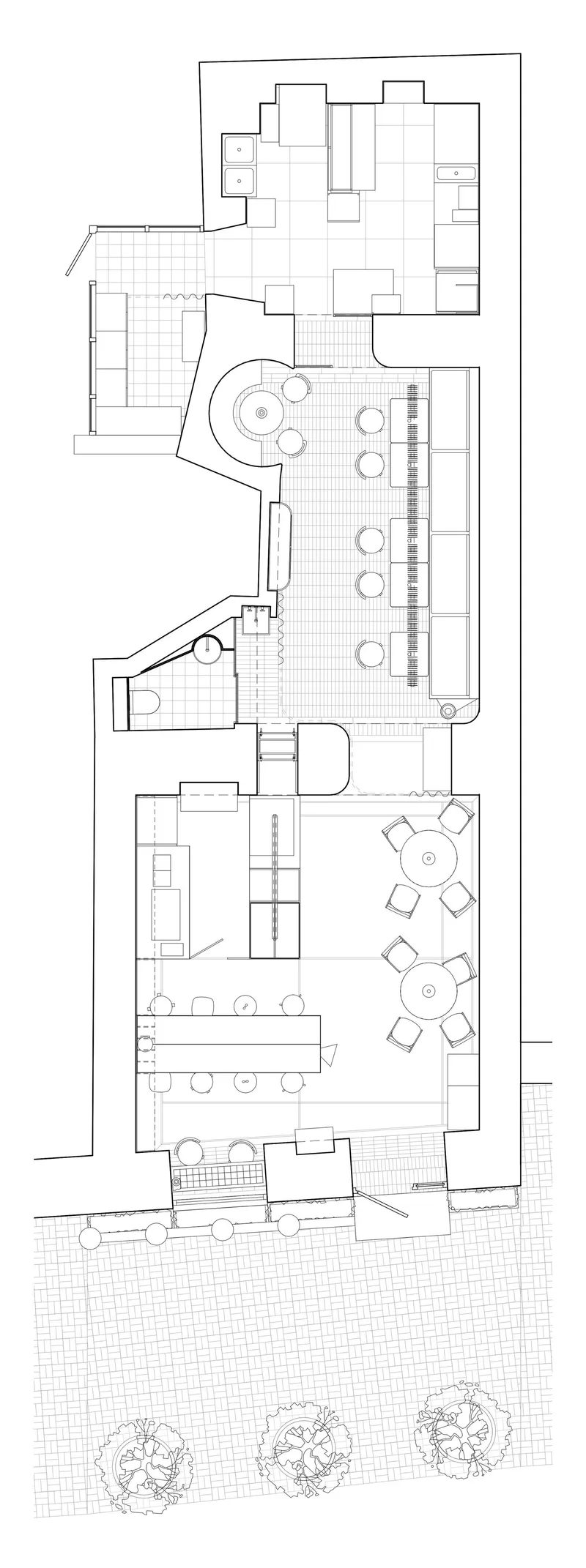
The floor plan confirms what the photographs suggest: a strictly linear layout organized along a single axis from the street entrance to the back of the space. A curved service counter anchors the middle of the plan, creating a natural eddy in the circulation that separates the entry zone from the deeper seating areas. Street trees are drawn as part of the composition, reinforcing the idea that the café's territory extends to the sidewalk. The plan also reveals how the alcoves are carved from the rectangular envelope, each one a slight spatial deviation that produces outsized atmospheric returns.
Why This Project Matters
Mitte Café 2.0 is not a radical project. It does not reinvent the typology or challenge structural conventions. What it does, with notable discipline, is demonstrate that 68 square meters can hold genuine spatial variety when every material joint, every color shift, and every light fixture is treated as a design decision rather than a specification. The sequel relationship with the Pavlenko brothers gives LIS design studio something rare: a client who already trusts the process and wants to see where it leads. The result feels less like a brief fulfilled and more like a conversation continued.
For a studio working in wartime Ukraine, the project also carries weight beyond its square meters. Building a café in Lviv in 2025, with this level of material ambition and attention, is a statement about continuity and normalcy in extraordinary circumstances. The name Mitte, center, takes on additional meaning: this is a place that insists on holding the middle ground, on being a stable reference point in a city navigating immense uncertainty. That combination of craft precision and civic purpose is worth studying.
Mitte Café 2.0 by LIS design studio (Shpelyk Roman, Andriy Lutsa), Lviv, Ukraine. 68 m², completed 2025. Photography by Misha Lukashuk.
About the Studio
Share Your Own Work on uni.xyz
If projects like this are the kind of work you want to make, uni.xyz is a place to publish your own, find collaborators, and enter design competitions.


Popular Articles
Popular articles from the community


GROUP A Strips a 1969 Rotterdam Harbor Headquarters to Its Frame and Wraps It in Timber Louvers
In Rotterdam's M4H harbor district, Ferro Offices reuses a 1969 frame, adds one timber storey and reaches BREEAM-NL Outstanding.

longwave studio Reorganizes a 112 m² Tainan Apartment Around the Daily Routines of a Family and Two Cats
In Tainan, Taiwan, birch plywood, rust-red furniture and a freestanding plaster wall link arrival, storage, work and family life in one apartment.

Juan García Correa, John González and Claudia Rueda Sink a Circular Amphitheater into a Manizales Engineering Building
On the La Nubia campus in Manizales, Colombia, the S1 Building folds labs and offices into a hillside of ramped lawns that double as a campus route.

LT2A and OPEN Architectes Thread a Brick and Glass High School Through a Wooded Belgian Campus
In Braine-l'Alleud, a 3,000 m² wing for Collège Cardinal Mercier pairs pale brick with a glazed colonnade, deferring to a small chapel and a dense wood.

Similar Reads
You might also enjoy these articles


LAVA Architecten Gives Vocational Education a Sawtooth-Roofed Face on a Mechelen School Campus
In Mechelen, Belgium, a 2,053 m² STEM school on a 6×6 m grid turns workshops and classrooms into rooms that can be rearranged as teaching changes.

KEMA Studio Turns a Derelict Marvila Attic into a 60 m² Lighthouse Apartment Above Lisbon
In Lisbon's Marvila district, a rebuilt roof, four skylights and two plywood volumes turn an unlivable attic into a bright home facing the Tagus.

Pixel Gardens: One Repeated Module Stacked Into a Terraced Social Housing Tower for Famagusta
Salem Bader's shortlisted housing tower builds a vertical neighbourhood from one repeated module, offsetting units to carve terraces, light and air.

Bao Huynh Watercolor Atelier: A Serene Art Retreat in Hội An
Bao Huynh Watercolor Atelier in Hội An blends multifunctional art spaces, sustainable design, local materials, and family-friendly living in a serene environment.

Explore Cafe Competitions
Discover active competitions in this discipline

Challenge to design luxury tourism on rails

VR headsets Storefront design competition

Designing a staircase for a client
Comments (0)
Please login or sign up to add comments
No comments yet. Be the first to comment!