
LoftPub: Fibonacci-Driven Housing on Moscow's Post-Industrial Riverfront
A shortlisted proposal transforms a brownfield in Moscow's Zil district into a youth-oriented residential complex powered by hybrid onsite energy.


What happens when you apply the Fibonacci sequence to a brownfield in one of Moscow's most neglected industrial corridors? LoftPub answers that question with a housing complex that stacks residential lofts, green terraces, and shared social zones into a mathematically proportioned form, all while generating its own electricity, hot water, and natural gas onsite. The proposal takes the Zil district, a former industrial zone typified by contaminated land and disuse, and rewrites it as a prototype for ecologically responsive urban living aimed squarely at immigrant youth and young professionals.
Designed by Nima Asadi Jozani, Alireza Abdi, and Shiva Biglari, LoftPub was shortlisted in Hustle Hub 2019. The competition asked entrants to rethink co-living for dense megacities, and this team responded with an architecture that treats sustainability not as an afterthought but as the structural logic governing every decision, from the building's aerodynamic envelope to the micro CHP system buried in its mechanical core.
A Stepped Facade That Gives Back to the Street

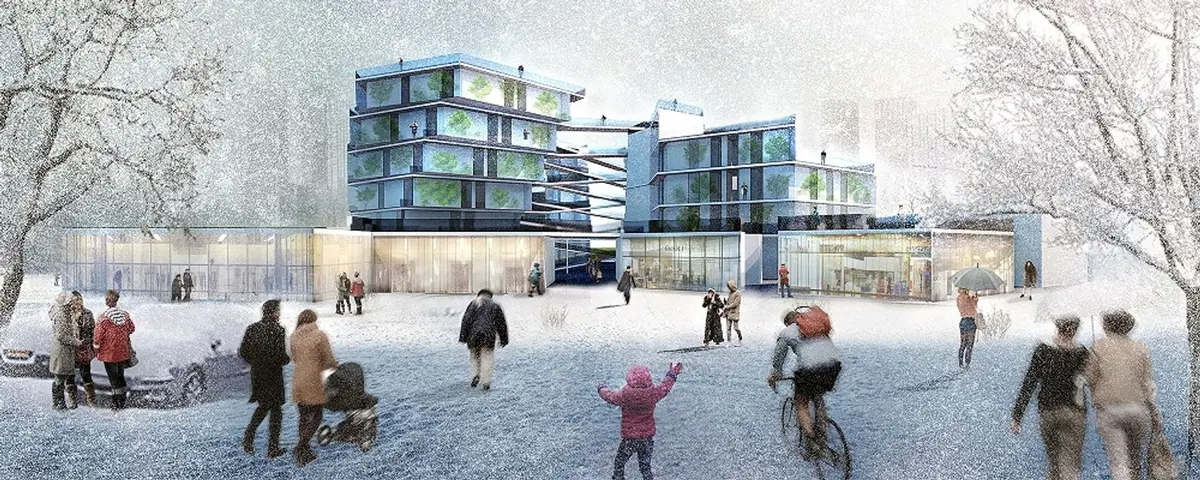
The primary elevation reads as a cascading series of planted terraces stepping down toward a public plaza alive with pedestrians and cyclists. This is not decorative greenery tacked onto a conventional slab. The terracing is the building's organizing principle, layering residential lofts with shared courtyards and pedestrian corridors so that each level has direct access to open sky and vegetation. The golden ratio governs the proportional relationships between these steps, producing a rhythm that feels intuitive rather than arbitrary. At ground level, the former brownfield site becomes an accessible and interactive public space, dissolving the boundary between private residential territory and the city.
An Atrium Engineered for Airflow, Not Just Light

Cut open the building and you find a central atrium defined by cantilevered floor slabs, red horizontal beams, and a generous skylight at its crown. The space is visually dramatic, but its real purpose is thermodynamic. Advanced CFD simulations shaped this void and the building's broader aerodynamic form to regulate airflow year-round. Passive ventilation strategies channel cool air upward through the atrium during Moscow's warmer months, mitigating heat buildup without mechanical intervention. In winter, the same geometry helps retain warmth. The result is a section that performs as hard as it looks, maintaining thermal comfort across a climate that swings from freezing to temperate.
Two Volumes, One Glazed Connection, Minus Twenty Degrees

Seen from the exterior on a snowy winter day, LoftPub reveals its parti most clearly: two stepped residential volumes linked at their base by a glazed connector. The massing breaks what could be a monolithic block into two distinct figures, each with its own terraced profile, while the transparent ground plane preserves visual and physical permeability across the site. The design team's choice to emphasize openness even in a city with brutal winters is made credible by the hybrid energy system operating beneath the surface. An Organic Rankine Cycle, biomass boilers, photovoltaics, and solar thermal units work in concert with a micro CHP system and methanation technology to generate energy onsite, enabling the complex to function with minimal external dependency regardless of season.
Reclaiming the Riverfront for Daily Life
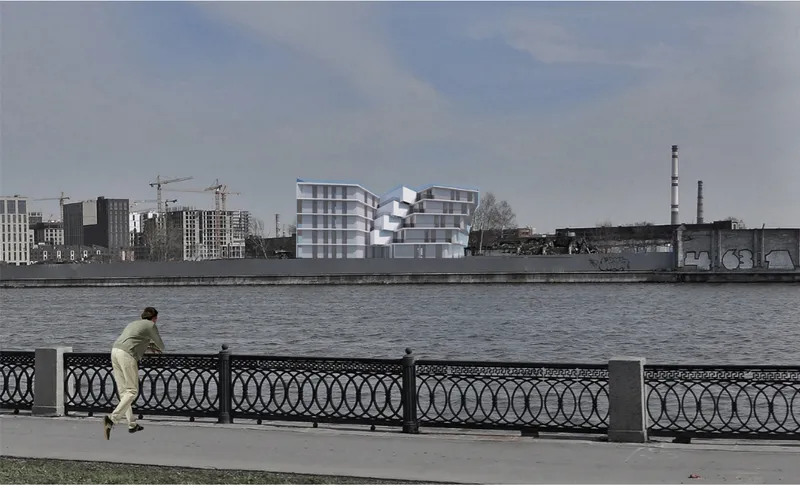
From the river, the stacked volumes assert themselves as a new presence on Moscow's waterfront, while the promenade below, complete with ornamental railings, invites joggers and pedestrians into a landscape that was recently inaccessible industrial land. The project's social ambition is legible here: by situating youth-oriented housing directly along a public waterfront walk, LoftPub turns its residents into participants in a shared urban life rather than occupants sealed off behind a perimeter. The building is both landmark and infrastructure, marking the Zil district's transition while actively contributing to the public realm at its edges.
Why This Project Matters
LoftPub is compelling because it refuses to treat energy performance and community building as separate agendas. The Fibonacci-derived massing is not ornamental mathematics; it directly generates the terraced social spaces and the aerodynamic envelope that make the building livable without excessive mechanical systems. Similarly, the hybrid energy infrastructure is not a checklist of green technologies but a coordinated system, ORC plus biomass plus photovoltaics plus solar thermal plus micro CHP, calibrated to deliver resilience across Moscow's extreme seasonal swings.
For a shortlisted competition entry, the level of technical integration is notable. Jozani, Abdi, and Biglari demonstrate that post-industrial redevelopment does not have to choose between social inclusivity and environmental performance. LoftPub argues, persuasively, that a brownfield can become a net contributor to the city: producing its own energy, hosting public space on land that was once fenced off, and offering immigrant youth a place that belongs to them. That is a blueprint worth paying attention to.
View the Full Project
About the Designers
Designers: Nima Asadi Jozani, Alireza Abdi, Shiva Biglari
Enter a Design Competition on uni.xyz
uni.xyz runs architecture and design competitions year-round that reward proposals with spatial conviction and real site intelligence.
Project credits: LoftPub by Nima Asadi Jozani, Alireza Abdi, Shiva Biglari Hustle Hub 2019 (uni.xyz).


Popular Articles
Popular articles from the community


The Ocean Hive: Sustainable Architecture for a Self-Sufficient Civilization at Sea
The Ocean Hive imagines sustainable architecture at sea, where modular habitats, algae, wave power and ocean waste sustain a growing colony.

Little Red Riding Hood: Architectural Design as a Journey Through Fear, Light, and Storytelling
Little Red Riding Hood reimagines the fairy tale through architectural design shaped by fear, light, scale, memory, uncertainty, and choice.

The Musturak Paradise: Senior Living Architecture for a Connected Future in Temara, Morocco
The Musturak Paradise reimagines senior living architecture in Temara via private homes, social spaces, culture, community, and shared care.

Conexión: Biophilic Design Reimagines High-Rise Living in Hong Kong
Conexión reimagines high-rise living in Hong Kong through biophilic design, green facades, shared spaces, daylight, water and nature within.

Similar Reads
You might also enjoy these articles

Day and Night Park: A Time-Based Urban Newsstand in Beijing
A temporary urban newsstand in Beijing blending travel, light, and reading through poetic colors, compact form, and community-focused design.

Modernist Patio Renovation in El Masnou, Barcelona by Oliver Segura Arquitectura + Cebrià Arquitectura
Modernist patio renovation blending tradition and innovation with a movable pool, leveled floors, and Catalan materials in El Masnou.

Alto Residencial Coop: Cooperative Housing Development in Santiago de Compostela by Carbajo Barrios Arquitectos
A linear cooperative housing complex blending white volumes and perforated metal façades, enhancing community living, natural light, privacy, and urban integration.
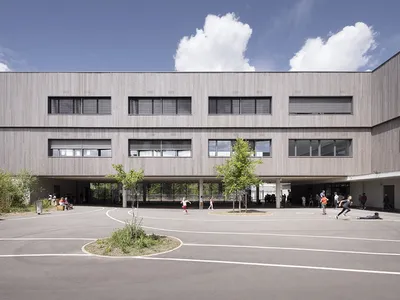
Vil Genis School by BPA ARCHITECTURE – Massy, France
Vil Genis School in Massy, France, features sustainable design, south-facing classrooms, community integration, accessible spaces, and modern educational architecture.


Comments (0)
Please login or sign up to add comments
No comments yet. Be the first to comment!