
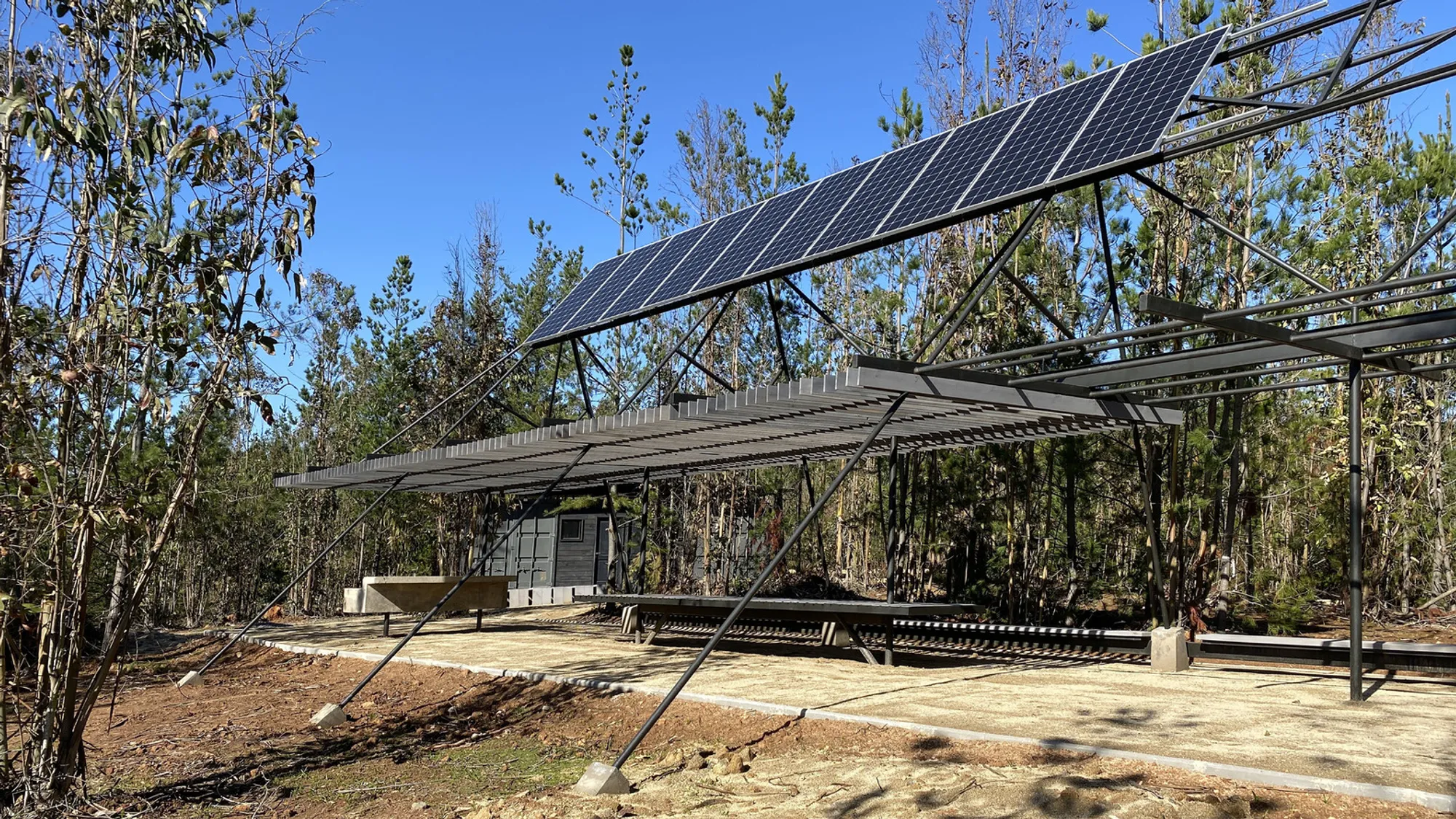
Dharq Arquitectos Builds a Solar Canopy Pavilion on Untamed Chilean Land
A 120-square-meter steel and wood structure in Los Colihues doubles as a solar array and a communal gathering space among the pines.


Photovoltaic panels need angle, height, and orientation. A communal gathering space needs shade, enclosure, and a reason to sit down. Dharq Arquitectos, led by Patricio Huidobro Tornvall, took both of those requirements and collapsed them into a single 120-square-meter structure on a wild, largely undeveloped site in Los Colihues, Chile. The result is a pavilion that generates electricity for its own lighting and water pumping while offering a shaded retreat with a table, a bench, and a grill beneath a canopy of steel and wood.
What makes the project worth studying is the economy of means. There is no façade, no enclosure in the conventional sense, and almost no material palette to speak of. The entire design proposition rests on a structural frame that exists to hold solar panels at the correct angle, and then exploits the leftover space beneath for human occupation. It is a refreshingly honest piece of architecture: infrastructure that doubles as shelter, with nothing added for decoration.
Steel Frame as Landscape Object
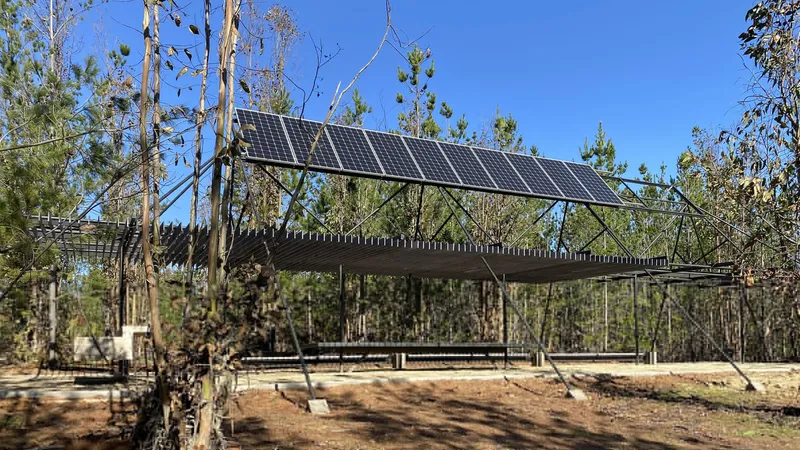
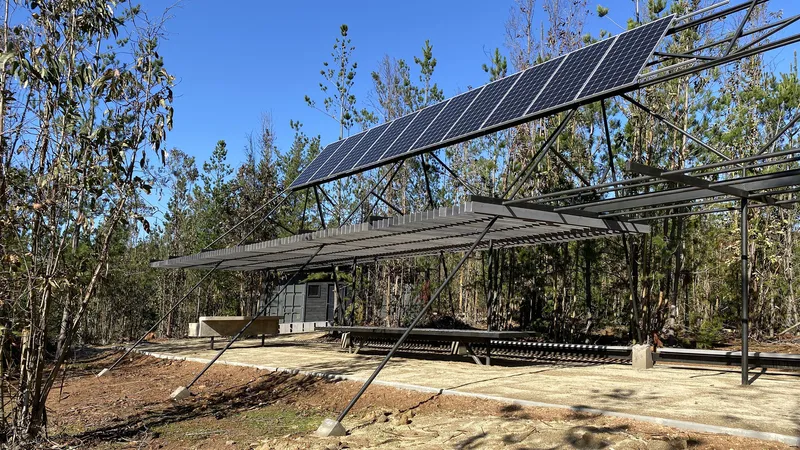
From a distance the pavilion reads as an elevated solar array, its panels tilted toward optimal exposure on slender steel verticals that almost disappear against the surrounding pine trunks. The proportions are deliberate. The frame had to reach a specific height and rake angle to maximize energy capture, and the architects used that constraint as the generator for the entire form. Lightweight metal columns lift the panel deck well above head height, which simultaneously satisfies the engineering brief and creates a generous volume of shade below.
Seen in the context of the cleared forest site, the structure has a quiet industrial quality. It does not mimic nature or apologize for being man-made. Instead it stands in frank contrast to the irregular bark and bare branches around it, asserting its purpose without competing for visual dominance.
The Hybrid Structure Up Close
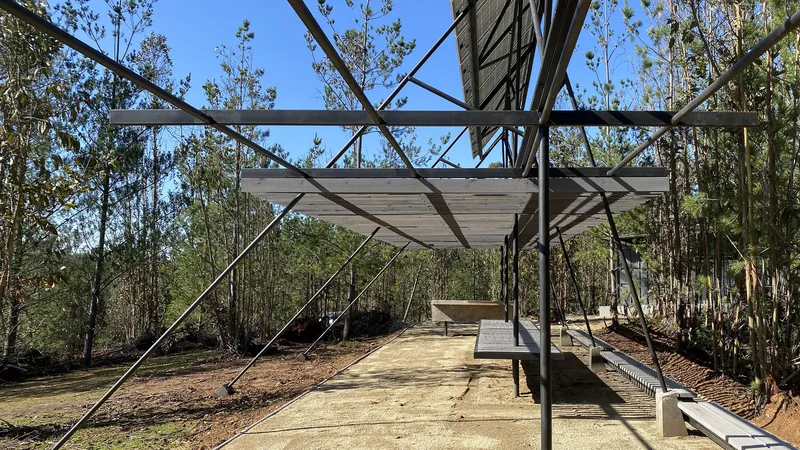
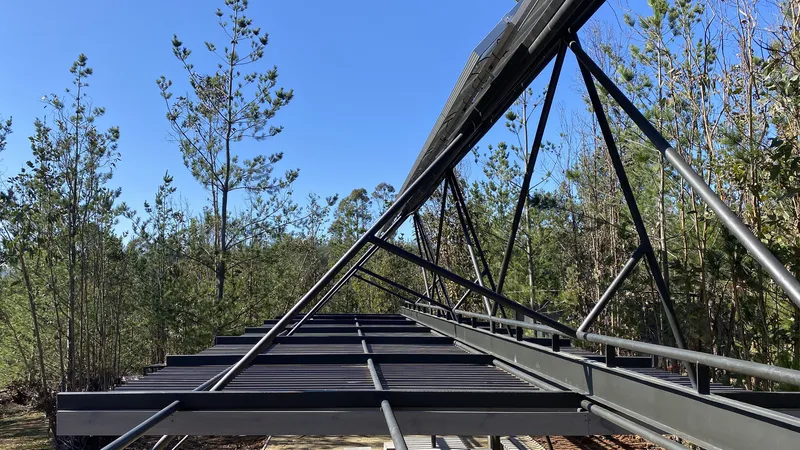
Look up from beneath the canopy and the structural logic becomes legible. A network of steel trusses with diagonal bracing transfers the load of the solar panels down to the columns. The corrugated metal roof deck spans between beams at regular intervals, creating a taut, utilitarian ceiling that filters light along its ridges. Every connection is exposed; there are no soffits or cladding panels hiding the joints.
The architects describe a hybrid approach using both steel and wood. Steel handles the primary structure, keeping members thin and the visual footprint minimal. A suspended wooden element at roughly 2.5 meters provides secondary shading and casts moving shadow patterns as the sun tracks across the sky. The interplay between the two materials is not decorative but functional: metal for span and rigidity, wood for thermal comfort and human scale.
Gathering Space Beneath the Panels
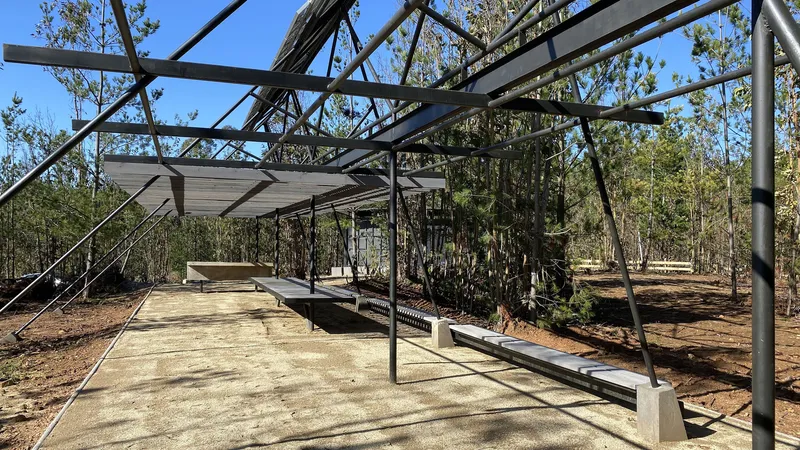
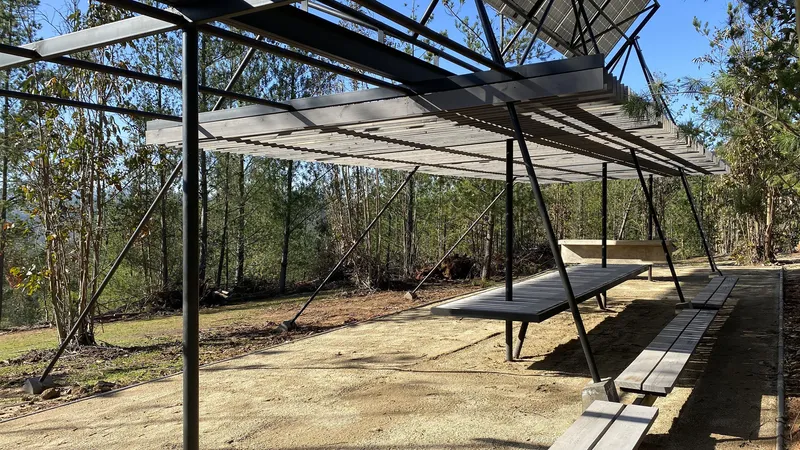
The social program sits directly underneath the solar infrastructure. A concrete pad anchors a long communal table with built-in bench seating, oriented so that occupants face outward toward the surrounding woodland. A secondary zone, shielded by a tensioned fabric membrane rather than rigid panels, moderates direct sunlight while keeping the perimeter fully open to views and breezes. There is no door to open, no threshold to cross. You simply walk in from the forest.
That openness is the point. The pavilion is less a building and more a piece of landscape furniture scaled up to the size of a room. It defines territory without enclosing it. The grill, the table, and the bench establish a center of gravity for gathering, while the canopy overhead provides just enough protection to make lingering comfortable through the heat of a Chilean afternoon.
Energy as Architecture
Many buildings bolt solar panels onto a roof as an afterthought. Here the panels are the roof. The JA Solar array is not supplementary to the design; it is the design's reason for existing. Energy consultant AMC Energía worked with the architects to determine the optimal tilt and orientation, and those parameters dictated the geometry of the steel frame before any consideration of shade or seating entered the picture. Architecture emerged from the surplus.
That inversion of priorities is what makes the project instructive. Rather than starting with a pavilion and then asking how to make it sustainable, Dharq Arquitectos started with an energy installation and asked how to make it habitable. The distinction is more than semantic. It produces a structure in which sustainability is not a checklist item but the organizing logic.
Why This Project Matters
At 120 square meters, the Los Colihues Pavilion is small enough to be overlooked. But its contribution lies in method, not magnitude. By treating renewable energy infrastructure as the primary architectural brief, Dharq Arquitectos demonstrates that sustainability and spatial quality do not have to negotiate with each other. The canopy shades because the panels need angle. The columns are slender because the loads are modest. The space is open because there is nothing to hide. Every design decision has a legible cause, and that legibility is the project's real luxury.
For architects working on rural sites with limited budgets and ambitious environmental goals, the pavilion offers a transferable idea: let the infrastructure do double duty. When energy generation becomes the armature for community space, neither function is diminished. Both are, in fact, sharpened by the constraint.
Los Colihues Pavilion by Dharq Arquitectos (Lead Architect: Patricio Huidobro Tornvall). Los Colihues, Chile. 120 m². Completed 2022. Construction by Constructora Construmox. Energy consultant: AMC Energía.
About the Studio
Share Your Own Work on uni.xyz
If projects like this are the kind of work you want to make, uni.xyz is a place to publish your own, find collaborators, and enter design competitions.




Popular Articles
Popular articles from the community


Hill & Cross Opera: Sculptural Opera House Architecture Shaped by Tallinn’s Landscape and Identity
Hill & Cross Opera reimagines opera house architecture in Tallinn through its sculptural hill, civic plaza, glass wave and a luminous cross.

Co-life: Sustainable Architecture for Age-Friendly Community Living
Co-life reimagines sustainable architecture for seniors through courtyards, rammed earth, shared gardens, and spaces designed for belonging.

Co-Life: Senior Housing Design That Reconnects Older Adults With the City
Co-Life reimagines senior housing design through healing gardens, shared streets, workshops, and a sustainable community across generations.

The Ocean Hive: Sustainable Architecture for a Self-Sufficient Civilization at Sea
The Ocean Hive imagines sustainable architecture at sea, where modular habitats, algae, wave power and ocean waste sustain a growing colony.

Similar Reads
You might also enjoy these articles


Hodi-Mandai Geram
Project Function: Preservation and revitalization of the Intangible heritage and socio-spatial identity of the Hodi by Housing, Cultural Memory Center, Sacred Grove, landscape, local tourism economy


Olio Towers: A Mid-Rise for Performers That Fuses Housing, Rehearsal, and Stage
Located blocks from Houston's Theater District, this modular tower stacks living units around a central performance atrium.

Oasis: Modular Green Housing Carved into Dhaka's Urban Fabric
A shortlisted Plugin Housing entry reclaims unauthorized settlements in Dhaka with stepped concrete volumes, green roofs, and ventilation-driven design.

Black Hole: A Floating Megastructure for the Post-Physical Era
Emiliano Mazzarotto envisions a spherical, self-scaling arena where e-sports, digital hotels, and holographic stadiums replace traditional public space.


Explore Architecture Competitions
Discover active competitions in this discipline


Challenge to design a portable theatre


Challenge to design a portable music platform


Challenge to design an open learning module for the elderly


Challenge to reimagine the Iron Throne
Comments (0)
Please login or sign up to add comments
No comments yet. Be the first to comment!