
Christoph Wagner Architekten Builds Berlin's First LGBTQ+ Housing Block in Friedrichshain-Kreuzberg
A queer cooperative housing project in Berlin pairs raw concrete and candy-colored cladding with radically inclusive spatial planning.


Berlin's Friedrichshain-Kreuzberg has long been the city's center of gravity for queer culture, activist politics, and cooperative living. The LOVO Building, designed by Christoph Wagner Architekten, crystallizes all three into a single residential structure: a six-story block that houses an LGBTQ+ cooperative alongside ground-floor community and commercial space. The name, the colors, and the spatial logic all signal that this is architecture built for a specific community rather than marketed to one.
What makes the project genuinely interesting is how it translates social intention into architectural form. The building is not simply affordable housing with a rainbow flag. Its plan types, ranging from single-occupancy rooms around a shared lounge to split-level maisonettes with double-height voids, emerge from real conversations about how queer households live: sometimes alone, sometimes in chosen families, often in fluid arrangements that conventional apartment typologies fail to accommodate. The facade advertises none of this legibility from the street; instead it offers a playful composition of corrugated metal, pink and teal frames, and deep balconies that reads as confident without being didactic.
Color as Identity, Not Decoration
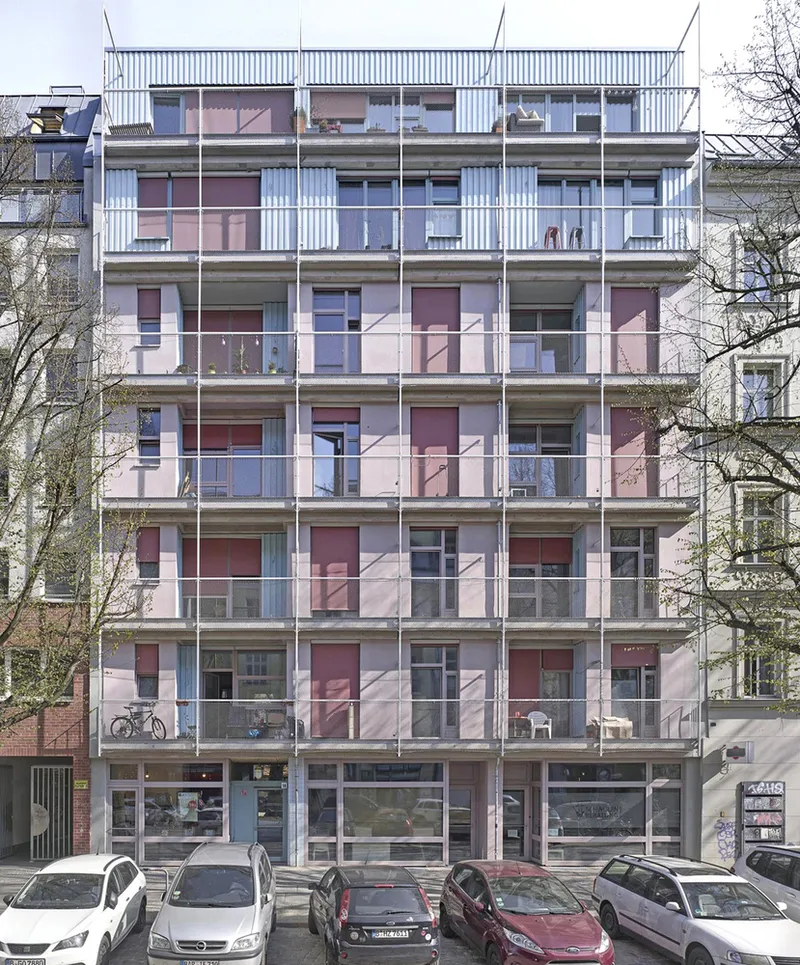
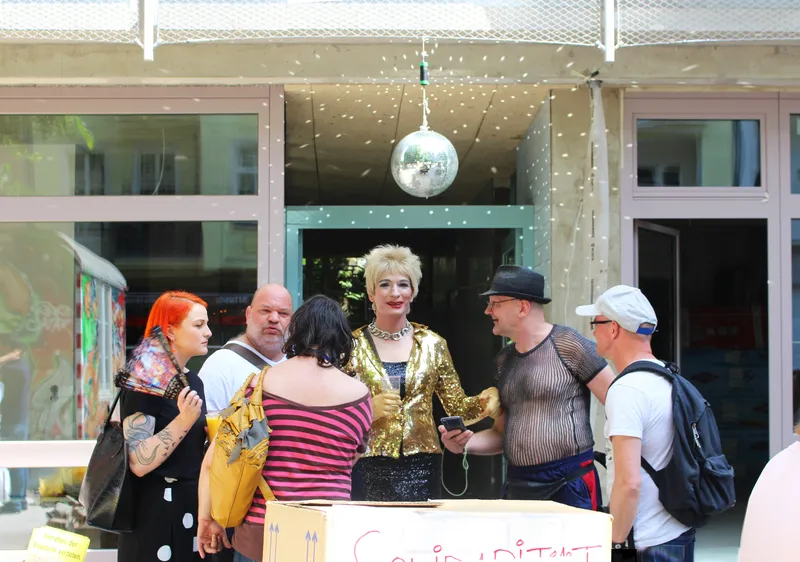
The street facade oscillates between pink, burgundy, and teal in a way that feels simultaneously festive and deliberate. Corrugated metal cladding in varying shades wraps the balconies and upper floors, while teal window frames punctuate the composition with a kind of counter-rhythm. A disco ball hangs at the ground-floor storefront entrance, a detail that could tip into parody but somehow holds its nerve, signaling that the building's public face is welcoming and unapologetic.
This is not pastiche queer aesthetics slapped onto a developer shell. The palette runs consistently through the interior: pink window frames visible from blue-floored bedrooms, mosaic-tiled bathrooms in saturated blue, red pendant lamps in plywood kitchens. The color choices read as integral to the material logic, tied to the exposed concrete and timber rather than applied over them.
The Courtyard and Collective Thresholds
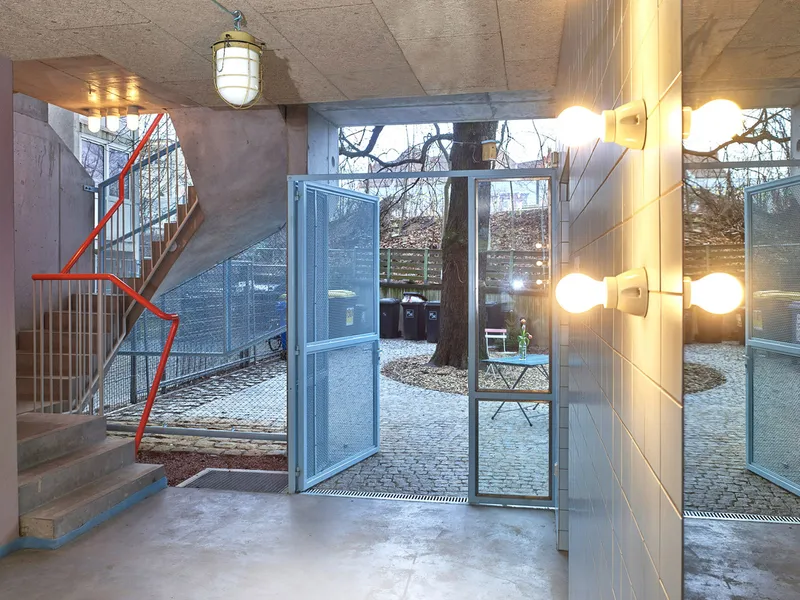
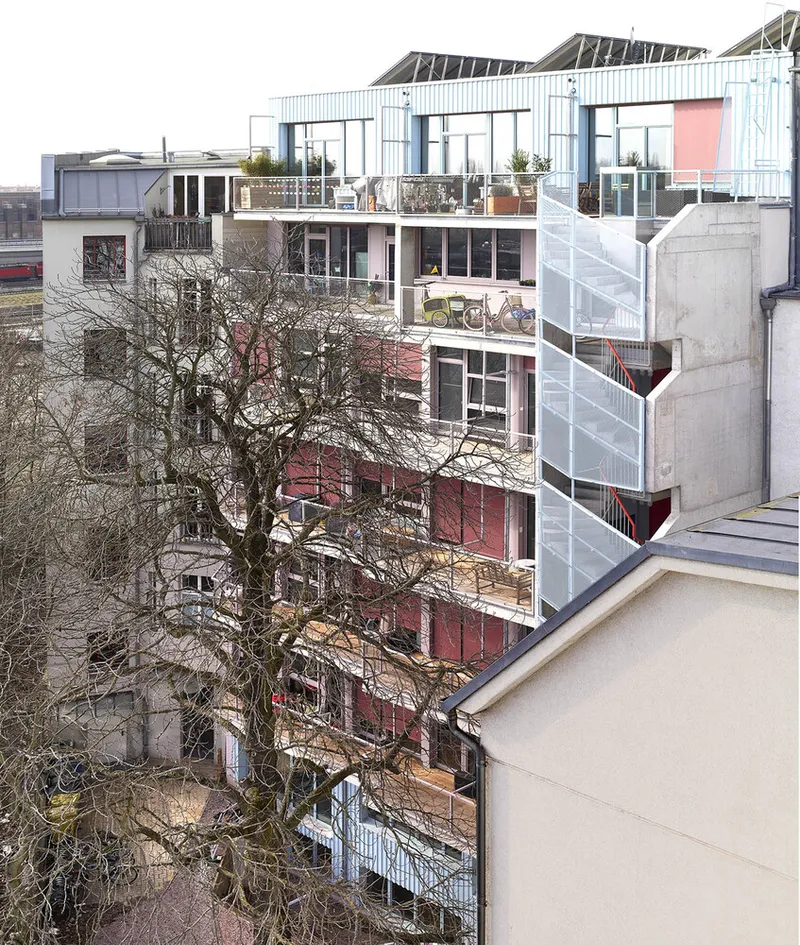
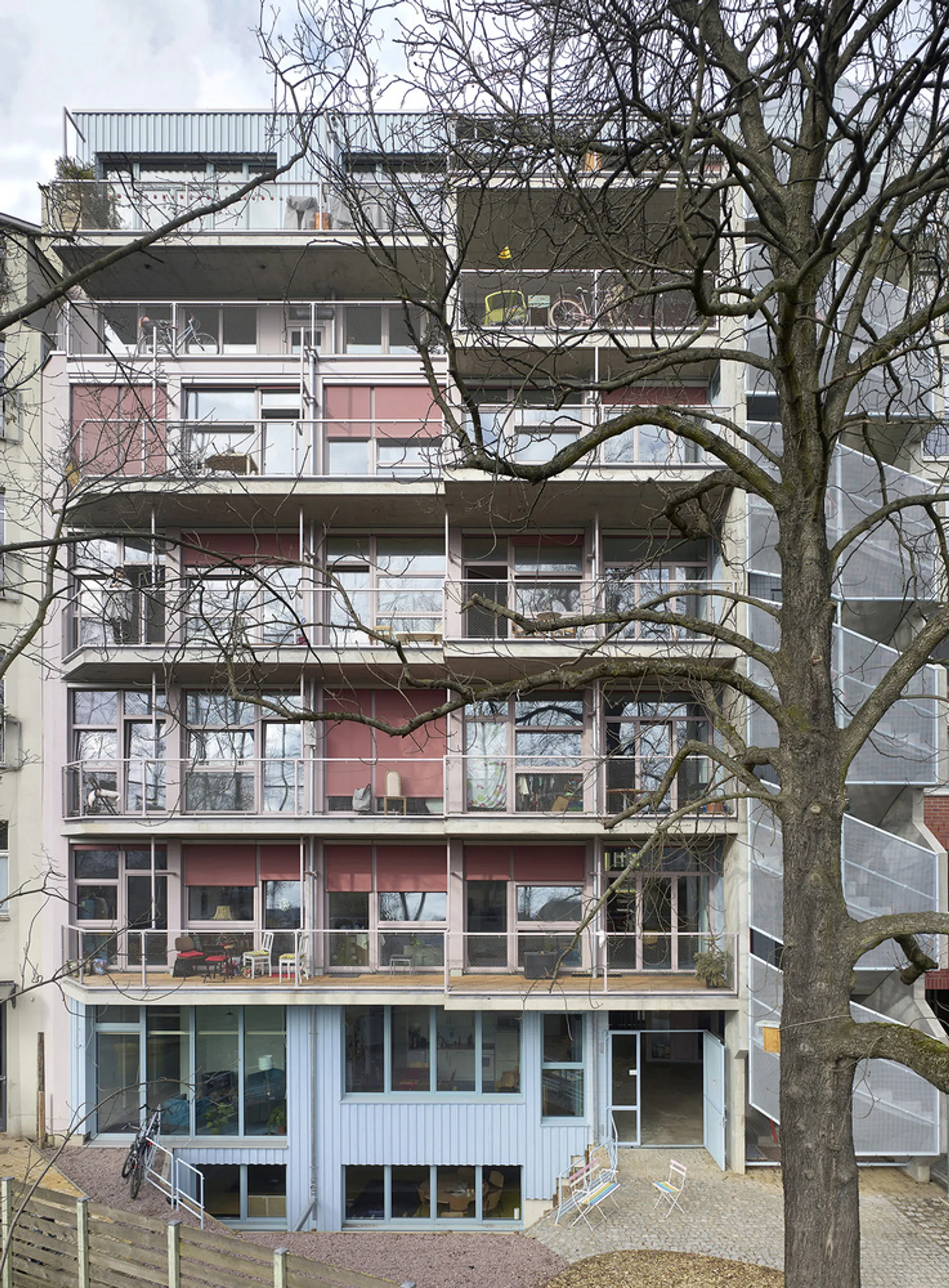
The entry sequence moves from the street through a glass-doored lobby and onto a cobblestone courtyard anchored by a single tree. This is classic Berlin Hinterhof planning, but the courtyard here does particular work: it creates a buffer between the public face and the private residences, a threshold where the cooperative's collective identity can register without surveillance from the street. Balconies, planted terraces, and parked bicycles layer the courtyard elevation with the visual noise of actual habitation.
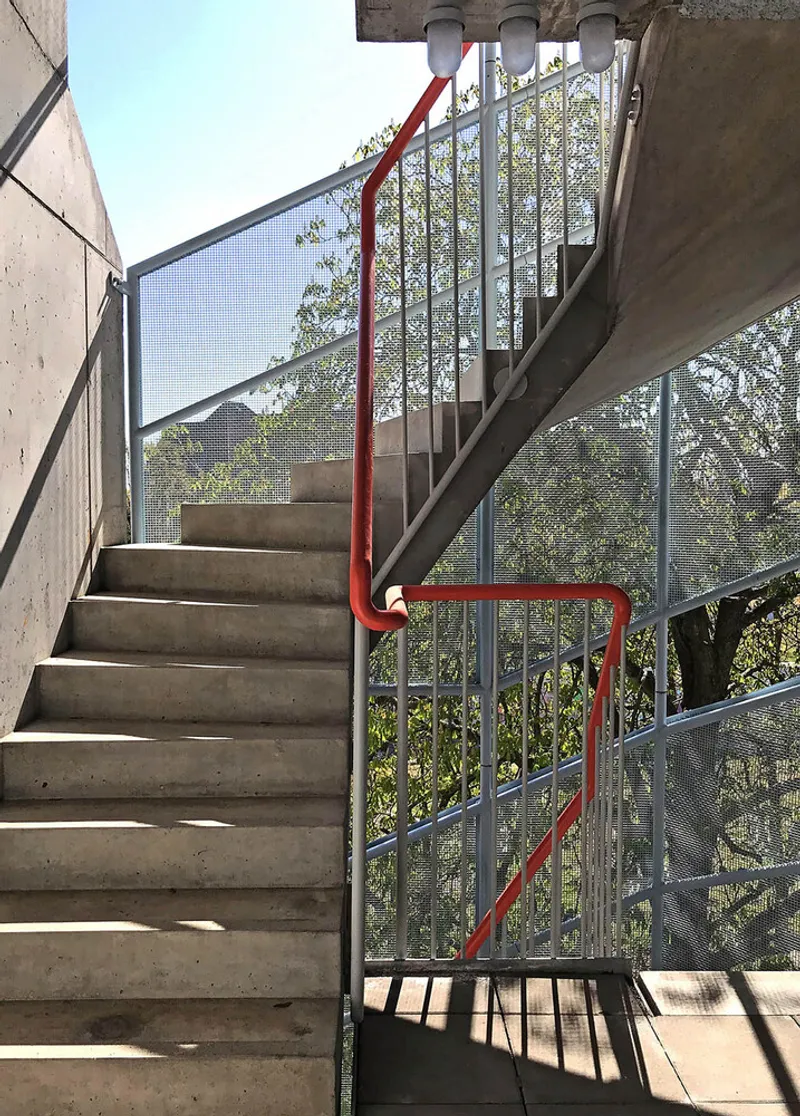
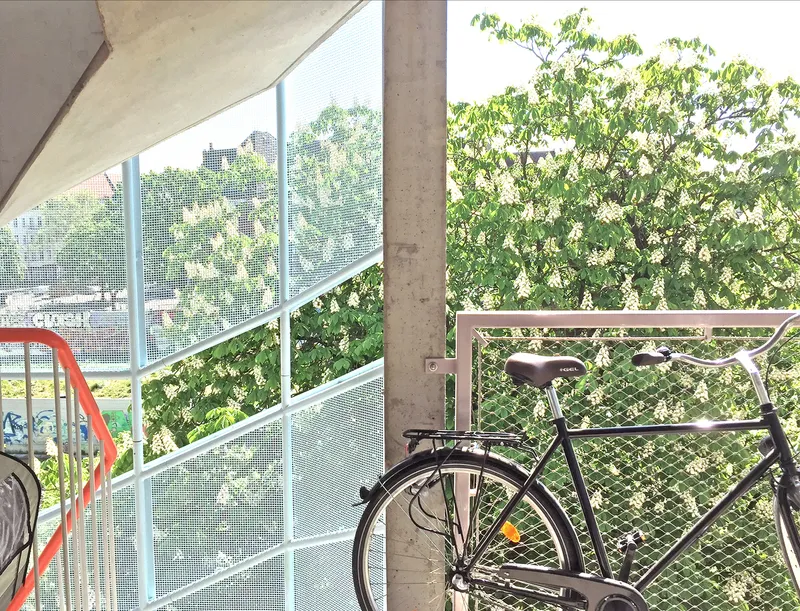
The concrete staircase, with its red handrail and perforated metal balustrade, threads through the building as both circulation spine and social connector. Green foliage presses against the stairwell glazing, softening what could otherwise feel institutional. It is a generous stair, wide enough for conversation, with landings that open to views of neighboring rooftops.
Living Spaces: Plywood, Concrete, and Flexible Domesticity
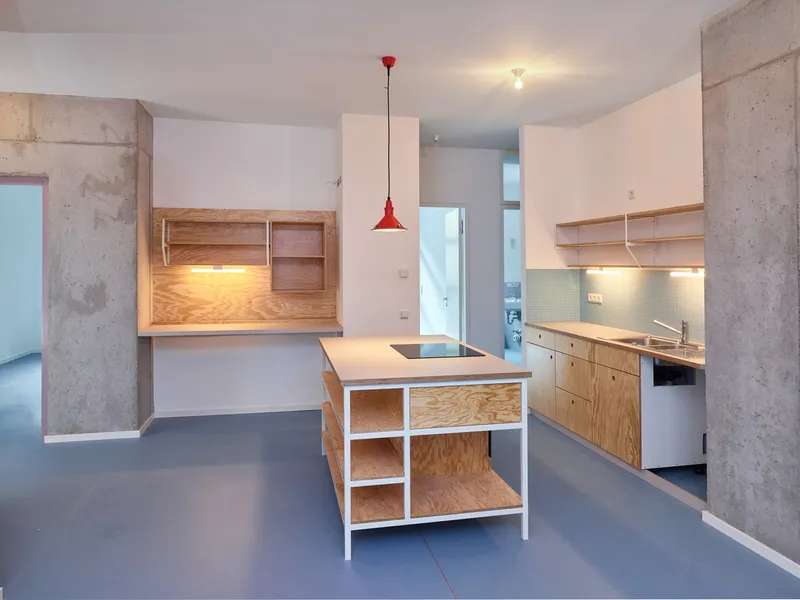
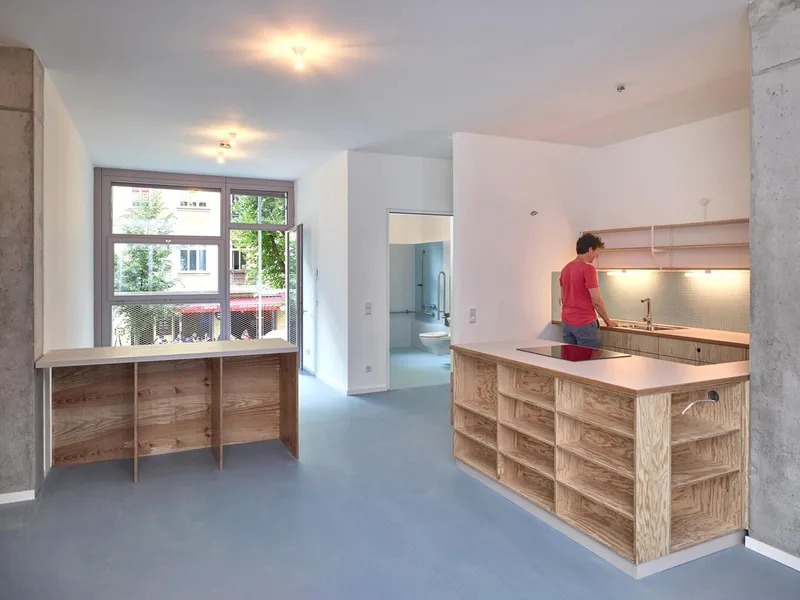
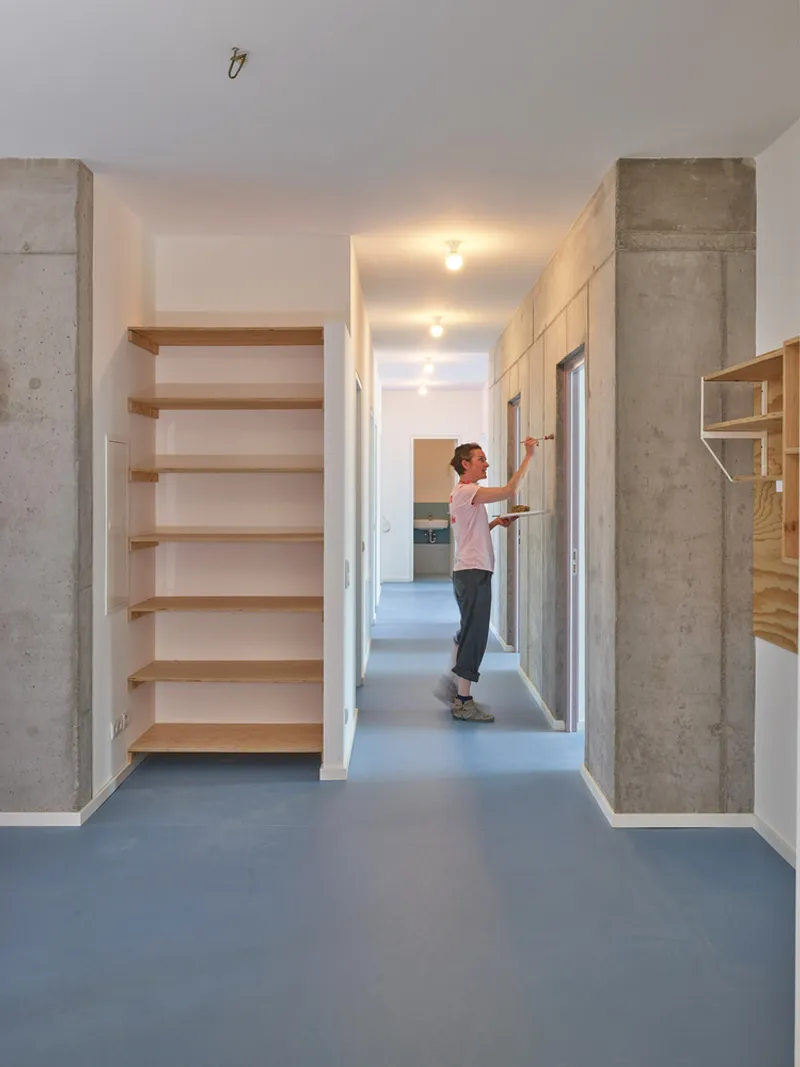
Inside the apartments, the material vocabulary narrows to three elements: exposed concrete structure, plywood joinery, and colored flooring. Kitchens are fitted with plywood islands and white countertops; shelving in the hallways is plywood too, giving residents a built-in framework they can organize rather than a finished interior they must accept. Concrete columns stand exposed throughout, serving as honest markers of the structural grid and anchoring the domestic spaces with a rawness that keeps the rooms from feeling precious.
The blue flooring that appears in bedrooms and hallways is a strong commitment, the kind of choice that a commercial developer would never risk. It works because it operates as a unifying field beneath the otherwise neutral palette of concrete and wood, pulling together rooms of different proportions and orientations.
Bedrooms and Bathrooms: Color in the Intimate Rooms
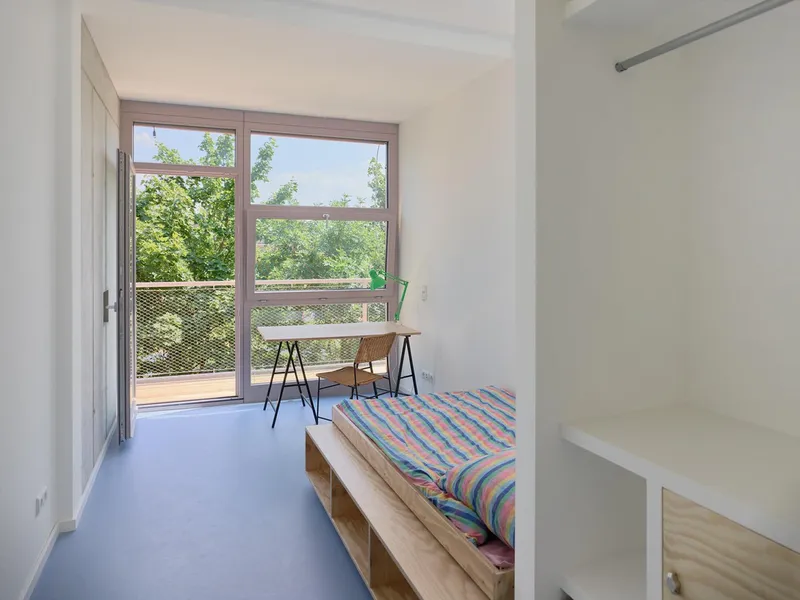
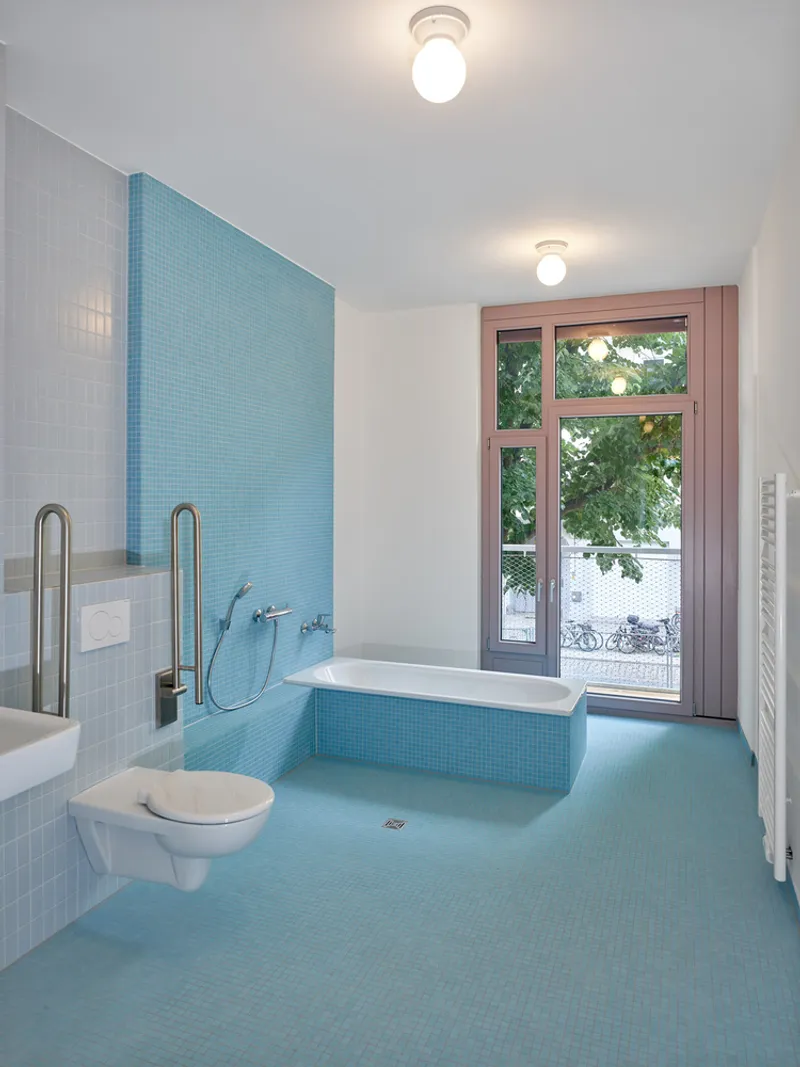
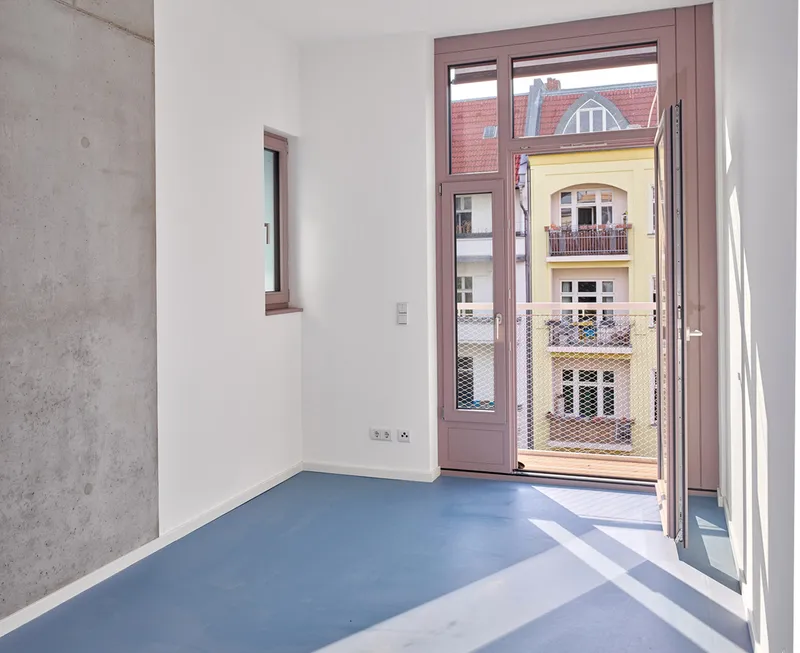
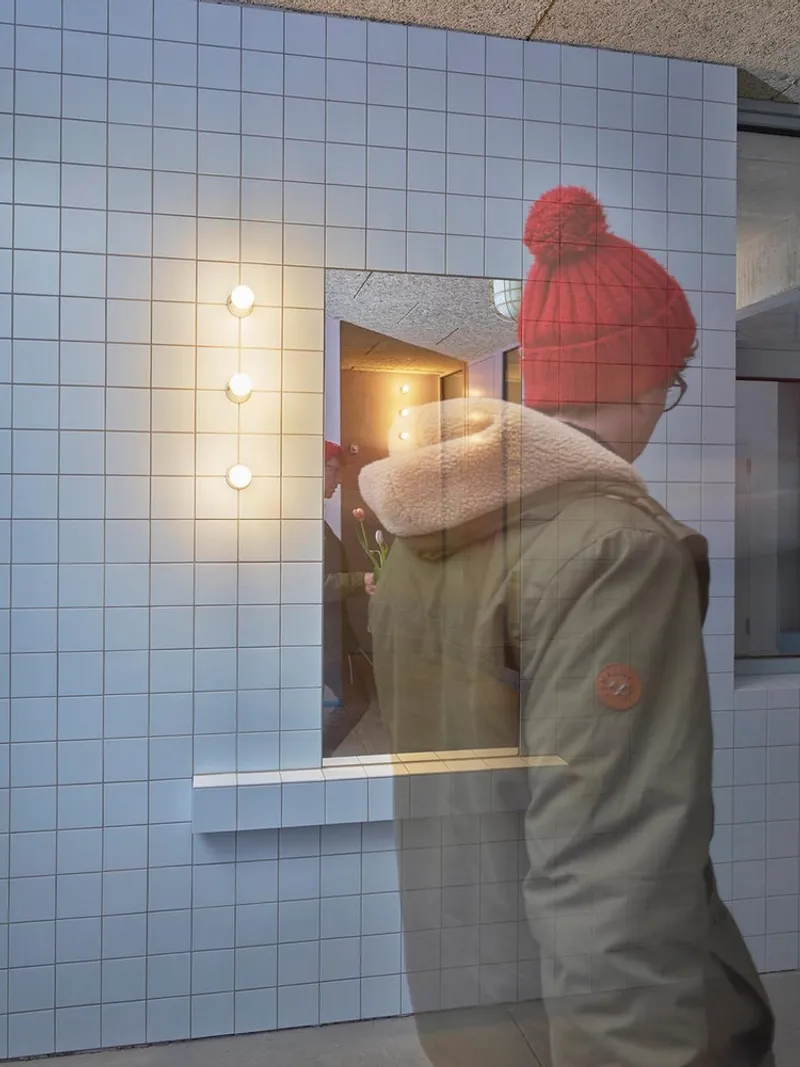
The bedrooms open directly onto balconies through glazed doors with pink frames, a connection that privileges daylight and greenery over privacy from neighbors. Plywood bed frames sit low against the blue floors, minimal but warm. The bathrooms take the chromatic program further: saturated blue mosaic tile, a sunken tub, and a pink-framed window that turns a functional room into something almost theatrical. Globe lights set into a recessed alcove in one bathroom wall suggest a deliberate overlap between domestic utility and pleasure.
Balconies as Extended Rooms
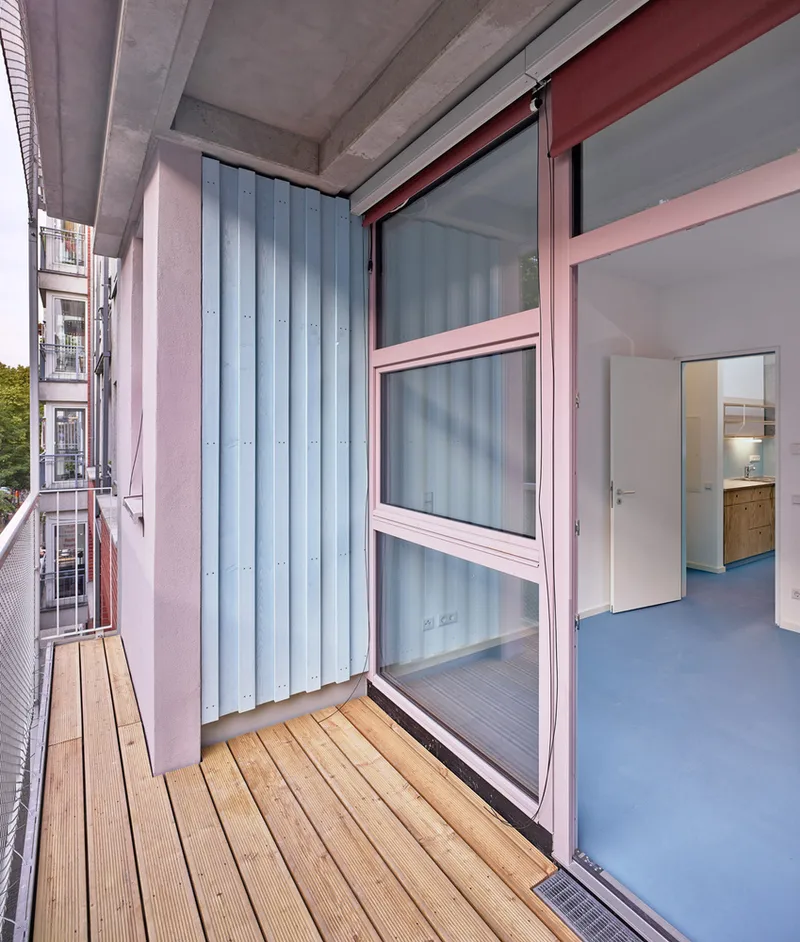
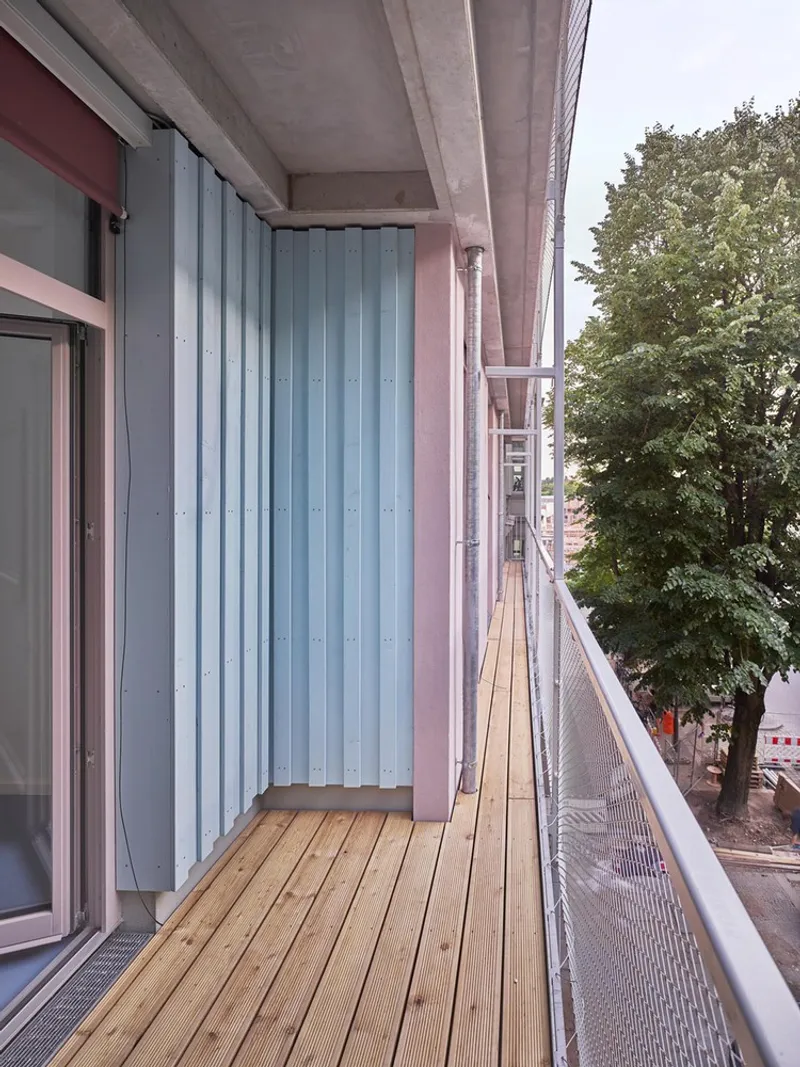
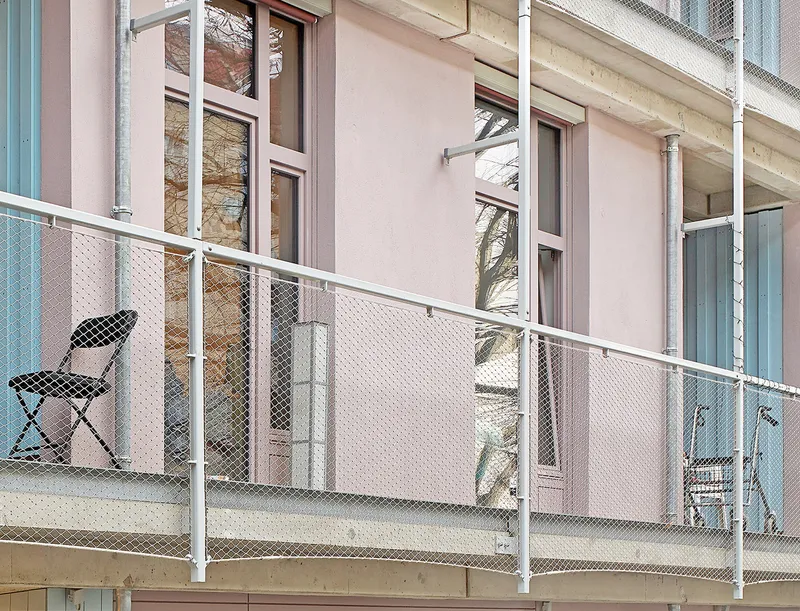
Deep balconies with timber decking and corrugated metal privacy screens function as outdoor rooms rather than token ledges. The concrete soffits overhead provide weather protection, while perforated mesh railings allow air and filtered views without full exposure. Flowering trees visible beyond the screens suggest that the landscape strategy extends vertically, blurring the edge between private balcony and shared green courtyard.
One balcony photographed with a bicycle propped against a concrete column and a mesh screen framing the tree canopy captures the building's lived-in quality. These are spaces designed for daily use, not for glossy photo shoots on completion day.
Double Heights and Maisonette Voids
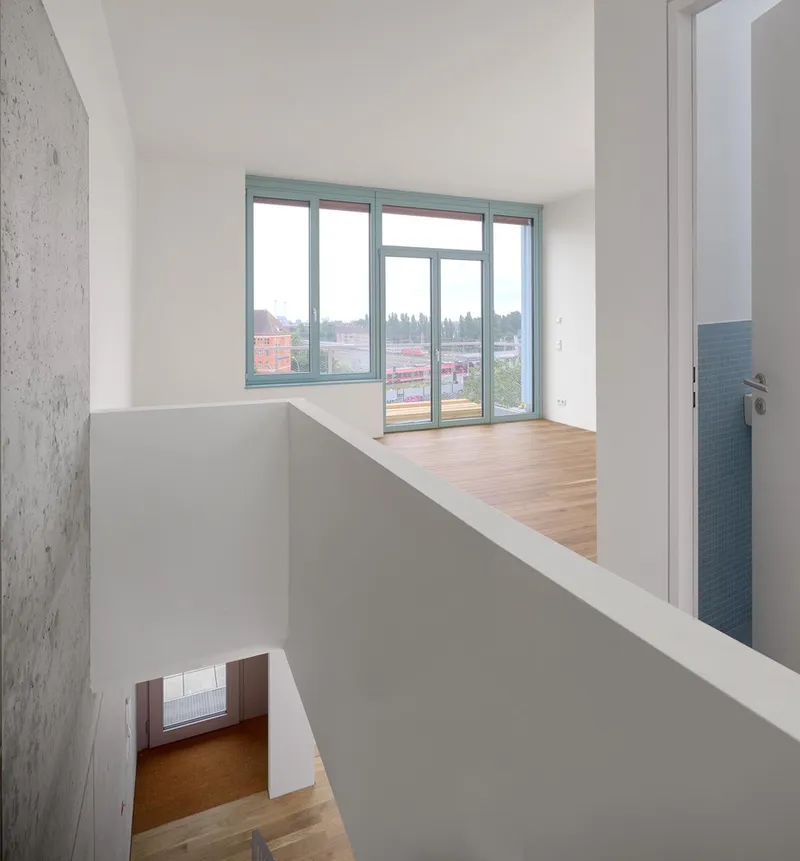
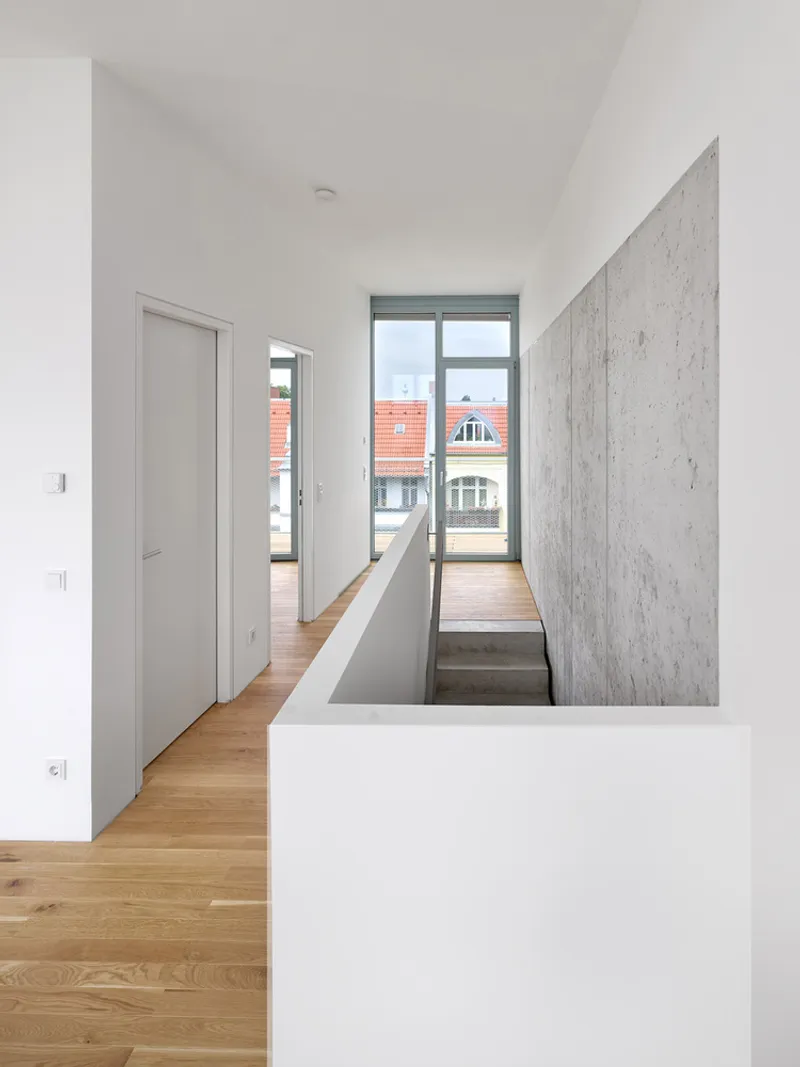
Several upper units feature double-height voids that bring light deep into the plan and create a spatial generosity uncommon in Berlin's typically tight residential sections. White walls and teal-framed windows in these voids amplify the sense of openness. The timber flooring in the maisonettes shifts register from the blue resin floors below, marking the split-level units as distinct within the building's typological mix.
An upper hallway with oak flooring and a window framing rooftop views demonstrates how the stairwell and corridor spaces are treated with the same care as the living rooms. In a cooperative housing project, the shared spaces are as politically significant as the private ones.
Plans and Drawings
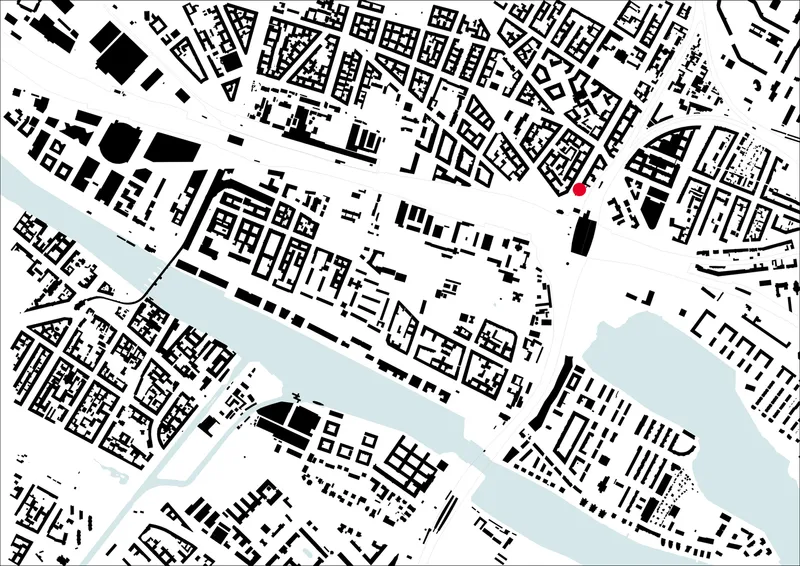
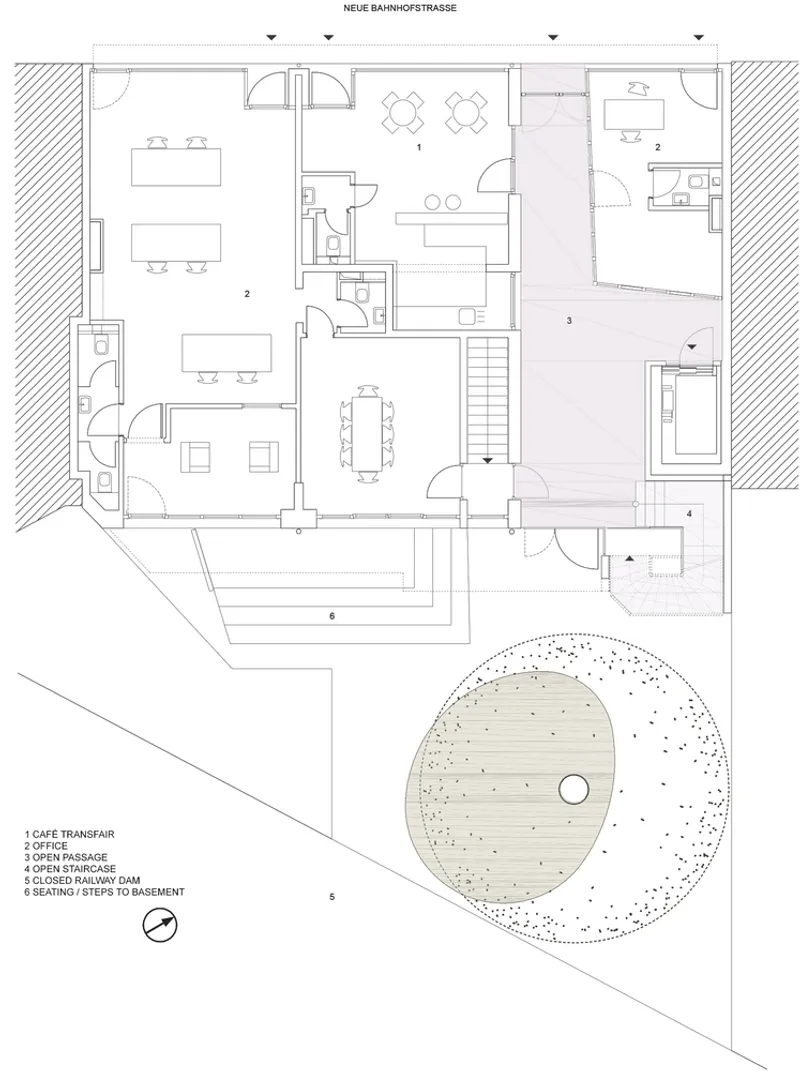
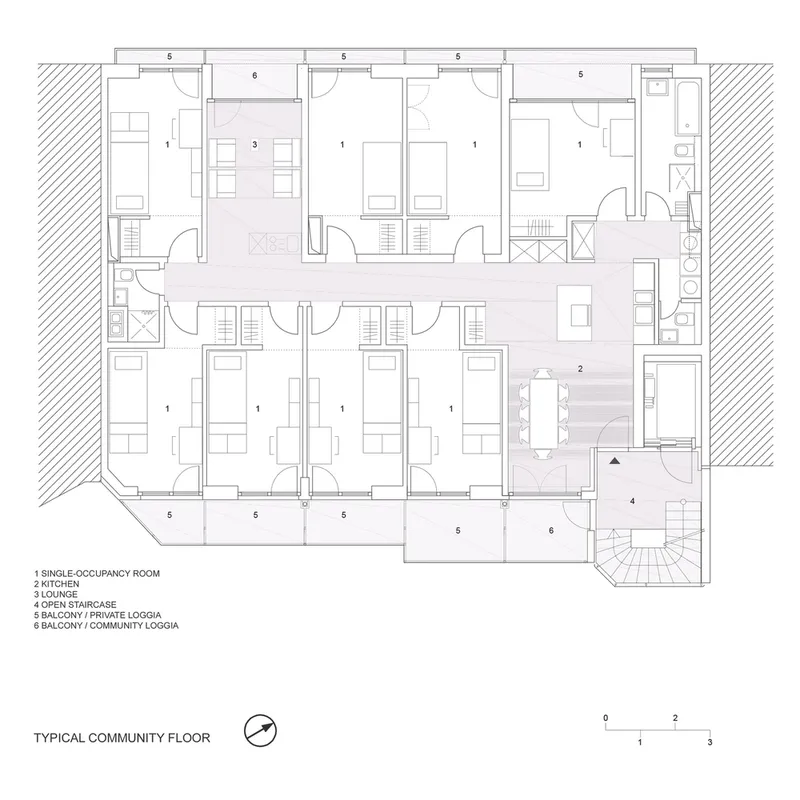
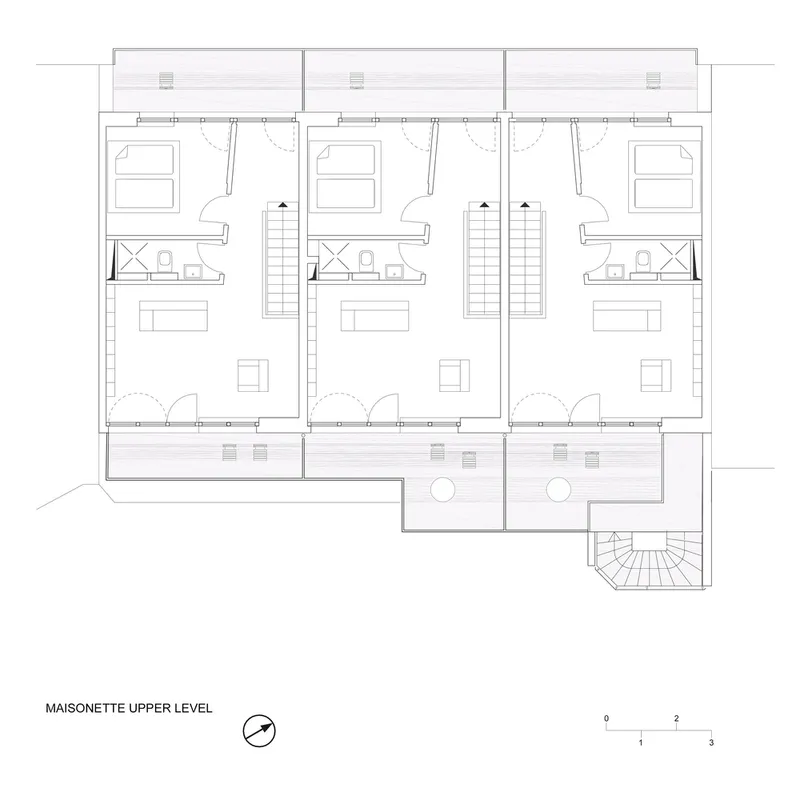
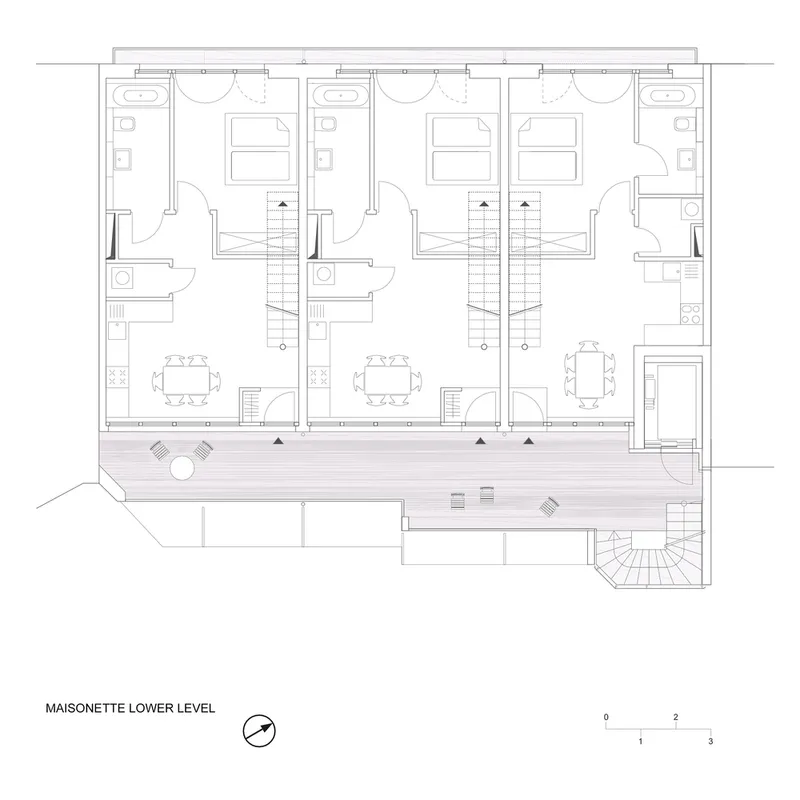
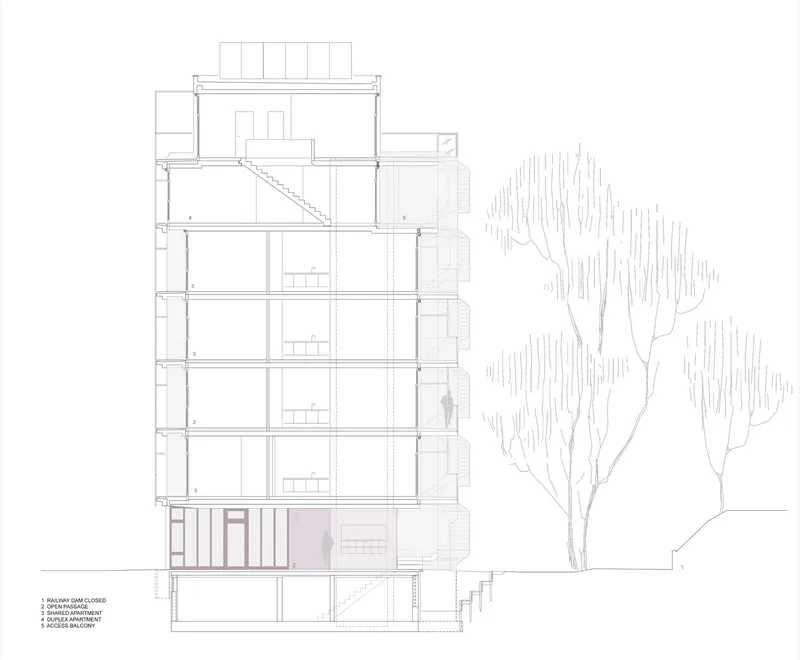
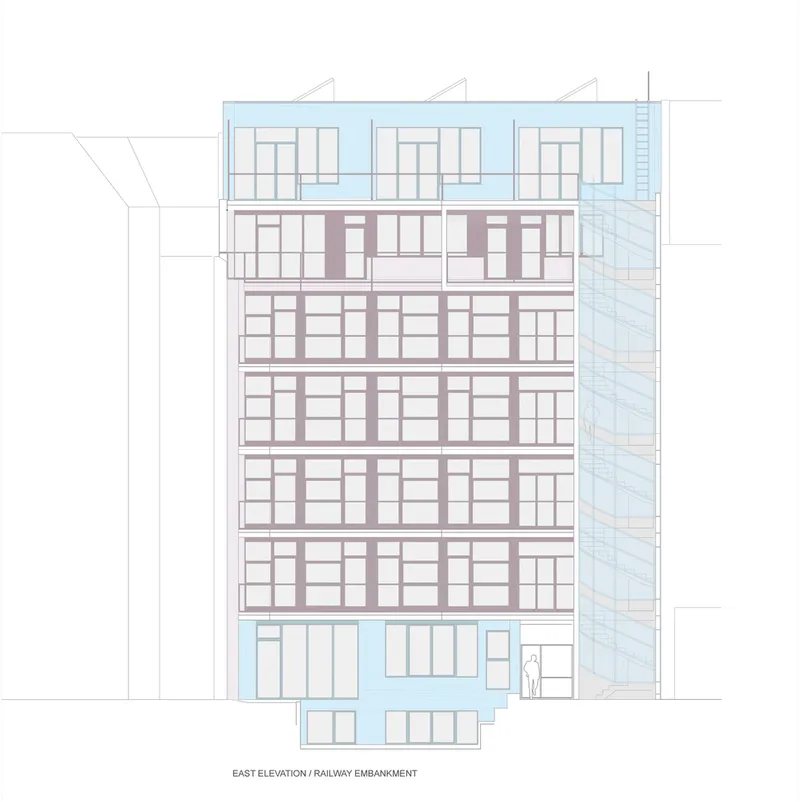
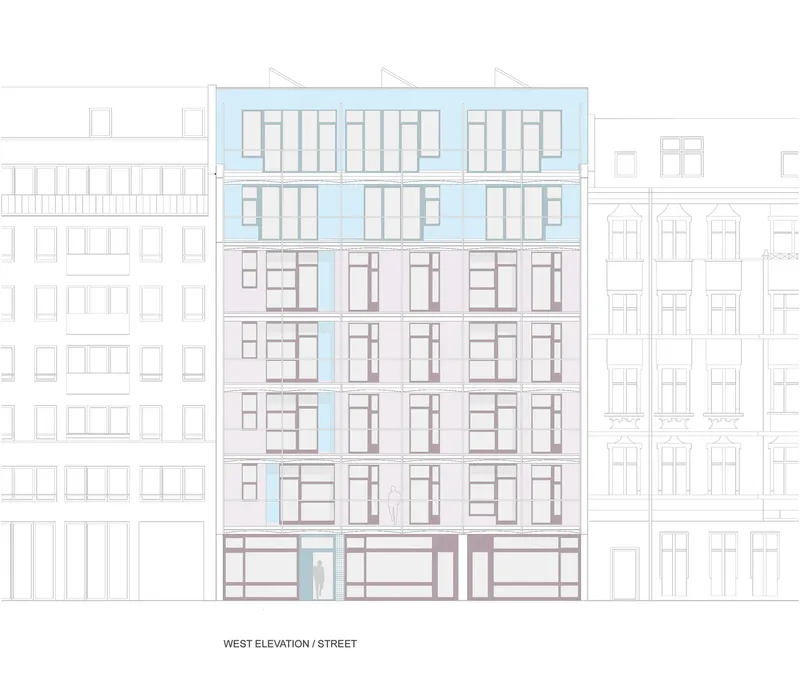
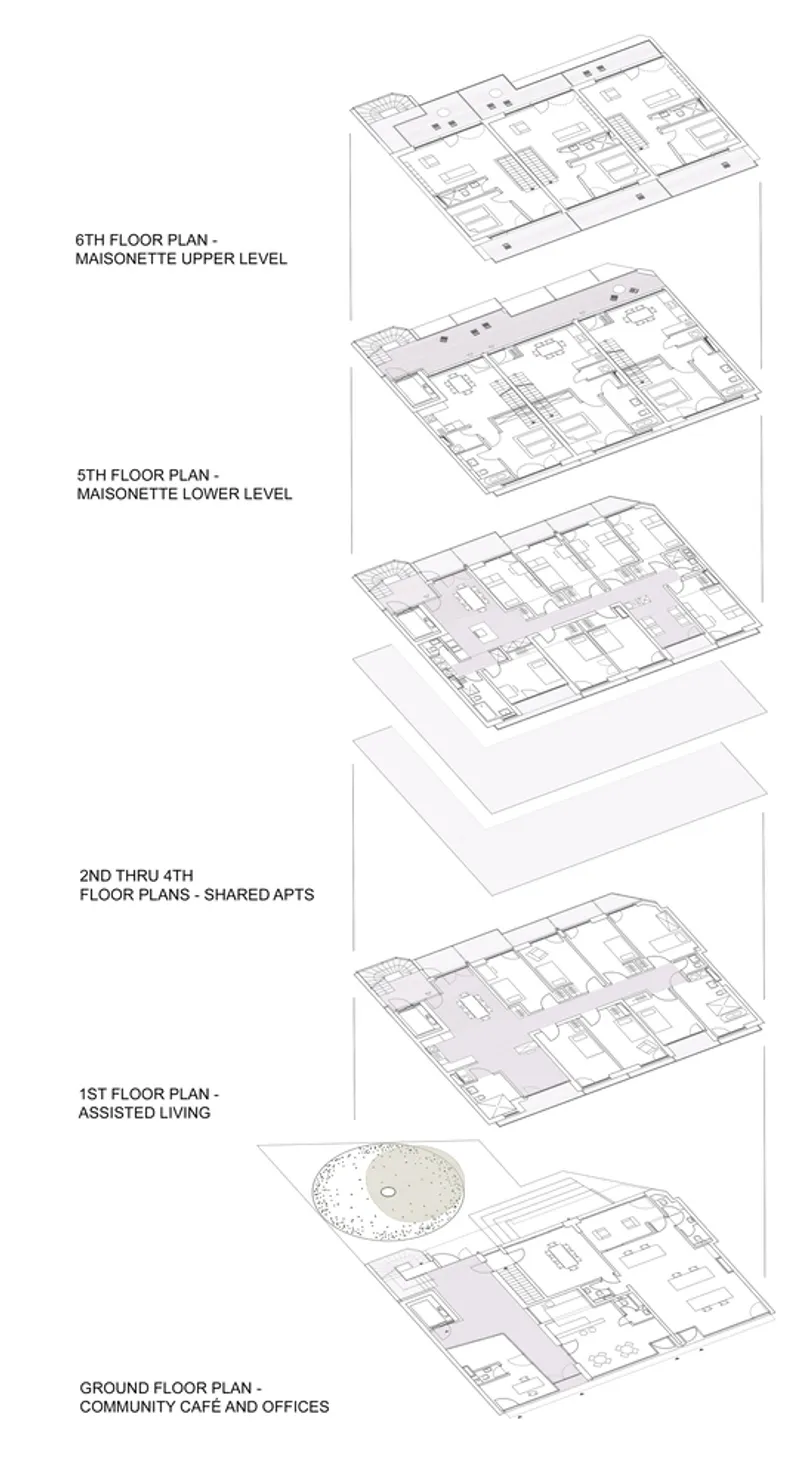
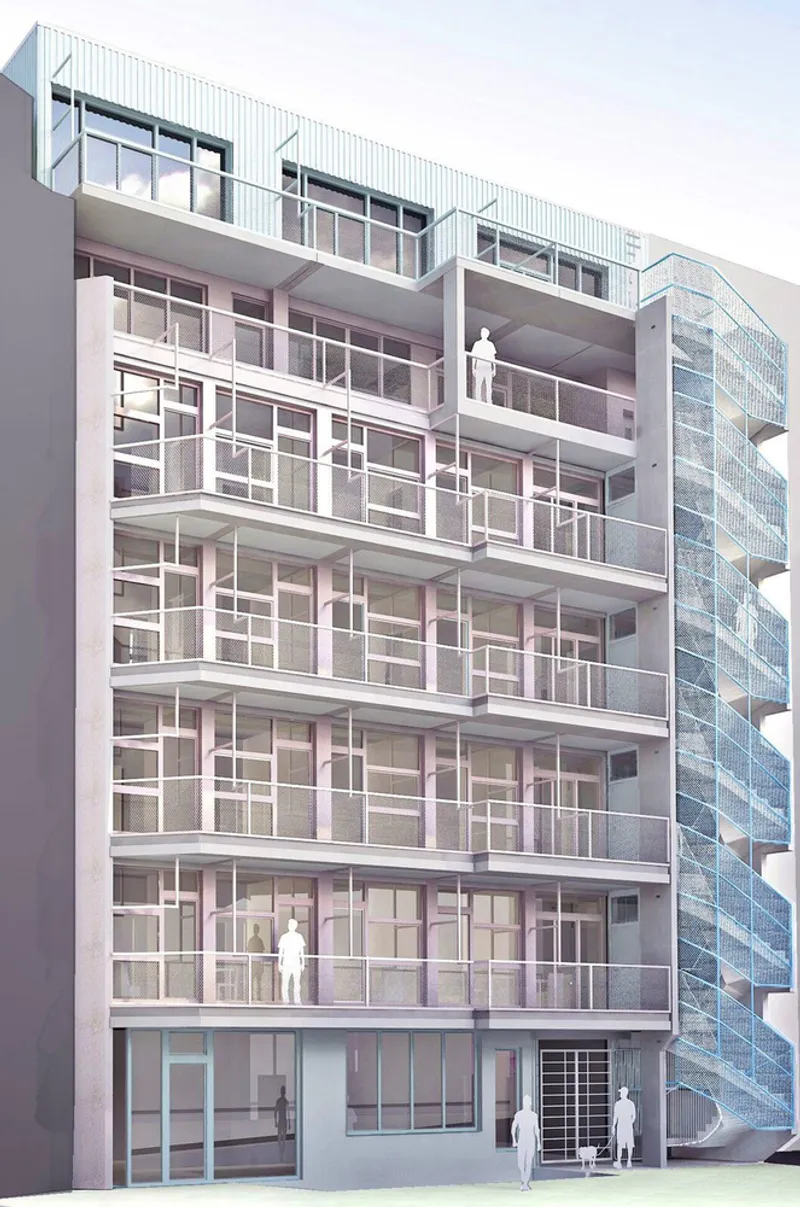
The site plan locates the building in red against the surrounding urban fabric, with the Spree visible nearby, confirming the tight, infill character of the site. Floor plans reveal three distinct residential typologies stacked vertically: a community floor with single-occupancy rooms ringing a central lounge, standard apartments organized around a circular courtyard element, and upper maisonettes with internal staircases and double-height living spaces. The section drawing shows how these types interlock over six floors, with the central staircase providing vertical continuity.
The exploded axonometric is the most revealing drawing. It separates each floor plan and stacks them in sequence, making legible the way the building's social program shifts as you move upward: from collective ground-floor space, through the community room level, into progressively more private domestic configurations. The east and west elevations show two very different faces: the street facade with its playful corrugated panels, and the railway-side elevation with a quieter, more utilitarian expression. The physical model of the facade, with its glazed screens and stacked balconies, confirms the depth of the balcony zone as a critical design move.
Why This Project Matters
Cooperative housing projects are common enough in Berlin, and LGBTQ+ community spaces are hardly new. What makes the LOVO Building worth attention is its refusal to separate those two ambitions. The architecture does not reduce queerness to a symbol or a color; instead it embeds inclusive thinking into the plan itself, offering a range of unit types that respond to how people actually organize their lives rather than how the market assumes they should. A community floor with shared lounge and single rooms sits below maisonettes for families or chosen households, and the transition between them is handled with spatial intelligence, not just signage.
Christoph Wagner Architekten have produced a building that takes its politics seriously without sacrificing architectural pleasure. The raw concrete, the bold color, the deep balconies, and the carefully varied plan types add up to a project that is genuinely livable and genuinely radical. In a city where rising rents and developer pressure constantly threaten the cooperative model, LOVO stands as evidence that architecture can still serve a community's values first and the market second.
LOVO Building by Christoph Wagner Architekten, Friedrichshain-Kreuzberg, Berlin, Germany. Photography by Eric Tschernow and Christoph Wagner.
About the Studio
Share Your Own Work on uni.xyz
If projects like this are the kind of work you want to make, uni.xyz is a place to publish your own, find collaborators, and enter design competitions.




Popular Articles
Popular articles from the community


The Earth Pod: 3D Printed Homes for Resilient Refugee Communities
The Earth Pod reimagines refugee housing through 3D printed homes made from clay, combining resilience, self-sufficiency, and rapid shelter.

The Musturak Paradise: Senior Living Architecture for a Connected Future in Temara, Morocco
The Musturak Paradise reimagines senior living architecture in Temara via private homes, social spaces, culture, community, and shared care.

Play: Fragments of Their World
Familiar architecture becomes modular playground design, creating safe spaces where displaced children can learn, connect, imagine and play.

Conexión: Biophilic Design Reimagines High-Rise Living in Hong Kong
Conexión reimagines high-rise living in Hong Kong through biophilic design, green facades, shared spaces, daylight, water and nature within.


Similar Reads
You might also enjoy these articles


Hodi-Mandai Geram
Project Function: Preservation and revitalization of the Intangible heritage and socio-spatial identity of the Hodi by Housing, Cultural Memory Center, Sacred Grove, landscape, local tourism economy


Olio Towers: A Mid-Rise for Performers That Fuses Housing, Rehearsal, and Stage
Located blocks from Houston's Theater District, this modular tower stacks living units around a central performance atrium.

Oasis: Modular Green Housing Carved into Dhaka's Urban Fabric
A shortlisted Plugin Housing entry reclaims unauthorized settlements in Dhaka with stepped concrete volumes, green roofs, and ventilation-driven design.

Black Hole: A Floating Megastructure for the Post-Physical Era
Emiliano Mazzarotto envisions a spherical, self-scaling arena where e-sports, digital hotels, and holographic stadiums replace traditional public space.

Explore Architecture Competitions
Discover active competitions in this discipline



Challenge to reimagine the Iron Throne


Photograph architecture without architects


Illustrate the lost glory of Angkor Wat - Render Challenge


Design challenge to reuse E-waste
Comments (0)
Please login or sign up to add comments
No comments yet. Be the first to comment!