
LRO Architects Stack Timber Learning Houses on a Former US Military Base in Mannheim
Primary School Franklin turns prefabricated dowel-laminated timber into a village of hipped-roof classrooms for 448 pupils on a redevelopment site.


Mannheim's Franklin district sits on the footprint of a former US military barracks, a vast redevelopment zone in the city's northeast that will eventually house over 9,000 residents. The first major civic anchor to land here is a four-form primary school designed by LRO GmbH & Co. KG Freie Architekten BDA, completed in 2024 and already in operation since the 2023/24 school year. At nearly 9,000 square meters, the building manages to accommodate sixteen classrooms, a cafeteria, specialist rooms, administration, after-school care, and a partially buried sports hall, all without demolishing the existing school building that remained active on the site during construction.
What makes this project genuinely interesting is not just its hybrid timber construction or its sustainability credentials, both of which are substantial, but the way it translates a pedagogical model into built form. The upper floor is organized as a cluster of individual timber houses, each topped with a hipped roof and skylights, grouped into mixed-age learning communities of four classrooms each. The metaphor of a village is not decorative. It structures circulation, daylight, acoustics, and identity. The ground floor, poured in concrete to meet seismic requirements, is the civic base; the timber houses above are the intimate world of the child.
A Pale Green Compound
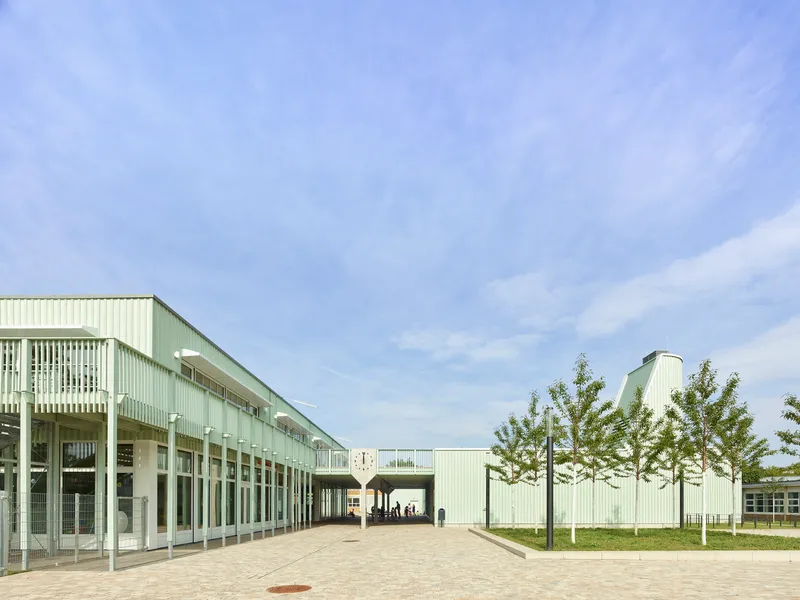
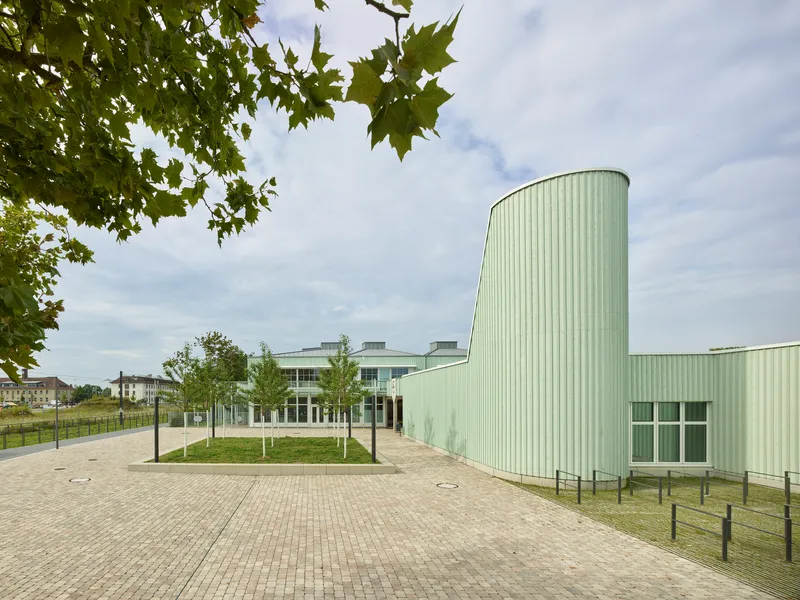
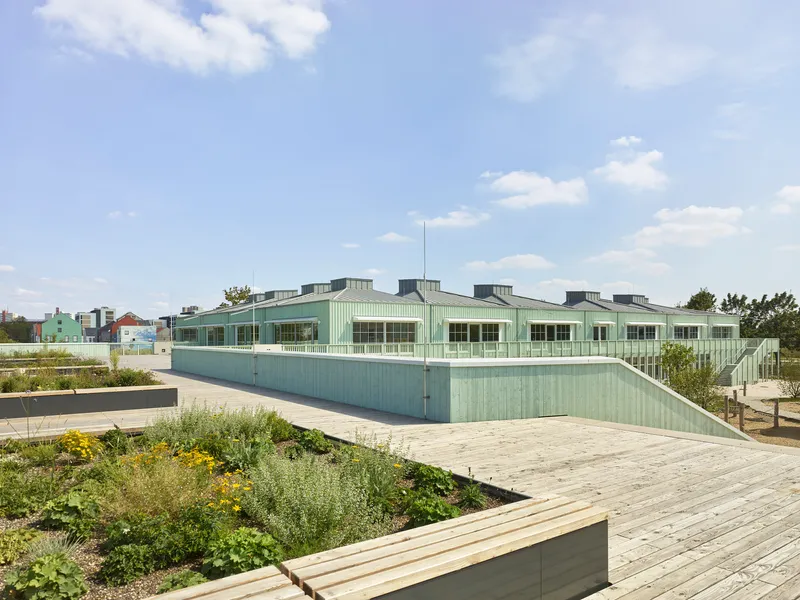
The school reads from the outside as a collection of volumes wrapped in ventilated pale green corrugated metal. The colour is muted enough to recede on overcast days and warm enough to feel approachable under sun. Columns and pergola structures line the courtyards, providing shading and framing a series of differentiated outdoor spaces. A curved tower element punctuates the composition, giving the complex a landmark without resorting to height.
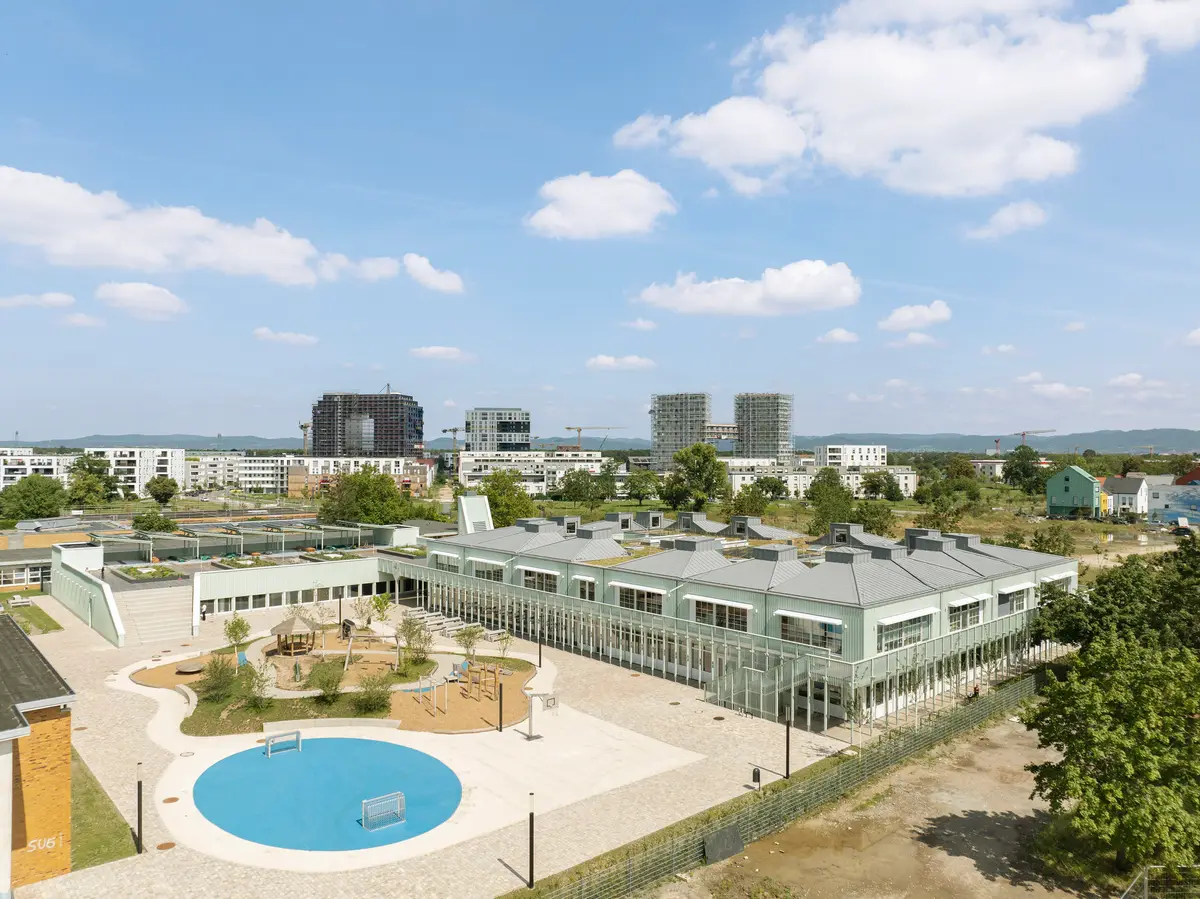
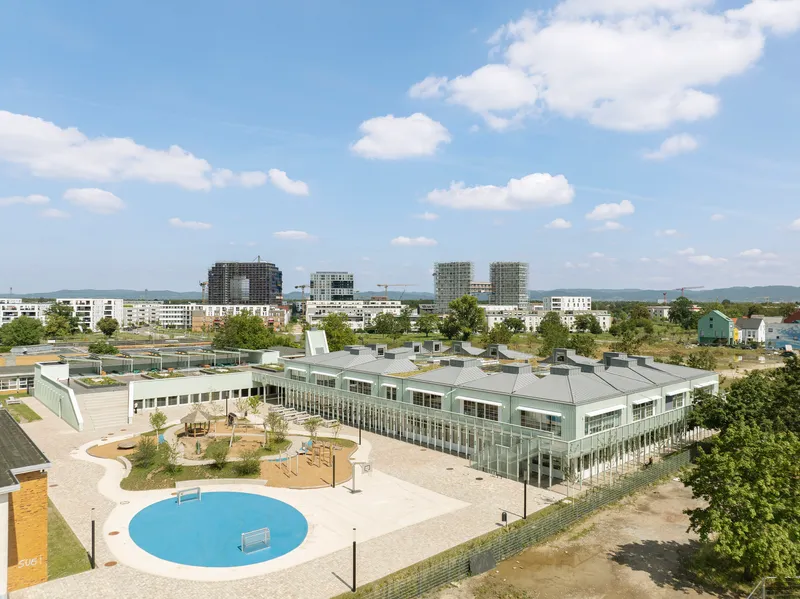
From the air, the roofscape reveals its logic: the hipped pyramids of the classroom houses cluster together, separated by flat-roofed connecting zones. A circular blue pool sits in the foreground plaza, and the planted mound of the schoolyard, ringed by a serpentine skating track, occupies the unpaved ground. The roof of the partially buried sports hall doubles as an accessible landscape, reached via seating steps from the yard. Every surface here has a second job.
Timber Above, Concrete Below
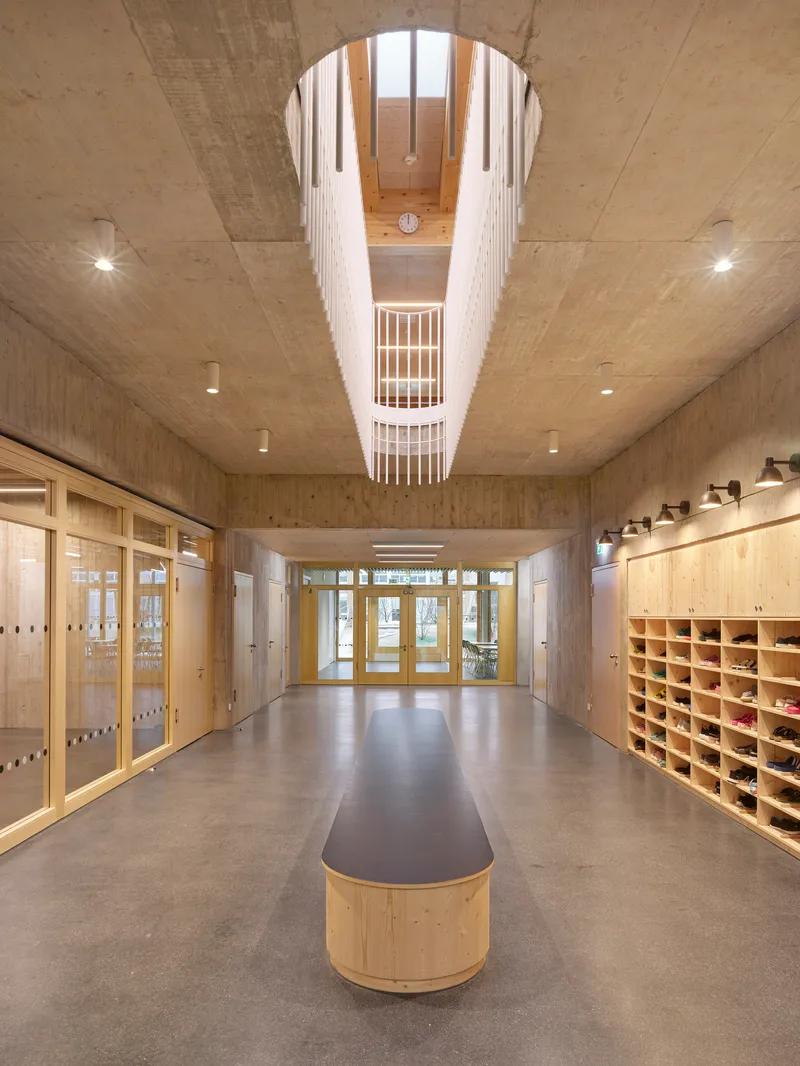
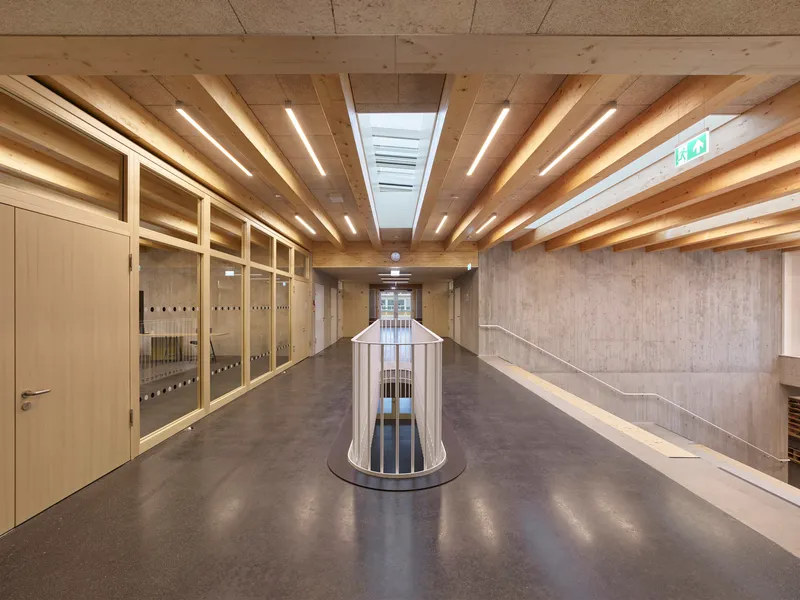
The structural split is legible in the interiors. At ground level, exposed concrete ceilings and walls define a more robust, institutional character. The entry corridor, lit by a cylindrical skylight above a curved bench, has the solidity of a civic threshold. This is where the cafeteria, administration, and specialist rooms live, spaces that serve the whole school community and benefit from the mass and durability of in-situ concrete.
Move upstairs and the material world changes entirely. Corridors are lined with exposed timber beams and stacked board ceilings, their surfaces left untreated so the grain and knots are visible. Linear skylights and pendant lights wash these circulation zones in even, diffused light. The transition from concrete to timber is not just a construction detail; it marks a shift in scale and atmosphere from shared institution to intimate learning environment.
Classrooms as Houses
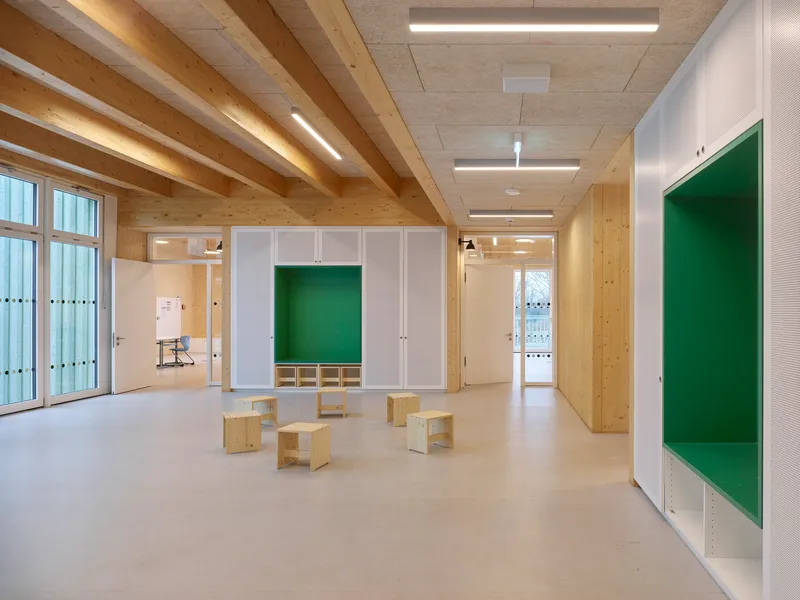
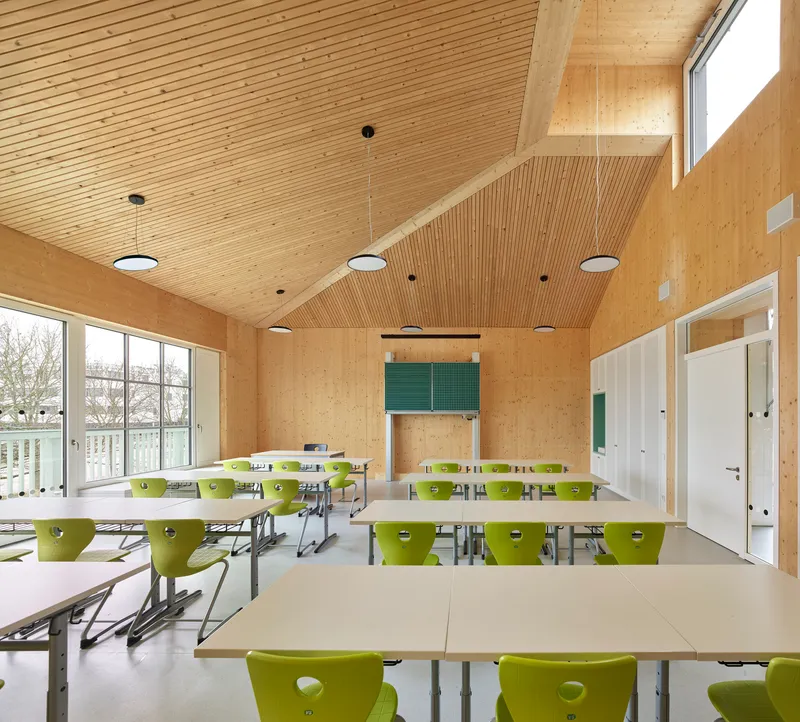
The classroom interiors are the project's strongest argument. Each room sits beneath an angled timber ceiling that rises to a central skylight, giving even a standard-sized teaching space the feel of a small hall. Plywood partitions with green-painted alcoves create breakout nooks within the room, supporting the mixed-age cluster model where children of different years share spaces and resources. The furniture is deliberately modest: light wood benches, green chairs, open shelving.
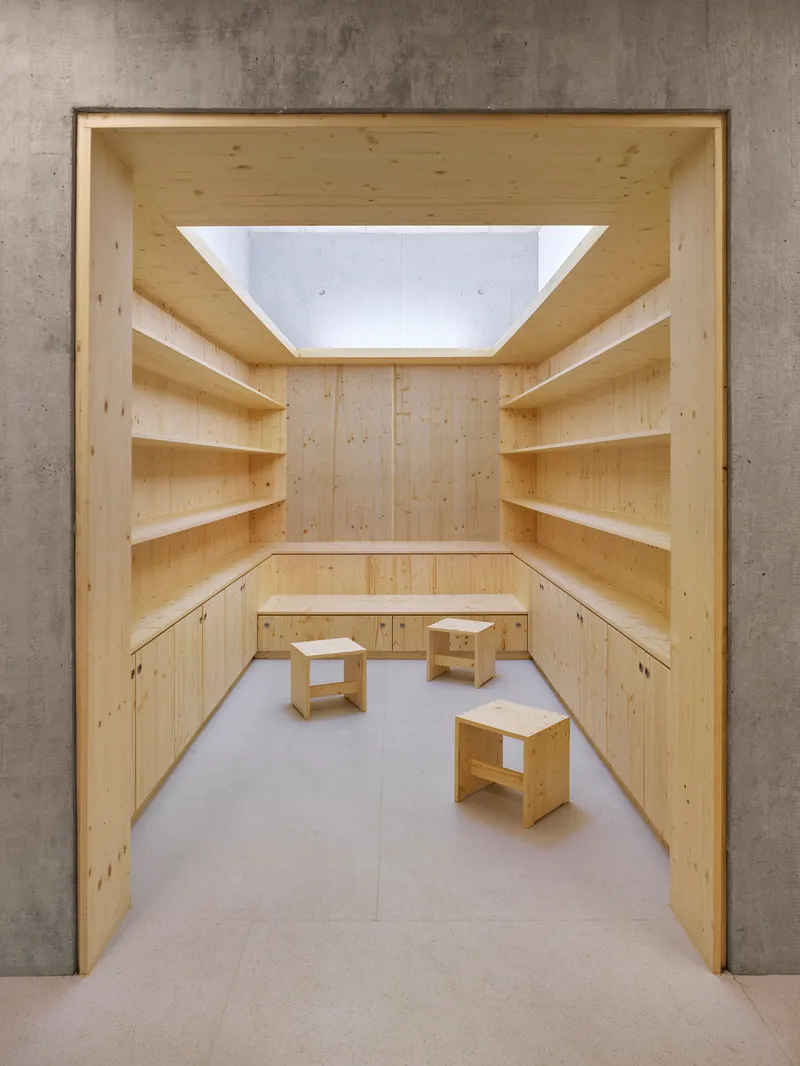
A particularly well-resolved detail is the pine shelving alcove framed by concrete walls with a skylight punched through the ceiling above. Three stools sit beneath it, inviting small-group work in a space that feels carved out rather than partitioned off. The architects understood that primary school children need both the openness of a shared floor and the enclosure of a den. The hipped-roof geometry, which could have been merely picturesque, actually generates the spatial variety that makes this possible.
The Buried Sports Hall
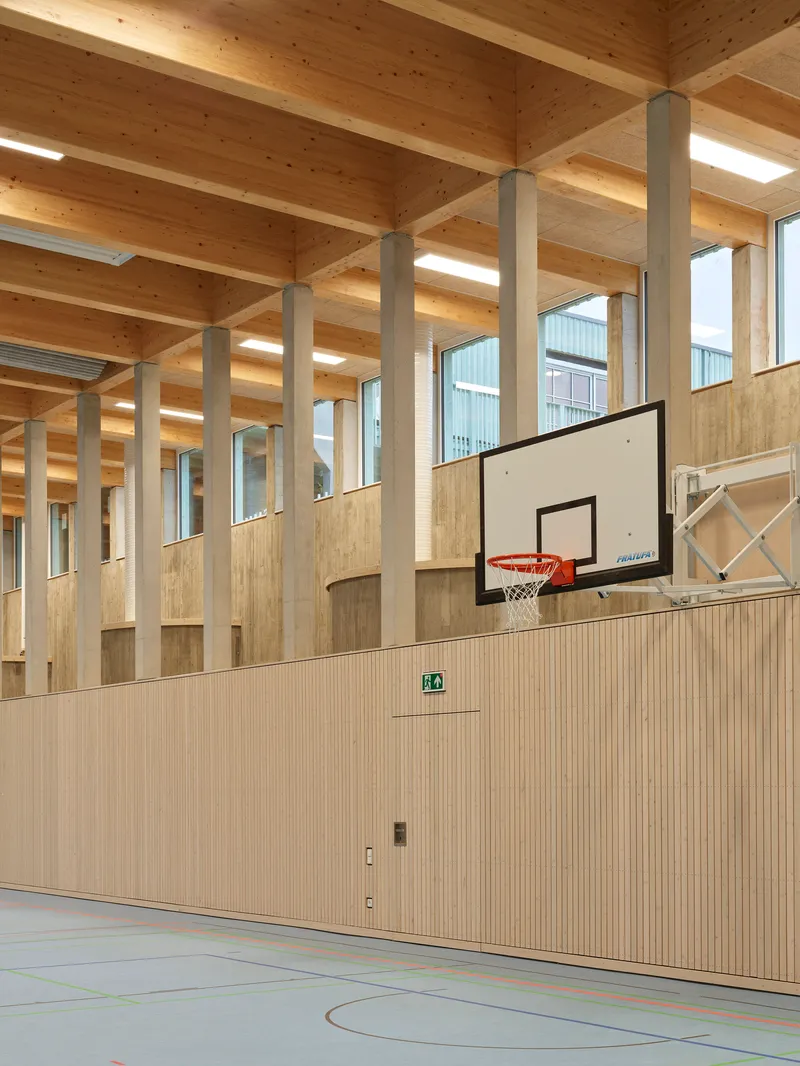
Burying a gymnasium is not a new idea, but here the payoff is unusually clear. By sinking the sports hall into the terrain and exploiting a one-storey height difference, the architects turned its roof into a planted garden with raised beds and views back across the school. The hall itself is lined in light wood paneling with an exposed timber post-and-beam ceiling, maintaining material continuity with the classrooms above. A basketball hoop, clean sightlines, and generous ceiling height confirm this is a fully functional competition space, not a compressed afterthought.
The rooftop garden above the sports hall serves as what the school calls a "research landscape," an outdoor teaching zone with planters and blue and biodiverse roof surfaces designed for rainwater retention. Combined with a high-capacity infiltration system beneath the planted mound in the schoolyard, the project's water strategy is comprehensive and visible. Children can observe the systems that manage the rain falling on their school.
Prefabrication and Speed
The timber upper floors were assembled from prefabricated dowel-laminated timber panels, a system that uses no glue or metal fasteners in the panel itself. From design to delivery, the timber assembly took roughly six months. For a public school project of this size, that speed is remarkable, and it was a practical necessity: the existing school building had to remain operational throughout construction, and the compact site left little room for extended phasing.
The prefabrication also shows in the interior finish. Stacked board ceilings with integrated acoustic milling handle sound absorption without applied panels, and the dowel-laminated surfaces are left exposed throughout. This is not timber as veneer or decoration. It is the structure itself, doing double duty as finish, insulation substrate, and acoustic treatment. Cellulose insulation fills the cavities, and a CO₂ demand-controlled ventilation system with night cooling via gravity ventilation keeps the classrooms comfortable without mechanical air conditioning. A photovoltaic pergola provides shading and power generation simultaneously.
Plans and Drawings

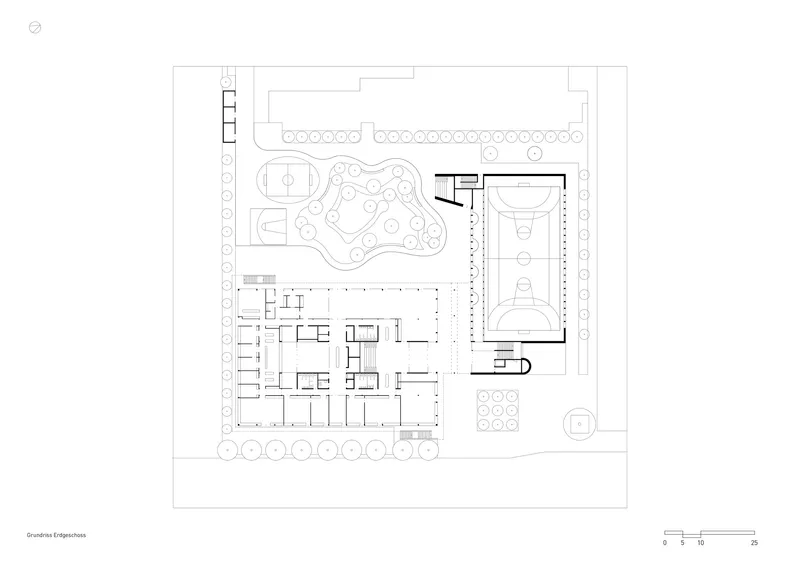
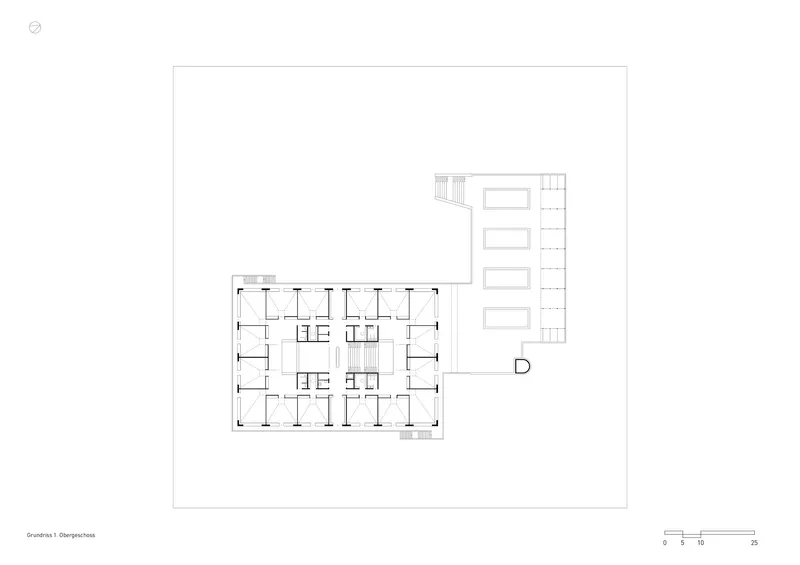
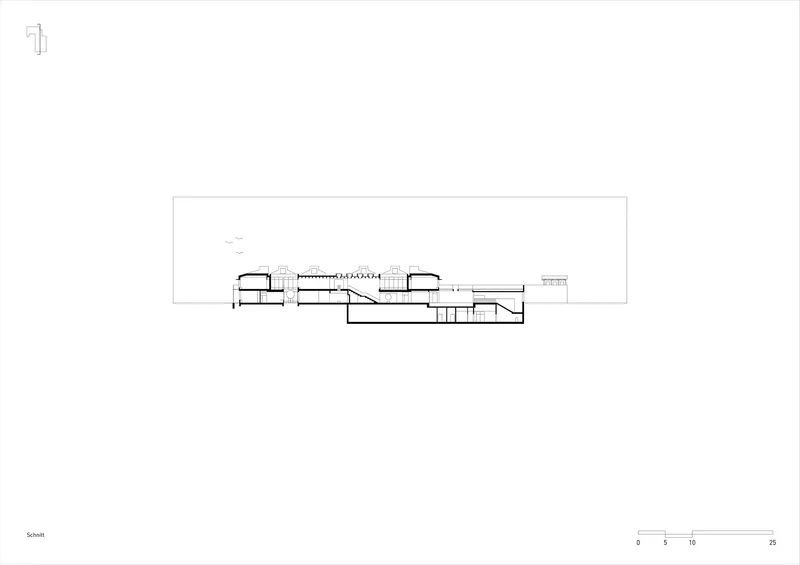
The site plan shows how precisely the new building negotiates its context on the former barracks. The red-highlighted footprint wraps around the existing school, creating courtyards and open spaces between old and new without requiring demolition. The ground floor plan reveals the cafeteria opening directly onto the schoolyard, specialist rooms along the perimeter, and a wide, centrally positioned bleacher staircase leading up to the cluster floor. The upper floor plan confirms the logic of four classroom houses grouped around shared zones, each with its own roof geometry. The section drawing is perhaps the most revealing: it shows the stepped volumes, the central atrium void, the buried sports hall, and the way the building negotiates the sloping site to make the rooftop landscape accessible at grade from the yard.
Why This Project Matters
Primary School Franklin is a proof of concept for several things at once: that hybrid timber construction can deliver a complex public building on a tight timeline, that prefabrication does not have to mean generic interiors, and that pedagogical ambition and environmental performance can reinforce each other rather than compete. The mixed-age cluster model, which is gaining traction across German-speaking Europe, finds a built form here that is specific, legible, and genuinely child-scaled. The hipped-roof houses are not metaphor. They are structure, daylight strategy, and spatial identity rolled into one move.
For the Franklin district itself, still in the early stages of its transformation from military base to civilian neighbourhood, the school is a significant civic gesture. It declares that this new quarter will be defined not by housing density alone but by the quality of its public institutions. LRO's design treats the primary school as architecture worthy of invention, not just a programmatic checkbox. That attitude, in an era of shrinking public budgets and expanding school populations, is worth paying attention to.
Primary School Franklin by LRO GmbH & Co. KG Freie Architekten BDA. Lead architects: Marc Oei, Katja Pütter, Klaus Hildenbrand, Heiko Müller. Mannheim, Germany. 8,995 m². Completed 2024. Photography by Roland Halbe.
About the Studio
Share Your Own Work on uni.xyz
If projects like this are the kind of work you want to make, uni.xyz is a place to publish your own, find collaborators, and enter design competitions.


Popular Articles
Popular articles from the community


Opera on the Sea: Driftwood Logic Shapes a Timber Opera House on Estonia's Coast
Trevor Orgill's opera house translates the entangled drift of floating timber into a civic building where wood, water, and music converge.

Aquadapt: An Underwater Habitat That Rewrites Its Rooms by the Hour
Curved modules ring the seabed while one shell shifts from breakfast room to cinema, farm and football pitch as residents' needs change.

The Amber Palace Opera: A Geological Fiction Surfaces on Tallinn's Baltic Waterfront
Pierre Brillard reimagines a Baltic legend as a public landscape, opera house, and waterfront promenade rooted in Tallinn's coastal identity.


David Ortega Stacks a Two-Story Mexico City Penthouse Around a Steel Stair and a Pergola-Shaded Roof Terrace
In Colonia Roma, a 300 m² penthouse uses oak joinery, a planted steel stair and a slatted roof pergola to make a new-build apartment feel like a house.

Similar Reads
You might also enjoy these articles

LAVA Architecten Gives Vocational Education a Sawtooth-Roofed Face on a Mechelen School Campus
In Mechelen, Belgium, a 2,053 m² STEM school on a 6×6 m grid turns workshops and classrooms into rooms that can be rearranged as teaching changes.

KEMA Studio Turns a Derelict Marvila Attic into a 60 m² Lighthouse Apartment Above Lisbon
In Lisbon's Marvila district, a rebuilt roof, four skylights and two plywood volumes turn an unlivable attic into a bright home facing the Tagus.

Pixel Gardens: One Repeated Module Stacked Into a Terraced Social Housing Tower for Famagusta
Salem Bader's shortlisted housing tower builds a vertical neighbourhood from one repeated module, offsetting units to carve terraces, light and air.

Bao Huynh Watercolor Atelier: A Serene Art Retreat in Hội An
Bao Huynh Watercolor Atelier in Hội An blends multifunctional art spaces, sustainable design, local materials, and family-friendly living in a serene environment.


Comments (0)
Please login or sign up to add comments
No comments yet. Be the first to comment!