

Make an “Elsewhere”: Reimagining Biophilic Architecture for Children
A visionary biophilic architecture project that creates a safe, nature-rich “elsewhere” where children reconnect with ecosystems beyond urban stress.


In rapidly urbanizing cities, childhood is increasingly shaped by concrete, congestion, and constraint. The project Make an “Elsewhere” confronts this condition directly, proposing a radical rethinking of how architecture can serve children in dense urban environments. Designed by Khanh Anh and shortlisted for the Education '20 category, the project positions biophilic architecture for children as a critical framework for restoring lost connections between young minds and the natural world.
At its core, the project identifies a fundamental conflict: the tension between urban infrastructure and the innocence of childhood. Cities impose a reality of high-rise living, pollution, noise, and psychological stress. In contrast, childhood demands exploration, curiosity, and engagement with living systems. This project asks a precise question: how can architecture construct an alternate world within the existing one?
Rebuilding a Lost Paradise Through Architecture
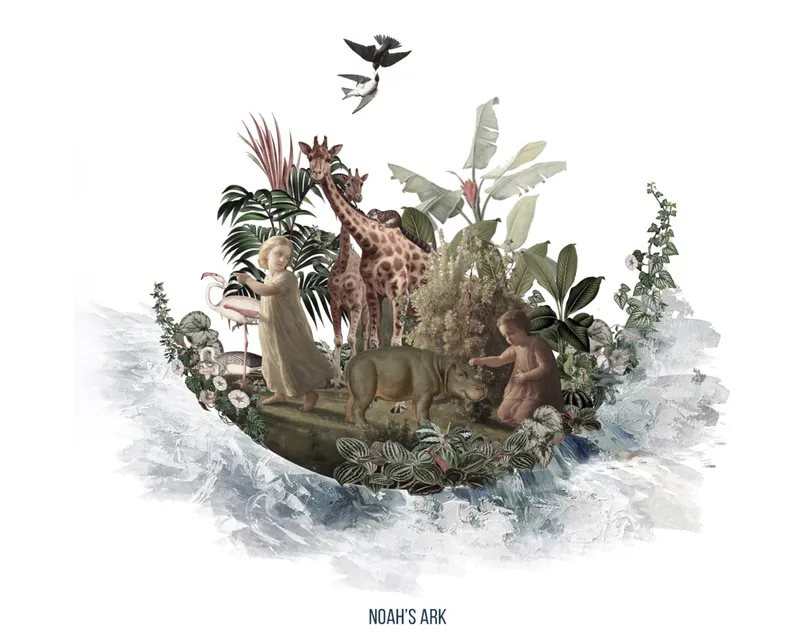
The conceptual foundation draws inspiration from the narrative of Noah’s Ark, not as a literal reference but as an architectural strategy. Just as the Ark preserved life during crisis, this project proposes a built environment that shelters biodiversity within the city. It becomes a curated ecosystem where plants, animals, and children coexist.
This is not symbolic landscaping. It is a structured ecological integration. The building acts as a contained micro-world, a “piece of earth” that can be inserted into dense urban fabric. The intention is clear: to reconstruct a disappeared paradise within the constraints of contemporary cities.
A Layered Ecosystem: Plants, Animals, and Children
The project organizes its spatial logic through three primary layers: vegetation, fauna, and human occupation. These are not segregated zones but interdependent systems. The green envelope wraps the structure, hosting plant life across multiple levels. Animal habitats are integrated into the architectural section, creating opportunities for observation and interaction. Children inhabit this environment as participants, not passive users.
This layered strategy aligns directly with principles of biophilic architecture. It emphasizes multisensory engagement, ecological awareness, and spatial diversity. Instead of isolating nature as a peripheral element, the project embeds it into the architectural DNA.
Urban Insertion: A Portable Landscape
One of the most compelling aspects of the proposal is its adaptability. The building is conceived as a modular, self-contained system that can be placed anywhere within the city. The urban diagrams illustrate this clearly. Amid dense blocks and infrastructural grids, the project appears as a distinct green entity.
This portability transforms the project into a scalable solution. It is not a one-off intervention but a replicable model for cities worldwide. Each instance becomes a node of ecological restoration and childhood experience.
Sectional Intelligence and Environmental Control
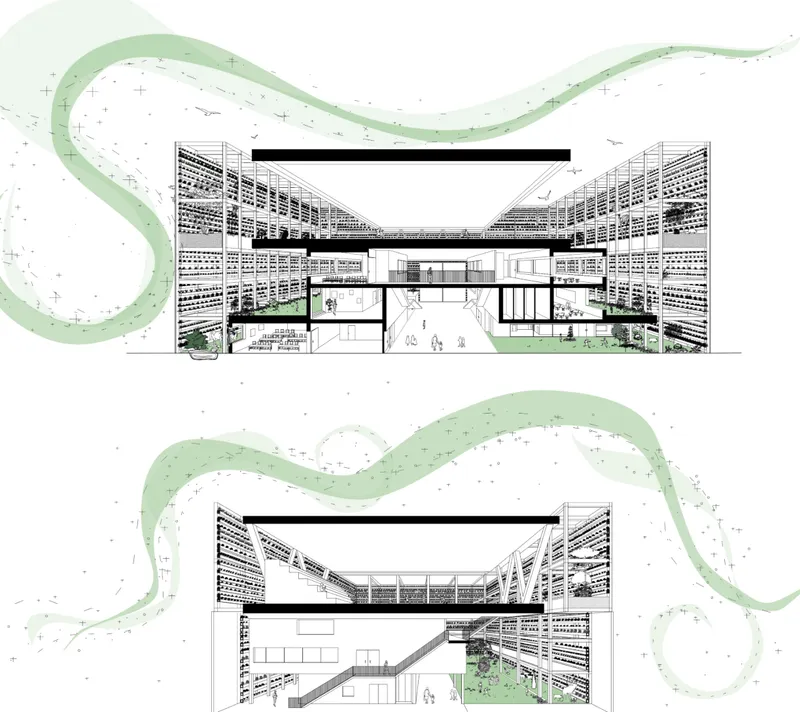
The sectional drawings reveal a sophisticated environmental strategy. The architecture creates internal courtyards and vertical green walls that regulate microclimate conditions. Light, airflow, and vegetation are orchestrated to produce a distinct internal atmosphere. The statement “a different air, a different view, a different sun” is not poetic exaggeration. It reflects a deliberate environmental recalibration.
Children moving through the building experience shifting spatial conditions. Enclosed classrooms transition into open green terraces. Circulation paths become exploratory trails. The architecture functions as both educational infrastructure and experiential landscape.
Programmatic Organization and Spatial Diversity
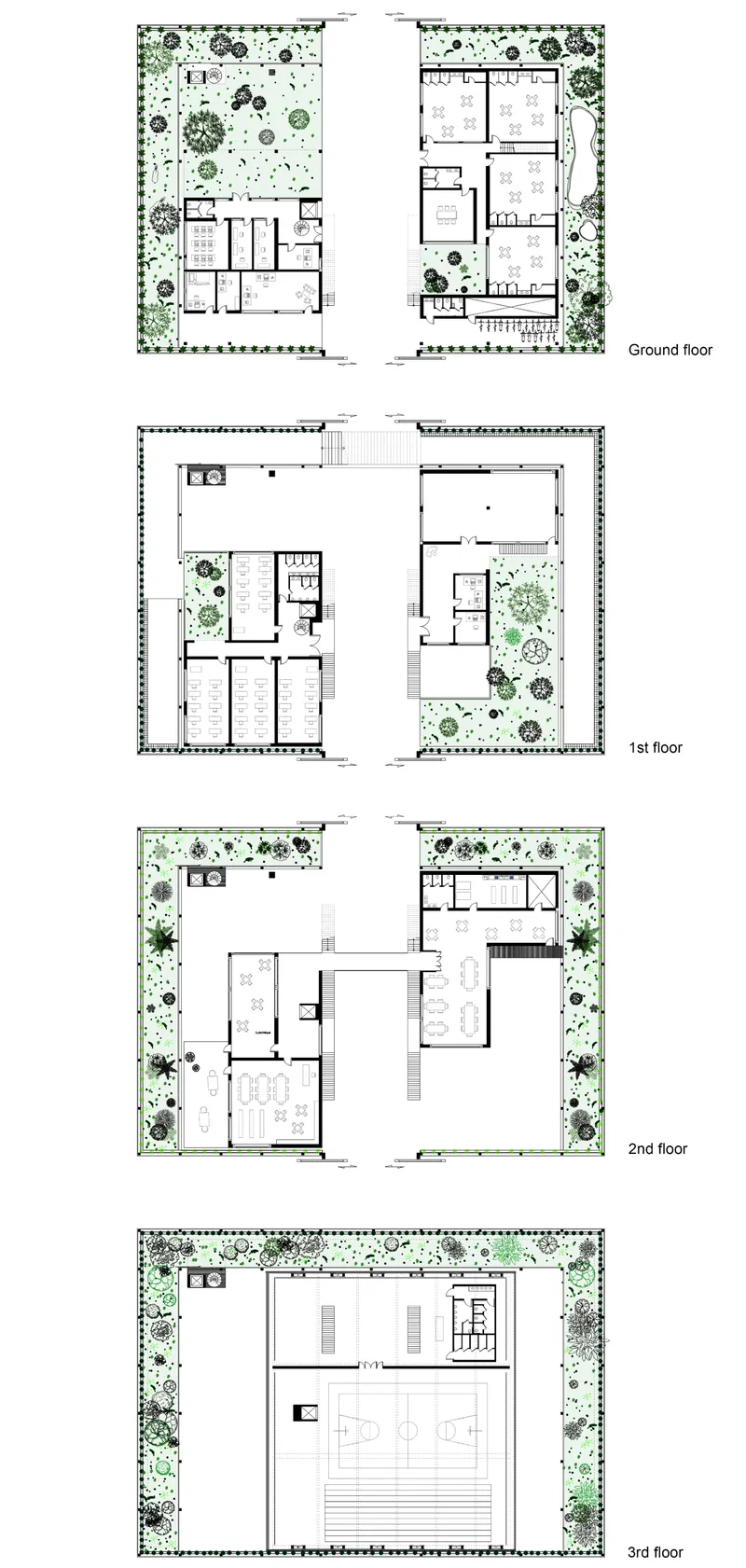
The floor plans demonstrate a careful balance between structured learning and open exploration. Ground levels prioritize communal and administrative functions, while upper levels introduce classrooms, recreational areas, and green zones. The integration of vegetation across all floors ensures continuity of experience.
The top level introduces a large open space, potentially for sports or collective activities, reinforcing the idea that physical movement and environmental awareness are inseparable. The building avoids rigid zoning, instead promoting fluid transitions between programs.
Structural Logic and Material Expression
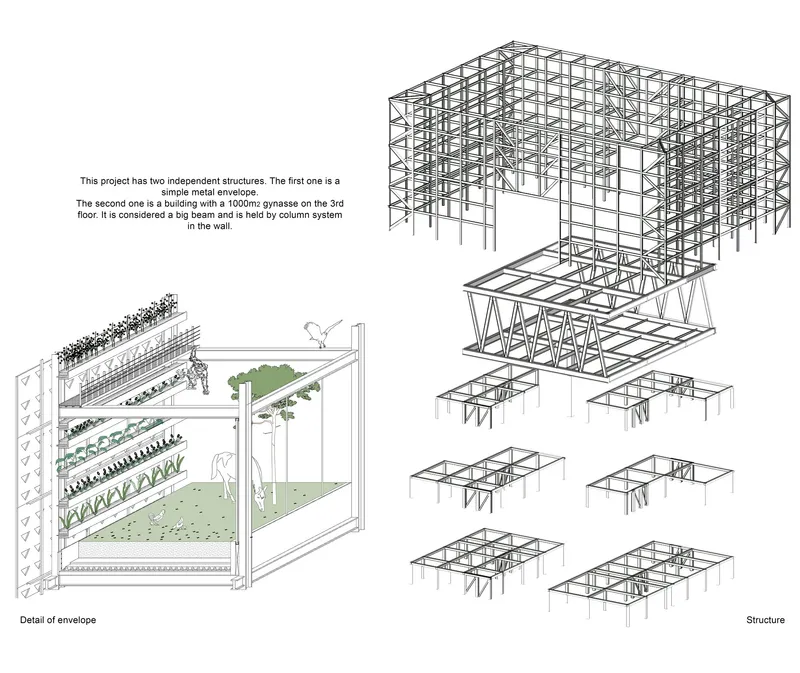
The project employs a dual-structure system. The outer layer functions as a lightweight metal envelope, supporting the vertical green systems. The inner structure, more solid and grounded, houses the primary programmatic spaces. This separation allows for flexibility and environmental performance optimization.
The exposed structural framework also contributes to the educational dimension. Children are not only surrounded by nature but also by visible systems of construction, encouraging awareness of how built environments function.
Biophilic Architecture as Pedagogy
What distinguishes this project is its understanding of architecture as a pedagogical tool. It does not merely accommodate educational functions. It actively teaches. Through spatial experience, children learn about ecosystems, coexistence, and environmental responsibility.
In this sense, the project extends beyond architecture into behavioral design. It shapes how children perceive and interact with the world. The “elsewhere” is not an escape from reality but a recalibration of it.
Make an “Elsewhere” presents a compelling argument for rethinking urban education through biophilic architecture for children. It demonstrates that even within dense cities, it is possible to construct environments that nurture imagination, ecological awareness, and emotional well-being.
By integrating plants, animals, and human activity into a cohesive system, the project transforms architecture into a living framework. It is both shelter and ecosystem, both school and landscape.
In doing so, it offers a clear proposition: the future of cities must include spaces where children can rediscover the natural world. Not at the edge of the city, but at its very center.
This is how we rebuild the world.


Popular Articles
Popular articles from the community


Temporary Home for Dogs: A Reversed Zoo Rethinks Animal Shelter Architecture
In Bucharest, a sinuous corridor and freed landscape flip the logic of containment, designing a shelter that works to make itself unnecessary.
Extended Shell: Retrofitting Kolkata's Balconies as Living Urban Thresholds
A modular retrofit system recovers the social and environmental intelligence of Kolkata's historic verandas for contemporary Park Street residents.

Singing Woman: Contemporary Architecture Inspired by Estonia’s Voice and the Sea
Singing Woman turns Estonia’s song culture into flowing opera house architecture, blending public life, landscape, sea, and national memory.

The Amber Palace Opera: A Geological Fiction Surfaces on Tallinn's Baltic Waterfront
Pierre Brillard reimagines a Baltic legend as a public landscape, opera house, and waterfront promenade rooted in Tallinn's coastal identity.

Similar Reads
You might also enjoy these articles

Eco Chapel: A Green Architecture Pavilion Designed in Symbiosis with the Forest
Eco Chapel uses green architecture to weave prayer, learning and reuse into a forest pavilion shaped by modular hexagonal canopies for life.
Kaffeebühnen: Coffee Shop Architecture Designed as a Civic Stage Between Vienna’s City and Park
Kaffeebühnen turns coffee shop architecture into a civic stage, linking Vienna’s park edge, urban life, warm timber yards, and coffee craft.
Healing Façade: Sustainable Architecture for Reforestation, Community, and Sacred Ecology in Ethiopia
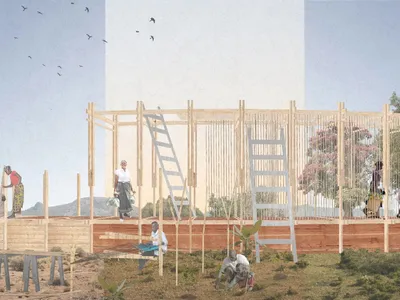
Healing Façade reimagines sustainable architecture as a living wall that restores soil, catches water and renews Ethiopia's forest churches.


Urban Forest: A Vertical Ecosystem for 5,000 Workers in Singapore's Changi Business Park
Radially stacked pods and layered green decks turn a 7-acre plot into 47 acres of ecological workspace projected for 2040.

Explore Biophilic Competitions
Discover active competitions in this discipline

Challenge to design public laboratory

Challenge to reimagine the Iron Throne

Photograph architecture without architects

Illustrate the lost glory of Angkor Wat - Render Challenge
Comments (0)
Please login or sign up to add comments
No comments yet. Be the first to comment!