

Malevart Innovative Offices Transformation by h2o architectes, Paris
Former car dealership transformed into sustainable Paris offices, featuring half-level layouts, restored concrete façade, rooftop terrace, and flexible, light-filled workspaces.


The Malevart Innovative Offices Transformation by h2o architectes is a compelling example of adaptive reuse architecture in Paris, redefining a former car dealership into a contemporary, light-filled office building. Located within the dense urban fabric of the Villa du Clos-de-Malevart in the 11th Arrondissement, the project demonstrates how restrained architectural intervention can radically improve spatial quality, environmental performance, and urban connectivity.
Completed in 2023, the 3,687-square-meter office renovation transforms an inward-looking, almost entirely opaque concrete structure into a flexible and sustainable workplace tailored to contemporary professional needs.

Reconnecting an Inward-Facing Building to the City
Originally conceived as an industrial car showroom, the existing building presented a closed façade and minimal relationship with its surroundings. Rather than erasing its past, the architects chose to preserve and reinterpret its structural identity. The exposed concrete framework, organized through the distinctive “Humy system” of half-level offsets, became the backbone of the new spatial strategy.
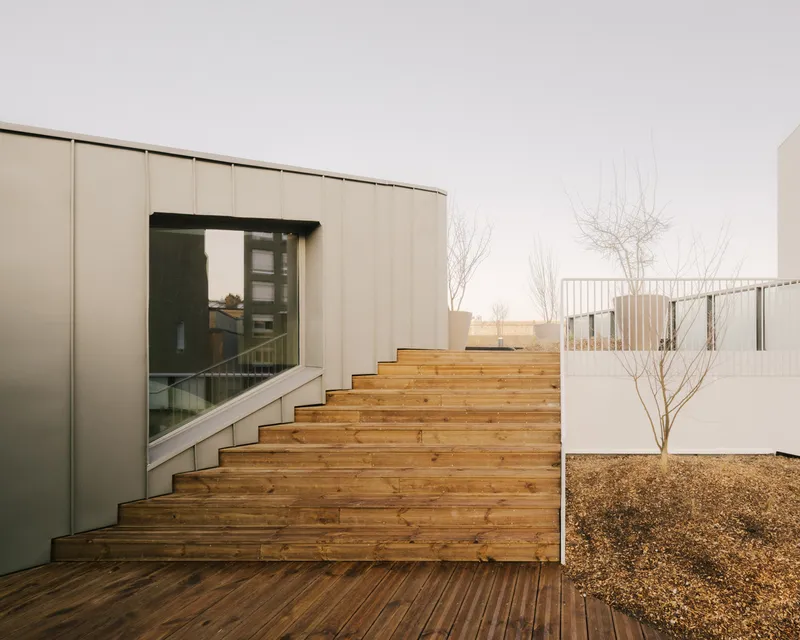
By opening the main façade and removing a later extension at first-floor level, the project introduces a planted forecourt at the entrance, immediately softening the building’s relationship with the street. The transformation culminates in a double-height glazed volume, acting as an urban signal at the end of the blind alley and drawing daylight deep into the interior.
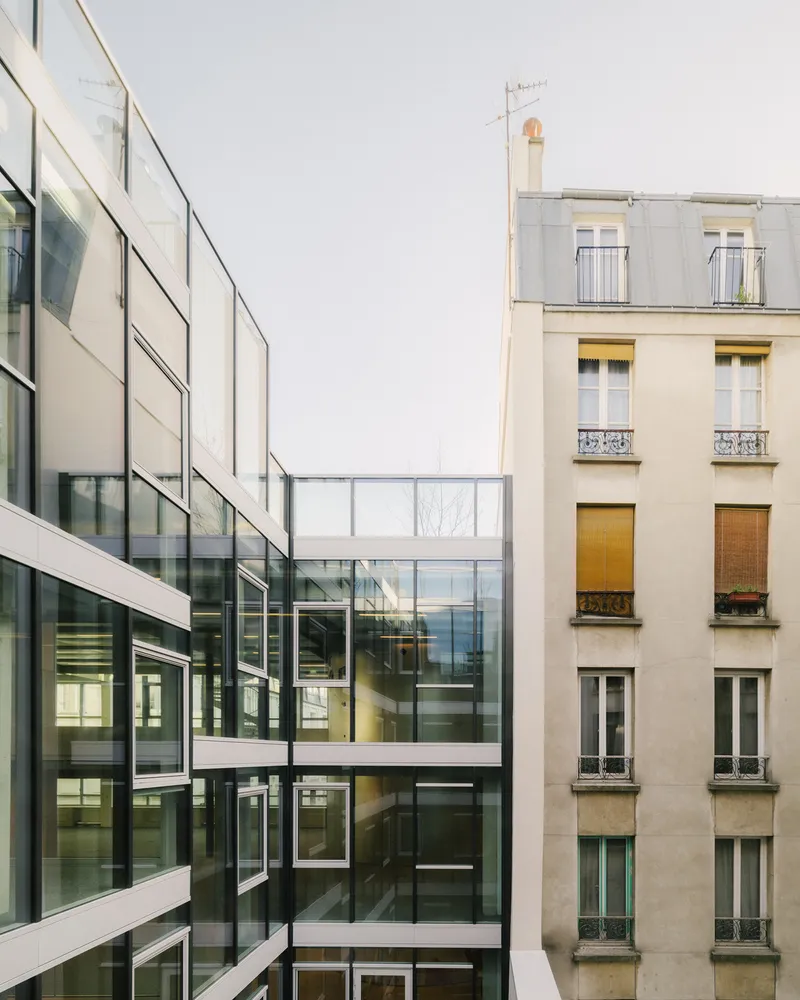
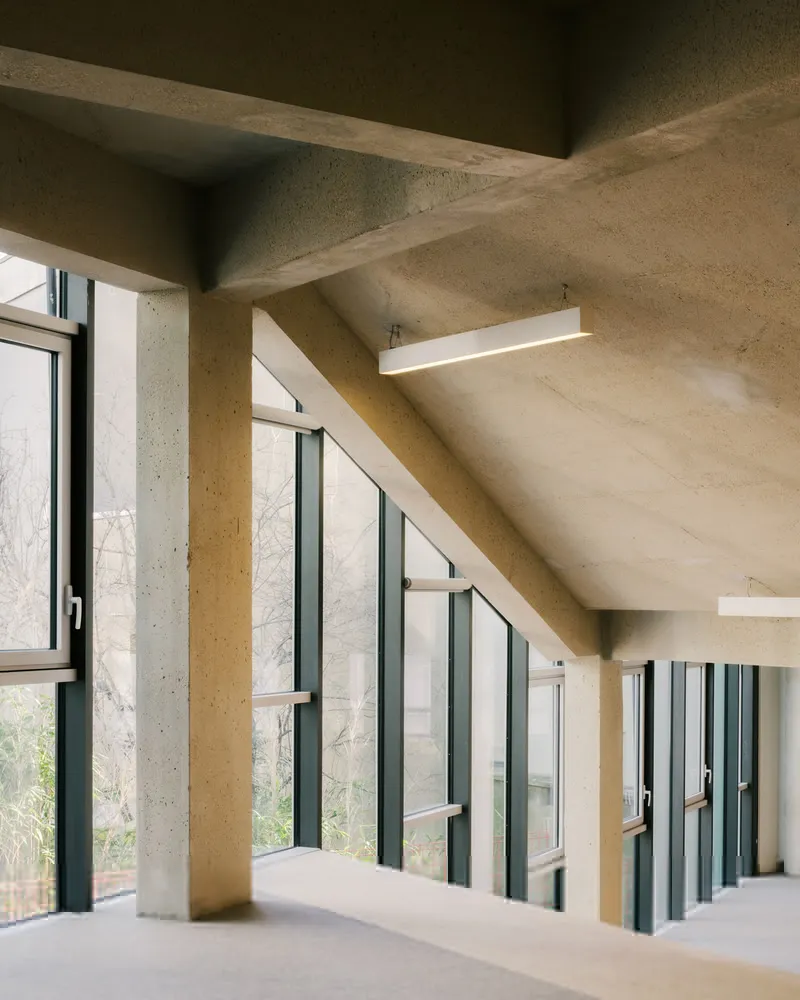
Half-Levels, Diagonal Views, and Spatial Continuity
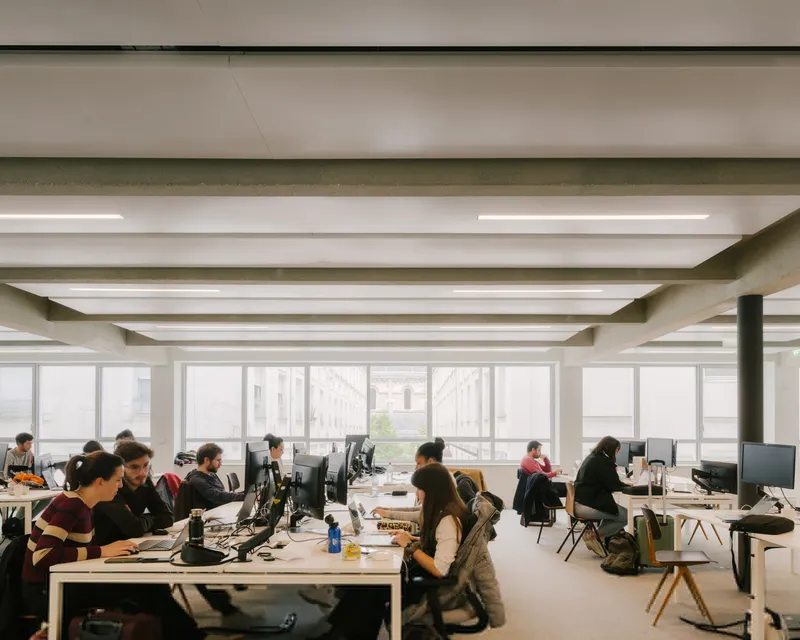
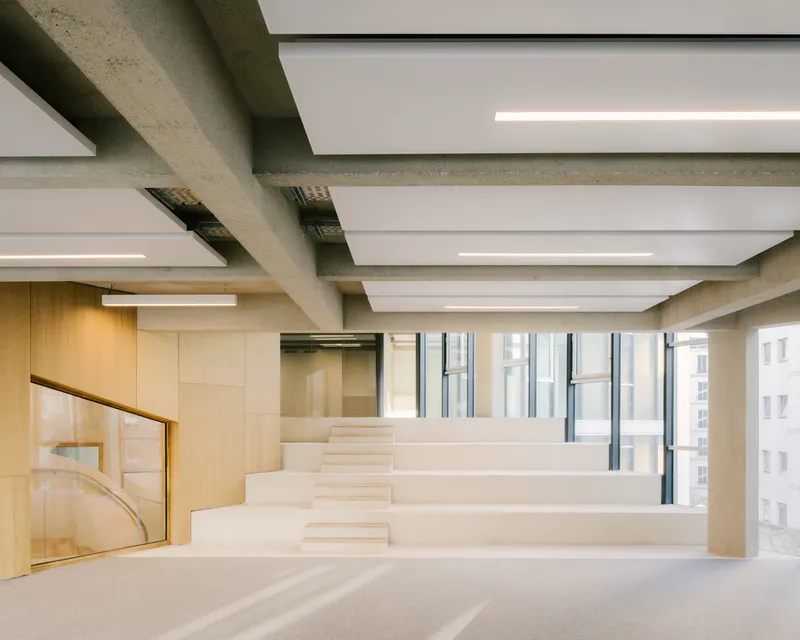
One of the project’s defining architectural moves is the intelligent reuse of the existing half-level structure. These staggered floors create a continuous workspace with layered perspectives, unexpected diagonal views, and a dynamic sense of movement. Rather than isolating departments, the tiered layout encourages visual connection and informal interaction across levels.
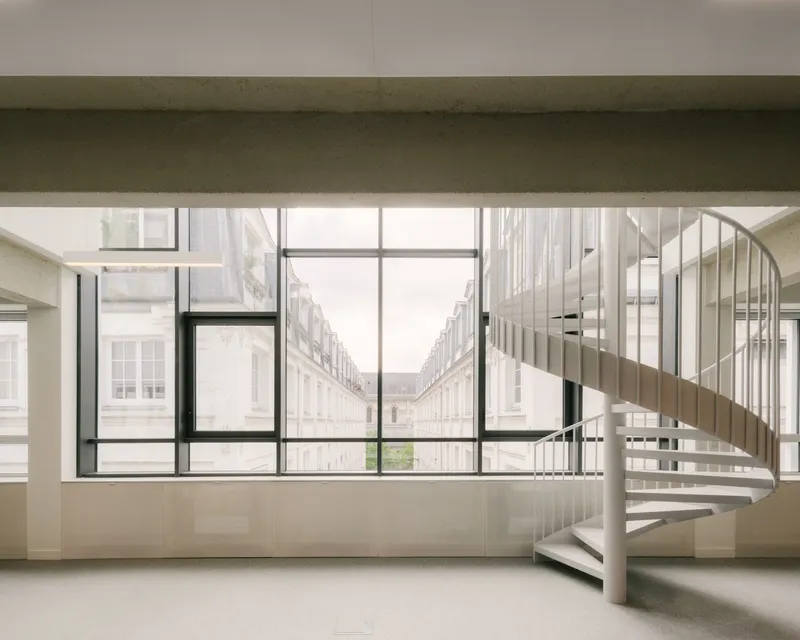
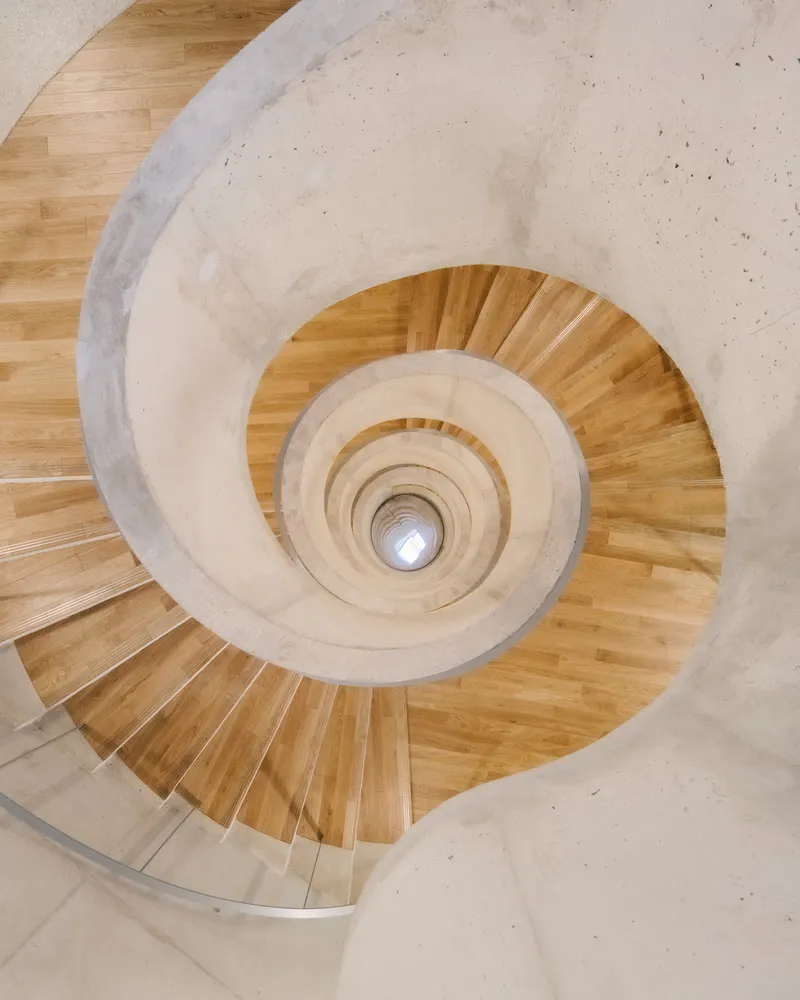
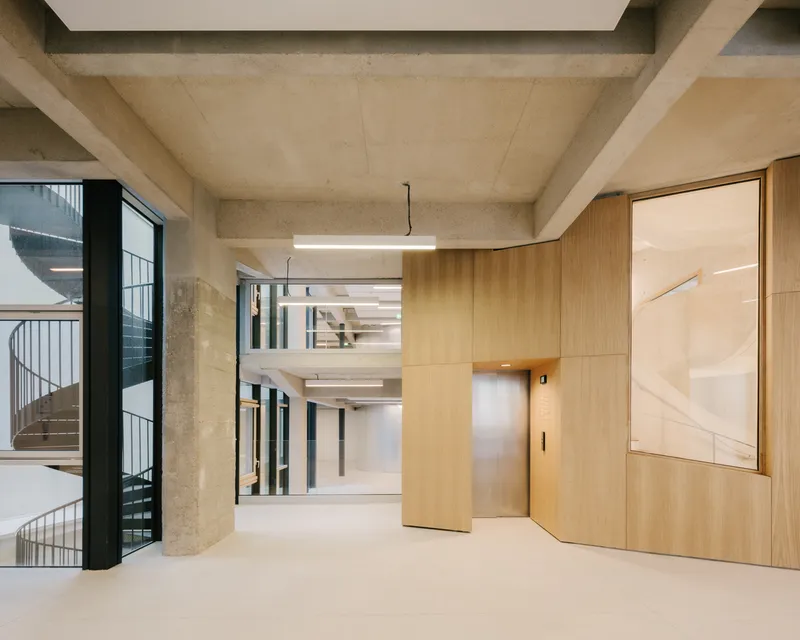
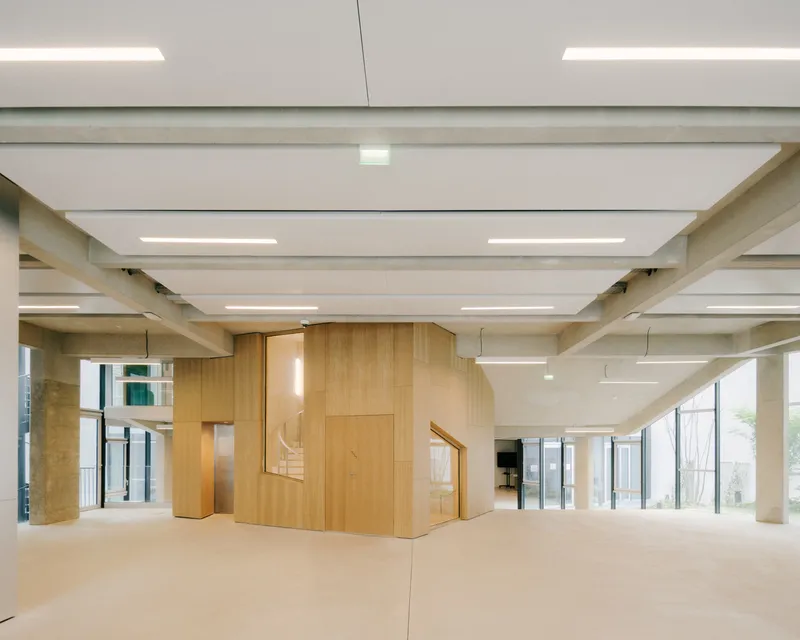
Three vertical cores run through the building, organizing circulation and allowing flexible partitioning according to evolving user needs. A sculptural staircase and a double-entry elevator are integrated into the heart of the building, ensuring intuitive circulation while reinforcing spatial cohesion.

Material Frugality and Interior Atmosphere
The interior design embraces a restrained palette, relying primarily on concrete and wood. Existing and new concrete surfaces were sandblasted to achieve a uniform texture, celebrating material honesty while avoiding visual excess. A wood-clad central volume introduces warmth and acoustic comfort, balancing the rawness of the concrete framework.
This frugal yet refined material approach aligns with the project’s broader sustainability goals, proving that architectural quality can emerge from careful reuse rather than excessive finishes.

Façade Transformation and Outdoor Workspaces
The restored concrete window grilles maintain the building’s original character, with subtle horizontal incisions introduced to improve transparency and daylight penetration. This delicate intervention respects the building’s identity while enhancing comfort and visibility.
Above, the roof has been transformed into an accessible terrace, offering open-air meeting spaces, a vegetable garden, and areas for rest and informal collaboration. These outdoor amenities extend the workspace beyond enclosed interiors, supporting well-being and alternative modes of working.

Environmental Performance and Circular Design Strategy
Environmental responsibility played a central role throughout the project. In collaboration with Deepki, a specialist in ESG performance and SaaS platforms, the design team minimized the carbon footprint of the interior fit-out. Strategies included limited partitioning, open-plan workspaces, the use of phone booths instead of new meeting rooms, and the avoidance of unnecessary reconfiguration.
Notably, 50% of the office furniture was sourced from second-hand suppliers, significantly reducing embodied carbon and reinforcing a circular design approach. This pragmatic sustainability strategy demonstrates how office renovations can align architectural ambition with measurable environmental impact.

A Model for Sustainable Office Renovation in Paris
The Malevart Innovative Offices Transformation stands as a reference project for adaptive reuse, sustainable office design, and urban regeneration in Paris. By valuing existing structures, optimizing natural light, and embracing circular construction principles, h2o architectes deliver a workplace that is flexible, humane, and environmentally responsible.
This project illustrates how thoughtful rehabilitation can turn industrial heritage into future-ready architecture, without ostentation, but with lasting urban and ecological value.


Popular Articles
Popular articles from the community


David Ortega Stacks a Two-Story Mexico City Penthouse Around a Steel Stair and a Pergola-Shaded Roof Terrace
In Colonia Roma, a 300 m² penthouse uses oak joinery, a planted steel stair and a slatted roof pergola to make a new-build apartment feel like a house.

FCC Arquitectura Expands a Portuguese Granite House with a Board-Marked Concrete Wing
In Portugal, JV House pairs a cleaned-up whitewashed and granite dwelling with a timber-shuttered concrete extension, courtyards and a garden pool.

Cube Design Draws an Ecological Corridor Between Two Shenzhen Hills with the Nankai Building
Beside Shenzhen's container docks, the Nankai Building pairs stacked balconies with a climbing green screen to connect two hillsides across its height.


Aquadapt: An Underwater Habitat That Rewrites Its Rooms by the Hour
Curved modules ring the seabed while one shell shifts from breakfast room to cinema, farm and football pitch as residents' needs change.

Similar Reads
You might also enjoy these articles
Cube Design Draws an Ecological Corridor Between Two Shenzhen Hills with the Nankai Building
Beside Shenzhen's container docks, the Nankai Building pairs stacked balconies with a climbing green screen to connect two hillsides across its height.

Praksis A and Studio Sted Bend a Red Timber Cabin Across the Granite of Norway's Southern Coast
On the southern Norwegian coast, a 105 m² cabin follows the rock on slender posts, pairing red cladding outside with pine, brick and plywood within.
David Ortega Stacks a Two-Story Mexico City Penthouse Around a Steel Stair and a Pergola-Shaded Roof Terrace
In Colonia Roma, a 300 m² penthouse uses oak joinery, a planted steel stair and a slatted roof pergola to make a new-build apartment feel like a house.

PARALELA and LB2 Thread a Public Walkway Through the Base of a Las Condes Residential Tower
In Las Condes, Santiago, the Hamlet Building gives its fenceless ground floor to a 70-metre wooded passage linking two streets and the metro.

Explore Architecture Competitions
Discover active competitions in this discipline

Challenge to reimagine the Iron Throne

Photograph architecture without architects

Illustrate the lost glory of Angkor Wat - Render Challenge

Design challenge to reuse E-waste
Comments (0)
Please login or sign up to add comments
No comments yet. Be the first to comment!