

Mario Cucinella Architects Grows Three Elliptical Towers from a Hanging Garden on Via Ostiense
Roma Tre University's new rectorate trades institutional severity for permeable, climate-tuned towers rooted in a former industrial quarter.


Universities rarely open themselves to the street. They tend to wall off, turn inward, and let perimeter fences do the talking. Mario Cucinella Architects rejected that instinct entirely for the new Roma Tre University rectorate on Via Ostiense, the ancient road linking Rome to its port at Ostia. Three elliptical towers, nine to eleven stories tall, rise from a covered public piazza that faces the street with a fully glazed facade. Rather than a gatehouse, the ground level is an invitation: pedestrian traffic, reception spaces, and university services sit where a wall might otherwise stand.
What makes this 12,000 square metre complex genuinely interesting is how it layers environmental performance into a legible urban gesture. The elliptical plans are not formal indulgence. They orient the narrowest profiles toward east and west to cut glare and heat gain, while south-facing terraces and overhangs act as thermal buffers. A raised garden slab, just 400 mm thick, links the three towers at an upper level and creates a second, semi-public piazza in the sky. The result is a building that breathes, shades itself, and speaks to the industrial heritage of the Ostiense quarter, all without feeling like a sustainability exhibit.
Steel Filigree and an Industrial Echo
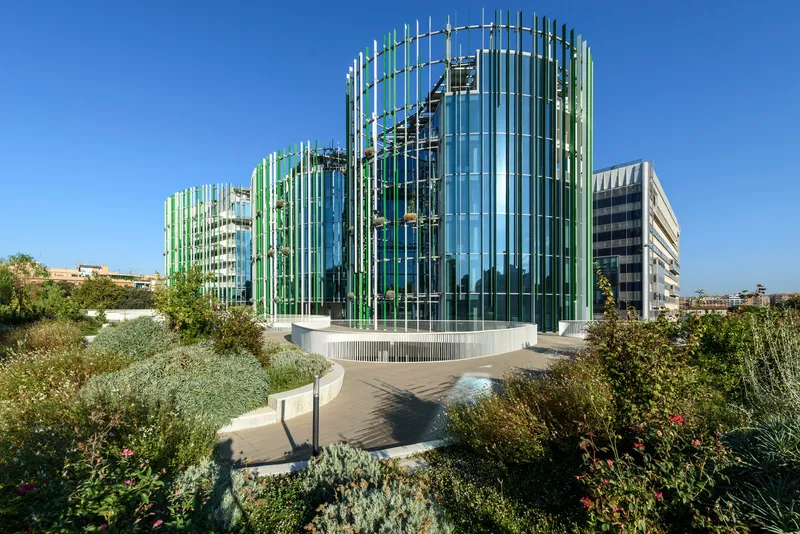
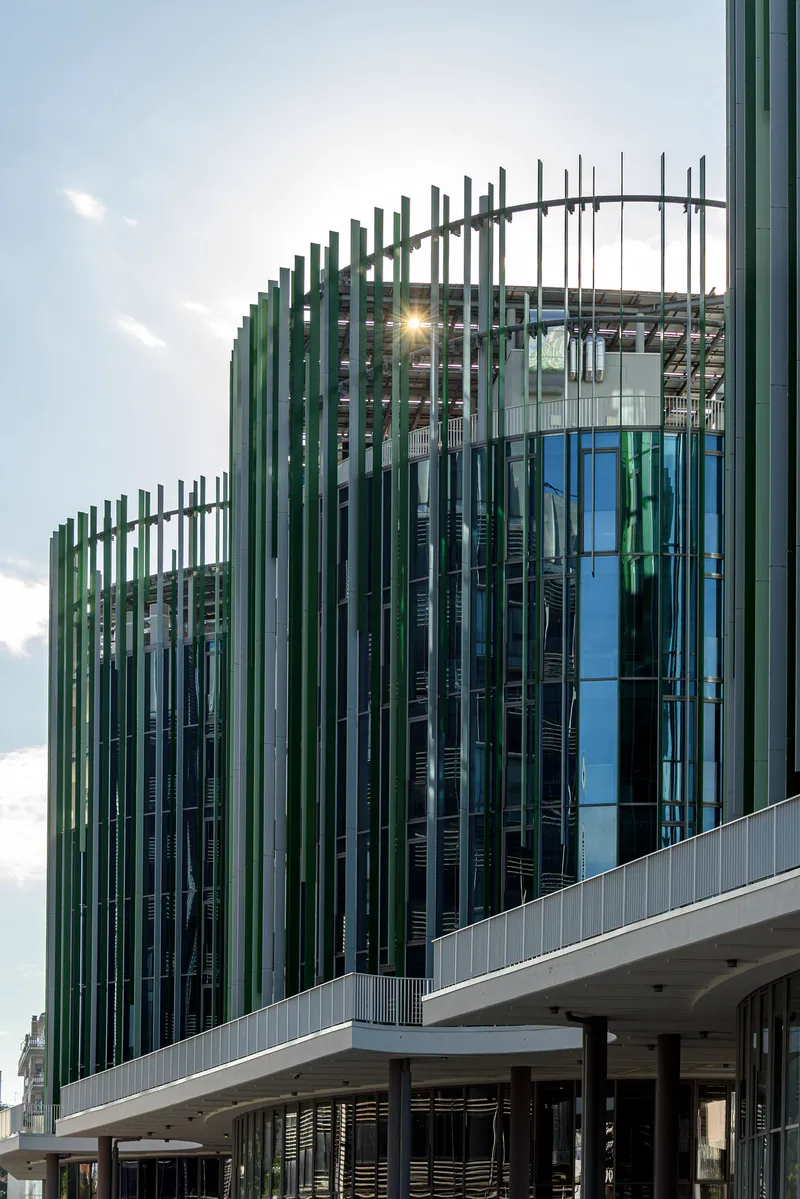
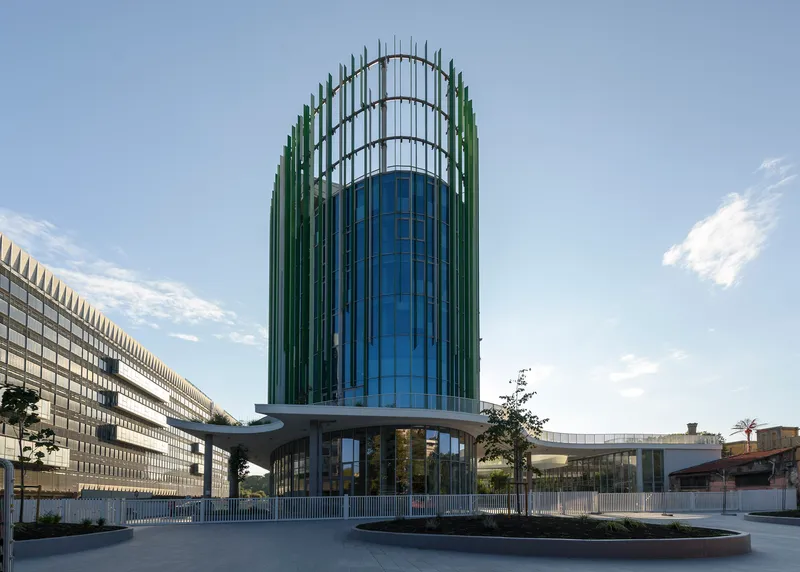
The vertical aluminum fins wrapping each tower in alternating green and white bands are the building's most visible move, and they carry more weight than decoration. They serve as brises-soleil, moderating solar exposure around the curved perimeter while giving the towers a textile quality that shifts with viewing angle and time of day. At dusk, the green deepens against the glass, producing a layered depth that a flat curtain wall could never achieve.
The reference point is local. The Ostiense quarter's 1937 gasometer, a filigree steel cylinder visible across the neighborhood, set a precedent for wrapping utility in delicate structure. MCA takes the cue and updates it: a trellis of steel columns defines the tower perimeters, supporting the fin system and freeing interior layouts from the facade grid. It is industrial memory recast as climate strategy.
The Hanging Garden as Urban Connector
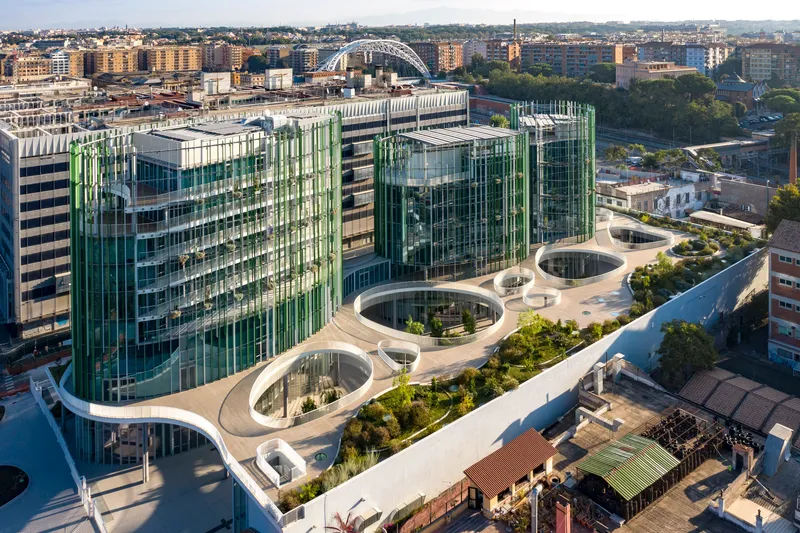
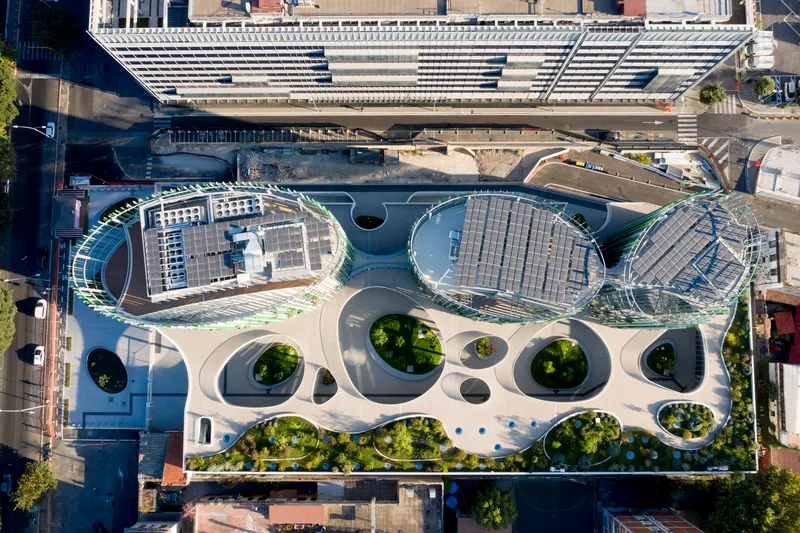
Seen from above, the elevated plaza reads as a topographic event: a curved concrete plate punctured by circular openings that admit daylight to the level below and host planted voids with polychrome maples, aromatic herbs, and pocket lawns. The plate tapers at its perimeter and around each opening, expressing its thinness rather than hiding it. These gardens are not cosmetic rooftop fillers. They provide shade, filter views, and create seating along biomorphic planter rims, turning a circulation slab into a genuine gathering space.
The decision to split the project into three separate towers rather than a single block amplifies this effect. Gaps between the volumes let wind through and create sightlines across the garden to the city beyond. MCA describes the composition as intentionally fragmented, a way to strip the institutional character that a unified mass would impose. The garden holds the pieces together without locking them down.
Ground Plane: Piazza, Not Lobby


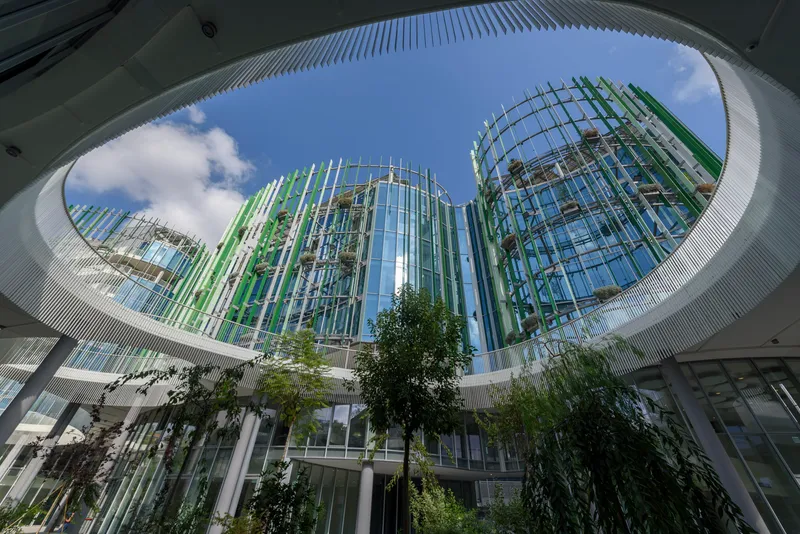
The covered ground level is the project's strongest urban contribution. Cylindrical columns support a curved canopy, and planted islands break the surface of what could otherwise feel like a parking garage. Glazed perimeter walls allow light to wash across the floor, while the circular roof openings above create dramatic shafts of sun and shadow that shift through the day. Standing beneath one of these voids and looking up through vertical louvres and tree canopies is a reminder that the building treats section as seriously as plan.
The ground and first floors handle the messiest program: reception, public services, pedestrian distribution. Pushing these functions to the base keeps the tower floors free for offices and meeting rooms, which MCA arranges along the perimeter to maximize natural light and ventilation. It is a straightforward organizational logic, but executing it within an elliptical footprint takes careful planning, particularly when the tallest tower also houses the Aula Magna on its second floor.
Perimeter Life: Walkways, Climbing Plants, and Detail


A maintenance walkway wrapping the curved perimeter reveals a secondary layer of green: climbing plants threading through the fin system, softening the aluminum geometry and adding a biological dimension to the sun-shading strategy. Over time, this layer will thicken and change with the seasons, meaning the building's appearance is not fixed at completion. It is an uncommon commitment for a public institution, where maintenance budgets tend to favor permanence over growth.
At ground level, the relationship between tower, elevated walkway, and planted beds reads as a sectional stack: landscape, infrastructure, architecture, landscape again. The elevated pedestrian bridge at the base of each tower connects garden terraces and provides a covered route that keeps you in the shade. It is a small but effective detail, the kind of thing that separates a good climate strategy from a diagram that never touches the body.
Interior Spaces: Light, Gathering, and Transparency


Inside, the interiors follow through on the facade's promise of permeability. A dining space with floor-to-ceiling glazing opens to a terrace beyond the vertical screen, letting occupants sit in filtered daylight without the thermal penalty of full exposure. The Aula Magna, housed in the tallest tower, features rows of green upholstered seating beneath white ceiling panels and recessed lighting. The palette is restrained: greens echo the exterior fins, whites keep the ceiling plane bright, and the room avoids the heavy, darkened theater aesthetic that dominates most institutional auditoriums.
Structurally, the conference rooms are notable for being entirely free of pillars. MCA achieves this through a coffered floor system: pairs of solid slabs resting on mixed steel-concrete columns create clear spans beneath without the visual clutter of intermediate supports. It is the kind of engineering decision that registers as spatial generosity rather than technical achievement, which is exactly the point.
Plans and Drawings
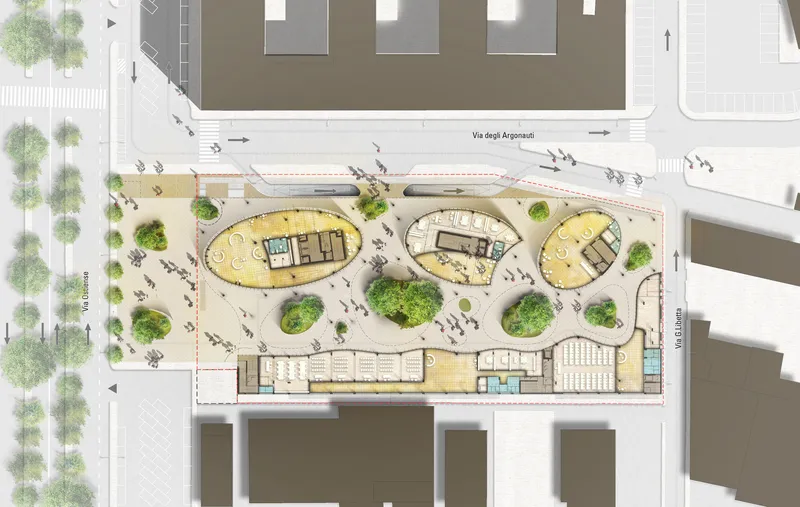
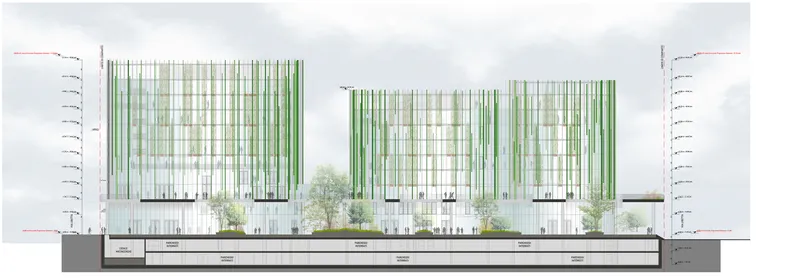
The site plan reveals the formal logic most clearly: three oval footprints arranged around circular planted voids, with pedestrian pathways threading between them. The composition is looser than a conventional campus quad, and the yellow roofs mark each tower as a distinct volume rather than a wing of one building. In the elevation drawing, the green-striped facades rise above a horizontal base anchored by trees, confirming that the project's proportions depend on the base slab as much as the towers. Without the raised garden, these would be three objects in a parking lot. With it, they share a ground.
Why This Project Matters
Roma Tre University's rectorate demonstrates that climate-responsive design and urban generosity are not competing agendas. The elliptical plans, the aluminum fins, the hanging garden, and the open ground-floor piazza all serve both purposes simultaneously. MCA did not bolt sustainability onto a conventional office block. They let environmental analysis shape the geometry from the outset, and the result is a building whose form is legible as performance rather than style.
More broadly, the project offers a model for how universities can engage their neighborhoods. By opening the ground plane to the street and raising a second public landscape above, MCA created a campus building that functions as infrastructure for Via Ostiense, not just for the university. In a quarter that spent most of the twentieth century as an industrial backwater, that openness carries real civic weight. The Ostiense gasometer was a container. This is a threshold.
Roma Tre University Building, designed by Mario Cucinella Architects, Roma, Italy. 12,000 m². Completed 2021. Photography by Moreno Maggi.
About the Studio
Share Your Own Work on uni.xyz
If projects like this are the kind of work you want to make, uni.xyz is a place to publish your own, find collaborators, and enter design competitions.


Popular Articles
Popular articles from the community


Cloaked Colonization: A Mobile Underwater Habitat That Moves Like a Fish
Micah Abaya's shortlisted EHC Pacific entry reimagines ocean settlement as a dispersed network of self-sustaining architectural organisms.
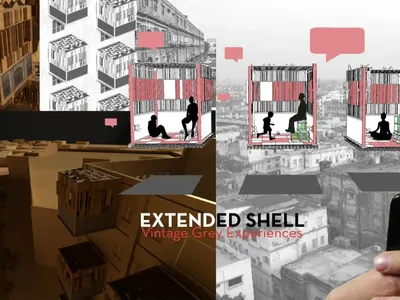
Extended Shell: Retrofitting Kolkata's Balconies as Living Urban Thresholds
A modular retrofit system recovers the social and environmental intelligence of Kolkata's historic verandas for contemporary Park Street residents.
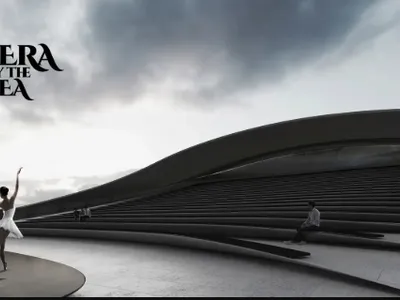
Opera by the Sea Estonia: Three Shells Dissolving Architecture into Tallinn's Coastline
A winning opera house proposal replaces monumental form with interconnected shells that blur the boundary between building, park and Baltic Sea.

Opera on the Sea: Driftwood Logic Shapes a Timber Opera House on Estonia's Coast
Trevor Orgill's opera house translates the entangled drift of floating timber into a civic building where wood, water, and music converge.

Similar Reads
You might also enjoy these articles

Pixel Gardens: One Repeated Module Stacked Into a Terraced Social Housing Tower for Famagusta
Salem Bader's shortlisted housing tower builds a vertical neighbourhood from one repeated module, offsetting units to carve terraces, light and air.

Bao Huynh Watercolor Atelier: A Serene Art Retreat in Hội An
Bao Huynh Watercolor Atelier in Hội An blends multifunctional art spaces, sustainable design, local materials, and family-friendly living in a serene environment.

Atelier Macri Concept Store Interior Design by CASE-REAL
Atelier Macri store features a "ko" counter, walnut wood details, cork displays, blending retail, gallery, and seamless customer experiences.

Manuel Vargas Izquierdo Stadium and High-Performance Sports Center: Architectural Excellence in Jalpa de Méndez
The Manuel Vargas Izquierdo Stadium blends sustainable design, inclusive sports facilities, and cultural-inspired architecture, revitalizing Jalpa de Méndez’s public spaces.


Comments (0)
Please login or sign up to add comments
No comments yet. Be the first to comment!