

MARS Architectes Wraps a Gonesse School Cafeteria in a Curving Canopy That Shelters Trees and Children Alike
A 1,646 square meter timber-framed lunch pavilion in suburban Paris threads itself around existing pines and planted courtyards.


School cafeterias rarely get the architectural attention they deserve. They are functional afterthoughts, squeezed into leftover footprints, clad in materials chosen for durability rather than delight. MARS Architectes takes a different position with this 1,646 square meter project in Gonesse, a suburban commune just north of Paris. Here, a middle school's dining program becomes the occasion for a building that is simultaneously landscape infrastructure and civic gesture, its long curving canopy stitching together courtyards, circulation, and existing trees into a single generous figure.
What makes the project genuinely interesting is the refusal to treat the canopy as decoration. The sweeping white roof is a working element: it organizes arrival, shelters outdoor walkways, frames views into planted gardens, and negotiates the boundary between the school's existing buildings and its new dining volumes. Rather than clearing the site and starting fresh, MARS Architectes kept mature pines in place and designed around them, punching circular openings through the canopy so trunks and crowns break through the roofline. The result is a building that belongs to its site rather than merely occupying it.
The Canopy as Organizing Device


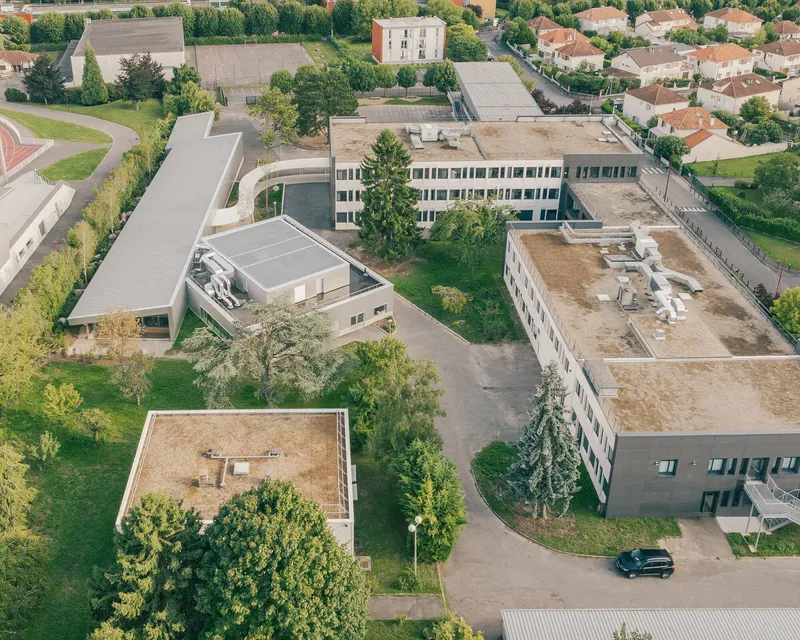
Seen from above, the project reads as a single curving stroke drawn across the school campus. The canopy connects distinct programmatic volumes, from kitchen and dining areas to covered walkways and a sheltered parking structure, without forcing them into a single monolithic block. It floats on slender steel columns, its white surface reflecting soft light down into the courtyards below. The curve is not arbitrary; it follows the existing property boundary and aligns with the campus's athletic fields, creating a smooth transition between the new cafeteria and the neighborhood beyond.
The aerial views reveal how carefully the building mediates between scales. Against the repetitive fabric of suburban housing to the north and east, the canopy introduces a longer, slower geometry. It pulls the eye along its length, giving the school a legible identity from a distance while keeping the building low and deferential at ground level.
Trees Through the Roof


The circular opening in the canopy is the project's most memorable move. A mature pine rises through the roof plane, its trunk surrounded by a planted bed, its canopy spreading above the white surface. The detail is precise: the aperture is wide enough to allow the tree to sway in wind without touching the structure, and the surrounding planting creates a pocket garden visible from the covered walkways on all sides. It is an almost literal inversion of the standard suburban logic, where trees are removed to make way for buildings.
Other pines are preserved in the courtyards between volumes, framed by low glazed facades. The landscape treatment is restrained: large boulders, gravel, and native plantings replace the manicured lawns you might expect in a school setting. The effect is closer to a cleared woodland than a garden, giving children a sensory environment that shifts with the seasons.
Timber Structure and Interior Warmth


Step inside the dining hall and the character changes entirely. The ceiling is a rhythmic field of exposed timber joists, closely spaced and left unfinished, running perpendicular to the glazed exterior wall. The repetition is calming rather than monotonous; the timber absorbs sound, tempers the scale of the room, and gives it a domestic warmth that fluorescent-lit institutional cafeterias rarely achieve. Dark acoustic panels between the joists control reverberation without hiding the structure.
Continuous floor-to-ceiling glazing dissolves the boundary between the dining area and the planted courtyards. Children eating lunch look directly into gardens with boulders, gravel paths, and tree trunks. The mechanical systems, ductwork, and lighting are threaded between joists rather than buried behind a suspended ceiling, keeping the room honest about its construction while maintaining visual order.
Covered Walkways and Threshold Spaces
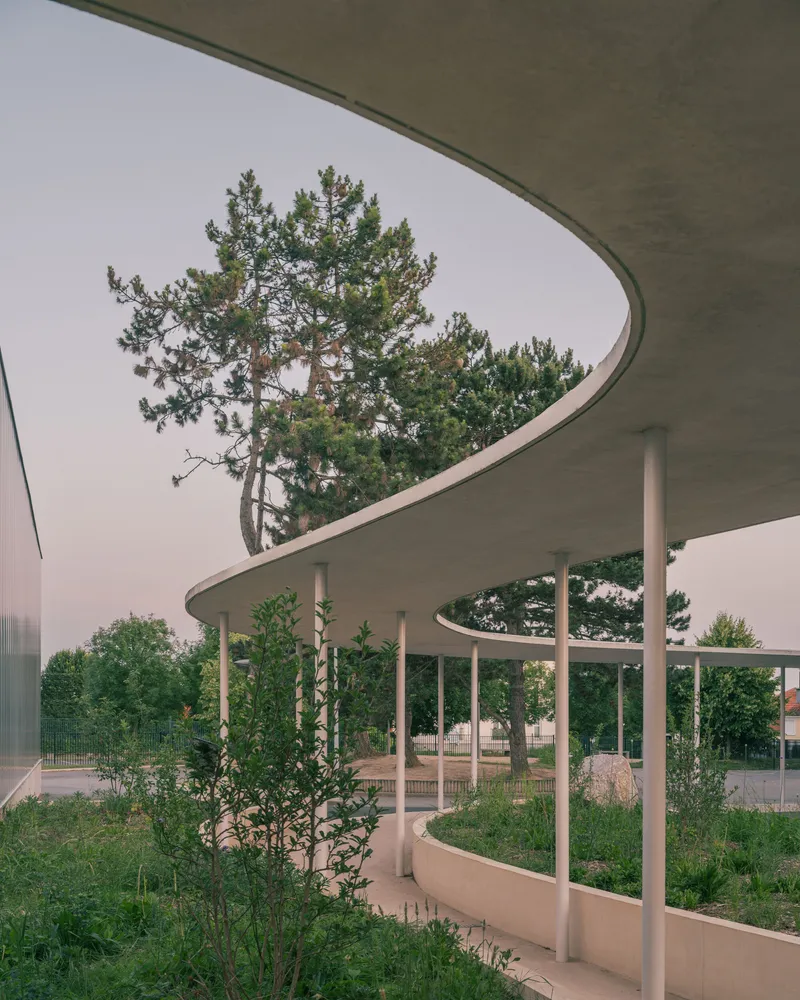
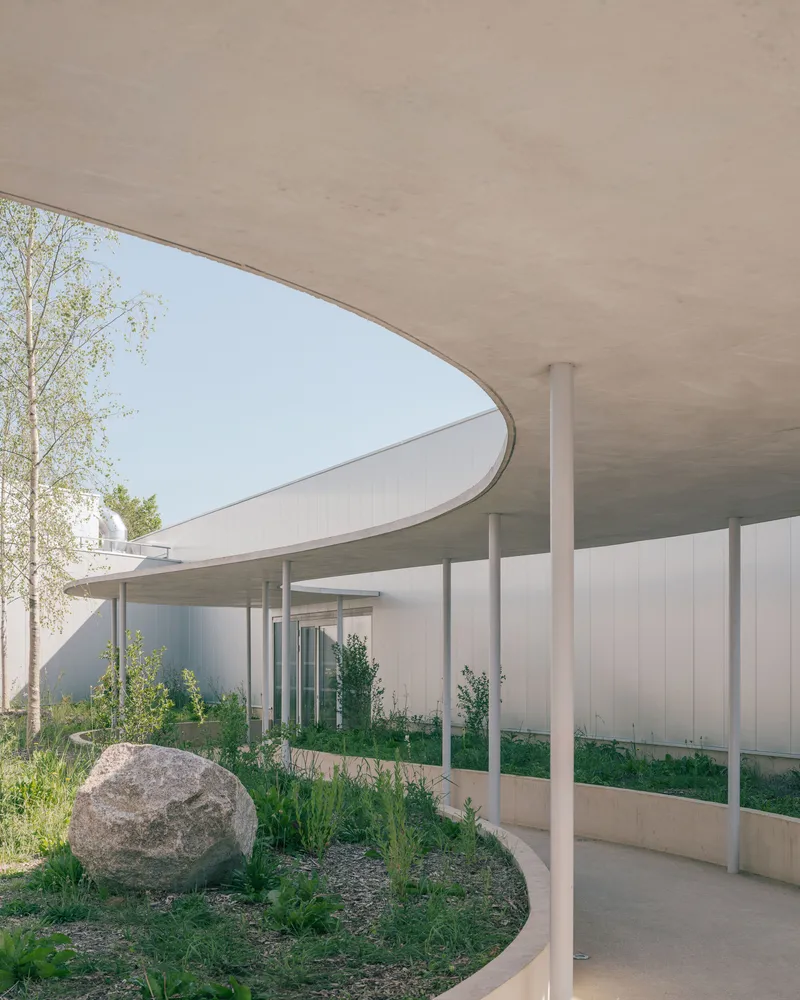
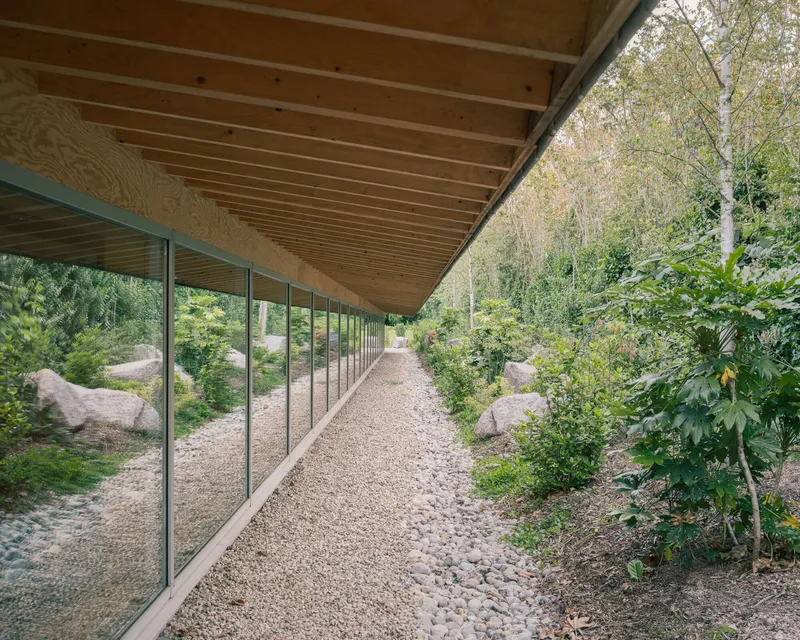
Some of the project's best moments happen not inside rooms but along the covered paths that connect them. Slender columns support angled timber ceilings, creating sheltered corridors where children move between buildings without exposure to rain. Planted beds with boulders and birch saplings line one side; glazed walls open to interiors on the other. At dusk, these walkways glow softly, the timber overhead catching warm light from interior fixtures.
The walkways do more than solve a logistics problem. They create threshold zones, spaces that are neither fully inside nor fully outside, where the pace slows and the landscape is close enough to touch. For a building type defined by speed and throughput, this generosity with in-between space is a deliberate and welcome act of resistance.
Facade and Evening Presence

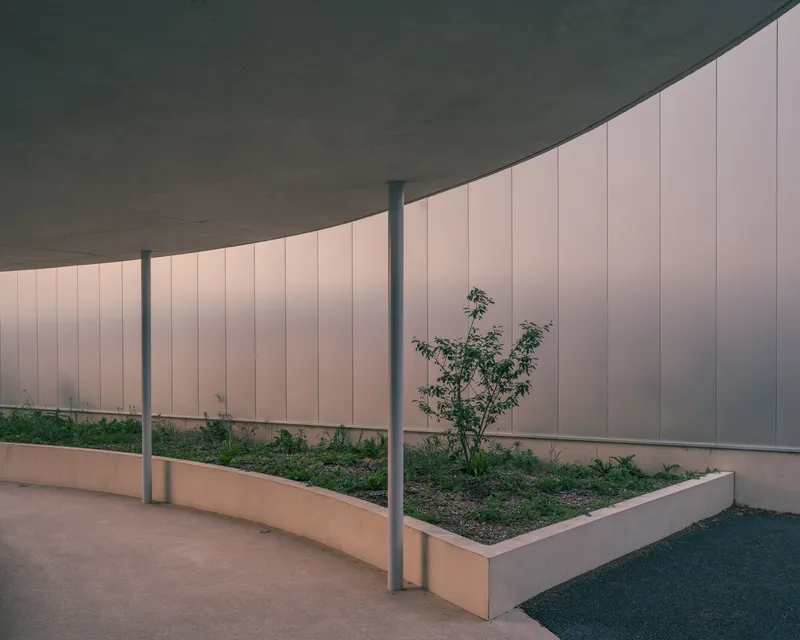

The curving facade reads differently depending on the time of day. In daylight, the white canopy and translucent panels are crisp and recessive, blending with the overcast northern French sky. At dusk, the building comes alive: interior lighting turns the translucent cladding into a soft lantern, and the silhouettes of mature pines in front of the entrance give the approach a quiet theatrical quality. Vertical metal panel cladding at the entrance zone adds a finer grain, catching oblique light and giving the curve a sense of materiality up close.
MARS Architectes uses a limited palette, white concrete, translucent polycarbonate, timber, metal, and lets the geometry do the expressive work. There is no applied color, no graphic interventions, no attempt to signal "school" through cartoonish gestures. The restraint is deliberate, treating students as inhabitants of architecture rather than consumers of themed environments.
Working Spaces: Kitchen, Corridors, Classrooms

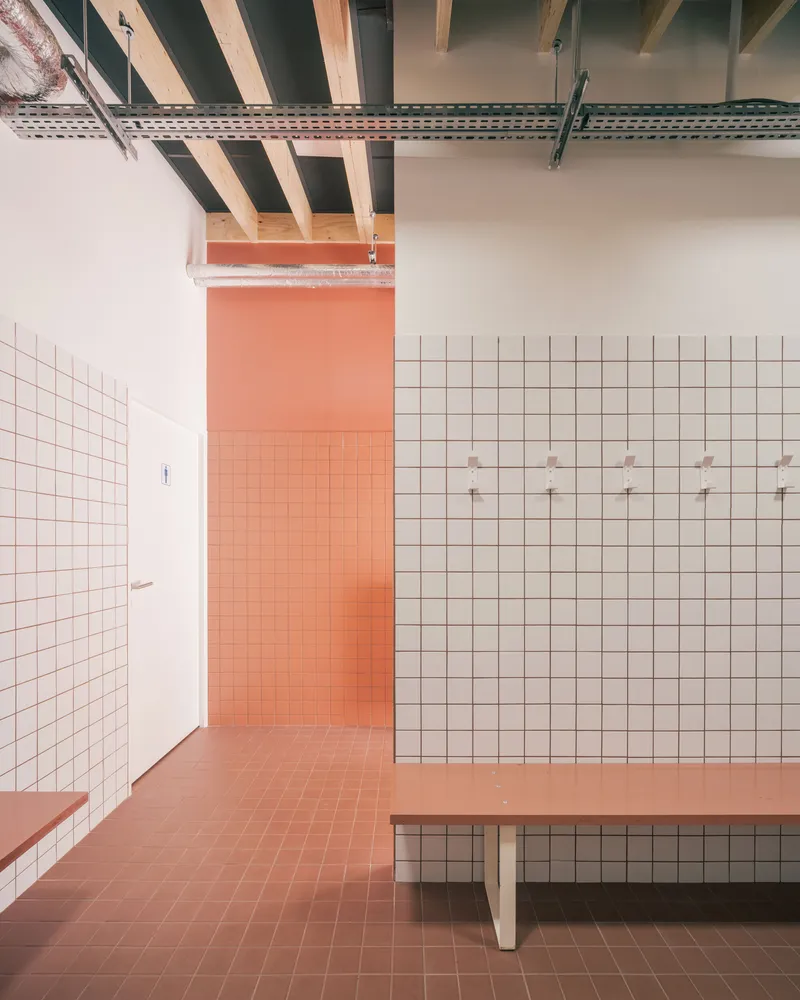

The back-of-house spaces receive the same level of care. The commercial kitchen, visible through a serving hatch, is outfitted with stainless steel islands and professional-grade ventilation, but the room is bright and well proportioned rather than claustrophobic. Corridors use terracotta floor tiles and white gridded wall tiles to create surfaces that are robust enough for heavy daily use while maintaining a visual warmth. A classroom visible in the sequence features suspended acoustic ceiling tiles and glazed partitions that allow borrowed light from adjacent spaces, a detail that keeps even interior rooms from feeling isolated.
Landscape as Architecture


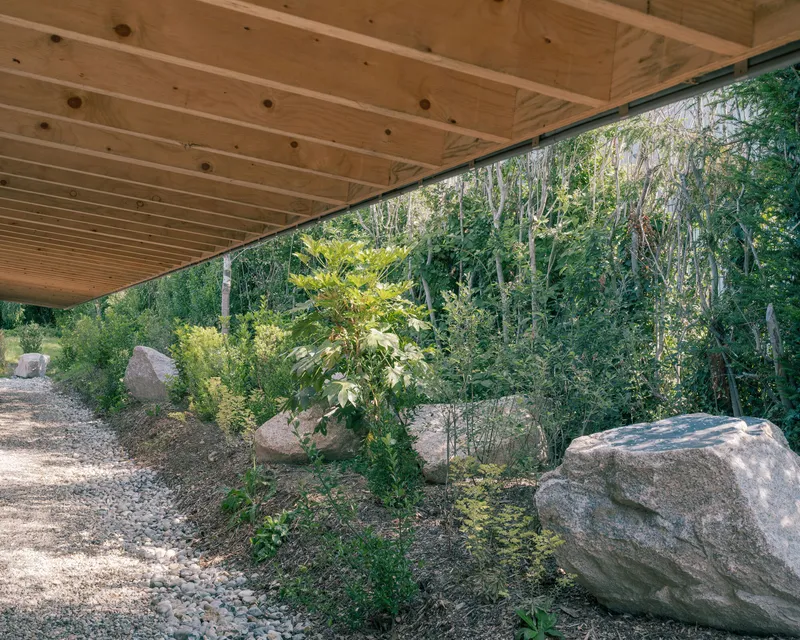
The boundary between building and landscape is deliberately blurred. Floor-to-ceiling glazing brings the boulder gardens into the dining experience, while cantilevered timber overhangs extend the roof plane over naturalized plantings outside. Large stones, some the size of a seated child, anchor the gravel beds and give the gardens a geological presence that resists the generic "green space" treatment typical of school campuses.
There is an ecological argument here, too. Native plantings require less maintenance and irrigation than conventional lawns, and the preserved trees provide canopy shade that will reduce cooling loads as they mature. But the landscape is not just pragmatic; it is experiential. Children encounter texture, weight, and seasonal change every time they walk to lunch.
Interior Views and Structural Detail


Close-up views reveal the care invested in the timber structure. Radiating joists fan out from interior posts, creating a subtle change in ceiling geometry as you move through the building. The plywood decking above the joists is left visible, adding another layer of wood grain to the composition. A corner window seat, framed by timber posts with boulders and gravel gardens beyond, offers a small moment of retreat within the larger dining program. These details accumulate: the building rewards attention without demanding it.
Plans and Drawings

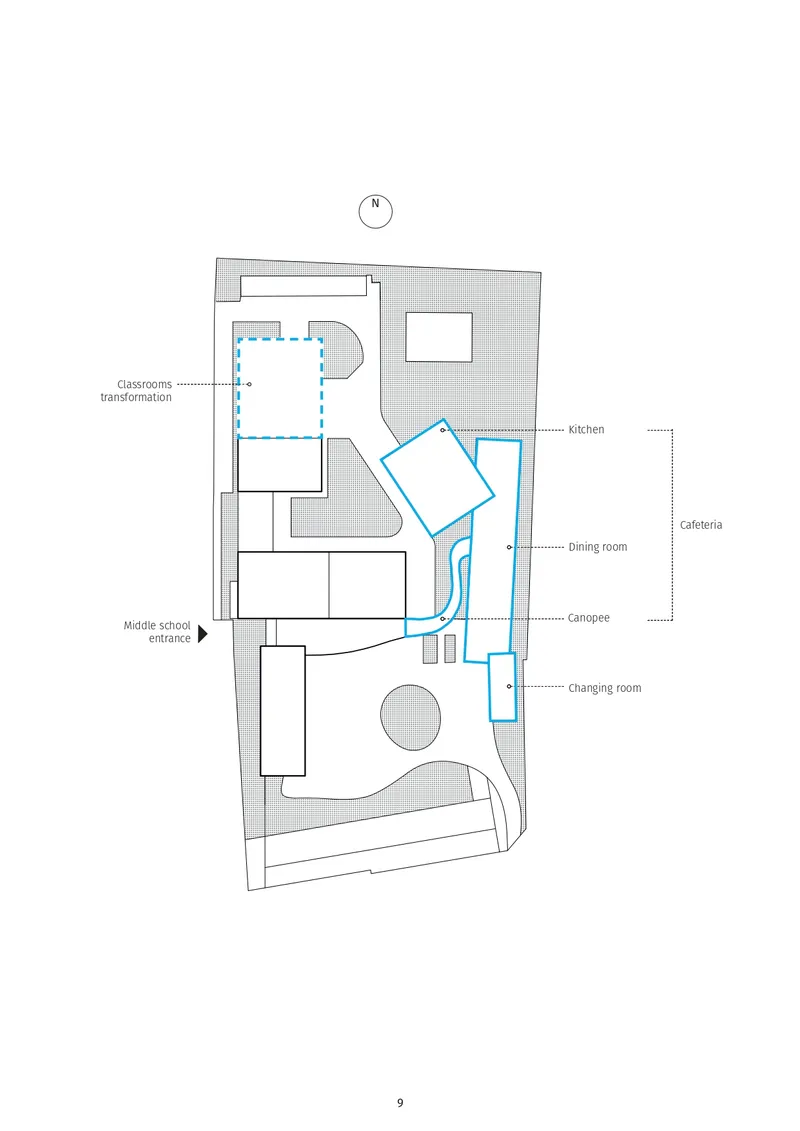


The site plan diagrams make the project's urban strategy legible. The yellow footprint sits at the edge of the school campus, mediating between the athletic fields and the residential fabric. The floor plan shows a clear separation between the kitchen and service areas on one side and the dining hall and canopied walkways on the other, with the preserved trees occupying voids between the two. A second plan compares the cafeteria layout with a separate classroom and fablab wing, suggesting that the curving canopy could eventually extend to connect additional program. The section drawing confirms the low profile: the building barely rises above the tree canopy, and the sloped rooflines channel natural light deep into the dining spaces through continuous clerestory glazing.
Why This Project Matters
School buildings are where public investment meets daily life most directly. A child eats lunch in the same room five days a week for four years. The quality of that room, its light, its air, its relationship to the outdoors, shapes habits of attention and care that outlast any lesson plan. MARS Architectes treats this reality with the seriousness it deserves, investing in timber structure, landscape integration, and spatial generosity where a lesser commission might have produced a prefabricated box.
The project also demonstrates that sustainability and beauty are not competing agendas. Preserving existing trees, using timber structure, specifying native plantings, and maximizing natural light are all environmentally responsible choices. They also happen to produce a building that is genuinely pleasant to occupy. In a suburban context where architecture is often reduced to a question of efficiency and cost, this cafeteria argues that public buildings can still be acts of civic imagination.
Middle School Cafeteria in Gonesse by MARS Architectes. Gonesse, France. 1,646 m². Completed 2025. Photography by Charly Broyez.
About the Studio
Share Your Own Work on uni.xyz
If projects like this are the kind of work you want to make, uni.xyz is a place to publish your own, find collaborators, and enter design competitions.


Popular Articles
Popular articles from the community


David Ortega Stacks a Two-Story Mexico City Penthouse Around a Steel Stair and a Pergola-Shaded Roof Terrace
In Colonia Roma, a 300 m² penthouse uses oak joinery, a planted steel stair and a slatted roof pergola to make a new-build apartment feel like a house.

longwave studio Reorganizes a 112 m² Tainan Apartment Around the Daily Routines of a Family and Two Cats
In Tainan, Taiwan, birch plywood, rust-red furniture and a freestanding plaster wall link arrival, storage, work and family life in one apartment.

LT2A and OPEN Architectes Thread a Brick and Glass High School Through a Wooded Belgian Campus
In Braine-l'Alleud, a 3,000 m² wing for Collège Cardinal Mercier pairs pale brick with a glazed colonnade, deferring to a small chapel and a dense wood.

Juan García Correa, John González and Claudia Rueda Sink a Circular Amphitheater into a Manizales Engineering Building
On the La Nubia campus in Manizales, Colombia, the S1 Building folds labs and offices into a hillside of ramped lawns that double as a campus route.

Similar Reads
You might also enjoy these articles


LAVA Architecten Gives Vocational Education a Sawtooth-Roofed Face on a Mechelen School Campus
In Mechelen, Belgium, a 2,053 m² STEM school on a 6×6 m grid turns workshops and classrooms into rooms that can be rearranged as teaching changes.

KEMA Studio Turns a Derelict Marvila Attic into a 60 m² Lighthouse Apartment Above Lisbon
In Lisbon's Marvila district, a rebuilt roof, four skylights and two plywood volumes turn an unlivable attic into a bright home facing the Tagus.

Pixel Gardens: One Repeated Module Stacked Into a Terraced Social Housing Tower for Famagusta
Salem Bader's shortlisted housing tower builds a vertical neighbourhood from one repeated module, offsetting units to carve terraces, light and air.

Bao Huynh Watercolor Atelier: A Serene Art Retreat in Hội An
Bao Huynh Watercolor Atelier in Hội An blends multifunctional art spaces, sustainable design, local materials, and family-friendly living in a serene environment.

Explore Cafeteria Competitions
Discover active competitions in this discipline

Challenge to design a barrier free sports center

Challenge to design an outdoor ice-rink and park

Challenge to design public laboratory
Comments (0)
Please login or sign up to add comments
No comments yet. Be the first to comment!