

Massive Order Uses a 30 cm Grid to Shape Every Surface of a Kuwaiti Coastal Home
House 30 in Al Khiran, Kuwait, treats a dimensional module as both construction logic and architectural expression across 480 square meters.


A house ruled by a number sounds like a gimmick until you see how thoroughly it commits. House 30, designed by Massive Order under the lead of Muhannad Al-Baqshi, takes its name from a 30 cm grid that dictates every dimension in the building: wall thicknesses, window widths, floor-to-floor heights, the depth of a fin, the setback of a slab edge. The result, at 480 square meters in Al Khiran on Kuwait's southern coast, is a house that feels simultaneously strict and spacious, its proportions locked into a rhythm you sense before you consciously register it.
What makes the project worth studying is not the grid itself but what the grid produces. Rather than a boxy container, the discipline yields a collection of interlocking volumes topped by jagged, offset roof planes that break the skyline into a small mountain range of white concrete. The grid keeps the complexity coherent. Every peak, every slot window, every cantilevered ledge snaps to the same dimensional family, giving the house an internal consistency that holds it together even as its silhouette fragments against the flat Kuwaiti horizon.
A Serrated Skyline
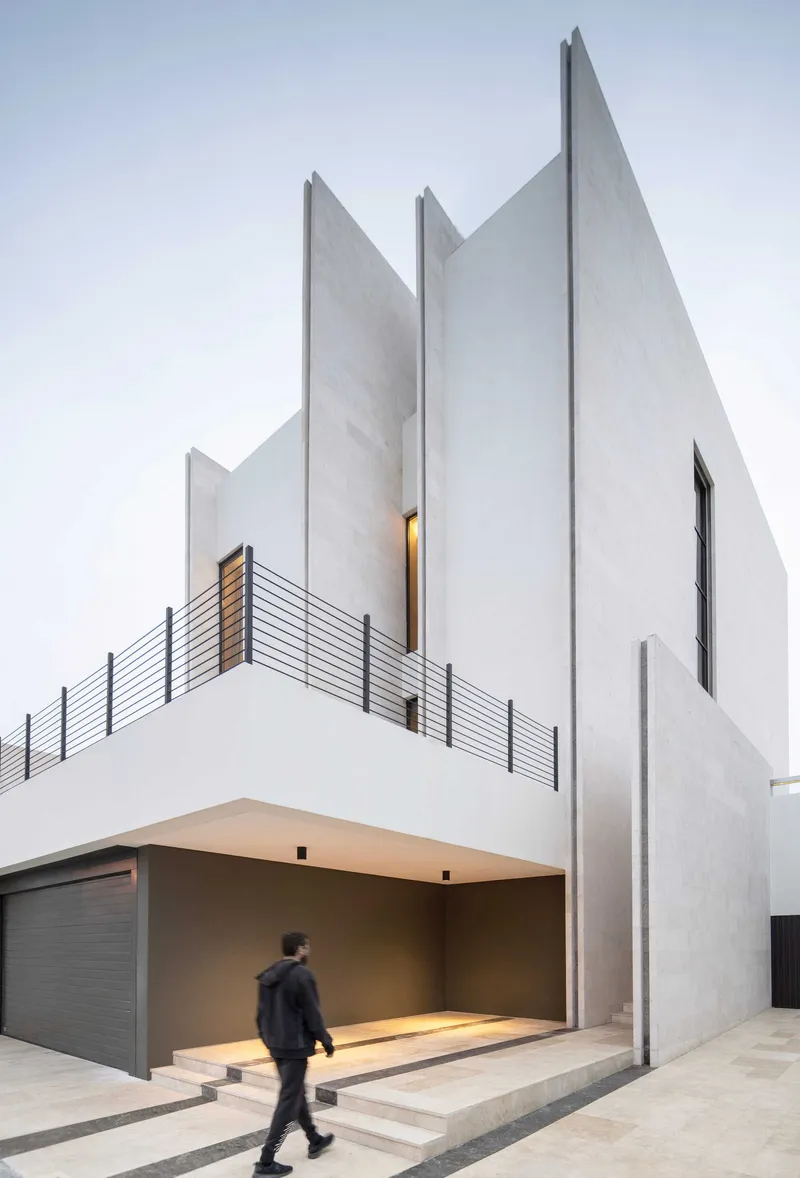
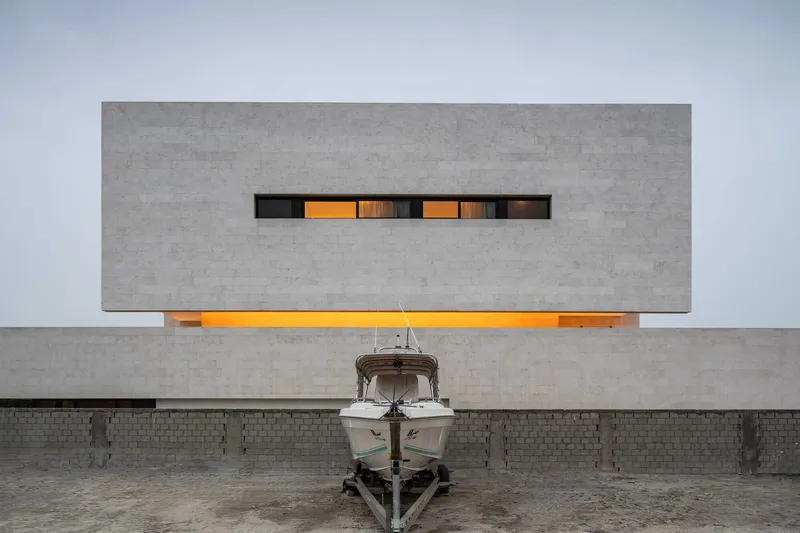
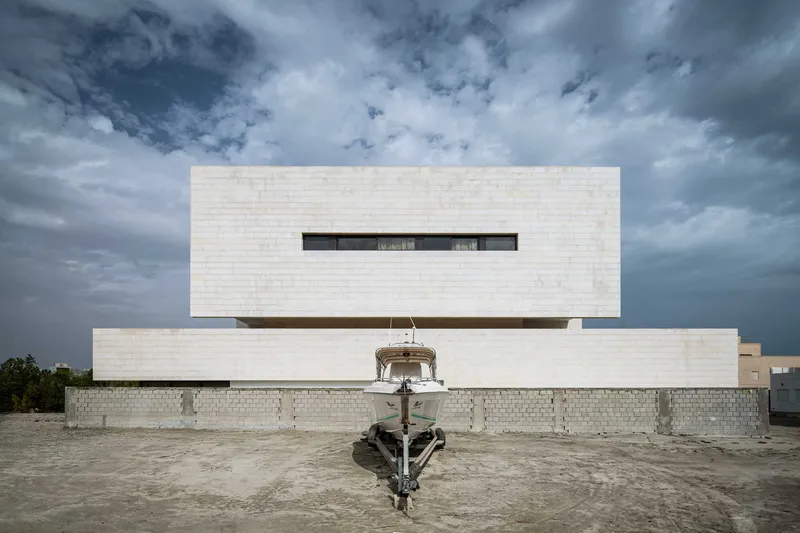
The most immediately striking move is the roofline. Where most residential projects in the region default to flat parapets, House 30 pushes its concrete volumes to different heights, creating a serrated crown that reads almost like a geological formation. From the street, the layered white limestone facade presents itself as a stack of horizontal bands punctuated by narrow ribbon windows, the kind of composition that demands precision because there is nowhere to hide a misalignment. A boat parked in the forecourt under stormy skies only reinforces how much the house belongs to its coastal context.
At dusk the ribbon windows glow amber, transforming the opaque mass into something lantern-like. The contrast between the heavy, almost fortress-like daytime presence and the warm evening transparency is one of the house's best qualities.
Concrete Detailing at Close Range
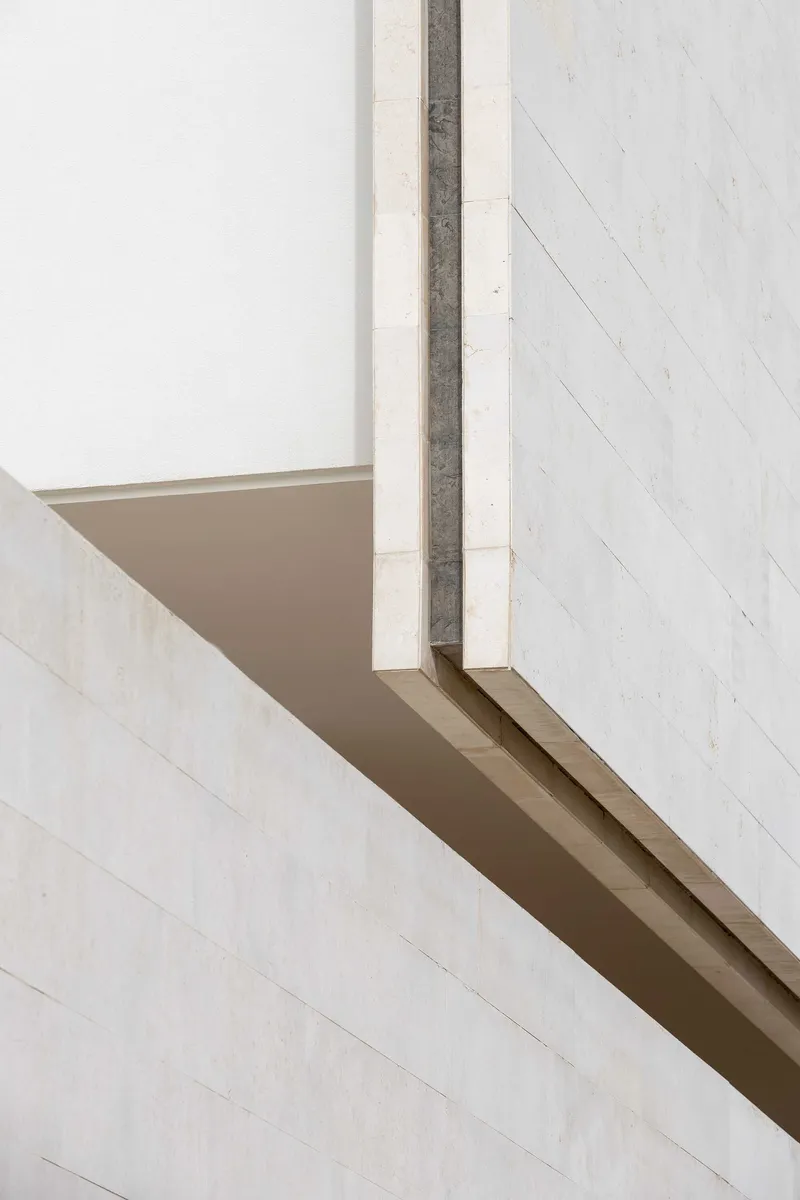
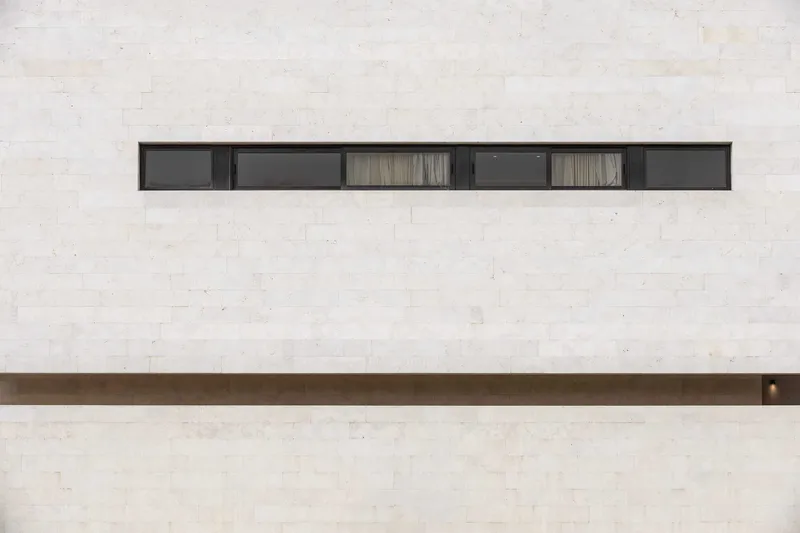
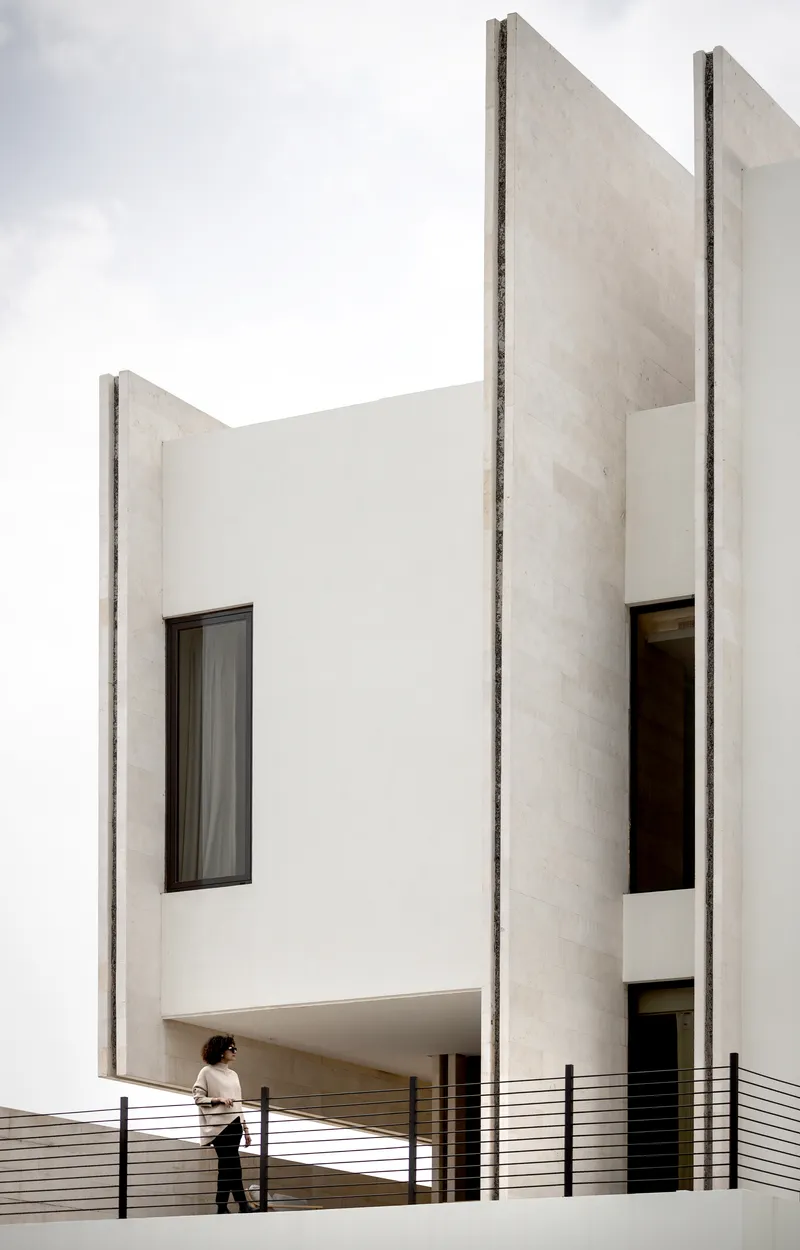
Zoom in and the grid announces itself in the joints. A close-up of one concrete fin meeting the underside of a cantilevered slab reveals a sloped soffit detail that is pure geometry: the angle, the shadow line, the gap between elements all feel calibrated to the millimeter. These are not decorative flourishes. They are the direct outcome of locking every component to a 30 cm module and then letting the intersections express themselves honestly.
The six-panel ribbon window set into what appears to be a pale travertine facade with bronze detailing below it shows how the module scales up. Each panel width is a multiple of 30, and the bronze trim at the base provides a thin datum line that ties the window assembly back to the stone coursing. On the upper terrace, white concrete towers frame a generous outdoor room where horizontal railings run between the vertical masses, creating a sheltered but open-air living zone.
Stone Corridors and Controlled Light
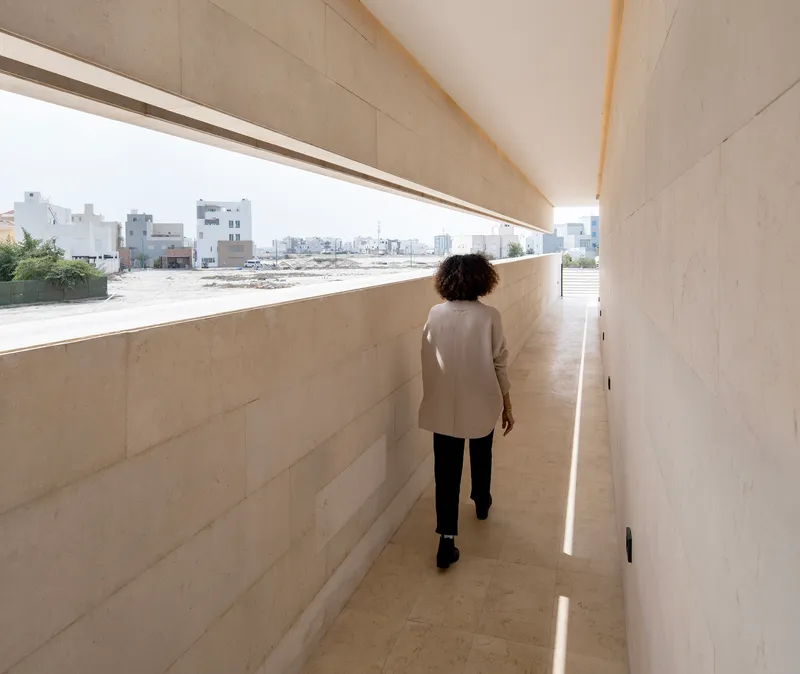
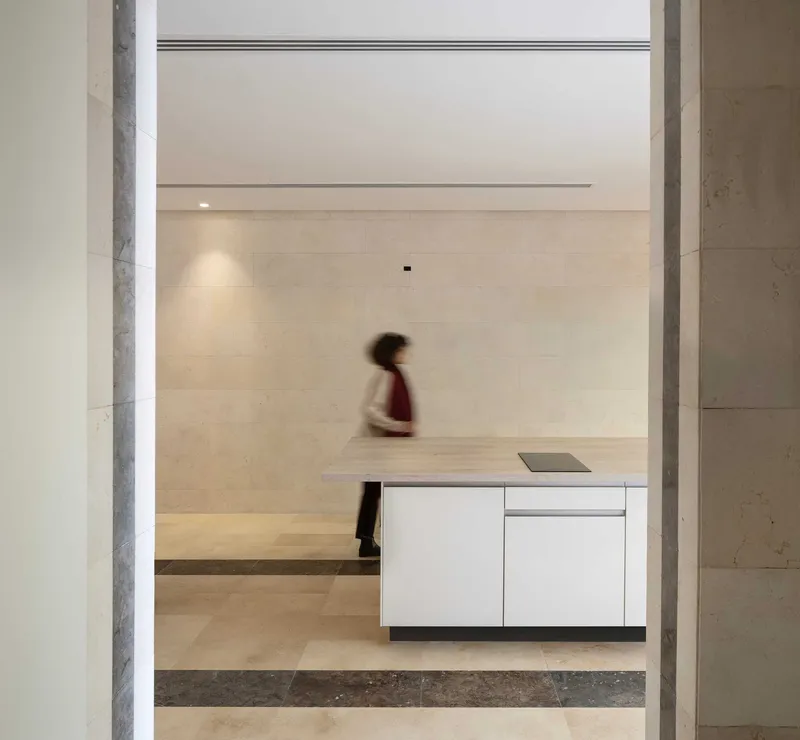
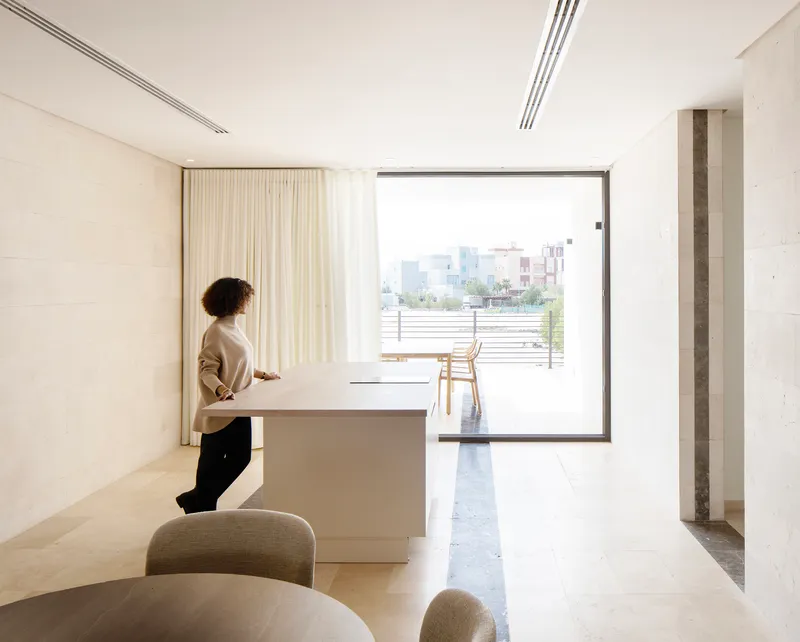
Inside, the material palette shifts to limestone-clad walls and pale stone flooring that keep the interiors cool and luminous. A corridor with a horizontal window overlooking the surrounding neighborhood functions as a light scoop, pulling daylight deep into the plan while offering a framed view out. The proportions of that window opening, predictably, snap to the grid, making it feel inevitable rather than arbitrary.
Movement through the interior is sequential: a view through a doorway catches a figure crossing pale stone floors past white kitchen cabinetry, while in the living space a person stands at a counter facing a full-height sliding glass door that opens to the terrace beyond. The transitions between inside and outside are handled with restraint: no grand reveals, just a steady alternation between enclosed and open that mirrors the solid-void rhythm of the facade.
Terrace Living After Dark
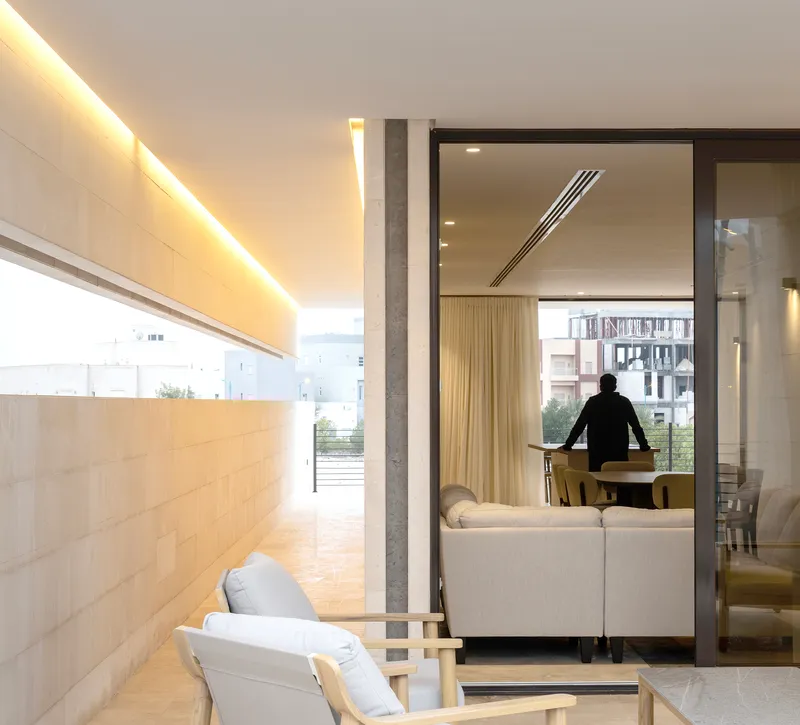
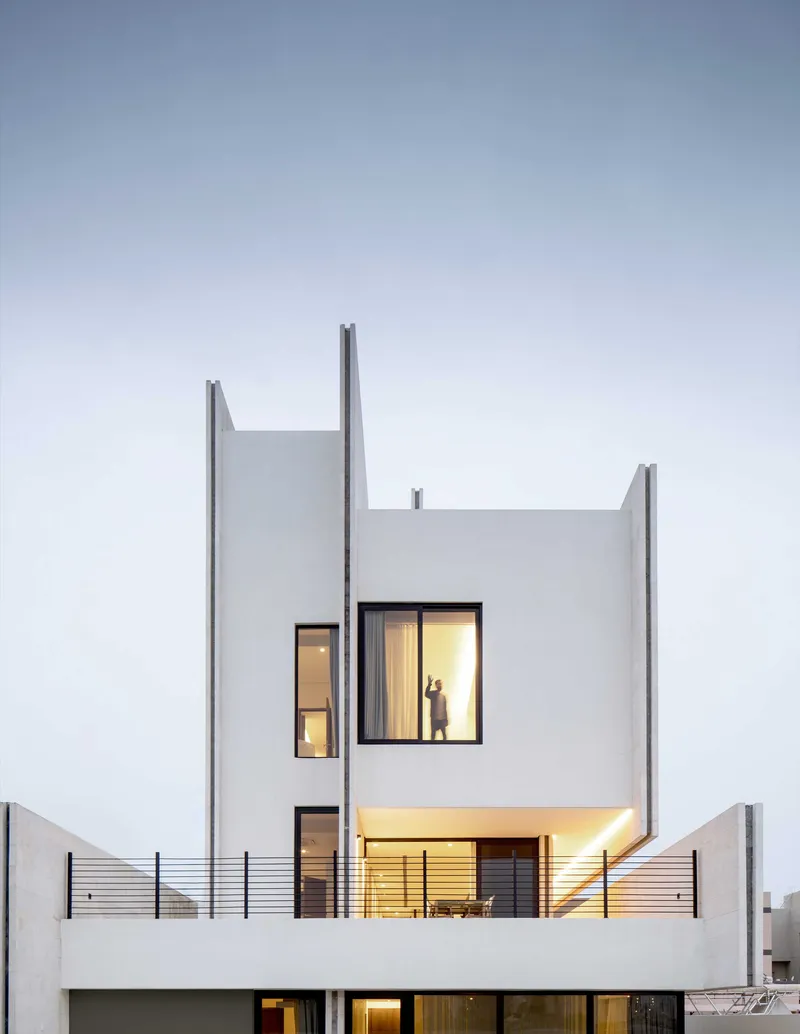
The covered terrace with its concealed linear lighting is where the house comes alive socially. Looking through glazed doors back into the living room, the boundary between interior and exterior dissolves into a single continuous plane of pale stone. At the rear facade, twilight reveals an illuminated upper terrace outfitted with dining furniture behind horizontal wire railings. In Kuwait's climate, where evenings are the primary time for outdoor life, these terraces are not amenities; they are the most important rooms in the house.
The wire railings are worth noting. In a project this disciplined, a heavy balustrade would have felt like a contradiction. The thin horizontal wires maintain visual continuity between levels while barely registering against the sky, keeping the stacked volumes legible as distinct horizontal planes.
Plans and Drawings
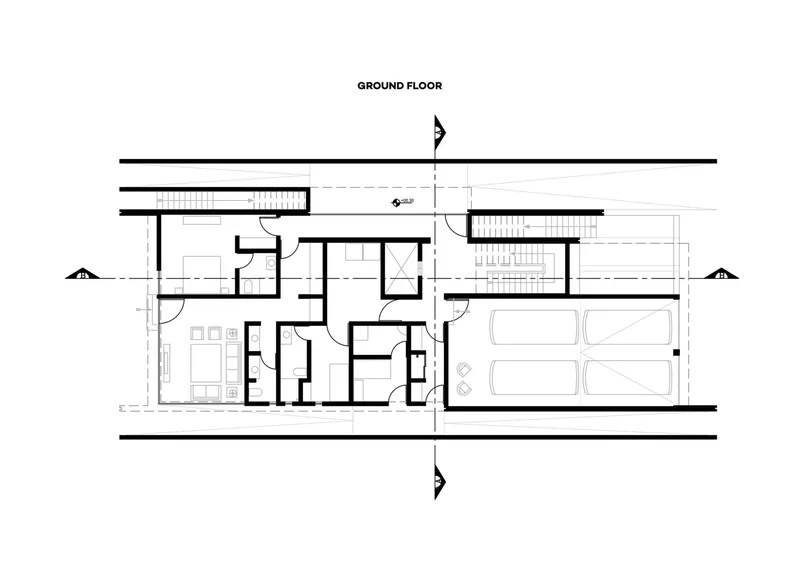
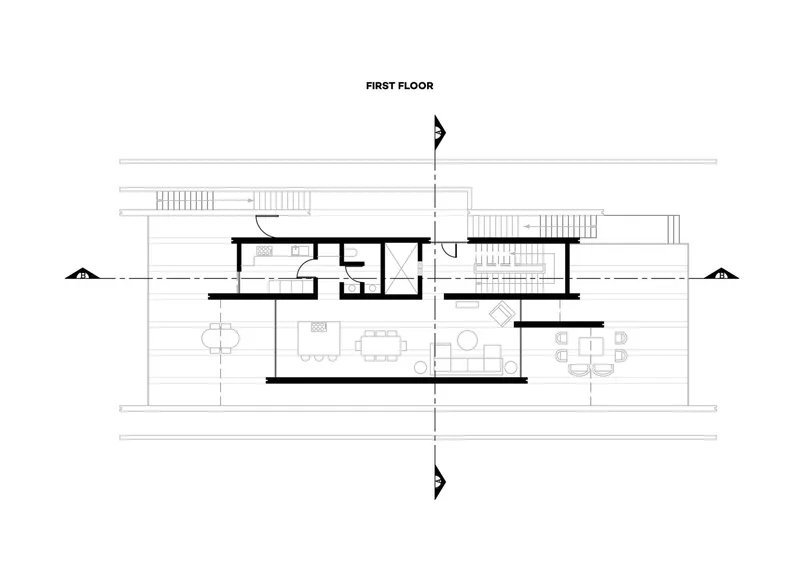
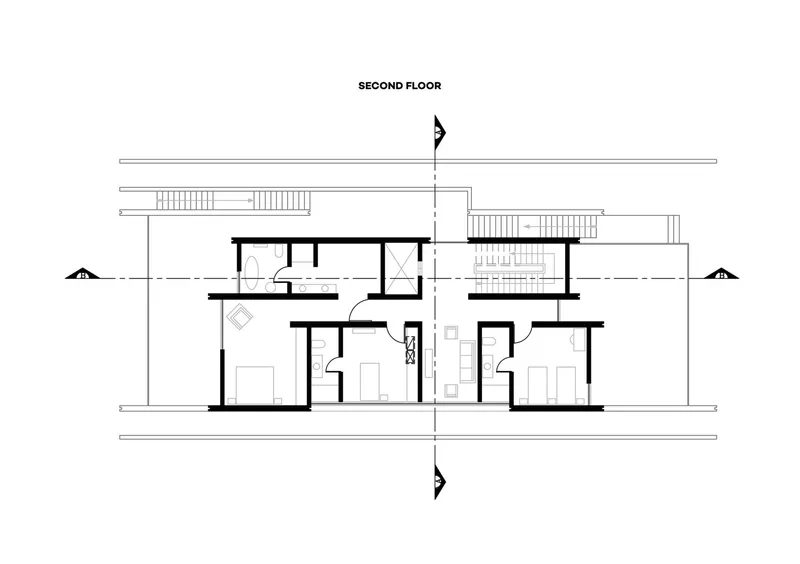
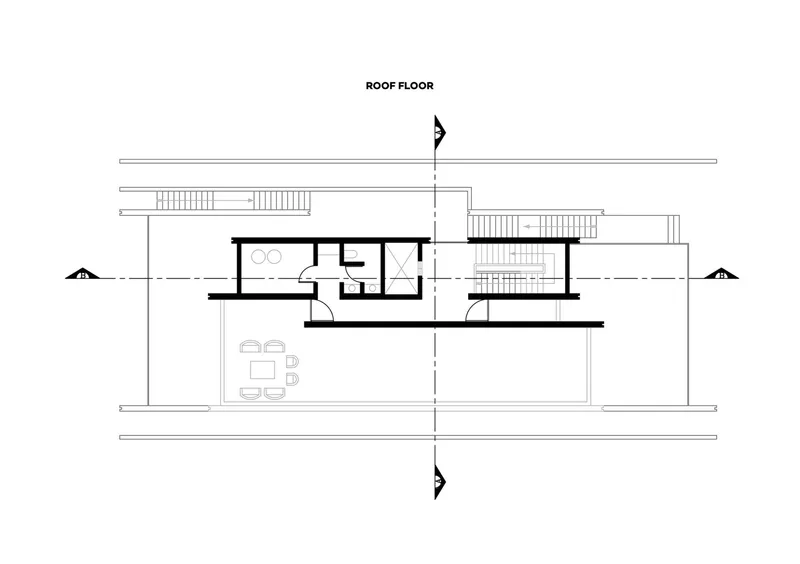
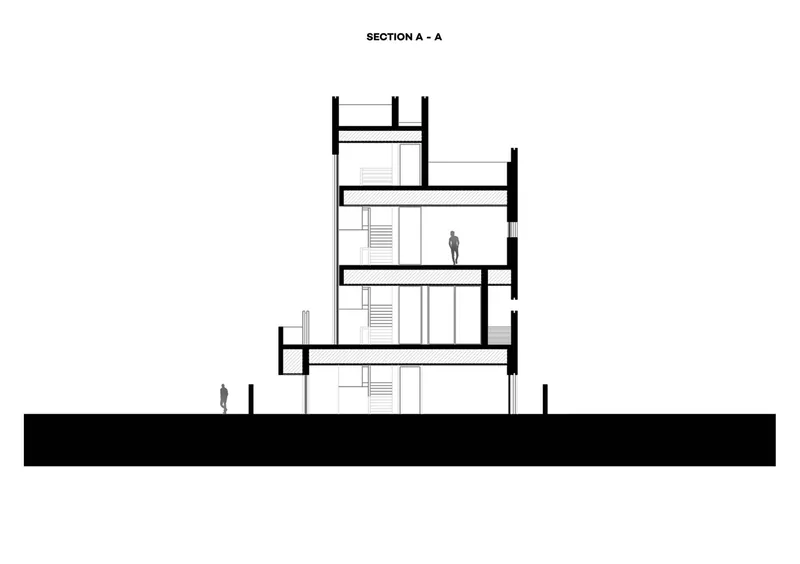
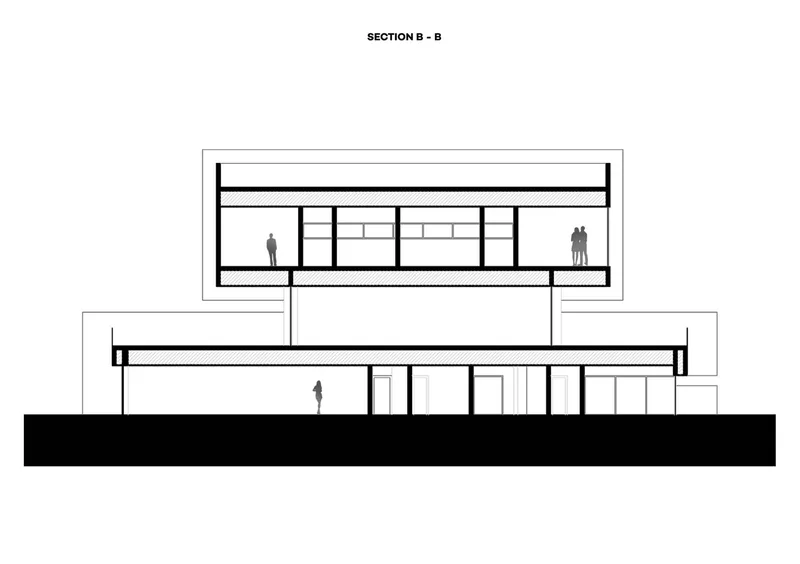
The floor plans reveal a compact but legible organization. At ground level, central living areas are flanked by two staircases with the garage tucked to one side. The first floor elevates the main living and dining spaces, flanking them with exterior decks that extend the usable area outward. By the second floor the plan tightens to two bedroom suites separated by a central stairwell, while the roof level opens back up into a generous terrace with a dining area and enclosed mechanical spaces.
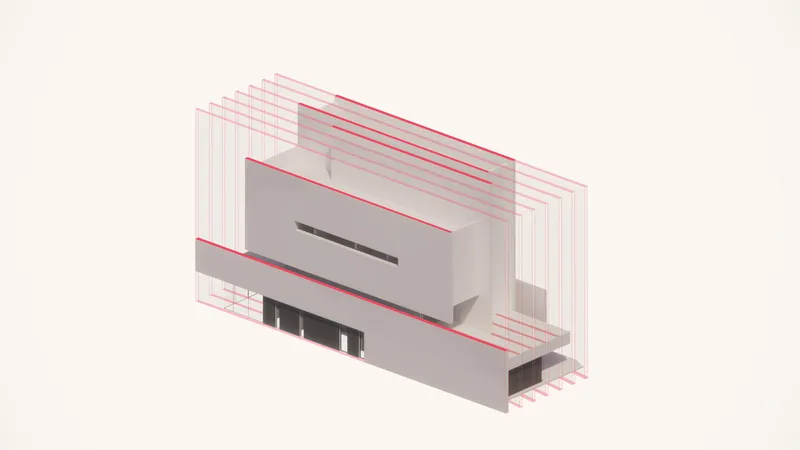
The two section drawings confirm the vertical ambition: three stacked levels with a cantilevered roof that oversails the top terrace. The axonometric diagram, with its layered roof planes highlighted in red, makes the compositional strategy explicit. Those angled planes are not sculptural whims; they are the logical conclusion of offsetting identically gridded volumes and letting the resulting gaps become skylights, clerestories, and ventilation channels. The red overlay reveals a project where the roof is not a cap but a fifth facade, possibly the most expressive one.
Why This Project Matters
Modular design is often invoked as an efficiency strategy, a way to save money on construction by standardizing components. House 30 demonstrates that a rigorous dimensional module can serve a more ambitious purpose: generating architectural expression. By constraining every decision to a 30 cm grid, Massive Order turned what could have been an arbitrary collection of volumes into a unified composition where each element reinforces the next. The discipline is the design.
In a region where residential architecture frequently oscillates between generic villas and over-styled mansions, House 30 offers a third path. It is specific to its site, honest about its materials, and legible in its logic. At 480 square meters it is not a small house, but it never feels bloated, because every square centimeter was placed on the grid and earned its keep. For architects interested in how constraint breeds invention, this is a case study worth returning to.
House 30 by Massive Order, lead architects Muhannad Al-Baqshi and Faisal Alhawaj. Al Khiran, Kuwait. 480 m². Completed 2015.
About the Studio
Share Your Own Work on uni.xyz
If projects like this are the kind of work you want to make, uni.xyz is a place to publish your own, find collaborators, and enter design competitions.


Popular Articles
Popular articles from the community


Architekt Andreas Gruber Scatters 23 Dark Timber Chalets Across a South Tyrolean Forest Edge
In Molini di Tures, Amonti Chalets breaks a resort into a hamlet of gabled timber houses, with parking, storage and services pushed into the slope.

longwave studio Reorganizes a 112 m² Tainan Apartment Around the Daily Routines of a Family and Two Cats
In Tainan, Taiwan, birch plywood, rust-red furniture and a freestanding plaster wall link arrival, storage, work and family life in one apartment.

Jaramillo Van Sluys Arquitectura and Urbanismo Turn a Demolished Registry Lot in Quito into an Orchard Plaza
In Quito's Centro Histórico, a 2,800 m² plaza exposes the San Agustín convent wall and redraws its lost Augustinian orchard in volcanic stone.

GROUP A Strips a 1969 Rotterdam Harbor Headquarters to Its Frame and Wraps It in Timber Louvers
In Rotterdam's M4H harbor district, Ferro Offices reuses a 1969 frame, adds one timber storey and reaches BREEAM-NL Outstanding.

Similar Reads
You might also enjoy these articles


LAVA Architecten Gives Vocational Education a Sawtooth-Roofed Face on a Mechelen School Campus
In Mechelen, Belgium, a 2,053 m² STEM school on a 6×6 m grid turns workshops and classrooms into rooms that can be rearranged as teaching changes.

KEMA Studio Turns a Derelict Marvila Attic into a 60 m² Lighthouse Apartment Above Lisbon
In Lisbon's Marvila district, a rebuilt roof, four skylights and two plywood volumes turn an unlivable attic into a bright home facing the Tagus.

Pixel Gardens: One Repeated Module Stacked Into a Terraced Social Housing Tower for Famagusta
Salem Bader's shortlisted housing tower builds a vertical neighbourhood from one repeated module, offsetting units to carve terraces, light and air.

Bao Huynh Watercolor Atelier: A Serene Art Retreat in Hội An
Bao Huynh Watercolor Atelier in Hội An blends multifunctional art spaces, sustainable design, local materials, and family-friendly living in a serene environment.

Explore Massing Design Competitions
Discover active competitions in this discipline

Challenge to design mud housing for contemporary communities

Challenge to reimagine the Iron Throne

Photograph architecture without architects

Illustrate the lost glory of Angkor Wat - Render Challenge
Comments (0)
Please login or sign up to add comments
No comments yet. Be the first to comment!