

Mastrominas ARChitecture Builds a Stone Village Hotel on the Island of Kos
Theros All Suite Hotel channels the vernacular settlements and medicinal heritage of Hippocrates' birthplace into 47 suites on a narrow coastal plot.


Hotels on Greek islands tend to fall into one of two traps: the whitewashed minimalism that flattens every Aegean destination into the same Instagram backdrop, or the resort bloat that ignores local building traditions entirely. Mastrominas ARChitecture sidesteps both with Theros All Suite Hotel, a 3,100 m² compound on a narrow 40-by-150-meter plot in the outskirts of Kos city. Rather than imposing a single monolithic building, the studio fragments the program into introverted neighborhoods of clustered stone and stucco volumes, borrowing directly from the island's vernacular settlements, its medieval castle, and its adjacent windmills.
What makes the project genuinely interesting is the conviction behind its sourcing. The stone walls are built with large mud joints in the same technique used on Kos's traditional cottages. Olive trees were transplanted from the architect's family grove, each private courtyard receiving its own. Aromatic and Hippocratic medicinal herbs line the paths, feeding both the kitchen and the spa. The hotel is located 120 meters from a leeward beach, adjacent to a protected public area of eucalyptus and tamarisk trees. In a tourism economy that often consumes its own context, Theros tries to grow out of it.
A Village, Not a Building


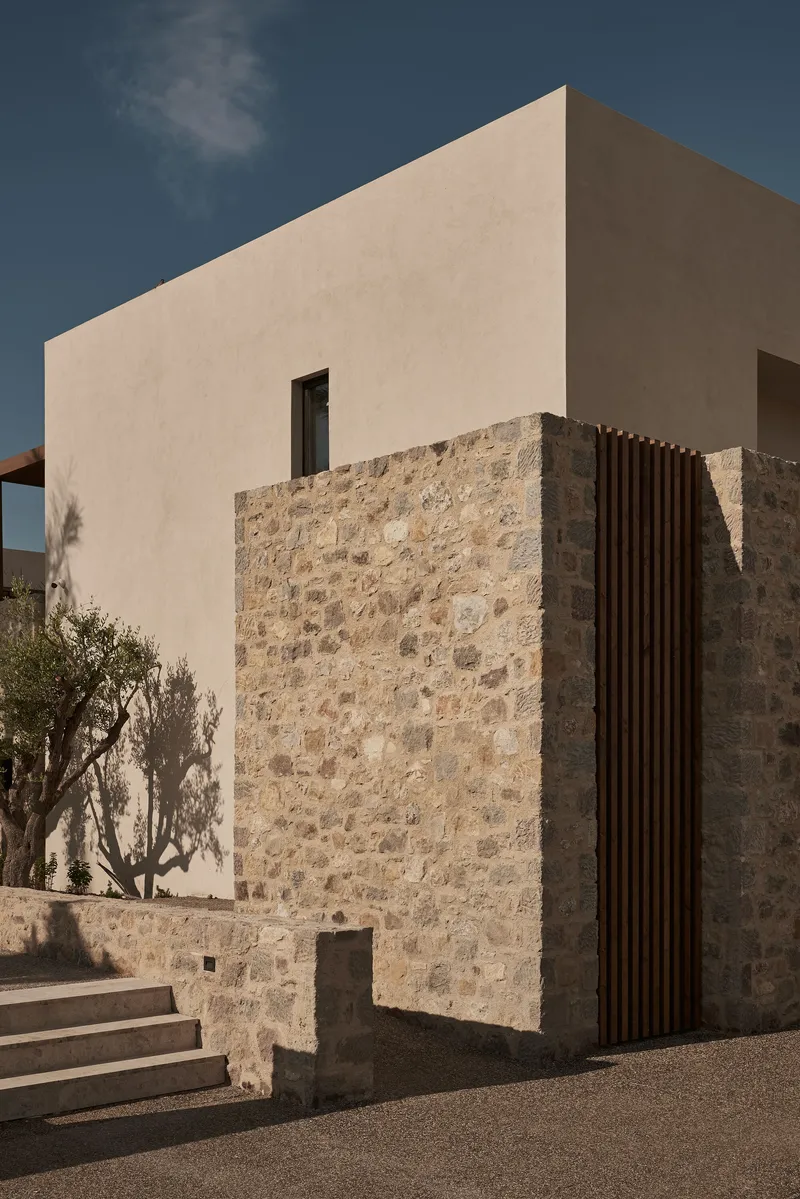
The master plan splits the long, narrow site into two zones. The eastern end holds the public functions: reception, dining, and leisure, all gathered under a rectangular slab with large glazed openings on two facades. The western portion breaks into clusters of 47 suites arranged in tight groupings that read more like a hillside settlement than a hospitality compound. Ground-floor suites get private pools; upper-floor rooms open onto generous verandas with hammocks and roof gardens.
The massing strategy is critical. By keeping volumes low and staggered, Mastrominas avoids the wall-of-rooms effect that plagues resort architecture. Rough stone bases anchor each cluster to the ground, while smooth stucco upper volumes lift away from the earth. Tall slot windows puncture the facades, offering ventilation and privacy without resorting to the curtain walls that would overheat interiors in a Mediterranean summer.
Stone, Timber, and the Logic of Craft
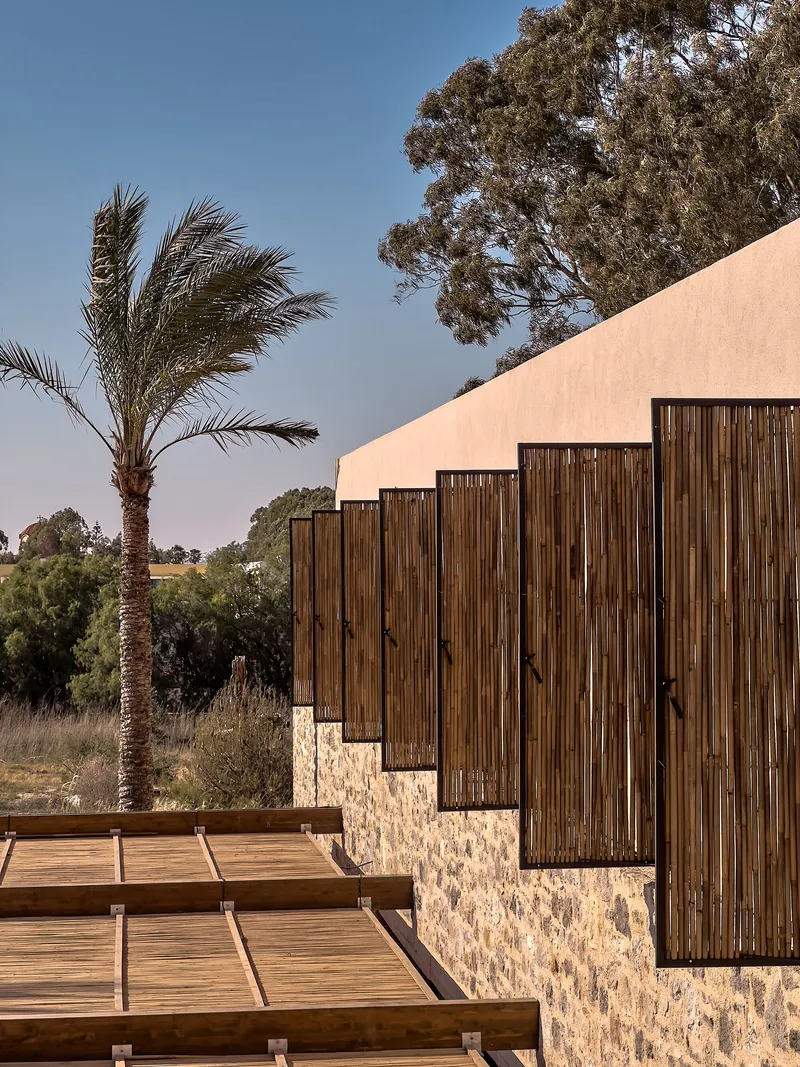


The material palette is disciplined: local stone with oversized mud joints, timber slatted screens, woven reed panels, and areas of pale stucco. Each element does identifiable work. The stone walls carry thermal mass and cultural memory. The vertical timber screens filter light and create privacy gradients between suites. Reed panels, a nod to the site's original border vegetation, soften transitions and add texture without pretension.
Mastrominas treats material transitions as the project's primary architectural gesture. The shift from rough stone to smooth plaster, from open timber pergola to enclosed room, marks the passage from public to semi-public to private. You cross a wooden bridge over water to enter the hotel, a threshold that is theatrical but earned by the landscape logic that follows.
Water as Organizing Element
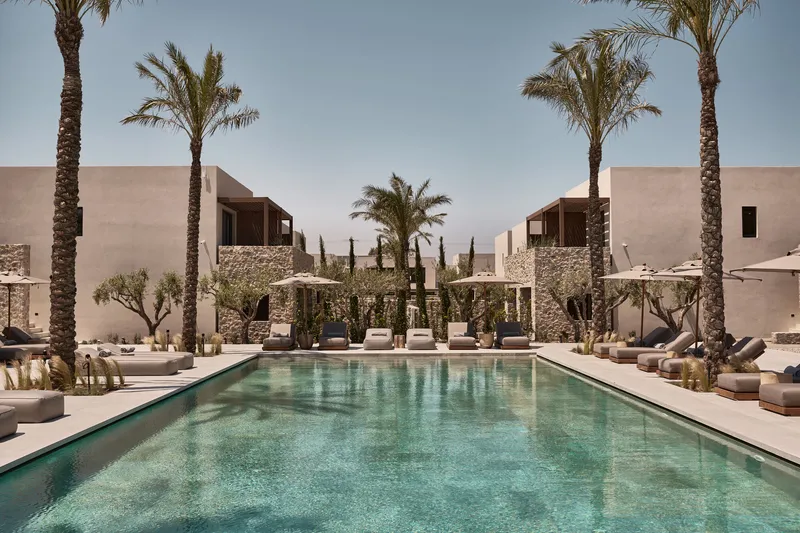
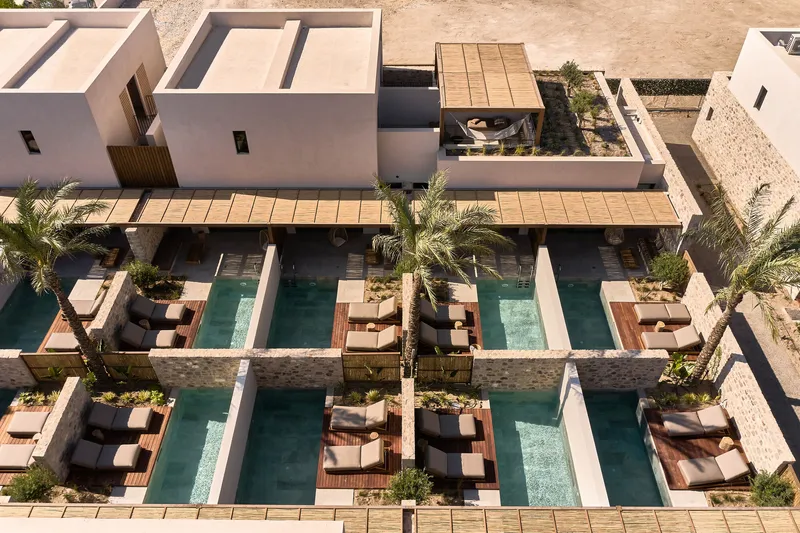
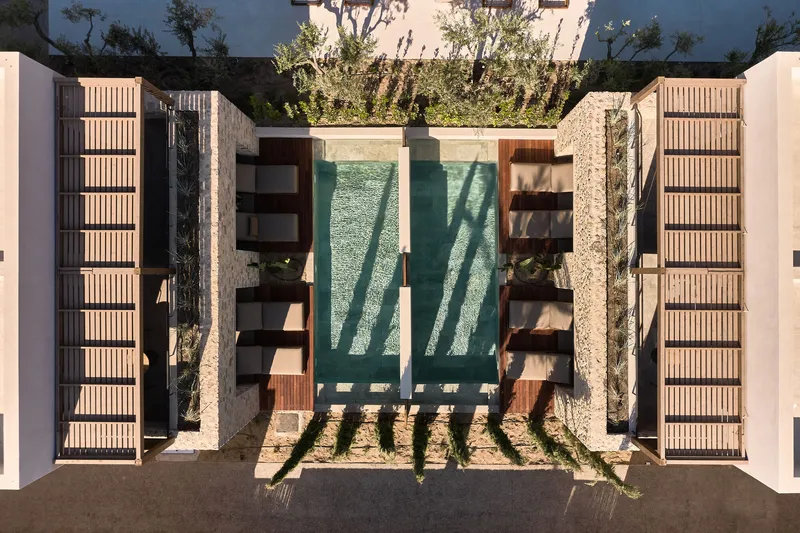
Water appears at every scale. The entrance bridge spans a shallow channel. A central swimming pool anchored by symmetrical stone pergolas acts as the social heart of the public zone. And 26 private courtyard pools give ground-floor suites their own enclosed worlds. Seen from above, the pools read as a chain of blue rectangles threaded through timber decking and palm canopies, a geometry that unifies the village-like plan.
The pools are chemical-free, a detail worth noting. Combined with the bioclimatic strategies, including passive cooling through narrow wall openings, high-performance thermal insulation, and KNX-controlled climate systems with smart sensors, the project makes a credible case that resort luxury and environmental responsibility are not opposing goals. Solar water heaters handle domestic hot water, keeping operational energy low.
Private Courtyards and the Suite Experience

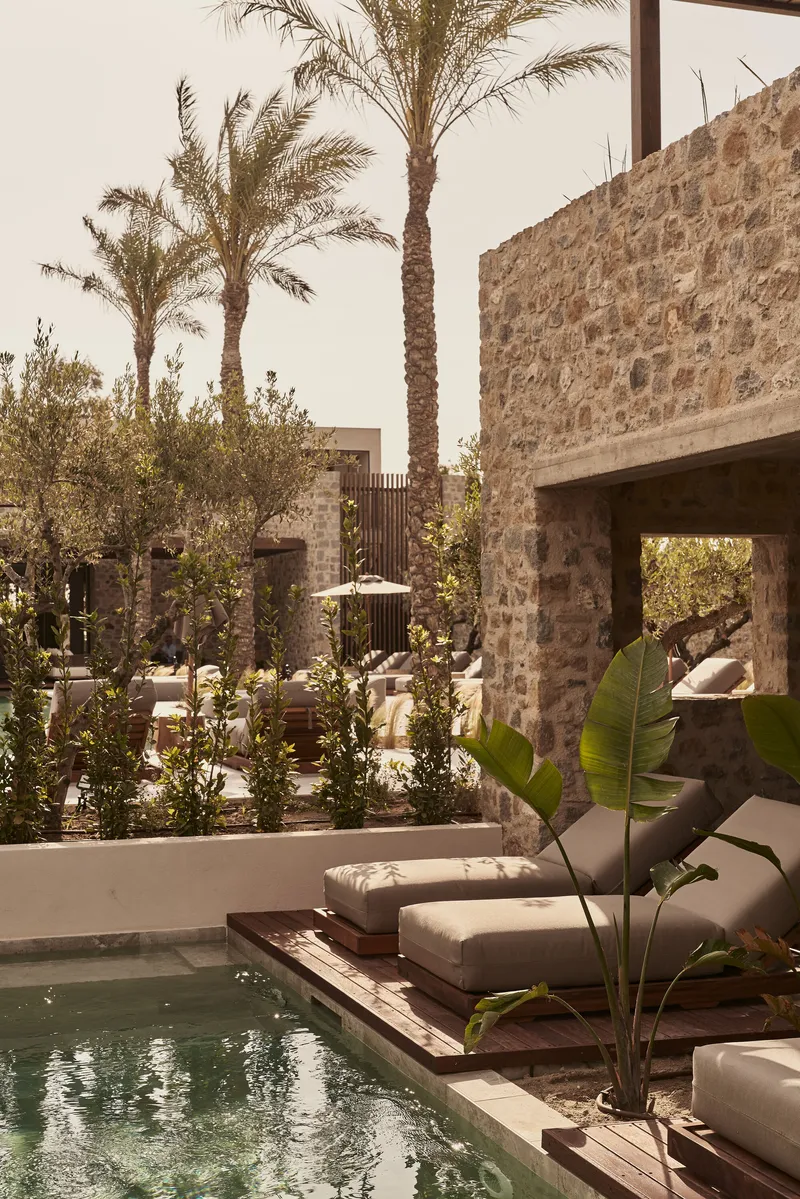
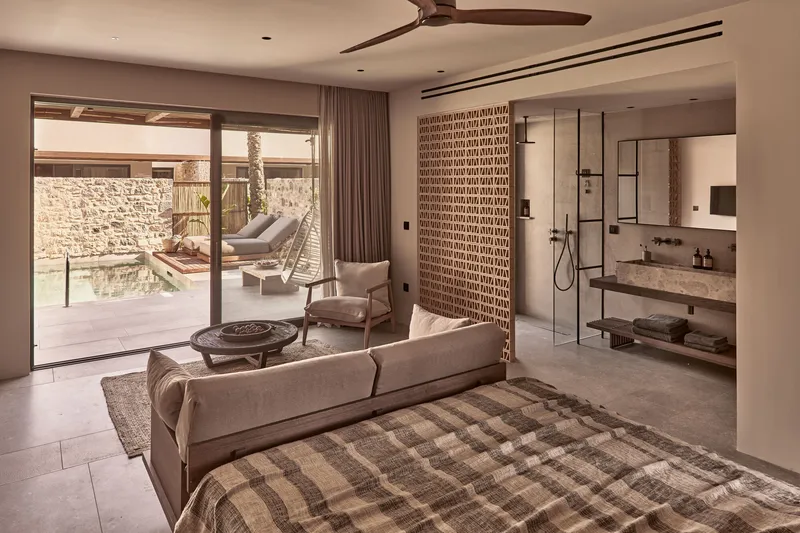
The private courtyard is the basic spatial unit. Each ground-floor suite opens onto a walled garden with a pool, timber deck, and at least one transplanted olive tree. The enclosure is tight enough to feel intimate but open enough to the sky that it avoids claustrophobia. Stone walls on three sides, full-height glazing on the fourth: the relationship is simple and effective.
Inside, the suites maintain the same restrained palette. Herringbone timber floors, exposed beam ceilings, and glass-enclosed bathrooms that borrow light from the courtyard give the rooms a sense of depth beyond their actual footprint. Sheer curtains partition sleeping areas from sitting nooks, and vertical timber slat screens frame mirrors and vanities. The interiors are quiet, not performative.
Interior Atmospheres


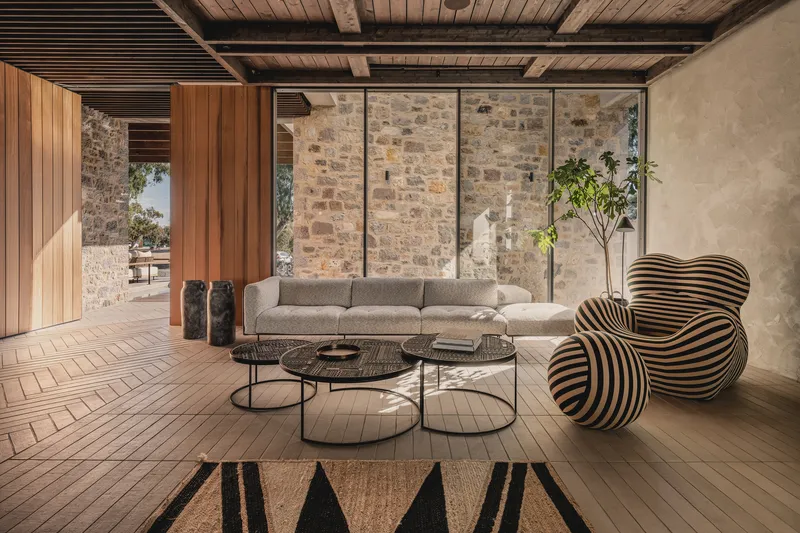

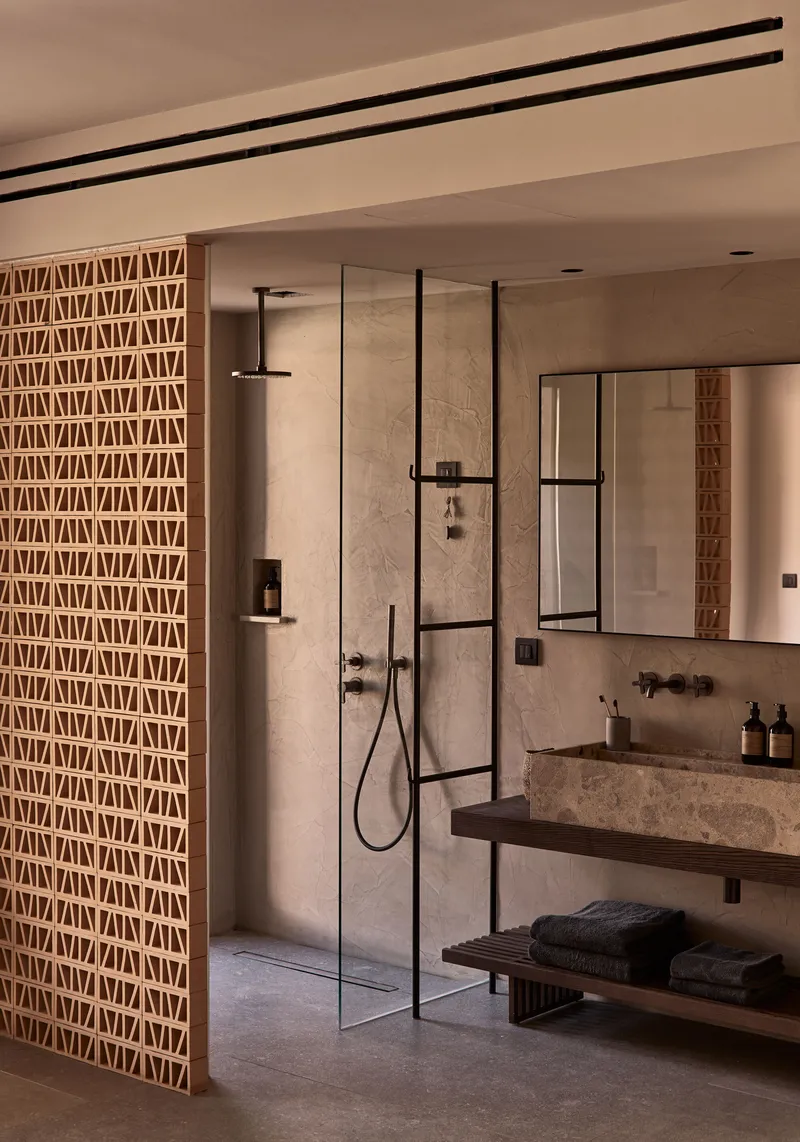
Across the suites and common areas, Mastrominas calibrates light with care. Lattice screens throw geometric shadow patterns across bathrooms. Timber beam ceilings break up overhead planes and create rhythm in what could otherwise be flat white boxes. Built-in shelving in dark timber anchors guest rooms, giving them a sense of permanence that loose furniture alone cannot provide.
The spa treatment rooms and corridors carry the same language: exposed ceiling beams, terrazzo floors, and woven lounge chairs that read as handcraft rather than catalog product. An open-tread timber staircase with a steel frame connects levels without ceremony. The design avoids spectacle in favor of accumulated texture.
Dining and Common Ground

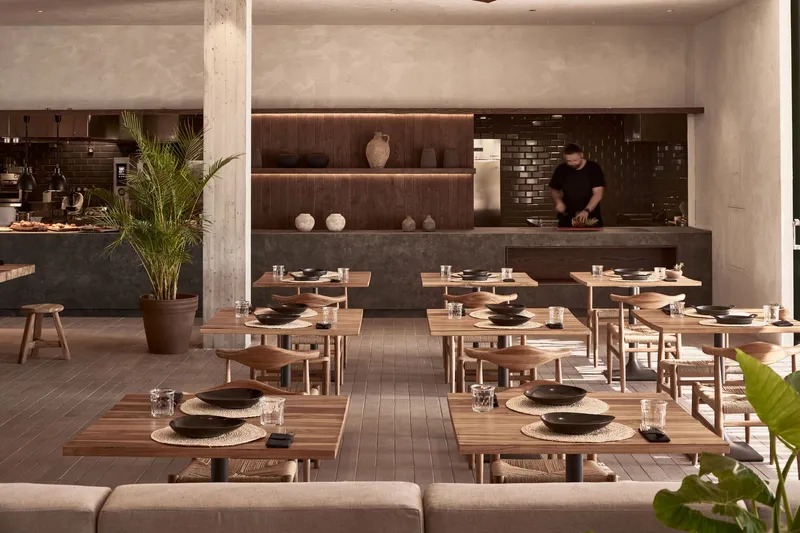


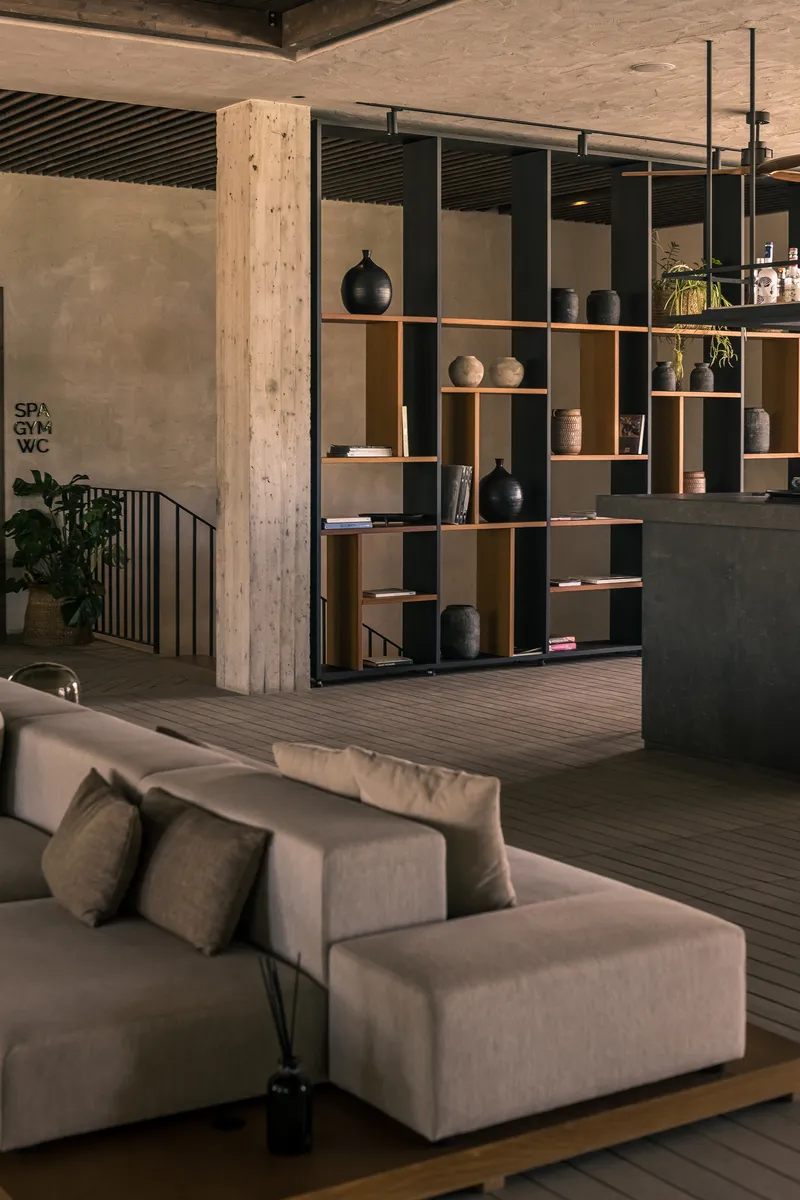
The public zone houses the restaurant, bar, and reception under a rectangular concrete slab with exposed timber beams. Concrete columns define the structural bay without enclosing it; large glazed openings on two facades dissolve the boundary between dining room and landscape. An open kitchen puts food preparation on display, reinforcing the farm-to-table ethos that connects the dining program to the on-site herb and tomato gardens.
Freestanding shelving units display ceramics and potted plants, doubling as room dividers. The palette of rough stone, smooth concrete, and dark timber shelving carries through from the suites, ensuring the public and private realms belong to the same architectural world. Evening lighting is warm and directional, avoiding the flat over-illumination that ruins so many hotel common spaces.
Landscape as Infrastructure
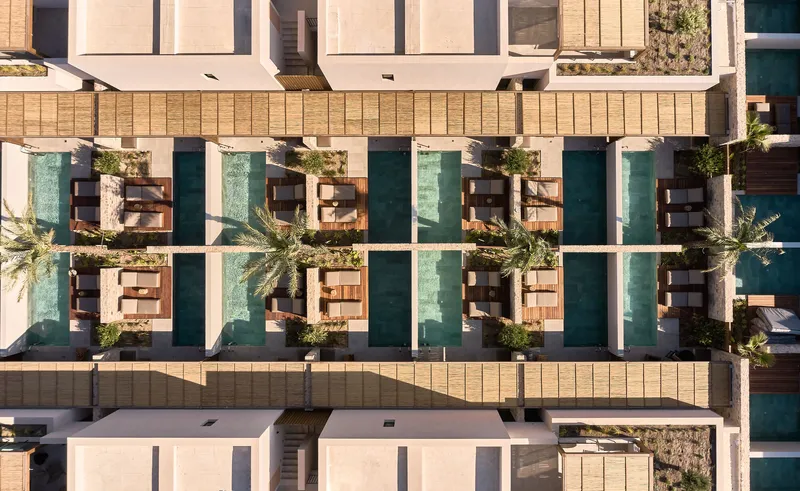
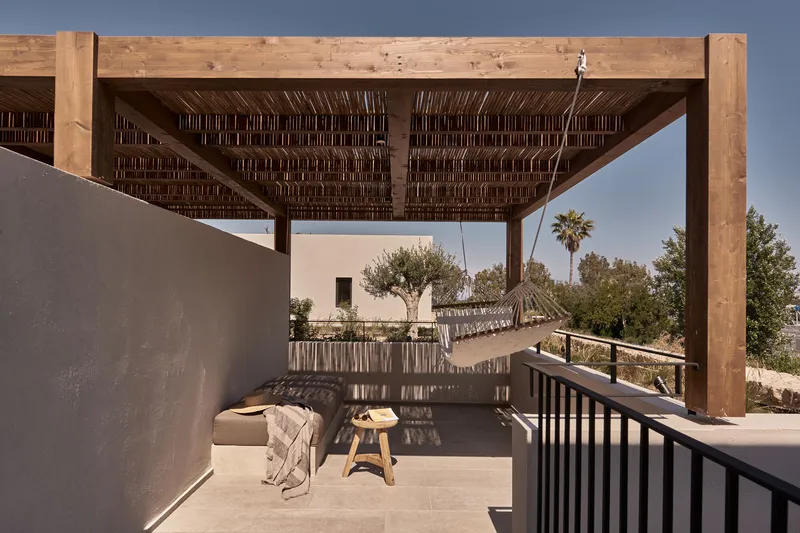

The planting strategy is unusually rigorous for a hotel project. Native Mediterranean species, including olive trees, cypresses, palms, and lemon trees, were selected for minimal water demand. Peripheral paths are flanked by reeds on one side and stone walls on the other, creating shaded corridors that channel sea breezes through the compound. Rooftop terraces are topped with timber pergolas and woven reed screens, extending the planted world upward.
Hippocratic medicinal herbs line the botanic gardens, a reference to the island's most famous native son and a functional resource for the spa and kitchen. The transplanted olive trees from the architect's family grove give the landscape an immediate maturity and a personal dimension that purely commercial planting schemes lack. It is the kind of decision that cannot be replicated by specification alone.
Plans and Drawings


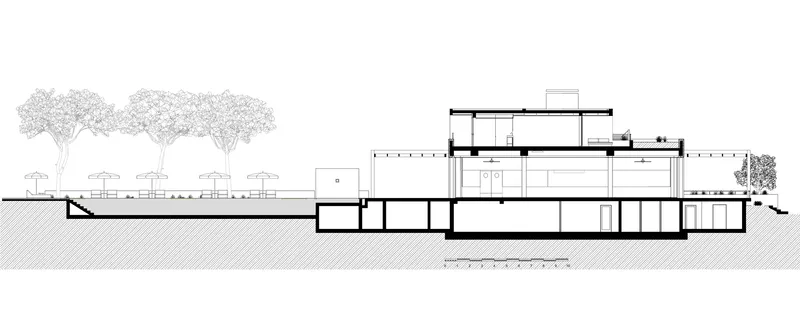
The floor plans make the dual-zone strategy legible. Suite clusters flank central courtyards with pools and palm trees, each unit oriented inward for privacy. The public building is an open-plan volume with pool terrace and palm grove extending eastward toward the sea. The section drawing reveals modest split-level changes across the sloped site, with a row of trees establishing the datum line between built and natural ground.
Why This Project Matters
Theros All Suite Hotel matters because it demonstrates that resort architecture can be specific without being nostalgic and contemporary without being generic. Mastrominas ARChitecture has not recreated a traditional village; it has distilled the principles of one, the inward-turning courtyard, the stone wall, the narrow cooling opening, the communal path, and rearranged them into a modern hospitality program. The result is a place that belongs to Kos in a way that most island hotels do not belong to anywhere.
The project also suggests a viable model for sustainable resort development in the Mediterranean: chemical-free pools, passive cooling strategies, smart climate control, solar heating, and a landscape built from transplanted family trees and native species. None of these moves are revolutionary on their own. Taken together, deployed with consistency across 47 suites and 3,100 square meters, they add up to a position. That position is worth watching.
Theros All Suite Hotel by Mastrominas ARChitecture. Located in Kos, Greece. 3,100 m². Completed in 2022. Photography by George Papapostolou and Brechenmacher & Baumann Photography.
About the Studio
Share Your Own Work on uni.xyz
If projects like this are the kind of work you want to make, uni.xyz is a place to publish your own, find collaborators, and enter design competitions.


Popular Articles
Popular articles from the community

Opera by the Sea Estonia: Three Shells Dissolving Architecture into Tallinn's Coastline
A winning opera house proposal replaces monumental form with interconnected shells that blur the boundary between building, park and Baltic Sea.

Extended Shell: Retrofitting Kolkata's Balconies as Living Urban Thresholds
A modular retrofit system recovers the social and environmental intelligence of Kolkata's historic verandas for contemporary Park Street residents.

Singing Woman: Contemporary Architecture Inspired by Estonia’s Voice and the Sea
Singing Woman turns Estonia’s song culture into flowing opera house architecture, blending public life, landscape, sea, and national memory.

Cloaked Colonization: A Mobile Underwater Habitat That Moves Like a Fish
Micah Abaya's shortlisted EHC Pacific entry reimagines ocean settlement as a dispersed network of self-sustaining architectural organisms.

Similar Reads
You might also enjoy these articles

Bao Huynh Watercolor Atelier: A Serene Art Retreat in Hội An
Bao Huynh Watercolor Atelier in Hội An blends multifunctional art spaces, sustainable design, local materials, and family-friendly living in a serene environment.

Atelier Macri Concept Store Interior Design by CASE-REAL
Atelier Macri store features a "ko" counter, walnut wood details, cork displays, blending retail, gallery, and seamless customer experiences.

Manuel Vargas Izquierdo Stadium and High-Performance Sports Center: Architectural Excellence in Jalpa de Méndez
The Manuel Vargas Izquierdo Stadium blends sustainable design, inclusive sports facilities, and cultural-inspired architecture, revitalizing Jalpa de Méndez’s public spaces.

KAKR Buluh Awar Hall: Revitalizing Community and Ecology Through Bamboo Architecture
Community built bamboo hall revitalizes Buluh Awar village, empowering youth, restoring ecology, celebrating vernacular craftsmanship through sustainable architecture and culture.

Explore Hospitality Building Competitions
Discover active competitions in this discipline

Challenge to reimagine the Iron Throne

Photograph architecture without architects

Illustrate the lost glory of Angkor Wat - Render Challenge

Design challenge to reuse E-waste
Comments (0)
Please login or sign up to add comments
No comments yet. Be the first to comment!