

Mazumdar Bravo Tucks a Planted Concrete Pavilion into the Hillside Above Pawna Lake
A house near Pawnanagar, India, disappears beneath its own roofscape to let the Western Ghats take center stage.


The Western Ghats above Pawna Lake are not a landscape that needs embellishment. The Tikona and Tung forts punctuate a horizon of ridgelines and water, and any building planted here risks competing with geography it cannot beat. Mazumdar Bravo understood the assignment: their Lake House, completed in 2024 near Pawnanagar, is a work of deliberate self-effacement, a concrete frame that presses itself into the hillside and then covers its own roof with planting so thick you could lose a soccer ball in it.
What makes the project genuinely interesting is not the green roof as a gesture (architects have been burying houses for decades) but the discipline with which the entire section, plan, and material palette conspire to redirect your attention outward. Every corridor terminates in a mountain view. Every courtyard is a cropped frame of sky and vegetation. The house is organized as a chain of pavilions linked by covered walkways, meaning no single mass ever blocks the slope, and the terrain reads as continuous from the road above to the lake below.
Concrete as Ground Plane
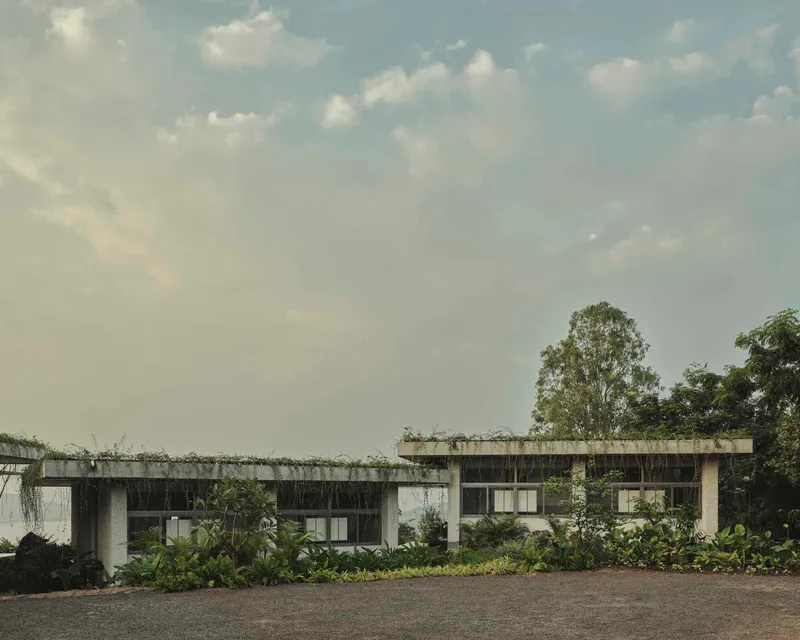
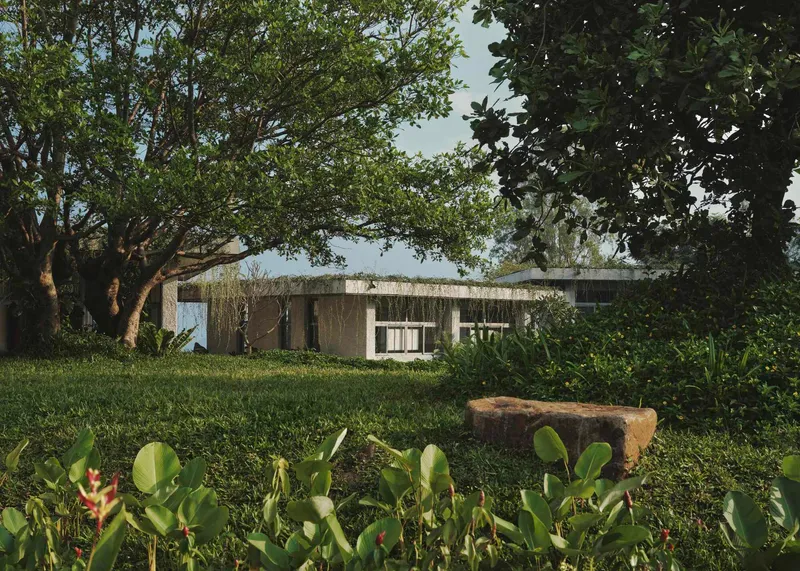
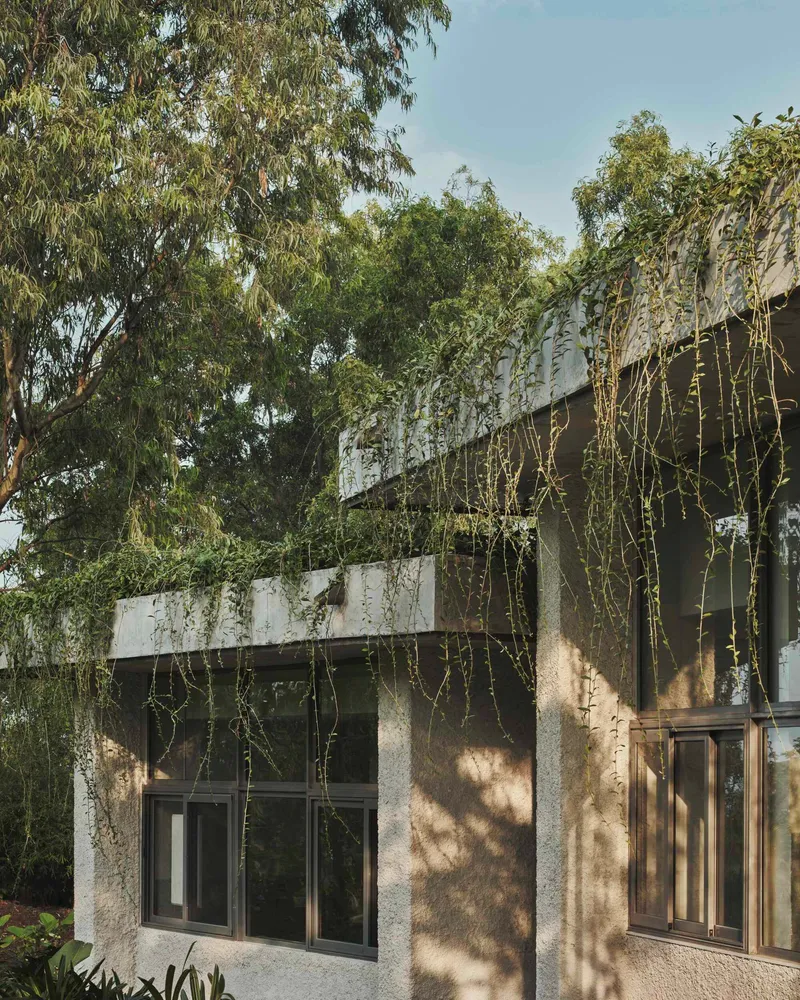
Board-formed concrete does the heavy structural and visual lifting. The facades are deliberately plain: banded windows, deep soffits, and flat surfaces that weather and stain in a way that makes the building look geological rather than architectural after a few monsoon seasons. Cascading vines are already colonizing the walls, softening edges that were sharp at handover.
The planted roof is the real trick. Seen from above or from the approach road, the house registers as a series of garden terraces rather than a built volume. Mature trees grow right up to the concrete edges, and the boundary between constructed and natural ground is often impossible to locate. The commitment here is structural as much as aesthetic: the roof slabs carry significant soil depth, which in turn demands the robust concrete frame visible at the perimeter.
Pavilions and Passages
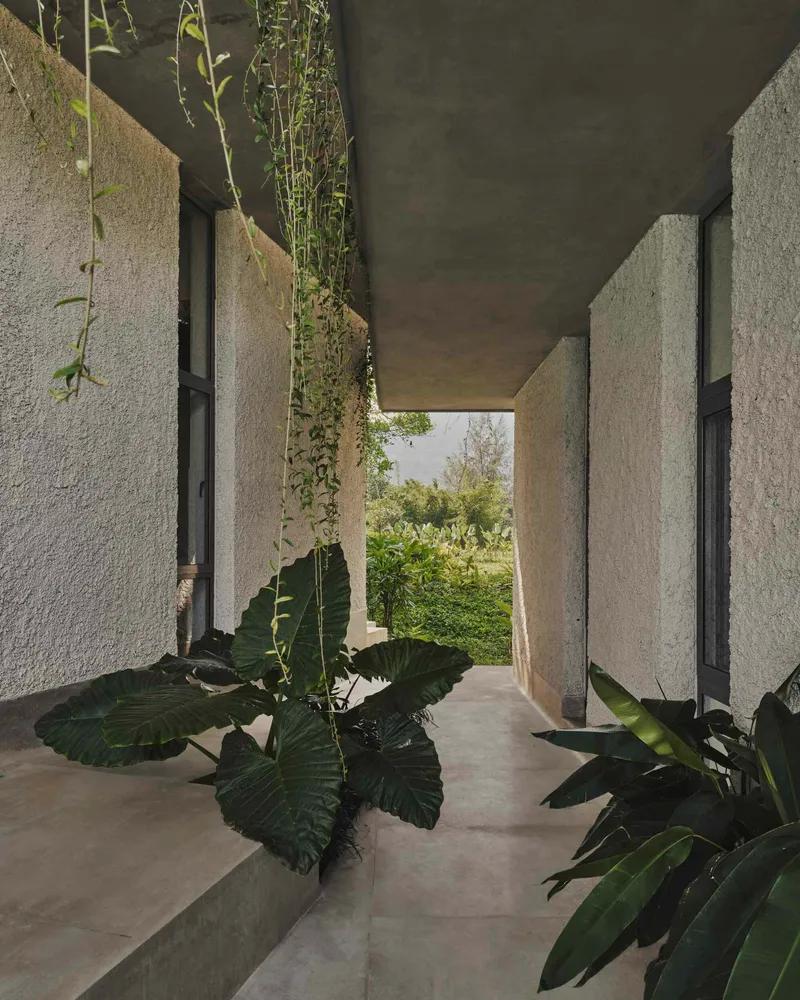
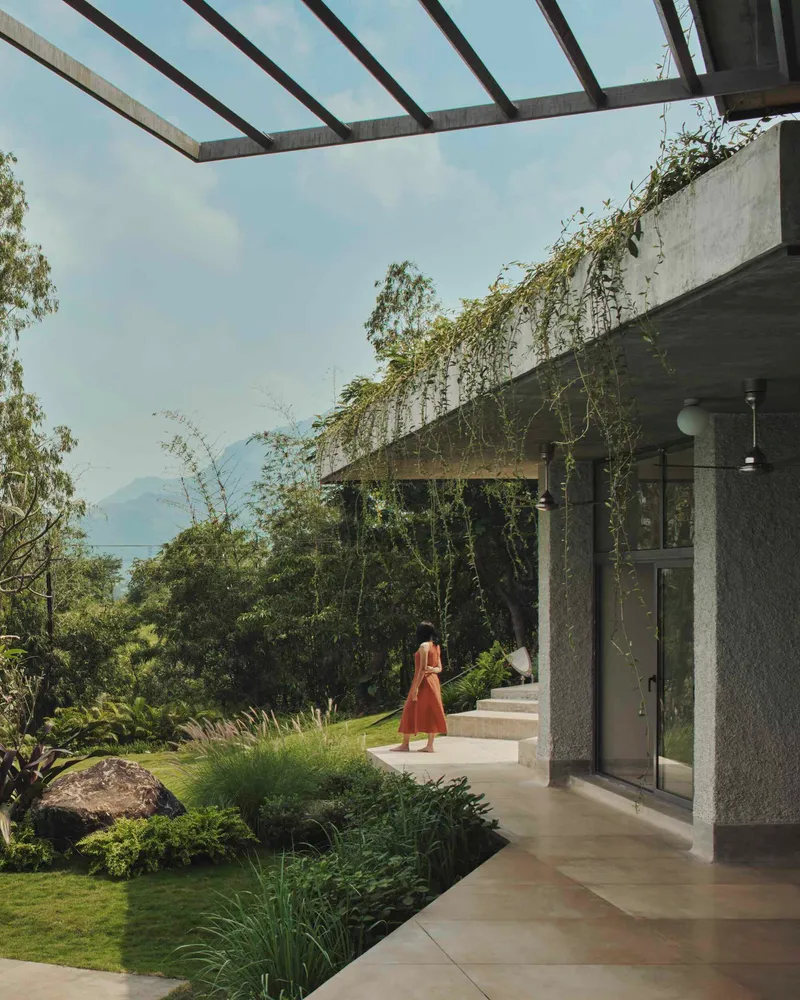
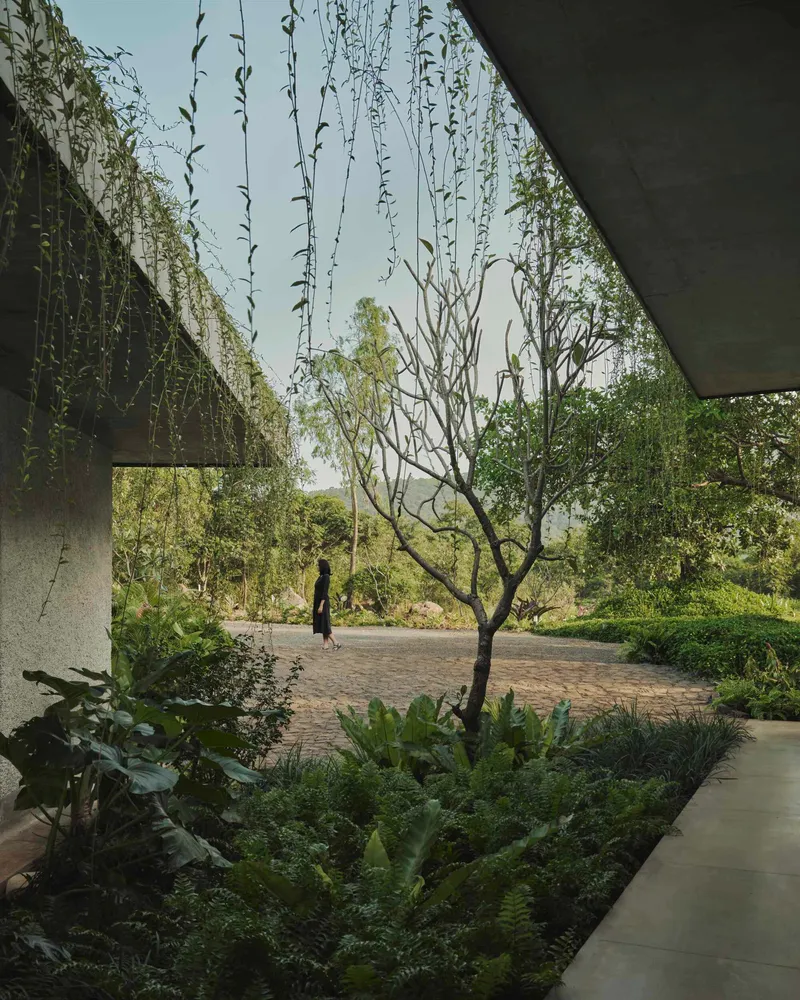
Rather than a single enclosed volume, the house is organized as a sequence of interconnected pavilions separated by courtyards and linked by covered corridors. These in-between spaces do more work than the rooms themselves. Deep concrete pergola beams throw rhythmic shadows across the walkways. Large-leaf tropical planting pushes in from both sides, so moving through the house feels like walking through a garden that happens to have a ceiling.
The covered walkway facing the mountains is the best passage in the house. Concrete beams frame the distant ridgeline into a horizontal strip, and the planted roof edges above drip greenery into the periphery of your vision. It is a controlled moment of compression before the view opens up at the pool terrace, and the sequence is cinematic in a way that static photographs can only hint at.
The Infinity Edge and the View
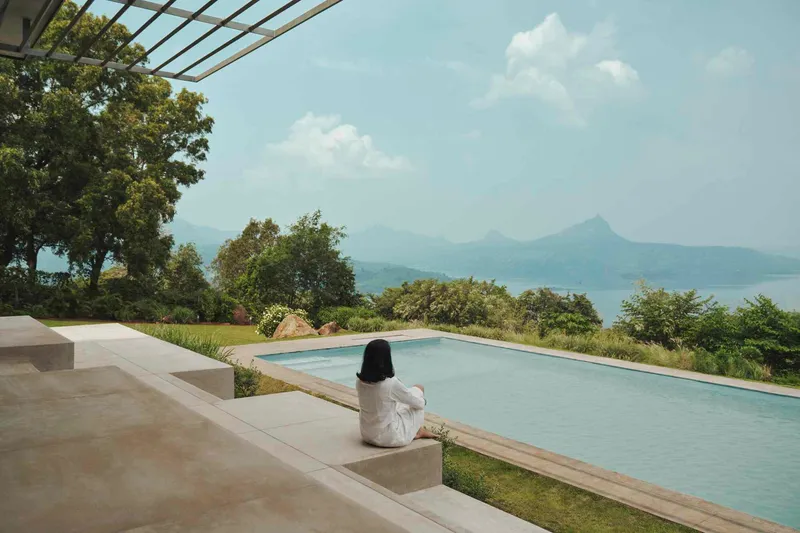
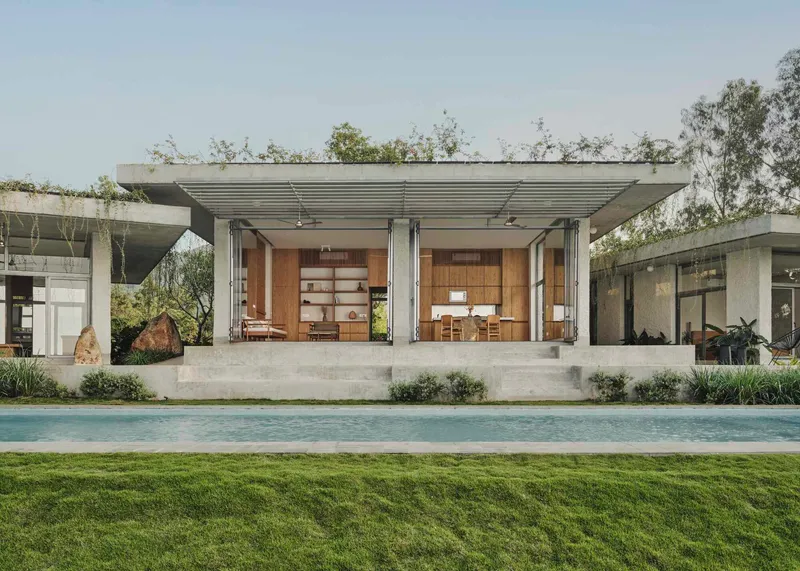
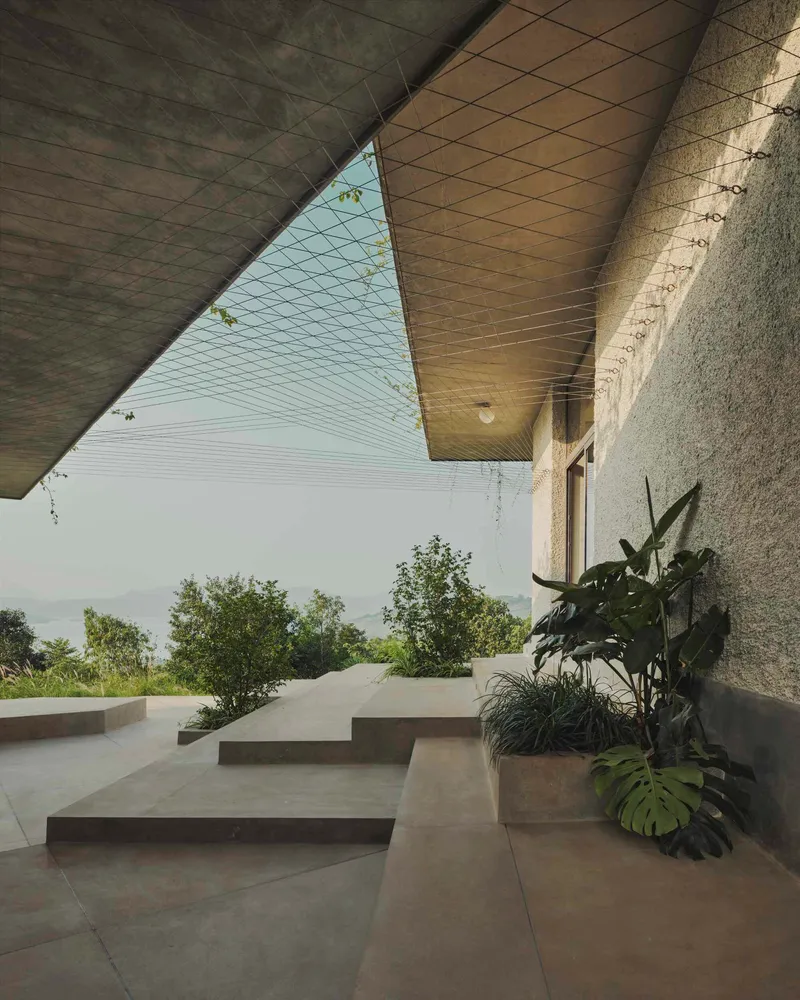
The infinity pool terrace is the climactic moment. A concrete seating ledge runs along the edge, and the water surface merges visually with Pawna Lake in the valley below. The effect is not subtle, but it does not need to be. The entire plan builds toward this reveal, and the payoff works precisely because the approach corridors and courtyard gardens have kept the panorama hidden until you arrive at this threshold.
On the pool side, large folding glass doors open the kitchen and dining pavilion directly onto the terrace. The transition from interior to exterior is effectively zero when the panels are stacked: you stand at the kitchen island and look straight across the water to the forts. The covered terrace on the opposite end uses a folded concrete soffit with cable tensioning to create a deep overhang that shades the seating area without introducing any visual obstruction to the landscape beyond.
Oak, Timber, and Interior Restraint
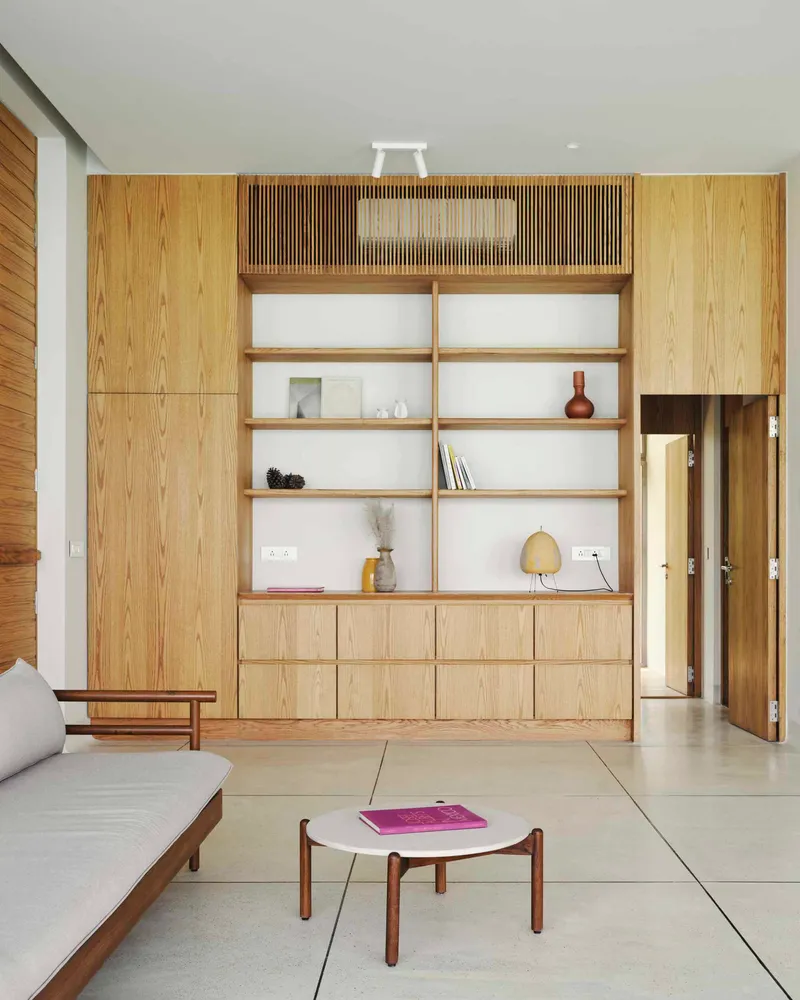
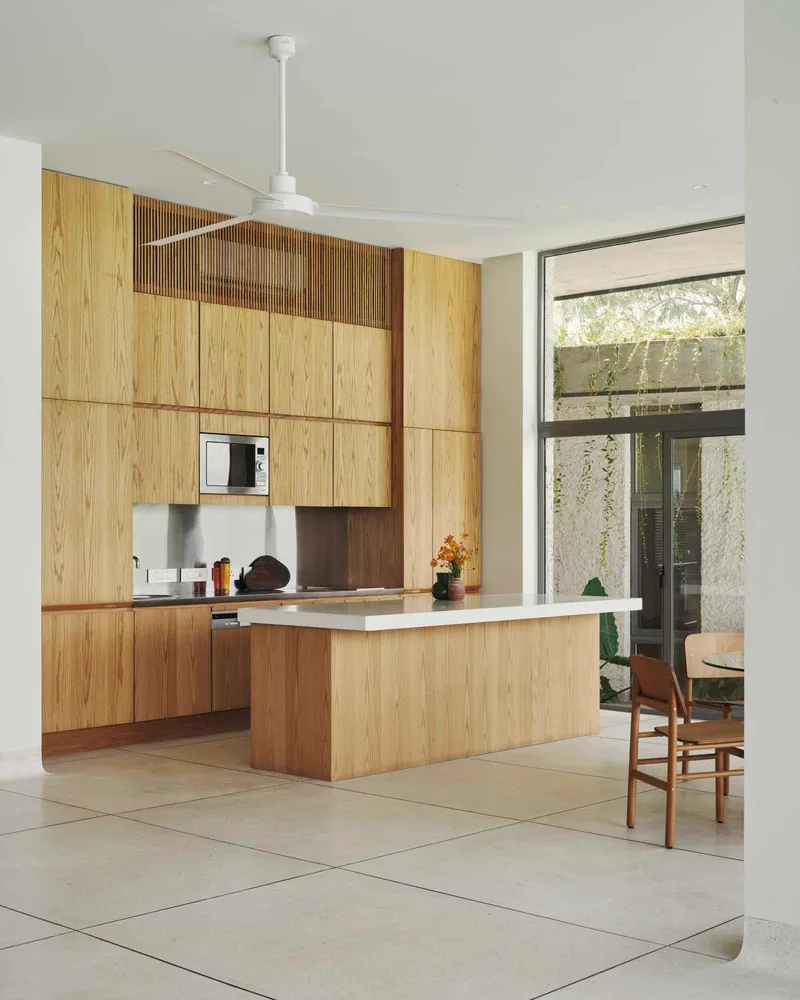
Inside, the palette narrows to white walls and oak joinery. A floor-to-ceiling storage wall in the living space integrates shelving and slatted ventilation panels into a single timber surface that reads as furniture rather than architecture. The open kitchen continues this logic: an oak island and cabinetry wrap a glazed corner that opens to a planted courtyard, so the room always has greenery in its peripheral vision.
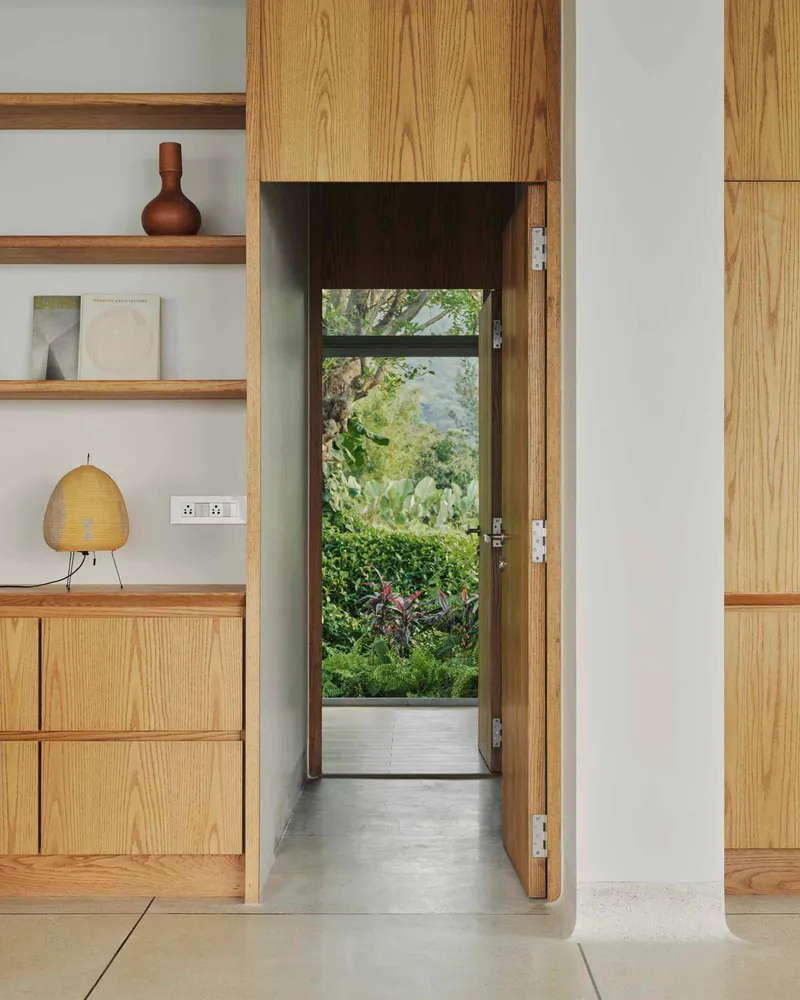
Narrow passageways framed entirely by oak cabinetry lead to glazed doors and garden views beyond. These moments are intentionally compressed, borrowing a spatial trick from Japanese residential architecture where the corridor acts as a decompression chamber between served spaces. The timber warmth offsets the coolness of the exposed concrete outside, giving the interiors a domestic quality that the exteriors deliberately avoid.
Landscape as Architecture
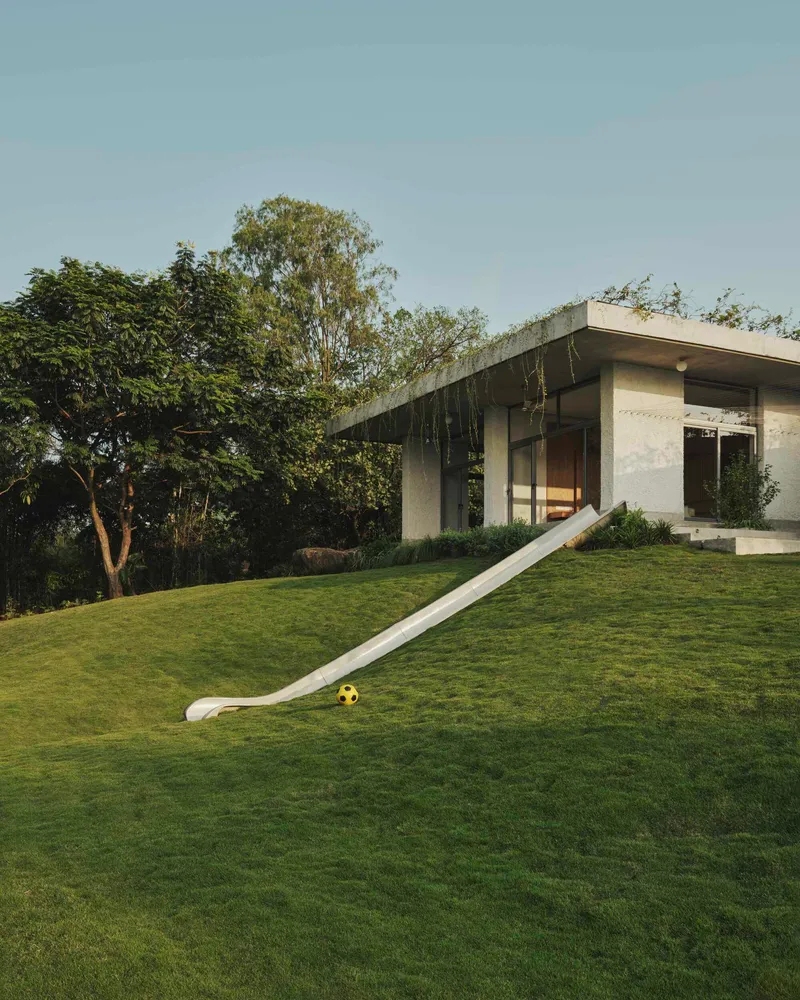
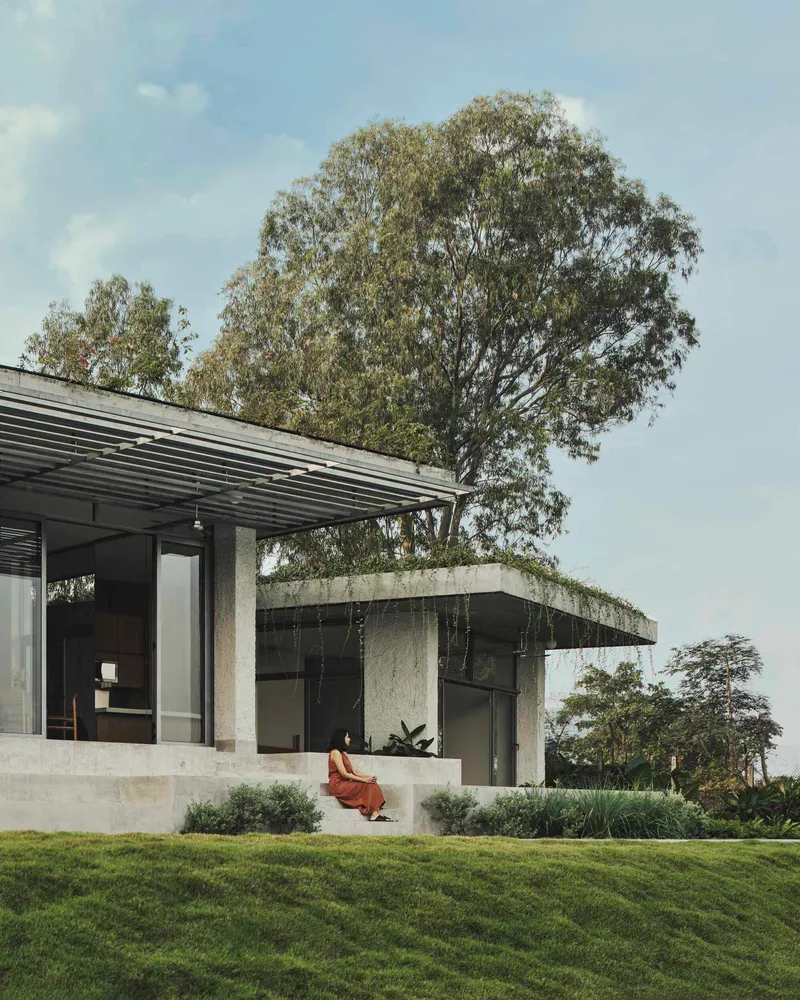
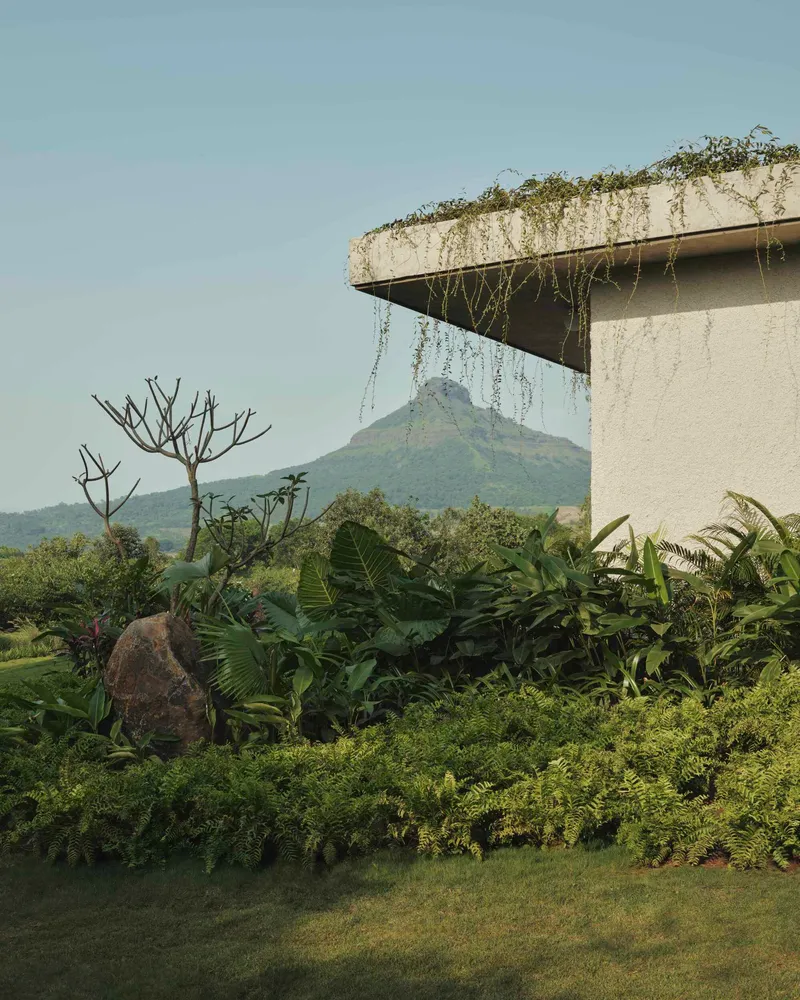
The planted roof is not decoration; it is the fifth elevation, and for many visitors arriving from higher ground, it is the first elevation they encounter. A white slide descends the lawn on one side, turning the roof into a playground and proving the soil depth is real. Elsewhere, the concrete canopy supports trailing vines that hang against the mountain backdrop, creating a layered composition where building, garden, and landscape are stacked into a single visual field.
The surrounding planting is tropical and dense: large-leaf species, mature trees retained from the original site, and cascading ground cover that blurs the line between garden and hillside. The strategy relies on time. As the vines thicken and the roof planting matures, the architecture will recede further into its context. In a decade, the Lake House will be more garden than building, which is precisely the point.
Concrete and Vine: The Facade Up Close
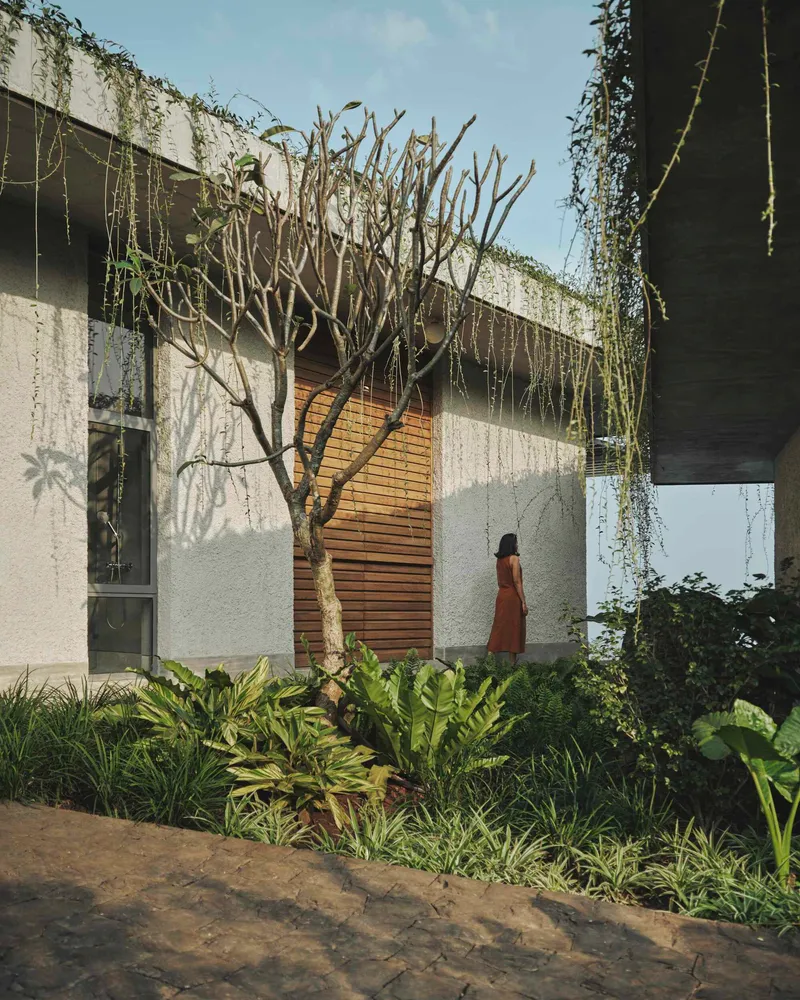
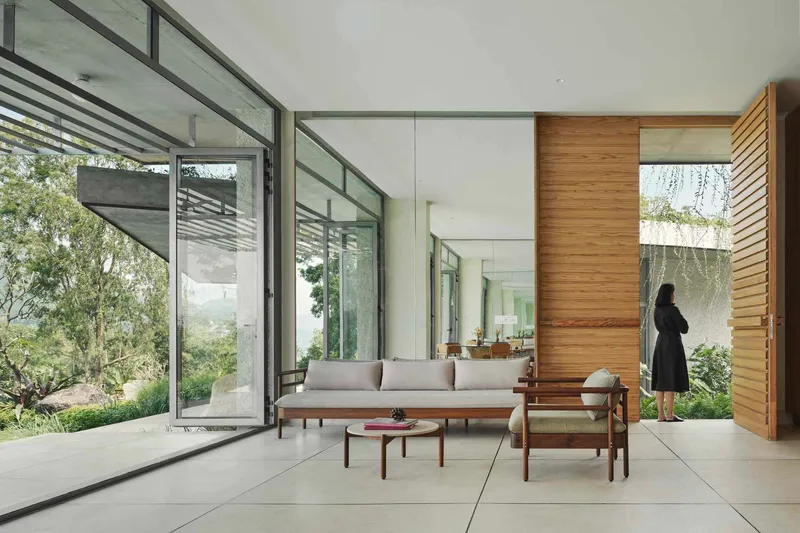
At the entrance, a timber slat door is set into a concrete frame already half-consumed by cascading vines. A bare tree and planted beds complete the composition, giving the arrival sequence a quality of botanical ruin that belies the building's youth. Inside, the open living space uses folding glass walls and a timber feature wall to create a room that is simultaneously enclosed and exposed, with the courtyard visible through the full width of the opening.
Plans and Drawings
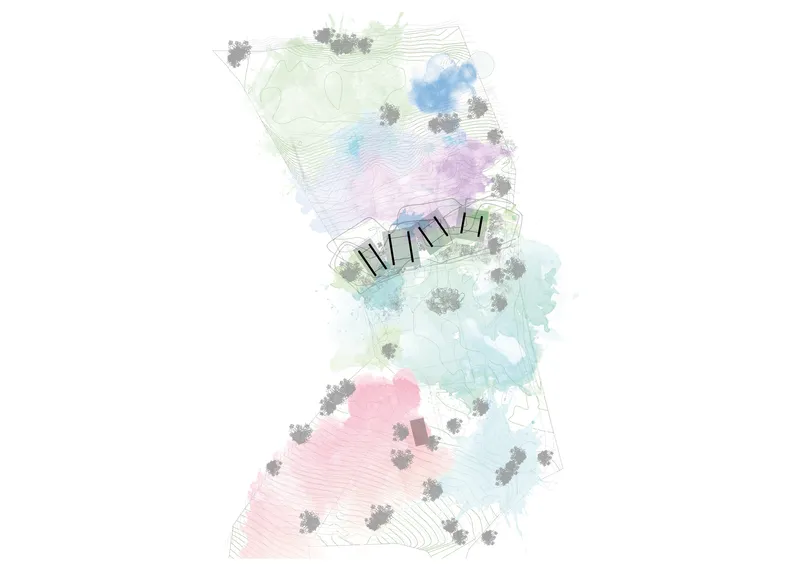
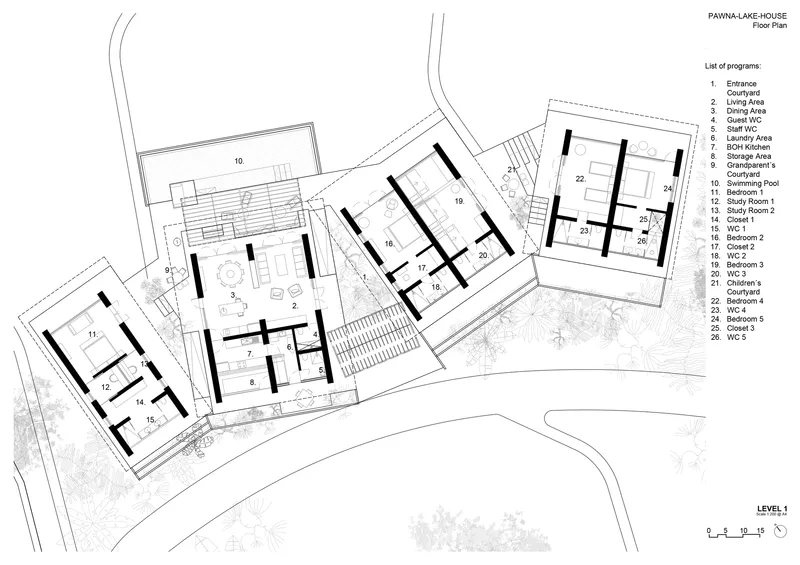
The site plan, rendered in watercolor over contour lines, reveals just how carefully the pavilions are arranged to follow the slope's natural fall. The interconnected volumes fan out around courtyards, with the pool occupying the lowest terrace closest to the lake view. Living areas, bedrooms, and service spaces are distributed across separate wings, so each program occupies its own pavilion with its own relationship to the landscape.
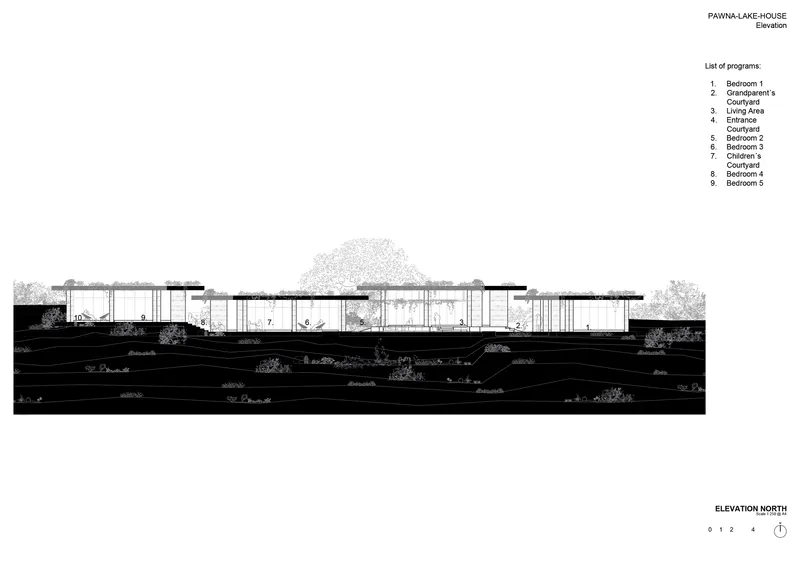
The elevation drawing confirms the sectional logic: flat-roofed horizontal volumes nestle into the sloping terrain, their planted roofs continuous with the hillside above. No volume rises more than a single story above its uphill grade, which is why the house remains invisible from many angles. The strategy is not about hiding architecture so much as refusing to let it dominate a site that is already complete.
Why This Project Matters
Backdrop architecture is easy to describe and extraordinarily difficult to execute. The temptation to make a statement on a site this dramatic is enormous, and most architects yield to it. Mazumdar Bravo's discipline here is the project's real achievement: every decision, from the planted roof to the pavilion plan to the restrained material palette, serves the same goal of making the Western Ghats the protagonist and the house the supporting cast.
The Lake House also demonstrates that concrete need not feel heavy or austere in a tropical setting. Paired with dense planting, oak interiors, and an open plan that dissolves the building's edges, the concrete frame becomes a scaffold for landscape rather than a barrier against it. As Indian second-home architecture increasingly confronts questions of environmental sensitivity and contextual responsibility, this project offers a persuasive model: build less, plant more, and let the view do the talking.
Lake House by Mazumdar Bravo, Pawnanagar, India. Completed 2024. Photography by Suleiman Merchant.
About the Studio
Share Your Own Work on uni.xyz
If projects like this are the kind of work you want to make, uni.xyz is a place to publish your own, find collaborators, and enter design competitions.


Popular Articles
Popular articles from the community


Juan García Correa, John González and Claudia Rueda Sink a Circular Amphitheater into a Manizales Engineering Building
On the La Nubia campus in Manizales, Colombia, the S1 Building folds labs and offices into a hillside of ramped lawns that double as a campus route.

longwave studio Reorganizes a 112 m² Tainan Apartment Around the Daily Routines of a Family and Two Cats
In Tainan, Taiwan, birch plywood, rust-red furniture and a freestanding plaster wall link arrival, storage, work and family life in one apartment.

David Macias Steps a Doorless Stone and Plaster House Down a Tropical Colombian Hillside
In the humid hills of Colombia, Threshold House replaces the front door with an open void and terraces its 850 m² down the slope instead of fighting it.

GROUP A Strips a 1969 Rotterdam Harbor Headquarters to Its Frame and Wraps It in Timber Louvers
In Rotterdam's M4H harbor district, Ferro Offices reuses a 1969 frame, adds one timber storey and reaches BREEAM-NL Outstanding.

Similar Reads
You might also enjoy these articles


LAVA Architecten Gives Vocational Education a Sawtooth-Roofed Face on a Mechelen School Campus
In Mechelen, Belgium, a 2,053 m² STEM school on a 6×6 m grid turns workshops and classrooms into rooms that can be rearranged as teaching changes.

KEMA Studio Turns a Derelict Marvila Attic into a 60 m² Lighthouse Apartment Above Lisbon
In Lisbon's Marvila district, a rebuilt roof, four skylights and two plywood volumes turn an unlivable attic into a bright home facing the Tagus.

Pixel Gardens: One Repeated Module Stacked Into a Terraced Social Housing Tower for Famagusta
Salem Bader's shortlisted housing tower builds a vertical neighbourhood from one repeated module, offsetting units to carve terraces, light and air.

Bao Huynh Watercolor Atelier: A Serene Art Retreat in Hội An
Bao Huynh Watercolor Atelier in Hội An blends multifunctional art spaces, sustainable design, local materials, and family-friendly living in a serene environment.

Explore Plug-In House Competitions
Discover active competitions in this discipline

Challenge to design a portable theatre

Challenge to design a portable music platform

Challenge to design an open learning module for the elderly

Challenge to design mud housing for contemporary communities
Comments (0)
Please login or sign up to add comments
No comments yet. Be the first to comment!