

Mecanoo Wraps a Dune-Side Villa in Schoorl with Iridescent Ceramic Tiles
Villa BW sits where the Dutch dune landscape meets the polder, its double-curved roof clad in 5,000 handcrafted glazed tiles by Koninklijke Tichelaar.


A residential street in the beach resort of Schoorl is not the place you expect to find a building that reads more like a piece of sculptural ceramics than a house. Yet Mecanoo's Villa BW, completed in 2022, does exactly that: it takes the familiar Dutch gable, stretches it into a double-curved roof form, and sheathes the entire thing in custom-made glazed tiles that shift between grey, green, and blue depending on the angle of light. The effect is something between camouflage and provocation, a house that both belongs to its street and quietly refuses to behave like its neighbors.
What makes Villa BW genuinely interesting is not just the surface treatment, though the collaboration with Koninklijke Tichelaar, one of the oldest ceramic manufacturers in the Netherlands, is remarkable in its own right. It is the way the building uses the site's natural slope to bury two of its four levels underground, letting the dune landscape roll over the house while the interior opens through a full-height curtain wall toward the southeast. The 308 m² house is organized around a timber-clad core, with the section doing most of the architectural heavy lifting.
A Gable That Shapeshifts
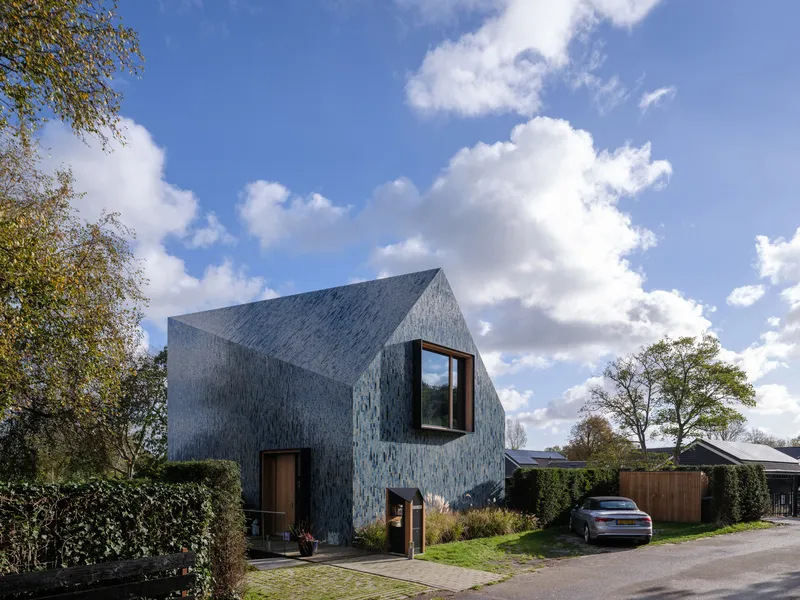

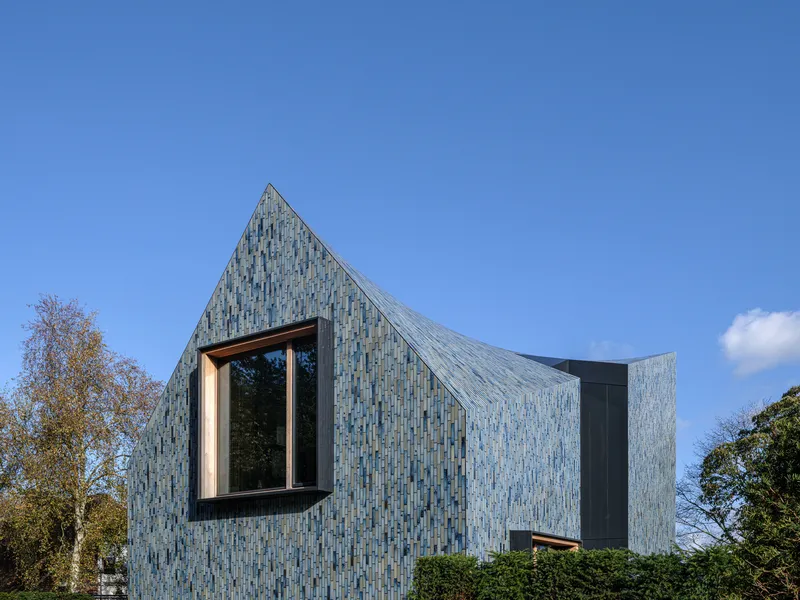
From the dune side, Villa BW presents a pitched gable that conforms to the character of Oorsprongweg, the residential street it sits on. Walk around to the polder side, and the roofline flattens into a horizontal plane. The geometry is generated by overlapping two shapes: the traditional gable and a low-slung bar. The result is a double-curved surface that reads as a single continuous skin, unified by the tile cladding rather than broken into distinct roof and wall planes.
It is a deliberate abstraction of local typology. Mecanoo is not mimicking the traditional houses; they are compressing the transition between two landscape types, dune and polder, into the geometry of a single building. The gable is the dune. The horizontal line is the flat farmland beyond. The house is a topographic diagram.
Five Shades of Iridescence
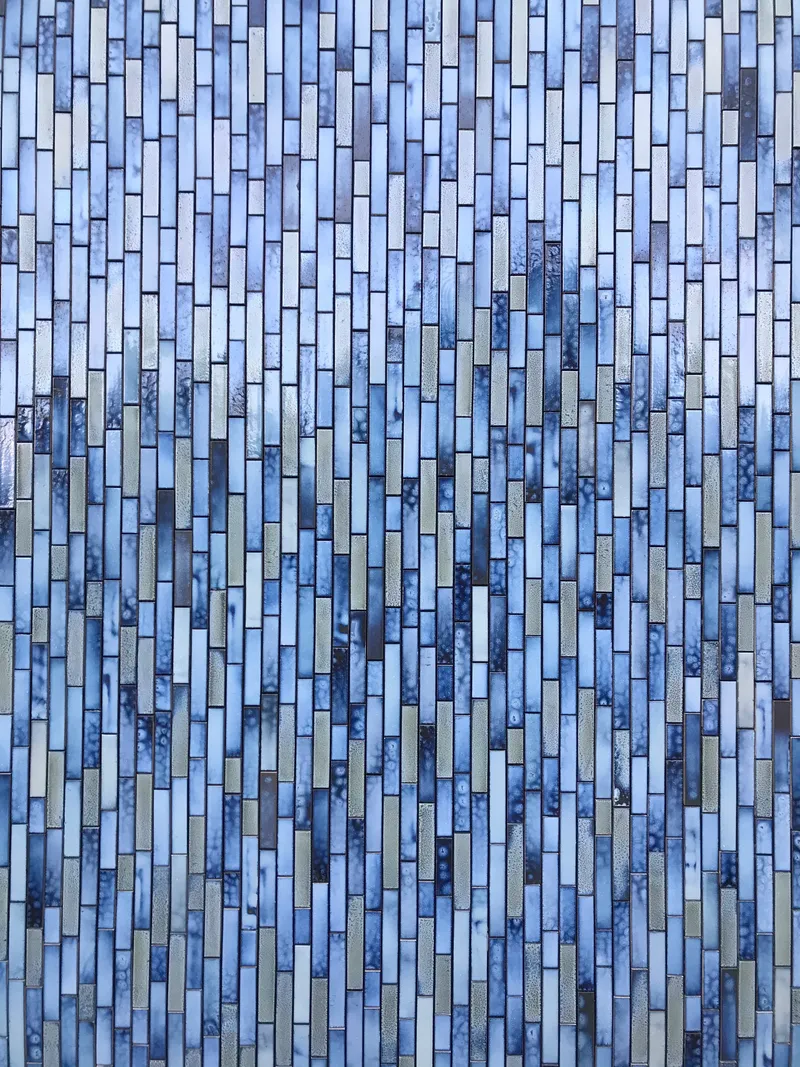
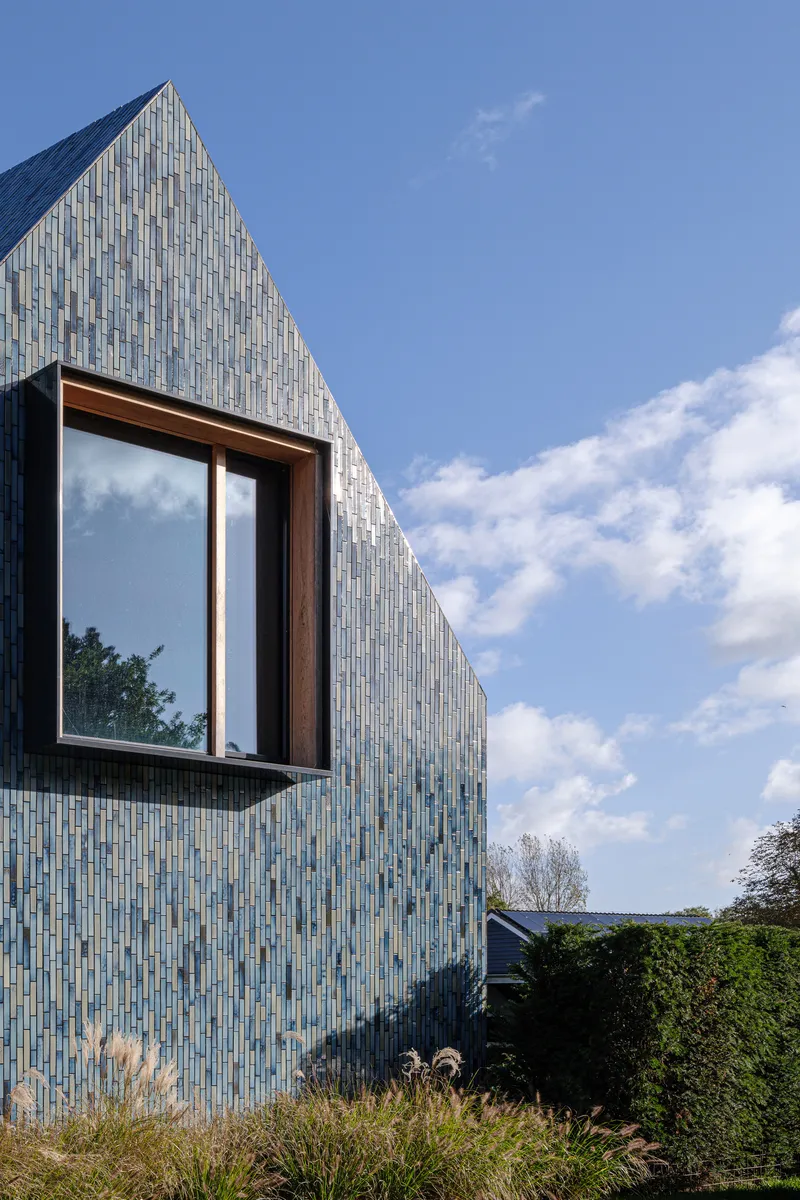
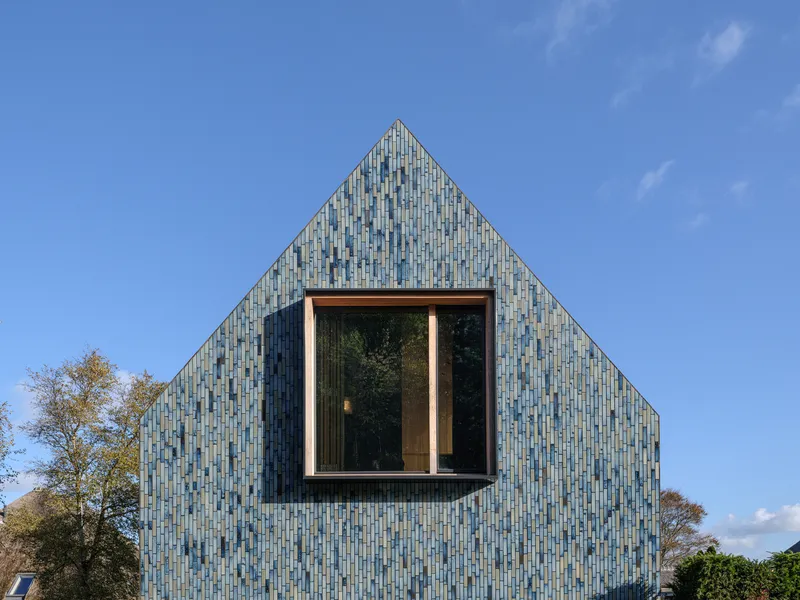
The tile cladding is the project's most obsessive detail. Working with Koninklijke Tichelaar, Mecanoo developed five shades of grey, green, and blue, each treated with a pearlescent glaze that produces an iridescent shimmer. The tiles come in four widths (110, 180, 240, and 290 mm, all 52 mm tall) and are set with 5 mm vertical open joints that run in continuous lines across the roof surface. The color mix was calibrated through multiple sampling rounds, with on-site evaluations conducted under different lighting conditions to assess how colors, textures, and gloss levels interact.
The installation method is worth noting: tiles were delivered in preselected packages with a predetermined ratio of sizes and colors, but skilled craftsmen applied them according to a set of rules rather than a fixed bond pattern. The approach deliberately minimizes repetition, producing a surface that feels organic and geological rather than tiled. Up close, the staggered tones evoke sedimentary layers, reinforcing the concept of soil strata shifting from light dune sand to darker polder earth.
Landscape as Architecture
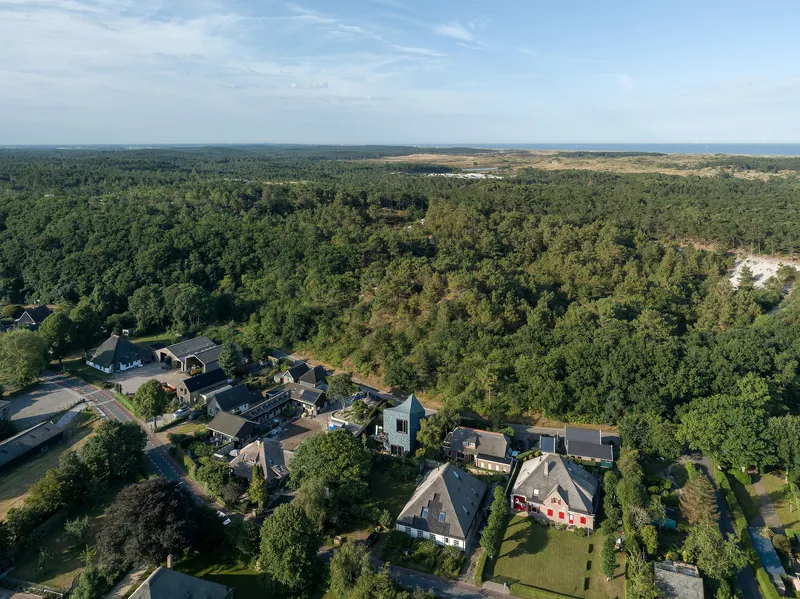

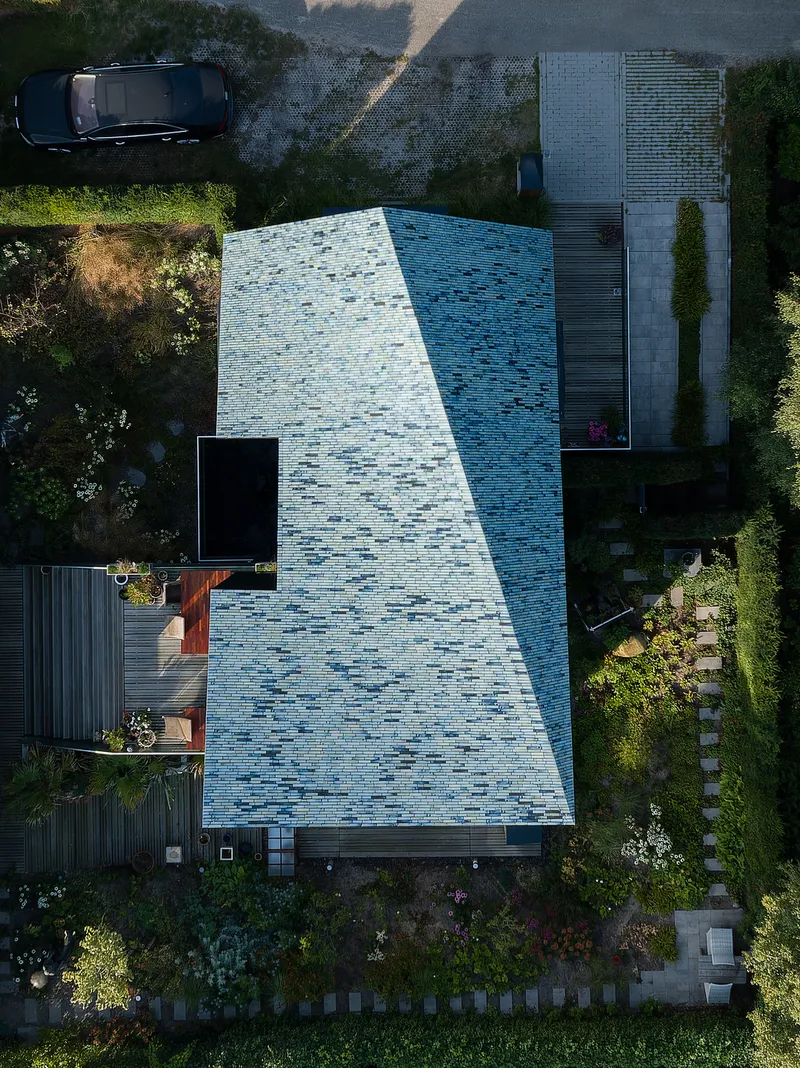
The aerial views reveal Villa BW's relationship to its context more clearly than any ground-level photograph. Schoorl sits at the boundary between forested dune ridges and open polder farmland, and the house is planted right on the seam. Mecanoo replenished the site's embankment to extend the dune landscape up and over the building, creating a sloped garden that connects the roof level to the terrain below.
From above, the variegated tile roof reads as another surface in the landscape, a mineral patch among the greens. Stepping stones cross the planted garden, and the building's footprint sits comfortably within a cluster of more conventional dwellings. The strategy is not earth-sheltered architecture in the dramatic sense but something subtler: a house that acknowledges it occupies a slope and uses that slope as an organizing principle rather than fighting it with retaining walls and flat pads.
The Street at Dusk
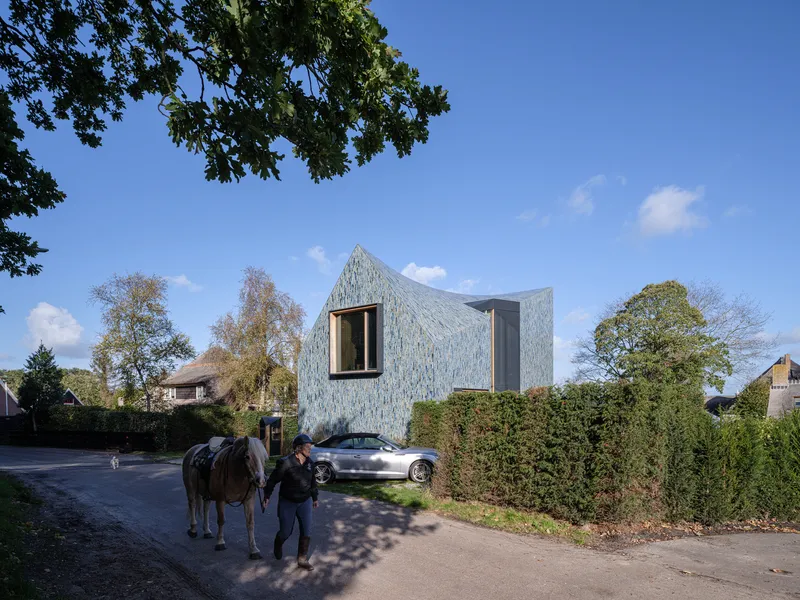
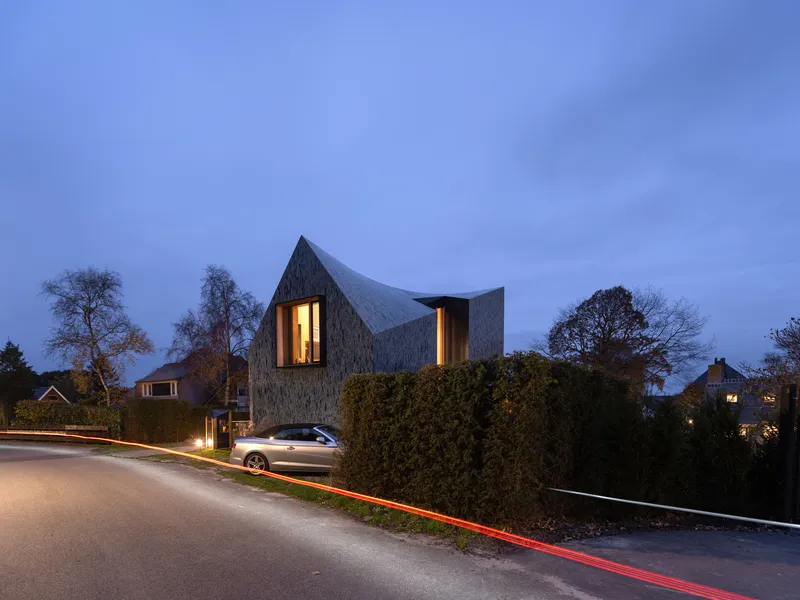

Villa BW's relationship to its street is perhaps most legible at dusk, when the windows glow behind the hedge and the tile surface loses its color to become a dark, textured mass. The house sits behind a hedge like its neighbors, maintaining the residential rhythm of Oorsprongweg. A person passes with a horse in the autumn light, and the house simply exists as part of the scene, not shouting for attention.
During the day, the projecting timber-framed window boxes punctuate the facade with warmth, their wood grain contrasting sharply with the cool ceramic surface. These are not decorative gestures; they are functional bay windows that push the interior toward the landscape and provide deep reveals that shade the glass. The vertical window slots on the northwest elevation are more restrained, limiting views to the street while maximizing privacy.
Timber Core, Terrazzo Ground
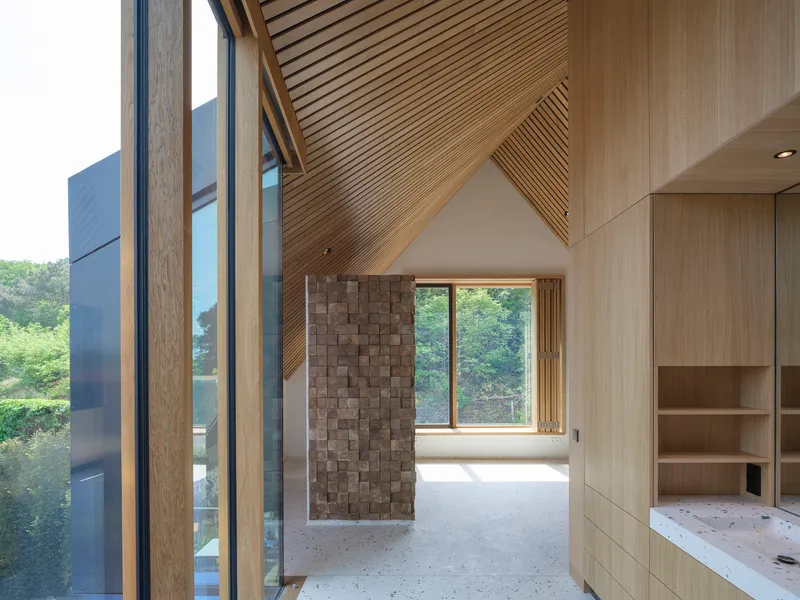
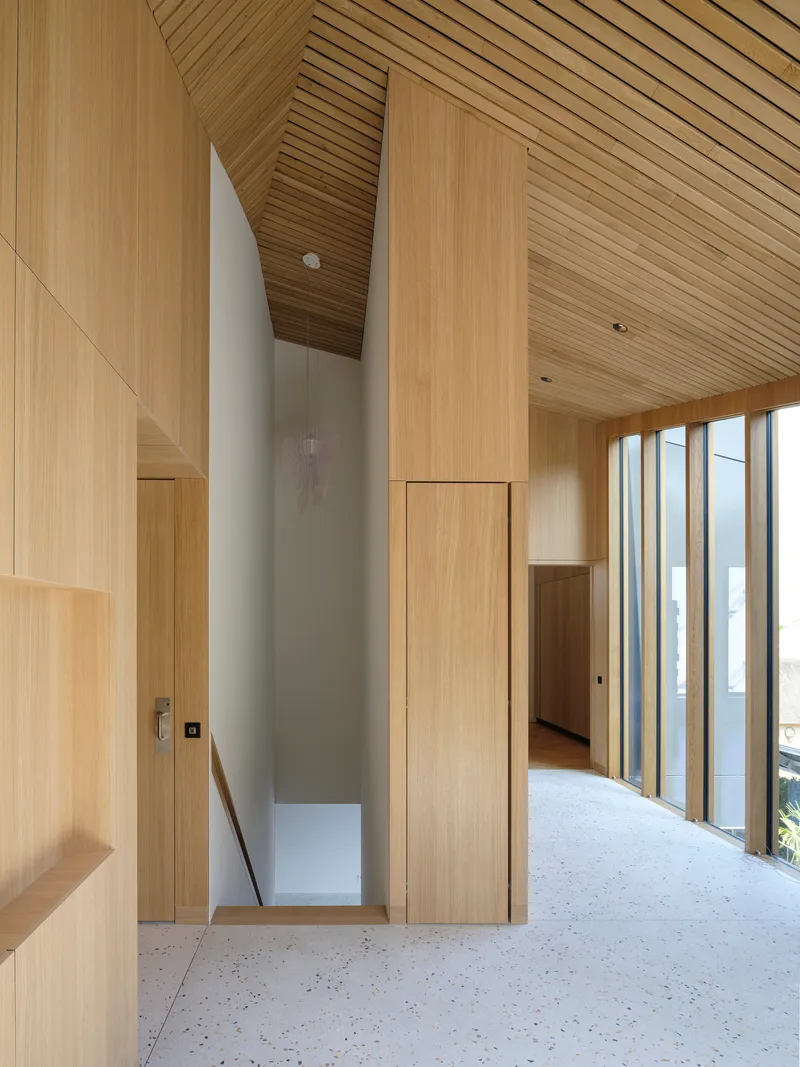
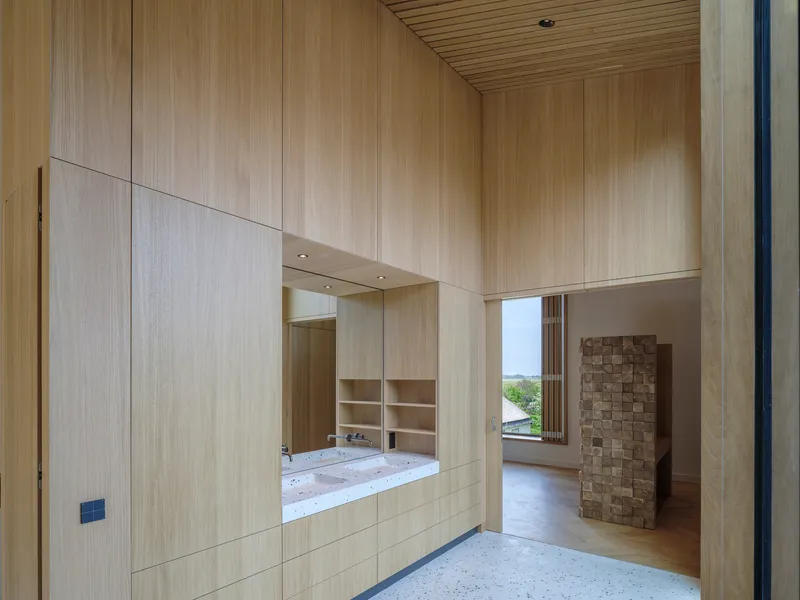
Inside, the material palette inverts. The cool, mineral exterior gives way to warm timber: slatted ceilings pitched along the roof geometry, wood-paneled walls, and a central core clad in timber that houses services, storage, and circulation. The living spaces wrap around this core, borrowing light from the double-height voids that face southeast through the curtain wall system.
Terrazzo flooring and countertops anchor the ground plane with a material that echoes the aggregate quality of the exterior tiles. A brick chimney appears in the living area, a deliberate nod to traditional Dutch domesticity that feels earned rather than nostalgic. The diagonal timber slats beneath the pitched roof create a rhythmic ceiling pattern that tracks the double-curved geometry overhead, making the interior space legible as something carved beneath a landscape rather than contained within four walls.
Crafted Details Within
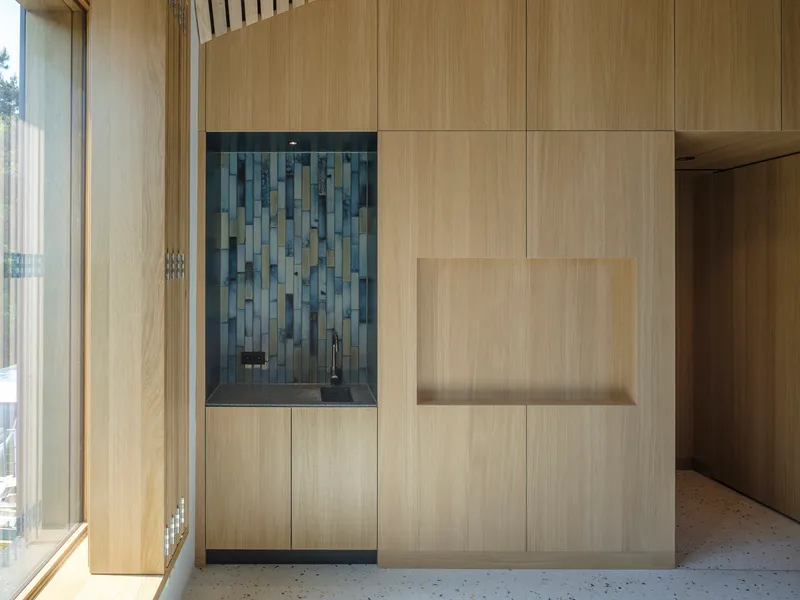
The built-in cabinetry demonstrates a level of joinery care that matches the tile work outside. A niche lined with blue ceramic tiles, likely the same Tichelaar product used on the facade, sits within a light wood paneling system, creating a small moment of connection between inside and out. Storage is integrated flush into the timber walls, maintaining clean surfaces throughout.
The textured block wall visible in the upper level adds a third material register: rough, masonry-like, and grounding. It is a reminder that this is fundamentally a solid building, not a timber pavilion. The interplay between the three interior materials, smooth timber, rough block, and polished terrazzo, gives each room a distinct atmosphere without fragmenting the overall sense of a unified interior.
Plans and Drawings
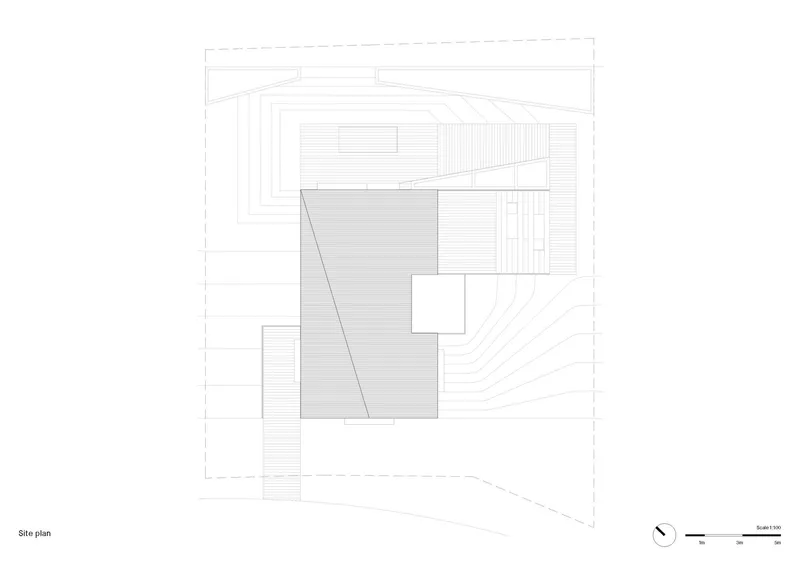
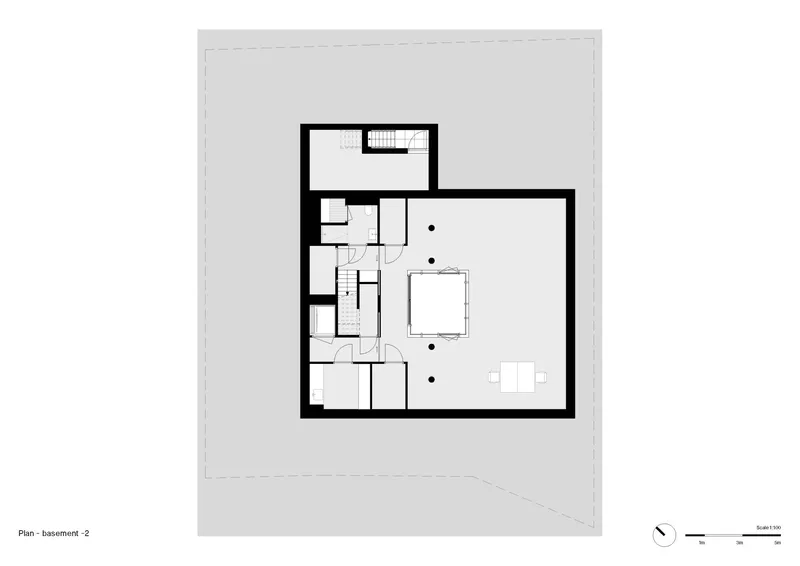
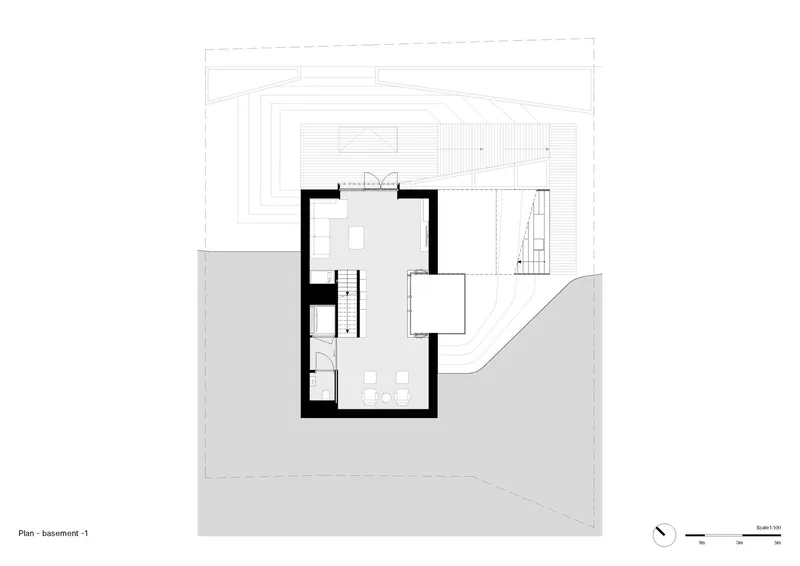
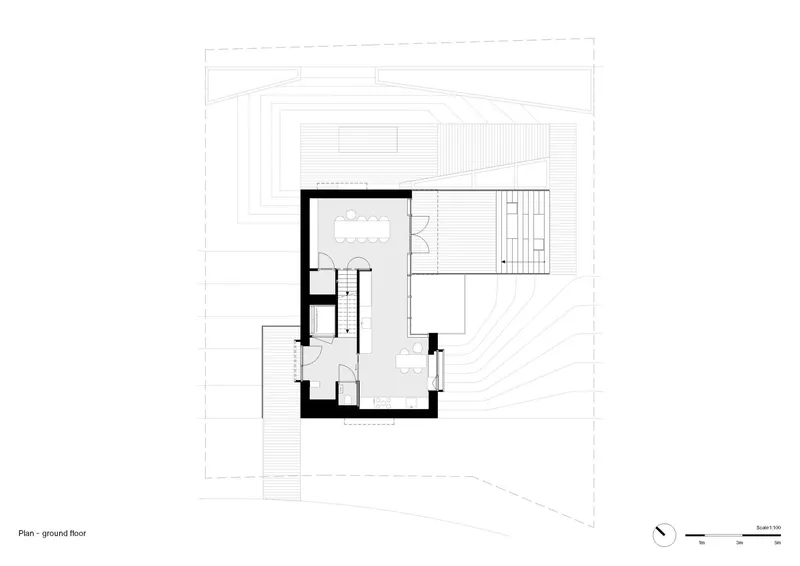


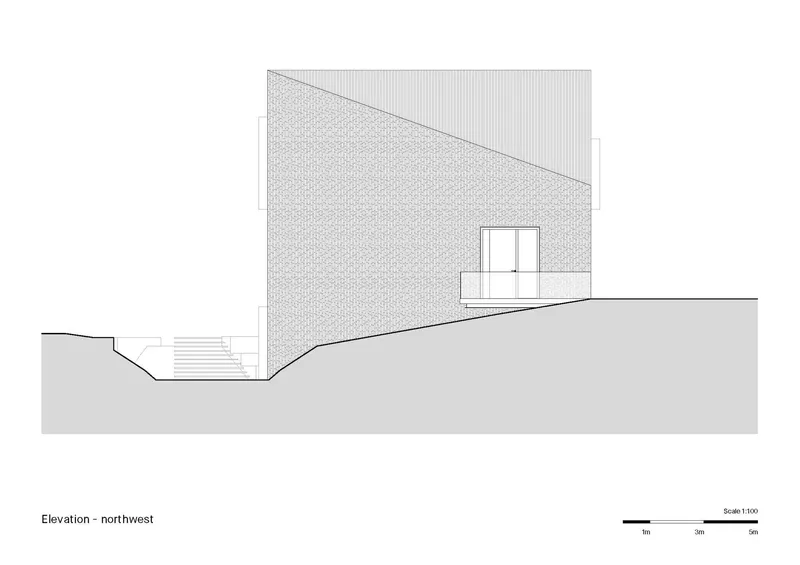
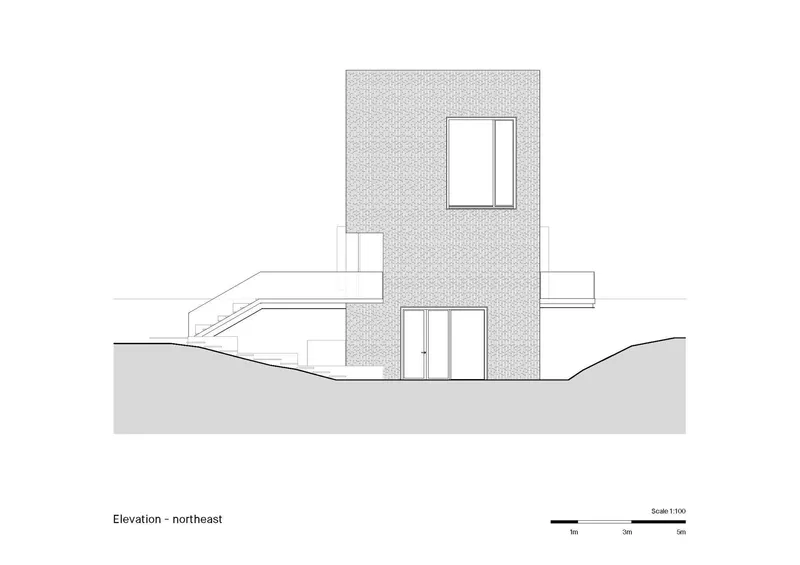
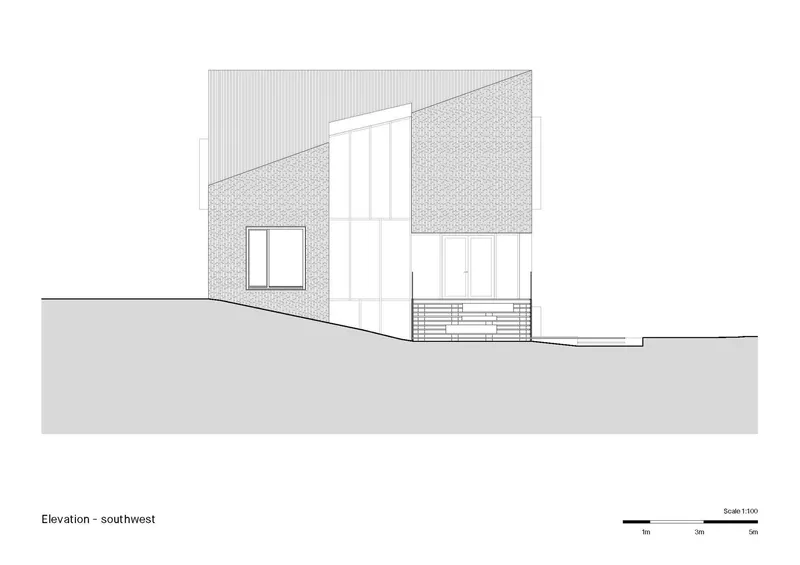

The section drawings are where Villa BW's spatial logic becomes fully clear. Four levels stack within the double-curved envelope: two below grade and two above. The central staircase connects all levels, and the curtain wall on the southeast face floods even the basement with daylight. The site plan shows how the contour lines of the dune landscape wrap around the building footprint, confirming that the terrain was regraded to embrace the structure rather than accommodate it.
The floor plans reveal an L-shaped layout on the ground floor with thick walls responding to the thermal mass requirements of a partially submerged building. The first floor is more compact, three rooms arranged around the stair, tucked beneath the narrowing roof geometry. The basement level houses bathroom clusters and an open living area, taking advantage of the double-height void to avoid the claustrophobia that typically plagues below-grade residential space. The elevations, meanwhile, show four distinctly different faces: each facade is calibrated to its orientation and its relationship to either the street, the landscape, or the garden.
Why This Project Matters
Villa BW matters because it demonstrates that craft and concept can be mutually reinforcing rather than competing interests. The tile cladding is not decoration applied to a form; it is the means by which the form achieves its continuity, its color gradient, and its relationship to the geological layers of the site. The collaboration with Koninklijke Tichelaar produced a genuinely site-specific material, not a catalog product, and the installation method, guided by rules rather than a predetermined pattern, introduces a controlled randomness that keeps the surface alive.
More broadly, the project offers a model for how a contemporary house can engage with vernacular typology without resorting to pastiche. The gable is there, but it has been geometrically fused with a second roof form to create something new. The brick chimney is there, but it sits within a timber-lined interior that owes nothing to period style. Mecanoo has built a house that is legibly Dutch without being retro, technically sophisticated without being cold, and deeply embedded in its landscape without disappearing into it. For a 308 m² private residence, that is a rare combination.
Villa BW by Mecanoo, located in Schoorl, The Netherlands. 308 m², completed in 2022. Photography by Ossip Architectuurfotografie.
About the Studio
Share Your Own Work on uni.xyz
If projects like this are the kind of work you want to make, uni.xyz is a place to publish your own, find collaborators, and enter design competitions.


Popular Articles
Popular articles from the community


Faces of the Soviet Avant-Garde: Turning Moscow's Street Names into an Open-Air Museum
A network of sculptural installations across a Moscow residential district transforms forgotten architect names into spatial encounters with cultural memor

Tsunami Convergenics: Turning Catastrophic Ocean Forces into Underwater Housing Infrastructure
A speculative underwater settlement off the coast of Onagawa, Japan, treats tsunamis and typhoons as energy sources rather than threats.

Singing Woman: Contemporary Architecture Inspired by Estonia’s Voice and the Sea
Singing Woman turns Estonia’s song culture into flowing opera house architecture, blending public life, landscape, sea, and national memory.
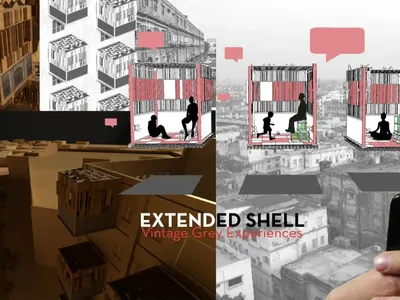
Extended Shell: Retrofitting Kolkata's Balconies as Living Urban Thresholds
A modular retrofit system recovers the social and environmental intelligence of Kolkata's historic verandas for contemporary Park Street residents.

Similar Reads
You might also enjoy these articles

Bao Huynh Watercolor Atelier: A Serene Art Retreat in Hội An
Bao Huynh Watercolor Atelier in Hội An blends multifunctional art spaces, sustainable design, local materials, and family-friendly living in a serene environment.

Atelier Macri Concept Store Interior Design by CASE-REAL
Atelier Macri store features a "ko" counter, walnut wood details, cork displays, blending retail, gallery, and seamless customer experiences.

Manuel Vargas Izquierdo Stadium and High-Performance Sports Center: Architectural Excellence in Jalpa de Méndez
The Manuel Vargas Izquierdo Stadium blends sustainable design, inclusive sports facilities, and cultural-inspired architecture, revitalizing Jalpa de Méndez’s public spaces.

KAKR Buluh Awar Hall: Revitalizing Community and Ecology Through Bamboo Architecture
Community built bamboo hall revitalizes Buluh Awar village, empowering youth, restoring ecology, celebrating vernacular craftsmanship through sustainable architecture and culture.

Explore Villa Competitions
Discover active competitions in this discipline

Challenge to design mud housing for contemporary communities

Challenge to reimagine the Iron Throne

Photograph architecture without architects

Illustrate the lost glory of Angkor Wat - Render Challenge
Comments (0)
Please login or sign up to add comments
No comments yet. Be the first to comment!