
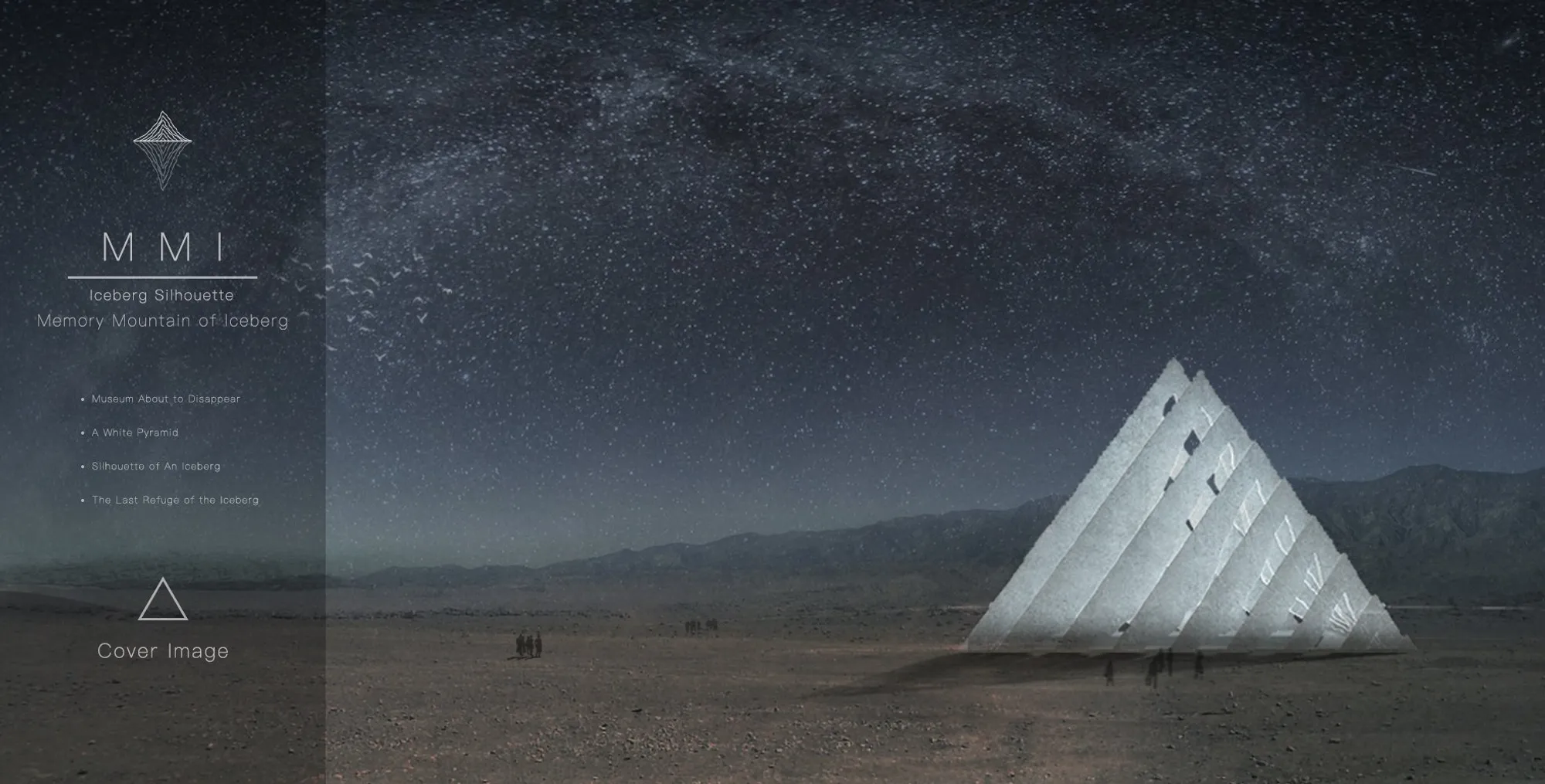
Memory Mountain of Iceberg
A striking climate change memorial in Egypt transforms a melting iceberg into architecture, merging water, sound, and space to provoke reflection


In contemporary architecture, the role of design has evolved beyond function and aesthetics to address urgent global issues. One of the most compelling directions in this shift is climate change memorial architecture, where spatial experiences are used to communicate environmental crises. Memory Mountain of Iceberg, designed by Shida Wang, Danhua Liang, and Weikun Dai, stands as a powerful exploration of this emerging typology.
Recognized as an Editor’s Choice entry in the Hourglass competition, the project situates a monumental pyramid-like structure in the Egyptian desert, creating a stark contrast between extreme climates. Through this juxtaposition, the design transforms the invisible processes of global warming into a tangible architectural experience.
Concept: Translating Climate Change into Architecture
The conceptual foundation of this climate change memorial draws from a provocative historical idea. In the 1970s, French engineer Georges Muran proposed transporting icebergs from polar regions to arid landscapes to solve water shortages. While technically ambitious and economically challenging, the idea serves as a conceptual catalyst for the project.
Rather than implementing this idea literally, the designers reinterpret it architecturally. The project imagines a “zoo” for endangered icebergs, placing them in the most unlikely context, the desert. This deliberate displacement creates a strong narrative tension that encourages visitors to reflect on human intervention in natural systems.
The architecture operates as both metaphor and medium. The iceberg is no longer just an object, it becomes a spatial condition, a disappearing presence, and a memory embedded within the structure.
Spatial Experience and Narrative Journey
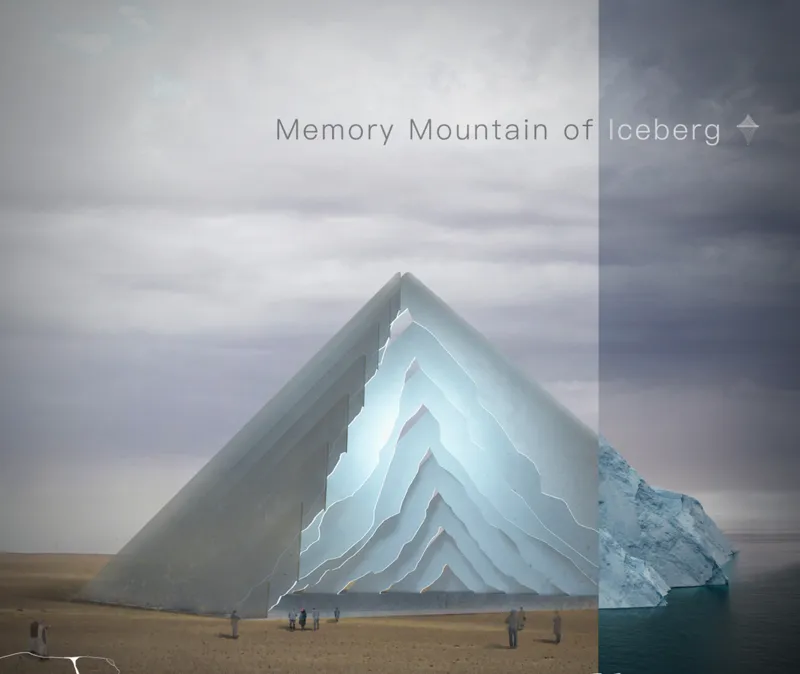
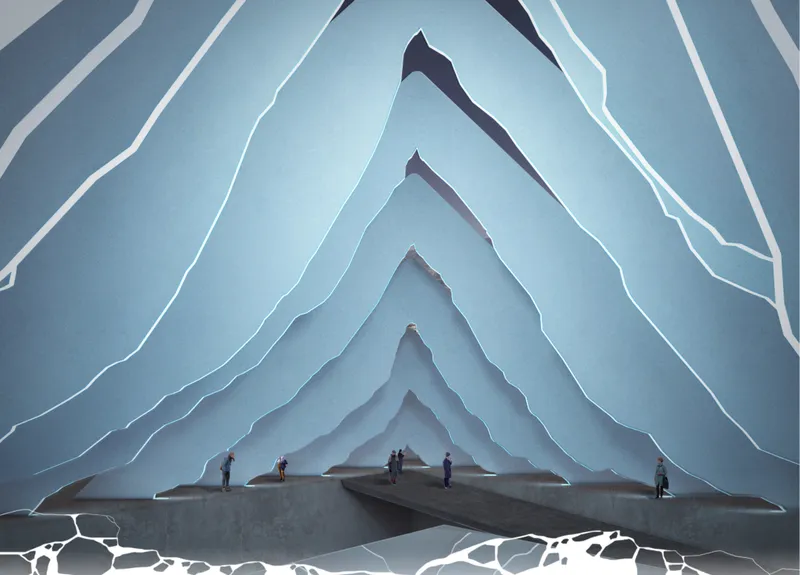
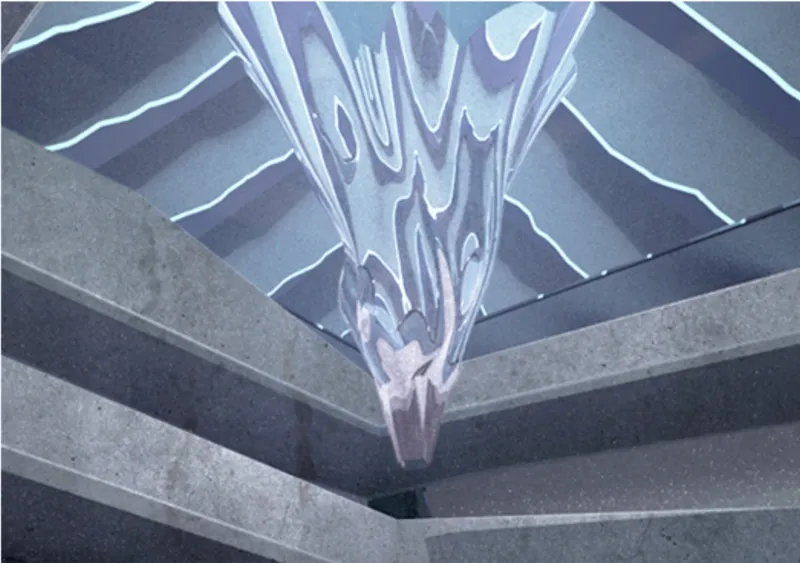
The memorial is designed as an immersive journey. Visitors encounter a pristine white pyramid rising from the desert landscape, referencing Egypt’s iconic architectural language while simultaneously subverting it. Instead of solid mass, the interior reveals a hollowed geometry shaped by the outline of a real iceberg.
As visitors move through the structure, they experience a gradual transformation:
- Above ground, the pyramid represents the visible trace of the iceberg
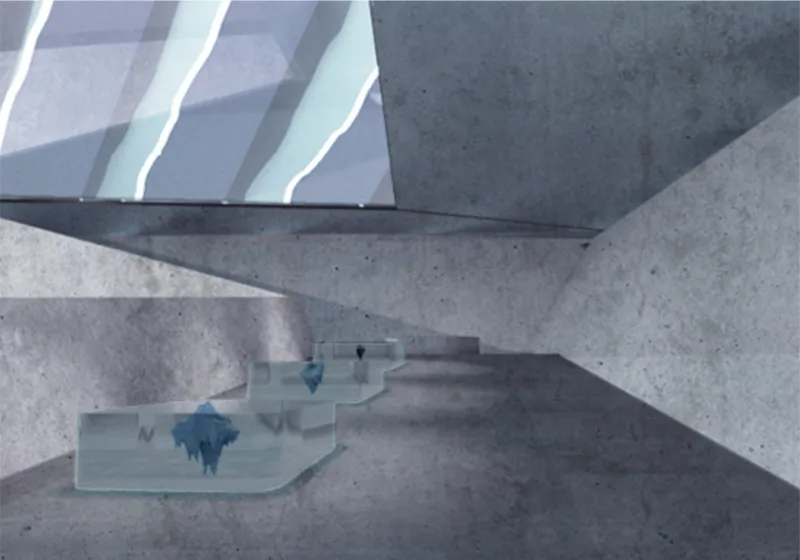
- Below ground, the submerged portion reveals the hidden mass of the iceberg
- At the core, a pool collects water, symbolizing the result of melting
The auditory dimension plays a critical role. The sound of dripping water echoes through the underground chambers, reinforcing the sense of gradual loss. This dynamic feature transforms the space into a living system, where time, temperature, and environmental change are perceived through sound.
Architectural Strategy and Form Development
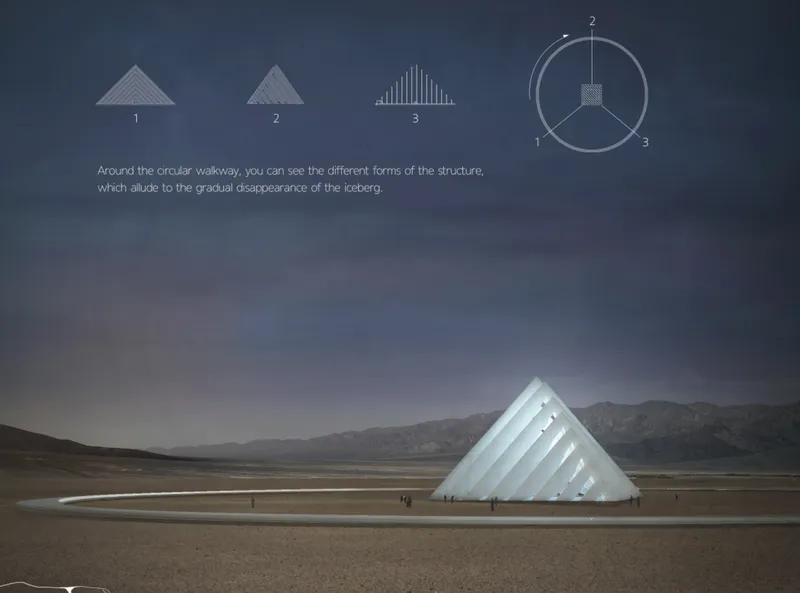
Formally, the project derives its geometry from the iceberg C-15A, translating its irregular outline into a structured architectural language. The pyramid form is layered and fragmented, creating a sequence of receding planes that visually represent the gradual disappearance of ice.
The use of translucent concrete allows light to penetrate the structure, generating luminous bands that simulate the internal qualities of ice. This material strategy enhances the experiential quality, making the building appear both solid and ephemeral.
A circular walkway surrounds the structure, offering multiple viewpoints and reinforcing the narrative of transformation. As visitors move along this path, the changing geometry of the pyramid communicates the stages of melting and loss.
Environmental Response and Water System
Beyond symbolism, the project integrates a functional environmental system. Rainwater and condensation are collected within the structure and stored in an underground tank. This water is then redistributed to the surrounding region, addressing local water scarcity.
This dual approach positions the project at the intersection of speculative design and practical intervention. While the memorial communicates the urgency of climate change, it also contributes to resource management in a measurable way.
The collected water becomes both a physical resource and a narrative device, reinforcing the connection between environmental processes and human survival.

Cultural Context and Global Relevance
The decision to locate the project in Egypt is both symbolic and strategic. The pyramid form resonates with the country’s architectural heritage, making the project immediately recognizable. At the same time, the introduction of an iceberg into this context disrupts expectations, creating a powerful visual and conceptual contrast.
This contrast reflects a broader global condition. Climate change is not confined to polar regions or specific geographies. Its effects are interconnected, crossing boundaries and affecting diverse ecosystems. By placing an iceberg in the desert, the project visualizes this interconnectedness in a direct and impactful way.
Critical Reflection and Jury Insight
The project has been praised for its clarity and conceptual strength. As noted by juror Jonas Prismontas, the idea is compelling and well communicated through drawings and presentation. The project successfully translates a complex environmental issue into a coherent architectural narrative.
However, the jury also raises an important question regarding materiality. The use of concrete, while effective in achieving the desired form and durability, introduces concerns about environmental impact. This critique highlights a key tension in climate change memorial architecture: the need to balance symbolic expression with sustainable construction practices.
The designers address this concern indirectly through the water collection system, suggesting that the long-term benefits of the project may offset its initial environmental cost. This debate adds depth to the project, positioning it within ongoing discussions about sustainability in architecture.
Architecture as Memory and Warning
At its core, Memory Mountain of Iceberg is not just a building. It is a temporal artifact that captures a moment of environmental crisis. The iceberg, once present, is now represented through absence, sound, and trace.
The gradual reduction of dripping water over time becomes a metric of change. If future generations succeed in addressing climate change, the sound may eventually disappear. In this way, the memorial evolves from a warning into a record of human action.
This transformation positions the project within a broader architectural discourse. Buildings are no longer static objects but dynamic systems that respond to environmental conditions and human behavior.
Memory Mountain of Iceberg exemplifies the potential of climate change memorial architecture to engage audiences on both emotional and intellectual levels. By combining strong conceptual grounding, immersive spatial design, and environmental responsiveness, the project creates a compelling narrative about loss, responsibility, and possibility.
In an era where climate change often feels abstract and distant, this project makes it immediate and experiential. It challenges visitors to confront the consequences of human actions while offering a vision of how architecture can contribute to awareness and change.
Through its integration of form, sound, and water, the memorial transforms the disappearing iceberg into a lasting architectural memory, one that continues to resonate across time and place.



Popular Articles
Popular articles from the community


Hill & Cross Opera: Sculptural Opera House Architecture Shaped by Tallinn’s Landscape and Identity
Hill & Cross Opera reimagines opera house architecture in Tallinn through its sculptural hill, civic plaza, glass wave and a luminous cross.

Co-life: Sustainable Architecture for Age-Friendly Community Living
Co-life reimagines sustainable architecture for seniors through courtyards, rammed earth, shared gardens, and spaces designed for belonging.

AL-JANNAH: Sustainable Architecture and Permaculture for Afghan Widows
AL-JANNAH uses sustainable architecture and permaculture to create resilient oasis of housing, learning, work and renewal for Afghan widows.

Riyadh For All: Intergenerational Urban Design for Active Aging in Rabat
Riyadh For All reimagines urban design in Rabat with intergenerational co-living, adaptive courtyards, and Moroccan cultural exchange today.


Similar Reads
You might also enjoy these articles

Eco Chapel: A Green Architecture Pavilion Designed in Symbiosis with the Forest
Eco Chapel uses green architecture to weave prayer, learning and reuse into a forest pavilion shaped by modular hexagonal canopies for life.
Kaffeebühnen: Coffee Shop Architecture Designed as a Civic Stage Between Vienna’s City and Park
Kaffeebühnen turns coffee shop architecture into a civic stage, linking Vienna’s park edge, urban life, warm timber yards, and coffee craft.
Healing Façade: Sustainable Architecture for Reforestation, Community, and Sacred Ecology in Ethiopia
Healing Façade reimagines sustainable architecture as a living wall that restores soil, catches water and renews Ethiopia's forest churches.


Urban Forest: A Vertical Ecosystem for 5,000 Workers in Singapore's Changi Business Park
Radially stacked pods and layered green decks turn a 7-acre plot into 47 acres of ecological workspace projected for 2040.
Explore Architecture Competitions
Discover active competitions in this discipline



Challenge to design public laboratory


Challenge to reimagine the Iron Throne


Photograph architecture without architects


Illustrate the lost glory of Angkor Wat - Render Challenge
Comments (0)
Please login or sign up to add comments
No comments yet. Be the first to comment!