

Memory Requiem: Dissolving the Boundary Between Cemetery and City Park in Shanghai
A shortlisted cemetery design splits a dense Shanghai site into zones for life and death, linked by a contemplative park and bio-lab ecology.


Cemeteries in dense cities tend to operate as sealed-off enclaves, walled away from the living. Memory Requiem flips that logic by embedding a cremation facility, a museum, a bio-lab, and a public park into a single site in Shanghai, then organizing them along a north-south axis that maps directly onto the cycle of life and death. Life occupies the north; death occupies the south; and between them, an open landscape stitches both into the daily rhythms of the city.
Designed by Ecem Kutlay, Duygu Kalkanli, Mert Akay, and Furkan Şanlı, the project was shortlisted in the Circle of Life competition. Juror Manuel Herrera of TALLER DIEZ 05 observed that "there are clearly two typologies in the project that I think have to interact more precisely; the idea of park is well adapted to its surroundings." That tension between two distinct programmatic identities, and the landscape that mediates them, is exactly what gives the scheme its force.
Reading the City Before Designing the Cemetery
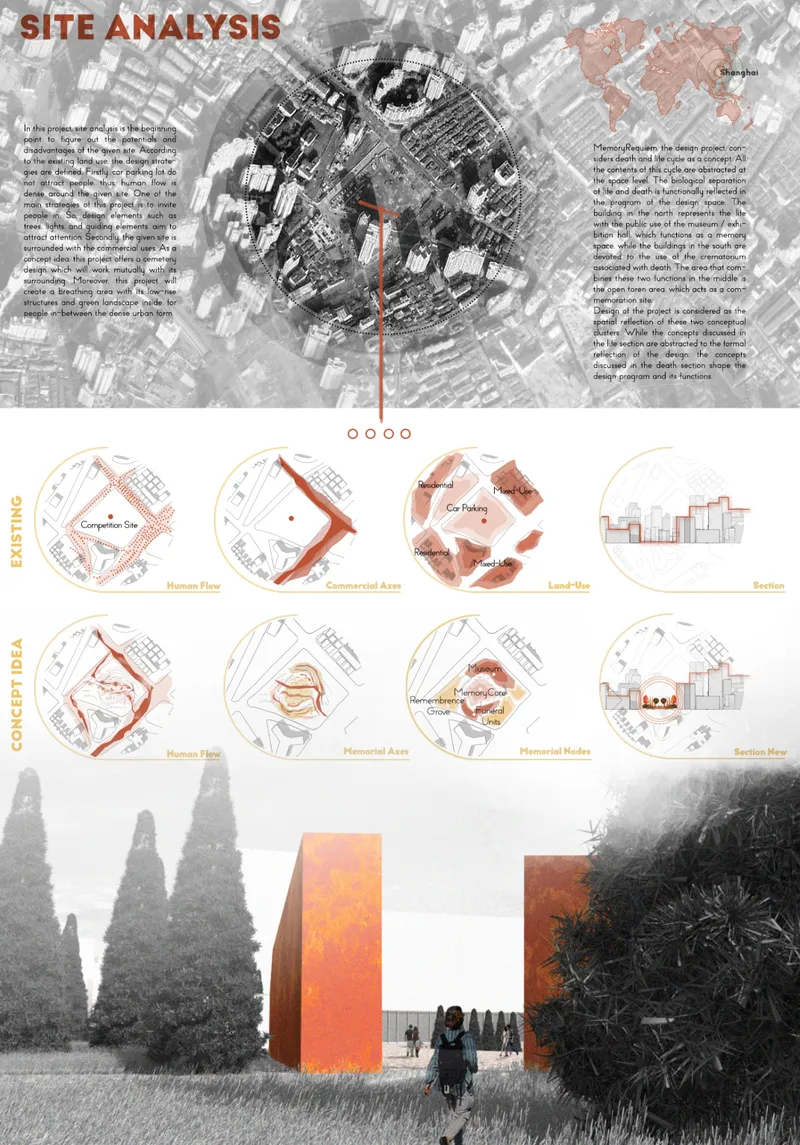
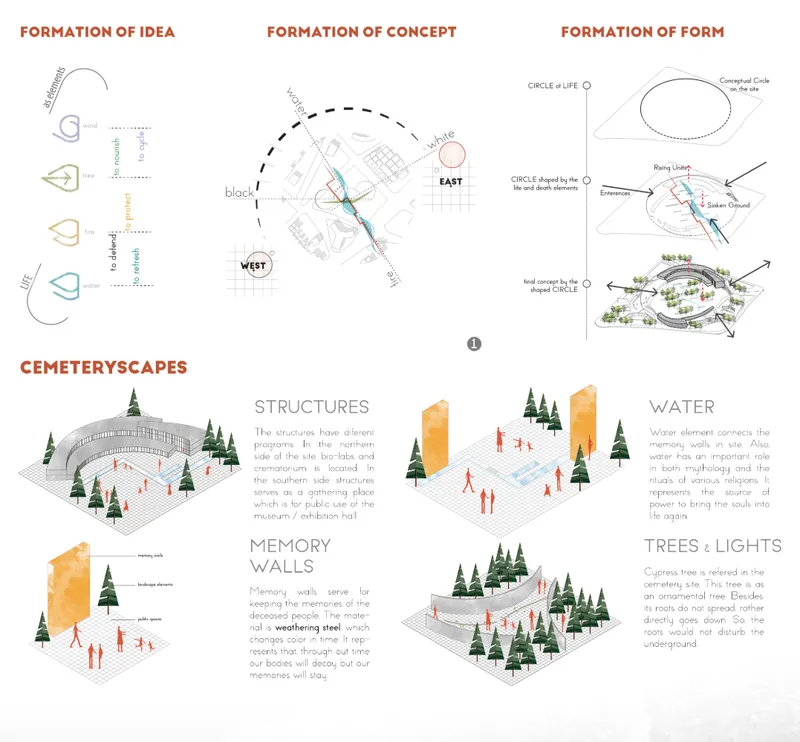
The designers began with a thorough site analysis of existing pedestrian and commercial flows, then reinterpreted those vectors as memorial axes and spatial nodes. The aerial diagrams and formation studies reveal how a previously utilitarian plot gets reorganized into a legible sequence: arrival, contemplation, ritual. Cypress trees, a recurring motif in funerary landscapes worldwide, punctuate the site and anchor the tall orange portal visible in early renderings. That portal works as both a landmark and a threshold, signaling to the surrounding neighborhood that this is a space with distinct purpose.
Isometric breakdowns show how individual cemetery elements, from memory walls to planting beds, aggregate into larger spatial compositions. The low-rise massing keeps the complex deferential to Shanghai's skyline while maximizing green open area. Rather than a single monumental gesture, the scheme relies on an accumulation of smaller architectural moments that visitors discover as they move through the site.
Weathering Steel and Cypress: Decay as a Design Language
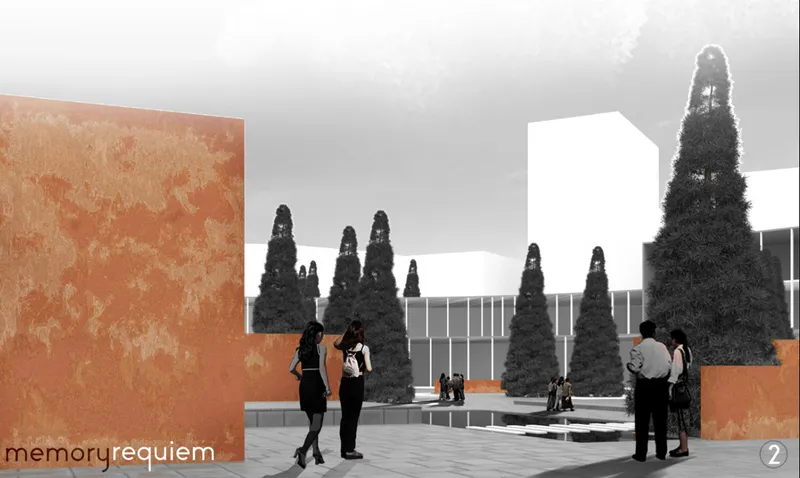
The courtyard rendering makes the material palette unmistakable: warm orange Corten steel volumes sit alongside white concrete forms, all set within groves of dark cypress. The weathering steel is not merely aesthetic. Its slow oxidation over years becomes a physical metaphor for the passage of time, where decay is absorbed into the architecture rather than resisted. Memory walls built from this material will shift in tone and texture season by season, making the building itself a participant in the remembrance it houses.
Inclusivity across faiths is built into these contemplative zones. Water features, landscaped groves, and memory walls draw on religious mythologies but are interpreted through a secular, spatial lens. The result is a series of settings that accommodate diverse rituals without prescribing any single narrative. Visitors from any background can find a point of connection.
Guiding Light: Circulation and Emotional Choreography
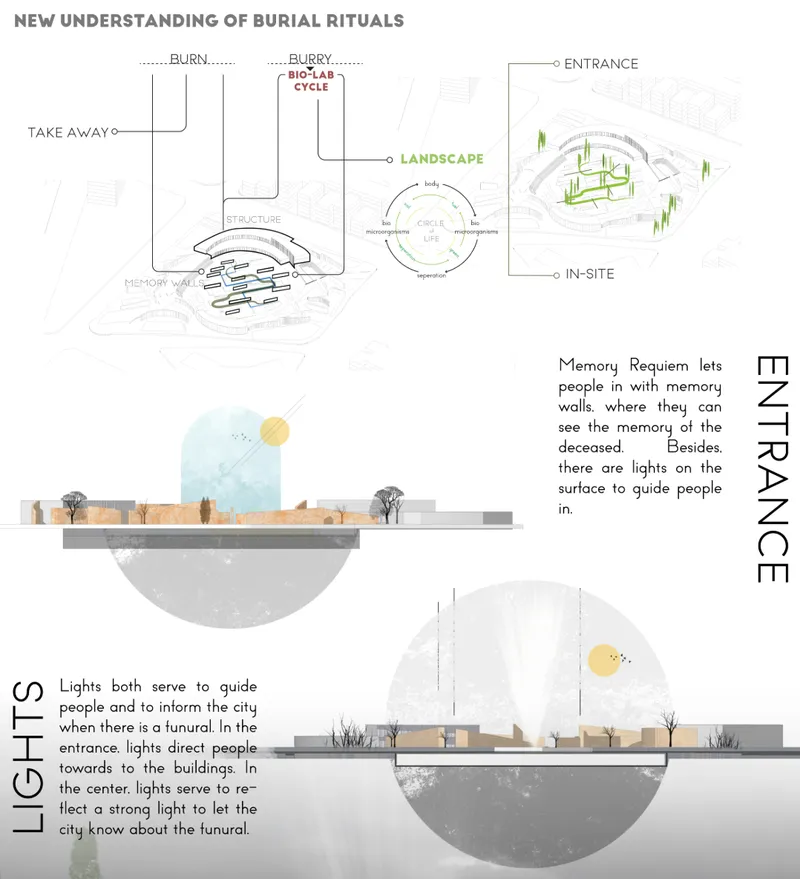
Section drawings lay out the lighting strategy that structures both movement and mood. During funerals, illumination in the central area becomes visible to the surrounding city, a quiet signal of someone's passing that acknowledges death as a communal event. At the entrance, guiding lights serve a more practical role: they orient newcomers and reduce the psychological barrier of entering a space associated with loss. The diagrams also clarify how burial rituals circulate through the site, moving from public to increasingly intimate zones.
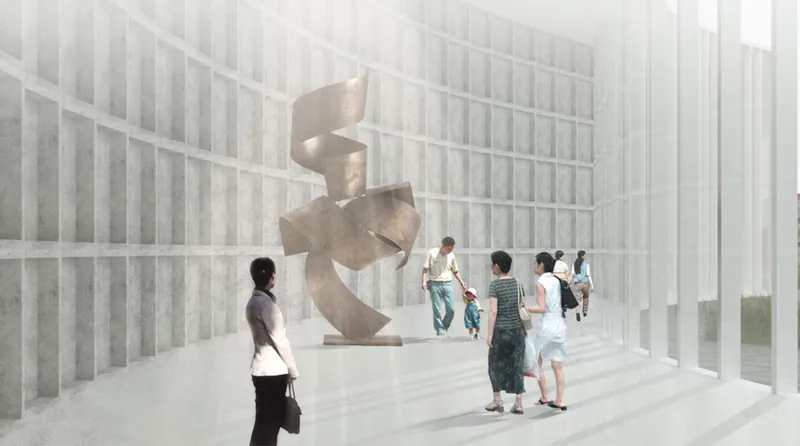
The interior view reveals a different register entirely. Folded metal sculptures stand on a white gridded floor, flanked by translucent columns that filter daylight into a diffused glow. Visitors pass through at their own pace. The space operates less like a traditional memorial hall and more like a gallery of absence, where the architecture holds space for individual reflection without imposing a fixed emotional script.
A Bio-Lab Loop: Composting as Urban Ecology
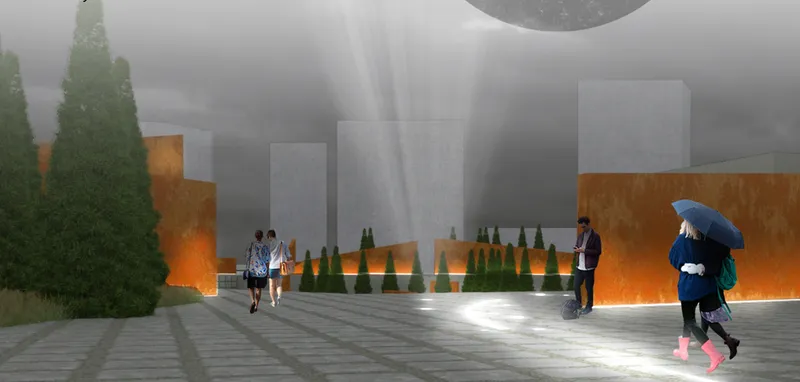
The evening render captures the project's quieter public face: a backlit orange wall beneath grey volumes, visitors crossing a paved plaza with umbrellas in hand. It reads like any well-designed urban park, and that ordinariness is the point. The bio-lab component, housed in the northern zone alongside the museum, uses technologies that accelerate decomposition and transform human remains into nutrient-rich compost. That compost feeds back into the site's planting, creating a closed ecological loop where burial directly sustains urban biodiversity. It is a radical departure from traditional interment, reframing death not as an endpoint but as a material contribution to the living city.
Why This Project Matters
Memory Requiem confronts a problem most urban designers sidestep: where do the dead go in a city running out of space? By splitting its program between zones of life and death and binding them with a public park, the scheme refuses the common assumption that cemeteries must be isolated from daily urban life. The bio-lab composting strategy pushes the argument further, proposing that burial infrastructure can actively improve the ecological health of its surroundings rather than simply consuming land.
What makes the project compelling is its refusal to sentimentalize. The weathering steel will corrode; the compost will nurture new trees; the guiding lights will mark funerals visible to the city at large. Every design decision folds decay, time, and transformation into the architecture itself. For a competition asking designers to reconsider the circle of life, Kutlay, Kalkanli, Akay, and Şanlı delivered a scheme where that circle is not symbolic decoration but the operating logic of the entire site.
View the Full Project
About the Designers
Designers: Ecem Kutlay, Duygu Kalkanli, Mert Akay, Furkan Şanlı
Enter a Design Competition on uni.xyz
uni.xyz runs architecture and design competitions year-round that reward proposals with spatial conviction and real site intelligence.
Project credits: Memory Requiem by Ecem Kutlay, Duygu Kalkanli, Mert Akay, Furkan Şanlı Circle of Life (uni.xyz).


Popular Articles
Popular articles from the community


Opera by the Sea Estonia: Three Shells Dissolving Architecture into Tallinn's Coastline
A winning opera house proposal replaces monumental form with interconnected shells that blur the boundary between building, park and Baltic Sea.

Cloaked Colonization: A Mobile Underwater Habitat That Moves Like a Fish
Micah Abaya's shortlisted EHC Pacific entry reimagines ocean settlement as a dispersed network of self-sustaining architectural organisms.

Temporary Home for Dogs: A Reversed Zoo Rethinks Animal Shelter Architecture
In Bucharest, a sinuous corridor and freed landscape flip the logic of containment, designing a shelter that works to make itself unnecessary.

Extended Shell: Retrofitting Kolkata's Balconies as Living Urban Thresholds
A modular retrofit system recovers the social and environmental intelligence of Kolkata's historic verandas for contemporary Park Street residents.

Similar Reads
You might also enjoy these articles

Day and Night Park: A Time-Based Urban Newsstand in Beijing
A temporary urban newsstand in Beijing blending travel, light, and reading through poetic colors, compact form, and community-focused design.

Modernist Patio Renovation in El Masnou, Barcelona by Oliver Segura Arquitectura + Cebrià Arquitectura
Modernist patio renovation blending tradition and innovation with a movable pool, leveled floors, and Catalan materials in El Masnou.

Alto Residencial Coop: Cooperative Housing Development in Santiago de Compostela by Carbajo Barrios Arquitectos
A linear cooperative housing complex blending white volumes and perforated metal façades, enhancing community living, natural light, privacy, and urban integration.

Vil Genis School by BPA ARCHITECTURE – Massy, France
Vil Genis School in Massy, France, features sustainable design, south-facing classrooms, community integration, accessible spaces, and modern educational architecture.

Explore Memorial Design Competitions
Discover active competitions in this discipline

Challenge to reimagine the Iron Throne

Photograph architecture without architects

Illustrate the lost glory of Angkor Wat - Render Challenge

Design challenge to reuse E-waste
Comments (0)
Please login or sign up to add comments
No comments yet. Be the first to comment!