

Merricks Farmhouse: A Contemporary Reimagining of the Australian Rural Homestead
Modern farmhouse blending rural vernacular with contemporary design, featuring a central courtyard, sustainable water systems, and immersive landscape integration.


Nestled on a striking 50-acre hilltop estate in Merricks, Victoria, with panoramic views across vineyards to Philip Island and Western Port Bay, the Merricks Farmhouse by Michael Lumby Architecture and Nielsen Jenkins is a masterful response to site, climate, and heritage. Conceived as a modern abstraction of the traditional Australian farmhouse, the design balances openness with shelter, landscape immersion with privacy, and large-scale living with adaptable intimacy.

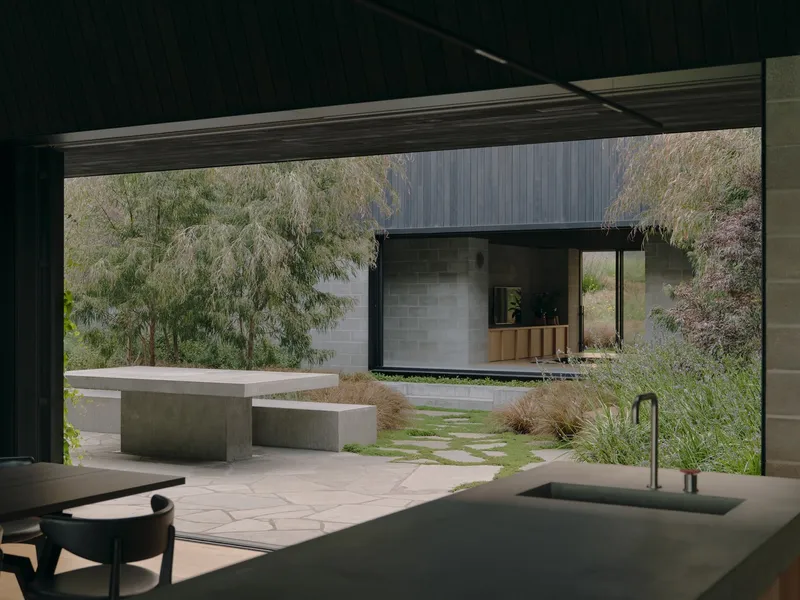
A Home Defined by Landscape and Climate
Perched on elevated terrain, the farmhouse captures expansive coastal and vineyard vistas while contending with the region’s exposed climatic conditions. The architects counter this through a clever spatial layout organized around a central courtyard garden, transforming it into the conceptual and climatic heart of the home. This inward-facing oasis offers a calm refuge, balancing the intensity of the surrounding landscape and anchoring the home with a meditative focus.


Flexible Living for a Multigenerational Family
Although generously sized at 640 m², the farmhouse is tailored to the needs of just two permanent residents. Designed for dynamic use, it seamlessly expands and contracts to accommodate visits from their four adult children and their families. Up to three-quarters of the house can be shut down when not in use, transforming the layout into a compact one-bedroom pavilion. This modular approach allows for energy efficiency, spatial intimacy, and a personalized living experience regardless of occupancy.


A Roof that Collects, Walls that Frame
The architecture is both monolithic and poetic. A single, sleek roof hovers above thick, 1-meter-wide planted walls that extend into the landscape. These walls choreograph sightlines, circulation, and thresholds, while occasionally curving back to form secluded courtyards. Every room is deliberately framed with floor-to-ceiling views of gardens and greenery, making nature a constant visual and emotional presence.


Architectural Minimalism Meets Agricultural Vernacular
True to its rural context, the building integrates farming motifs throughout. The roof serves a practical and sustainable function, collecting all the site’s domestic water, which is then stored in circular concrete tanks. These utilitarian elements—commonplace in rural Australia—are reimagined as sculptural garden features, serving as birdbaths, ponds, and even a firepit. The result is a site-specific language that merges agricultural identity with architectural refinement.
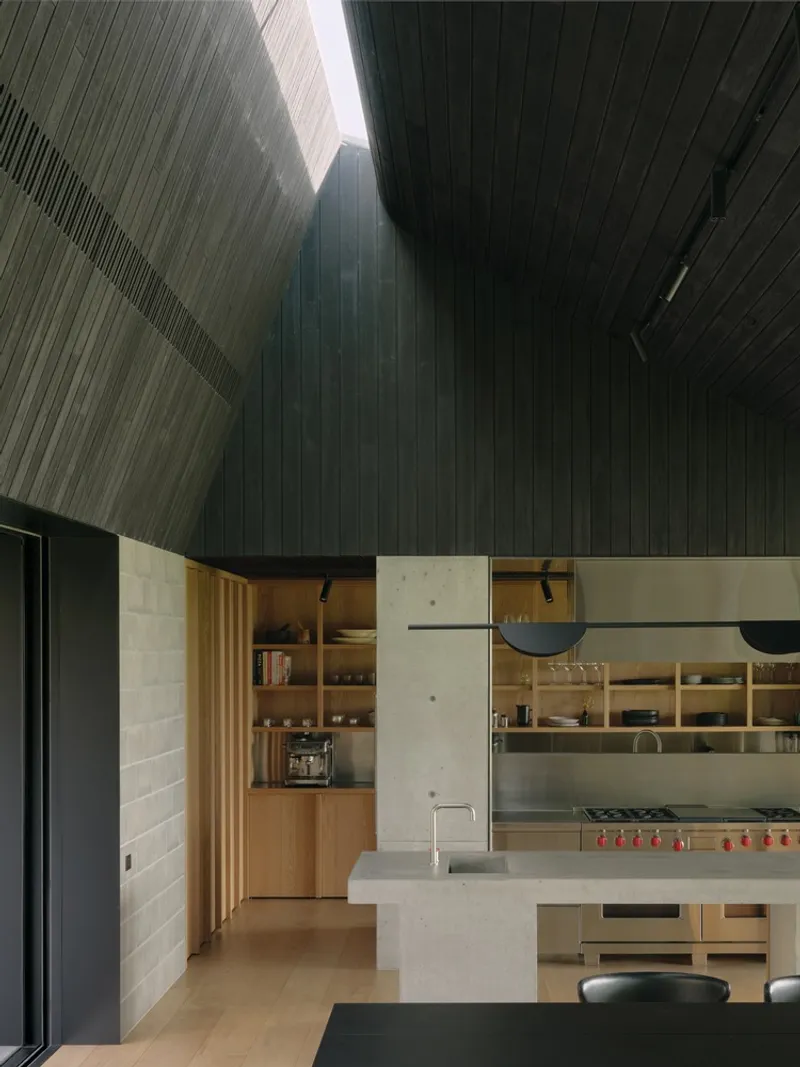

Designed Around Trees and Memory
Landscape played a pivotal role in the design narrative. Existing vegetation—such as an avenue of elm trees from the old driveway and a stand of lilly-pillies near the pool—was carefully preserved and integrated into the experience of approach and enclosure. These living elements frame views, define transitions, and create soft, leafy boundaries that blur the line between architecture and garden.

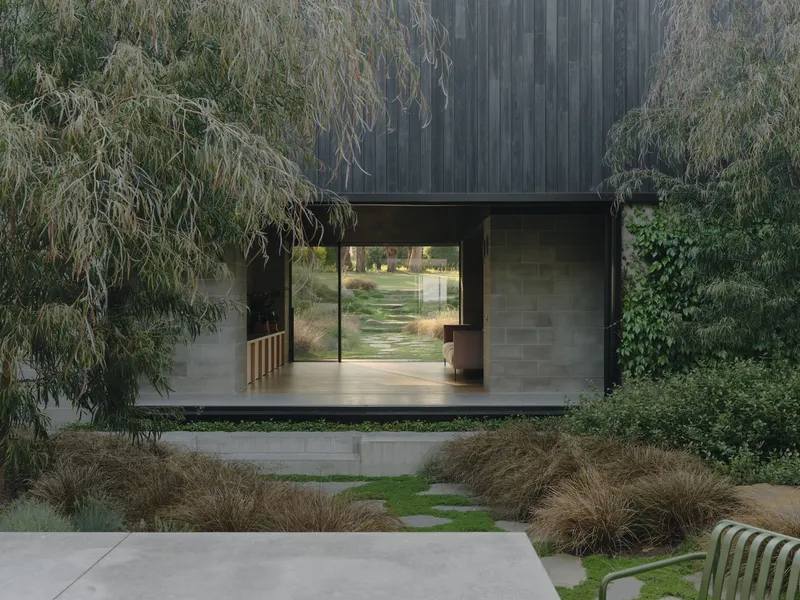

All Photographs are works of Tom Ross


Popular Articles
Popular articles from the community


Manzana Morphosis: Stretching Barcelona's Grid into a Living Landscape for 2050
A radical reworking of the Eixample manzana turns density into a tool for generous public space, vertical ecology, and environmental performance.


FCC Arquitectura Expands a Portuguese Granite House with a Board-Marked Concrete Wing
In Portugal, JV House pairs a cleaned-up whitewashed and granite dwelling with a timber-shuttered concrete extension, courtyards and a garden pool.

David Ortega Stacks a Two-Story Mexico City Penthouse Around a Steel Stair and a Pergola-Shaded Roof Terrace
In Colonia Roma, a 300 m² penthouse uses oak joinery, a planted steel stair and a slatted roof pergola to make a new-build apartment feel like a house.

Cube Design Draws an Ecological Corridor Between Two Shenzhen Hills with the Nankai Building
Beside Shenzhen's container docks, the Nankai Building pairs stacked balconies with a climbing green screen to connect two hillsides across its height.

Similar Reads
You might also enjoy these articles


Hodi-Mandai Geram
Project Function: Preservation and revitalization of the Intangible heritage and socio-spatial identity of the Hodi by Housing, Cultural Memory Center, Sacred Grove, landscape, local tourism economy


Olio Towers: A Mid-Rise for Performers That Fuses Housing, Rehearsal, and Stage
Located blocks from Houston's Theater District, this modular tower stacks living units around a central performance atrium.

Oasis: Modular Green Housing Carved into Dhaka's Urban Fabric
A shortlisted Plugin Housing entry reclaims unauthorized settlements in Dhaka with stepped concrete volumes, green roofs, and ventilation-driven design.

Black Hole: A Floating Megastructure for the Post-Physical Era
Emiliano Mazzarotto envisions a spherical, self-scaling arena where e-sports, digital hotels, and holographic stadiums replace traditional public space.

Explore Architecture Competitions
Discover active competitions in this discipline

Challenge to reimagine the Iron Throne

Photograph architecture without architects

Illustrate the lost glory of Angkor Wat - Render Challenge

Design challenge to reuse E-waste
Comments (0)
Please login or sign up to add comments
No comments yet. Be the first to comment!