

Schwartz and Architecture Nearly Doubles an Aaron Green Eichler Without Breaking the Spell
A 1966 Frank Lloyd Wright protégé house in Palo Alto grows from 1,590 to over 4,000 square feet while keeping its soul intact.


In Silicon Valley, an Eichler home is roughly as sacred as anything secular can be. Of the 11,000 houses Joseph Eichler built across California, about 2,700 landed in Palo Alto, and a particular subset of those carry the fingerprints of Aaron Green, Frank Lloyd Wright's West Coast representative. The Green House, completed in 1966, is one of them: a roughly triangular footprint tucked back on a flag lot in the Palo Verde neighborhood, its spider-like roof touching down through concrete drainage scuppers, its garden side dissolved into glass. The original owner kept it preserved in amber until 2019. Then a young family arrived, and the question became: how do you nearly double a finished composition without finishing it off?
Schwartz and Architecture answered with a deceptively simple credo: "First, do no harm." The firm took 1,590 square feet to 3,102 inside the main house and added a 288-square-foot gym and office building plus a 215-square-foot ADU, pushing the total to 4,115 square feet. The additions are reverential but deferential, to borrow the architects' own phrasing. Every new material, whether board-formed concrete or vertical grain Douglas fir, was chosen not to mimic Green's original palette but to rhyme with it. The result, completed in September 2023 after a construction process that stretched through the pandemic, is a renovation that proves preservation and expansion are not opposites.
Arriving at the House Green Built

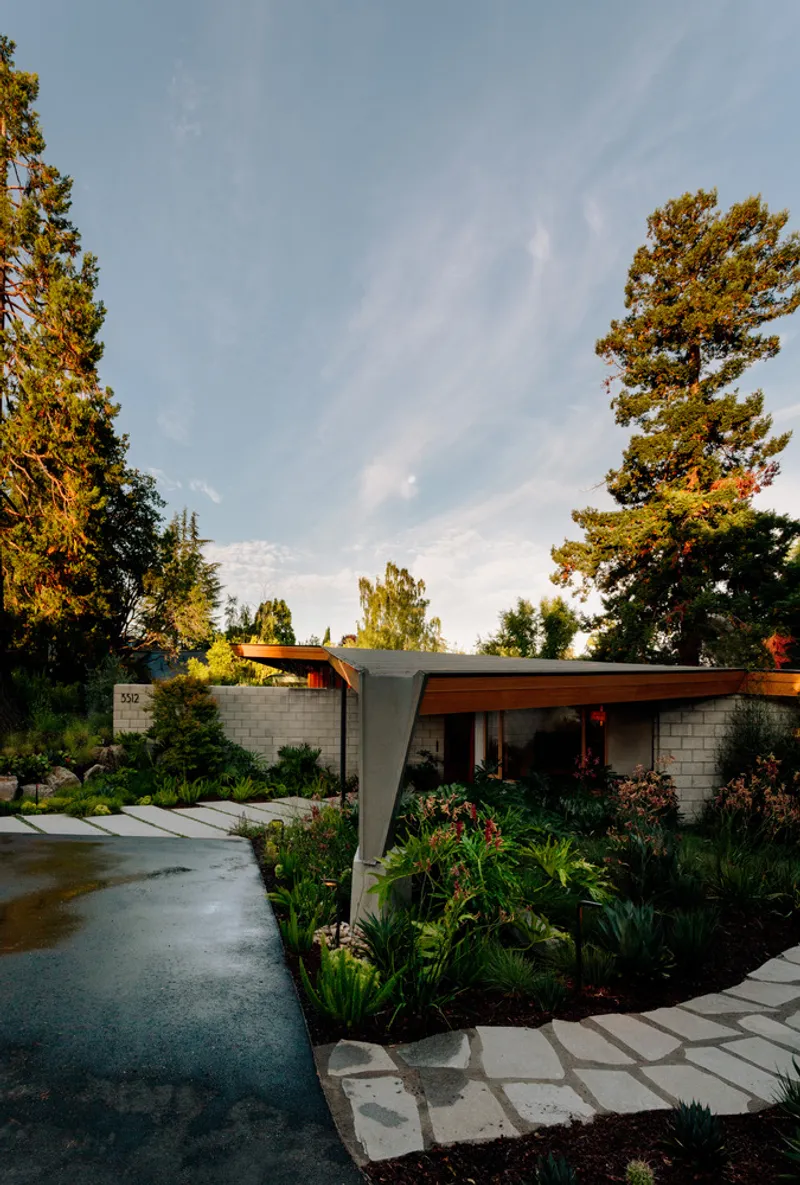

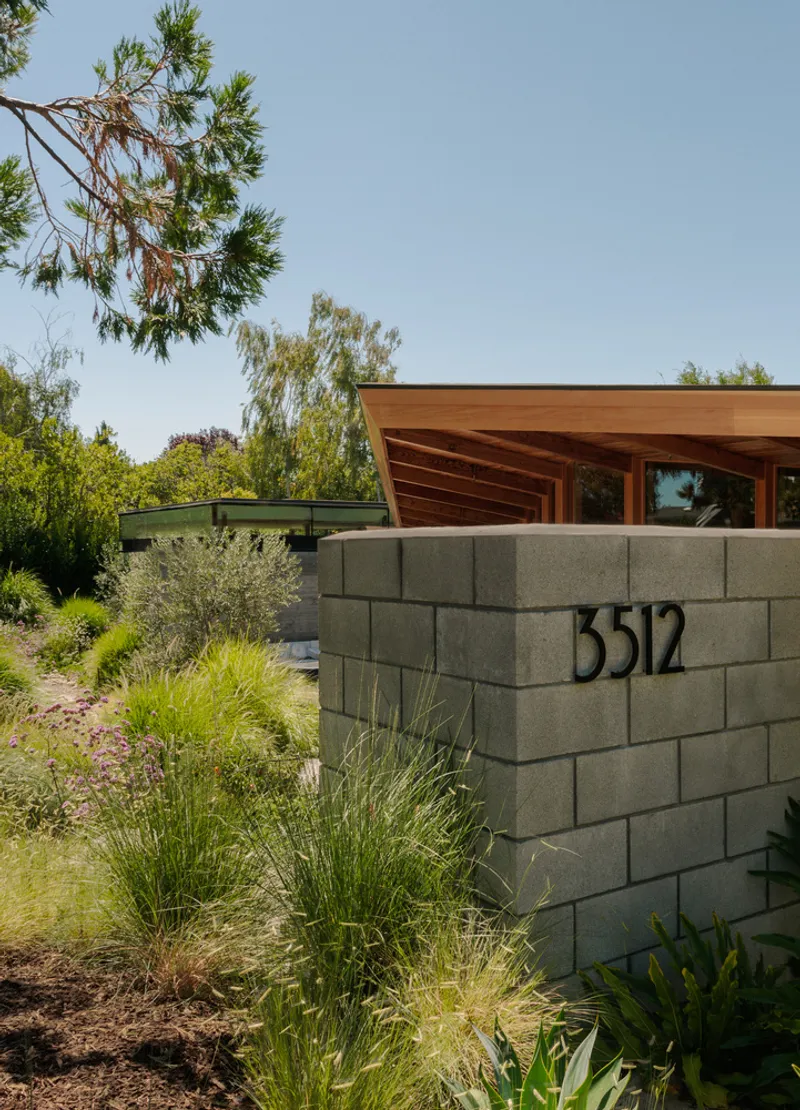
From the street, the Green House barely announces itself. A concrete block wall bearing the house numbers, a planted island, and an angled roof column are all you get. The low-slung canopy hovers over a concrete paver walkway lined with grasses, a threshold that compresses space before the interior releases it. Boxleaf Design's landscape of tall grasses, flowering plants, and stone pathways starts working the moment you pull into the curved driveway, softening the concrete geometry and managing a natural swale that handles the area's high water table.
The entry sequence is pure mid-century choreography: horizontal lines, natural materials, and a sense that the house is of the land rather than on it. What Schwartz and Architecture achieved here is restraint. They raised the roofline where the old carport sat, but from the curb the home still reads as a single, low gesture against the sky.
The Concrete Block Spine


Concrete masonry is the backbone of the original house, and Schwartz and Architecture treated it accordingly. Existing CMU walls were retained, patched, and left exposed wherever possible. A corridor lined with textured concrete block, punctuated by clerestory glazing and an arched doorway that frames a planted courtyard, captures the tension between mass and transparency that Green embedded in the design. At structural junctions, concrete piers support the original timber ceiling joists, their rawness unadorned.
When the architects needed to add new walls for the primary bedroom suite, they chose board-formed concrete rather than matching the block. The strategy is honest: you can tell what is original and what is not, yet the material family holds. The board-form texture introduces a finer grain that complements the coarser CMU without competing. It is the architectural equivalent of a well-chosen synonym.
Living Under the Original Roof


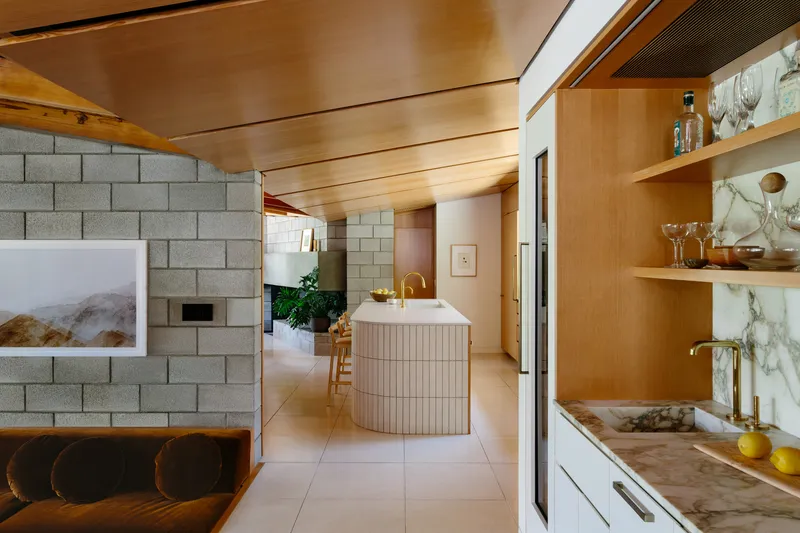
The heart of the house remains the living room and its relationship to the garden. Original redwood roof beams and tongue-and-groove ceiling deck have been preserved and exposed, their warm tones counterbalancing the concrete block fireplace wall. The iconic glass wall on the garden side was kept intact, and from inside, the room still reads as Aaron Green intended: an interior landscape defined by structure overhead and nature beyond.
The open kitchen merges into this volume through a fluted wood ceiling that carries the rhythm of the original beams into new territory. Terrazzo-inspired tiles replace the original flooring throughout, a contemporary surface that holds its own against the heavy materials above. Lighting consultants Loisos + Ubbelohde placed hidden fixtures where original beams once ran, a detail that preserves the ceiling plane's visual continuity while subtly marking the seam between old and new.
The Sunken Room and the Vanished Carport
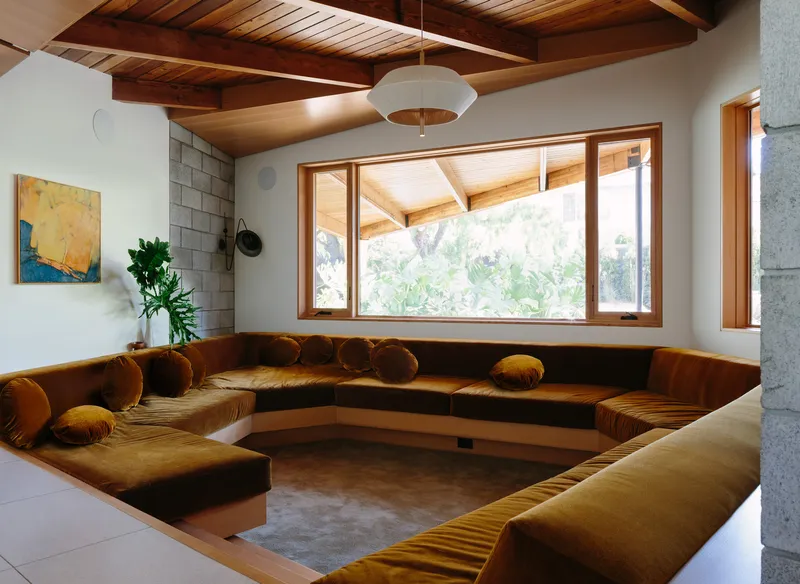

The original carport was too low for modern vehicles and out of compliance with local codes. Rather than demolish and rebuild, the architects raised the roofline and sank the floor, converting the space into a family room with a conversation pit upholstered in burnt orange. Beneath the exposed timber rafters and clerestory windows, the room feels like a found space, as if it had always been waiting under the carport slab. A prior owner had inserted a closed stair in the middle of the home to reach a developed attic; Schwartz and Architecture tore it out and replaced it with an open stair, restoring the original plan's flow.
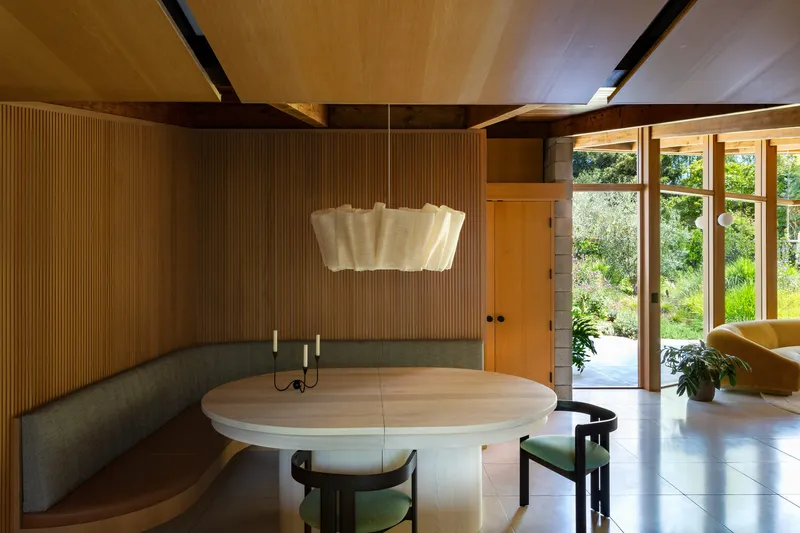
Adjacent to this zone, a dining nook with a built-in banquette sits under clerestory windows, while a second dining area features a curved built-in bench, ribbed wood walls, and exposed black steel beams beneath a plywood ceiling. Interior designer Sarah Sherman Samuel brought warmth to these spaces without nostalgia, letting the architecture set the tone.
Private Rooms and Quiet Details


The rear addition slides under an upward-sloping roof, opening up previously dark bedrooms to natural light. In the primary bedroom, clerestory windows balance the visual weight of the new concrete wall, casting afternoon sunlight across the room without sacrificing privacy. A kid's bedroom features a built-in timber bookshelf, a window seat nook, and patterned wallpaper beneath a plywood ceiling. Behind the bookshelf, a secret door leads to the bathroom, a playful detail that earns its place because the rest of the house is so disciplined.
Throughout the private quarters, vertical grain Douglas fir replaces the original redwood for new elements. The grain pattern is close enough to read as family, different enough to signal the passage of time. The concrete floor slab, which could not be punctured, and the untouched concrete foundations meant every intervention had to work above grade, a constraint that sharpened every decision.
Bathing and the Garden

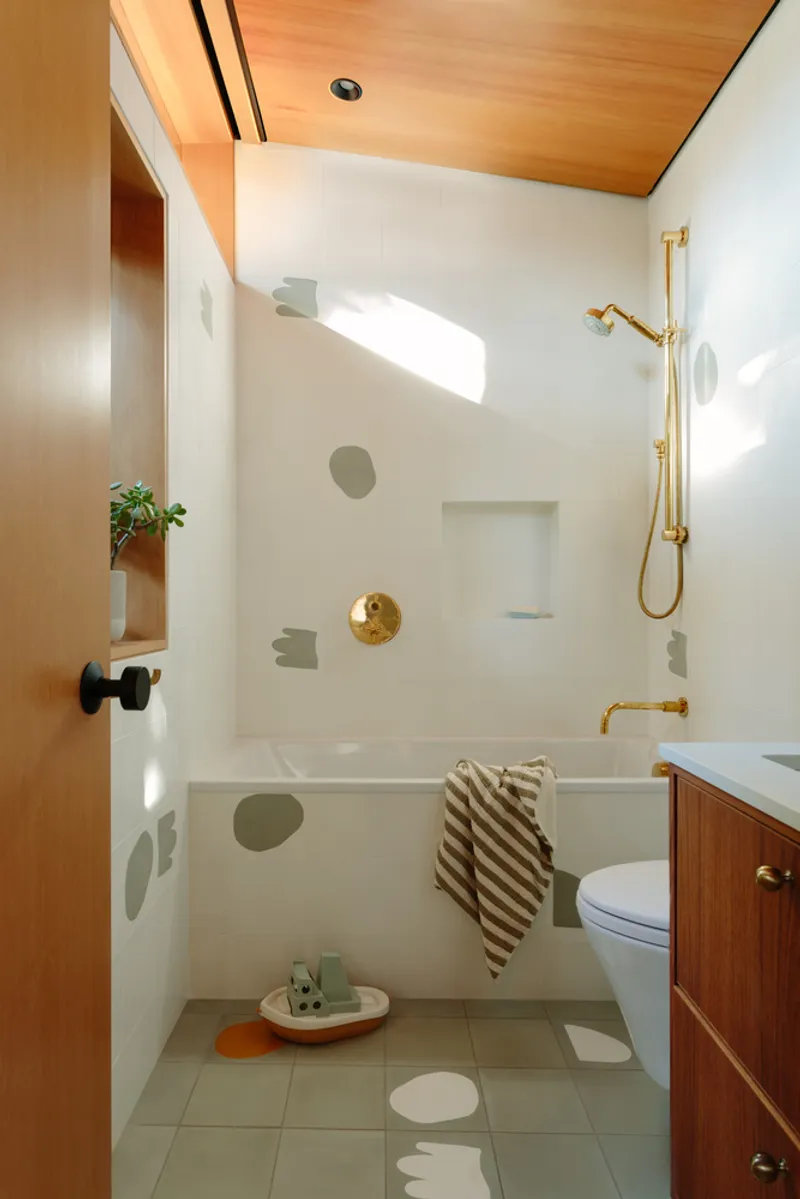

Two bathrooms show the range of the renovation's tonal register. One pairs a freestanding white tub with a timber-framed window overlooking dense garden planting, collapsing the boundary between interior ritual and exterior landscape. The other opts for a white tiled tub surround, brass fixtures, and a plywood ceiling washed in morning sunlight. Neither tries to be spectacular; both succeed by being specific.
A bar alcove with white cabinetry, veined marble backsplash, and timber-framed open shelving sits nearby, proof that even the functional moments of the house received the same material care. The marble is the one overtly luxurious surface in the project, and it works precisely because it is isolated.
The Garden Wall at Dusk
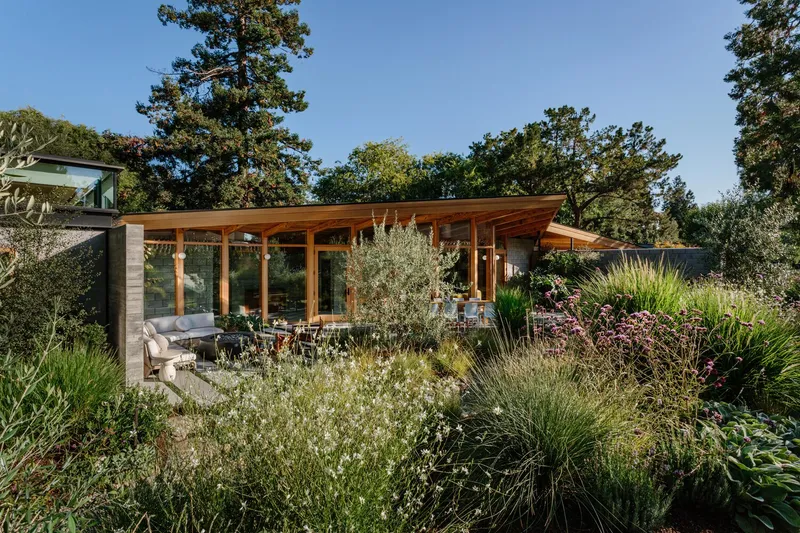
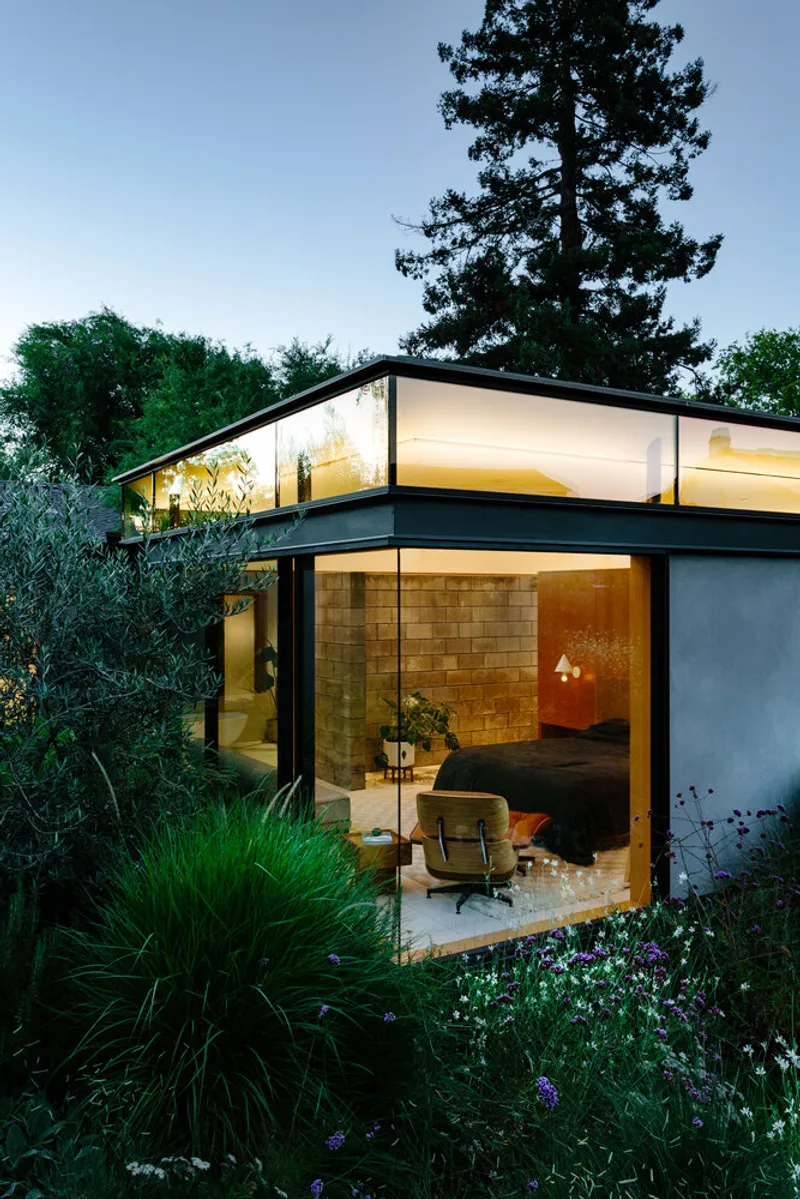
From the garden side, the house reveals its full ambition. The low-pitched timber roof hovers over a glazed pavilion set in a wildflower meadow, the translucent clerestory band glowing at dusk. Views through the space frame the iconic roof scuppers as they touch down to the ground, turning structural drainage into sculpture. The landscape by Boxleaf Design, with its patches of grasses and trees laced with stone pathways, refuses to compete with the architecture, instead offering a soft ground plane that makes the geometric roof float.
Plans and Drawings
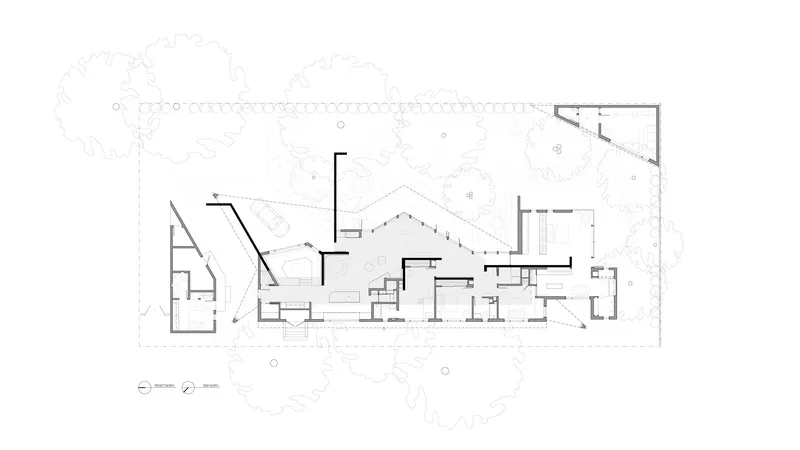

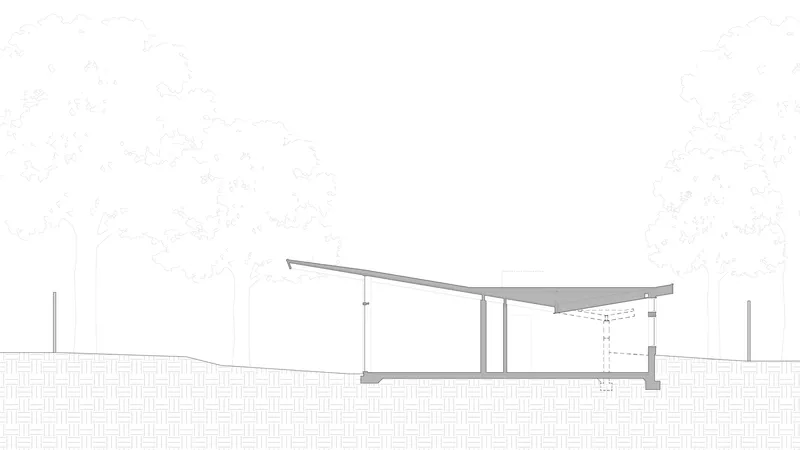
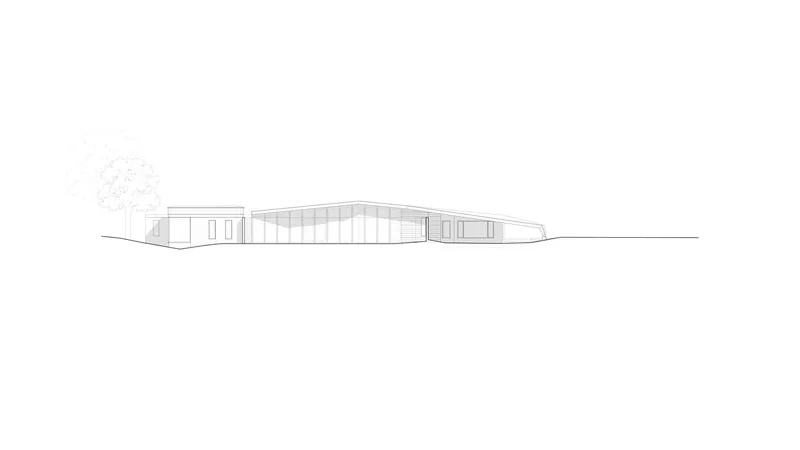


The floor plan reveals the roughly triangular original footprint and the logic of the rear addition: a linear volume running the length of the house, its upward-sloping roof creating a clerestory seam between old and new. Section drawings show how the roof beams were terminated mid-span to insert this addition, a surgical move that preserved the original structure's silhouette from the street while transforming the interior experience. The presentation board documenting the design process, with its annotated sketches and photographs, makes clear that this was a project governed by questions rather than assumptions. "What would Mr. Green do?" turns out to be a productive design prompt when you actually respect the answer.
Why This Project Matters
Mid-century renovation in California has become its own genre, with its own clichés: the fetishized Eichler, the white-box insertion, the before-and-after that prioritizes the after. The Green House avoids all of these traps. By treating Aaron Green's original design as a living system rather than a museum piece, Schwartz and Architecture found room to nearly double the square footage while preserving the spatial logic that made the house worth saving. The material strategy alone is worth studying: existing redwood stays, new wood is Douglas fir, existing block stays, new concrete is board-formed. Old and new share a language but never pretend to be the same sentence.
More broadly, the project demonstrates that preservation and growth are not a zero-sum game. A 1,590-square-foot house that was perfect for its original owner and era became a 4,115-square-foot house that works for a young family, complete with ADU, home gym, and a sunken conversation pit. The secret is discipline: knowing where to cut a beam, where to raise a roofline, and where to leave a concrete block wall exactly as it was. In an industry that loves the grand gesture, the Green House makes a case for the precise one.
The Green House by Schwartz and Architecture, Palo Alto, California, United States. 4,115 square feet. Completed 2023. Contractors: Marrone & Marrone. Structural Consultants: SWM & Associates. Landscape Architects: Boxleaf Design. Lighting Consultants: Loisos + Ubbelohde. Interior Designer: Sarah Sherman Samuel. Photography by Ayla Christman.
About the Studio
Share Your Own Work on uni.xyz
If projects like this are the kind of work you want to make, uni.xyz is a place to publish your own, find collaborators, and enter design competitions.




Popular Articles
Popular articles from the community


Conexión: Biophilic Design Reimagines High-Rise Living in Hong Kong
Conexión reimagines high-rise living in Hong Kong through biophilic design, green facades, shared spaces, daylight, water and nature within.
EW PARK: Sustainable Architecture Reimagines the Future of Urban Parking
EW PARK reimagines city parking as a modular wooden tower combining automation, solar energy, electric mobility, and adaptable urban design.

The Musturak Paradise: Senior Living Architecture for a Connected Future in Temara, Morocco
The Musturak Paradise reimagines senior living architecture in Temara via private homes, social spaces, culture, community, and shared care.

Riyadh For All: Intergenerational Urban Design for Active Aging in Rabat
Riyadh For All reimagines urban design in Rabat with intergenerational co-living, adaptive courtyards, and Moroccan cultural exchange today.


Similar Reads
You might also enjoy these articles


Hodi-Mandai Geram
Project Function: Preservation and revitalization of the Intangible heritage and socio-spatial identity of the Hodi by Housing, Cultural Memory Center, Sacred Grove, landscape, local tourism economy


Olio Towers: A Mid-Rise for Performers That Fuses Housing, Rehearsal, and Stage
Located blocks from Houston's Theater District, this modular tower stacks living units around a central performance atrium.

Oasis: Modular Green Housing Carved into Dhaka's Urban Fabric
A shortlisted Plugin Housing entry reclaims unauthorized settlements in Dhaka with stepped concrete volumes, green roofs, and ventilation-driven design.

Black Hole: A Floating Megastructure for the Post-Physical Era
Emiliano Mazzarotto envisions a spherical, self-scaling arena where e-sports, digital hotels, and holographic stadiums replace traditional public space.


Explore Architecture Competitions
Discover active competitions in this discipline



Challenge to reimagine the Iron Throne


Photograph architecture without architects


Illustrate the lost glory of Angkor Wat - Render Challenge


Design challenge to reuse E-waste
Comments (0)
Please login or sign up to add comments
No comments yet. Be the first to comment!