

Middle Ground
In an island struggling with mass tourism, Middle Ground seeks to be one of the first architectural expressions of a movement hoping to renew the local-tourist relationship on an interpersonal, cultural, and environmental level.

Background
Over the last few decades, Bali has become Indonesia’s most popular tourist destination(1). Its picture-perfect landscapes and rich cultural and religious backgrounds attracted almost 6.3 million foreign visitors in 2019(1). This surge in tourism has not just drastically benefited Bali, but the whole nation of Indonesia, accounting for 80% of its economy(2) and increasing employment. However, the losses outweigh the benefits, and ironically, while tourists come to appreciate the unique sites and culture that Bali offers, they are unaware that they are actually destroying them in the process.
Negative Impacts of Mass Tourism
The shift from cultural to mass tourism has extreme negative effects on the island’s environment and culture. The continuous building of profit-seeking resorts and villas produces thousands of tons of plastic waste and reduces Bali’s land and water supply. For example, a single room in a four-star hotel depletes 300 liters of water daily (3), leaving local communities with very little resources. Other challenges such as rising sea levels and temperatures prompted by the climate crisis and the government’s desire to massively redevelop the island for tourism leave the Balinese people mourning over their land.
Moreover, mass tourism is slowly erasing Bali’s culture. Many buildings’, including cafes, aesthetics and atmosphere take on a luxurious international inspiration, giving tourists what they want to see, instead of exposing them to the authentic Balinese culture. This propagates cultural suppression and class inequality; walking down the streets of Benoa Bay, there is a clear distinction between what is for the local and what is for the tourist. All of these factors have created a local-tourist relationship that is divided, hierarchical, and detrimental to both Bali and its residents.
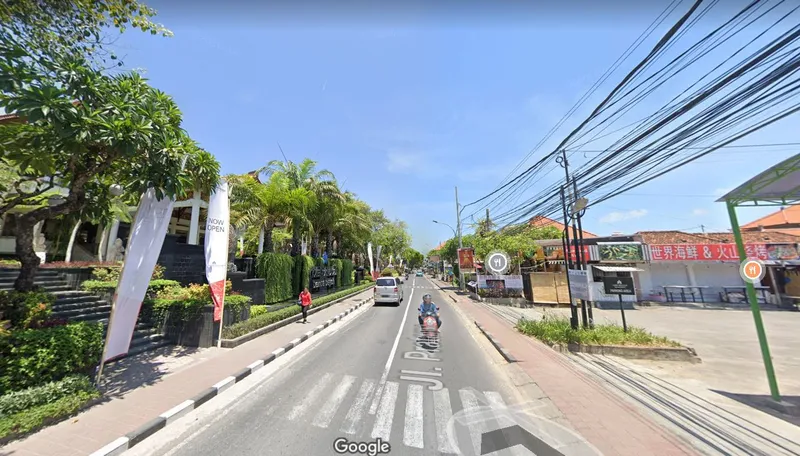
Walking on JI.Pratama Street, one can see the luxurious entrance to Hotel Nikko Bali to the left. To the right, local businesses, parking spots, and middle-class homes populate the area(4).
Concept
Middle Ground becomes the first step in solving this problem. The solution is not to eliminate tourists, but rather to attract them in a new way that places them in the middle of a movement that cares just as much, if not more, about Bali’s cultural and environmental preservation than about its economic growth. For too long, the experience of the tourists has been prioritized at the expense of the island’s environment, culture, and people. Thus, the key is to create a middle ground, a space that benefits both the tourists and the locals. In this context, the simple action of getting a coffee becomes the medium through which the local-tourist relationship is mended interpersonally, through conversation, culturally, through performance and storytelling, and environmentally, through sustainable construction and biophilia. The relationships between these three elements are what drove the design.
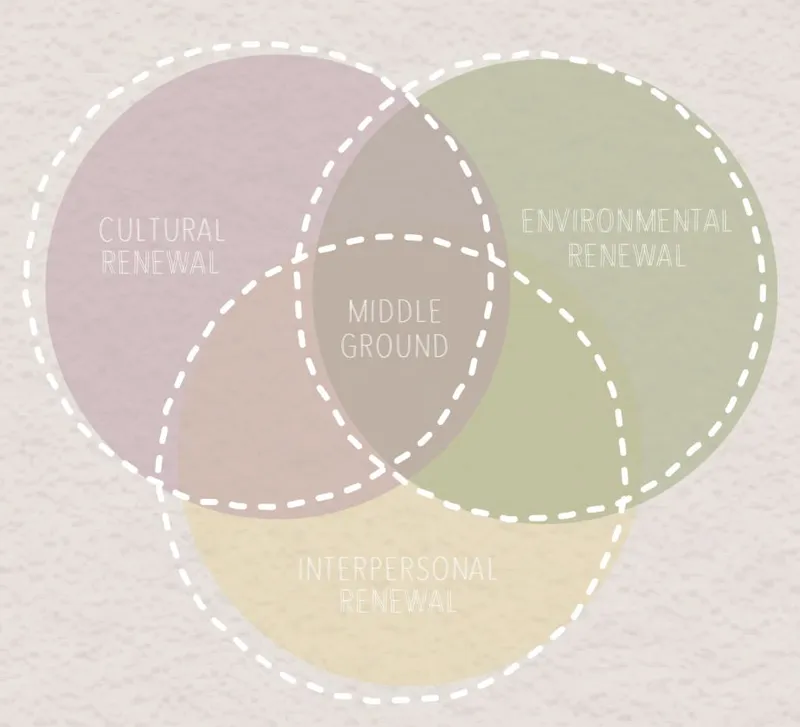
Venn diagram showcasing the cafe's main conceptual drivers.
Design Investigation and Program
The design process started by identifying the program of the coffee house. It was decided that the coffee house needed to serve a dual purpose. A space for storytelling and performance seemed to be the best fit. This area is not a conventional stage where the locals are the performers, and the tourists are the spectators. Rather, the vision is for the space to encourage the intermingling of locals and tourists. It consists of a series of platforms where both locals and tourists can stand or sit and share stories in the form of singing, poetry, spoken word, or other art forms. Often times, the Balinese people want to interact with tourists; they want to participate in cultural exchange and learn about foreign languages, but not in a way where their role is to serve the tourist. This space places both parties at the same level.
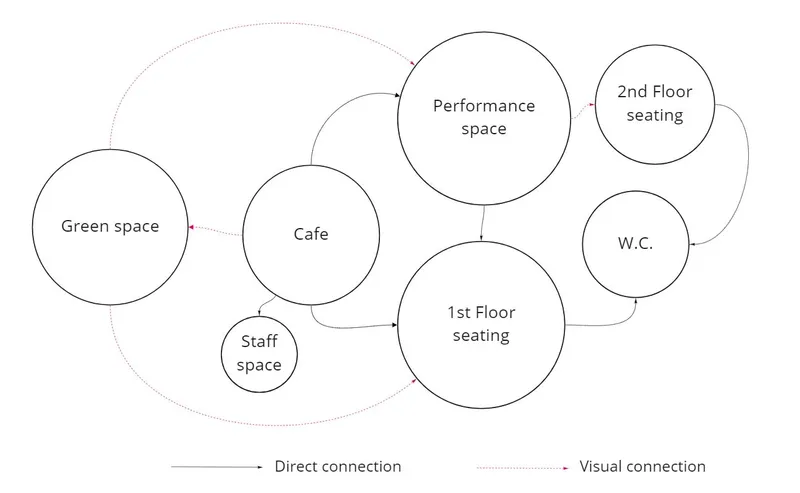
This aspatial program diagram initiated the design process.
The relationship between the café program and the performance space, in response to the site, became the driver for the project. A green space was also desirable, celebrating Bali’s landscape, representing the building’s steps towards sustainability, and offering users a biophilic space. Approximately ten ideations of form were tested; in some, the café and the performance space occupied their own structures. In others, they took place in the same volume. Some ideations favoured the building’s visibility from the road, while others took on a more inward-looking atmosphere.
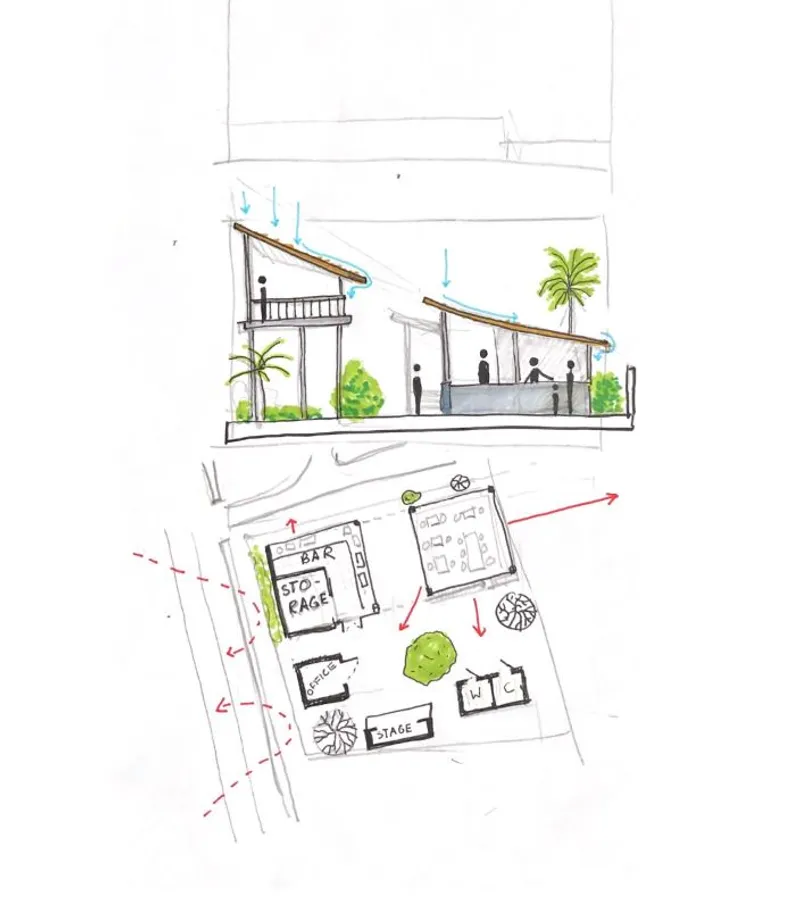
One of many ideations created throughout the design process.
From Ideation to Iteration
It was decided for the café program and the performance space to occupy one space. By placing the café counter across from the performance space, the coffee becomes a medium through which people experience the building. From a user’s perspective, upon entry, the café is the first visible space; turning around, one sees that they are not just in a café. Areas of conversation become increasingly important as well. More intimate seating areas on the first and second floor encourage the renewal of personal relationships between tourists and locals. Individuals can meet to socialize and to learn more about Bali’s rich history. Much experimentation was conducted around the connection of these spaces and their circulation. About five iterations were tested before reaching the final result.
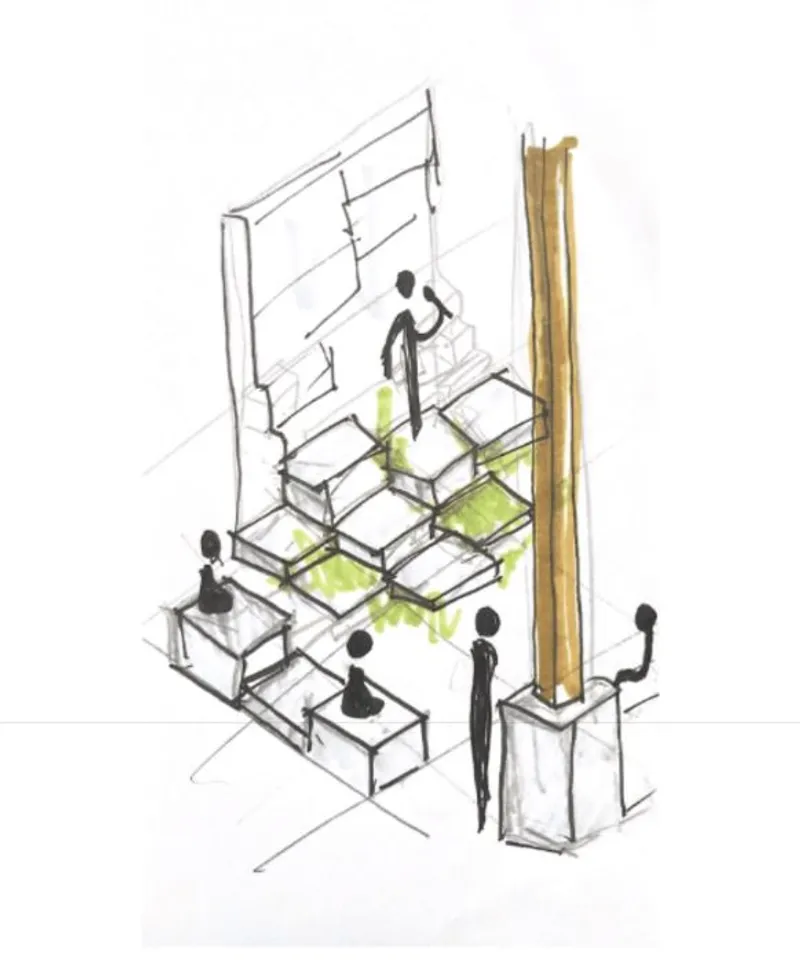
Iterative sketch of the performance space.
Aesthetics and Sustainability
Building a new structure in a rich cultural and urban context is challenging. It was decided for Middle Ground to somewhat defy the quintessential and luxurious coffee shop. Formally, the building draws inspiration from the surrounding vernacular architecture while still maintaining a novel identity. It is oriented towards the city, instead of the beach, since the focus is not creating another space that adds to the mass tourism crisis, but one that truly allows tourists to immerse themselves in the culture.
Throughout the process, it was very evident that the materials chosen had to be in line with Bali’s culture and movement towards green building. Wood is used for the column grid and main structure of the building because wood is very apparent in older, more traditional Balinese buildings. In addition, bamboo is used for walls, division screens and details throughout the structure. Both materials are renewable and sequester carbon for their lifetime, pushing Bali further towards sustainable construction. Lots of plants and vegetation such as green walls are also used in the design. Furthermore, the double-sided water wall uses stone, connecting the interior and the exterior.
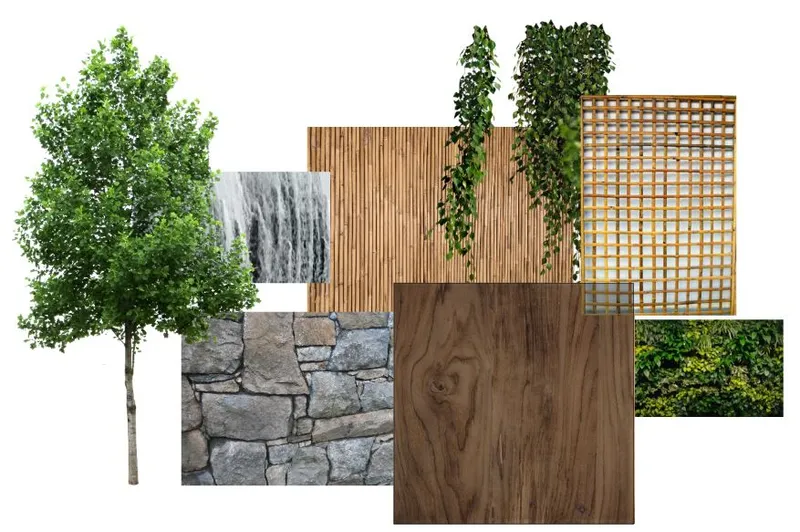
Preliminary material palette created in the middle of the design process.
This water wall becomes increasingly important. Since water pollution is a huge threat to Bali, placing a double-sided water wall bursting with vegetation behind the performance area lets the Balinese set one of their challenges front and centre, publicly committing to prioritizing the island’s water moving forward. Middle Ground becomes a part of that commitment by having a rainwater collection system for use within the building. In addition, passive cooling and ventilation strategies are used to maintain a comfortable interior environment. For example, large roof overhangs mitigate solar gain and open facades allow air to pass through the building. Finally, solar panels on the roof capture solar energy for use within the building. Such considerations allow the café to begin to heal the tourist-local relationship on an environmental level.
Moving Forward
While Middle Ground will not immediately reverse the effects of mass tourism on Bali, it is a first step in the renewal of the local-tourist relationship on an interpersonal, cultural, and environmental level. With both tourists and locals trying to preserve the island, Bali can still welcome many tourists for years to come.
References (4)

Popular Articles
Popular articles from the community

Temporary Home for Dogs: A Reversed Zoo Rethinks Animal Shelter Architecture
In Bucharest, a sinuous corridor and freed landscape flip the logic of containment, designing a shelter that works to make itself unnecessary.
Tsunami Convergenics: Turning Catastrophic Ocean Forces into Underwater Housing Infrastructure
A speculative underwater settlement off the coast of Onagawa, Japan, treats tsunamis and typhoons as energy sources rather than threats.

Manzana Morphosis: Stretching Barcelona's Grid into a Living Landscape for 2050
A radical reworking of the Eixample manzana turns density into a tool for generous public space, vertical ecology, and environmental performance.
Extended Shell: Retrofitting Kolkata's Balconies as Living Urban Thresholds
A modular retrofit system recovers the social and environmental intelligence of Kolkata's historic verandas for contemporary Park Street residents.

Similar Reads
You might also enjoy these articles

The Rhythm of Seasons
A Farmers' Market Connecting Nature and the City

More Than a Building-Designing a Living System
More Than a Building-Designing a Living System
Base Beyond
DESERT COMPOUND ARID: TOURISM OF ABSENCE AND ABUNDANCE

Explore Cultural Architecture Competitions
Discover active competitions in this discipline


Challenge to reimagine the Iron Throne

Photograph architecture without architects

Illustrate the lost glory of Angkor Wat - Render Challenge

Bring back Drive In's
Comments (0)
Please login or sign up to add comments
No comments yet. Be the first to comment!